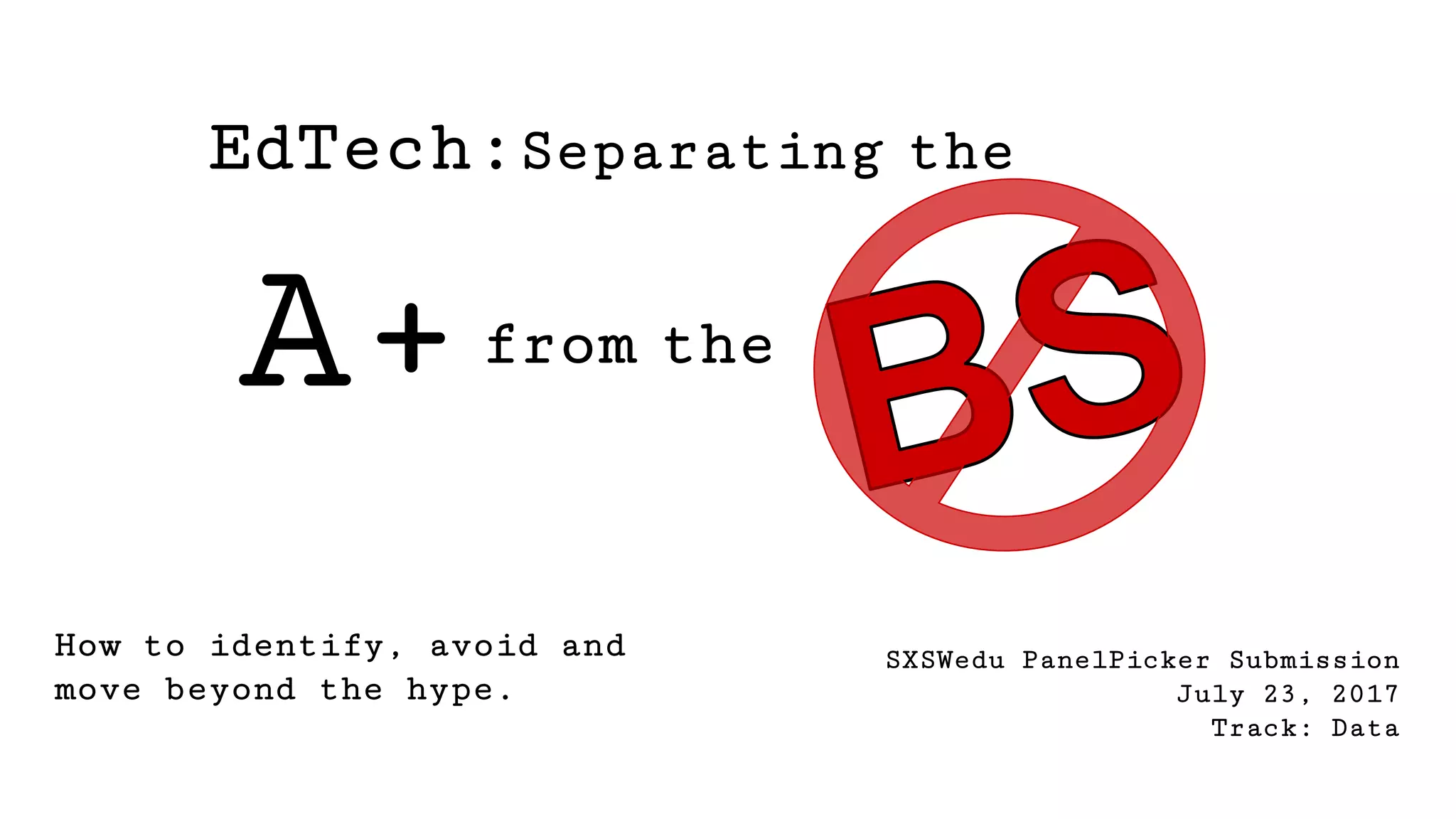
EdTech:Separating the
from the
How to identify, avoid and
move beyond the hype.
SXSWedu PanelPicker Submission
July 23, 2017
Track: Data
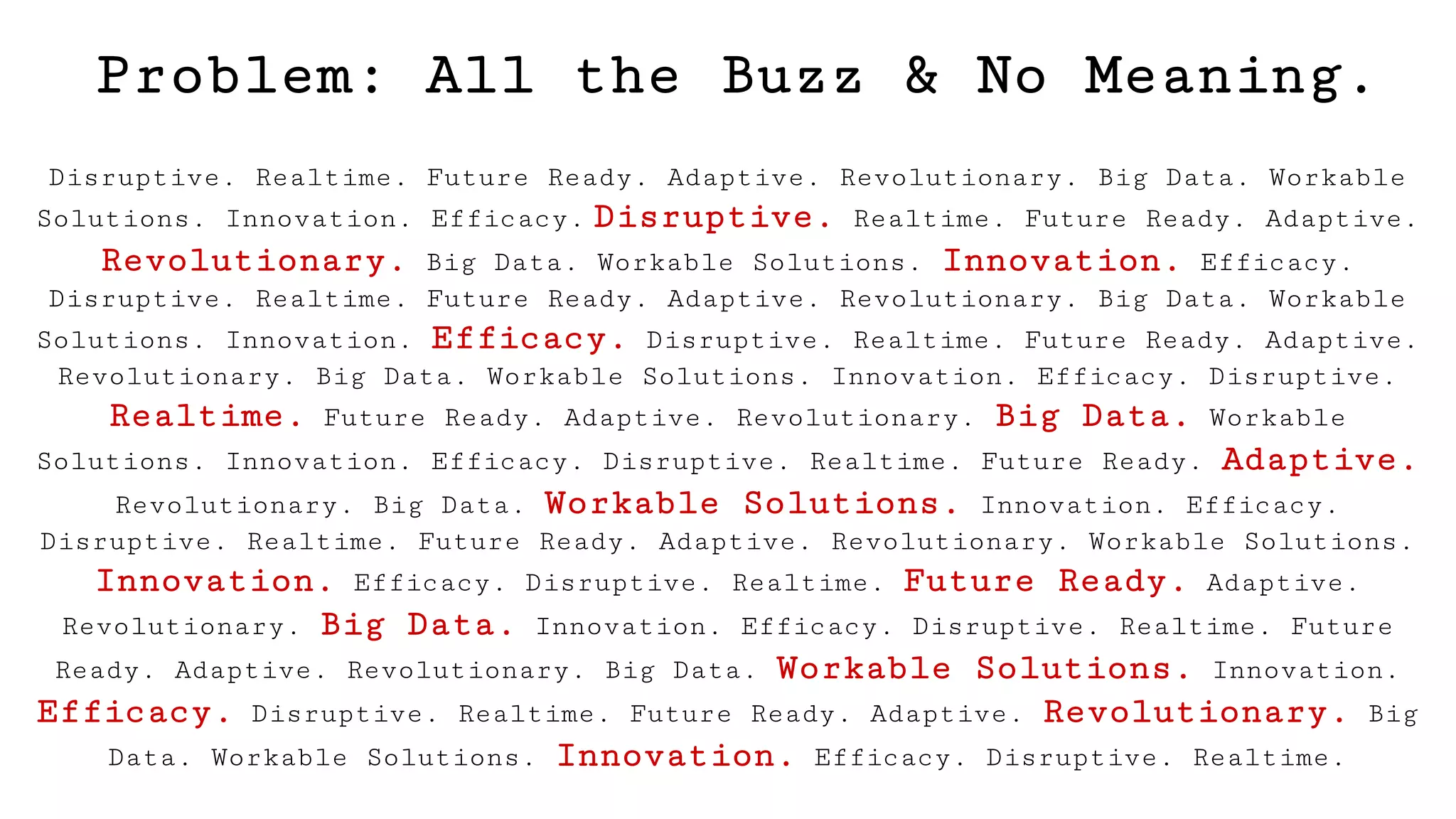
Problem: All the Buzz & No Meaning.
Disruptive. Realtime. Future Ready. Adaptive. Revolutionary. Big Data. Workable
Solutions. Innovation. Efficacy. Disruptive. Realtime. Future Ready. Adaptive.
Revolutionary. Big Data. Workable Solutions. Innovation. Efficacy.
Disruptive. Realtime. Future Ready. Adaptive. Revolutionary. Big Data. Workable
Solutions. Innovation. Efficacy. Disruptive. Realtime. Future Ready. Adaptive.
Revolutionary. Big Data. Workable Solutions. Innovation. Efficacy. Disruptive.
Realtime. Future Ready. Adaptive. Revolutionary. Big Data. Workable
Solutions. Innovation. Efficacy. Disruptive. Realtime. Future Ready. Adaptive.
Revolutionary. Big Data. Workable Solutions. Innovation. Efficacy.
Disruptive. Realtime. Future Ready. Adaptive. Revolutionary. Workable Solutions.
Innovation. Efficacy. Disruptive. Realtime. Future Ready. Adaptive.
Revolutionary. Big Data. Innovation. Efficacy. Disruptive. Realtime. Future
Ready. Adaptive. Revolutionary. Big Data. Workable Solutions. Innovation.
Efficacy. Disruptive. Realtime. Future Ready. Adaptive. Revolutionary. Big
Data. Workable Solutions. Innovation. Efficacy. Disruptive. Realtime.
The essential gift for a good writer is a built-in, shockproof,
bullshit detector.
- Ernest Hemingway
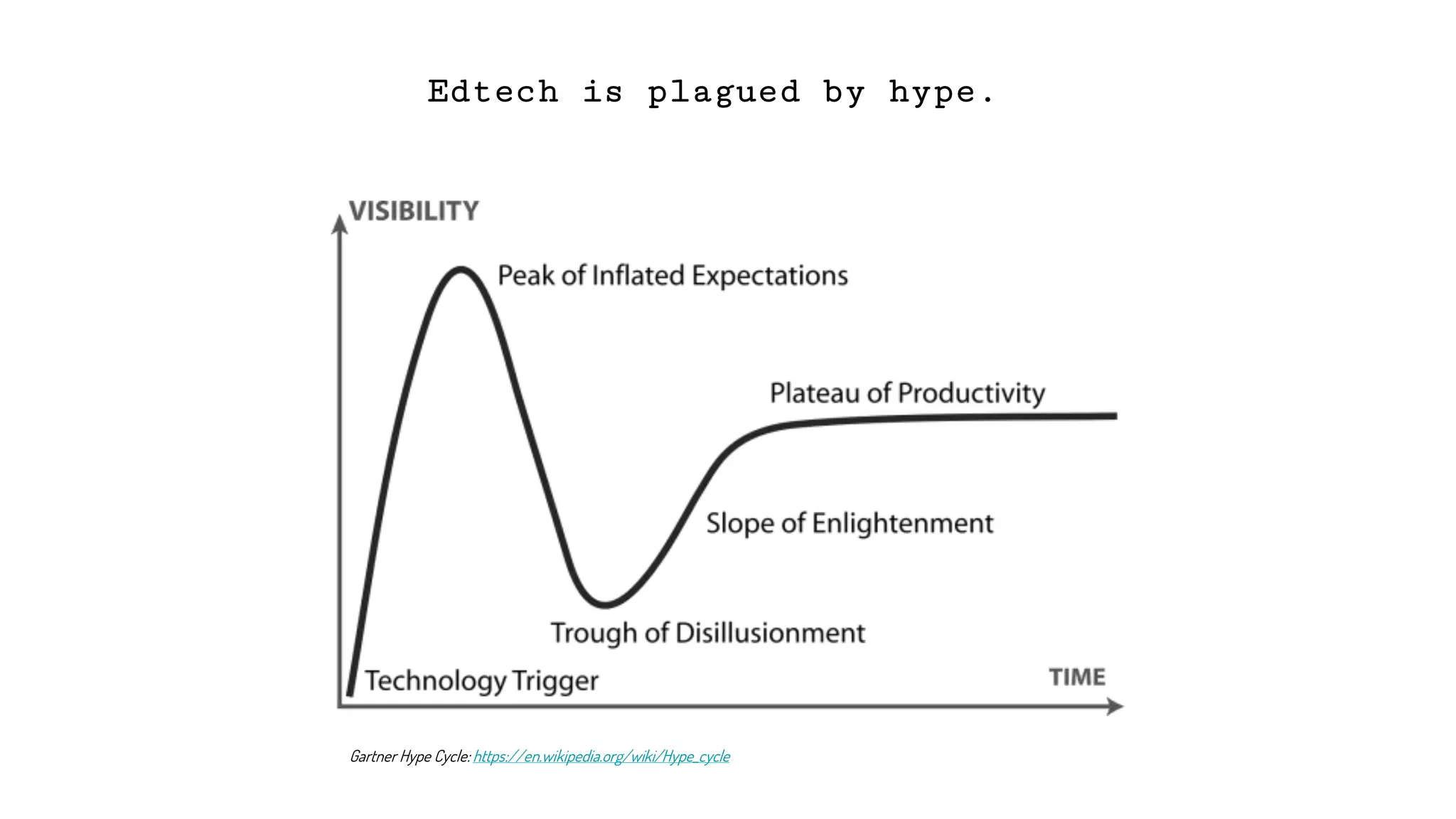
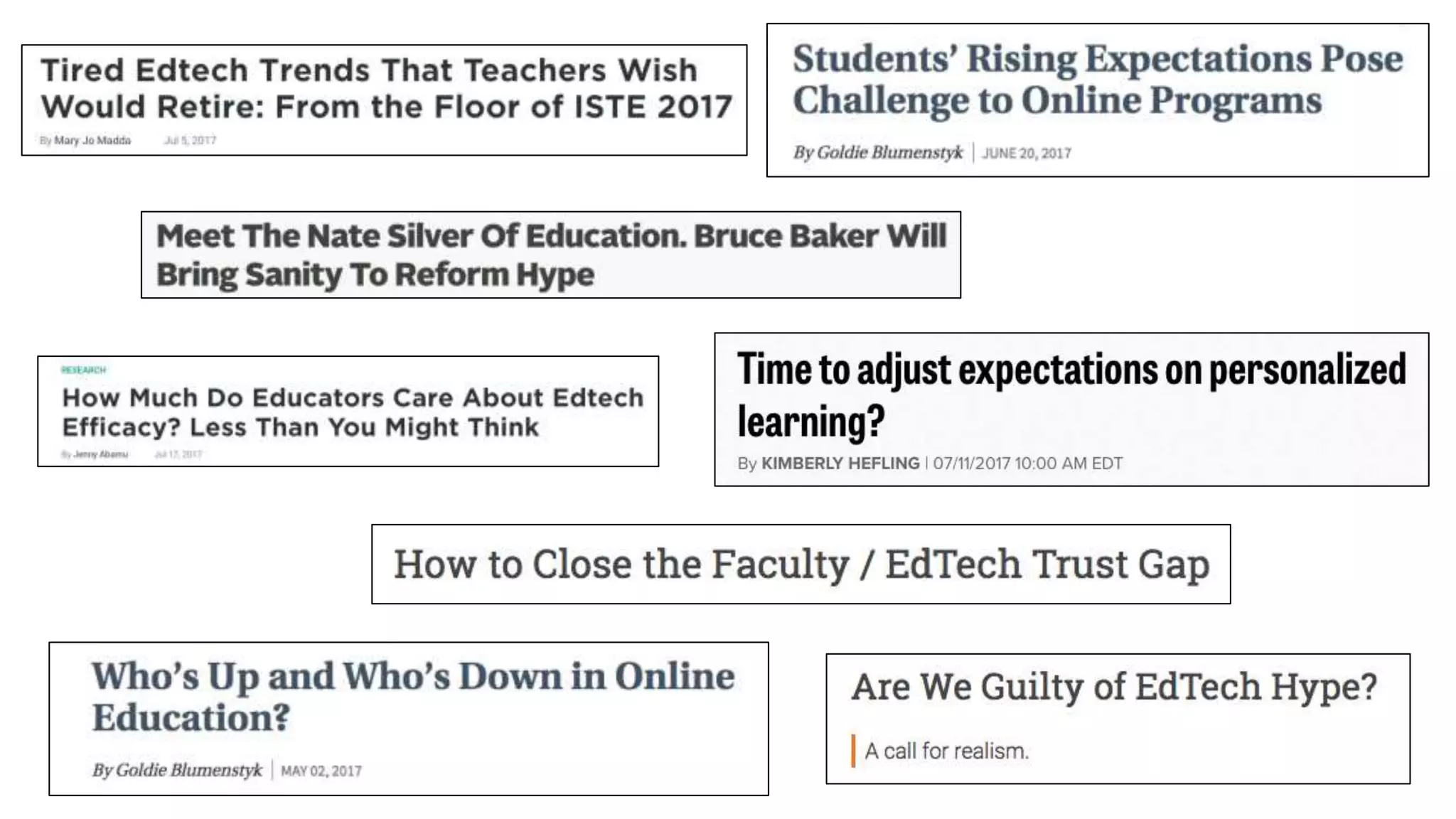
Edtech is plagued by hype.
Gartner Hype Cycle: https://en.wikipedia.org/wiki/Hype_cycle
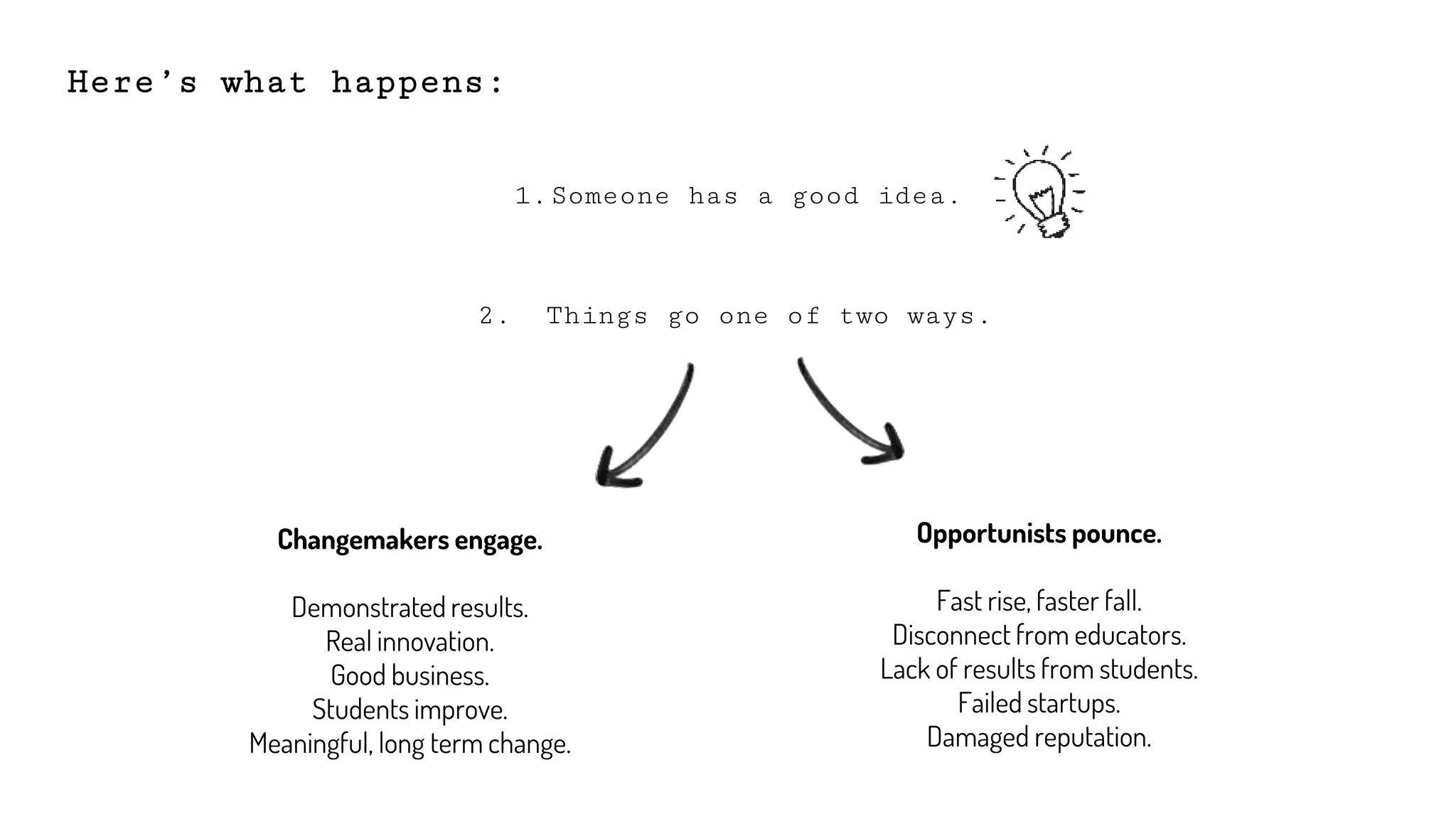
Here’s what happens:
1.Someone has a good idea.
Opportunists pounce.
Fast rise, faster fall.
Disconnect from educators.
Lack of results from students.
Failed startups.
Damaged reputation.
2. Things go one of two ways.
Changemakers engage.
Demonstrated results.
Real innovation.
Good business.
Students improve.
Meaningful, long term change.
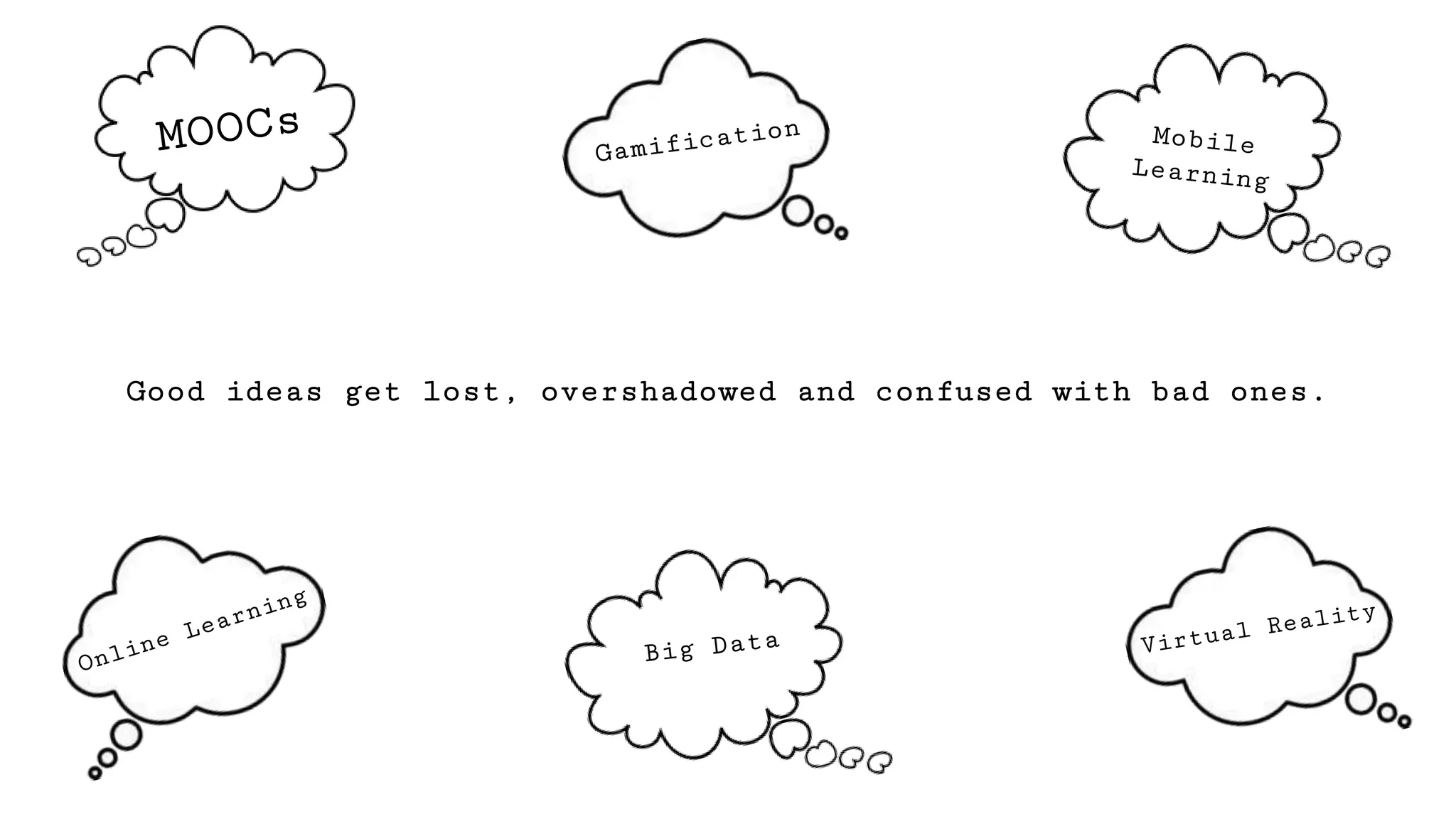
Good ideas get lost, overshadowed and confused with bad ones.
What to do about it?
Most of the time, it’s the people behind the edtech that matter. How can those in it for students create distance
from those just in it for the profit?
We will look at cases of successes and failures to help you know what hype looks like, know how to avoid it, and
know how to be better than it.
Create space.
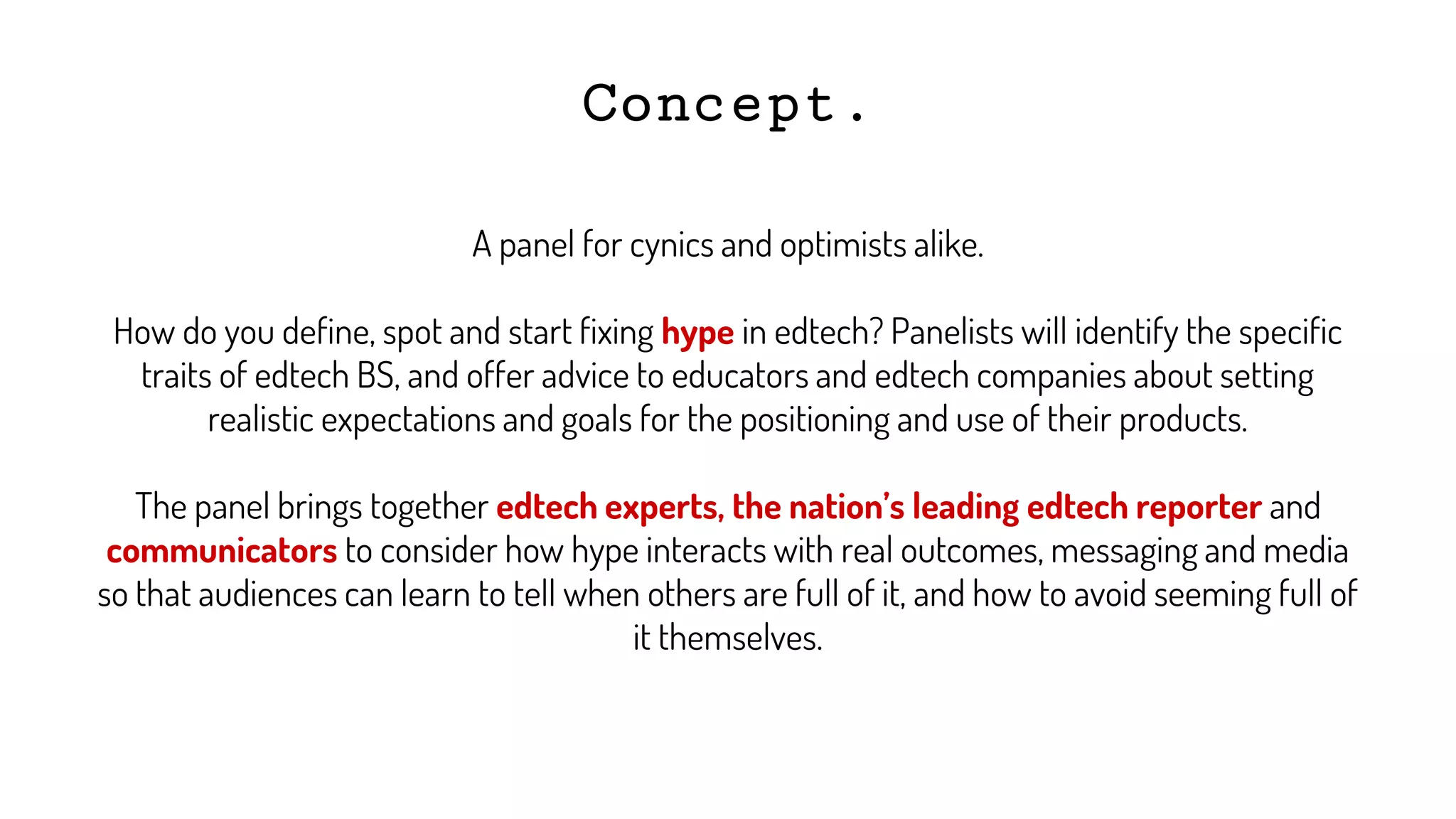
Concept.
A panel for cynics and optimists alike.
How do you define, spot and start fixing hype in edtech? Panelists will identify the specific
traits of edtech BS, and offer advice to educators and edtech companies about setting
realistic expectations and goals for the positioning and use of their products.
The panel brings together edtech experts, the nation’s leading edtech reporter and
communicators to consider how hype interacts with real outcomes, messaging and media
so that audiences can learn to tell when others are full of it, and how to avoid seeming full of
it themselves.
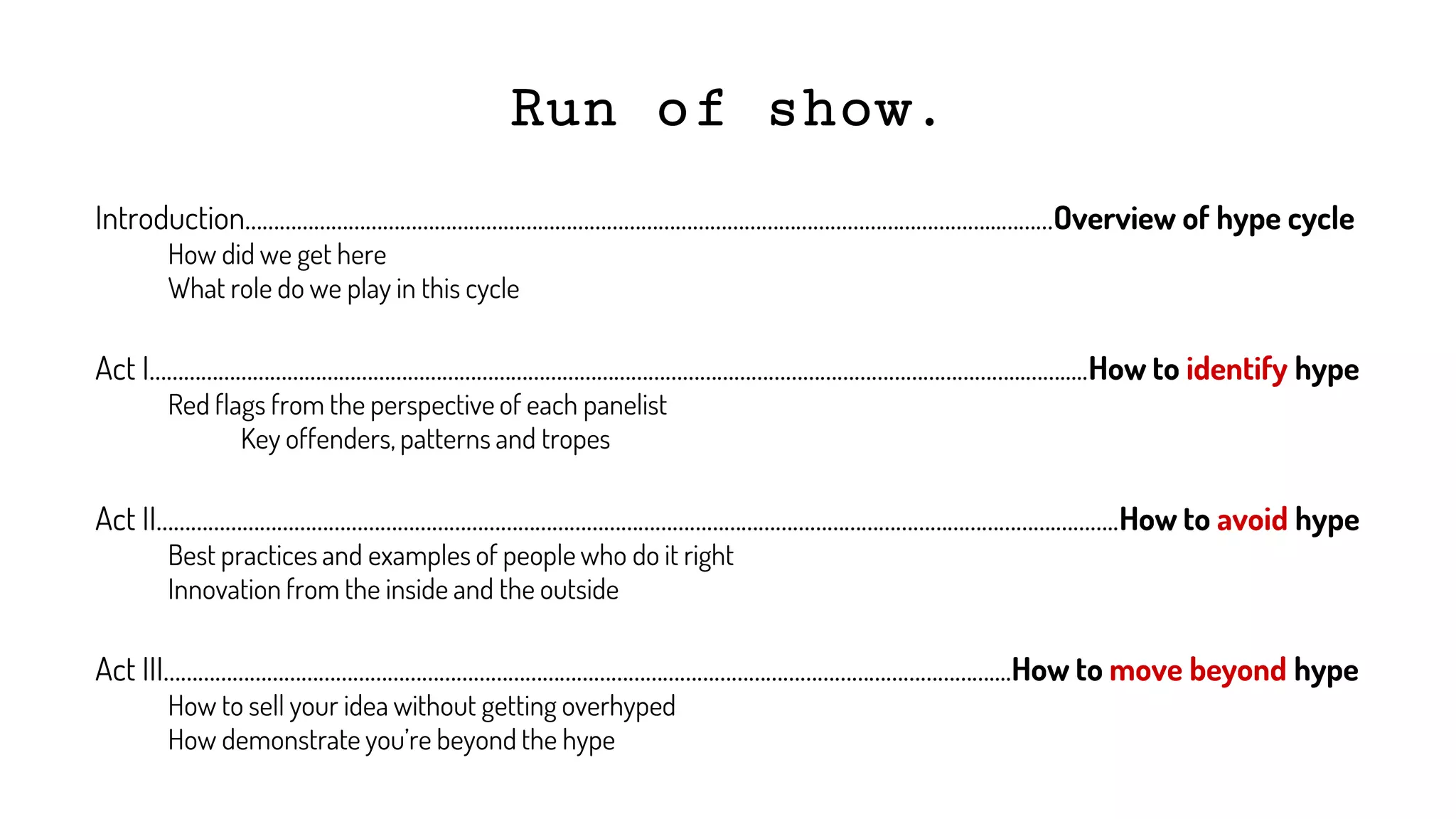
Run of show.
Introduction…………………………………………………………………………………………………………………...………Overview of hype cycle
How did we get here
What role do we play in this cycle
Act I……………………………………………………………………………………………………………………………………...…….....How to identify hype
Red flags from the perspective of each panelist
Key offenders, patterns and tropes
Act II………………………………………………………………………………………………………………………………………….………..How to avoid hype
Best practices and examples of people who do it right
Innovation from the inside and the outside
Act III………………………………………………………………………………………………………………………………....How to move beyond hype
How to sell your idea without getting overhyped
How demonstrate you’re beyond the hype
Players.
Goldie Blumenstyk | Senior Writer, Chronicle of Higher Education
Gordon Freedman | President of the National Laboratory for Education Transformation
Phil Komarny | Chief Digital Officer University of Texas System's Institute for
Transformational Learning
Alex Slater | Managing Director, Clyde Group
Players: Goldie Blumenstyk.
(The Journalist)
Goldie Blumenstyk is one of the nation’s most respected higher-education journalists. As a reporter and an editor at The Chronicle of
Higher Education since 1988, Goldie Blumenstyk has covered a wide range of topics, including distance education, the Internet boom and
bust, state politics, university governance, and fund raising.
She is nationally known for her expertise on for-profit higher education, college finances, and university patents and the
commercialization of academic research. She has reported for The Chronicle from Peru, China, and several countries in Europe, and her
stories have received numerous awards, including first prize from the Education Writers Association for 2011 for beat reporting on the
Business of Higher Education and as a contributor to the The Chronicle‘s package,”The Gates Effect,” awarded first prize for investigative
reporting in 2013.
Goldie speaks frequently at higher-education industry conferences and events for members of the news media, and appears often as a
guest on radio and public-television shows. Before joining The Chronicle, she covered government issues and City Hall at The Orlando
Sentinel.
She has a B.A. (History) from Colgate University, and a master’s degree from the Columbia University Graduate School of Journalism.
Players: Gordon Freedman.
(The Ed Guy)
Gordon Freedman helped evolve the fields of education technology and online learning and is now an advocate for broad-based
change across the K-to-Career spectrum.
Freedman is President of the National Laboratory for Education Transformation (www.NLET.org), a California-based 501(c)(3) non-profit
committed to transforming 20th century education into 21st century learning. Freedman founded NLET to create an organization that
looks three to five years into the future, acting as a broad social, research and organizational platform for the alignment of education and
training with the technology of the knowledge economy and youth culture. The nonprofit has received federal and foundation grants in
partnerships with universities, community colleges, school districts and research institutes.
Freedman formerly served as Vice President Global Education Strategy, Blackboard Inc, during its growth from 100 million dollar in annual
revenue to an exit at 1.4 billion dollars. During his tenure, Freedman traveled to 19 countries examining learning models and policy
strategies, launched the Blackboard Institute and provided thought leadership for the company globally.
He was part of the start-up of California State University Monterey Bay, the Prometheus Learning Management System at George
Washington University, and the online learning portal, HungryMinds.
Freedman is the co-founder of the International School of Monterey, a K-8 California charter school, and is a former fellow at UC Berkeley
and SRI.com.
Players: Phil Komarny.
(The Tech Guy)
Phil Komarny has been delivering digital innovation to higher education for over 15 years, and was the first to bring the iPad the the
classroom when he lead the iPads for Everyone initiative at Seton Hill University in 2010. Apple awarded these efforts with the
Distinguished Program award 4 years in a row, and Phil was named to the CIO100 by CIO magazine in 2013.
He continues his work in higher education with the University of Texas Systems' Institute for Transformational Learning where he is
crafting platforms that will become an opportunity engine for the second largest university system in the country. Through this innovative
work, Phil has invented the ChainScript: a platform underpinned by a block chain that will provide the UT system a mechanism to revision
many processes included transcripts, aid and digital rights management.
Before joining the UT system, Komarny was the CEO of Robots & Pencils Inc., overseeing the development and introduction of over 20
educational apps designed to make learning more accessible, interactive and personalized for thousands of individuals of all ages across
North America. From 2009 - 2014, Komarny served as CIO at Seton Hill University. He was a member of the President’s cabinet, providing
visionary leadership on all matters related to administrative and academic uses of technology. He worked across campus departments to
construct collaborative applications that have resulted in more efficient processes, better student retention and positive operating
margins.
Komarny has discussed his work at speaking engagements across the country, including SXSWedu, Dreamforce and EDUCAUSE.
Players: Alex Slater.
Alex Slater is Managing Director of Clyde Group, the Washington D.C.-based communications and public affairs agency, advising global
corporations, major nonprofits and advocacy groups on issues management and crises. He advises universities, Fortune 10 companies, high
profile celebrities and major political organizations.
Recognized by NBC News, USA Today and the Washington Post as one of the nation’s trailblazing PR advisors, Slater has honed his
communications skills within the education space for decades. He has led major communications efforts for New York University, Hamilton
College, the Annenberg School at the University of Pennsylvania, Capella University and University of Phoenix. In the foundation space, he
has worked on educational initiatives for Strada Education Network, Gallup, the US Chamber Foundation, Sallie Mae and America Saves. His
educational experience includes advising college leaders on positioning, promoting major new academic initiatives, dealing with challenging
situations and promoting positive educational outcomes.
Slater started his career as the first employee of the now widely respected Glover Park Group, leaving a decade later as Managing Director
of Public Affairs. In 2011, he was tapped to grow a public affairs practice at SKDKnickerbocker. A strong leader and creative force, Slater was
recently named to PRWeek’s 2016 40 Under 40 List. His firm was selected as a finalist for “Boutique of the Year” and he sits on the board of
Whitman-Walker Health, an organization for which he led a major rebranding campaign.
(The Communicator Guy)

EdTech: Separating the A+ from the BS

  • 1.
    EdTech:Separating the from the Howto identify, avoid and move beyond the hype. SXSWedu PanelPicker Submission July 23, 2017 Track: Data
  • 2.
    Problem: All theBuzz & No Meaning. Disruptive. Realtime. Future Ready. Adaptive. Revolutionary. Big Data. Workable Solutions. Innovation. Efficacy. Disruptive. Realtime. Future Ready. Adaptive. Revolutionary. Big Data. Workable Solutions. Innovation. Efficacy. Disruptive. Realtime. Future Ready. Adaptive. Revolutionary. Big Data. Workable Solutions. Innovation. Efficacy. Disruptive. Realtime. Future Ready. Adaptive. Revolutionary. Big Data. Workable Solutions. Innovation. Efficacy. Disruptive. Realtime. Future Ready. Adaptive. Revolutionary. Big Data. Workable Solutions. Innovation. Efficacy. Disruptive. Realtime. Future Ready. Adaptive. Revolutionary. Big Data. Workable Solutions. Innovation. Efficacy. Disruptive. Realtime. Future Ready. Adaptive. Revolutionary. Workable Solutions. Innovation. Efficacy. Disruptive. Realtime. Future Ready. Adaptive. Revolutionary. Big Data. Innovation. Efficacy. Disruptive. Realtime. Future Ready. Adaptive. Revolutionary. Big Data. Workable Solutions. Innovation. Efficacy. Disruptive. Realtime. Future Ready. Adaptive. Revolutionary. Big Data. Workable Solutions. Innovation. Efficacy. Disruptive. Realtime.
  • 3.
    The essential giftfor a good writer is a built-in, shockproof, bullshit detector. - Ernest Hemingway
  • 4.
    Edtech is plaguedby hype. Gartner Hype Cycle: https://en.wikipedia.org/wiki/Hype_cycle
  • 6.
    Here’s what happens: 1.Someonehas a good idea. Opportunists pounce. Fast rise, faster fall. Disconnect from educators. Lack of results from students. Failed startups. Damaged reputation. 2. Things go one of two ways. Changemakers engage. Demonstrated results. Real innovation. Good business. Students improve. Meaningful, long term change.
  • 7.
    Good ideas getlost, overshadowed and confused with bad ones.
  • 8.
    What to doabout it?
  • 9.
    Most of thetime, it’s the people behind the edtech that matter. How can those in it for students create distance from those just in it for the profit? We will look at cases of successes and failures to help you know what hype looks like, know how to avoid it, and know how to be better than it. Create space.
  • 10.
    Concept. A panel forcynics and optimists alike. How do you define, spot and start fixing hype in edtech? Panelists will identify the specific traits of edtech BS, and offer advice to educators and edtech companies about setting realistic expectations and goals for the positioning and use of their products. The panel brings together edtech experts, the nation’s leading edtech reporter and communicators to consider how hype interacts with real outcomes, messaging and media so that audiences can learn to tell when others are full of it, and how to avoid seeming full of it themselves.
  • 11.
    Run of show. Introduction…………………………………………………………………………………………………………………...………Overviewof hype cycle How did we get here What role do we play in this cycle Act I……………………………………………………………………………………………………………………………………...…….....How to identify hype Red flags from the perspective of each panelist Key offenders, patterns and tropes Act II………………………………………………………………………………………………………………………………………….………..How to avoid hype Best practices and examples of people who do it right Innovation from the inside and the outside Act III………………………………………………………………………………………………………………………………....How to move beyond hype How to sell your idea without getting overhyped How demonstrate you’re beyond the hype
  • 12.
    Players. Goldie Blumenstyk |Senior Writer, Chronicle of Higher Education Gordon Freedman | President of the National Laboratory for Education Transformation Phil Komarny | Chief Digital Officer University of Texas System's Institute for Transformational Learning Alex Slater | Managing Director, Clyde Group
  • 13.
    Players: Goldie Blumenstyk. (TheJournalist) Goldie Blumenstyk is one of the nation’s most respected higher-education journalists. As a reporter and an editor at The Chronicle of Higher Education since 1988, Goldie Blumenstyk has covered a wide range of topics, including distance education, the Internet boom and bust, state politics, university governance, and fund raising. She is nationally known for her expertise on for-profit higher education, college finances, and university patents and the commercialization of academic research. She has reported for The Chronicle from Peru, China, and several countries in Europe, and her stories have received numerous awards, including first prize from the Education Writers Association for 2011 for beat reporting on the Business of Higher Education and as a contributor to the The Chronicle‘s package,”The Gates Effect,” awarded first prize for investigative reporting in 2013. Goldie speaks frequently at higher-education industry conferences and events for members of the news media, and appears often as a guest on radio and public-television shows. Before joining The Chronicle, she covered government issues and City Hall at The Orlando Sentinel. She has a B.A. (History) from Colgate University, and a master’s degree from the Columbia University Graduate School of Journalism.
  • 14.
    Players: Gordon Freedman. (TheEd Guy) Gordon Freedman helped evolve the fields of education technology and online learning and is now an advocate for broad-based change across the K-to-Career spectrum. Freedman is President of the National Laboratory for Education Transformation (www.NLET.org), a California-based 501(c)(3) non-profit committed to transforming 20th century education into 21st century learning. Freedman founded NLET to create an organization that looks three to five years into the future, acting as a broad social, research and organizational platform for the alignment of education and training with the technology of the knowledge economy and youth culture. The nonprofit has received federal and foundation grants in partnerships with universities, community colleges, school districts and research institutes. Freedman formerly served as Vice President Global Education Strategy, Blackboard Inc, during its growth from 100 million dollar in annual revenue to an exit at 1.4 billion dollars. During his tenure, Freedman traveled to 19 countries examining learning models and policy strategies, launched the Blackboard Institute and provided thought leadership for the company globally. He was part of the start-up of California State University Monterey Bay, the Prometheus Learning Management System at George Washington University, and the online learning portal, HungryMinds. Freedman is the co-founder of the International School of Monterey, a K-8 California charter school, and is a former fellow at UC Berkeley and SRI.com.
  • 15.
    Players: Phil Komarny. (TheTech Guy) Phil Komarny has been delivering digital innovation to higher education for over 15 years, and was the first to bring the iPad the the classroom when he lead the iPads for Everyone initiative at Seton Hill University in 2010. Apple awarded these efforts with the Distinguished Program award 4 years in a row, and Phil was named to the CIO100 by CIO magazine in 2013. He continues his work in higher education with the University of Texas Systems' Institute for Transformational Learning where he is crafting platforms that will become an opportunity engine for the second largest university system in the country. Through this innovative work, Phil has invented the ChainScript: a platform underpinned by a block chain that will provide the UT system a mechanism to revision many processes included transcripts, aid and digital rights management. Before joining the UT system, Komarny was the CEO of Robots & Pencils Inc., overseeing the development and introduction of over 20 educational apps designed to make learning more accessible, interactive and personalized for thousands of individuals of all ages across North America. From 2009 - 2014, Komarny served as CIO at Seton Hill University. He was a member of the President’s cabinet, providing visionary leadership on all matters related to administrative and academic uses of technology. He worked across campus departments to construct collaborative applications that have resulted in more efficient processes, better student retention and positive operating margins. Komarny has discussed his work at speaking engagements across the country, including SXSWedu, Dreamforce and EDUCAUSE.
  • 16.
    Players: Alex Slater. AlexSlater is Managing Director of Clyde Group, the Washington D.C.-based communications and public affairs agency, advising global corporations, major nonprofits and advocacy groups on issues management and crises. He advises universities, Fortune 10 companies, high profile celebrities and major political organizations. Recognized by NBC News, USA Today and the Washington Post as one of the nation’s trailblazing PR advisors, Slater has honed his communications skills within the education space for decades. He has led major communications efforts for New York University, Hamilton College, the Annenberg School at the University of Pennsylvania, Capella University and University of Phoenix. In the foundation space, he has worked on educational initiatives for Strada Education Network, Gallup, the US Chamber Foundation, Sallie Mae and America Saves. His educational experience includes advising college leaders on positioning, promoting major new academic initiatives, dealing with challenging situations and promoting positive educational outcomes. Slater started his career as the first employee of the now widely respected Glover Park Group, leaving a decade later as Managing Director of Public Affairs. In 2011, he was tapped to grow a public affairs practice at SKDKnickerbocker. A strong leader and creative force, Slater was recently named to PRWeek’s 2016 40 Under 40 List. His firm was selected as a finalist for “Boutique of the Year” and he sits on the board of Whitman-Walker Health, an organization for which he led a major rebranding campaign. (The Communicator Guy)