

PowerPoint Presentation by Charlie CookPowerPoint Presentation by Charlie Cook
The University of West AlabamaThe University of West Alabama
1
Human ResourceHuman Resource
ManagementManagement
ELEVENTH EDITIONELEVENTH EDITION
G A R Y D E S S L E RG A R Y D E S S L E R
© 2008 Prentice Hall, Inc.© 2008 Prentice Hall, Inc.
All rights reserved.All rights reserved.
Job AnalysisJob Analysis
Chapter 4Chapter 4
Part 2 | Recruitment and PlacementPart 2 | Recruitment and Placement
© 2008 Prentice Hall, Inc. All rights reserved. 4–2
After studying this chapter, you should be able to:
1.1. Discuss the nature of job analysis, including what it isDiscuss the nature of job analysis, including what it is
and how it’s used.and how it’s used.
2.2. Use at least three methods of collecting job analysisUse at least three methods of collecting job analysis
information, including interviews, questionnaires, andinformation, including interviews, questionnaires, and
observation.observation.
3.3. Write job descriptions, including summaries and jobWrite job descriptions, including summaries and job
functions, using the Internet and traditional methods.functions, using the Internet and traditional methods.
4.4. Write job specifications using the Internet as well asWrite job specifications using the Internet as well as
your judgment.your judgment.
5.5. Explain job analysis in a “jobless” world, includingExplain job analysis in a “jobless” world, including
what it means and how it’s done in practice.what it means and how it’s done in practice.
© 2008 Prentice Hall, Inc. All rights reserved. 4–3
Methods of Collecting Job AnalysisMethods of Collecting Job Analysis
Information: The InterviewInformation: The Interview
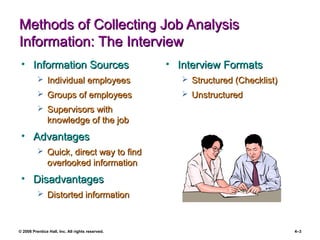
• Information SourcesInformation Sources
 Individual employeesIndividual employees
 Groups of employeesGroups of employees
 Supervisors withSupervisors with
knowledge of the jobknowledge of the job
• AdvantagesAdvantages
 Quick, direct way to findQuick, direct way to find
overlooked informationoverlooked information
• DisadvantagesDisadvantages
 Distorted informationDistorted information
• Interview FormatsInterview Formats
 Structured (Checklist)Structured (Checklist)
 UnstructuredUnstructured
© 2008 Prentice Hall, Inc. All rights reserved. 4–4
Methods of Collecting Job AnalysisMethods of Collecting Job Analysis
Information: QuestionnairesInformation: Questionnaires
• Information SourceInformation Source
 Have employees fill outHave employees fill out
questionnaires to describequestionnaires to describe
their job-related duties andtheir job-related duties and
responsibilitiesresponsibilities
• Questionnaire FormatsQuestionnaire Formats
 Structured checklistsStructured checklists
 Open-ended questionsOpen-ended questions
• AdvantagesAdvantages
 Quick and efficient way toQuick and efficient way to
gather information fromgather information from
large numbers oflarge numbers of
employeesemployees
• DisadvantagesDisadvantages
 Expense and timeExpense and time
consumed in preparingconsumed in preparing
and testing theand testing the
questionnairequestionnaire
© 2008 Prentice Hall, Inc. All rights reserved. 4–5
Methods of Collecting Job AnalysisMethods of Collecting Job Analysis
Information: ObservationInformation: Observation
• Information SourceInformation Source
 Observing and noting theObserving and noting the
physical activities ofphysical activities of
employees as they goemployees as they go
about their jobsabout their jobs
• AdvantagesAdvantages
 Provides first-handProvides first-hand
informationinformation
 Reduces distortion ofReduces distortion of
informationinformation
• DisadvantagesDisadvantages
 Time consumingTime consuming
 Difficulty in capturingDifficulty in capturing
entire job cycleentire job cycle
 Of little use if job involvesOf little use if job involves
a high level of mentala high level of mental
activityactivity
© 2008 Prentice Hall, Inc. All rights reserved. 4–6
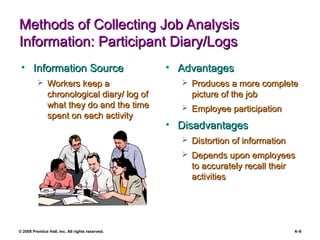
Methods of Collecting Job AnalysisMethods of Collecting Job Analysis
Information: Participant Diary/LogsInformation: Participant Diary/Logs
• Information SourceInformation Source
 Workers keep aWorkers keep a
chronological diary/ log ofchronological diary/ log of
what they do and the timewhat they do and the time
spent on each activityspent on each activity
• AdvantagesAdvantages
 Produces a more completeProduces a more complete
picture of the jobpicture of the job
 Employee participationEmployee participation
• DisadvantagesDisadvantages
 Distortion of informationDistortion of information
 Depends upon employeesDepends upon employees
to accurately recall theirto accurately recall their
activitiesactivities
© 2008 Prentice Hall, Inc. All rights reserved. 4–7
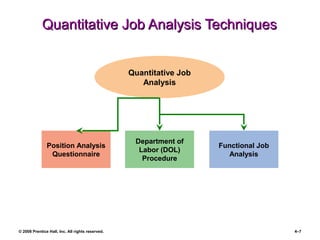
Quantitative Job Analysis TechniquesQuantitative Job Analysis Techniques
Position Analysis
Questionnaire
Functional Job
Analysis
Quantitative Job
Analysis
Department of
Labor (DOL)
Procedure
© 2008 Prentice Hall, Inc. All rights reserved. 4–8
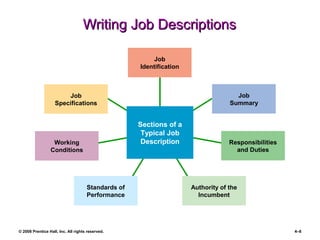
Writing Job DescriptionsWriting Job Descriptions
Job
Identification
Job
Summary
Responsibilities
and Duties
Authority of the
Incumbent
Standards of
Performance
Working
Conditions
Job
Specifications
Sections of a
Typical Job
Description
© 2008 Prentice Hall, Inc. All rights reserved. 4–9
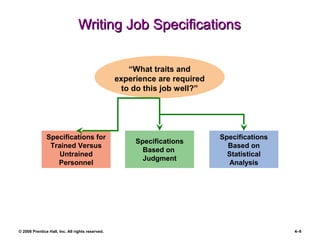
Writing Job SpecificationsWriting Job Specifications
Specifications for
Trained Versus
Untrained
Personnel
Specifications
Based on
Statistical
Analysis
“What traits and
experience are required
to do this job well?”
Specifications
Based on
Judgment
© 2008 Prentice Hall, Inc. All rights reserved. 4–10
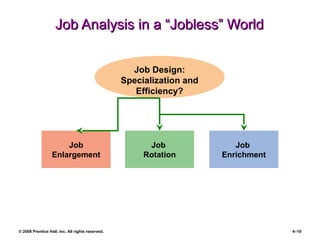
Job Analysis in a “Jobless” WorldJob Analysis in a “Jobless” World
Job
Enlargement
Job
Enrichment
Job Design:
Specialization and
Efficiency?
Job
Rotation
© 2008 Prentice Hall, Inc. All rights reserved. 4–11
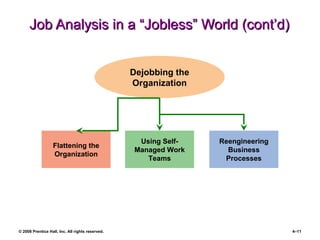
Job Analysis in a “Jobless” World (cont’d)Job Analysis in a “Jobless” World (cont’d)
Flattening the
Organization
Reengineering
Business
Processes
Dejobbing the
Organization
Using Self-
Managed Work
Teams
© 2008 Prentice Hall, Inc. All rights reserved. 4–12
K E Y T E R M S
job analysisjob analysis
job descriptionjob description
job specificationsjob specifications
organization chartorganization chart
process chartprocess chart
diary/logdiary/log
position analysis questionnaireposition analysis questionnaire
(PAQ)(PAQ)
U.S. Department of Labor (DOL)U.S. Department of Labor (DOL)
job analysis procedurejob analysis procedure
functional job analysisfunctional job analysis
Standard OccupationalStandard Occupational
Classification (SOC)Classification (SOC)
job enlargementjob enlargement
job rotationjob rotation
job enrichmentjob enrichment
dejobbingdejobbing
boundaryless organizationboundaryless organization
reengineeringreengineering
competenciescompetencies
competency-based job analysiscompetency-based job analysis
performance managementperformance management

Garry Dessler Human Resource Management Chapter 4 Part 2

  • 1.
    PowerPoint Presentation byCharlie CookPowerPoint Presentation by Charlie Cook The University of West AlabamaThe University of West Alabama 1 Human ResourceHuman Resource ManagementManagement ELEVENTH EDITIONELEVENTH EDITION G A R Y D E S S L E RG A R Y D E S S L E R © 2008 Prentice Hall, Inc.© 2008 Prentice Hall, Inc. All rights reserved.All rights reserved. Job AnalysisJob Analysis Chapter 4Chapter 4 Part 2 | Recruitment and PlacementPart 2 | Recruitment and Placement
  • 2.
    © 2008 PrenticeHall, Inc. All rights reserved. 4–2 After studying this chapter, you should be able to: 1.1. Discuss the nature of job analysis, including what it isDiscuss the nature of job analysis, including what it is and how it’s used.and how it’s used. 2.2. Use at least three methods of collecting job analysisUse at least three methods of collecting job analysis information, including interviews, questionnaires, andinformation, including interviews, questionnaires, and observation.observation. 3.3. Write job descriptions, including summaries and jobWrite job descriptions, including summaries and job functions, using the Internet and traditional methods.functions, using the Internet and traditional methods. 4.4. Write job specifications using the Internet as well asWrite job specifications using the Internet as well as your judgment.your judgment. 5.5. Explain job analysis in a “jobless” world, includingExplain job analysis in a “jobless” world, including what it means and how it’s done in practice.what it means and how it’s done in practice.
  • 3.
    © 2008 PrenticeHall, Inc. All rights reserved. 4–3 Methods of Collecting Job AnalysisMethods of Collecting Job Analysis Information: The InterviewInformation: The Interview • Information SourcesInformation Sources  Individual employeesIndividual employees  Groups of employeesGroups of employees  Supervisors withSupervisors with knowledge of the jobknowledge of the job • AdvantagesAdvantages  Quick, direct way to findQuick, direct way to find overlooked informationoverlooked information • DisadvantagesDisadvantages  Distorted informationDistorted information • Interview FormatsInterview Formats  Structured (Checklist)Structured (Checklist)  UnstructuredUnstructured
  • 4.
    © 2008 PrenticeHall, Inc. All rights reserved. 4–4 Methods of Collecting Job AnalysisMethods of Collecting Job Analysis Information: QuestionnairesInformation: Questionnaires • Information SourceInformation Source  Have employees fill outHave employees fill out questionnaires to describequestionnaires to describe their job-related duties andtheir job-related duties and responsibilitiesresponsibilities • Questionnaire FormatsQuestionnaire Formats  Structured checklistsStructured checklists  Open-ended questionsOpen-ended questions • AdvantagesAdvantages  Quick and efficient way toQuick and efficient way to gather information fromgather information from large numbers oflarge numbers of employeesemployees • DisadvantagesDisadvantages  Expense and timeExpense and time consumed in preparingconsumed in preparing and testing theand testing the questionnairequestionnaire
  • 5.
    © 2008 PrenticeHall, Inc. All rights reserved. 4–5 Methods of Collecting Job AnalysisMethods of Collecting Job Analysis Information: ObservationInformation: Observation • Information SourceInformation Source  Observing and noting theObserving and noting the physical activities ofphysical activities of employees as they goemployees as they go about their jobsabout their jobs • AdvantagesAdvantages  Provides first-handProvides first-hand informationinformation  Reduces distortion ofReduces distortion of informationinformation • DisadvantagesDisadvantages  Time consumingTime consuming  Difficulty in capturingDifficulty in capturing entire job cycleentire job cycle  Of little use if job involvesOf little use if job involves a high level of mentala high level of mental activityactivity
  • 6.
    © 2008 PrenticeHall, Inc. All rights reserved. 4–6 Methods of Collecting Job AnalysisMethods of Collecting Job Analysis Information: Participant Diary/LogsInformation: Participant Diary/Logs • Information SourceInformation Source  Workers keep aWorkers keep a chronological diary/ log ofchronological diary/ log of what they do and the timewhat they do and the time spent on each activityspent on each activity • AdvantagesAdvantages  Produces a more completeProduces a more complete picture of the jobpicture of the job  Employee participationEmployee participation • DisadvantagesDisadvantages  Distortion of informationDistortion of information  Depends upon employeesDepends upon employees to accurately recall theirto accurately recall their activitiesactivities
  • 7.
    © 2008 PrenticeHall, Inc. All rights reserved. 4–7 Quantitative Job Analysis TechniquesQuantitative Job Analysis Techniques Position Analysis Questionnaire Functional Job Analysis Quantitative Job Analysis Department of Labor (DOL) Procedure
  • 8.
    © 2008 PrenticeHall, Inc. All rights reserved. 4–8 Writing Job DescriptionsWriting Job Descriptions Job Identification Job Summary Responsibilities and Duties Authority of the Incumbent Standards of Performance Working Conditions Job Specifications Sections of a Typical Job Description
  • 9.
    © 2008 PrenticeHall, Inc. All rights reserved. 4–9 Writing Job SpecificationsWriting Job Specifications Specifications for Trained Versus Untrained Personnel Specifications Based on Statistical Analysis “What traits and experience are required to do this job well?” Specifications Based on Judgment
  • 10.
    © 2008 PrenticeHall, Inc. All rights reserved. 4–10 Job Analysis in a “Jobless” WorldJob Analysis in a “Jobless” World Job Enlargement Job Enrichment Job Design: Specialization and Efficiency? Job Rotation
  • 11.
    © 2008 PrenticeHall, Inc. All rights reserved. 4–11 Job Analysis in a “Jobless” World (cont’d)Job Analysis in a “Jobless” World (cont’d) Flattening the Organization Reengineering Business Processes Dejobbing the Organization Using Self- Managed Work Teams
  • 12.
    © 2008 PrenticeHall, Inc. All rights reserved. 4–12 K E Y T E R M S job analysisjob analysis job descriptionjob description job specificationsjob specifications organization chartorganization chart process chartprocess chart diary/logdiary/log position analysis questionnaireposition analysis questionnaire (PAQ)(PAQ) U.S. Department of Labor (DOL)U.S. Department of Labor (DOL) job analysis procedurejob analysis procedure functional job analysisfunctional job analysis Standard OccupationalStandard Occupational Classification (SOC)Classification (SOC) job enlargementjob enlargement job rotationjob rotation job enrichmentjob enrichment dejobbingdejobbing boundaryless organizationboundaryless organization reengineeringreengineering competenciescompetencies competency-based job analysiscompetency-based job analysis performance managementperformance management