SITE, Stockholm School of Economics
 
Call for Papers
Corruption remains a crucial problem for most low and middle income countries, as
highlighted by a wave of recent empirical studies. There is a strong negative
correlation between levels of income and levels of corruption, with almost
exclusively very poor countries in the bottom of world rankings. Even within income
brackets there is however variation. The former Soviet Union countries of the CIS, for
instance, tend to score worse than expected given their level of income. Even in fast
growing emerging markets such as China and India the policy debate identifies
corruption as the main force hindering the success of economic reforms. Policy
interest in the subject is very high and many international conventions for limiting
corruption have been signed in the last years. However, detecting and fighting
corruption remains a challenge, as does measuring its effects on growth and
welfare. Additionally, there is a widespread perception that "research has been
lagging behind policy", and that the economic literature has still “more questions to
pose than concrete answers."
The Stockholm Institute of Transition Economics and the aswede network will host an
academic conference at the Stockholm School of Economics to bring together
researchers across all fields of economics contributing to the debate about
corruption, its effects, and the optimal tools to fight it. The focus is on low and
middle-income countries and the role of legal institutions, with one section in
particular focusing on the experience of the transition countries in the CIS and CEE
regions.
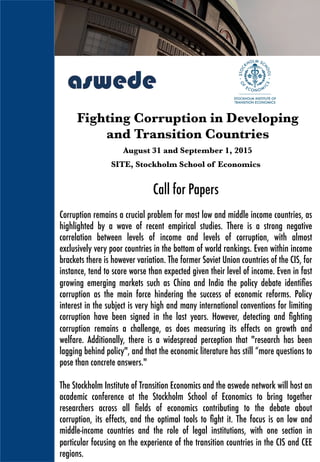
Fighting Corruption in Developing 
and Transition Countries

August 31 and September 1, 2015
Besides academic research, there have been important and rather different policy
experiences in terms of fighting corruption, and new experiments are under way.
For example, Georgia seems to have implemented a successful set of policies in the
last decade, and the Chinese government announced an overhaul of the anti-
corruption legislation a few weeks ago. The views on successful policies differ
considerably even among policy makers. The conference program will therefore
also include a roundtable discussing several of these different recent experiences
in the fight of corruption.
We invite submissions of empirical and theoretical research related to all aspects of
corruption and its prevention, with particular attention on developing and
transition countries. Empirical, theoretical and experimental studies are equally
welcome.
Please send your submission to siteconferences@gmail.com before June 30, 2015.
Priority is given to complete papers, but extended abstracts will be considered as
well. Funds for accommodation and travel are available; please indicate upon
paper submission if such assistance is required for participation.
Kaushik Basu is Senior Vice President and Chief Economist at the World Bank. He is
on leave from Cornell University where he is Professor of Economics and the C.
Marks Professor of International Studies. From December 2009 to July 2012 he
served as the Chief Economic Advisor (CEA) to the Government of India at the
Ministry of Finance. Till 2009 he was Chairman of the Department of Economics
and during 2006-9 he was Director of the Center for Analytic Economics at Cornell.
Kaushik
Basu 	
  
Keynote Speakers
Abhijit is currently the Ford Foundation International Professor of Economics at the
Massachusetts Institute of Technology. In 2003 he founded the Abdul Latif Jameel
Poverty Action Lab (J-PAL). Banerjee is a past president of the Bureau for the
Research in the Economic Analysis of Development, a Research Associate of the
NBER, a CEPR research fellow, International Research Fellow of the Kiel Institute, a
fellow of the American Academy of Arts and Sciences and the Econometric Society
and has been a Guggenheim Fellow and an Alfred P. Sloan Fellow.
Abhijit
Banerjee 	
  
Simeon Djankov is rector of the New Economic School in Moscow. From 2009 to
2013, he was the Deputy Prime Minister and Minister of Finance of Bulgaria in the
government of Boyko Borisov. Prior to his cabinet appointment, Simeon Djankov
was a Chief economist of the finance and private sector vice-presidency of the World
Bank. He was an associate editor of the Journal of Comparative Economics from
2004 to 2009, and he has also served as chairman of the board of the European
Bank for Reconstruction and Development. He is also a member of the World Bank's
Knowledge and Advisory Council, and a Visiting Fellow at the Peterson Institute for
International Economics.
Simeon
Djankov
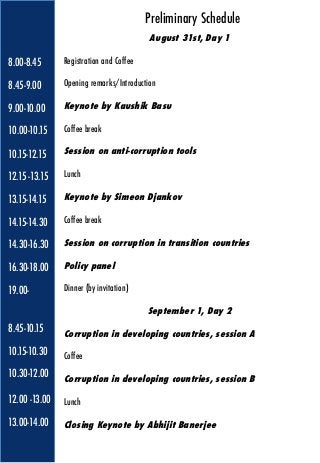
8.00-8.45
8.45-9.00
9.00-10.00
10.00-10.15
10.15-12.15
12.15 -13.15
13.15-14.15
14.15-14.30
14.30-16.30
16.30-18.00
19.00-
8.45-10.15
10.15-10.30
10.30-12.00
12.00 -13.00
13.00-14.00
August 31st, Day 1
Registration and Coffee
Opening remarks/Introduction 
Keynote by Kaushik Basu
Coffee break
Session on anti-corruption tools
Lunch
Keynote by Simeon Djankov
Coffee break
Session on corruption in transition countries
Policy panel
Dinner (by invitation)
September 1, Day 2
Corruption in developing countries, session A
Coffee
Corruption in developing countries, session B
Lunch
Closing Keynote by Abhijit Banerjee
Preliminary Schedule

Conference "Fighting Corruption in Developing and Transition Countries"

  • 1.
    SITE, Stockholm Schoolof Economics   Call for Papers Corruption remains a crucial problem for most low and middle income countries, as highlighted by a wave of recent empirical studies. There is a strong negative correlation between levels of income and levels of corruption, with almost exclusively very poor countries in the bottom of world rankings. Even within income brackets there is however variation. The former Soviet Union countries of the CIS, for instance, tend to score worse than expected given their level of income. Even in fast growing emerging markets such as China and India the policy debate identifies corruption as the main force hindering the success of economic reforms. Policy interest in the subject is very high and many international conventions for limiting corruption have been signed in the last years. However, detecting and fighting corruption remains a challenge, as does measuring its effects on growth and welfare. Additionally, there is a widespread perception that "research has been lagging behind policy", and that the economic literature has still “more questions to pose than concrete answers." The Stockholm Institute of Transition Economics and the aswede network will host an academic conference at the Stockholm School of Economics to bring together researchers across all fields of economics contributing to the debate about corruption, its effects, and the optimal tools to fight it. The focus is on low and middle-income countries and the role of legal institutions, with one section in particular focusing on the experience of the transition countries in the CIS and CEE regions. Fighting Corruption in Developing and Transition Countries August 31 and September 1, 2015
  • 2.
    Besides academic research,there have been important and rather different policy experiences in terms of fighting corruption, and new experiments are under way. For example, Georgia seems to have implemented a successful set of policies in the last decade, and the Chinese government announced an overhaul of the anti- corruption legislation a few weeks ago. The views on successful policies differ considerably even among policy makers. The conference program will therefore also include a roundtable discussing several of these different recent experiences in the fight of corruption. We invite submissions of empirical and theoretical research related to all aspects of corruption and its prevention, with particular attention on developing and transition countries. Empirical, theoretical and experimental studies are equally welcome. Please send your submission to siteconferences@gmail.com before June 30, 2015. Priority is given to complete papers, but extended abstracts will be considered as well. Funds for accommodation and travel are available; please indicate upon paper submission if such assistance is required for participation. Kaushik Basu is Senior Vice President and Chief Economist at the World Bank. He is on leave from Cornell University where he is Professor of Economics and the C. Marks Professor of International Studies. From December 2009 to July 2012 he served as the Chief Economic Advisor (CEA) to the Government of India at the Ministry of Finance. Till 2009 he was Chairman of the Department of Economics and during 2006-9 he was Director of the Center for Analytic Economics at Cornell. Kaushik Basu   Keynote Speakers Abhijit is currently the Ford Foundation International Professor of Economics at the Massachusetts Institute of Technology. In 2003 he founded the Abdul Latif Jameel Poverty Action Lab (J-PAL). Banerjee is a past president of the Bureau for the Research in the Economic Analysis of Development, a Research Associate of the NBER, a CEPR research fellow, International Research Fellow of the Kiel Institute, a fellow of the American Academy of Arts and Sciences and the Econometric Society and has been a Guggenheim Fellow and an Alfred P. Sloan Fellow. Abhijit Banerjee   Simeon Djankov is rector of the New Economic School in Moscow. From 2009 to 2013, he was the Deputy Prime Minister and Minister of Finance of Bulgaria in the government of Boyko Borisov. Prior to his cabinet appointment, Simeon Djankov was a Chief economist of the finance and private sector vice-presidency of the World Bank. He was an associate editor of the Journal of Comparative Economics from 2004 to 2009, and he has also served as chairman of the board of the European Bank for Reconstruction and Development. He is also a member of the World Bank's Knowledge and Advisory Council, and a Visiting Fellow at the Peterson Institute for International Economics. Simeon Djankov
  • 3.
    8.00-8.45 8.45-9.00 9.00-10.00 10.00-10.15 10.15-12.15 12.15 -13.15 13.15-14.15 14.15-14.30 14.30-16.30 16.30-18.00 19.00- 8.45-10.15 10.15-10.30 10.30-12.00 12.00 -13.00 13.00-14.00 August31st, Day 1 Registration and Coffee Opening remarks/Introduction  Keynote by Kaushik Basu Coffee break Session on anti-corruption tools Lunch Keynote by Simeon Djankov Coffee break Session on corruption in transition countries Policy panel Dinner (by invitation) September 1, Day 2 Corruption in developing countries, session A Coffee Corruption in developing countries, session B Lunch Closing Keynote by Abhijit Banerjee Preliminary Schedule