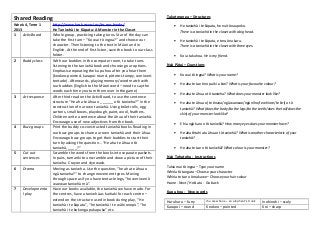
Shared reading plan for the online 'big book' - Taniwha i te kāpata
1.
Shared Reading
Week 4,Term 1
2013
1
ActivBoard
2
3
4
Buddy class
Art response
Buzz groups
5
Cut out
sentences
6
Drama
7
Developmenta
l play
http://www.kmk.maori.nz/te-reo-books/
He Taniwhā i te Kāpata: A Monster in the Closet
Whole group, practicing taking turns. Star of the day can
take the first turn – “Ko wai tō ingoa?” and choose our
character. Then listening to the text in Māori and in
English. At the end of first listen, save the book to our class
folder.
With our buddies in the computer room, to take turns
listening to the taniwhā book and choosing our options.
Emphasise repeating the kupu hou after you hear them
(keokeo-pointed, karapoi-round, pōtete-stumpy, weriweritentacle). Afterwards, playing memory/word match with
our buddies (English to the Māori word – need to say the
words each time you turn them over in the game)
After third read on the ActivBoard, to use the sentence
structure “He aha te āhua o ______ o tō taniwha?” in the
construction of our own taniwhā. Using toilet rolls, egg
cartons, small boxes, playdough, paint, wool, feathers.
Children write a sentence about the āhua of their taniwhā.
Encourage use of new adjectives from the book.
Print the buddy co-constructed taniwhā books. Reading in
our buzz groups to share our own taniwhā and their āhua.
Encourage buzz groups to get their buddies to start their
turn by asking the question… “He aha te āhua o tō
taniwhā, ____?”
Scramble the words from the books into separate packets.
In pairs, tamariki to unscramble and draw a picture of their
taniwha. Crayon and dye wash.
Moving as taniwha. Use the question, “he aha te āhua o
ngā taniwha?” to change movement types. Moving
through space as if you have tentacle legs, “he weriweri ō
waewae taniwhā mā”.
Have our books available, the taniwhā we have made. For
the centres, have a taniwhā as kaitiaki for each centre –
extend on the structure used in book during play, “He
taniwhā i te kāpata”, “he taniwhā i te wāhi onepū”, “he
taniwhā i te kokonga pukapuka” etc.
Takotoranga – Structures
•
He taniwhā i te kāpata, he nui tōna upoko.
There is a taniwhā in the closet with a big head.
•
He taniwhā i te kāpata, e toru ōna karu.
There is a taniwhā in the closet with three eyes.
•
Ko ia taku hoa. He is my friend.
Ngā Pātai – Questions
•
Ko wai tō ingoa? What is your name?
•
He aha te tae tino pai ki a koe? What is your favourite colour?
•
He aha te āhua o tō taniwha? What does your monster look like?
•
He aha te āhua o (te tinana/ngā waewae/ngā niho/te whiore/te kiri) o tō
taniwhā? What (does the body/do the legs/do the teeth/does the tail/does the
skin) of your monster look like?
•
E hia ngā karu o tō taniwhā? How many eyes does your monster have?
•
He aha tētahi atu āhua o tō taniwhā? What is another characteristic of your
taniwhā?
•
He aha te tae o tō taniwhā? What colour is your monster?
Ngā Tohutohu - Instructions
Tuhia mai tō ingoa – Type your name
Whiria tō tangata – Choose your character
Whiria te tae o ō makawe – Choose your hair colour
Haere - Next / Hoki atu - Go back
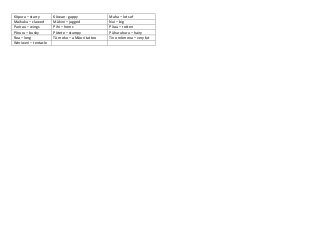
Kupu hou - New words
Huruhuru – furry
Karapoi – round
Ihu arewhana – an elephant’s trunk
Keokeo – pointed
Inohinohi – scaly
Koi – sharp
2.
Kōpura – starry
Maikuku– clawed
Parirau – wings
Pōruru – bushy
Roa – long
Weriweri – tentacle
Kōwae - gappy
Mākini – jagged
Pihi – horns
Pōtete – stumpy
Tā moko – a Māori tattoo
Maha – lots of
Nui – big
Pīrau – rotten
Pūhuruhuru – hairy
Tino mōmona – very fat