Project Management
Risk Management
Topic 7
LEARNING OUTCOMES
• After completing this chapter, you should be able to:
1. Define project risk.
2. Recognize four key stages in project risk management and
the steps necessary to manage risk.
3. Understand five primary causes of project risk and four
major approaches to risk identification.
4. Recognize four primary risk mitigation strategies.
5. Explain the Project Risk Analysis and Management (PRAM)
process.
OUTLINE
• Gambaran umum tentang lingkup proyek
• Work Breakdown Structure (WBS): Konsep dan Aplikasi
• Pentingnya pengelolaan lingkup di dalam proyek
PMBOK Core Concepts
Project Management Body of Knowledge (PMBoK) covered in this chapter includes:
1. Plan Risk Management (PMBoK 11.1)
2. Identify Risks (PMBoK 11.2)
3. Perform Qualitative Risk Analysis (PMBoK 11.3)
4. Perform Quantitative Risk Analysis (PMBoK 11.4)
5. Plan Risk Responses (PMBoK 11.5)
6. Control Risks (PMBoK 11.6)
4
Copyright ©2016 Pearson Education, Ltd.
Gambaran umum tentang manajemen risiko
proyek
Project Risk Management
• Risk management – the art and science of identifying, analyzing,
and responding to risk factors throughout the life of a project and in
the best interest of its objectives.
Project risk – an uncertain event or condition that, if it occurs,
has a positive or negative effect on one or more project
objectives such as scope, schedule, cost, or quality.
Risk = (Probability of Event) * (Consequences of Event)
Copyright ©2016 Pearson Education, Ltd. 6
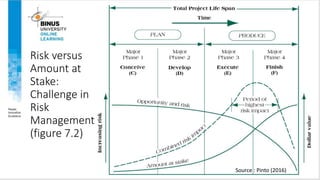
Risk versus
Amount at
Stake:
Challenge in
Risk
Management
(figure 7.2)
7
Source : Pinto (2016)
Proses di dalam pengelolaan risiko proyek
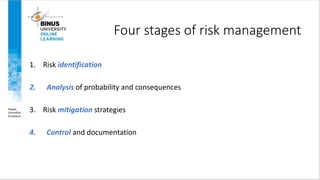
Four stages of risk management
1. Risk identification
2. Analysis of probability and consequences
3. Risk mitigation strategies
4. Control and documentation
Copyright ©2016 Pearson Education, Ltd. 9
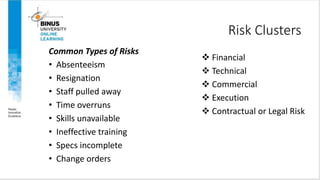
Risk Clusters
 Financial
 Technical
 Commercial
 Execution
 Contractual or Legal Risk
Common Types of Risks
• Absenteeism
• Resignation
• Staff pulled away
• Time overruns
• Skills unavailable
• Ineffective training
• Specs incomplete
• Change orders
Risk Factor Identification
Brainstorming meetings
Expert opinion
Past history
Multiple (or team based) assessments
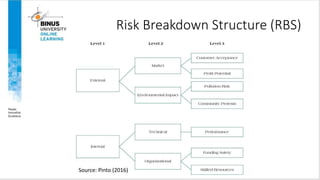
Risk Breakdown Structure (RBS)
Source: Pinto (2016)
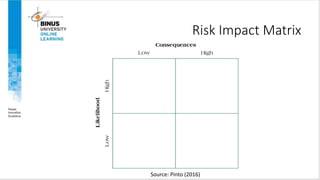
Risk Impact Matrix
Source: Pinto (2016)
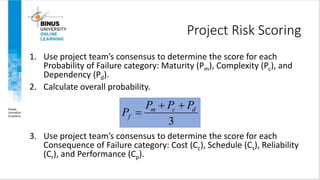
Project Risk Scoring
1. Use project team’s consensus to determine the score for each
Probability of Failure category: Maturity (Pm), Complexity (Pc), and
Dependency (Pd).
2. Calculate overall probability.
3. Use project team’s consensus to determine the score for each
Consequence of Failure category: Cost (Cc), Schedule (Cs), Reliability
(Cr), and Performance (Cp).
3
m c d
f
P P P
P
 

Project Risk Scoring
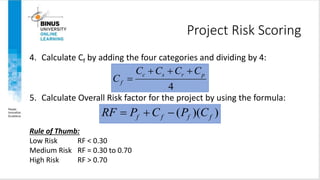
4. Calculate Cf by adding the four categories and dividing by 4:
5. Calculate Overall Risk factor for the project by using the formula:
Rule of Thumb:
Low Risk RF < 0.30
Medium Risk RF = 0.30 to 0.70
High Risk RF > 0.70
4
c s r p
f
C C C C
C
  

( )( )
f f f f
RF P C P C
  
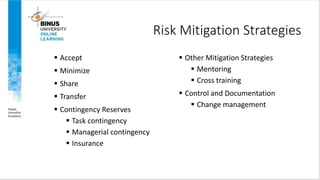
Risk Mitigation Strategies
 Accept
 Minimize
 Share
 Transfer
 Contingency Reserves
 Task contingency
 Managerial contingency
 Insurance
 Other Mitigation Strategies
 Mentoring
 Cross training
 Control and Documentation
 Change management
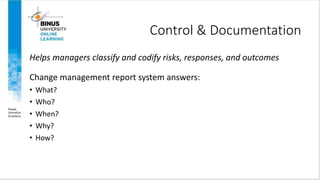
Control & Documentation
Helps managers classify and codify risks, responses, and outcomes
Change management report system answers:
• What?
• Who?
• When?
• Why?
• How?
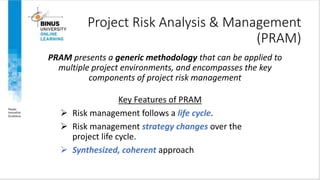
Project Risk Analysis & Management (PRAM)
Project Risk Analysis & Management
(PRAM)
PRAM presents a generic methodology that can be applied to
multiple project environments, and encompasses the key
components of project risk management
Key Features of PRAM
 Risk management follows a life cycle.
 Risk management strategy changes over the
project life cycle.
 Synthesized, coherent approach
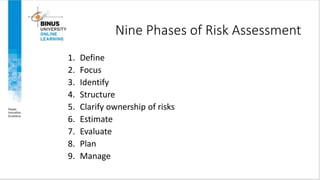
Nine Phases of Risk Assessment
1. Define
2. Focus
3. Identify
4. Structure
5. Clarify ownership of risks
6. Estimate
7. Evaluate
8. Plan
9. Manage
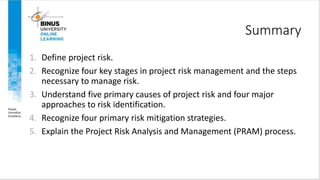
Summary
1. Define project risk.
2. Recognize four key stages in project risk management and the steps
necessary to manage risk.
3. Understand five primary causes of project risk and four major
approaches to risk identification.
4. Recognize four primary risk mitigation strategies.
5. Explain the Project Risk Analysis and Management (PRAM) process.
REFERENCES
Pinto. J.K. (2016). Project Management: Achieving Competitive
Advantage. Pearson Education Limited. London. ISBN:978-1-292-
09479-3, Chapter 5
PPT07 - Risk Management .pptx

PPT07 - Risk Management .pptx

  • 1.
  • 2.
    LEARNING OUTCOMES • Aftercompleting this chapter, you should be able to: 1. Define project risk. 2. Recognize four key stages in project risk management and the steps necessary to manage risk. 3. Understand five primary causes of project risk and four major approaches to risk identification. 4. Recognize four primary risk mitigation strategies. 5. Explain the Project Risk Analysis and Management (PRAM) process.
  • 3.
    OUTLINE • Gambaran umumtentang lingkup proyek • Work Breakdown Structure (WBS): Konsep dan Aplikasi • Pentingnya pengelolaan lingkup di dalam proyek
  • 4.
    PMBOK Core Concepts ProjectManagement Body of Knowledge (PMBoK) covered in this chapter includes: 1. Plan Risk Management (PMBoK 11.1) 2. Identify Risks (PMBoK 11.2) 3. Perform Qualitative Risk Analysis (PMBoK 11.3) 4. Perform Quantitative Risk Analysis (PMBoK 11.4) 5. Plan Risk Responses (PMBoK 11.5) 6. Control Risks (PMBoK 11.6) 4 Copyright ©2016 Pearson Education, Ltd.
  • 5.
    Gambaran umum tentangmanajemen risiko proyek
  • 6.
    Project Risk Management •Risk management – the art and science of identifying, analyzing, and responding to risk factors throughout the life of a project and in the best interest of its objectives. Project risk – an uncertain event or condition that, if it occurs, has a positive or negative effect on one or more project objectives such as scope, schedule, cost, or quality. Risk = (Probability of Event) * (Consequences of Event) Copyright ©2016 Pearson Education, Ltd. 6
  • 7.
    Risk versus Amount at Stake: Challengein Risk Management (figure 7.2) 7 Source : Pinto (2016)
  • 8.
    Proses di dalampengelolaan risiko proyek
  • 9.
    Four stages ofrisk management 1. Risk identification 2. Analysis of probability and consequences 3. Risk mitigation strategies 4. Control and documentation Copyright ©2016 Pearson Education, Ltd. 9
  • 10.
    Risk Clusters  Financial Technical  Commercial  Execution  Contractual or Legal Risk Common Types of Risks • Absenteeism • Resignation • Staff pulled away • Time overruns • Skills unavailable • Ineffective training • Specs incomplete • Change orders
  • 11.
    Risk Factor Identification Brainstormingmeetings Expert opinion Past history Multiple (or team based) assessments
  • 12.
    Risk Breakdown Structure(RBS) Source: Pinto (2016)
  • 13.
  • 14.
    Project Risk Scoring 1.Use project team’s consensus to determine the score for each Probability of Failure category: Maturity (Pm), Complexity (Pc), and Dependency (Pd). 2. Calculate overall probability. 3. Use project team’s consensus to determine the score for each Consequence of Failure category: Cost (Cc), Schedule (Cs), Reliability (Cr), and Performance (Cp). 3 m c d f P P P P   
  • 15.
    Project Risk Scoring 4.Calculate Cf by adding the four categories and dividing by 4: 5. Calculate Overall Risk factor for the project by using the formula: Rule of Thumb: Low Risk RF < 0.30 Medium Risk RF = 0.30 to 0.70 High Risk RF > 0.70 4 c s r p f C C C C C     ( )( ) f f f f RF P C P C   
  • 16.
    Risk Mitigation Strategies Accept  Minimize  Share  Transfer  Contingency Reserves  Task contingency  Managerial contingency  Insurance  Other Mitigation Strategies  Mentoring  Cross training  Control and Documentation  Change management
  • 17.
    Control & Documentation Helpsmanagers classify and codify risks, responses, and outcomes Change management report system answers: • What? • Who? • When? • Why? • How?
  • 18.
    Project Risk Analysis& Management (PRAM)
  • 19.
    Project Risk Analysis& Management (PRAM) PRAM presents a generic methodology that can be applied to multiple project environments, and encompasses the key components of project risk management Key Features of PRAM  Risk management follows a life cycle.  Risk management strategy changes over the project life cycle.  Synthesized, coherent approach
  • 20.
    Nine Phases ofRisk Assessment 1. Define 2. Focus 3. Identify 4. Structure 5. Clarify ownership of risks 6. Estimate 7. Evaluate 8. Plan 9. Manage
  • 21.
    Summary 1. Define projectrisk. 2. Recognize four key stages in project risk management and the steps necessary to manage risk. 3. Understand five primary causes of project risk and four major approaches to risk identification. 4. Recognize four primary risk mitigation strategies. 5. Explain the Project Risk Analysis and Management (PRAM) process.
  • 22.
    REFERENCES Pinto. J.K. (2016).Project Management: Achieving Competitive Advantage. Pearson Education Limited. London. ISBN:978-1-292- 09479-3, Chapter 5