z
Chapter 2
Knowing Oneself
PERSONAL DEVELOPMENT
z
 Defining the “Self”
 Personality
Nature, Nurture, and Personality
 Traits Theories
 Personality Traits
 Measuring Personality
z
Who Am I?
z
 Adolescence is the time when young
people start to ask questions about
themselves , about their future, and
even about their religious and political
beliefs. During the adolescent stage
of development, the young person
grapples with his or her identity. This
may seem very philosophical to
some, but to know oneself is the first
step in personal development.
z
For Plato, the beginning of knowledge is
self-knowledge. The ancient Hindu writings
Upanihads confirmed, “Enquiry into the truth of
the “Self” is knowledge.” The Persian poet
Rumi ruminated, “Who am I in the midst of all
this thought traffic?” and the American poet
Walt Whitman celebrated his “Self” as “a
simple, separate person.”
z
Concept of Self
In philosophical terms, it is the being, which is
the source of a person’s consciousness. It is the
agent responsible for an individual’s thoughts and
actions.
z
Definition
of
Self
z
Self
– is an intangible entity that directs a person’s
thoughts and actions. It is outside the physical realm
of the person.
- is the essence of a person: his thoughts, feelings
and actions, experiences, beliefs, values,
principles, and relationships.
- The “Self” includes a person’s life purpose,
meaning and aspirations.
z
Since our approach to personal development
is holistic, we will integrate the various definitions
of “Self” from the philosophical, spiritual, and
psychological realms, but we will focus and give
more emphasis on its psychological definitions.
If the “Self” is defined as the cognitive and
affective representation of one’s identity, it is then
defined in terms of human characteristics such as
behavior and thought.
z
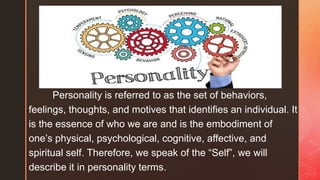
Personality is referred to as the set of behaviors,
feelings, thoughts, and motives that identifies an individual. It
is the essence of who we are and is the embodiment of
one’s physical, psychological, cognitive, affective, and
spiritual self. Therefore, we speak of the “Self”, we will
describe it in personality terms.
z
For example, a person who is considered as
“friendly” would, at any given situation, be outgoing
and easily liked by others or is someone who is not
perceived as threatening or aggressive. This
person’s uniqueness is manifested in his own
brand of showing friendliness: a sunny disposition,
a readiness to give advice when needed, and
generosity to those in need.
z
In terms of being
consistent, as an adolescent,
this friendly individual develops
friendships among his peers.
Upon entering adulthood, this
same friendly individual is
perceived by co-workers and
peers to still be his old friendly
self as when he was in high
school.
z
The consistency through time and the unique manner by
which thoughts, feelings, and behavior are expressed, defines
personality. However, there will always be exceptions to these
two components. Consistency is more likely to mean most of
the time but not all the time. A friendly person can get nasty or
aggressive when provoked or cornered.
z
Sickness can often
times change the
consistency of an individual’s
personality. An example of
this is Alzheimer’s disease.
Studies have shown that Alzheimer’s disease changes three of
the Big Five dimensions of personality (anxiety, extraversion,
and openness)
z
NATURE, NURTURE AND
PERSONALITY
z
Personality is influenced by both nature
(heredity or genetic make-up) and nurture
(environment). There is no single gene that
creates a trait. It is always a complex
combination of genes, environmental exposure
and experiences, and cultural backgrounds.
z
Psychologist Costa and
McRae (1992) developed a
categorized scheme that
described personality. Based
on their research, they
discovered the existence of
five universal and widely
agreed upon dimension of
personality.
z FIVE - FACTOR MODEL
zTHE MYERS-BRIGGS TYPE
APPROACH
By Katherine Briggs and Isabel Briggs Myers
z1. E or I (Extraversion or Introversion) – is how an individual prefers
to channel his or her energy when dealing with people, whether it is
inward (introversion) or outward (extraversion).
2. S or N (Sensing or Intuition) – is how one prefers to process
information, whether through the use of senses such as being able to
describe what one sees, or intuitively like dealing with ideas.
3. T or F (Thinking or Feeling) – is how an individual prefers to make
decisions, either thinking or using logic and analysis, or feeling which
uses the cognitive senses based on values or beliefs.
4. J or P (Judgement or Perception) – is how an individual prefers to
manage one’s life, whether through judging, which means a planned
and organized life, versus perception, which has a more flexible
approach to living.
z
z
z
z
z
z
z
z
z
z
z
z
z
z
z
z

Chapter 2 Personhood Development

  • 1.
  • 2.
    z  Defining the“Self”  Personality Nature, Nurture, and Personality  Traits Theories  Personality Traits  Measuring Personality
  • 3.
  • 4.
    z  Adolescence isthe time when young people start to ask questions about themselves , about their future, and even about their religious and political beliefs. During the adolescent stage of development, the young person grapples with his or her identity. This may seem very philosophical to some, but to know oneself is the first step in personal development.
  • 5.
    z For Plato, thebeginning of knowledge is self-knowledge. The ancient Hindu writings Upanihads confirmed, “Enquiry into the truth of the “Self” is knowledge.” The Persian poet Rumi ruminated, “Who am I in the midst of all this thought traffic?” and the American poet Walt Whitman celebrated his “Self” as “a simple, separate person.”
  • 6.
    z Concept of Self Inphilosophical terms, it is the being, which is the source of a person’s consciousness. It is the agent responsible for an individual’s thoughts and actions.
  • 7.
  • 8.
    z Self – is anintangible entity that directs a person’s thoughts and actions. It is outside the physical realm of the person. - is the essence of a person: his thoughts, feelings and actions, experiences, beliefs, values, principles, and relationships. - The “Self” includes a person’s life purpose, meaning and aspirations.
  • 9.
    z Since our approachto personal development is holistic, we will integrate the various definitions of “Self” from the philosophical, spiritual, and psychological realms, but we will focus and give more emphasis on its psychological definitions. If the “Self” is defined as the cognitive and affective representation of one’s identity, it is then defined in terms of human characteristics such as behavior and thought.
  • 10.
    z Personality is referredto as the set of behaviors, feelings, thoughts, and motives that identifies an individual. It is the essence of who we are and is the embodiment of one’s physical, psychological, cognitive, affective, and spiritual self. Therefore, we speak of the “Self”, we will describe it in personality terms.
  • 11.
    z For example, aperson who is considered as “friendly” would, at any given situation, be outgoing and easily liked by others or is someone who is not perceived as threatening or aggressive. This person’s uniqueness is manifested in his own brand of showing friendliness: a sunny disposition, a readiness to give advice when needed, and generosity to those in need.
  • 12.
    z In terms ofbeing consistent, as an adolescent, this friendly individual develops friendships among his peers. Upon entering adulthood, this same friendly individual is perceived by co-workers and peers to still be his old friendly self as when he was in high school.
  • 13.
    z The consistency throughtime and the unique manner by which thoughts, feelings, and behavior are expressed, defines personality. However, there will always be exceptions to these two components. Consistency is more likely to mean most of the time but not all the time. A friendly person can get nasty or aggressive when provoked or cornered.
  • 14.
    z Sickness can often timeschange the consistency of an individual’s personality. An example of this is Alzheimer’s disease. Studies have shown that Alzheimer’s disease changes three of the Big Five dimensions of personality (anxiety, extraversion, and openness)
  • 15.
  • 16.
    z Personality is influencedby both nature (heredity or genetic make-up) and nurture (environment). There is no single gene that creates a trait. It is always a complex combination of genes, environmental exposure and experiences, and cultural backgrounds.
  • 17.
    z Psychologist Costa and McRae(1992) developed a categorized scheme that described personality. Based on their research, they discovered the existence of five universal and widely agreed upon dimension of personality.
  • 18.
    z FIVE -FACTOR MODEL
  • 19.
    zTHE MYERS-BRIGGS TYPE APPROACH ByKatherine Briggs and Isabel Briggs Myers
  • 20.
    z1. E orI (Extraversion or Introversion) – is how an individual prefers to channel his or her energy when dealing with people, whether it is inward (introversion) or outward (extraversion). 2. S or N (Sensing or Intuition) – is how one prefers to process information, whether through the use of senses such as being able to describe what one sees, or intuitively like dealing with ideas. 3. T or F (Thinking or Feeling) – is how an individual prefers to make decisions, either thinking or using logic and analysis, or feeling which uses the cognitive senses based on values or beliefs. 4. J or P (Judgement or Perception) – is how an individual prefers to manage one’s life, whether through judging, which means a planned and organized life, versus perception, which has a more flexible approach to living.
  • 21.
  • 22.
  • 23.
  • 24.
  • 25.
  • 26.
  • 27.
  • 28.
  • 29.
  • 30.
  • 31.
  • 32.
  • 33.
  • 34.
  • 35.
  • 36.