Data Mining In Retail
Industries
Presented By-
Rahul
Bca SemVI
23
Contents
 What is data mining?
 Why data mining is required?
 Data mining Applications
 Data mining in Retail Industry
 Marketing
 Risk Management
 Fraud Detection
 Customer Acquisition and Retention
What is Data mining?
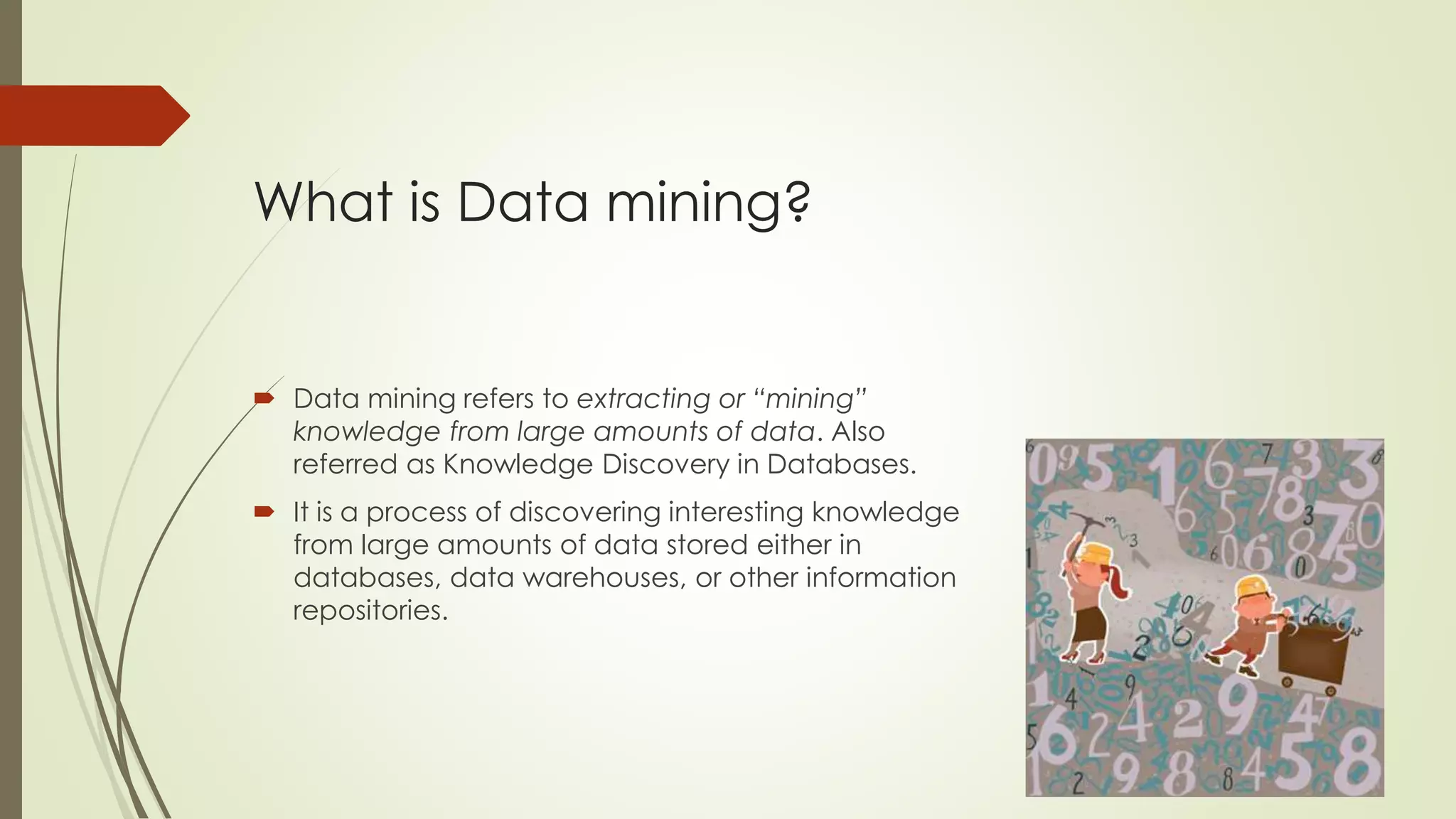
 Data mining refers to extracting or “mining”
knowledge from large amounts of data. Also
referred as Knowledge Discovery in Databases.
 It is a process of discovering interesting knowledge
from large amounts of data stored either in
databases, data warehouses, or other information
repositories.
Why data mining is required?
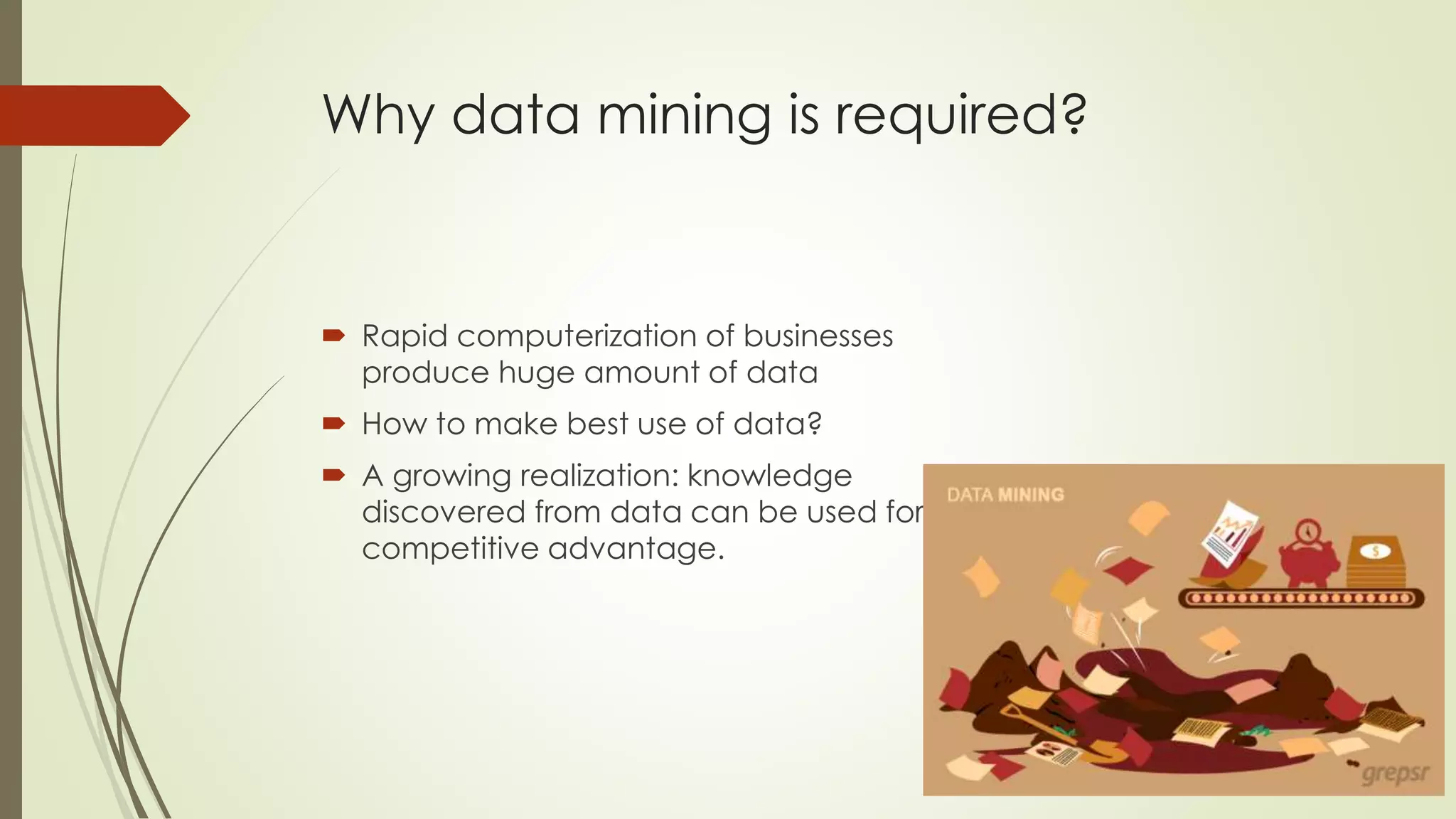
 Rapid computerization of businesses
produce huge amount of data
 How to make best use of data?
 A growing realization: knowledge
discovered from data can be used for
competitive advantage.
Data mining Applications
Data mining is an interdisciplinary field with wide
and diverse applications
There exist nontrivial gaps between data mining
principles and domain-specific applications
Some application domains
Financial data analysis
Retail industry
Telecommunication industry
Biological data and DNA analysis
Data mining in Retail Industry
 Retail industry: huge amounts of data on sales,
customer shopping history, etc.
 Applications of retail data mining
 Identify customer buying behaviors
 Discover customer shopping patterns and trends
 Improve the quality of customer service
 Achieve better customer retention and satisfaction
 Enhance goods consumption ratios
 Design more effective goods transportation and
distribution policies
Marketing
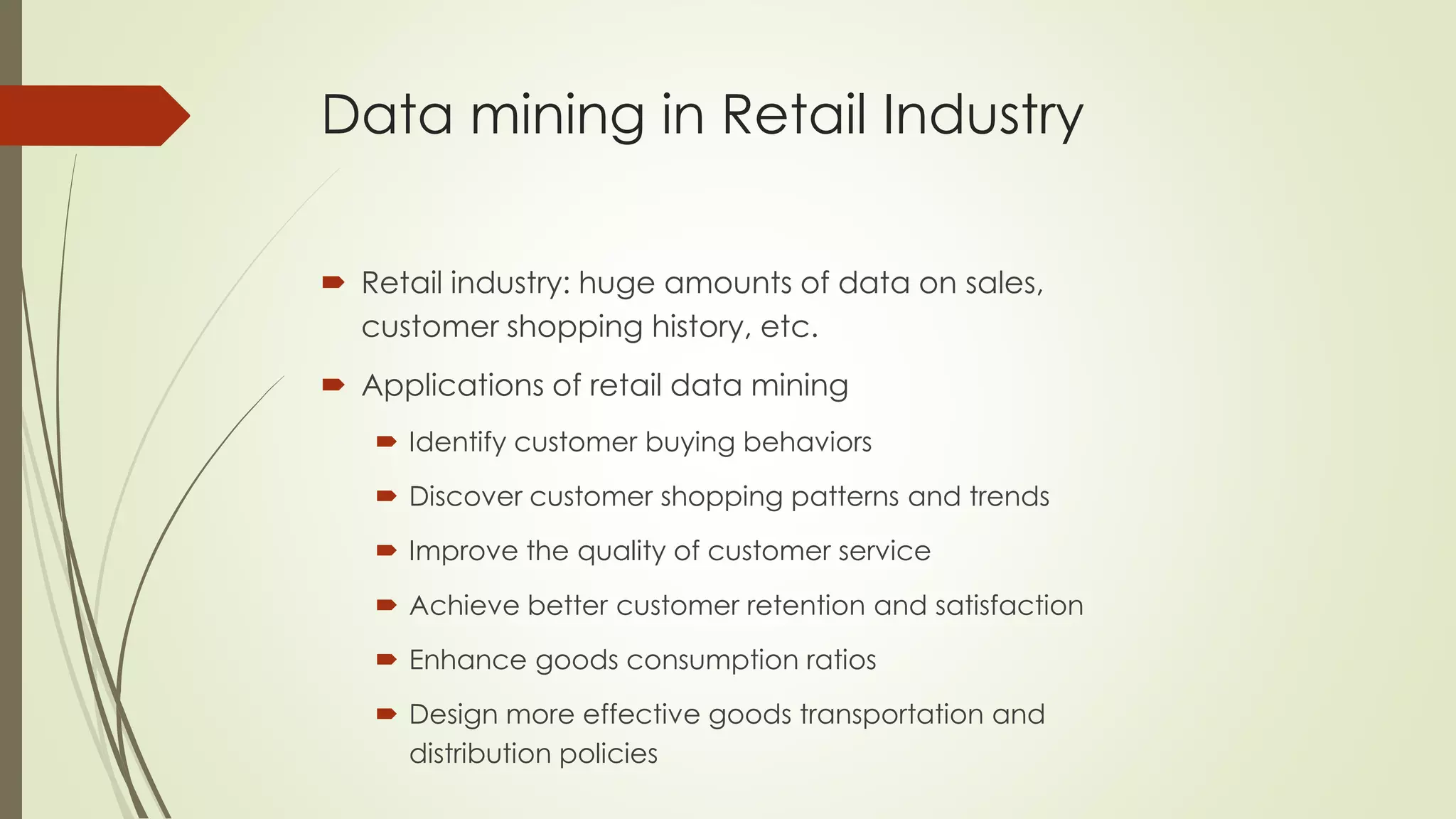
 ‘Market basket analysis’ is a marketing method used by many
retailers.
 The study of retail stock movement data recorded at a Point of Sale
(PoS)—to support decisions on shelf-space allocation, store layout,
product location and promotion effectiveness.
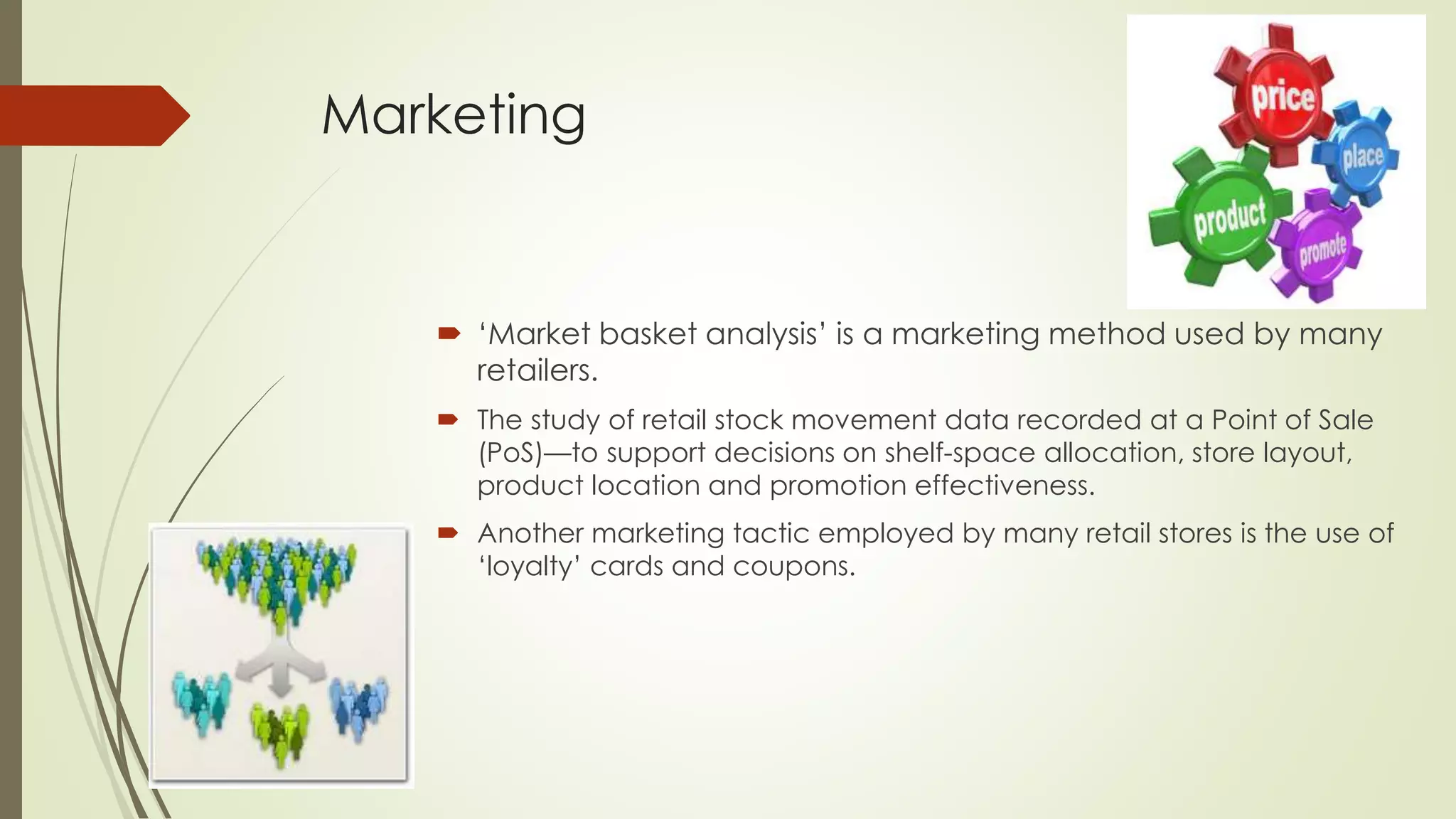
 Another marketing tactic employed by many retail stores is the use of
‘loyalty’ cards and coupons.
Risk Management
 Retail organizations use data mining to understand
which products may be vulnerable to competitive
offers or changing customer purchasing patterns.
 Data mining enables retailers to remain competitive
and reduce risks by helping them understand what
their customers are really doing.
 Retailers can then target those customers who are
more likely to buy a certain brand or product.
Fraud Detection
 Retail shrink because of dishonest employees.
 Some super-markets use CCTV, along with data
mining, to enable retail loss prevention to expose
cashier stealing.
 Loss of data, credit card fraud, duplicate payment
can be avoided with the help of data mining.
Customer Acquisition and Retention
 Data mining helps in acquiring and retaining
customers in the retail industry.
 Retail industry deals with high levels of
competition, and can use data mining to
better understand customers’ needs.
 Retailer can study customers’ past purchasing
histories and know with what kinds of
promotions and incentives to target
customers.
Data Mining in Retail Industries

Data Mining in Retail Industries

  • 1.
    Data Mining InRetail Industries Presented By- Rahul Bca SemVI 23
  • 2.
    Contents  What isdata mining?  Why data mining is required?  Data mining Applications  Data mining in Retail Industry  Marketing  Risk Management  Fraud Detection  Customer Acquisition and Retention
  • 3.
    What is Datamining?  Data mining refers to extracting or “mining” knowledge from large amounts of data. Also referred as Knowledge Discovery in Databases.  It is a process of discovering interesting knowledge from large amounts of data stored either in databases, data warehouses, or other information repositories.
  • 4.
    Why data miningis required?  Rapid computerization of businesses produce huge amount of data  How to make best use of data?  A growing realization: knowledge discovered from data can be used for competitive advantage.
  • 5.
    Data mining Applications Datamining is an interdisciplinary field with wide and diverse applications There exist nontrivial gaps between data mining principles and domain-specific applications Some application domains Financial data analysis Retail industry Telecommunication industry Biological data and DNA analysis
  • 6.
    Data mining inRetail Industry  Retail industry: huge amounts of data on sales, customer shopping history, etc.  Applications of retail data mining  Identify customer buying behaviors  Discover customer shopping patterns and trends  Improve the quality of customer service  Achieve better customer retention and satisfaction  Enhance goods consumption ratios  Design more effective goods transportation and distribution policies
  • 7.
    Marketing  ‘Market basketanalysis’ is a marketing method used by many retailers.  The study of retail stock movement data recorded at a Point of Sale (PoS)—to support decisions on shelf-space allocation, store layout, product location and promotion effectiveness.  Another marketing tactic employed by many retail stores is the use of ‘loyalty’ cards and coupons.
  • 8.
    Risk Management  Retailorganizations use data mining to understand which products may be vulnerable to competitive offers or changing customer purchasing patterns.  Data mining enables retailers to remain competitive and reduce risks by helping them understand what their customers are really doing.  Retailers can then target those customers who are more likely to buy a certain brand or product.
  • 9.
    Fraud Detection  Retailshrink because of dishonest employees.  Some super-markets use CCTV, along with data mining, to enable retail loss prevention to expose cashier stealing.  Loss of data, credit card fraud, duplicate payment can be avoided with the help of data mining.
  • 10.
    Customer Acquisition andRetention  Data mining helps in acquiring and retaining customers in the retail industry.  Retail industry deals with high levels of competition, and can use data mining to better understand customers’ needs.  Retailer can study customers’ past purchasing histories and know with what kinds of promotions and incentives to target customers.