N U C L E U S
B Y R AB I U L N O O R
PRESENCE
TYPES OF CELLS
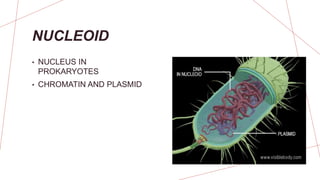
NUCLEOID
• NUCLEUS IN
PROKARYOTES
• CHROMATIN AND PLASMID
TYPES OF EUKARYOTIC CELLS
INTRODUCTION
Discovered by Robert brown in
1831
SHAPE OF NUCLEUS
• Spherical
• Elongated
• Irregular
• Oval
EXCEPTIONS
• Cells with no nucleus
• Plants ( sieve tube cells)
• Animals ( red blood cells )
• More than one nucleus
• Binucleate / Dikaryotic
• At time of cellular division
• Paramecium
• Multi nucleated
• Muscle cells
• Endosperm tissue
• Opalina
LOCATION
• Plants cells
• At side
• Exception young cells
• Animal cells
• In centre
• Except muscle cells
NUCLEAR
ENVELOPE
Outer membrane
Inner membrane
Perinuclear space
(10 –15 nm)
Nuclear pores
NUCLEOPLASM
Transparent semi ground substance
• Composition
Proteins (histone and non-histone)
Enzymes (DNA and RNA polymerase)
Nucleotides
Metal ions (Mg )
NUCLEOLUS
Composition
• 85%protiens
• 10% RNA
• 5% DNA
Function
• Formation of ribosomes.
Parts of nucleolus
• Peripheral granular area (ribosomal sub units)
• Central fibril area (rRNA and rDNA)
CHROMATIN
Composition
• DNA
• RNA
• PROTIENS (histone and non-histone)
Function
To convert loose strands of DNA
into denser structures
CHROMOSOME
Function
To equally separate genetic material
between newly forming cells.
Structure
• Primary constriction
• Secondary constriction
• Centromere
• Satellite bodies
STRUCTURE OF
CHROMOSOMES
• Primary constriction
o Thinner segments of
chromosomes
• Secondary constriction
o Gives rise to nucleoli
o Also called nucleolar
organizer.
 Centromere
 Kinetochore
TYPES OF
CHROMOSOMES
Metacentric
Submetacentric
Acrocentric
Telocentric
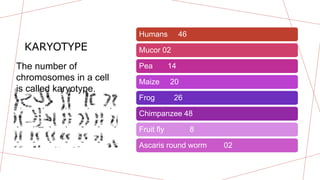
KARYOTYPE
Humans 46
Mucor 02
Pea 14
Maize 20
Frog 26
Chimpanzee 48
Fruit fly 8
Ascaris round worm 02
The number of
chromosomes in a cell
is called karyotype.

nucleus