Fuel Cells BY Pranali Patil
Fuel cells are electrochemical cells
consisting of two electrodes and an
electrolyte which convert the chemical
energy of chemical reaction between fuel
and oxidant directly into electrical energy.
Fuel
cells
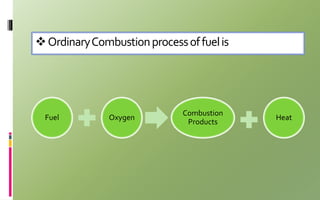
OrdinaryCombustionprocessoffuelis
Fuel Oxygen
Combustion
Products
Heat
Theprocessoffuelcellis
Fuel Oxygen
Oxidation
Products
Electricity
Chemical
Energy
Heat
Mechanical
Energy
Electrical
Energy
 Fuel cell consists of electrodes, electrolyte & catalyst to
facilitate the electrochemical redox reaction.
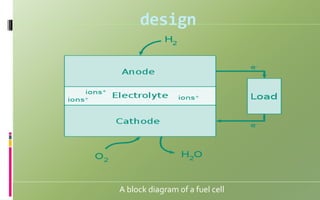
 The basic arrangement in a fuel cell can be represented
as follows:
Fuel Electrode Electrolyte Electrode Oxidant
design
A block diagram of a fuel cell
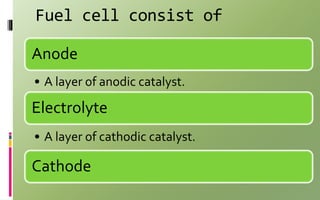
Fuel cell consist of
Anode
• A layer of anodic catalyst.
Electrolyte
Cathode
• A layer of cathodic catalyst.
• Materials which have high electron conductivity & zero
proton conductivity in the form of porous catalyst (porous
catalyst or carbon).
Anode & Cathode
• Platinum
Catalyst
• High proton conductivity & zero electron conductivity.
Electrolyte
Fuel cell consist of
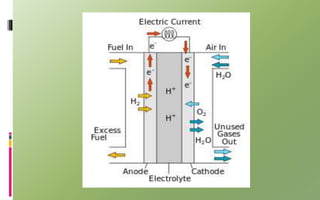
 Fuel Cell System:
1. The fuel (direct H2 or reformed H2) undergoes oxidation at
anode and releases electrons.
2. These electrons flow through the external circuit to the
cathode.
3. At cathode, oxidant (O2 from air) gets reduced.
4. The electrons produce electricity while passing through the
external circuit. Electricity is generated continuously as long as
fuel and the oxidant are continuously and separately supplied
to the electrodes of the cell from reservoirs outside the
electrochemical cell.
 The Fuel cell can be represented as:
• 2H2 → 4H+ + 4e-
At
anode
• O2 + 4H+ + 4e- → 2H2O
At
Cathode
• 2H2 + O2 → 2H2O
Overall
Reaction
 Large number of these cells are stacked together in series to
make a battery called as fuel cell battery or fuel battery.
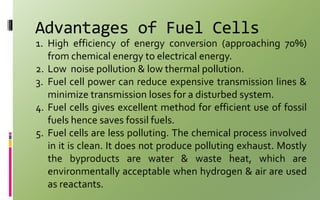
Advantages of Fuel Cells
1. High efficiency of energy conversion (approaching 70%)
from chemical energy to electrical energy.
2. Low noise pollution & low thermal pollution.
3. Fuel cell power can reduce expensive transmission lines &
minimize transmission loses for a disturbed system.
4. Fuel cells gives excellent method for efficient use of fossil
fuels hence saves fossil fuels.
5. Fuel cells are less polluting. The chemical process involved
in it is clean. It does not produce polluting exhaust. Mostly
the byproducts are water & waste heat, which are
environmentally acceptable when hydrogen & air are used
as reactants.
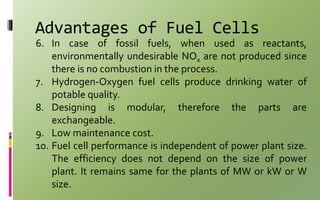
Advantages of Fuel Cells
6. In case of fossil fuels, when used as reactants,
environmentally undesirable NOx are not produced since
there is no combustion in the process.
7. Hydrogen-Oxygen fuel cells produce drinking water of
potable quality.
8. Designing is modular, therefore the parts are
exchangeable.
9. Low maintenance cost.
10. Fuel cell performance is independent of power plant size.
The efficiency does not depend on the size of power
plant. It remains same for the plants of MW or kW or W
size.
Advantages of Fuel Cells
11. Fast start up time for low temperature system.
12. The heat is cogenerated hence increases efficiency of high
temperature system.
13. The demand for variations in power & energy densities is
easily met as required. e.g. Laptop, computers requires
low power density & high energy density where as
automobile requires high power density, high energy
density. Both can be powered by fuel cells.
14. Fuel cells automotive batteries can render electric
vehicles, efficient & refillable.
Disadvantages of Fuel Cells
 High initial cost.
 Life times of the cells are not accurately known.
 Large weight and volume of gas fuel storage
system.
 High cost of pure hydrogen.
 Hydrogen can be stored in lesser volume by
liquefaction but liquefaction itself require 30% of
the stored energy.
 Lack of infrastructure for distributing hydrogen.
Applications of Fuel Cells
 The first commercial use of fuel cell was in NASA
space program to generate power for satellites
and space capsules.
 Fuels are used for primary and backup power for
commercial, industrial and residential buildings
in remote and inaccessible area.
 They are used to power fuel cell vehicles
including automobiles, aeroplanes, boats and
submarines.
Other applications
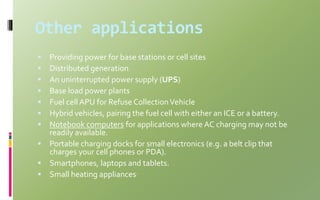
 Providing power for base stations or cell sites
 Distributed generation
 An uninterrupted power supply (UPS)
 Base load power plants
 Fuel cell APU for Refuse CollectionVehicle
 Hybrid vehicles, pairing the fuel cell with either an ICE or a battery.
 Notebook computers for applications where AC charging may not be
readily available.
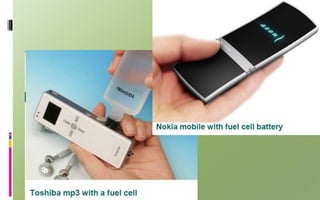
 Portable charging docks for small electronics (e.g. a belt clip that
charges your cell phones or PDA).
 Smartphones, laptops and tablets.
 Small heating appliances.
Types of Fuel Cells
Two Commercially important Fuel Cells as:
 Phosphoric Acid Fuel Cell
 Polymer Electrode to Membrane Fuel Cell
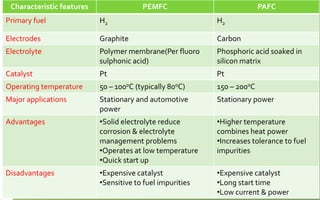
Characteristic features PEMFC PAFC
Primary fuel H2 H2
Electrodes Graphite Carbon
Electrolyte Polymer membrane(Per fluoro
sulphonic acid)
Phosphoric acid soaked in
silicon matrix
Catalyst Pt Pt
Operating temperature 50 – 1000C (typically 800C) 150 – 2000C
Major applications Stationary and automotive
power
Stationary power
Advantages •Solid electrolyte reduce
corrosion & electrolyte
management problems
•Operates at low temperature
•Quick start up
•Higher temperature
combines heat power
•Increases tolerance to fuel
impurities
Disadvantages •Expensive catalyst
•Sensitive to fuel impurities
•Expensive catalyst
•Long start time
•Low current & power
Comparison of PAFC & PEMFC
 It has H2 as a primary fuel.
 It requires carbon as an electrode.
 Phosphoric acid is used as an
electrolyte.
 Platinum acts as catalyst.
 It’s operating temperature is 150 to
200oC.
 It has major applications in
stationary & automotive power.
 It has H2 as a primary fuel.
 It requires graphite as an electrode.
 Polymer membrane is used as an
electrolyte.
 Platinum acts as catalyst.
 It’s operating temperature is 50 to
100oC (typically 80oC).
 It has major applications in
stationary power.
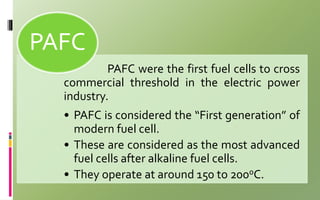
PAFC were the first fuel cells to cross
commercial threshold in the electric power
industry.
• PAFC is considered the “First generation” of
modern fuel cell.
• These are considered as the most advanced
fuel cells after alkaline fuel cells.
• They operate at around 150 to 200oC.
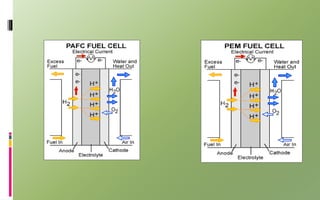
PAFC
Set up of PAFC
 These fuel cell use liquid phosphoric acid as
electrolyte contained in a silicon carbide matrix
placed between electrodes.
 The electrodes are made of carbon paper coated
with a finely dispersed platinum catalyst bonded
with teflon.
 Hydrogen or reformate gas (mixture of H2 + CO)
generated from alcohols or hydrocarbons is used
as the fuel whereas air is used as oxidant.
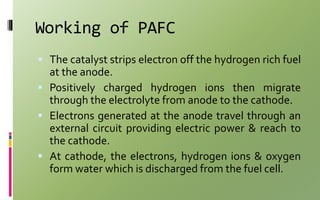
Working of PAFC
 The catalyst strips electron off the hydrogen rich fuel
at the anode.
 Positively charged hydrogen ions then migrate
through the electrolyte from anode to the cathode.
 Electrons generated at the anode travel through an
external circuit providing electric power & reach to
the cathode.
 At cathode, the electrons, hydrogen ions & oxygen
form water which is discharged from the fuel cell.
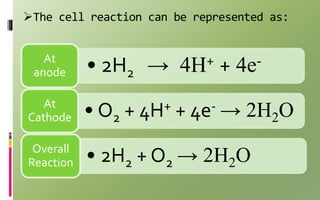
The cell reaction can be represented as:
• 2H2 → 4H+ + 4e-
At
anode
• O2 + 4H+ + 4e- → 2H2O
At
Cathode
• 2H2 + O2 → 2H2O
Overall
Reaction
Diagram
References
 www.wikipedia.org
 Nice, Karim and Strickland,Jonathan. "How
Fuel CellsWork: Polymer Exchange
Membrane Fuel Cells". How StuffWorks,
accessed August 4, 2011
 www.fuelcells.org
 www.fuelcellenergy.com
 onlinelibrary.wiley.com
 USES
 To back up power
 -to power device that use battery
 -to power machineries such as truck,
 buses, vehicles and ships
 Advantages over other fuel sources
 -excess heat released is used for other
 applications
 -operates quickly with fewer moving parts
 -environmental friendly, no pollution
 -high efficiency than others
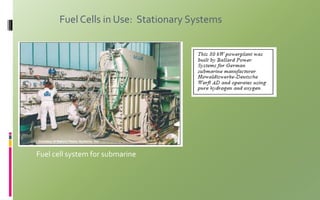
Fuel Cells in Use: Stationary Systems
Fuel cell system for submarine
Fuel Cells in Use: Transportation Systems
XCELLSiS fuel cell bus prototypes
Buses are most commercially
advanced applications of fuel
cells to date.
Are currently being used by
many American and European
cities.
Fuel Cells in Use: Transportation Systems
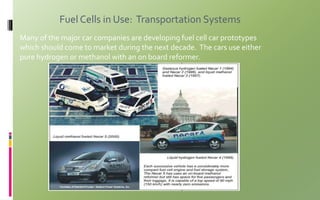
Many of the major car companies are developing fuel cell car prototypes
which should come to market during the next decade. The cars use either
pure hydrogen or methanol with an on board reformer.
Fuel Cells in Use: Hydrogen Fuel Cell System
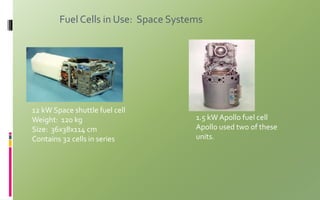
Fuel Cells in Use: Space Systems
1.5 kW Apollo fuel cell
Apollo used two of these
units.
12 kW Space shuttle fuel cell
Weight: 120 kg
Size: 36x38x114 cm
Contains 32 cells in series
Fuel Cells in Use: Portable Systems
A laptop using a fuel cell power source
can operate for up to 20 hours on a
single charge of fuel (Courtesy: Ballard
Power Systems)

fuelcells++++-.pptx

  • 1.
    Fuel Cells BYPranali Patil
  • 2.
    Fuel cells areelectrochemical cells consisting of two electrodes and an electrolyte which convert the chemical energy of chemical reaction between fuel and oxidant directly into electrical energy. Fuel cells
  • 3.
  • 4.
  • 5.
  • 6.
     Fuel cellconsists of electrodes, electrolyte & catalyst to facilitate the electrochemical redox reaction.  The basic arrangement in a fuel cell can be represented as follows: Fuel Electrode Electrolyte Electrode Oxidant
  • 7.
    design A block diagramof a fuel cell
  • 8.
    Fuel cell consistof Anode • A layer of anodic catalyst. Electrolyte Cathode • A layer of cathodic catalyst.
  • 9.
    • Materials whichhave high electron conductivity & zero proton conductivity in the form of porous catalyst (porous catalyst or carbon). Anode & Cathode • Platinum Catalyst • High proton conductivity & zero electron conductivity. Electrolyte Fuel cell consist of
  • 10.
     Fuel CellSystem: 1. The fuel (direct H2 or reformed H2) undergoes oxidation at anode and releases electrons. 2. These electrons flow through the external circuit to the cathode. 3. At cathode, oxidant (O2 from air) gets reduced. 4. The electrons produce electricity while passing through the external circuit. Electricity is generated continuously as long as fuel and the oxidant are continuously and separately supplied to the electrodes of the cell from reservoirs outside the electrochemical cell.
  • 11.
     The Fuelcell can be represented as: • 2H2 → 4H+ + 4e- At anode • O2 + 4H+ + 4e- → 2H2O At Cathode • 2H2 + O2 → 2H2O Overall Reaction  Large number of these cells are stacked together in series to make a battery called as fuel cell battery or fuel battery.
  • 13.
    Advantages of FuelCells 1. High efficiency of energy conversion (approaching 70%) from chemical energy to electrical energy. 2. Low noise pollution & low thermal pollution. 3. Fuel cell power can reduce expensive transmission lines & minimize transmission loses for a disturbed system. 4. Fuel cells gives excellent method for efficient use of fossil fuels hence saves fossil fuels. 5. Fuel cells are less polluting. The chemical process involved in it is clean. It does not produce polluting exhaust. Mostly the byproducts are water & waste heat, which are environmentally acceptable when hydrogen & air are used as reactants.
  • 14.
    Advantages of FuelCells 6. In case of fossil fuels, when used as reactants, environmentally undesirable NOx are not produced since there is no combustion in the process. 7. Hydrogen-Oxygen fuel cells produce drinking water of potable quality. 8. Designing is modular, therefore the parts are exchangeable. 9. Low maintenance cost. 10. Fuel cell performance is independent of power plant size. The efficiency does not depend on the size of power plant. It remains same for the plants of MW or kW or W size.
  • 15.
    Advantages of FuelCells 11. Fast start up time for low temperature system. 12. The heat is cogenerated hence increases efficiency of high temperature system. 13. The demand for variations in power & energy densities is easily met as required. e.g. Laptop, computers requires low power density & high energy density where as automobile requires high power density, high energy density. Both can be powered by fuel cells. 14. Fuel cells automotive batteries can render electric vehicles, efficient & refillable.
  • 16.
    Disadvantages of FuelCells  High initial cost.  Life times of the cells are not accurately known.  Large weight and volume of gas fuel storage system.  High cost of pure hydrogen.  Hydrogen can be stored in lesser volume by liquefaction but liquefaction itself require 30% of the stored energy.  Lack of infrastructure for distributing hydrogen.
  • 17.
    Applications of FuelCells  The first commercial use of fuel cell was in NASA space program to generate power for satellites and space capsules.  Fuels are used for primary and backup power for commercial, industrial and residential buildings in remote and inaccessible area.  They are used to power fuel cell vehicles including automobiles, aeroplanes, boats and submarines.
  • 20.
    Other applications  Providingpower for base stations or cell sites  Distributed generation  An uninterrupted power supply (UPS)  Base load power plants  Fuel cell APU for Refuse CollectionVehicle  Hybrid vehicles, pairing the fuel cell with either an ICE or a battery.  Notebook computers for applications where AC charging may not be readily available.  Portable charging docks for small electronics (e.g. a belt clip that charges your cell phones or PDA).  Smartphones, laptops and tablets.  Small heating appliances.
  • 21.
  • 22.
    Two Commercially importantFuel Cells as:  Phosphoric Acid Fuel Cell  Polymer Electrode to Membrane Fuel Cell
  • 24.
    Characteristic features PEMFCPAFC Primary fuel H2 H2 Electrodes Graphite Carbon Electrolyte Polymer membrane(Per fluoro sulphonic acid) Phosphoric acid soaked in silicon matrix Catalyst Pt Pt Operating temperature 50 – 1000C (typically 800C) 150 – 2000C Major applications Stationary and automotive power Stationary power Advantages •Solid electrolyte reduce corrosion & electrolyte management problems •Operates at low temperature •Quick start up •Higher temperature combines heat power •Increases tolerance to fuel impurities Disadvantages •Expensive catalyst •Sensitive to fuel impurities •Expensive catalyst •Long start time •Low current & power
  • 25.
    Comparison of PAFC& PEMFC  It has H2 as a primary fuel.  It requires carbon as an electrode.  Phosphoric acid is used as an electrolyte.  Platinum acts as catalyst.  It’s operating temperature is 150 to 200oC.  It has major applications in stationary & automotive power.  It has H2 as a primary fuel.  It requires graphite as an electrode.  Polymer membrane is used as an electrolyte.  Platinum acts as catalyst.  It’s operating temperature is 50 to 100oC (typically 80oC).  It has major applications in stationary power.
  • 26.
    PAFC were thefirst fuel cells to cross commercial threshold in the electric power industry. • PAFC is considered the “First generation” of modern fuel cell. • These are considered as the most advanced fuel cells after alkaline fuel cells. • They operate at around 150 to 200oC. PAFC
  • 27.
    Set up ofPAFC  These fuel cell use liquid phosphoric acid as electrolyte contained in a silicon carbide matrix placed between electrodes.  The electrodes are made of carbon paper coated with a finely dispersed platinum catalyst bonded with teflon.  Hydrogen or reformate gas (mixture of H2 + CO) generated from alcohols or hydrocarbons is used as the fuel whereas air is used as oxidant.
  • 28.
    Working of PAFC The catalyst strips electron off the hydrogen rich fuel at the anode.  Positively charged hydrogen ions then migrate through the electrolyte from anode to the cathode.  Electrons generated at the anode travel through an external circuit providing electric power & reach to the cathode.  At cathode, the electrons, hydrogen ions & oxygen form water which is discharged from the fuel cell.
  • 29.
    The cell reactioncan be represented as: • 2H2 → 4H+ + 4e- At anode • O2 + 4H+ + 4e- → 2H2O At Cathode • 2H2 + O2 → 2H2O Overall Reaction
  • 30.
  • 31.
    References  www.wikipedia.org  Nice,Karim and Strickland,Jonathan. "How Fuel CellsWork: Polymer Exchange Membrane Fuel Cells". How StuffWorks, accessed August 4, 2011  www.fuelcells.org  www.fuelcellenergy.com  onlinelibrary.wiley.com
  • 34.
     USES  Toback up power  -to power device that use battery  -to power machineries such as truck,  buses, vehicles and ships  Advantages over other fuel sources  -excess heat released is used for other  applications  -operates quickly with fewer moving parts  -environmental friendly, no pollution  -high efficiency than others
  • 35.
    Fuel Cells inUse: Stationary Systems
  • 36.
    Fuel Cells inUse: Stationary Systems Fuel cell system for submarine
  • 37.
    Fuel Cells inUse: Transportation Systems XCELLSiS fuel cell bus prototypes Buses are most commercially advanced applications of fuel cells to date. Are currently being used by many American and European cities.
  • 38.
    Fuel Cells inUse: Transportation Systems Many of the major car companies are developing fuel cell car prototypes which should come to market during the next decade. The cars use either pure hydrogen or methanol with an on board reformer.
  • 39.
    Fuel Cells inUse: Hydrogen Fuel Cell System
  • 40.
    Fuel Cells inUse: Space Systems 1.5 kW Apollo fuel cell Apollo used two of these units. 12 kW Space shuttle fuel cell Weight: 120 kg Size: 36x38x114 cm Contains 32 cells in series
  • 41.
    Fuel Cells inUse: Portable Systems A laptop using a fuel cell power source can operate for up to 20 hours on a single charge of fuel (Courtesy: Ballard Power Systems)

Editor's Notes

  • #8 Fuel cells come in many varieties; however, they all work in the same general manner. They are made up of three adjacent segments: the anode , the electrolyte , and the cathode . Two chemical reactions occur at the interfaces of the three different segments. The net result of the two reactions is that fuel is consumed, water or carbon dioxide is created, and an electric current is created, which can be used to power electrical devices, normally referred to as the load. Lớp thứ nhất là điện cực nhiên liệu (cực dương), lớp thứ hai là chất điện phân dẫn ion và lớp thứ ba là điện cực khí ôxy (cực âm). Hai điện cực được làm bằng chất dẫn điện (kim loại, than chì, ...). Chất điện phân được dùng là nhiều chất khác nhau tùy thuộc vào loại của tế bào nhiên liệu, có loại ở thể rắn, có loại ở thể lỏng và có cấu trúc màng. Vì một tế bào riêng lẻ chỉ tạo được một điện thế rất thấp cho nên tùy theo điện thế cần dùng nhiều tế bào riêng lẻ được nối kế tiếp vào nhau, tức là chồng lên nhau. Người ta thường gọi một lớp chồng lên nhau như vậy là stack. Ngoài ra, hệ thống đầy đủ cần có các thiết bị phụ trợ như máy nén, máy bơm, để cung cấp các khí đầu vào, máy trao đổi nhiệt, hệ thống kiểm tra các yêu cầu, sự chắc chắn của sự vận hành máy, hệ thống dự trữ và điều chế nhiên liệu.