Must-Know Statistics
to Improve B2B Lead
Generation Strategies
50
Website, Search
and Email Marketing
Websites and landing pages require optimization to
look good, while also making it easier for users to
digest the content. Optimization also helps faciliate
the regular indexing performed by search engines.
On-page SEO factors include keyword optimization,
inbound and outbound link building, developing
content and social sharing amongst others.
Email marketing has been effectively used in a wide
array of circumstances for over a decade. In this time,
best practices have evolved to cater to a wider
audience with more discerning tastes. Due to the
intrusive nature of email, marketers need to develop
techniques that reduce the annoyance factor by
providing something of value in return to the receiver.
To find out more about email marketing, click here.
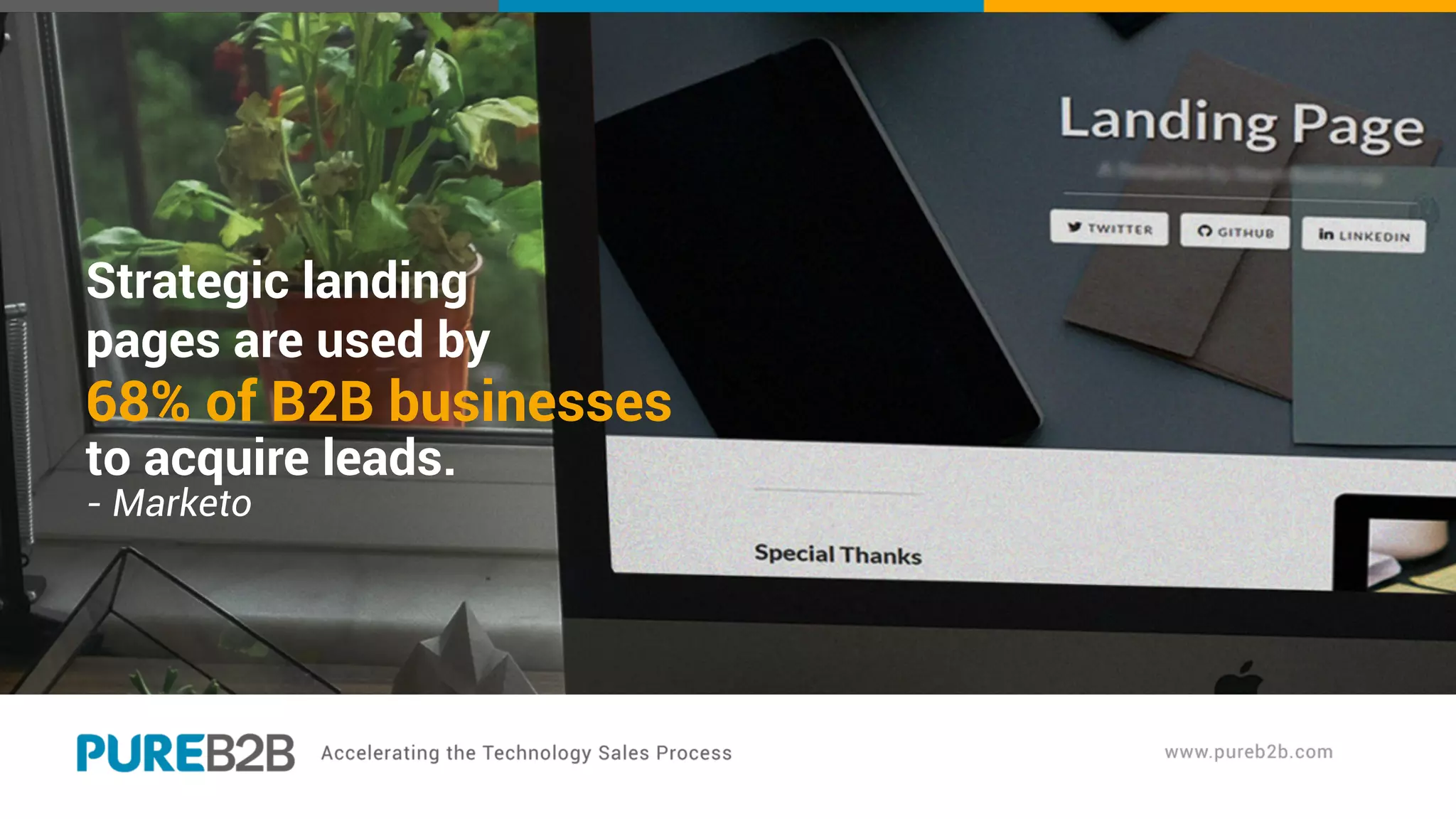
Strategic landing
pages are used by
68% of B2B businesses
to acquire leads.
- Marketo
49% of B2B buyers
prefer using
consumer websites
for work-related
purchases and expect
to be given the same
array of omnichannel
buying options they
have as consumers.
- The Future of Commerce
93% of the B2B
buying process
begin with an online search.
- Pinpoint Market Research
and Anderson Jones PR
Before finalizing a product purchase,
94% of B2B buyers
research online.
- Marketing Profs
76% of
B2B buyers
use three or more
marketing channels
when researching a
potential purchase.
- Blue Nile Research
The three most commonly used
B2B lead generation strategies are:
email marketing (78%),
event marketing (73%), &
content marketing (67%).
- Demand Metric Research Corporaton
Emailranks as the third most influential
information source for B2B audiences,
behind colleague recommendations and
industry-specifi intermediaries.
- BaseOne via Imagination
59% of B2B
marketers
say email is the most
effective channel for
generating revenue.
- BtoB magazine
It is expected that by 2017,
the number of emails sent
daily will reach approximately
297 billion.- The Wonder of Tech
Content
Marketing
Content Marketing is a concept that has been in use
since before the Internet. The notion of content
marketing is to generally tell a story to the reader,
and companies know that it is a strong promotional
strategy.
The content marketing process has evolved over the
years, but since the dawn of the Internet, sharing of
content has become an increasingly common
practice in people’s everyday lives, and distribution
techniques have progressed as well.
These days, content marketing involves creating and
distributing valuable information to a pre-determined
target audience to earn their attention and ultimately
drive profitable customer action. The goal is to foster
strong relationships between brands and their clients,
encourage awareness, trust, credibility, loyalty and in
best cases, advocacy.
Content marketing is now an essential part of any
effective inbound marketing strategy because it is a
far more cost-effective way to engage with customers
and generate sales leads. To find out more about
which content types will work best for your audience,
click here.
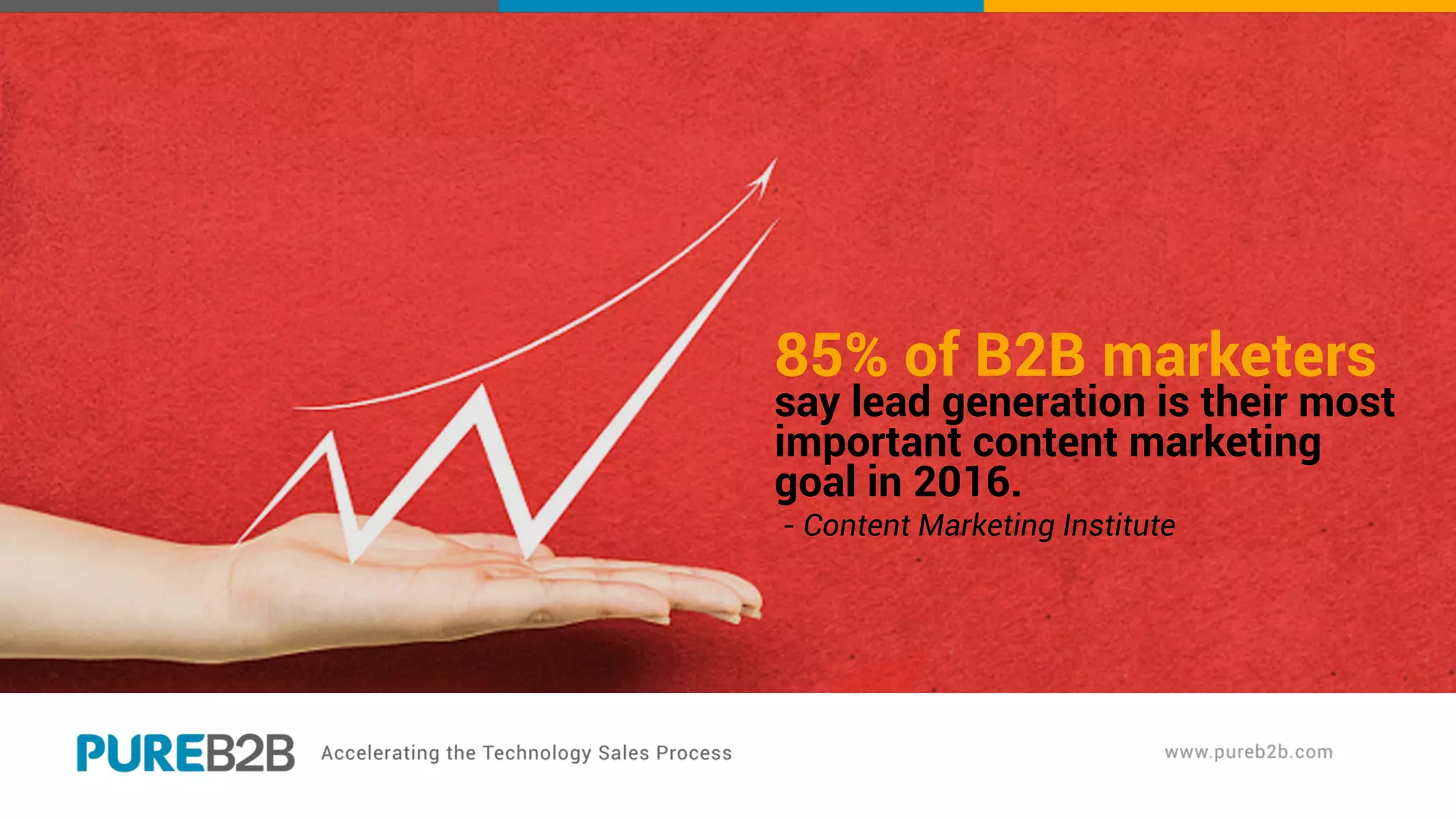
85% of B2B marketers
say lead generation is their most
important content marketing
goal in 2016.
- Content Marketing Institute
Content marketing is
used for lead generation by
83% of B2B marketers.
- Content Marketing Institute
Through the success of content marketing,
49% of B2B marketers
follow up with quality sales lead
for further assessment.
- Content Marketing Institute
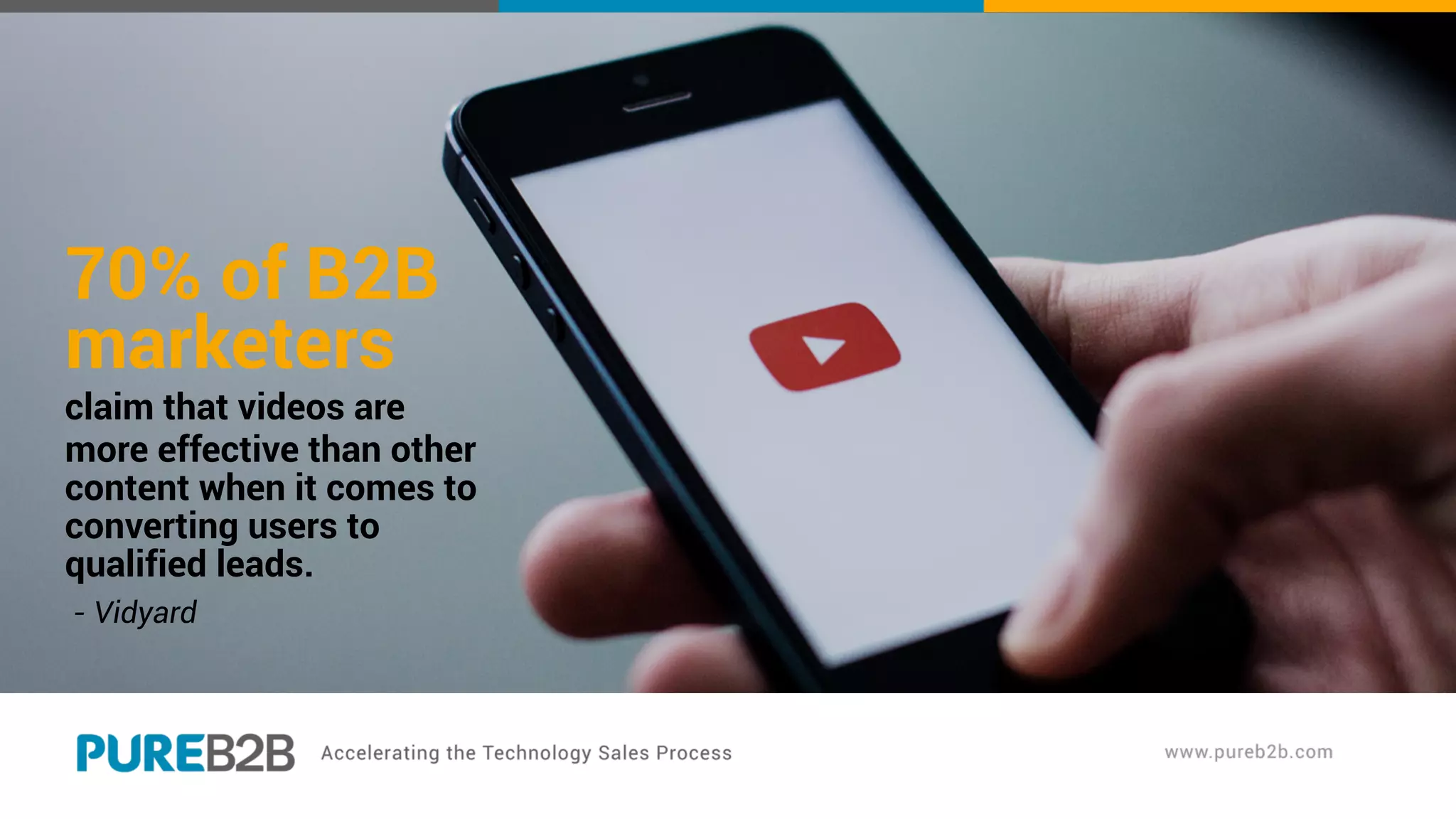
70% of B2B
marketers
claim that videos are
more effective than other
content when it comes to
converting users to
qualified leads.
- Vidyard
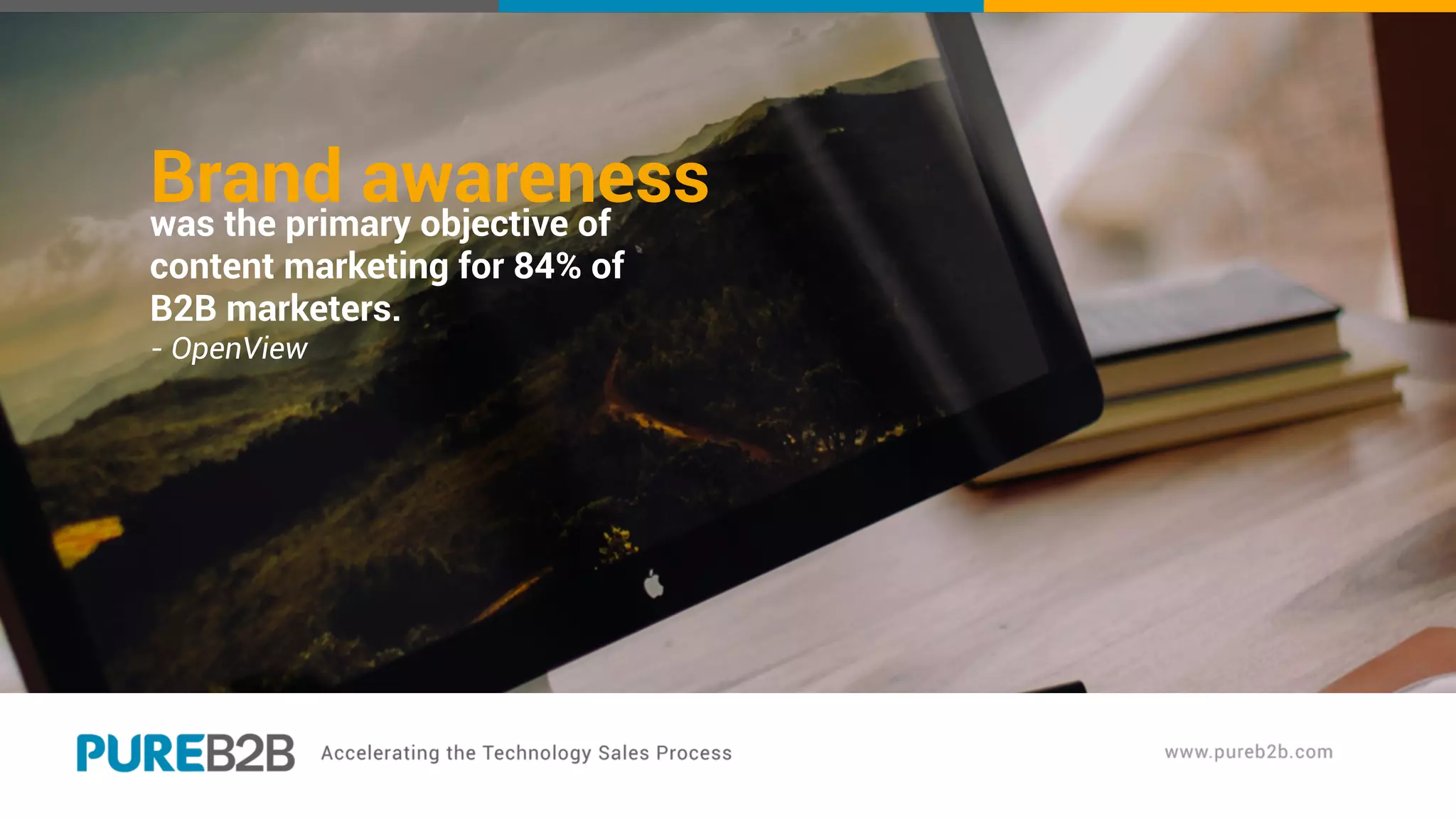
Brand awarenesswas the primary objective of
content marketing for 84% of
B2B marketers.
- OpenView
Social Media
Social media refers to the various types of media
shared via a social platform. Originally meant for
communities to use to connect with and share with
one another, social media usage has grown to the
point where the vast majority of Internet users
access social media portals. This phenomenon
provides an excellent opportunity for brands to
engage with and learn about their prospects.
Social media marketing can help increase website
traffic, leads and conversions, raise brand
awareness, create brand identity and association,
and improve interaction with the main audiences.
A strategic social media marketing plan involves
defining social objectives and goals, determining
your target audience, what platforms they are using,
improving your social media accounts, developing
relevant content and evaluating your posts and
activities.
LinkedIn has proven to be the most effective social
media platform for targeting B2B buyers. If you’d like
to find out more about LinkedIn marketing and how
to effectively implement it in your business, click
here.
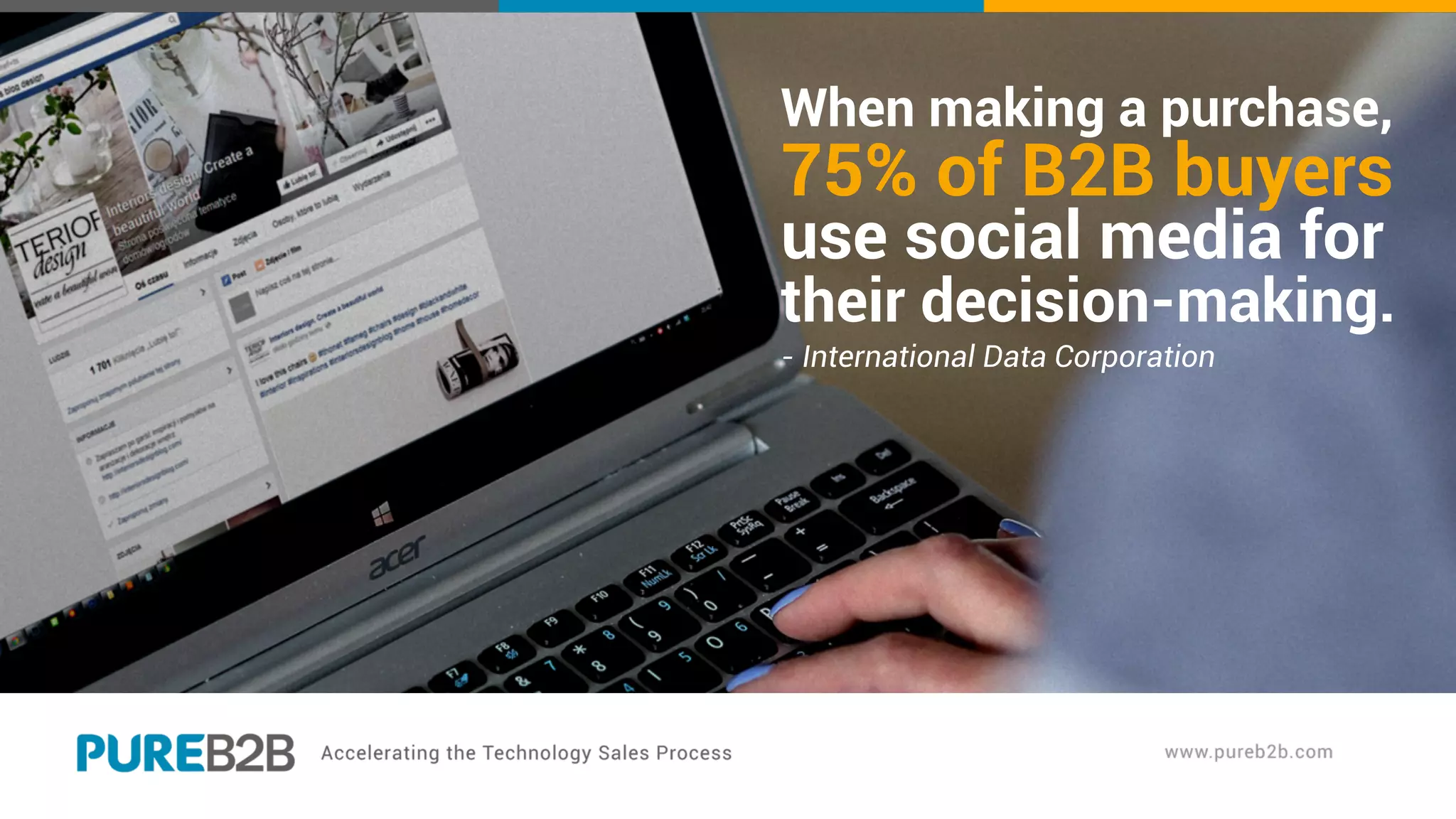
When making a purchase,
75% of B2B buyers
use social media for
their decision-making.
- International Data Corporation
49% of B2B marketers,
find social media to be the most difficult
marketing activity to implement.
- eMarketer
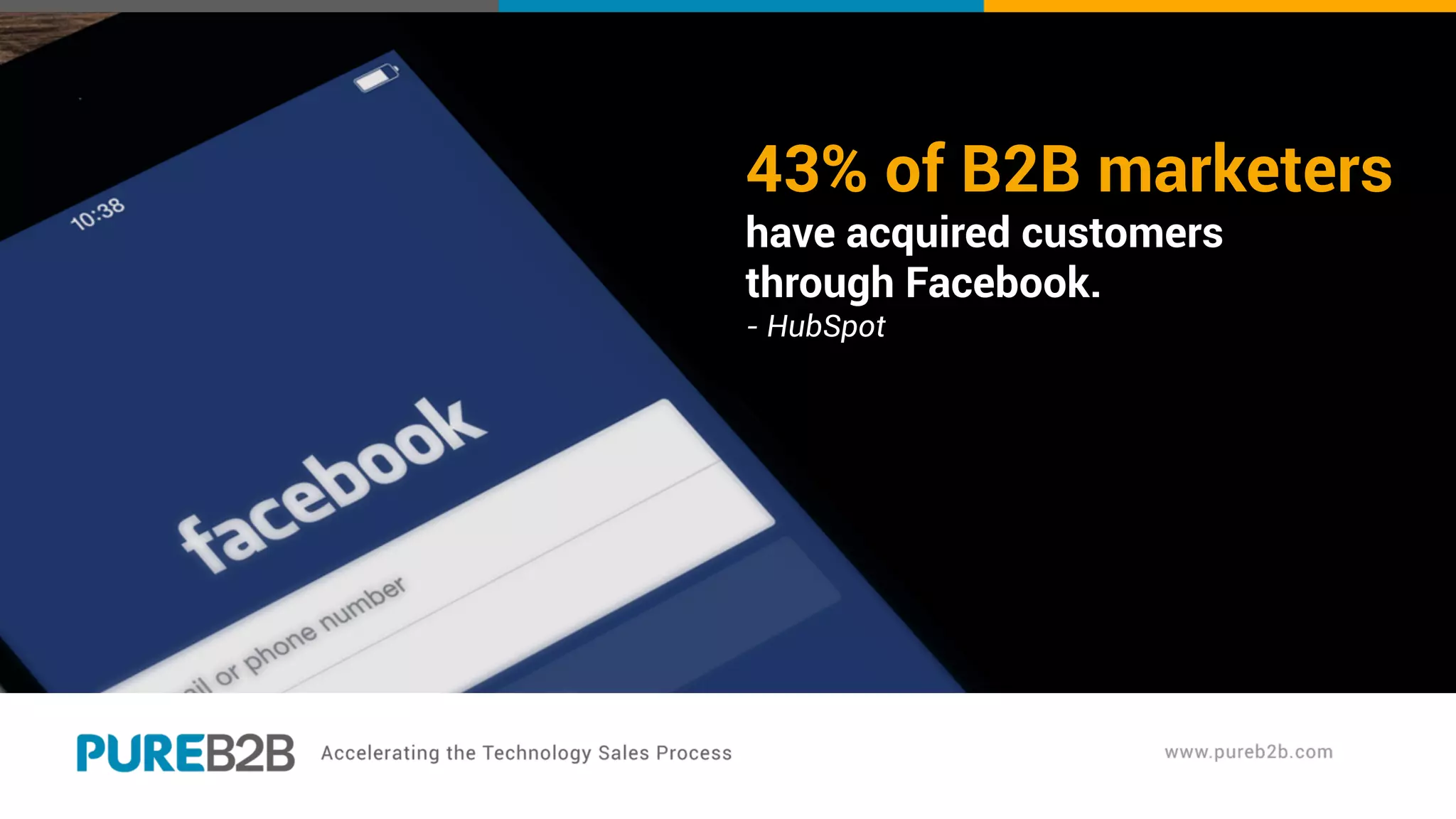
43% of B2B marketers
have acquired customers
through Facebook.
- HubSpot
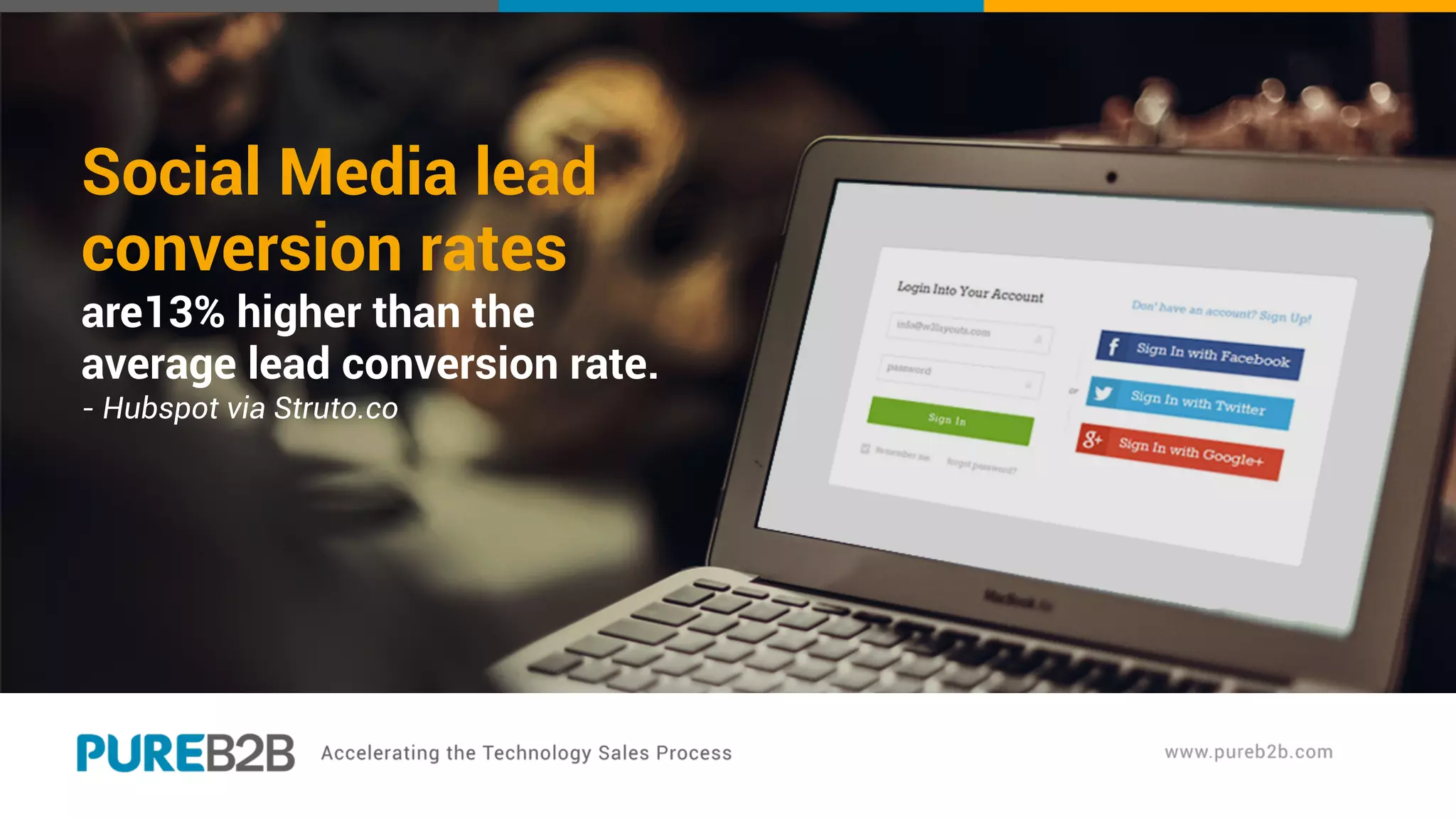
Social Media lead
conversion rates
are13% higher than the
average lead conversion rate.
- Hubspot via Struto.co
62% of B2B users
stated that LinkedIn
is the most effective
social media platform
for their business.
- Content Marketing Institute
Lead generation
from LinkedIn
was successful for
65% of B2B companies.
- LinkedIn
Focusing more on LinkedIn
has been considered a priority by
77% of B2B marketers.
- Social Media Examiner
Twitter is the top
social platform for B2B
mentions, with 73% of
B2B brand mentions.
- Brandwatch
Mobile Marketing
As the technology of mobile devices has evolved
over the years, so has the behavior of people that use
them. Mobile device usage has experienced a steady
increase since the origins of the first smartphones
and has reached a point where an estimated 60% of
all Internet traffic now comes from mobile devices.
It is no longer a question for marketers whether or
not to leverage mobile usage, but HOW to leverage
mobile usage behavior.
The numbers are in, and more people are using their
phones, tablets, media players, and other mobile
devices to go online than ever before — accounting for
about 50% more traffic than traditional computer users.
So, if you are NOT currently making the most of this
phenomenon and your website is NOT mobile-friendly,
your business is probably missing out on the extra
traffic and potential sales leads from users that could
be discouraged by the lack of compatibility.
If you would like to learn a little more about mobile
marketing, click here.
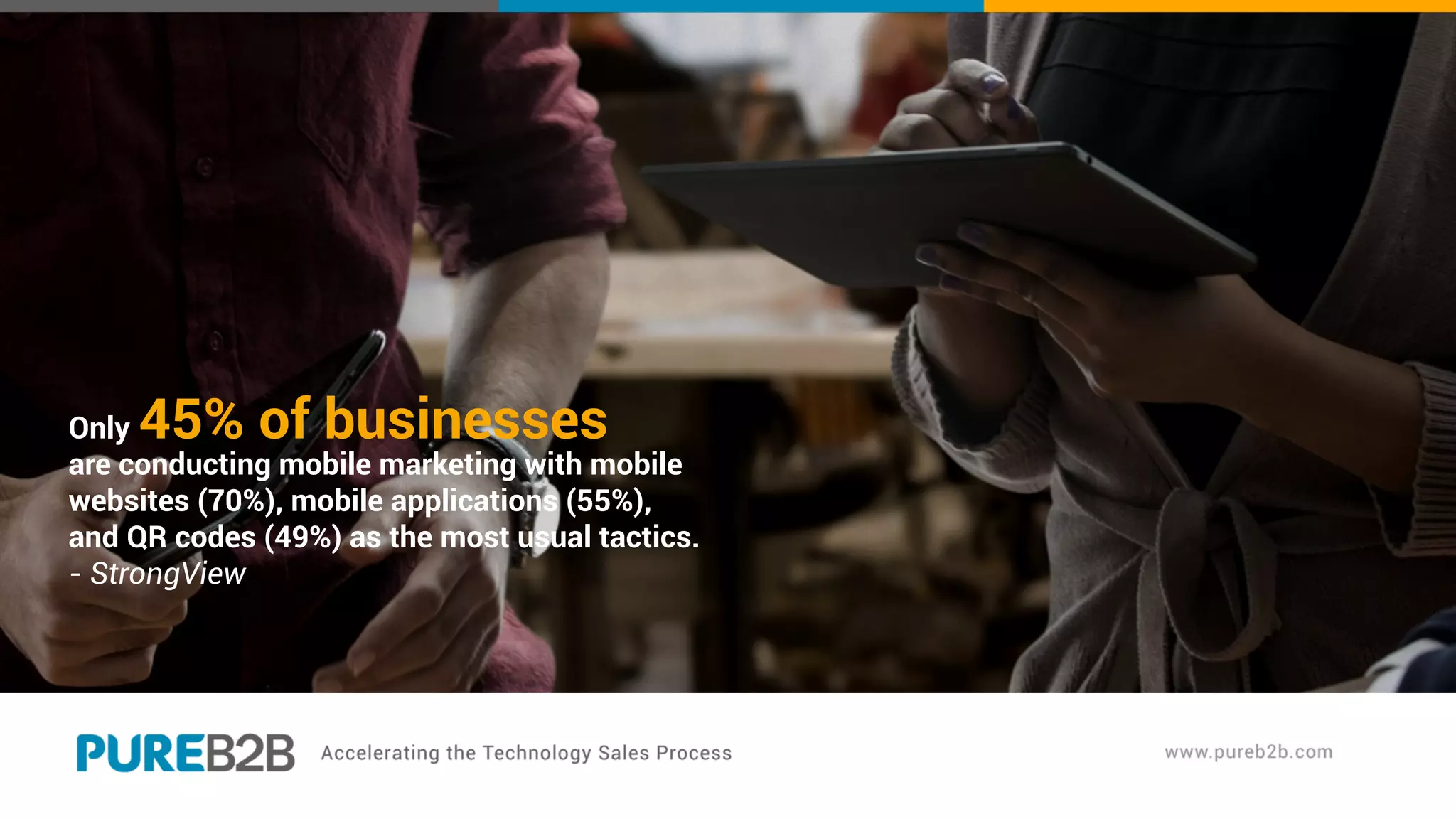
Only 45% of businesses
are conducting mobile marketing with mobile
websites (70%), mobile applications (55%),
and QR codes (49%) as the most usual tactics.
- StrongView
About 50% of B2B vendors
sell through mobile (including
stores and applications).
- MarketingCharts
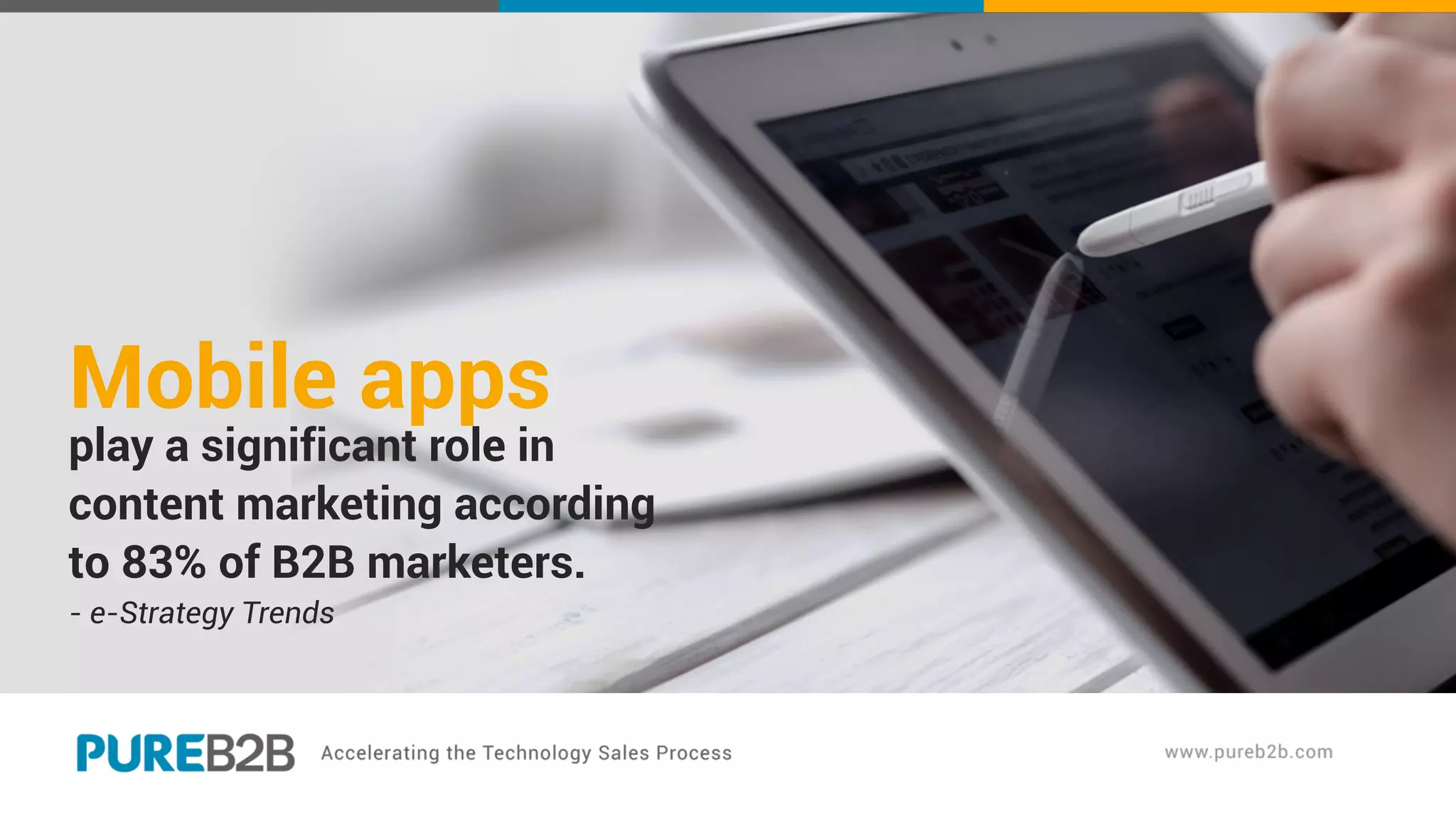
Mobile apps
play a significant role in
content marketing according
to 83% of B2B marketers.
- e-Strategy Trends
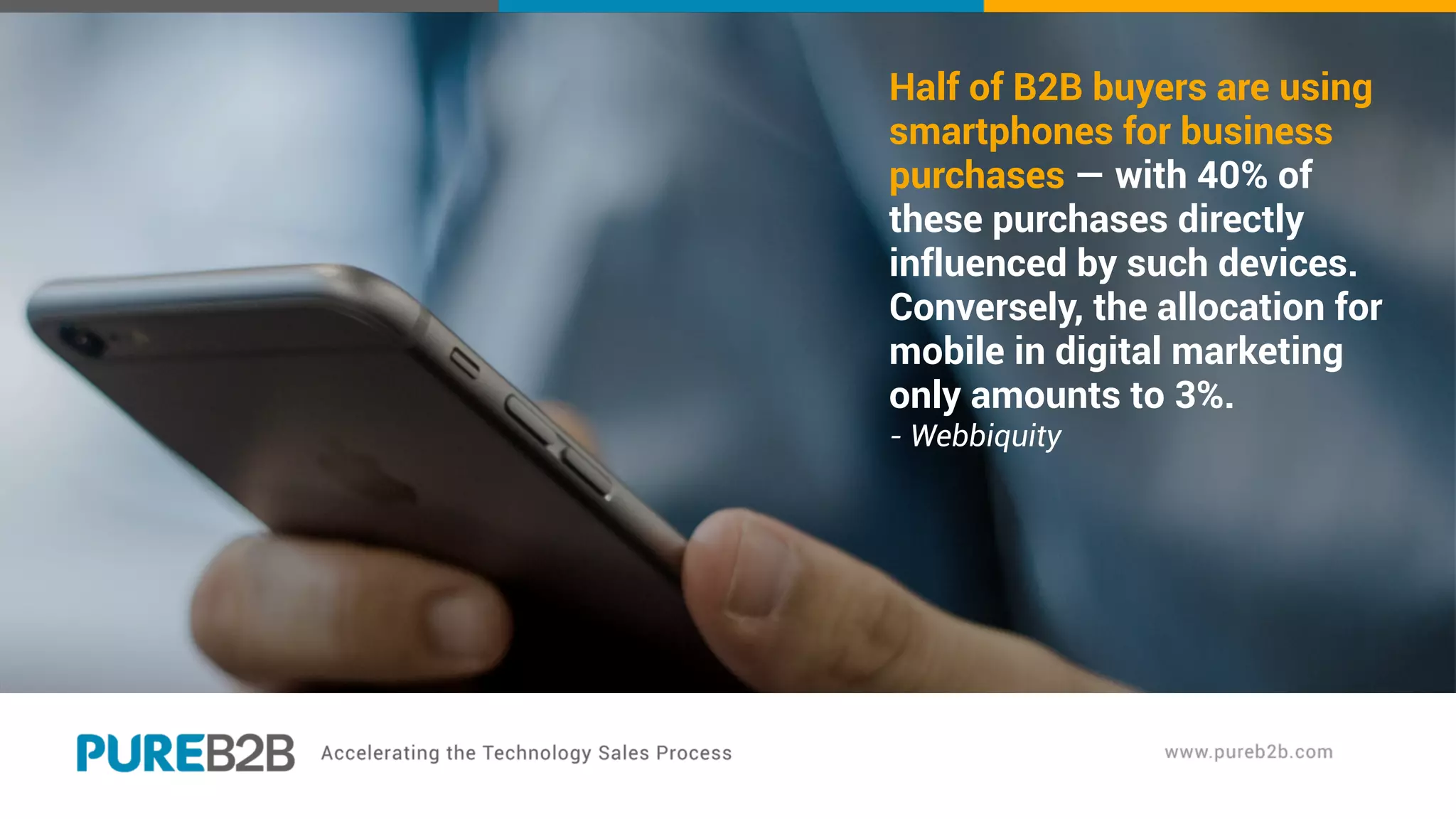
Half of B2B buyers are using
smartphones for business
purchases — with 40% of
these purchases directly
influenced by such devices.
Conversely, the allocation for
mobile in digital marketing
only amounts to 3%.
- Webbiquity
Demand
Generation |
Lead Generation
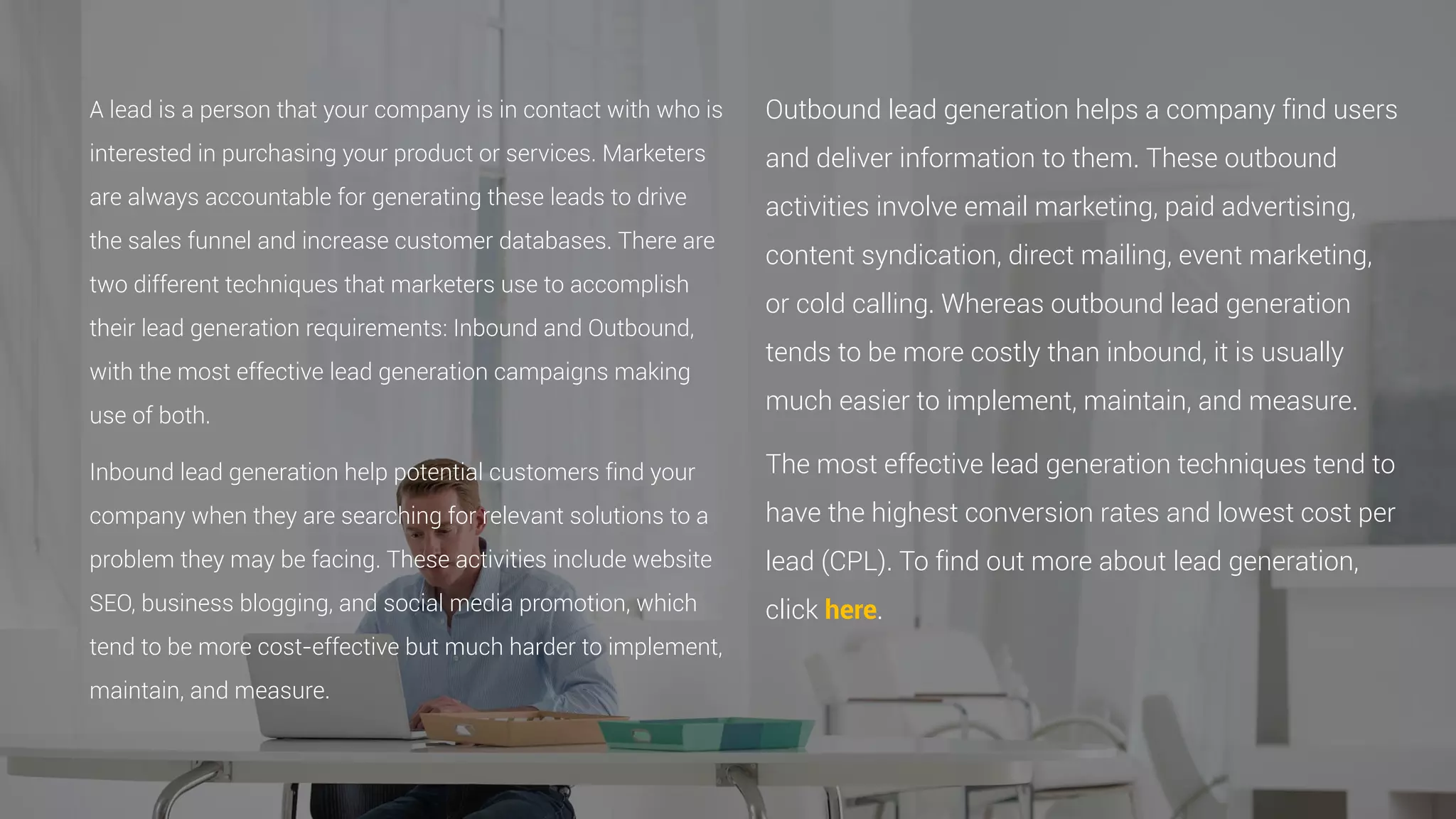
A lead is a person that your company is in contact with who is
interested in purchasing your product or services. Marketers
are always accountable for generating these leads to drive
the sales funnel and increase customer databases. There are
two different techniques that marketers use to accomplish
their lead generation requirements: Inbound and Outbound,
with the most effective lead generation campaigns making
use of both.
Inbound lead generation help potential customers find your
company when they are searching for relevant solutions to a
problem they may be facing. These activities include website
SEO, business blogging, and social media promotion, which
tend to be more cost-effective but much harder to implement,
maintain, and measure.
Outbound lead generation helps a company find users
and deliver information to them. These outbound
activities involve email marketing, paid advertising,
content syndication, direct mailing, event marketing,
or cold calling. Whereas outbound lead generation
tends to be more costly than inbound, it is usually
much easier to implement, maintain, and measure.
The most effective lead generation techniques tend to
have the highest conversion rates and lowest cost per
lead (CPL). To find out more about lead generation,
click here.
37% of marketers
state that the budget constraints hinder
them from conducting an efficient
marketing automation strategy.
- Pepper Global
68% of B2B companies
are still struggling with
lead generation.
- CSO Insights via Lattice Engines
Expertise in lead
nurturing results in a
50% increase in
sales-ready leads,
along with a 33% decrease in its cost.
- Forrester Research via Hubspot
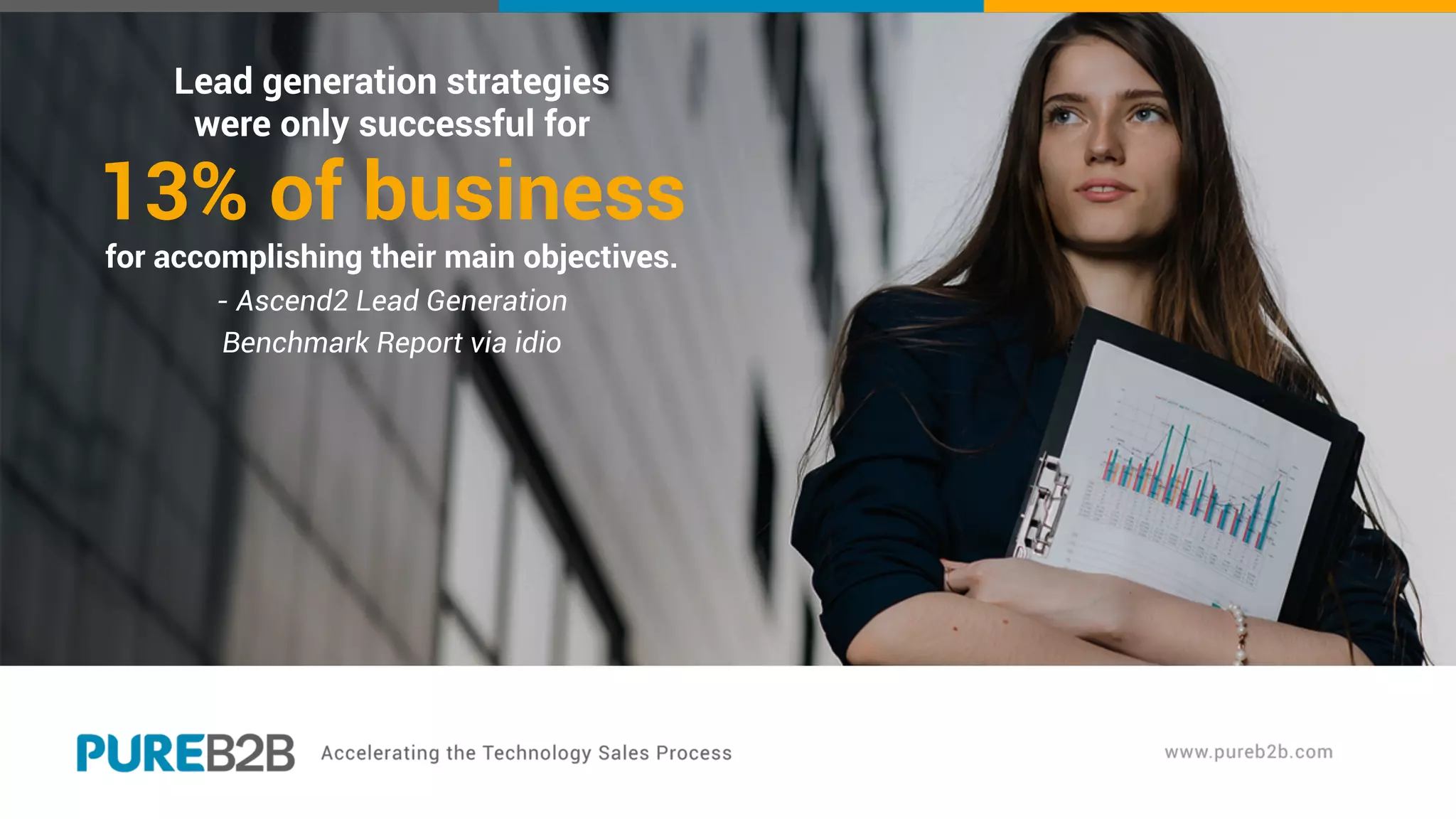
Lead generation strategies
were only successful for
13% of business
for accomplishing their main objectives.
- Ascend2 Lead Generation
Benchmark Report via idio
Outbound leads
cost 39% more than inbound leads.
- HubSpot
61% of B2B marketers
find generating high-quality leads
as their biggest challenge.
- B2B Technology Marketing Company
a CRM system
is believed by 84% of companies
to be beneficial in determining
the quality of leads.
- Demand Metric Research Corporation
via Direct Marketing News
High-quality
lead generation
is the top challenge for
61% of B2B marketers.
- B2B Technology Marketing Community
58% of B2B
marketers
said they will increase
their lead generation
budget in 2015.
- B2B Technology Marketing
Community
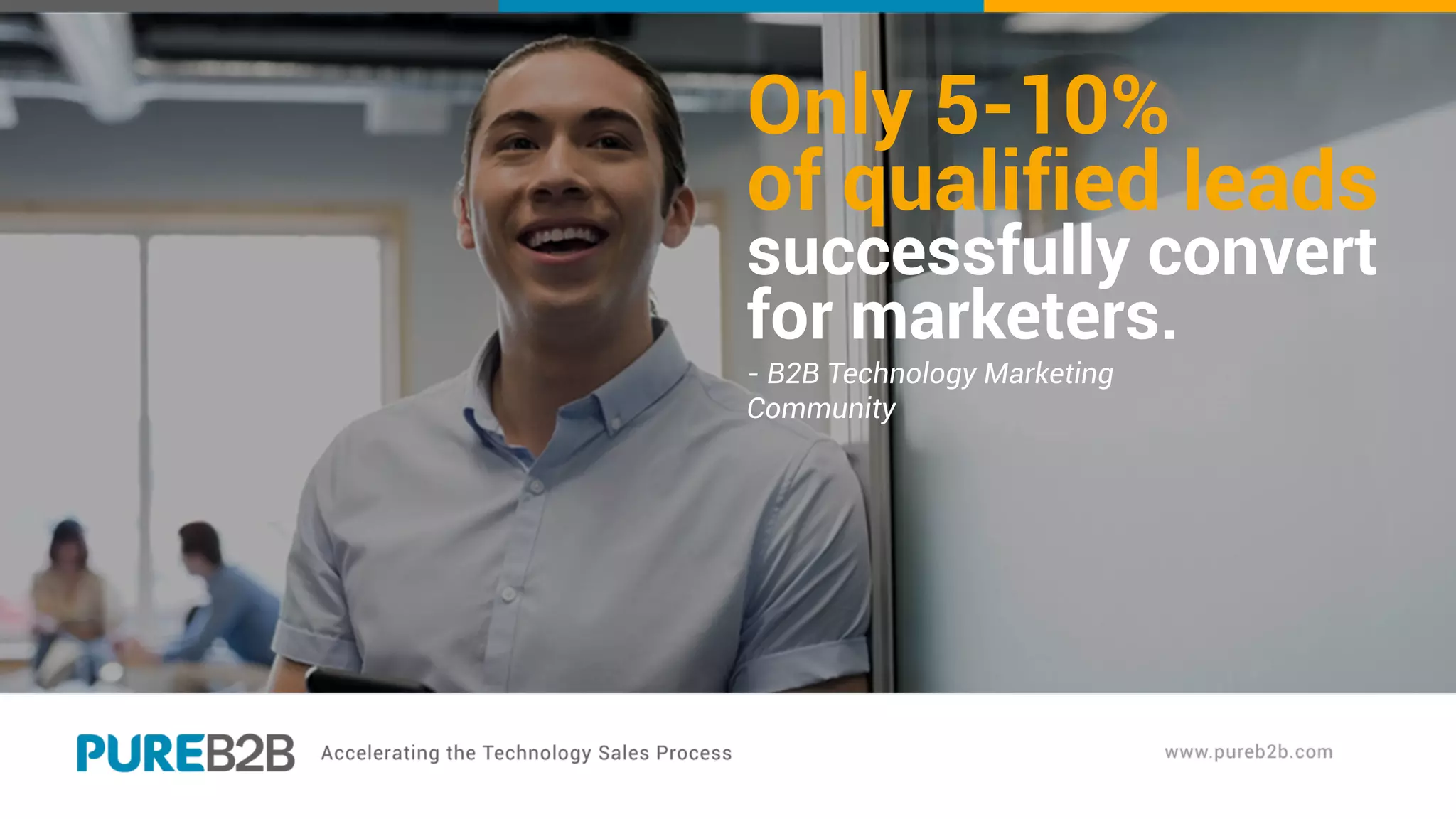
Only 5-10%
of qualified leads
successfully convert
for marketers.
- B2B Technology Marketing
Community
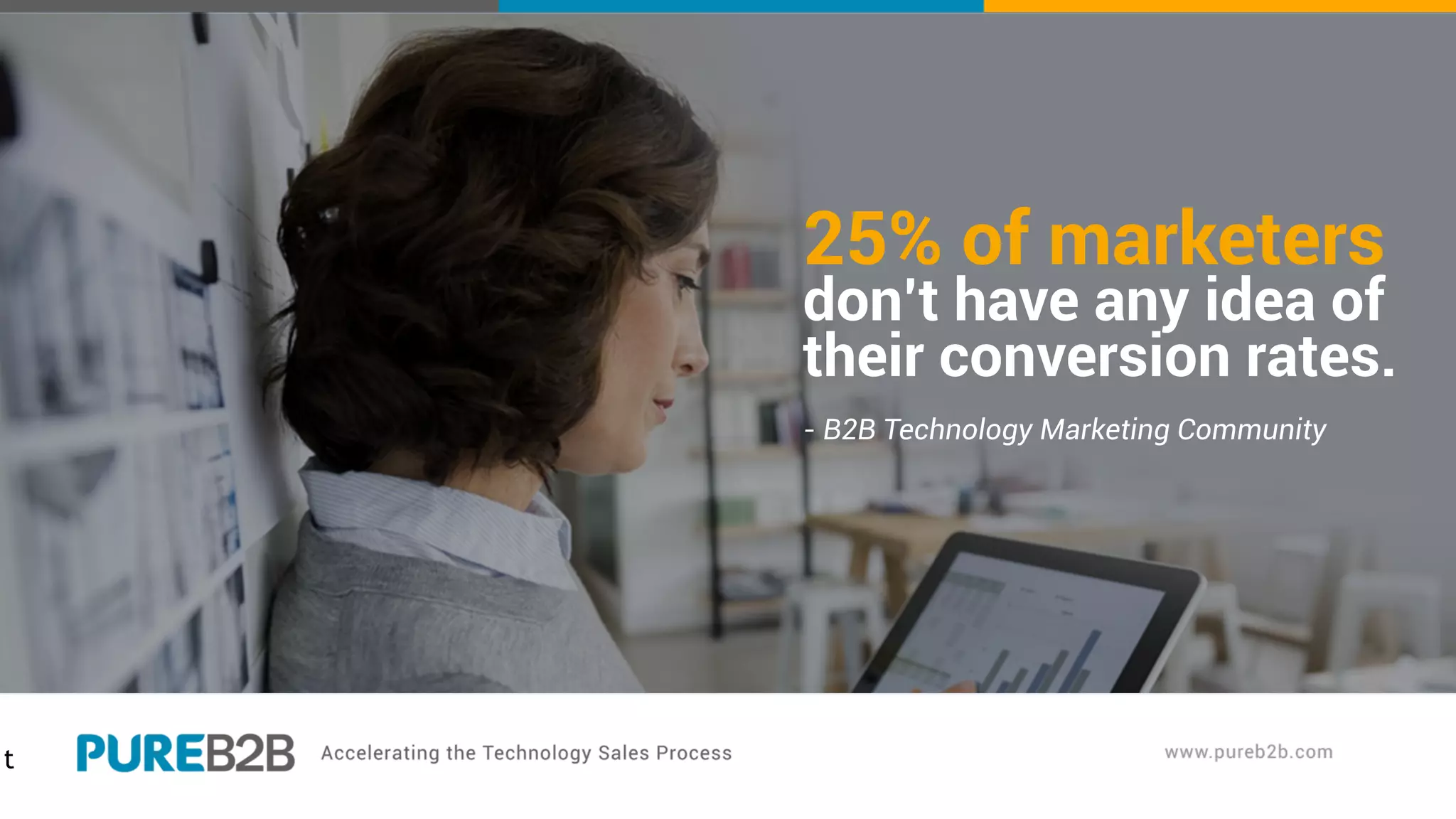
t
25% of marketers
don’t have any idea of
their conversion rates.
- B2B Technology Marketing Community
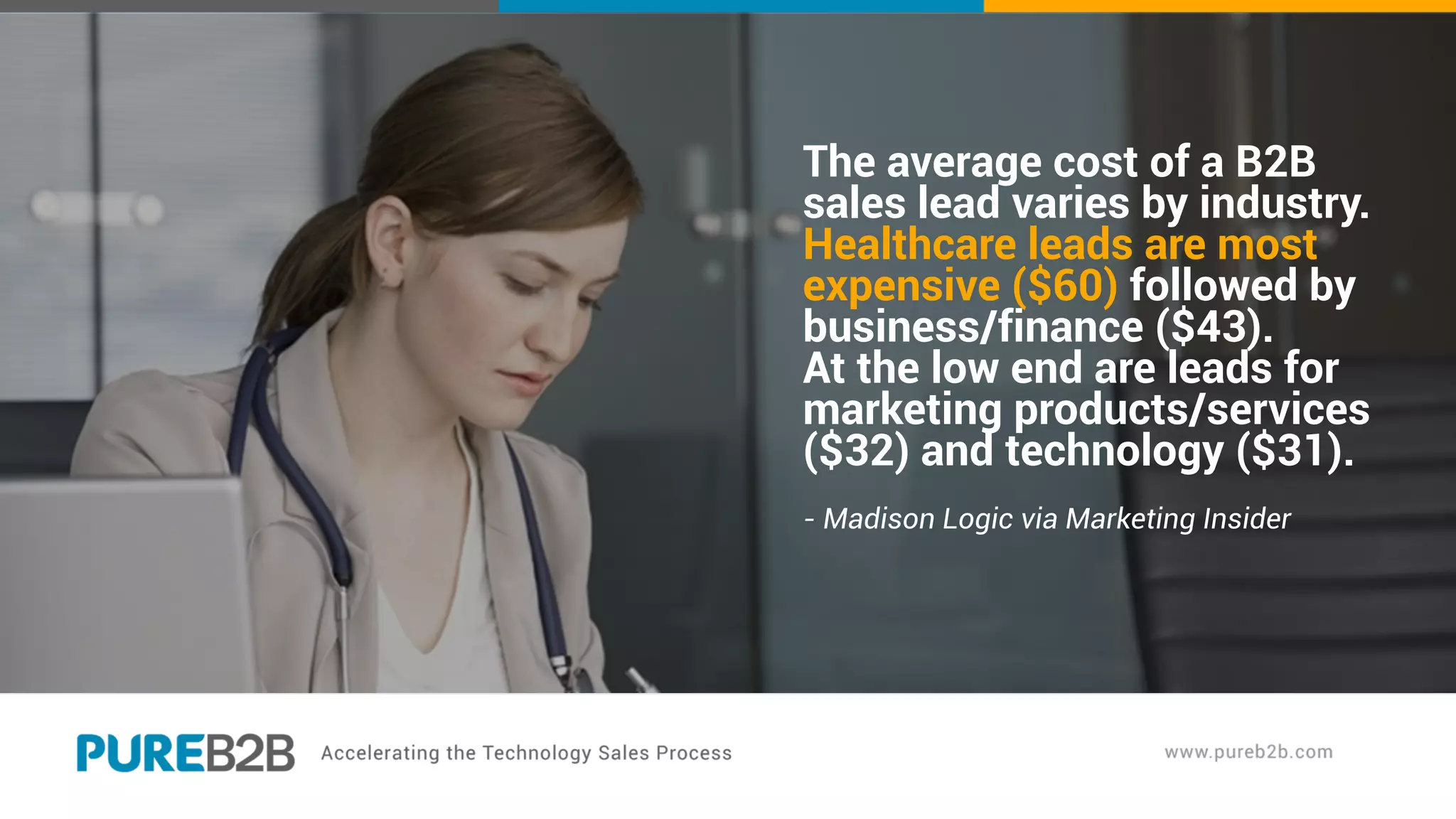
The average cost of a B2B
sales lead varies by industry.
Healthcare leads are most
expensive ($60) followed by
business/finance ($43).
At the low end are leads for
marketing products/services
($32) and technology ($31).
- Madison Logic via Marketing Insider
Verifying business leads
before passing it to the
sales team is conducted
by only 56% of B2B
companies.
- MarketingSherpa via Hubspot
With 61% of B2B
marketers immediately
forwarding leads to sales,
qualified leads only
amount to 27%.
- MarketingSherpa via Hubspot
More than 79% of marketing leads
don’t convert into sales with the lack of lead
nurturing as the leading cause.
- MarketingSherpa via Hubspot
Increasing the quality of leads
is the top priority for a majority
(68%) of B2B professionals, followed
by increasing lead volume (55%).
- B2B Technology Marketing Community
Lead generation outsourcing is
43% more efficient
than generating leads in-house
because of their expertise.
- Fearless Competitor
Only 57% of B2B firms
consider converting leads into paying
customers as their top priority when
devising their marketing campaigns.
- MarketingSherpa via HubSpot
Customer
Experience
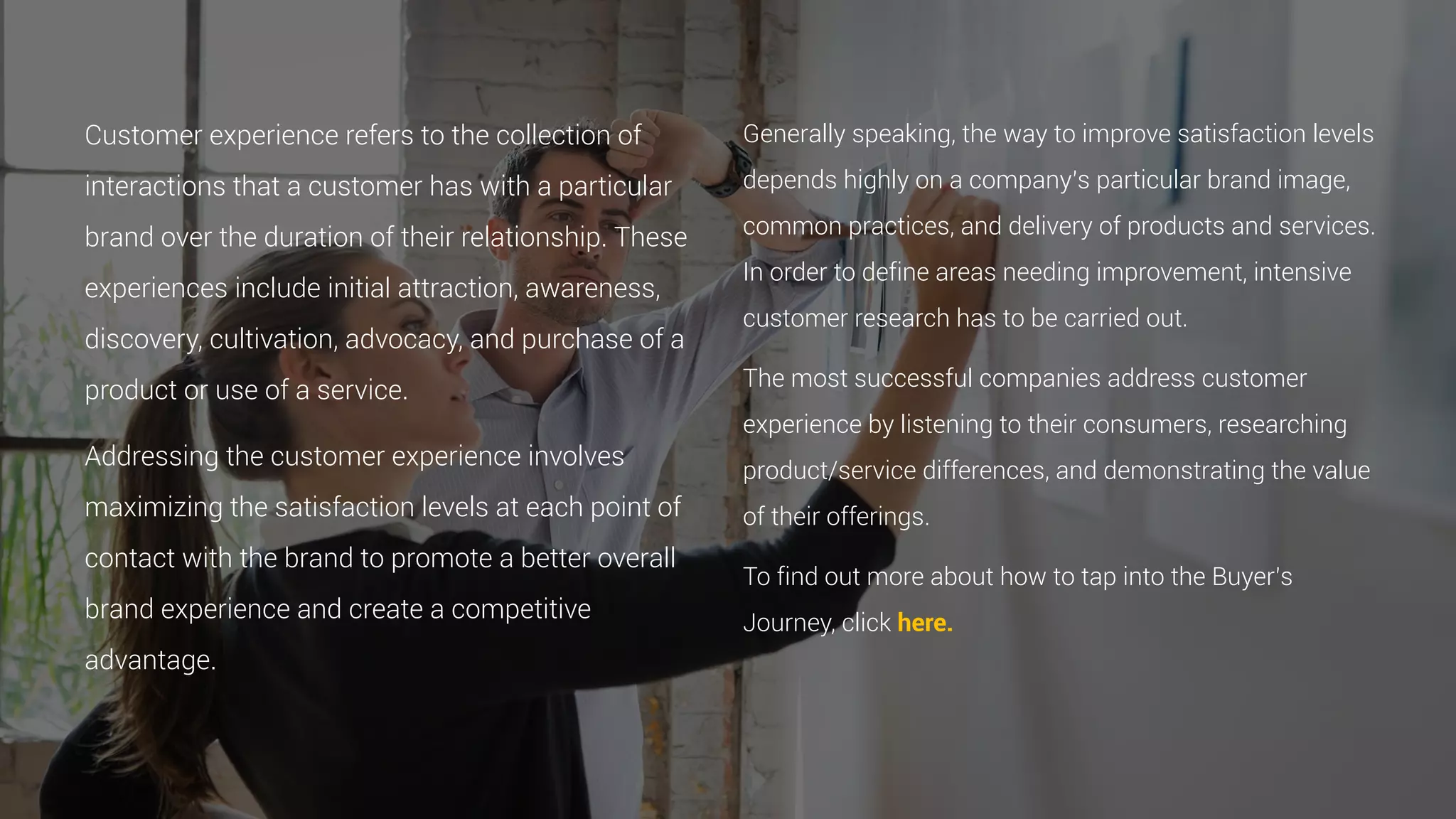
Customer experience refers to the collection of
interactions that a customer has with a particular
brand over the duration of their relationship. These
experiences include initial attraction, awareness,
discovery, cultivation, advocacy, and purchase of a
product or use of a service.
Addressing the customer experience involves
maximizing the satisfaction levels at each point of
contact with the brand to promote a better overall
brand experience and create a competitive
advantage.
Generally speaking, the way to improve satisfaction levels
depends highly on a company’s particular brand image,
common practices, and delivery of products and services.
In order to define areas needing improvement, intensive
customer research has to be carried out.
The most successful companies address customer
experience by listening to their consumers, researching
product/service differences, and demonstrating the value
of their offerings.
To find out more about how to tap into the Buyer’s
Journey, click here.
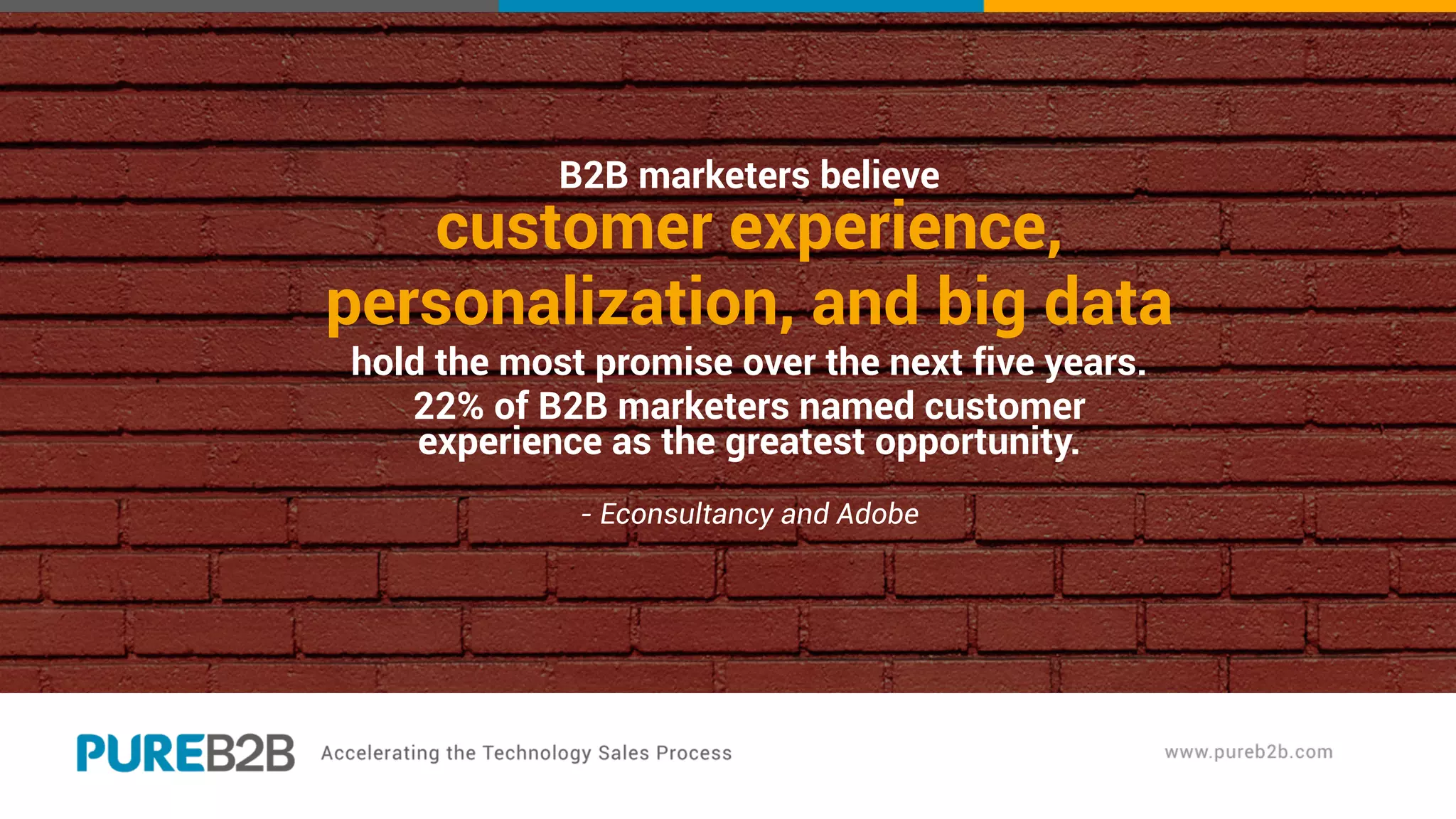
B2B marketers believe
customer experience,
personalization, and big data
hold the most promise over the next five years.
22% of B2B marketers named customer
experience as the greatest opportunity.
- Econsultancy and Adobe
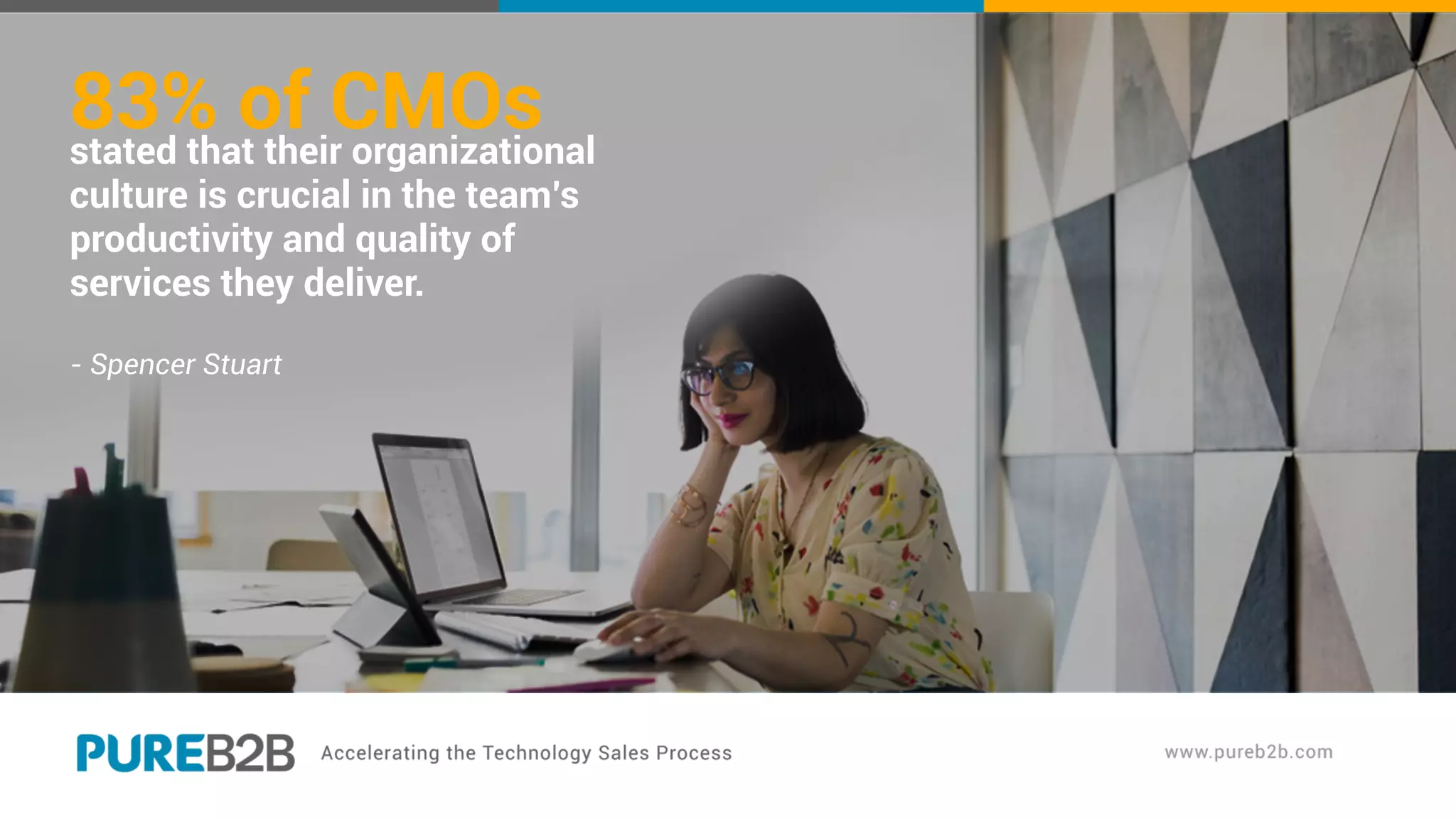
83% of CMOsstated that their organizational
culture is crucial in the team’s
productivity and quality of
services they deliver.
- Spencer Stuart
Approximately
90% of B2B companies
are likely to switch partners even with
just one single bad experience.
- CMO.com by Adobe
Only 45% of B2B marketers
are confident that they have good,
if not high, levels of customer centricity.
- FierceCMO
Visit Our Blog
www.pureb2b.com/blog
http://twitter.com/ThinkPureB2B http://facebook.com/ThinkPureB2B www.linkedin.com/company/pureb2b

50 Must Know Statistics for B2B Lead Generation

  • 1.
    Must-Know Statistics to ImproveB2B Lead Generation Strategies 50
  • 2.
  • 3.
    Websites and landingpages require optimization to look good, while also making it easier for users to digest the content. Optimization also helps faciliate the regular indexing performed by search engines. On-page SEO factors include keyword optimization, inbound and outbound link building, developing content and social sharing amongst others. Email marketing has been effectively used in a wide array of circumstances for over a decade. In this time, best practices have evolved to cater to a wider audience with more discerning tastes. Due to the intrusive nature of email, marketers need to develop techniques that reduce the annoyance factor by providing something of value in return to the receiver. To find out more about email marketing, click here.
  • 4.
    Strategic landing pages areused by 68% of B2B businesses to acquire leads. - Marketo
  • 5.
    49% of B2Bbuyers prefer using consumer websites for work-related purchases and expect to be given the same array of omnichannel buying options they have as consumers. - The Future of Commerce
  • 6.
    93% of theB2B buying process begin with an online search. - Pinpoint Market Research and Anderson Jones PR
  • 7.
    Before finalizing aproduct purchase, 94% of B2B buyers research online. - Marketing Profs
  • 8.
    76% of B2B buyers usethree or more marketing channels when researching a potential purchase. - Blue Nile Research
  • 9.
    The three mostcommonly used B2B lead generation strategies are: email marketing (78%), event marketing (73%), & content marketing (67%). - Demand Metric Research Corporaton
  • 10.
    Emailranks as thethird most influential information source for B2B audiences, behind colleague recommendations and industry-specifi intermediaries. - BaseOne via Imagination
  • 11.
    59% of B2B marketers sayemail is the most effective channel for generating revenue. - BtoB magazine
  • 12.
    It is expectedthat by 2017, the number of emails sent daily will reach approximately 297 billion.- The Wonder of Tech
  • 13.
  • 14.
    Content Marketing isa concept that has been in use since before the Internet. The notion of content marketing is to generally tell a story to the reader, and companies know that it is a strong promotional strategy. The content marketing process has evolved over the years, but since the dawn of the Internet, sharing of content has become an increasingly common practice in people’s everyday lives, and distribution techniques have progressed as well. These days, content marketing involves creating and distributing valuable information to a pre-determined target audience to earn their attention and ultimately drive profitable customer action. The goal is to foster strong relationships between brands and their clients, encourage awareness, trust, credibility, loyalty and in best cases, advocacy. Content marketing is now an essential part of any effective inbound marketing strategy because it is a far more cost-effective way to engage with customers and generate sales leads. To find out more about which content types will work best for your audience, click here.
  • 15.
    85% of B2Bmarketers say lead generation is their most important content marketing goal in 2016. - Content Marketing Institute
  • 16.
    Content marketing is usedfor lead generation by 83% of B2B marketers. - Content Marketing Institute
  • 17.
    Through the successof content marketing, 49% of B2B marketers follow up with quality sales lead for further assessment. - Content Marketing Institute
  • 18.
    70% of B2B marketers claimthat videos are more effective than other content when it comes to converting users to qualified leads. - Vidyard
  • 19.
    Brand awarenesswas theprimary objective of content marketing for 84% of B2B marketers. - OpenView
  • 20.
  • 21.
    Social media refersto the various types of media shared via a social platform. Originally meant for communities to use to connect with and share with one another, social media usage has grown to the point where the vast majority of Internet users access social media portals. This phenomenon provides an excellent opportunity for brands to engage with and learn about their prospects. Social media marketing can help increase website traffic, leads and conversions, raise brand awareness, create brand identity and association, and improve interaction with the main audiences. A strategic social media marketing plan involves defining social objectives and goals, determining your target audience, what platforms they are using, improving your social media accounts, developing relevant content and evaluating your posts and activities. LinkedIn has proven to be the most effective social media platform for targeting B2B buyers. If you’d like to find out more about LinkedIn marketing and how to effectively implement it in your business, click here.
  • 22.
    When making apurchase, 75% of B2B buyers use social media for their decision-making. - International Data Corporation
  • 23.
    49% of B2Bmarketers, find social media to be the most difficult marketing activity to implement. - eMarketer
  • 24.
    43% of B2Bmarketers have acquired customers through Facebook. - HubSpot
  • 25.
    Social Media lead conversionrates are13% higher than the average lead conversion rate. - Hubspot via Struto.co
  • 26.
    62% of B2Busers stated that LinkedIn is the most effective social media platform for their business. - Content Marketing Institute
  • 27.
    Lead generation from LinkedIn wassuccessful for 65% of B2B companies. - LinkedIn
  • 28.
    Focusing more onLinkedIn has been considered a priority by 77% of B2B marketers. - Social Media Examiner
  • 29.
    Twitter is thetop social platform for B2B mentions, with 73% of B2B brand mentions. - Brandwatch
  • 30.
  • 31.
    As the technologyof mobile devices has evolved over the years, so has the behavior of people that use them. Mobile device usage has experienced a steady increase since the origins of the first smartphones and has reached a point where an estimated 60% of all Internet traffic now comes from mobile devices. It is no longer a question for marketers whether or not to leverage mobile usage, but HOW to leverage mobile usage behavior. The numbers are in, and more people are using their phones, tablets, media players, and other mobile devices to go online than ever before — accounting for about 50% more traffic than traditional computer users. So, if you are NOT currently making the most of this phenomenon and your website is NOT mobile-friendly, your business is probably missing out on the extra traffic and potential sales leads from users that could be discouraged by the lack of compatibility. If you would like to learn a little more about mobile marketing, click here.
  • 32.
    Only 45% ofbusinesses are conducting mobile marketing with mobile websites (70%), mobile applications (55%), and QR codes (49%) as the most usual tactics. - StrongView
  • 33.
    About 50% ofB2B vendors sell through mobile (including stores and applications). - MarketingCharts
  • 34.
    Mobile apps play asignificant role in content marketing according to 83% of B2B marketers. - e-Strategy Trends
  • 35.
    Half of B2Bbuyers are using smartphones for business purchases — with 40% of these purchases directly influenced by such devices. Conversely, the allocation for mobile in digital marketing only amounts to 3%. - Webbiquity
  • 36.
  • 37.
    A lead isa person that your company is in contact with who is interested in purchasing your product or services. Marketers are always accountable for generating these leads to drive the sales funnel and increase customer databases. There are two different techniques that marketers use to accomplish their lead generation requirements: Inbound and Outbound, with the most effective lead generation campaigns making use of both. Inbound lead generation help potential customers find your company when they are searching for relevant solutions to a problem they may be facing. These activities include website SEO, business blogging, and social media promotion, which tend to be more cost-effective but much harder to implement, maintain, and measure. Outbound lead generation helps a company find users and deliver information to them. These outbound activities involve email marketing, paid advertising, content syndication, direct mailing, event marketing, or cold calling. Whereas outbound lead generation tends to be more costly than inbound, it is usually much easier to implement, maintain, and measure. The most effective lead generation techniques tend to have the highest conversion rates and lowest cost per lead (CPL). To find out more about lead generation, click here.
  • 38.
    37% of marketers statethat the budget constraints hinder them from conducting an efficient marketing automation strategy. - Pepper Global
  • 39.
    68% of B2Bcompanies are still struggling with lead generation. - CSO Insights via Lattice Engines
  • 40.
    Expertise in lead nurturingresults in a 50% increase in sales-ready leads, along with a 33% decrease in its cost. - Forrester Research via Hubspot
  • 41.
    Lead generation strategies wereonly successful for 13% of business for accomplishing their main objectives. - Ascend2 Lead Generation Benchmark Report via idio
  • 42.
    Outbound leads cost 39%more than inbound leads. - HubSpot
  • 43.
    61% of B2Bmarketers find generating high-quality leads as their biggest challenge. - B2B Technology Marketing Company
  • 44.
    a CRM system isbelieved by 84% of companies to be beneficial in determining the quality of leads. - Demand Metric Research Corporation via Direct Marketing News
  • 45.
    High-quality lead generation is thetop challenge for 61% of B2B marketers. - B2B Technology Marketing Community
  • 46.
    58% of B2B marketers saidthey will increase their lead generation budget in 2015. - B2B Technology Marketing Community
  • 47.
    Only 5-10% of qualifiedleads successfully convert for marketers. - B2B Technology Marketing Community
  • 48.
    t 25% of marketers don’thave any idea of their conversion rates. - B2B Technology Marketing Community
  • 49.
    The average costof a B2B sales lead varies by industry. Healthcare leads are most expensive ($60) followed by business/finance ($43). At the low end are leads for marketing products/services ($32) and technology ($31). - Madison Logic via Marketing Insider
  • 50.
    Verifying business leads beforepassing it to the sales team is conducted by only 56% of B2B companies. - MarketingSherpa via Hubspot
  • 51.
    With 61% ofB2B marketers immediately forwarding leads to sales, qualified leads only amount to 27%. - MarketingSherpa via Hubspot
  • 52.
    More than 79%of marketing leads don’t convert into sales with the lack of lead nurturing as the leading cause. - MarketingSherpa via Hubspot
  • 53.
    Increasing the qualityof leads is the top priority for a majority (68%) of B2B professionals, followed by increasing lead volume (55%). - B2B Technology Marketing Community
  • 54.
    Lead generation outsourcingis 43% more efficient than generating leads in-house because of their expertise. - Fearless Competitor
  • 55.
    Only 57% ofB2B firms consider converting leads into paying customers as their top priority when devising their marketing campaigns. - MarketingSherpa via HubSpot
  • 56.
  • 57.
    Customer experience refersto the collection of interactions that a customer has with a particular brand over the duration of their relationship. These experiences include initial attraction, awareness, discovery, cultivation, advocacy, and purchase of a product or use of a service. Addressing the customer experience involves maximizing the satisfaction levels at each point of contact with the brand to promote a better overall brand experience and create a competitive advantage. Generally speaking, the way to improve satisfaction levels depends highly on a company’s particular brand image, common practices, and delivery of products and services. In order to define areas needing improvement, intensive customer research has to be carried out. The most successful companies address customer experience by listening to their consumers, researching product/service differences, and demonstrating the value of their offerings. To find out more about how to tap into the Buyer’s Journey, click here.
  • 58.
    B2B marketers believe customerexperience, personalization, and big data hold the most promise over the next five years. 22% of B2B marketers named customer experience as the greatest opportunity. - Econsultancy and Adobe
  • 59.
    83% of CMOsstatedthat their organizational culture is crucial in the team’s productivity and quality of services they deliver. - Spencer Stuart
  • 60.
    Approximately 90% of B2Bcompanies are likely to switch partners even with just one single bad experience. - CMO.com by Adobe
  • 61.
    Only 45% ofB2B marketers are confident that they have good, if not high, levels of customer centricity. - FierceCMO
  • 62.
    Visit Our Blog www.pureb2b.com/blog http://twitter.com/ThinkPureB2Bhttp://facebook.com/ThinkPureB2B www.linkedin.com/company/pureb2b