Het ondersteunen van het gebruik van
opnames van colleges met
behulp van tags.
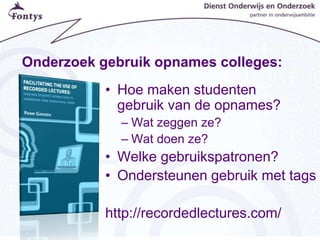
Onderzoek gebruik opnames colleges:
• Hoe maken studenten
gebruik van de opnames?
– Wat zeggen ze?
– Wat doen ze?
• Welke gebruikspatronen?
• Ondersteunen gebruik met tags
http://recordedlectures.com/
Opnames van colleges
Onderzoek gebruik
• Online vragenlijst
– 517 (46.1%, N =1.122)
– 7 vakken
• Interviews (14)
• Logdata op de server
– Filteren / Opschonen / Analyseren
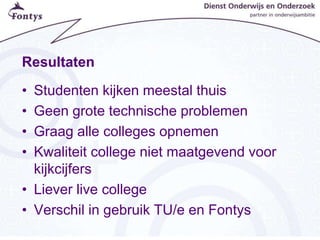
Resultaten
• Studenten kijken meestal thuis
• Geen grote technische problemen
• Graag alle colleges opnemen
• Kwaliteit college niet maatgevend voor
kijkcijfers
• Liever live college
• Verschil in gebruik TU/e en Fontys
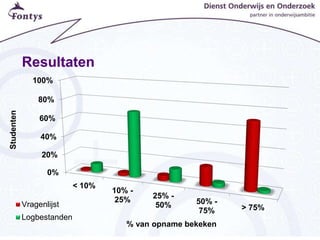
Resultaten
0%
20%
40%
60%
80%
100%
< 10%
10% -
25% 25% -
50% 50% -
75% > 75%
Studenten
% van opname bekeken
Vragenlijst
Logbestanden
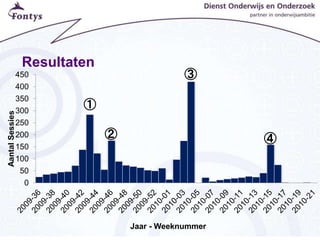
Resultaten
0
50
100
150
200
250
300
350
400
450
AantalSessies
Jaar - Weeknummer
①
② ④
③
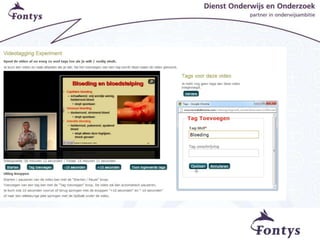
Tagging experimenten
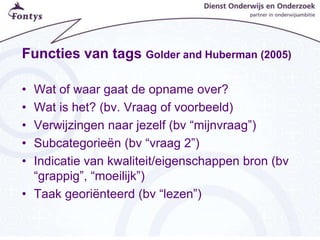
Functies van tags Golder and Huberman (2005)
• Wat of waar gaat de opname over?
• Wat is het? (bv. Vraag of voorbeeld)
• Verwijzingen naar jezelf (bv “mijnvraag”)
• Subcategorieën (bv “vraag 2”)
• Indicatie van kwaliteit/eigenschappen bron (bv
“grappig”, “moeilijk”)
• Taak georiënteerd (bv “lezen”)
Tagging experiment #1
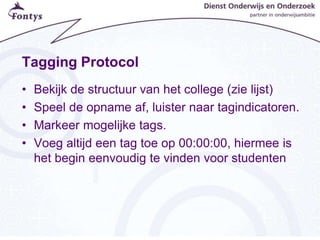
Tagging Protocol
• Bekijk de structuur van het college (zie lijst)
• Speel de opname af, luister naar tagindicatoren.
• Markeer mogelijke tags.
• Voeg altijd een tag toe op 00:00:00, hiermee is
het begin eenvoudig te vinden voor studenten
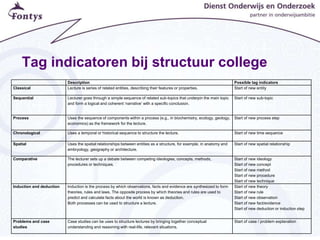
Tag indicatoren bij structuur college
Description Possible tag indicators
Classical Lecture is series of related entities, describing their features or properties. Start of new entity
Sequential Lecturer goes through a simple sequence of related sub-topics that underpin the main topic
and form a logical and coherent ‘narrative’ with a specific conclusion.
Start of new sub-topic
Process Uses the sequence of components within a process (e.g., in biochemistry, ecology, geology,
economics) as the framework for the lecture.
Start of new process step
Chronological Uses a temporal or historical sequence to structure the lecture. Start of new time sequence
Spatial Uses the spatial relationships between entities as a structure, for example, in anatomy and
embryology, geography or architecture.
Start of new spatial relationship
Comparative The lecturer sets up a debate between competing ideologies, concepts, methods,
procedures or techniques.
Start of new ideology
Start of new concept
Start of new method
Start of new procedure
Start of new technique
Induction and deduction Induction is the process by which observations, facts and evidence are synthesized to form
theories, rules and laws. The opposite process by which theories and rules are used to
predict and calculate facts about the world is known as deduction.
Both processes can be used to structure a lecture.
Start of new theory
Start of new rule
Start of new observation
Start of new fact/evidence
Start of new deduction or induction step
Problems and case
studies
Case studies can be uses to structure lectures by bringing together conceptual
understanding and reasoning with real-life, relevant situations.
Start of case / problem explanation
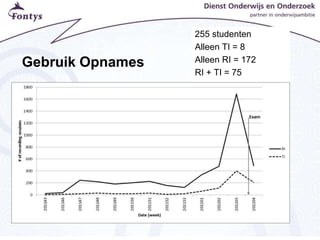
Gebruik Opnames
255 studenten
Alleen TI = 8
Alleen RI = 172
RI + TI = 75
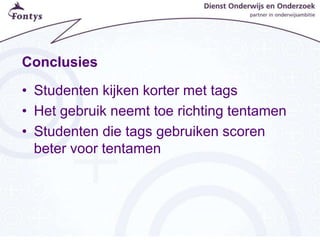
Conclusies
• Studenten kijken korter met tags
• Het gebruik neemt toe richting tentamen
• Studenten die tags gebruiken scoren
beter voor tentamen
Tagging experiment #2
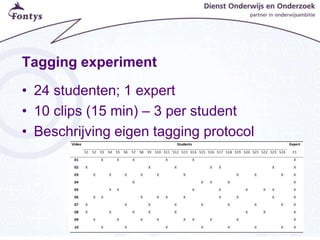
Tagging experiment
• 24 studenten; 1 expert
• 10 clips (15 min) – 3 per student
• Beschrijving eigen tagging protocol
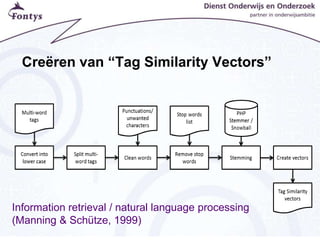
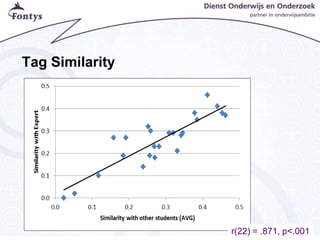
Creëren van “Tag Similarity Vectors”
Information retrieval / natural language processing
(Manning & Schütze, 1999)
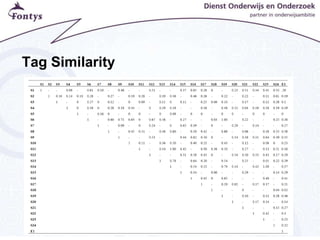
Tag Similarity
Tag Similarity
r(22) = .871, p<.001
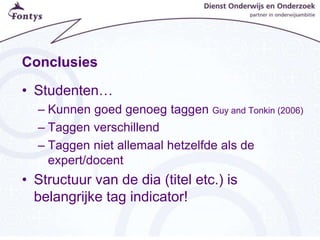
Conclusies
• Studenten…
– Kunnen goed genoeg taggen Guy and Tonkin (2006)
– Taggen verschillend
– Taggen niet allemaal hetzelfde als de
expert/docent
• Structuur van de dia (titel etc.) is
belangrijke tag indicator!
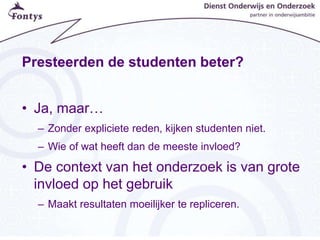
Presteerden de studenten beter?
• Ja, maar…
– Zonder expliciete reden, kijken studenten niet.
– Wie of wat heeft dan de meeste invloed?
• De context van het onderzoek is van grote
invloed op het gebruik
– Maakt resultaten moeilijker te repliceren.

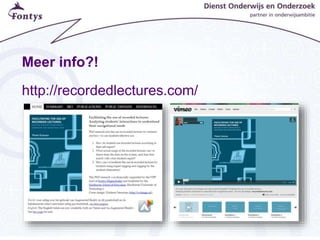
Meer info?!
http://recordedlectures.com/
Pierre Gorissen
P.Gorissen@fontys.nl
http://ictoblog.nl/
http://twitter.com/PeterMcAllister
http://www.slideshare.net/PiAir/
http://recordedlectures.com/

Het ondersteunen van het gebruik van opnames van colleges met behulp van tags

  • 1.
    Het ondersteunen vanhet gebruik van opnames van colleges met behulp van tags.
  • 2.
    Onderzoek gebruik opnamescolleges: • Hoe maken studenten gebruik van de opnames? – Wat zeggen ze? – Wat doen ze? • Welke gebruikspatronen? • Ondersteunen gebruik met tags http://recordedlectures.com/
  • 3.
  • 4.
    Onderzoek gebruik • Onlinevragenlijst – 517 (46.1%, N =1.122) – 7 vakken • Interviews (14) • Logdata op de server – Filteren / Opschonen / Analyseren
  • 5.
    Resultaten • Studenten kijkenmeestal thuis • Geen grote technische problemen • Graag alle colleges opnemen • Kwaliteit college niet maatgevend voor kijkcijfers • Liever live college • Verschil in gebruik TU/e en Fontys
  • 6.
    Resultaten 0% 20% 40% 60% 80% 100% < 10% 10% - 25%25% - 50% 50% - 75% > 75% Studenten % van opname bekeken Vragenlijst Logbestanden
  • 7.
  • 8.
  • 9.
    Functies van tagsGolder and Huberman (2005) • Wat of waar gaat de opname over? • Wat is het? (bv. Vraag of voorbeeld) • Verwijzingen naar jezelf (bv “mijnvraag”) • Subcategorieën (bv “vraag 2”) • Indicatie van kwaliteit/eigenschappen bron (bv “grappig”, “moeilijk”) • Taak georiënteerd (bv “lezen”)
  • 10.
  • 11.
    Tagging Protocol • Bekijkde structuur van het college (zie lijst) • Speel de opname af, luister naar tagindicatoren. • Markeer mogelijke tags. • Voeg altijd een tag toe op 00:00:00, hiermee is het begin eenvoudig te vinden voor studenten
  • 12.
    Tag indicatoren bijstructuur college Description Possible tag indicators Classical Lecture is series of related entities, describing their features or properties. Start of new entity Sequential Lecturer goes through a simple sequence of related sub-topics that underpin the main topic and form a logical and coherent ‘narrative’ with a specific conclusion. Start of new sub-topic Process Uses the sequence of components within a process (e.g., in biochemistry, ecology, geology, economics) as the framework for the lecture. Start of new process step Chronological Uses a temporal or historical sequence to structure the lecture. Start of new time sequence Spatial Uses the spatial relationships between entities as a structure, for example, in anatomy and embryology, geography or architecture. Start of new spatial relationship Comparative The lecturer sets up a debate between competing ideologies, concepts, methods, procedures or techniques. Start of new ideology Start of new concept Start of new method Start of new procedure Start of new technique Induction and deduction Induction is the process by which observations, facts and evidence are synthesized to form theories, rules and laws. The opposite process by which theories and rules are used to predict and calculate facts about the world is known as deduction. Both processes can be used to structure a lecture. Start of new theory Start of new rule Start of new observation Start of new fact/evidence Start of new deduction or induction step Problems and case studies Case studies can be uses to structure lectures by bringing together conceptual understanding and reasoning with real-life, relevant situations. Start of case / problem explanation
  • 13.
    Gebruik Opnames 255 studenten AlleenTI = 8 Alleen RI = 172 RI + TI = 75
  • 14.
    Conclusies • Studenten kijkenkorter met tags • Het gebruik neemt toe richting tentamen • Studenten die tags gebruiken scoren beter voor tentamen
  • 15.
  • 16.
    Tagging experiment • 24studenten; 1 expert • 10 clips (15 min) – 3 per student • Beschrijving eigen tagging protocol
  • 17.
    Creëren van “TagSimilarity Vectors” Information retrieval / natural language processing (Manning & Schütze, 1999)
  • 18.
  • 19.
  • 20.
    Conclusies • Studenten… – Kunnengoed genoeg taggen Guy and Tonkin (2006) – Taggen verschillend – Taggen niet allemaal hetzelfde als de expert/docent • Structuur van de dia (titel etc.) is belangrijke tag indicator!
  • 21.
    Presteerden de studentenbeter? • Ja, maar… – Zonder expliciete reden, kijken studenten niet. – Wie of wat heeft dan de meeste invloed? • De context van het onderzoek is van grote invloed op het gebruik – Maakt resultaten moeilijker te repliceren.
  • 22.
  • 23.