DIABETIC KETO ACIDOSIS (DKA)
PRESENTER: BIMENYIMANA Phocas, Med student, University of Rwanda
SUPERVISOR: Dr. NUBAHUMPATSE Emmanuel, Ped. Resident
Case scenario
A 9 years old, F patient consulted ER for drowsiness, abdominal pain and vomiting
for 2 days.
PMHx: known with DM 1, on Rapid insulin 4IU- 4IU and long acting insulin 8IU/day.
No hx of intoxification
VS: RR= 45, HR= 140, t=36, bp= 97/56
PE: drowsy, fruits smell, restlessness, weak pulses,
Inv: BG = 450mg/dl, VPH=7.0 , HCO3: 10meq/L, Urine ketones:++
BOHB = 2mmol/L
How can approach this patient?
What is your differentials?
Outline
1. Introduction
2. Etiology vs risk factors
3. Pathophysiology
4. Clinical manifestations
5. Ddx
6. Management
7. Complications
8. THM
INTRODUCTION
• DKA is the end result of the metabolic abnormalities resulting from a
severe deficiency of insulin or insulin effectiveness.
• Dka is the leading cause of mortality and morbidity in children with
DM 1
• It can also be seen in children ( adolescent) with DM 2
• It is one of diabetes mellitus emergencies
• Most of children who have DM1 will consult when they are in DKA
Definition (ISPAD) in 2018
• DKA is defined by the presence of all of the following in a
patient with diabetes
Hyperglycemia: Blood glucose of >200 mg/dL (11 mmol/L)
Metabolic acidosis: Venous pH <7.3 or a plasma bicarbonate
< 15 mmol/L
Ketosis: Determined by the presence of ketones in the blood
or urine
ETIOLOGY Vs RISK FACTORS
DKA is seen in Type 1 DM in case of:
 New onset DIABETIS MELLITUS (20-40 %)
 Known case of type 1 DM with omitted insulin dose or intercurrent
illness.
Idiopathic.
It is seen in Type 2 DM in case of:
Serious infections
 Trauma
 Cardiovascular or other emergencies
Pathophysiology
DKA TRIAD
• Hyperglycemia: BG of > 200mg/ (11mmol/dl)
• Metabolic acidosis: venous ph < 7.3 or plasma bicarbonates
< 15 meq/L
• Ketosis: ( ketonemia or ketonuria) beta hydroxybutyrate
BOHB >3mmol/L
Clinical manifestations
• The clinical manifestations of DKA are based on:
• Signs of preexisting diabetes mellitus (esp DM1)
• Electrolyte imbalance
• Volume depletion
• Acidosis.
CLINICAL PRESENTATIONS
• Polyuria; polydipsia less obvious in infants
• fatigue;
• signs of dehydration (underestimated due to increased serum
osmolality, then fluid shifts from intracellular to extracellular
• Nausea, vomiting, abdominal pain (can mimic acute abd?)
• Rapid and deep respiration (Kussmaul)
• Decreasing LOC related to severity acidosis
• weight loss, nocturia,...
• Occasionally diaper candidiasis
• Acetone(fruit) smell
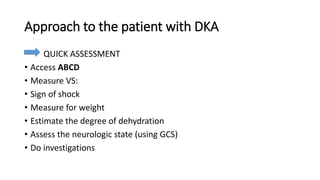
Approach to the patient with DKA
QUICK ASSESSMENT
• Access ABCD
• Measure VS:
• Sign of shock
• Measure for weight
• Estimate the degree of dehydration
• Assess the neurologic state (using GCS)
• Do investigations
Investigations
Immediate
• Blood glucose
• Venous pH and serum HCO3
• Ketosis (ketonemia, ketonuria)
• Accessory
• FBC
• Ca, phos, Mg
• Calculate anion gap
• Severity of DKA
• Electrolytes (Na, K, Cl)
• Urea, creatinine
• Pco2
Some comments on investigations
• Blood beta-hydroxybutyrate (BOHB) Concentrations ≥3 mmol/L are
consistent with DKA.
• But Measurement of urine ketones confirms ketosis but should not be
used to judge the severity of ketonemia acidosis, because this test
measures acetoacetate rather than BOHB, which is the predominant
ketone body at presentation of DKA.
• Urine acetoacetate (ketonuria) may persist for some time after
resolution of DKA and should not be considered an indication of
persistent ketoacidosis.
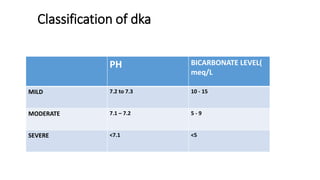
Classification of dka
PH BICARBONATE LEVEL(
meq/L
MILD 7.2 to 7.3 10 - 15
MODERATE 7.1 – 7.2 5 - 9
SEVERE <7.1 <5
Differential diagnosis
Management of dka
The clinician must individualize the treatment plan based on
the child's physical and laboratory findings, and treatment will need to
be adjusted over time for each child
The main principles of management are:
to administer insulin to resolve ketosis and
correct dehydration with intravenous (IV) fluids,
 reduce hyperglycemia,
correct electrolyte abnormalities with electrolyte replacement.
1. Fluids therapy
• Average water losses in children with DKA are approximately 70
mL/Kg (range 30 to 100 mL/Kg)
• Hypovolemic shock is rare in DKA but, if present, should be promptly
treated.
• Patients in shock should be evaluated for other causes of shock, such
as sepsis
• The goals of initial volume expansion are to restore the effective
circulating volume by acutely replacing some of the sodium and
water loss, and to improve the glomerular filtration rate to enhance
clearance of ketones and glucose from the blood
Fluids therapy cont’d
• Initial volume expansion of 10 to 20 mL/kg should be administered as
an IV bolus, using isotonic saline (0.9% normal saline]) or Ringer's
lactate in first 1-2 hrs
• If circulating volume is still compromised after the initial bolus is
complete, additional IV bolus infusions of 10 to 20 mL/kg can be
given
• Once the child is hemodynamically stable calculate fluids for
maintenance.
Dehydration should be corrected slowly to avoid cerebral edema
2. Correct Hyperglycemia
• Following the initial IV fluid bolus , an IV insulin 0.05-0.1 mg/kg/hr
infusion should be administered.
• Insulin administration offsets insulin resistance, suppresses hepatic
glucose output and ketogenesis, and stimulates peripheral glucose
uptake and metabolism to lower serum glucose concentrations and
resolve ketosis
• In addition, volume expansion will lower the serum glucose
concentration by dilution and via improvements in renal perfusion
Correct Hyperglycemia
• Insulin infusion: Insulin should be administered as an IV infusion at a
rate of 0.1 unit/kg/hour.
• Small studies comparing lower insulin infusion rates (0.05
unit/kg/hour) with this standard rate found no differences in the rate
of blood glucose decline and time to achieve the blood glucose target
of 250 mg/dL however, larger scale randomized trials are needed for
a more comprehensive comparison of benefits and risks of various
insulin infusion rates
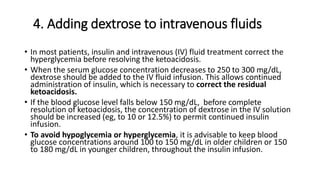
4. Adding dextrose to intravenous fluids
• In most patients, insulin and intravenous (IV) fluid treatment correct the
hyperglycemia before resolving the ketoacidosis.
• When the serum glucose concentration decreases to 250 to 300 mg/dL,
dextrose should be added to the IV fluid infusion. This allows continued
administration of insulin, which is necessary to correct the residual
ketoacidosis.
• If the blood glucose level falls below 150 mg/dL, before complete
resolution of ketoacidosis, the concentration of dextrose in the IV solution
should be increased (eg, to 10 or 12.5%) to permit continued insulin
infusion.
• To avoid hypoglycemia or hyperglycemia, it is advisable to keep blood
glucose concentrations around 100 to 150 mg/dL in older children or 150
to 180 mg/dL in younger children, throughout the insulin infusion.
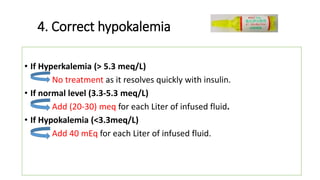
4. Correct hypokalemia
• If Hyperkalemia (> 5.3 meq/L)
No treatment as it resolves quickly with insulin.
• If normal level (3.3-5.3 meq/L)
Add (20-30) meq for each Liter of infused fluid.
• If Hypokalemia (<3.3meq/L)
Add 40 mEq for each Liter of infused fluid.
Mechanisms for treatment
• Insulin promotes the metabolism of ketoacid anions (BOHB and
acetoacetic acid), which also generates bicarbonate.
• Insulin also halts hepatic production of ketoacids and the release of
free fatty acids from fat to fuel ketogenesis.
• Rehydration improves renal perfusion and promotes excretion of
ketone bodies.
• Improved tissue perfusion also corrects lactic acidosis that may
contribute to the metabolic acid load.
5. Close monitoring
COMPLICATIONS
• Cerebral edema : over hydration
• Under hydration
• Hypokalemia
• Hypoglycemia
• For cerebral edema give mannitol: 0.5 - 1 g/kg intravenously over 15
minutes, acess and repeat after 30 min if necessary.
• Call neurologist for review.
Take home message
• DKA is defined by the presence of all of the following in a patient with
diabetes: Hyperglycemia, Metabolic acidosis and Ketosis
• Cause: Lack of insulin
• Treatment aim:
resolve ketosis
correct dehydration
reduce hyperglycemia
electrolyte abnormalities
• Hydration is the mainstay of management of DKA. Rapid and excessive
fluid administration should however be avoided due to the risk of cerebral
edema.
References
• International society of pediatric and adolescent diabetes
• Uptodate
• Nelson textbook of pediatrics 19 ed
• William’s endocrinology- 12th edition
Thank you for you kind attention
• COMMENTS AND QUESTIONS…………..
• OTHERWISE KEEP READING………………

Dka

  • 1.
    DIABETIC KETO ACIDOSIS(DKA) PRESENTER: BIMENYIMANA Phocas, Med student, University of Rwanda SUPERVISOR: Dr. NUBAHUMPATSE Emmanuel, Ped. Resident
  • 2.
    Case scenario A 9years old, F patient consulted ER for drowsiness, abdominal pain and vomiting for 2 days. PMHx: known with DM 1, on Rapid insulin 4IU- 4IU and long acting insulin 8IU/day. No hx of intoxification VS: RR= 45, HR= 140, t=36, bp= 97/56 PE: drowsy, fruits smell, restlessness, weak pulses, Inv: BG = 450mg/dl, VPH=7.0 , HCO3: 10meq/L, Urine ketones:++ BOHB = 2mmol/L How can approach this patient? What is your differentials?
  • 3.
    Outline 1. Introduction 2. Etiologyvs risk factors 3. Pathophysiology 4. Clinical manifestations 5. Ddx 6. Management 7. Complications 8. THM
  • 4.
    INTRODUCTION • DKA isthe end result of the metabolic abnormalities resulting from a severe deficiency of insulin or insulin effectiveness. • Dka is the leading cause of mortality and morbidity in children with DM 1 • It can also be seen in children ( adolescent) with DM 2 • It is one of diabetes mellitus emergencies • Most of children who have DM1 will consult when they are in DKA
  • 5.
    Definition (ISPAD) in2018 • DKA is defined by the presence of all of the following in a patient with diabetes Hyperglycemia: Blood glucose of >200 mg/dL (11 mmol/L) Metabolic acidosis: Venous pH <7.3 or a plasma bicarbonate < 15 mmol/L Ketosis: Determined by the presence of ketones in the blood or urine
  • 6.
    ETIOLOGY Vs RISKFACTORS DKA is seen in Type 1 DM in case of:  New onset DIABETIS MELLITUS (20-40 %)  Known case of type 1 DM with omitted insulin dose or intercurrent illness. Idiopathic. It is seen in Type 2 DM in case of: Serious infections  Trauma  Cardiovascular or other emergencies
  • 7.
  • 8.
    DKA TRIAD • Hyperglycemia:BG of > 200mg/ (11mmol/dl) • Metabolic acidosis: venous ph < 7.3 or plasma bicarbonates < 15 meq/L • Ketosis: ( ketonemia or ketonuria) beta hydroxybutyrate BOHB >3mmol/L
  • 9.
    Clinical manifestations • Theclinical manifestations of DKA are based on: • Signs of preexisting diabetes mellitus (esp DM1) • Electrolyte imbalance • Volume depletion • Acidosis.
  • 10.
    CLINICAL PRESENTATIONS • Polyuria;polydipsia less obvious in infants • fatigue; • signs of dehydration (underestimated due to increased serum osmolality, then fluid shifts from intracellular to extracellular • Nausea, vomiting, abdominal pain (can mimic acute abd?) • Rapid and deep respiration (Kussmaul) • Decreasing LOC related to severity acidosis • weight loss, nocturia,... • Occasionally diaper candidiasis • Acetone(fruit) smell
  • 11.
    Approach to thepatient with DKA QUICK ASSESSMENT • Access ABCD • Measure VS: • Sign of shock • Measure for weight • Estimate the degree of dehydration • Assess the neurologic state (using GCS) • Do investigations
  • 12.
    Investigations Immediate • Blood glucose •Venous pH and serum HCO3 • Ketosis (ketonemia, ketonuria) • Accessory • FBC • Ca, phos, Mg • Calculate anion gap • Severity of DKA • Electrolytes (Na, K, Cl) • Urea, creatinine • Pco2
  • 13.
    Some comments oninvestigations • Blood beta-hydroxybutyrate (BOHB) Concentrations ≥3 mmol/L are consistent with DKA. • But Measurement of urine ketones confirms ketosis but should not be used to judge the severity of ketonemia acidosis, because this test measures acetoacetate rather than BOHB, which is the predominant ketone body at presentation of DKA. • Urine acetoacetate (ketonuria) may persist for some time after resolution of DKA and should not be considered an indication of persistent ketoacidosis.
  • 14.
    Classification of dka PHBICARBONATE LEVEL( meq/L MILD 7.2 to 7.3 10 - 15 MODERATE 7.1 – 7.2 5 - 9 SEVERE <7.1 <5
  • 15.
  • 16.
    Management of dka Theclinician must individualize the treatment plan based on the child's physical and laboratory findings, and treatment will need to be adjusted over time for each child The main principles of management are: to administer insulin to resolve ketosis and correct dehydration with intravenous (IV) fluids,  reduce hyperglycemia, correct electrolyte abnormalities with electrolyte replacement.
  • 17.
    1. Fluids therapy •Average water losses in children with DKA are approximately 70 mL/Kg (range 30 to 100 mL/Kg) • Hypovolemic shock is rare in DKA but, if present, should be promptly treated. • Patients in shock should be evaluated for other causes of shock, such as sepsis • The goals of initial volume expansion are to restore the effective circulating volume by acutely replacing some of the sodium and water loss, and to improve the glomerular filtration rate to enhance clearance of ketones and glucose from the blood
  • 18.
    Fluids therapy cont’d •Initial volume expansion of 10 to 20 mL/kg should be administered as an IV bolus, using isotonic saline (0.9% normal saline]) or Ringer's lactate in first 1-2 hrs • If circulating volume is still compromised after the initial bolus is complete, additional IV bolus infusions of 10 to 20 mL/kg can be given • Once the child is hemodynamically stable calculate fluids for maintenance. Dehydration should be corrected slowly to avoid cerebral edema
  • 19.
    2. Correct Hyperglycemia •Following the initial IV fluid bolus , an IV insulin 0.05-0.1 mg/kg/hr infusion should be administered. • Insulin administration offsets insulin resistance, suppresses hepatic glucose output and ketogenesis, and stimulates peripheral glucose uptake and metabolism to lower serum glucose concentrations and resolve ketosis • In addition, volume expansion will lower the serum glucose concentration by dilution and via improvements in renal perfusion
  • 20.
    Correct Hyperglycemia • Insulininfusion: Insulin should be administered as an IV infusion at a rate of 0.1 unit/kg/hour. • Small studies comparing lower insulin infusion rates (0.05 unit/kg/hour) with this standard rate found no differences in the rate of blood glucose decline and time to achieve the blood glucose target of 250 mg/dL however, larger scale randomized trials are needed for a more comprehensive comparison of benefits and risks of various insulin infusion rates
  • 21.
    4. Adding dextroseto intravenous fluids • In most patients, insulin and intravenous (IV) fluid treatment correct the hyperglycemia before resolving the ketoacidosis. • When the serum glucose concentration decreases to 250 to 300 mg/dL, dextrose should be added to the IV fluid infusion. This allows continued administration of insulin, which is necessary to correct the residual ketoacidosis. • If the blood glucose level falls below 150 mg/dL, before complete resolution of ketoacidosis, the concentration of dextrose in the IV solution should be increased (eg, to 10 or 12.5%) to permit continued insulin infusion. • To avoid hypoglycemia or hyperglycemia, it is advisable to keep blood glucose concentrations around 100 to 150 mg/dL in older children or 150 to 180 mg/dL in younger children, throughout the insulin infusion.
  • 22.
    4. Correct hypokalemia •If Hyperkalemia (> 5.3 meq/L) No treatment as it resolves quickly with insulin. • If normal level (3.3-5.3 meq/L) Add (20-30) meq for each Liter of infused fluid. • If Hypokalemia (<3.3meq/L) Add 40 mEq for each Liter of infused fluid.
  • 23.
    Mechanisms for treatment •Insulin promotes the metabolism of ketoacid anions (BOHB and acetoacetic acid), which also generates bicarbonate. • Insulin also halts hepatic production of ketoacids and the release of free fatty acids from fat to fuel ketogenesis. • Rehydration improves renal perfusion and promotes excretion of ketone bodies. • Improved tissue perfusion also corrects lactic acidosis that may contribute to the metabolic acid load.
  • 25.
  • 26.
    COMPLICATIONS • Cerebral edema: over hydration • Under hydration • Hypokalemia • Hypoglycemia • For cerebral edema give mannitol: 0.5 - 1 g/kg intravenously over 15 minutes, acess and repeat after 30 min if necessary. • Call neurologist for review.
  • 27.
    Take home message •DKA is defined by the presence of all of the following in a patient with diabetes: Hyperglycemia, Metabolic acidosis and Ketosis • Cause: Lack of insulin • Treatment aim: resolve ketosis correct dehydration reduce hyperglycemia electrolyte abnormalities • Hydration is the mainstay of management of DKA. Rapid and excessive fluid administration should however be avoided due to the risk of cerebral edema.
  • 28.
    References • International societyof pediatric and adolescent diabetes • Uptodate • Nelson textbook of pediatrics 19 ed • William’s endocrinology- 12th edition
  • 29.
    Thank you foryou kind attention • COMMENTS AND QUESTIONS………….. • OTHERWISE KEEP READING………………