© Peter R. Egli 2015
1/11
Rev. 1.60
XML-RPC indigoo.com
INTRODUCTION TO XML-RPC,
A SIMPLE XML-BASED RPC MECHANISM
XML-RPC
Peter R. Egli
INDIGOO.COM
© Peter R. Egli 2015
2/11
Rev. 1.60
XML-RPC indigoo.com
Contents
1. What is XML-RPC?
2. XML-RPC architecture
3. XML-RPC protocol
4. XML-RPC server implementation in Java
5. Where to use XML-RPC
© Peter R. Egli 2015
3/11
Rev. 1.60
XML-RPC indigoo.com
1. What is XML-RPC?
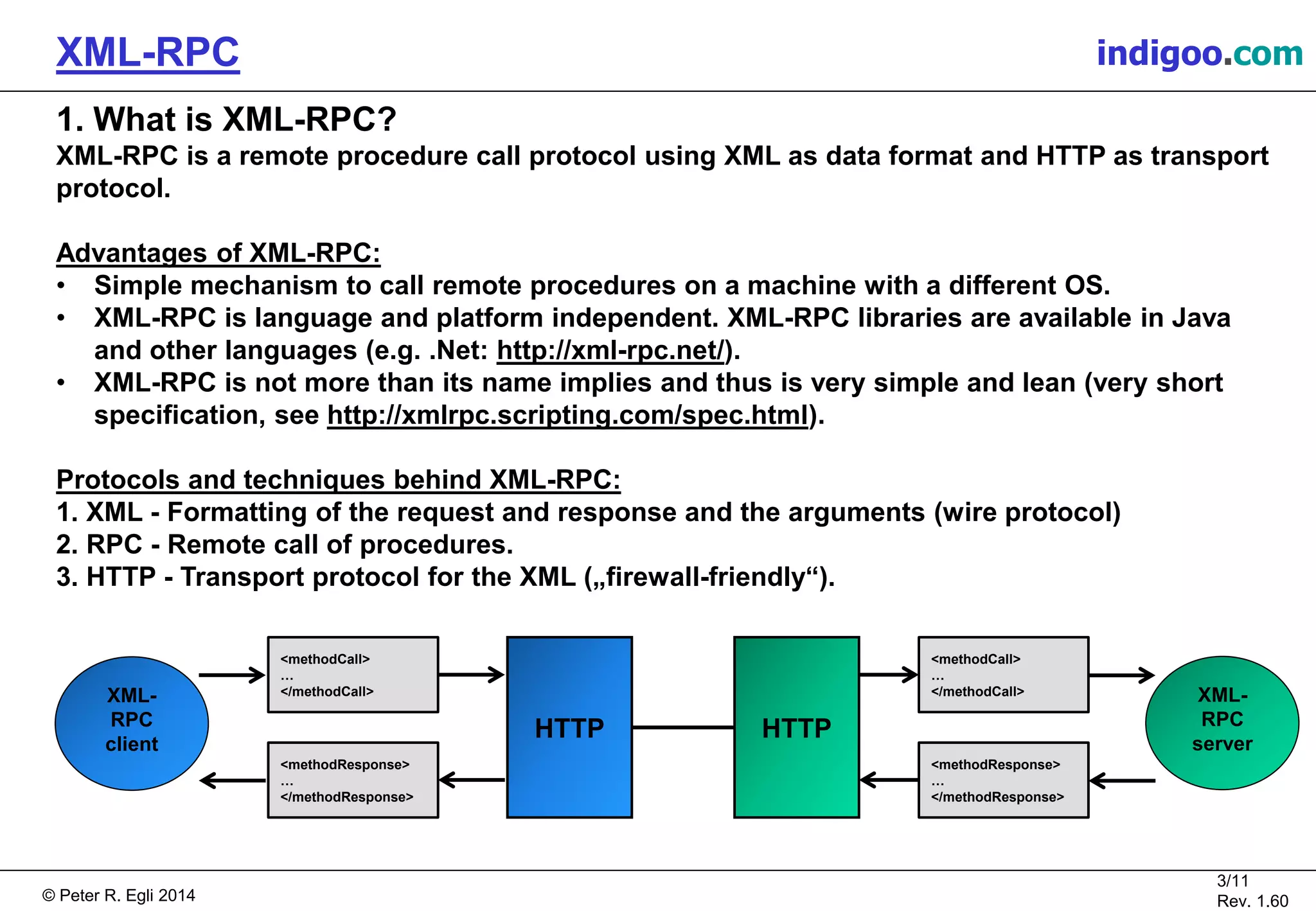
XML-RPC is a remote procedure call protocol using XML as data format and HTTP as transport
protocol.
Advantages of XML-RPC:
• Simple mechanism to call remote procedures on a machine with a different OS.
• XML-RPC is language and platform independent. XML-RPC libraries are available in Java
and other languages (e.g. .Net: http://xml-rpc.net/).
• XML-RPC is not more than its name implies and thus is very simple and lean (very short
specification, see http://xmlrpc.scripting.com/spec.html).
Protocols and techniques behind XML-RPC:
1. XML - Formatting of the request and response and the arguments (wire protocol)
2. RPC - Remote call of procedures.
3. HTTP - Transport protocol for the XML („firewall-friendly“).
<methodCall>
…
</methodCall>
HTTP HTTP
<methodResponse>
…
</methodResponse>
XML-
RPC
server
XML-
RPC
client
<methodCall>
…
</methodCall>
<methodResponse>
…
</methodResponse>
© Peter R. Egli 2015
4/11
Rev. 1.60
XML-RPC indigoo.com
2. XML-RPC architecture
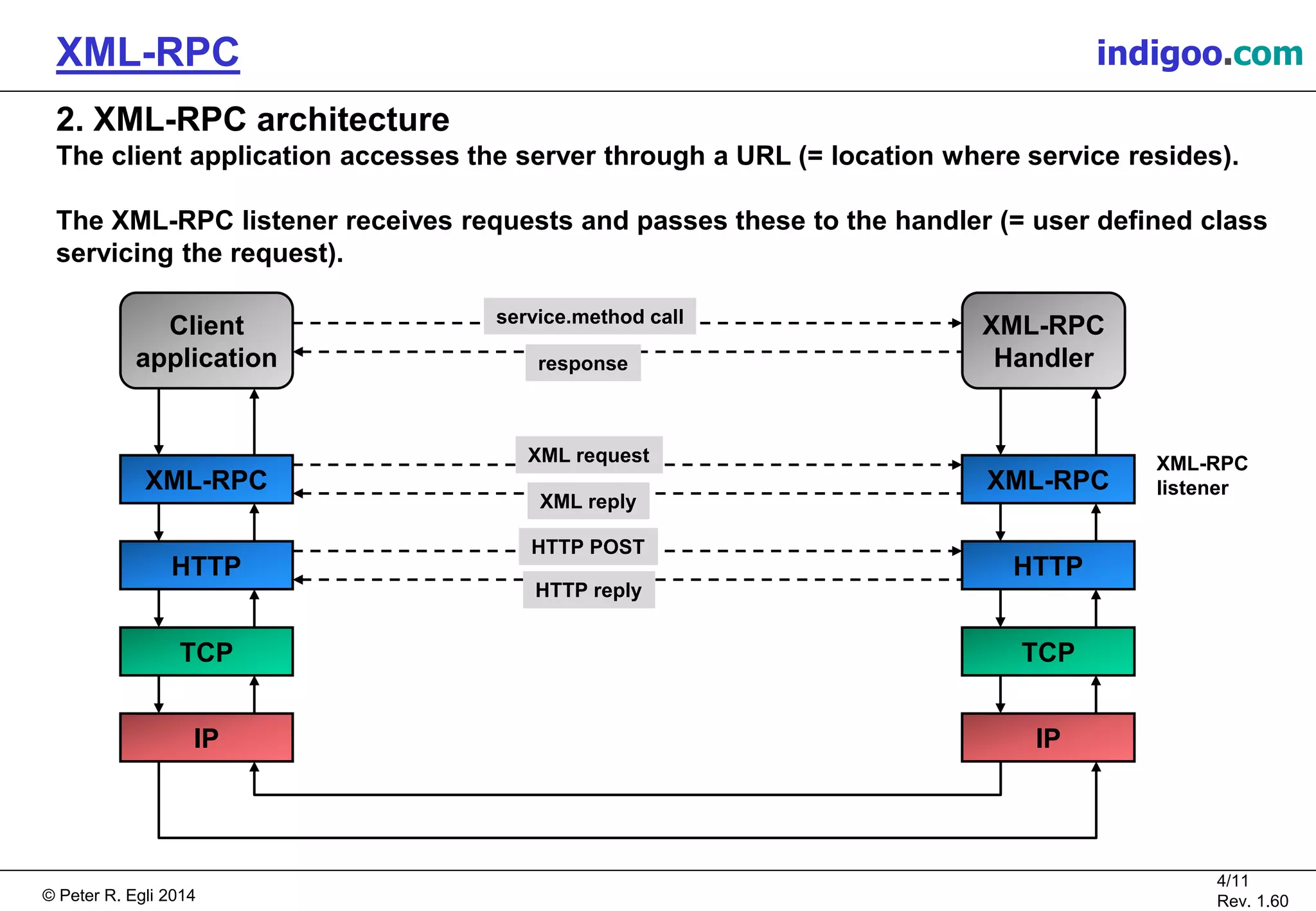
The client application accesses the server through a URL (= location where service resides).
The XML-RPC listener receives requests and passes these to the handler (= user defined class
servicing the request).
Client
application
XML-RPC
HTTP
TCP
IP
XML-RPC
HTTP
TCP
IP
XML-RPC
Handler
XML-RPC
listener
service.method call
response
XML request
XML reply
HTTP POST
HTTP reply
© Peter R. Egli 2015
5/11
Rev. 1.60
XML-RPC indigoo.com
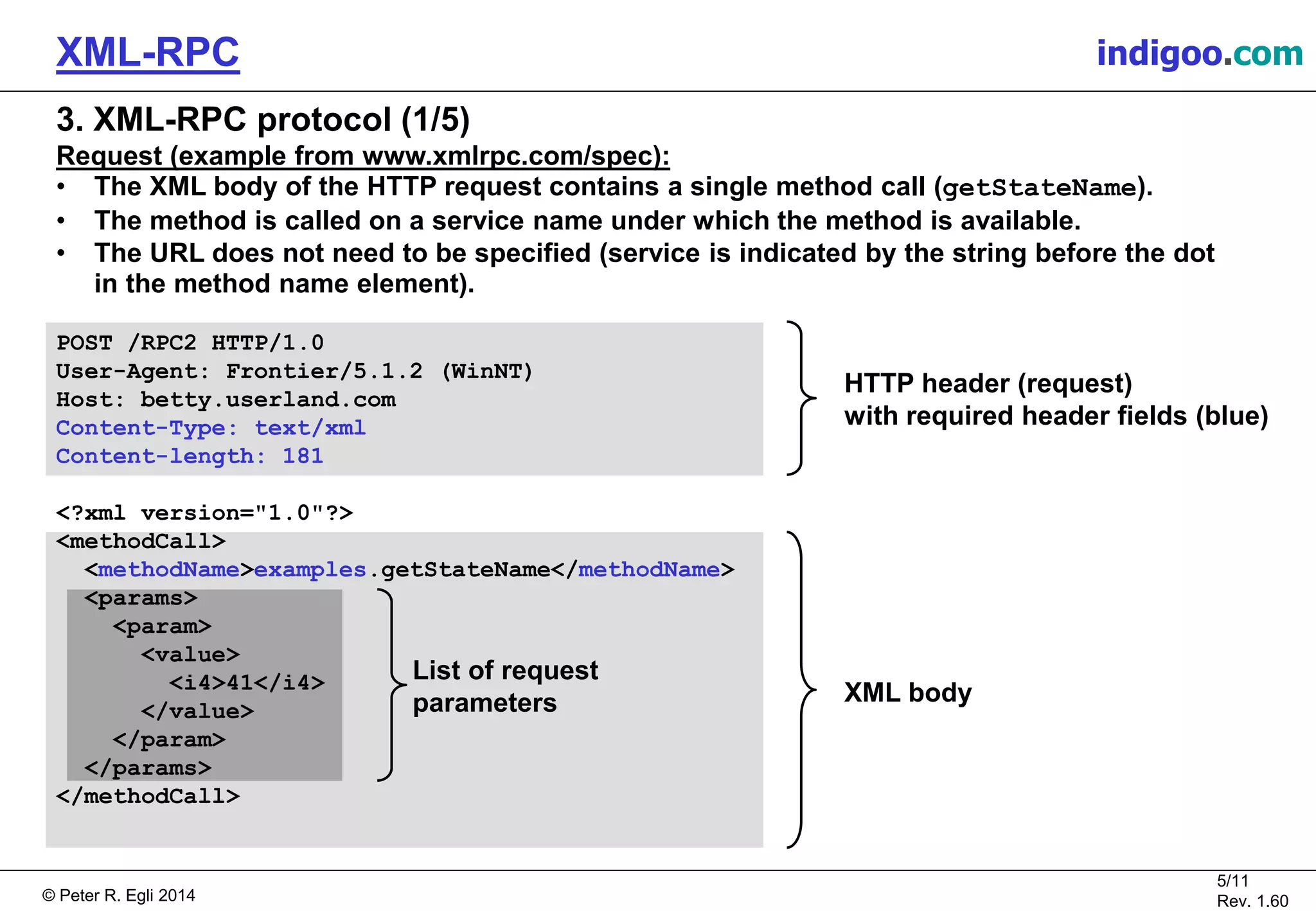
3. XML-RPC protocol (1/5)
Request (example from www.xmlrpc.com/spec):
• The XML body of the HTTP request contains a single method call (getStateName).
• The method is called on a service name under which the method is available.
• The URL does not need to be specified (service is indicated by the string before the dot
in the method name element).
POST /RPC2 HTTP/1.0
User-Agent: Frontier/5.1.2 (WinNT)
Host: betty.userland.com
Content-Type: text/xml
Content-length: 181
<?xml version="1.0"?>
<methodCall>
<methodName>examples.getStateName</methodName>
<params>
<param>
<value>
<i4>41</i4>
</value>
</param>
</params>
</methodCall>
HTTP header (request)
with required header fields (blue)
XML body
List of request
parameters
© Peter R. Egli 2015
6/11
Rev. 1.60
XML-RPC indigoo.com
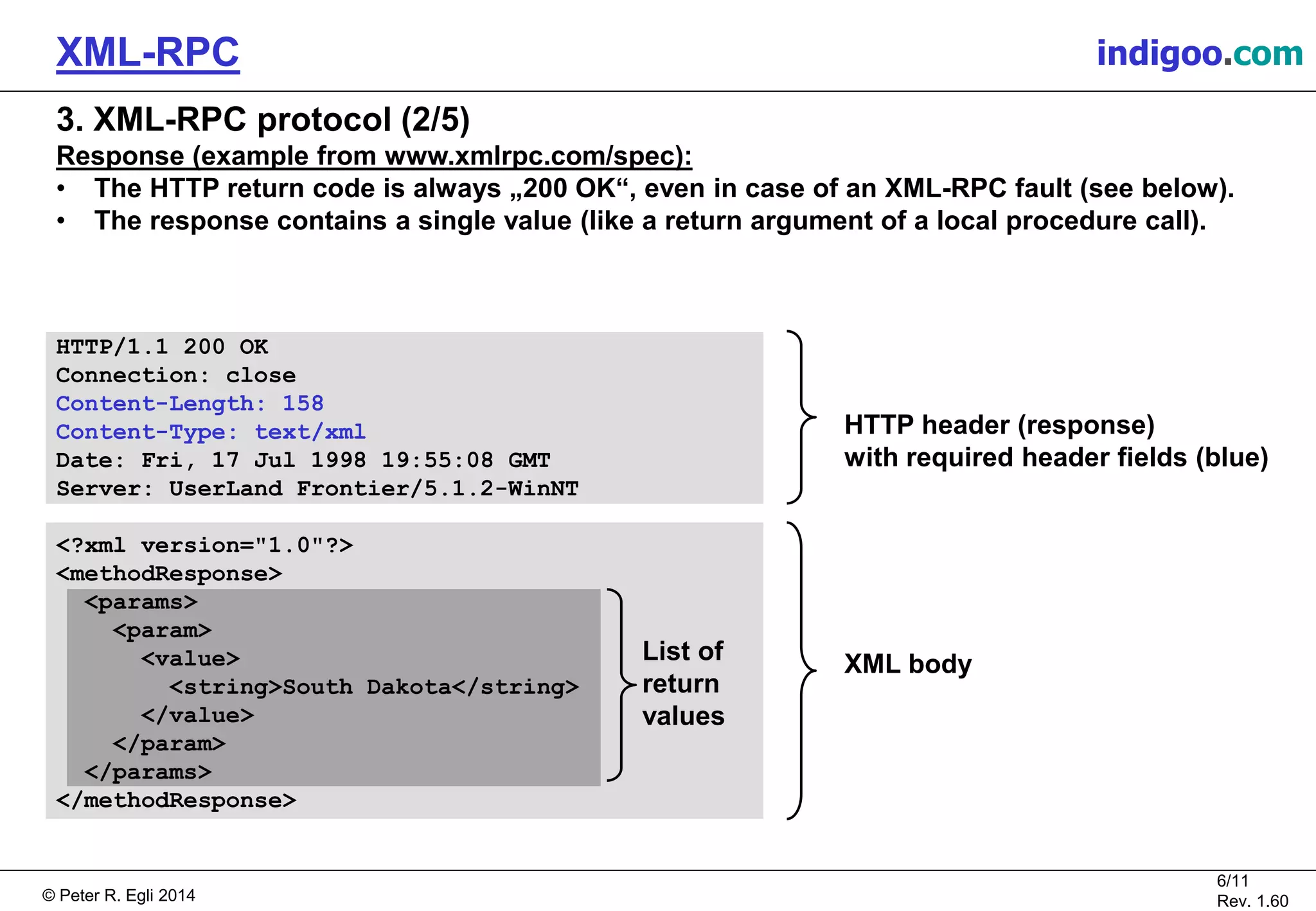
List of
return
values
3. XML-RPC protocol (2/5)
Response (example from www.xmlrpc.com/spec):
• The HTTP return code is always „200 OK“, even in case of an XML-RPC fault (see below).
• The response contains a single value (like a return argument of a local procedure call).
HTTP/1.1 200 OK
Connection: close
Content-Length: 158
Content-Type: text/xml
Date: Fri, 17 Jul 1998 19:55:08 GMT
Server: UserLand Frontier/5.1.2-WinNT
<?xml version="1.0"?>
<methodResponse>
<params>
<param>
<value>
<string>South Dakota</string>
</value>
</param>
</params>
</methodResponse>
HTTP header (response)
with required header fields (blue)
XML body
© Peter R. Egli 2015
7/11
Rev. 1.60
XML-RPC indigoo.com
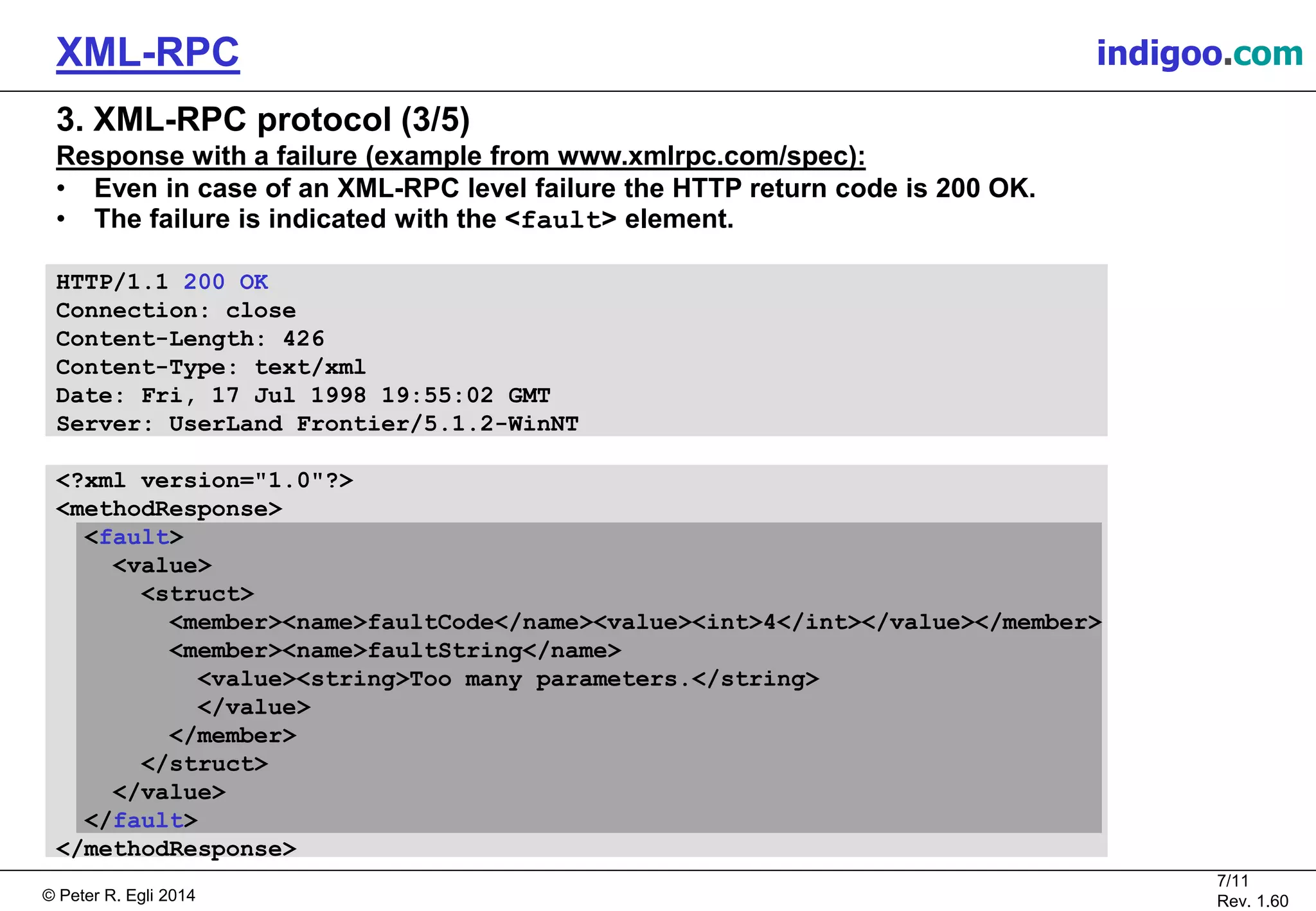
3. XML-RPC protocol (3/5)
Response with a failure (example from www.xmlrpc.com/spec):
• Even in case of an XML-RPC level failure the HTTP return code is 200 OK.
• The failure is indicated with the <fault> element.
HTTP/1.1 200 OK
Connection: close
Content-Length: 426
Content-Type: text/xml
Date: Fri, 17 Jul 1998 19:55:02 GMT
Server: UserLand Frontier/5.1.2-WinNT
<?xml version="1.0"?>
<methodResponse>
<fault>
<value>
<struct>
<member><name>faultCode</name><value><int>4</int></value></member>
<member><name>faultString</name>
<value><string>Too many parameters.</string>
</value>
</member>
</struct>
</value>
</fault>
</methodResponse>
© Peter R. Egli 2015
8/11
Rev. 1.60
XML-RPC indigoo.com
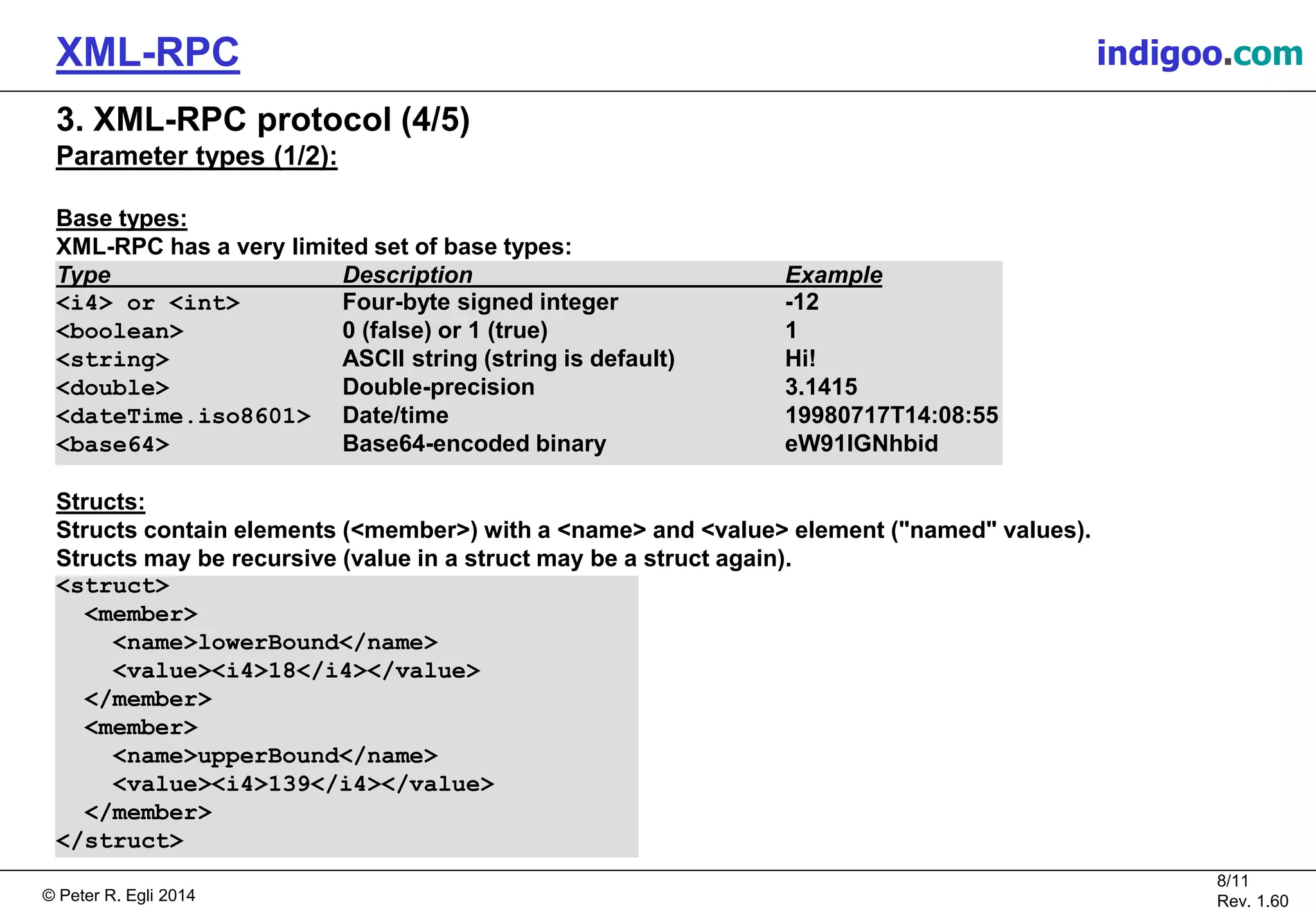
3. XML-RPC protocol (4/5)
Parameter types (1/2):
Base types:
XML-RPC has a very limited set of base types:
Type Description Example
<i4> or <int> Four-byte signed integer -12
<boolean> 0 (false) or 1 (true) 1
<string> ASCII string (string is default) Hi!
<double> Double-precision 3.1415
<dateTime.iso8601> Date/time 19980717T14:08:55
<base64> Base64-encoded binary eW91IGNhbid
Structs:
Structs contain elements (<member>) with a <name> and <value> element ("named" values).
Structs may be recursive (value in a struct may be a struct again).
<struct>
<member>
<name>lowerBound</name>
<value><i4>18</i4></value>
</member>
<member>
<name>upperBound</name>
<value><i4>139</i4></value>
</member>
</struct>
© Peter R. Egli 2015
9/11
Rev. 1.60
XML-RPC indigoo.com
3. XML-RPC protocol (5/5)
Parameter types (2/2):
Arrays:
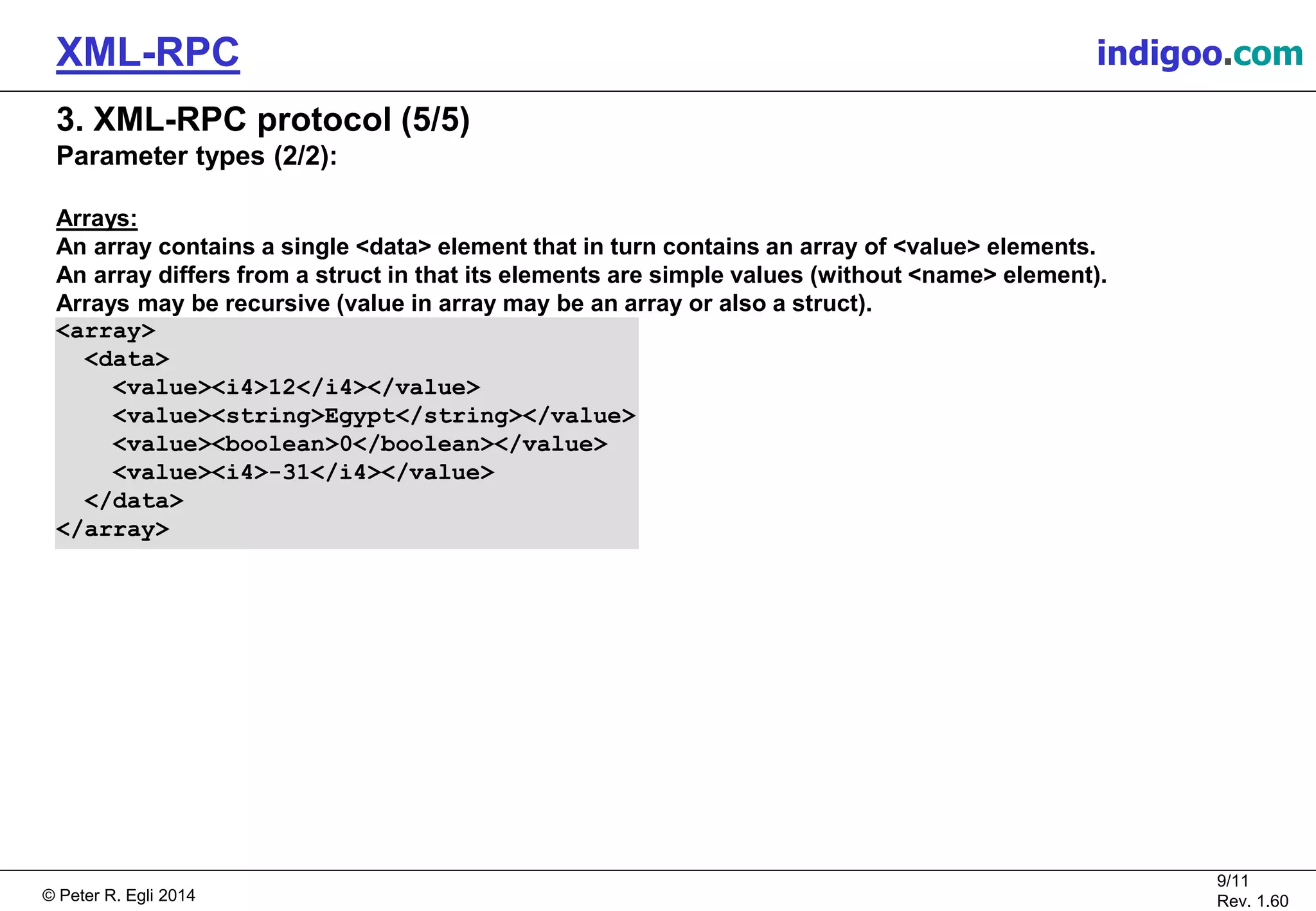
An array contains a single <data> element that in turn contains an array of <value> elements.
An array differs from a struct in that its elements are simple values (without <name> element).
Arrays may be recursive (value in array may be an array or also a struct).
<array>
<data>
<value><i4>12</i4></value>
<value><string>Egypt</string></value>
<value><boolean>0</boolean></value>
<value><i4>-31</i4></value>
</data>
</array>
© Peter R. Egli 2015
10/11
Rev. 1.60
XML-RPC indigoo.com
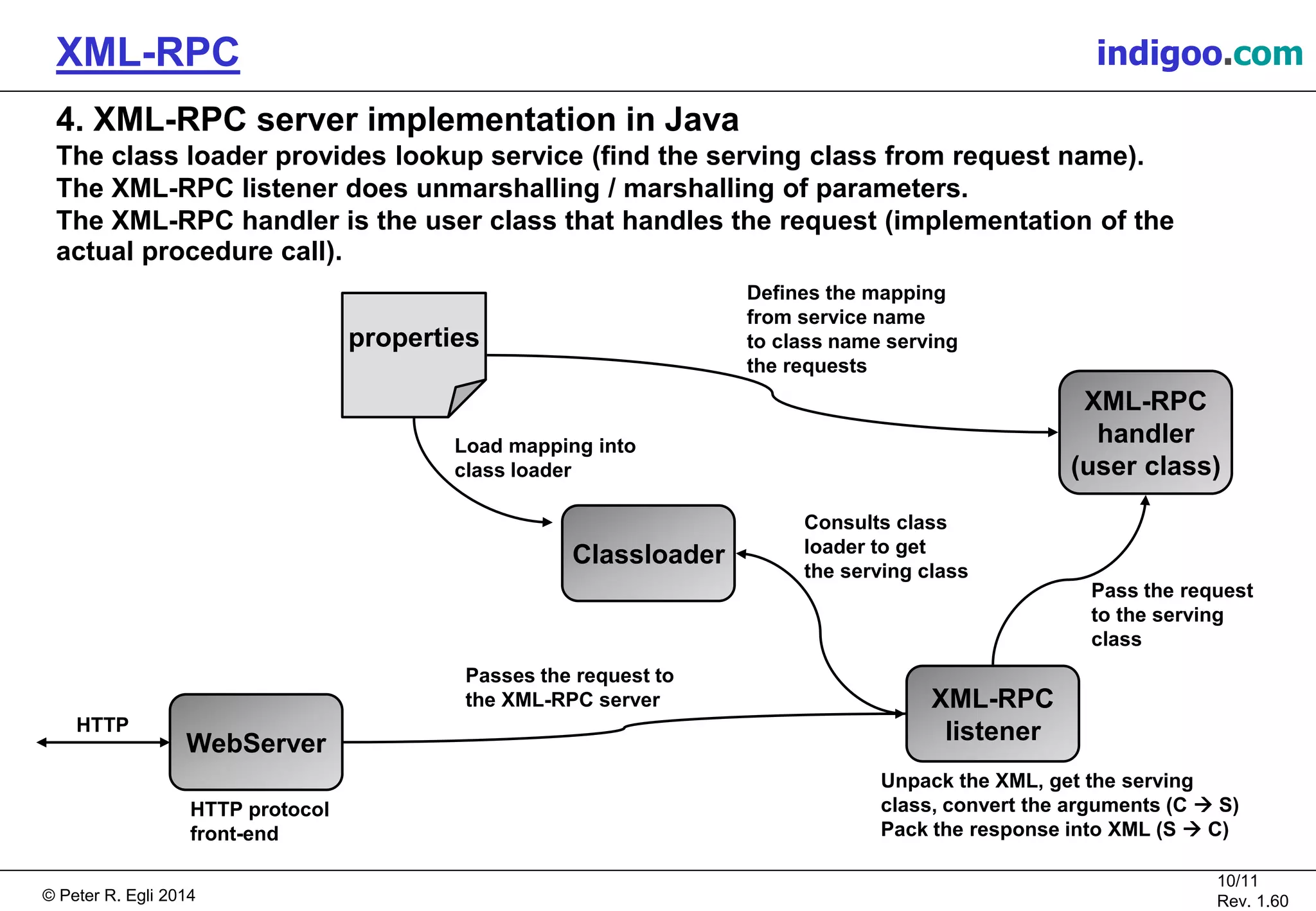
4. XML-RPC server implementation in Java
The class loader provides lookup service (find the serving class from request name).
The XML-RPC listener does unmarshalling / marshalling of parameters.
The XML-RPC handler is the user class that handles the request (implementation of the
actual procedure call).
WebServer
XML-RPC
listener
Classloader
properties
Load mapping into
class loader
XML-RPC
handler
(user class)
Defines the mapping
from service name
to class name serving
the requests
HTTP protocol
front-end
Passes the request to
the XML-RPC server
Consults class
loader to get
the serving class
Unpack the XML, get the serving
class, convert the arguments (C  S)
Pack the response into XML (S  C)
Pass the request
to the serving
class
HTTP
© Peter R. Egli 2015
11/11
Rev. 1.60
XML-RPC indigoo.com
5. Where to use XML-RPC
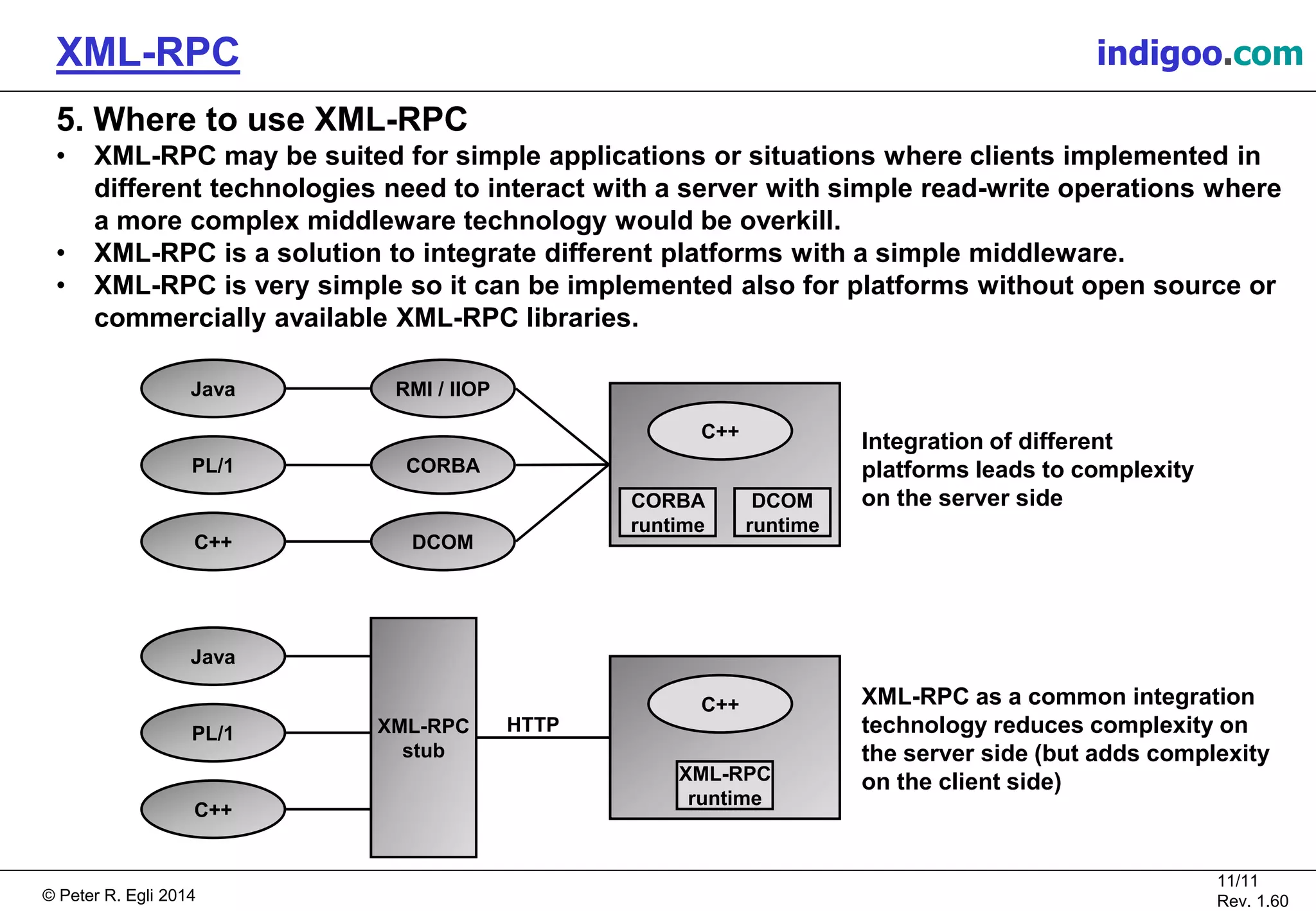
• XML-RPC may be suited for simple applications or situations where clients implemented in
different technologies need to interact with a server with simple read-write operations where
a more complex middleware technology would be overkill.
• XML-RPC is a solution to integrate different platforms with a simple middleware.
• XML-RPC is very simple so it can be implemented also for platforms without open source or
commercially available XML-RPC libraries.
Java
PL/1
C++
RMI / IIOP
CORBA
DCOM
CORBA
runtime
DCOM
runtime
C++
Integration of different
platforms leads to complexity
on the server side
Java
PL/1
C++
XML-RPC
runtime
C++ XML-RPC as a common integration
technology reduces complexity on
the server side (but adds complexity
on the client side)
XML-RPC
stub
HTTP

XML-RPC (XML Remote Procedure Call)

  • 1.
    © Peter R.Egli 2015 1/11 Rev. 1.60 XML-RPC indigoo.com INTRODUCTION TO XML-RPC, A SIMPLE XML-BASED RPC MECHANISM XML-RPC Peter R. Egli INDIGOO.COM
  • 2.
    © Peter R.Egli 2015 2/11 Rev. 1.60 XML-RPC indigoo.com Contents 1. What is XML-RPC? 2. XML-RPC architecture 3. XML-RPC protocol 4. XML-RPC server implementation in Java 5. Where to use XML-RPC
  • 3.
    © Peter R.Egli 2015 3/11 Rev. 1.60 XML-RPC indigoo.com 1. What is XML-RPC? XML-RPC is a remote procedure call protocol using XML as data format and HTTP as transport protocol. Advantages of XML-RPC: • Simple mechanism to call remote procedures on a machine with a different OS. • XML-RPC is language and platform independent. XML-RPC libraries are available in Java and other languages (e.g. .Net: http://xml-rpc.net/). • XML-RPC is not more than its name implies and thus is very simple and lean (very short specification, see http://xmlrpc.scripting.com/spec.html). Protocols and techniques behind XML-RPC: 1. XML - Formatting of the request and response and the arguments (wire protocol) 2. RPC - Remote call of procedures. 3. HTTP - Transport protocol for the XML („firewall-friendly“). <methodCall> … </methodCall> HTTP HTTP <methodResponse> … </methodResponse> XML- RPC server XML- RPC client <methodCall> … </methodCall> <methodResponse> … </methodResponse>
  • 4.
    © Peter R.Egli 2015 4/11 Rev. 1.60 XML-RPC indigoo.com 2. XML-RPC architecture The client application accesses the server through a URL (= location where service resides). The XML-RPC listener receives requests and passes these to the handler (= user defined class servicing the request). Client application XML-RPC HTTP TCP IP XML-RPC HTTP TCP IP XML-RPC Handler XML-RPC listener service.method call response XML request XML reply HTTP POST HTTP reply
  • 5.
    © Peter R.Egli 2015 5/11 Rev. 1.60 XML-RPC indigoo.com 3. XML-RPC protocol (1/5) Request (example from www.xmlrpc.com/spec): • The XML body of the HTTP request contains a single method call (getStateName). • The method is called on a service name under which the method is available. • The URL does not need to be specified (service is indicated by the string before the dot in the method name element). POST /RPC2 HTTP/1.0 User-Agent: Frontier/5.1.2 (WinNT) Host: betty.userland.com Content-Type: text/xml Content-length: 181 <?xml version="1.0"?> <methodCall> <methodName>examples.getStateName</methodName> <params> <param> <value> <i4>41</i4> </value> </param> </params> </methodCall> HTTP header (request) with required header fields (blue) XML body List of request parameters
  • 6.
    © Peter R.Egli 2015 6/11 Rev. 1.60 XML-RPC indigoo.com List of return values 3. XML-RPC protocol (2/5) Response (example from www.xmlrpc.com/spec): • The HTTP return code is always „200 OK“, even in case of an XML-RPC fault (see below). • The response contains a single value (like a return argument of a local procedure call). HTTP/1.1 200 OK Connection: close Content-Length: 158 Content-Type: text/xml Date: Fri, 17 Jul 1998 19:55:08 GMT Server: UserLand Frontier/5.1.2-WinNT <?xml version="1.0"?> <methodResponse> <params> <param> <value> <string>South Dakota</string> </value> </param> </params> </methodResponse> HTTP header (response) with required header fields (blue) XML body
  • 7.
    © Peter R.Egli 2015 7/11 Rev. 1.60 XML-RPC indigoo.com 3. XML-RPC protocol (3/5) Response with a failure (example from www.xmlrpc.com/spec): • Even in case of an XML-RPC level failure the HTTP return code is 200 OK. • The failure is indicated with the <fault> element. HTTP/1.1 200 OK Connection: close Content-Length: 426 Content-Type: text/xml Date: Fri, 17 Jul 1998 19:55:02 GMT Server: UserLand Frontier/5.1.2-WinNT <?xml version="1.0"?> <methodResponse> <fault> <value> <struct> <member><name>faultCode</name><value><int>4</int></value></member> <member><name>faultString</name> <value><string>Too many parameters.</string> </value> </member> </struct> </value> </fault> </methodResponse>
  • 8.
    © Peter R.Egli 2015 8/11 Rev. 1.60 XML-RPC indigoo.com 3. XML-RPC protocol (4/5) Parameter types (1/2): Base types: XML-RPC has a very limited set of base types: Type Description Example <i4> or <int> Four-byte signed integer -12 <boolean> 0 (false) or 1 (true) 1 <string> ASCII string (string is default) Hi! <double> Double-precision 3.1415 <dateTime.iso8601> Date/time 19980717T14:08:55 <base64> Base64-encoded binary eW91IGNhbid Structs: Structs contain elements (<member>) with a <name> and <value> element ("named" values). Structs may be recursive (value in a struct may be a struct again). <struct> <member> <name>lowerBound</name> <value><i4>18</i4></value> </member> <member> <name>upperBound</name> <value><i4>139</i4></value> </member> </struct>
  • 9.
    © Peter R.Egli 2015 9/11 Rev. 1.60 XML-RPC indigoo.com 3. XML-RPC protocol (5/5) Parameter types (2/2): Arrays: An array contains a single <data> element that in turn contains an array of <value> elements. An array differs from a struct in that its elements are simple values (without <name> element). Arrays may be recursive (value in array may be an array or also a struct). <array> <data> <value><i4>12</i4></value> <value><string>Egypt</string></value> <value><boolean>0</boolean></value> <value><i4>-31</i4></value> </data> </array>
  • 10.
    © Peter R.Egli 2015 10/11 Rev. 1.60 XML-RPC indigoo.com 4. XML-RPC server implementation in Java The class loader provides lookup service (find the serving class from request name). The XML-RPC listener does unmarshalling / marshalling of parameters. The XML-RPC handler is the user class that handles the request (implementation of the actual procedure call). WebServer XML-RPC listener Classloader properties Load mapping into class loader XML-RPC handler (user class) Defines the mapping from service name to class name serving the requests HTTP protocol front-end Passes the request to the XML-RPC server Consults class loader to get the serving class Unpack the XML, get the serving class, convert the arguments (C  S) Pack the response into XML (S  C) Pass the request to the serving class HTTP
  • 11.
    © Peter R.Egli 2015 11/11 Rev. 1.60 XML-RPC indigoo.com 5. Where to use XML-RPC • XML-RPC may be suited for simple applications or situations where clients implemented in different technologies need to interact with a server with simple read-write operations where a more complex middleware technology would be overkill. • XML-RPC is a solution to integrate different platforms with a simple middleware. • XML-RPC is very simple so it can be implemented also for platforms without open source or commercially available XML-RPC libraries. Java PL/1 C++ RMI / IIOP CORBA DCOM CORBA runtime DCOM runtime C++ Integration of different platforms leads to complexity on the server side Java PL/1 C++ XML-RPC runtime C++ XML-RPC as a common integration technology reduces complexity on the server side (but adds complexity on the client side) XML-RPC stub HTTP