Hackolade Tutorial
Part 8 – Import or reverse-engineer
Copyright © 2016-2023 Hackolade 1
Reverse-engineering
• Used to import structures into existing/new data models
• For modeling / documenting existing instances
• Starting point for further work:
• Descriptions and constraints
• Schema evolution
• Sharing with business-facing data dictionaries
• Data governance and compliance
• Consistency across different environments and deployments
• Etc…
Copyright © 2016-2023 Hackolade 2
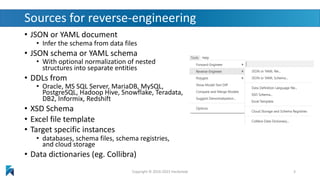
Sources for reverse-engineering
• JSON or YAML document
• Infer the schema from data files
• JSON schema or YAML schema
• With optional normalization of nested
structures into separate entities
• DDLs from
• Oracle, MS SQL Server, MariaDB, MySQL,
PostgreSQL, Hadoop Hive, Snowflake, Teradata,
DB2, Informix, Redshift
• XSD Schema
• Excel file template
• Target specific instances
• databases, schema files, schema registries,
and cloud storage
• Data dictionaries (eg. Collibra)
Copyright © 2016-2023 Hackolade 3
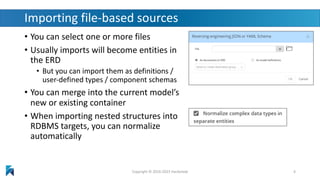
Importing file-based sources
• You can select one or more files
• Usually imports will become entities in
the ERD
• But you can import them as definitions /
user-defined types / component schemas
• You can merge into the current model’s
new or existing container
• When importing nested structures into
RDBMS targets, you can normalize
automatically
Copyright © 2016-2023 Hackolade 4
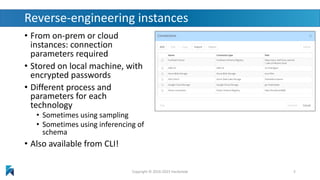
Reverse-engineering instances
• From on-prem or cloud
instances: connection
parameters required
• Stored on local machine, with
encrypted passwords
• Different process and
parameters for each
technology
• Sometimes using sampling
• Sometimes using inferencing of
schema
• Also available from CLI!
Copyright © 2016-2023 Hackolade 5
Reading material
• See Hackolade online documentation
• The Hackolade Blog
• This excellent new book:
MongoDB Data Modeling & Schema Design
• Many of the principles in the book are related to query
driven modeling based on access patterns!
• Hackolade’s on social media: LinkedIn page, Twitter page
• Download Hackolade studio for free
Copyright © 2016-2023 Hackolade 6
Questions?
Answers!
Copyright © 2016-2023 Hackolade 7

Hackolade Tutorial - part 8 - Import or reverse-engineer.pdf

  • 1.
    Hackolade Tutorial Part 8– Import or reverse-engineer Copyright © 2016-2023 Hackolade 1
  • 2.
    Reverse-engineering • Used toimport structures into existing/new data models • For modeling / documenting existing instances • Starting point for further work: • Descriptions and constraints • Schema evolution • Sharing with business-facing data dictionaries • Data governance and compliance • Consistency across different environments and deployments • Etc… Copyright © 2016-2023 Hackolade 2
  • 3.
    Sources for reverse-engineering •JSON or YAML document • Infer the schema from data files • JSON schema or YAML schema • With optional normalization of nested structures into separate entities • DDLs from • Oracle, MS SQL Server, MariaDB, MySQL, PostgreSQL, Hadoop Hive, Snowflake, Teradata, DB2, Informix, Redshift • XSD Schema • Excel file template • Target specific instances • databases, schema files, schema registries, and cloud storage • Data dictionaries (eg. Collibra) Copyright © 2016-2023 Hackolade 3
  • 4.
    Importing file-based sources •You can select one or more files • Usually imports will become entities in the ERD • But you can import them as definitions / user-defined types / component schemas • You can merge into the current model’s new or existing container • When importing nested structures into RDBMS targets, you can normalize automatically Copyright © 2016-2023 Hackolade 4
  • 5.
    Reverse-engineering instances • Fromon-prem or cloud instances: connection parameters required • Stored on local machine, with encrypted passwords • Different process and parameters for each technology • Sometimes using sampling • Sometimes using inferencing of schema • Also available from CLI! Copyright © 2016-2023 Hackolade 5
  • 6.
    Reading material • SeeHackolade online documentation • The Hackolade Blog • This excellent new book: MongoDB Data Modeling & Schema Design • Many of the principles in the book are related to query driven modeling based on access patterns! • Hackolade’s on social media: LinkedIn page, Twitter page • Download Hackolade studio for free Copyright © 2016-2023 Hackolade 6
  • 7.