Definition :
Maintenance is an action required to
preserve or retain the health of equipment.
Importance:
The solution to track various day to day
activities involved in maintenance department
of any organization. Activities such as
inspection, preventive maintenance and repair
of any technical object.
 Overview Plant Maintenance
 Technical Objects & benefits
 Plant Maintenance Processing & benefits
 Main Reports, Standard Analysis & benefits
 Overall benefits of SAP PM
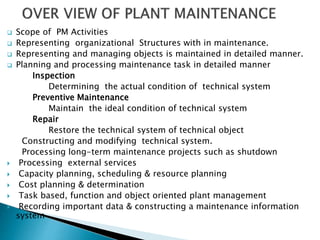
 Scope of PM Activities
 Representing organizational Structures with in maintenance.
 Representing and managing objects is maintained in detailed manner.
 Planning and processing maintenance task in detailed manner
Inspection
Determining the actual condition of technical system
Preventive Maintenance
Maintain the ideal condition of technical system
Repair
Restore the technical system of technical object
Constructing and modifying technical system.
Processing long-term maintenance projects such as shutdown
 Processing external services
 Capacity planning, scheduling & resource planning
 Cost planning & determination
 Task based, function and object oriented plant management
 Recording important data & constructing a maintenance information
system
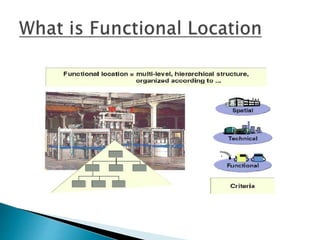
Functional Location
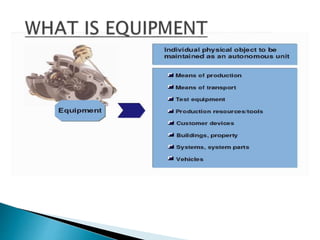
Equipment
Bill of Material
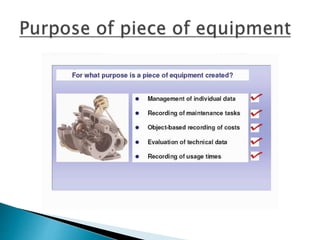
 Manage individual data from a maintenance perspective of the
object
 Perform individual maintenance tasks for the object
 Keep a record of maintenance tasks performed for the object
 Collect & evaluate data for over long period of time for the
object
 Time required for managing the technical object is reduced
 Maintenance processing is simplified
 More specific,through faster evelution of maintenance data.
 Time spent entering data during maintenance processing is
reduced
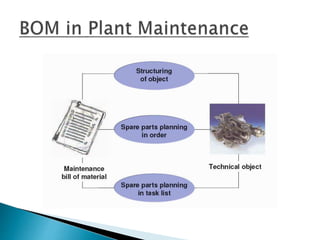
 A BILL OF MATERIAL ( BOM ) IS A COMPLETE
FORMALLY STRUCTURED LIST OF MATERIAL
MAKING UP A MACHINE OR ASSEMBLY
 A BILL OF MATERIAL ( BOM ) IS A COMPLETE
FORMALLY STRUCTURED LIST OF MATERIAL
MAKING UP A MACHINE OR ASSEMBLY
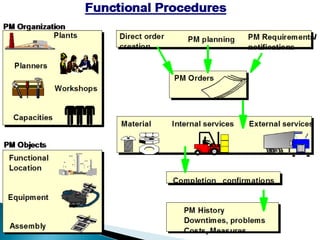
 Maintenance Notification
 Maintenance Order
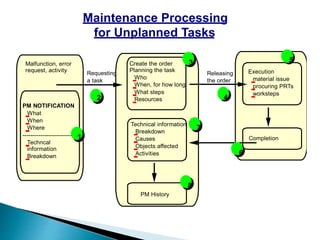
Maintenance Processing
for Unplanned Tasks
PM NOTIFICATION
What
When
Where
---------------------------
Techncal
information
Breakdown
Malfunction, error
request, activity
Create the order
Planning the task
Who
When, for how long
What steps
Resources
Technical information
Breakdown
Causes
Objects affected
Activities
PM History
Execution
material issue
procuring PRTs
worksteps
Completion1
2
3
4
5
6
7
8
Requesting
a task
Releasing
the order
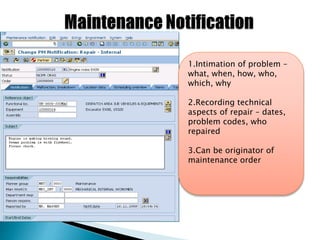
1.Intimation of problem –
what, when, how, who,
which, why
2.Recording technical
aspects of repair – dates,
problem codes, who
repaired
3.Can be originator of
maintenance order
1. Links to 1,2…n
Notifications
2. Commercial Functioning
3. Plan Labor, Spares,
External Service…..Planned
Costs & Dates…..Link with
MM, FICO, PS, HR, QM
4. Time Confirmation of
Labor, GI of Stock Material,
Service PR-PO-ES, Non
Stock Material PR-PO-GR,
Direct Bookings by
Accounts
5. Settlement
 The Plant Maintenance Information System can be
used at a variety of levels in the decision-making
process as an instrument for monitoring,
controlling and planning your business
operations.
 The Plant Maintenance Information System allows
you to evaluate breakdown behavior, or the
maintenance tasks of a technical system or
machine. It is also possible to analyze the costs
incurred or the party responsible for the
maintenance tasks and the exact activities that
have been performed.
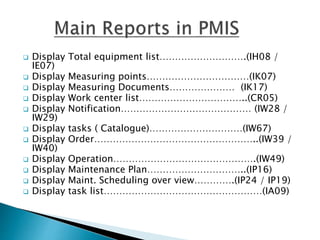
 Display Total equipment list……………………….(IH08 /
IE07)
 Display Measuring points……………………………(IK07)
 Display Measuring Documents………………… (IK17)
 Display Work center list……………………………..(CR05)
 Display Notification…………………………………… (IW28 /
IW29)
 Display tasks ( Catalogue)…………………………(IW67)
 Display Order……………………………………………..(IW39 /
IW40)
 Display Operation……………………………………….(IW49)
 Display Maintenance Plan…………………………..(IP16)
 Display Maint. Scheduling over view………….(IP24 / IP19)
 Display task list……………………………………………(IA09)
m
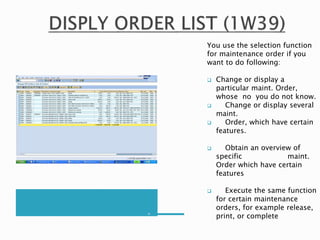
You use the selection function
for maintenance order if you
want to do following:
 Change or display a
particular maint. Order,
whose no you do not know.
 Change or display several
maint.
 Order, which have certain
features.
 Obtain an overview of
specific maint.
Order which have certain
features
 Execute the same function
for certain maintenance
orders, for example release,
print, or complete
There are a number of standard
analyses that are defined for
reviewing data, in Plant
Maintenance (PM). These standard
analyses review the data in the
information, structures related to
manufacturers, locations, damage
analysis, breakdowns, etc.
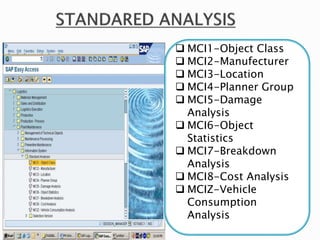
 MCI1-Object Class
 MCI2-Manufecturer
 MCI3-Location
 MCI4-Planner Group
 MCI5-Damage
Analysis
 MCI6-Object
Statistics
 MCI7-Breakdown
Analysis
 MCI8-Cost Analysis
 MCIZ-Vehicle
Consumption
Analysis
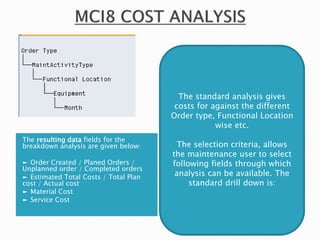
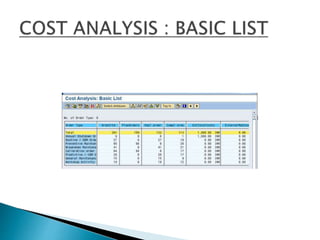
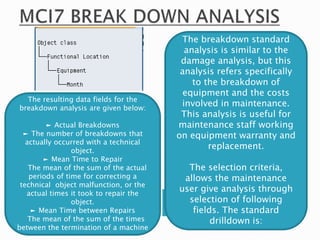
The resulting data fields for the
breakdown analysis are given below:
► Order Created / Planed Orders /
Unplanned order / Completed orders
► Estimated Total Costs / Total Plan
cost / Actual cost
► Material Cost
► Service Cost
The standard analysis gives
costs for against the different
Order type, Functional Location
wise etc.
The selection criteria, allows
the maintenance user to select
following fields through which
analysis can be available. The
standard drill down is:
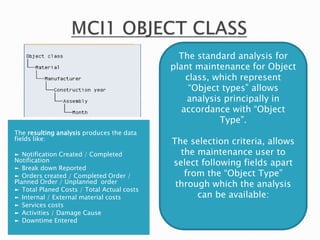
The resulting analysis produces the data
fields like:
► Notification Created / Completed
Notification
► Break down Reported
► Orders created / Completed Order /
Planned Order / Unplanned order
► Total Planed Costs / Total Actual costs
► Internal / External material costs
► Services costs
► Activities / Damage Cause
► Downtime Entered
The standard analysis for
plant maintenance for Object
class, which represent
“Object types” allows
analysis principally in
accordance with “Object
Type”.
The selection criteria, allows
the maintenance user to
select following fields apart
from the “Object Type”
through which the analysis
can be available:
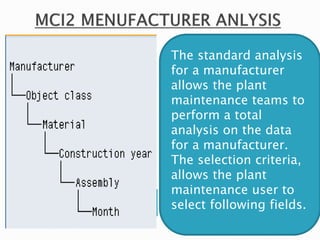
The standard analysis
for a manufacturer
allows the plant
maintenance teams to
perform a total
analysis on the data
for a manufacturer.
The selection criteria,
allows the plant
maintenance user to
select following fields.
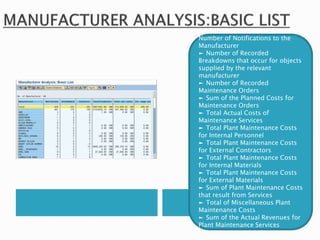
Number of Notifications to the
Manufacturer
► Number of Recorded
Breakdowns that occur for objects
supplied by the relevant
manufacturer
► Number of Recorded
Maintenance Orders
► Sum of the Planned Costs for
Maintenance Orders
► Total Actual Costs of
Maintenance Services
► Total Plant Maintenance Costs
for Internal Personnel
► Total Plant Maintenance Costs
for External Contractors
► Total Plant Maintenance Costs
for Internal Materials
► Total Plant Maintenance Costs
for External Materials
► Sum of Plant Maintenance Costs
that result from Services
► Total of Miscellaneous Plant
Maintenance Costs
► Sum of the Actual Revenues for
Plant Maintenance Services
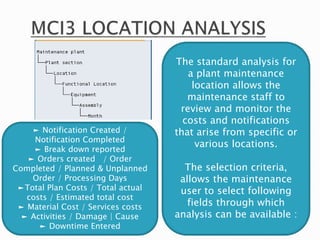
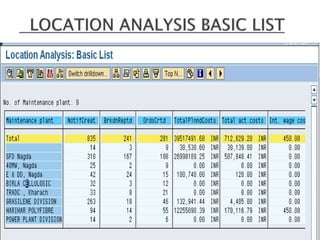
The standard analysis for
a plant maintenance
location allows the
maintenance staff to
review and monitor the
costs and notifications
that arise from specific or
various locations.
The selection criteria,
allows the maintenance
user to select following
fields through which
analysis can be available :
► Notification Created /
Notification Completed
► Break down reported
► Orders created / Order
Completed / Planned & Unplanned
Order / Processing Days
►Total Plan Costs / Total actual
costs / Estimated total cost
► Material Cost / Services costs
► Activities / Damage | Cause
► Downtime Entered
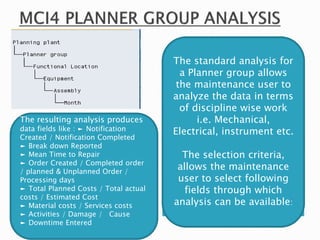
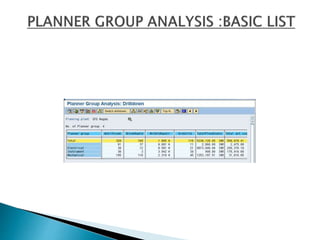
The standard analysis for
a Planner group allows
the maintenance user to
analyze the data in terms
of discipline wise work
i.e. Mechanical,
Electrical, instrument etc.
The selection criteria,
allows the maintenance
user to select following
fields through which
analysis can be available:
The resulting analysis produces
data fields like : ► Notification
Created / Notification Completed
► Break down Reported
► Mean Time to Repair
► Order Created / Completed order
/ planned & Unplanned Order /
Processing days
► Total Planned Costs / Total actual
costs / Estimated Cost
► Material costs / Services costs
► Activities / Damage / Cause
► Downtime Entered
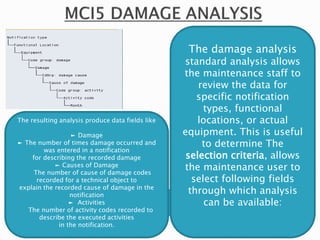
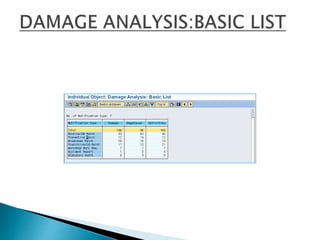
The damage analysis
standard analysis allows
the maintenance staff to
review the data for
specific notification
types, functional
locations, or actual
equipment. This is useful
to determine The
selection criteria, allows
the maintenance user to
select following fields
through which analysis
can be available:
The resulting analysis produce data fields like
► Damage
► The number of times damage occurred and
was entered in a notification
for describing the recorded damage
► Causes of Damage
The number of cause of damage codes
recorded for a technical object to
explain the recorded cause of damage in the
notification
► Activities
The number of activity codes recorded to
describe the executed activities
in the notification.
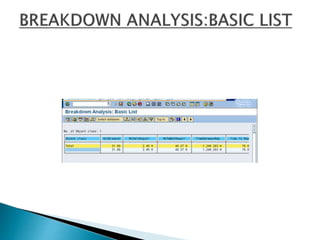
The breakdown standard
analysis is similar to the
damage analysis, but this
analysis refers specifically
to the breakdown of
equipment and the costs
involved in maintenance.
This analysis is useful for
maintenance staff working
on equipment warranty and
replacement.
The selection criteria,
allows the maintenance
user give analysis through
selection of following
fields. The standard
drilldown is:
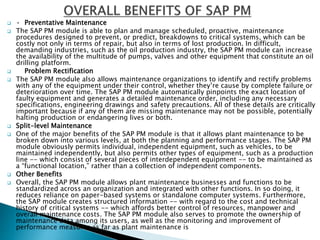
The resulting data fields for the
breakdown analysis are given below:
► Actual Breakdowns
► The number of breakdowns that
actually occurred with a technical
object.
► Mean Time to Repair
The mean of the sum of the actual
periods of time for correcting a
technical object malfunction, or the
actual times it took to repair the
object.
► Mean Time between Repairs
The mean of the sum of the times
between the termination of a machine
 · Preventative Maintenance
 The SAP PM module is able to plan and manage scheduled, proactive, maintenance
procedures designed to prevent, or predict, breakdowns to critical systems, which can be
costly not only in terms of repair, but also in terms of lost production. In difficult,
demanding industries, such as the oil production industry, the SAP PM module can increase
the availability of the multitude of pumps, valves and other equipment that constitute an oil
drilling platform.
 Problem Rectification
 The SAP PM module also allows maintenance organizations to identify and rectify problems
with any of the equipment under their control, whether they’re cause by complete failure or
deterioration over time. The SAP PM module automatically pinpoints the exact location of
faulty equipment and generates a detailed maintenance order, including any necessary
specifications, engineering drawings and safety precautions. All of these details are critically
important because if any of them are missing maintenance may not be possible, potentially
halting production or endangering lives or both.
 Split-level Maintenance
 One of the major benefits of the SAP PM module is that it allows plant maintenance to be
broken down into various levels, at both the planning and performance stages. The SAP PM
module obviously permits individual, independent equipment, such as vehicles, to be
maintained independently, but also permits other types of equipment, such as a production
line -- which consist of several pieces of interdependent equipment -- to be maintained as
a “functional location,” rather than a collection of independent components.
 Other Benefits
 Overall, the SAP PM module allows plant maintenance businesses and functions to be
standardized across an organization and integrated with other functions. In so doing, it
reduces reliance on paper-based systems or standalone computer systems. Furthermore,
the SAP module creates structured information -- with regard to the cost and technical
history of critical systems -- which affords better control of resources, manpower and
overall maintenance costs. The SAP PM module also serves to promote the ownership of
maintenance data among its users, as well as the monitoring and improvement of
performance measures as far as plant maintenance is

SAP BASED PLANT MAINTENANCE

  • 2.
    Definition : Maintenance isan action required to preserve or retain the health of equipment. Importance: The solution to track various day to day activities involved in maintenance department of any organization. Activities such as inspection, preventive maintenance and repair of any technical object.
  • 3.
     Overview PlantMaintenance  Technical Objects & benefits  Plant Maintenance Processing & benefits  Main Reports, Standard Analysis & benefits  Overall benefits of SAP PM
  • 4.
     Scope ofPM Activities  Representing organizational Structures with in maintenance.  Representing and managing objects is maintained in detailed manner.  Planning and processing maintenance task in detailed manner Inspection Determining the actual condition of technical system Preventive Maintenance Maintain the ideal condition of technical system Repair Restore the technical system of technical object Constructing and modifying technical system. Processing long-term maintenance projects such as shutdown  Processing external services  Capacity planning, scheduling & resource planning  Cost planning & determination  Task based, function and object oriented plant management  Recording important data & constructing a maintenance information system
  • 5.
  • 7.
     Manage individualdata from a maintenance perspective of the object  Perform individual maintenance tasks for the object  Keep a record of maintenance tasks performed for the object  Collect & evaluate data for over long period of time for the object  Time required for managing the technical object is reduced  Maintenance processing is simplified  More specific,through faster evelution of maintenance data.  Time spent entering data during maintenance processing is reduced
  • 10.
     A BILLOF MATERIAL ( BOM ) IS A COMPLETE FORMALLY STRUCTURED LIST OF MATERIAL MAKING UP A MACHINE OR ASSEMBLY  A BILL OF MATERIAL ( BOM ) IS A COMPLETE FORMALLY STRUCTURED LIST OF MATERIAL MAKING UP A MACHINE OR ASSEMBLY
  • 12.
  • 14.
    Maintenance Processing for UnplannedTasks PM NOTIFICATION What When Where --------------------------- Techncal information Breakdown Malfunction, error request, activity Create the order Planning the task Who When, for how long What steps Resources Technical information Breakdown Causes Objects affected Activities PM History Execution material issue procuring PRTs worksteps Completion1 2 3 4 5 6 7 8 Requesting a task Releasing the order
  • 15.
    1.Intimation of problem– what, when, how, who, which, why 2.Recording technical aspects of repair – dates, problem codes, who repaired 3.Can be originator of maintenance order
  • 16.
    1. Links to1,2…n Notifications 2. Commercial Functioning 3. Plan Labor, Spares, External Service…..Planned Costs & Dates…..Link with MM, FICO, PS, HR, QM 4. Time Confirmation of Labor, GI of Stock Material, Service PR-PO-ES, Non Stock Material PR-PO-GR, Direct Bookings by Accounts 5. Settlement
  • 18.
     The PlantMaintenance Information System can be used at a variety of levels in the decision-making process as an instrument for monitoring, controlling and planning your business operations.  The Plant Maintenance Information System allows you to evaluate breakdown behavior, or the maintenance tasks of a technical system or machine. It is also possible to analyze the costs incurred or the party responsible for the maintenance tasks and the exact activities that have been performed.
  • 19.
     Display Totalequipment list……………………….(IH08 / IE07)  Display Measuring points……………………………(IK07)  Display Measuring Documents………………… (IK17)  Display Work center list……………………………..(CR05)  Display Notification…………………………………… (IW28 / IW29)  Display tasks ( Catalogue)…………………………(IW67)  Display Order……………………………………………..(IW39 / IW40)  Display Operation……………………………………….(IW49)  Display Maintenance Plan…………………………..(IP16)  Display Maint. Scheduling over view………….(IP24 / IP19)  Display task list……………………………………………(IA09)
  • 20.
    m You use theselection function for maintenance order if you want to do following:  Change or display a particular maint. Order, whose no you do not know.  Change or display several maint.  Order, which have certain features.  Obtain an overview of specific maint. Order which have certain features  Execute the same function for certain maintenance orders, for example release, print, or complete
  • 21.
    There are anumber of standard analyses that are defined for reviewing data, in Plant Maintenance (PM). These standard analyses review the data in the information, structures related to manufacturers, locations, damage analysis, breakdowns, etc.
  • 22.
     MCI1-Object Class MCI2-Manufecturer  MCI3-Location  MCI4-Planner Group  MCI5-Damage Analysis  MCI6-Object Statistics  MCI7-Breakdown Analysis  MCI8-Cost Analysis  MCIZ-Vehicle Consumption Analysis
  • 23.
    The resulting datafields for the breakdown analysis are given below: ► Order Created / Planed Orders / Unplanned order / Completed orders ► Estimated Total Costs / Total Plan cost / Actual cost ► Material Cost ► Service Cost The standard analysis gives costs for against the different Order type, Functional Location wise etc. The selection criteria, allows the maintenance user to select following fields through which analysis can be available. The standard drill down is:
  • 24.
    The resulting analysisproduces the data fields like: ► Notification Created / Completed Notification ► Break down Reported ► Orders created / Completed Order / Planned Order / Unplanned order ► Total Planed Costs / Total Actual costs ► Internal / External material costs ► Services costs ► Activities / Damage Cause ► Downtime Entered The standard analysis for plant maintenance for Object class, which represent “Object types” allows analysis principally in accordance with “Object Type”. The selection criteria, allows the maintenance user to select following fields apart from the “Object Type” through which the analysis can be available:
  • 26.
    The standard analysis fora manufacturer allows the plant maintenance teams to perform a total analysis on the data for a manufacturer. The selection criteria, allows the plant maintenance user to select following fields.
  • 27.
    Number of Notificationsto the Manufacturer ► Number of Recorded Breakdowns that occur for objects supplied by the relevant manufacturer ► Number of Recorded Maintenance Orders ► Sum of the Planned Costs for Maintenance Orders ► Total Actual Costs of Maintenance Services ► Total Plant Maintenance Costs for Internal Personnel ► Total Plant Maintenance Costs for External Contractors ► Total Plant Maintenance Costs for Internal Materials ► Total Plant Maintenance Costs for External Materials ► Sum of Plant Maintenance Costs that result from Services ► Total of Miscellaneous Plant Maintenance Costs ► Sum of the Actual Revenues for Plant Maintenance Services
  • 28.
    The standard analysisfor a plant maintenance location allows the maintenance staff to review and monitor the costs and notifications that arise from specific or various locations. The selection criteria, allows the maintenance user to select following fields through which analysis can be available : ► Notification Created / Notification Completed ► Break down reported ► Orders created / Order Completed / Planned & Unplanned Order / Processing Days ►Total Plan Costs / Total actual costs / Estimated total cost ► Material Cost / Services costs ► Activities / Damage | Cause ► Downtime Entered
  • 30.
    The standard analysisfor a Planner group allows the maintenance user to analyze the data in terms of discipline wise work i.e. Mechanical, Electrical, instrument etc. The selection criteria, allows the maintenance user to select following fields through which analysis can be available: The resulting analysis produces data fields like : ► Notification Created / Notification Completed ► Break down Reported ► Mean Time to Repair ► Order Created / Completed order / planned & Unplanned Order / Processing days ► Total Planned Costs / Total actual costs / Estimated Cost ► Material costs / Services costs ► Activities / Damage / Cause ► Downtime Entered
  • 32.
    The damage analysis standardanalysis allows the maintenance staff to review the data for specific notification types, functional locations, or actual equipment. This is useful to determine The selection criteria, allows the maintenance user to select following fields through which analysis can be available: The resulting analysis produce data fields like ► Damage ► The number of times damage occurred and was entered in a notification for describing the recorded damage ► Causes of Damage The number of cause of damage codes recorded for a technical object to explain the recorded cause of damage in the notification ► Activities The number of activity codes recorded to describe the executed activities in the notification.
  • 35.
    The breakdown standard analysisis similar to the damage analysis, but this analysis refers specifically to the breakdown of equipment and the costs involved in maintenance. This analysis is useful for maintenance staff working on equipment warranty and replacement. The selection criteria, allows the maintenance user give analysis through selection of following fields. The standard drilldown is: The resulting data fields for the breakdown analysis are given below: ► Actual Breakdowns ► The number of breakdowns that actually occurred with a technical object. ► Mean Time to Repair The mean of the sum of the actual periods of time for correcting a technical object malfunction, or the actual times it took to repair the object. ► Mean Time between Repairs The mean of the sum of the times between the termination of a machine
  • 37.
     · PreventativeMaintenance  The SAP PM module is able to plan and manage scheduled, proactive, maintenance procedures designed to prevent, or predict, breakdowns to critical systems, which can be costly not only in terms of repair, but also in terms of lost production. In difficult, demanding industries, such as the oil production industry, the SAP PM module can increase the availability of the multitude of pumps, valves and other equipment that constitute an oil drilling platform.  Problem Rectification  The SAP PM module also allows maintenance organizations to identify and rectify problems with any of the equipment under their control, whether they’re cause by complete failure or deterioration over time. The SAP PM module automatically pinpoints the exact location of faulty equipment and generates a detailed maintenance order, including any necessary specifications, engineering drawings and safety precautions. All of these details are critically important because if any of them are missing maintenance may not be possible, potentially halting production or endangering lives or both.  Split-level Maintenance  One of the major benefits of the SAP PM module is that it allows plant maintenance to be broken down into various levels, at both the planning and performance stages. The SAP PM module obviously permits individual, independent equipment, such as vehicles, to be maintained independently, but also permits other types of equipment, such as a production line -- which consist of several pieces of interdependent equipment -- to be maintained as a “functional location,” rather than a collection of independent components.  Other Benefits  Overall, the SAP PM module allows plant maintenance businesses and functions to be standardized across an organization and integrated with other functions. In so doing, it reduces reliance on paper-based systems or standalone computer systems. Furthermore, the SAP module creates structured information -- with regard to the cost and technical history of critical systems -- which affords better control of resources, manpower and overall maintenance costs. The SAP PM module also serves to promote the ownership of maintenance data among its users, as well as the monitoring and improvement of performance measures as far as plant maintenance is