Securing natural capital on land:
Setting the scene
OECD, Paris, 24 November 2020
Dr Anne Larigauderie
Executive Secretary, IPBES
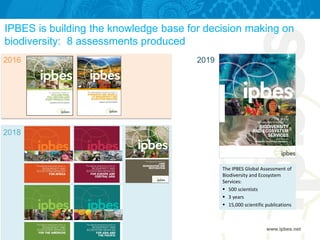
IPBES is building the knowledge base for decision making on
biodiversity: 8 assessments produced
www.ipbes.net
2016
2018
2019
The IPBES Global Assessment of
Biodiversity and Ecosystem
Services:
 500 scientists
 3 years
 15,000 scientific publications
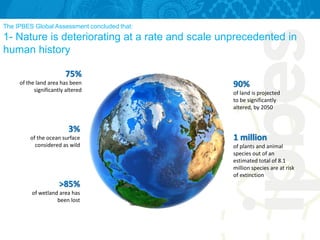
The IPBES Global Assessment concluded that:
1- Nature is deteriorating at a rate and scale unprecedented in
human history
1 million
of plants and animal
species out of an
estimated total of 8.1
million species are at risk
of extinction
90%
of land is projected
to be significantly
altered, by 2050
>85%
of wetland area has
been lost
75%
of the land area has been
significantly altered
3%
of the ocean surface
considered as wild
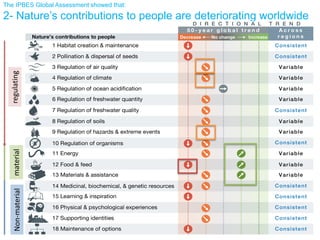
The IPBES Global Assessment showed that:
2- Nature’s contributions to people are deteriorating worldwideregulatingmaterialNon-material
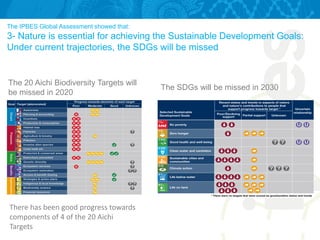
The 20 Aichi Biodiversity Targets will
be missed in 2020
There has been good progress towards
components of 4 of the 20 Aichi
Targets
The SDGs will be missed in 2030
The IPBES Global Assessment showed that:
3- Nature is essential for achieving the Sustainable Development Goals:
Under current trajectories, the SDGs will be missed
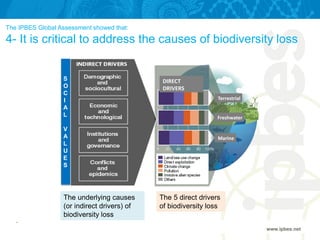
The IPBES Global Assessment showed that:
4- It is critical to address the causes of biodiversity loss
The 5 direct drivers
of biodiversity loss
DIRECT
DRIVERS
Terrestrial
Freshwater
Marine
S
O
C
I
A
L
V
A
L
U
E
S
www.ipbes.net
The underlying causes
(or indirect drivers) of
biodiversity loss
The IPBES Global Assessment of Biodiversity and Ecosystem Services (May 2019), and
The IPBES workshop report on biodiversity and pandemics (October 2020)
5- Nature is the origin of most infectious diseases
 Pandemics are becoming more frequent
 The majority (70%) of emerging diseases and almost all known pandemics (e.g. COVID-
19) are caused by microbes found on animals (zoonoses)
 Direct drivers of emergence:
• Land use change: e.g. deforestation (for agriculture, livestock farming)
• Wildlife trade
• Climate change
 Underlying drivers of emergence: consumption patterns, population growth
 Current pandemic strategy rely on responding to pandemics once they have emerged,
through technological innovations: costly, and inefficient
 New approach proposed, focused on preventing pandemics from occurring, by acting
on the drivers of emergence
The IPBES Global Assessment concluded that:
6- It is not too late to act, but transformative change is needed to
achieve sustainability
 Conserve and restore
• Conserve intact ecosystems, and restore ecosystems
• Protect critical habitats for freshwater systems
 Make cities more sustainable
• Limit urban sprawl
• Expand vegetation cover, promote urban gardens
 Employ nature-based solutions to mitigate against climate change
• Forests absorb one third of annual carbon emissions
 Transform agriculture and food systems
• Promote sustainable and healthy diets (diverse and local food, less meat)
• Promote agroecological practices (less pesticides and fertilizers, protect
pollinators, promote genetic diversity and soil biodiversity)
• Reduce harmful subsidies (e.g. pesticides, fossile fuels)
IPBES Secretariat, UN Campus
Platz der Vereinten Nationen 1, D-53113 Bonn, Germany
secretariat@ipbes.net www.ipbes.net
@IPBES

Session 1- Securing natural capital on land

  • 1.
    Securing natural capitalon land: Setting the scene OECD, Paris, 24 November 2020 Dr Anne Larigauderie Executive Secretary, IPBES
  • 2.
    IPBES is buildingthe knowledge base for decision making on biodiversity: 8 assessments produced www.ipbes.net 2016 2018 2019 The IPBES Global Assessment of Biodiversity and Ecosystem Services:  500 scientists  3 years  15,000 scientific publications
  • 3.
    The IPBES GlobalAssessment concluded that: 1- Nature is deteriorating at a rate and scale unprecedented in human history 1 million of plants and animal species out of an estimated total of 8.1 million species are at risk of extinction 90% of land is projected to be significantly altered, by 2050 >85% of wetland area has been lost 75% of the land area has been significantly altered 3% of the ocean surface considered as wild
  • 4.
    The IPBES GlobalAssessment showed that: 2- Nature’s contributions to people are deteriorating worldwideregulatingmaterialNon-material
  • 5.
    The 20 AichiBiodiversity Targets will be missed in 2020 There has been good progress towards components of 4 of the 20 Aichi Targets The SDGs will be missed in 2030 The IPBES Global Assessment showed that: 3- Nature is essential for achieving the Sustainable Development Goals: Under current trajectories, the SDGs will be missed
  • 6.
    The IPBES GlobalAssessment showed that: 4- It is critical to address the causes of biodiversity loss The 5 direct drivers of biodiversity loss DIRECT DRIVERS Terrestrial Freshwater Marine S O C I A L V A L U E S www.ipbes.net The underlying causes (or indirect drivers) of biodiversity loss
  • 7.
    The IPBES GlobalAssessment of Biodiversity and Ecosystem Services (May 2019), and The IPBES workshop report on biodiversity and pandemics (October 2020) 5- Nature is the origin of most infectious diseases  Pandemics are becoming more frequent  The majority (70%) of emerging diseases and almost all known pandemics (e.g. COVID- 19) are caused by microbes found on animals (zoonoses)  Direct drivers of emergence: • Land use change: e.g. deforestation (for agriculture, livestock farming) • Wildlife trade • Climate change  Underlying drivers of emergence: consumption patterns, population growth  Current pandemic strategy rely on responding to pandemics once they have emerged, through technological innovations: costly, and inefficient  New approach proposed, focused on preventing pandemics from occurring, by acting on the drivers of emergence
  • 8.
    The IPBES GlobalAssessment concluded that: 6- It is not too late to act, but transformative change is needed to achieve sustainability  Conserve and restore • Conserve intact ecosystems, and restore ecosystems • Protect critical habitats for freshwater systems  Make cities more sustainable • Limit urban sprawl • Expand vegetation cover, promote urban gardens  Employ nature-based solutions to mitigate against climate change • Forests absorb one third of annual carbon emissions  Transform agriculture and food systems • Promote sustainable and healthy diets (diverse and local food, less meat) • Promote agroecological practices (less pesticides and fertilizers, protect pollinators, promote genetic diversity and soil biodiversity) • Reduce harmful subsidies (e.g. pesticides, fossile fuels)
  • 9.
    IPBES Secretariat, UNCampus Platz der Vereinten Nationen 1, D-53113 Bonn, Germany secretariat@ipbes.net www.ipbes.net @IPBES