May 2015
Andreas Schleicher
Skills Outlook 2015
Youth, Skills and
Employability
Young people in OECD countries
Many young people struggle
in their transition to the labour-market
Youth who are neither employed nor in education (NEET)
0
5
10
15
20
25
30
35
2013 2008%
As a percentage of population, 15-29 year-olds
Young workers in routine jobs
Share of workers who consider they have little freedom to change the order of their tasks
0
5
10
15
20
25
30
35
16-29 year-olds 30-54 year-olds%
Youth who are badly prepared
Share of individuals with low numeracy skills
0
5
10
15
20
25
30
35
%
16-29 year-olds 30-54 year-olds
7
Share of young NEET by parents’ place of birth
0
5
10
15
20
25
30
%
Native-born offspring of immigrants Offspring of native-born
8
What can we do to strengthen young people’s skills
and employability?
Make a better use of young
people’s skills at work
Integrate youth into the
labour market
Improve young people
education and skills
Build a comprehensive approach
Skills Scoreboard: strengths and weaknesses
Make a better use of
young people’s skills at
work
Integrate youth into
the labour market
Improve young
people education and
skills
Make a better use of
young people’s skills at
work
Integrate youth into
the labour market
Improve young
people education and
skills
Make a better use of
young people’s skills at
work
Integrate youth into
the labour market
Improve young
people education and
skills
France
Ireland
Italy
Spain
Denmark
Korea
Norway
Poland
Austria
Check Rep.
Slovak Rep.
Sweden UK,
US
Australia
Belgium
Canada
Estonia
Finland
Germany
Japan
Netherlands
Improve young
people education and
skills
Make a better use of
young people’s skills at
work
Integrate youth into
the labour market
Preparing youths
Ensure that all youths leave school
with relevant skills
11
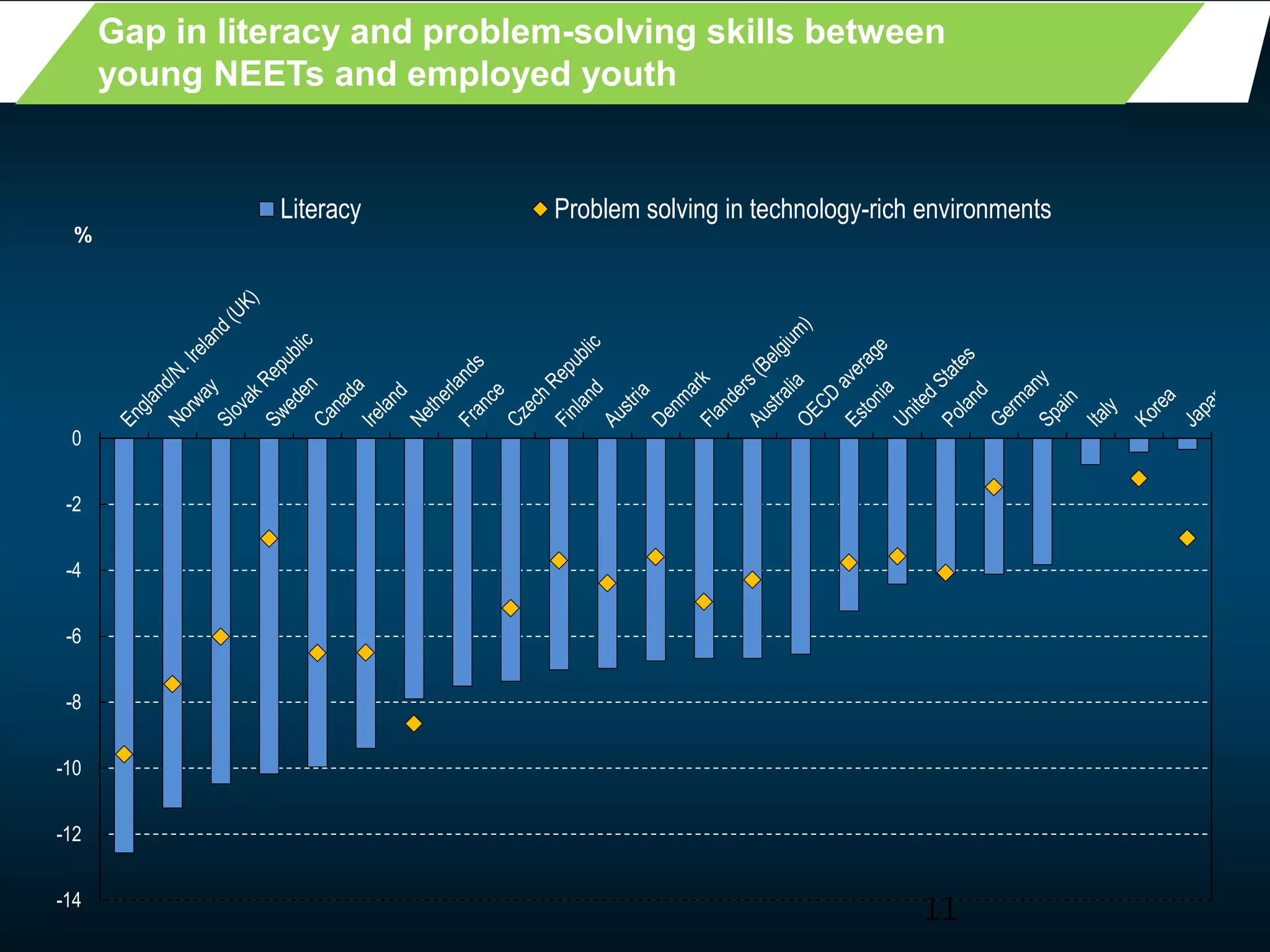
Gap in literacy and problem-solving skills between
young NEETs and employed youth
-14
-12
-10
-8
-6
-4
-2
0
%
Literacy Problem solving in technology-rich environments
New graduates (<2-years) with low numeracy skills (<226 points)
240
250
260
270
280
290
300
0
5
10
15
20
25
% Score
Share of new graduates with low numeracy skills Average numeracy score (right axis)
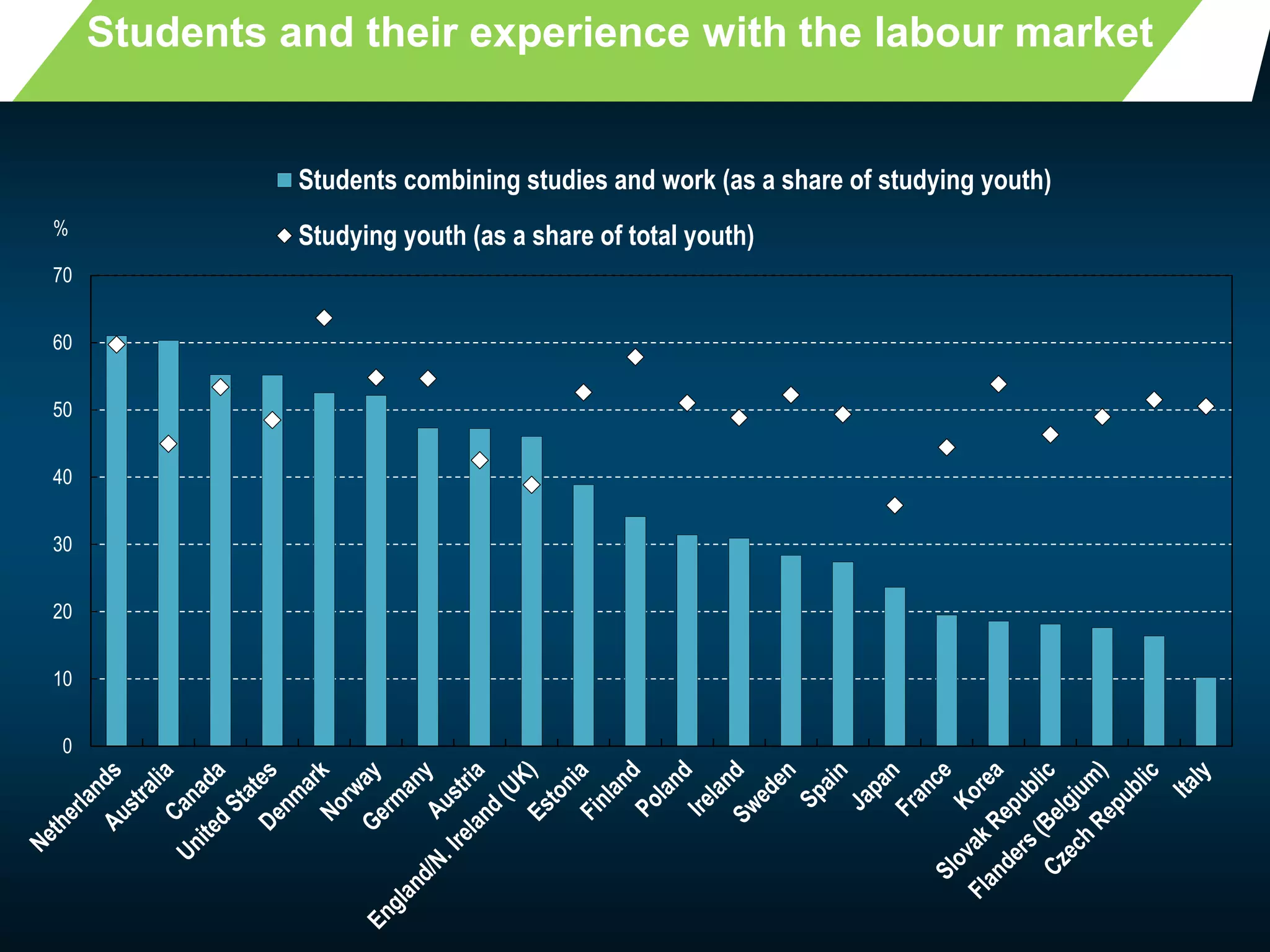
Students and their experience with the labour market
0
10
20
30
40
50
60
70
%
Students combining studies and work (as a share of studying youth)
Studying youth (as a share of total youth)
18
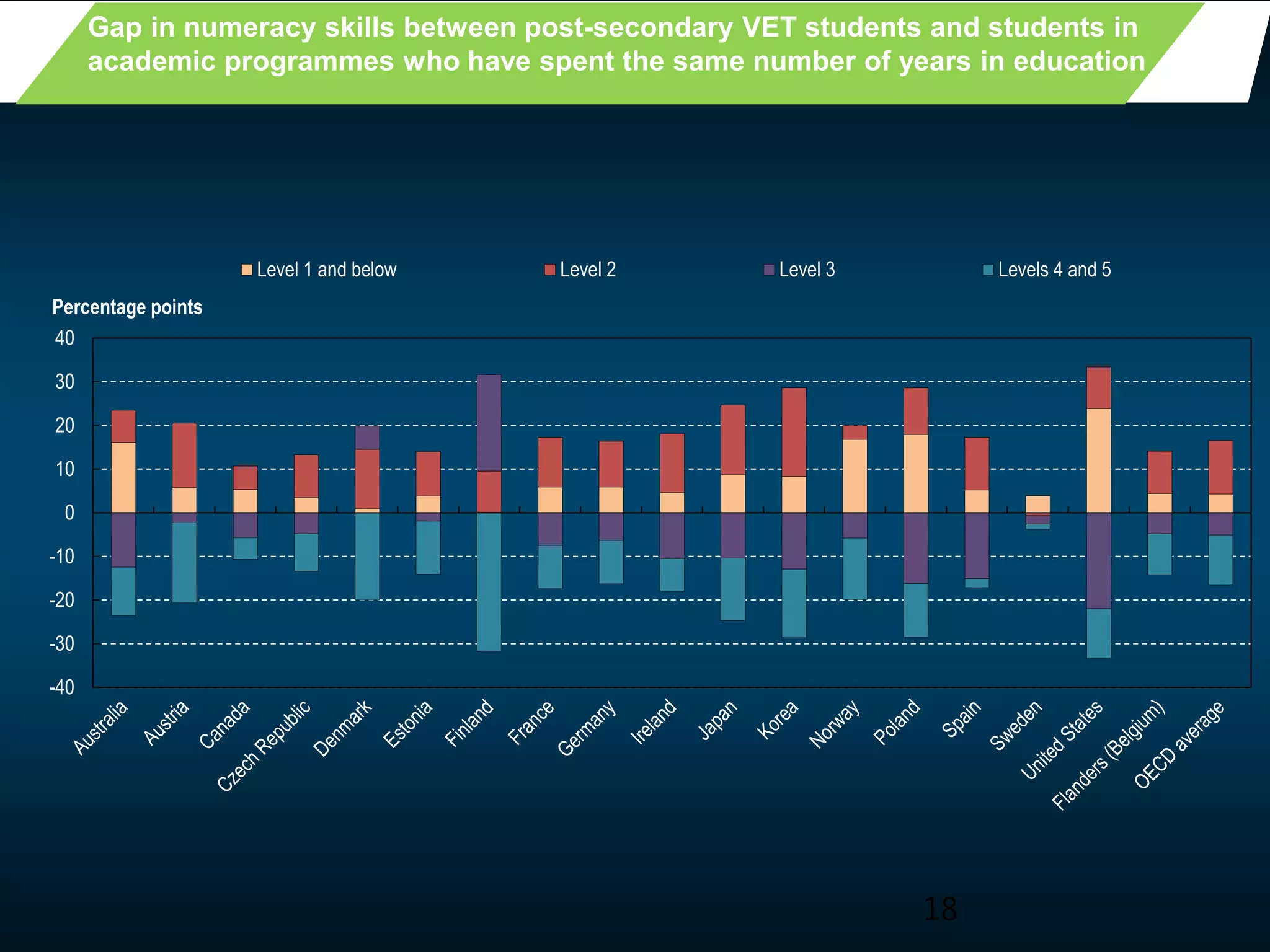
Gap in numeracy skills between post-secondary VET students and students in
academic programmes who have spent the same number of years in education
-40
-30
-20
-10
0
10
20
30
40
Percentage points
Level 1 and below Level 2 Level 3 Levels 4 and 5
Students in upper secondary vocational education
who are participating in work-based learning
0%
10%
20%
30%
40%
50%
60%
70%
80%
90%
100%
%
apprenticeship working outside of apprenticeship studying only
22
0
5
10
15
20
25
30
35
40
Below level1 Level 1 Level 2 Level 3 Level 4 Level 5
16-29 year-olds 30-54 year-olds
%
Share of workers in routine jobs by level of numeracy skills
Japan
United States
Australia
Netherlands
ItalyFinland Germany
Canada
Belgium Denmark
Ireland
Norway Poland
United KingdomSpain
Estonia
Austria
Sweden
France
Korea
Slovak Republic
Czech Republic
Skills Scoreboard: Is the development of skills inclusive?
Inequity
Equity
Low performance at school
Strong link between social background
and student performance
Strong influence of migration background
Ensure that all young people leave school with relevant skills
• Take a holistic approach to skills
• Provide multiple pathways within the education system. Give
disengaged youth a second chance to reintegrate into the
education system
• Develop work-based learning programmes across different
types of education, including universities
• Design high quality vocational education and training
programmes that develop cognitive and social and emotional
skills, and labour market experience
• Base career guidance services on relevant assessment of the
market returns of various career paths
• Engage employers and other stakeholders in the education
system at all levels .
Reengage youths
Identify and help NEETs to reengage
Youth who risk of falling under the radar
NEET who are not looking for a job
0
10
20
30
40
50
60
70
80
90
0
5
10
15
20
25
30
35
Unemployed NEETs Inactive NEETs Share of inactive NEETs in total NEETs%
%
Youth who are NEET and not looking for a job (inactive) or looking for a job (unemployed), 2013
Skills scoreboard: How close are NEETs to
the labour market?
Japan
United States
Australia
Netherlands
Italy
Finland
Germany
Canada
Belgium
Denmark Ireland
Norway
Poland
United
Kingdom
Spain
Estonia
Austria
Sweden
France
Korea
Slovak
Republic
Czech
Republic
Close
Far
High share of inactive NEETs
Share of NEETs with poor skills
Share of NEETs without baseline
qualifications
Share of long-term unemployed NEETs
2
Identify and help the NEETs to re-engage
•Develop a system of mutual obligations between
youth and institutions
•Encourage employment through efficient job-
search assistance and training, monitoring and
financial incentives
•Target places in training programmes and job
subsidies to youth with low skills and those who
face specific barriers in the labour market .
Reengaging youths
Remove institutional barriers to youth
employment
3
Remove institutional barriers to youth employment
• Design skills-friendly tax policies to foster
employment of low-skilled youth
• Continue to lower the gap in employment protection
legislation between temporary and permanent
contracts
• Encourage end-of-study internships within a
framework that combines flexibility and obligations
to firms .
Using skills
Make better use
of young workers skills
Young workers on temporary contracts
As a share of total employment in each age group, 2013
0
10
20
30
40
50
60
%
15-24 year-olds 25-54 year-olds
35
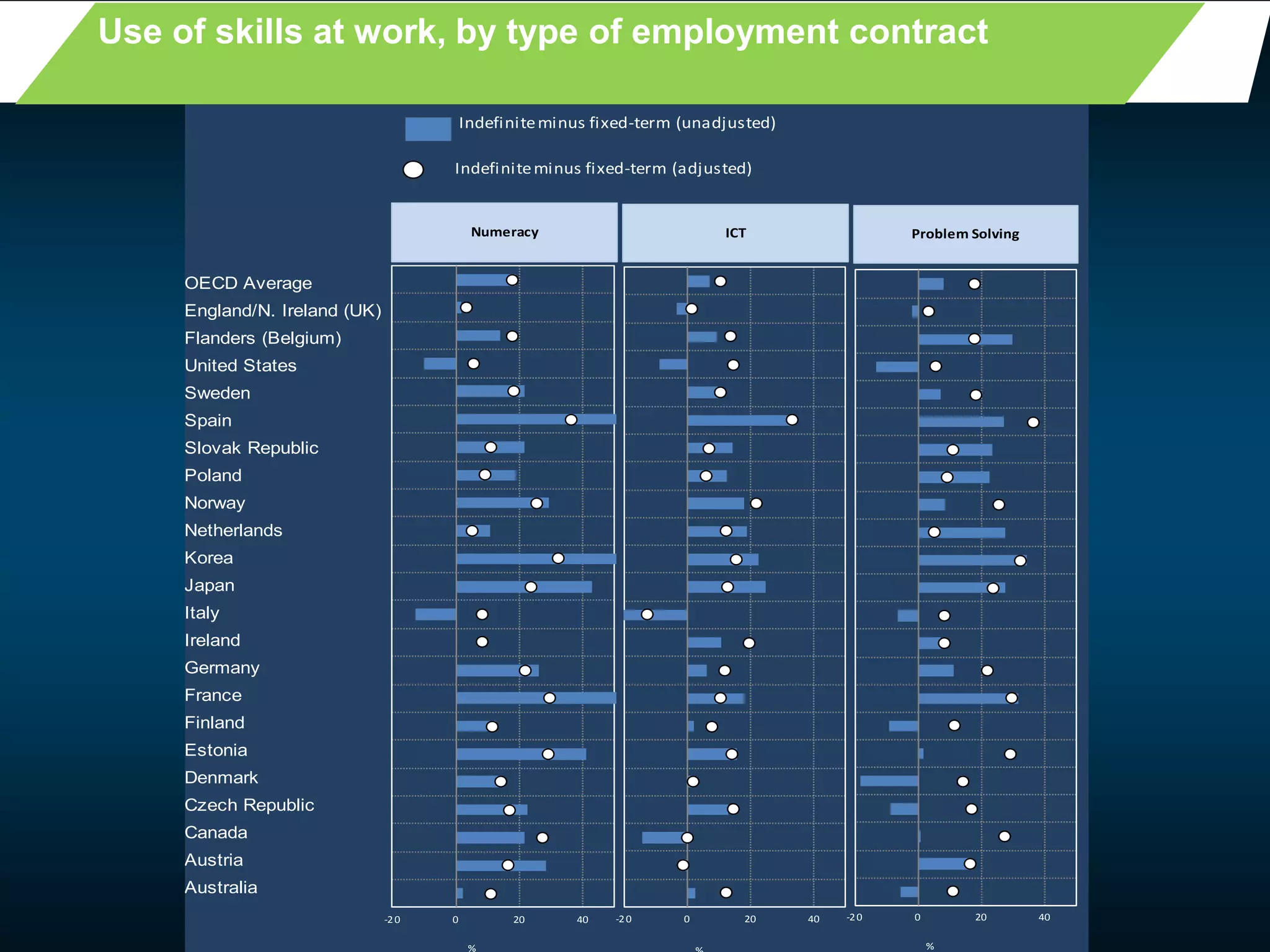
Use of skills at work, by type of employment contract
OECD Average
England/N. Ireland (UK)
Flanders (Belgium)
United States
Sweden
Spain
Slovak Republic
Poland
Norway
Netherlands
Korea
Japan
Italy
Ireland
Germany
France
Finland
Estonia
Denmark
Czech Republic
Canada
Austria
Australia
Indefiniteminus fixed-term (unadjusted)
Indefiniteminus fixed-term (adjusted)
-20 0 20 40
Numeracy
%
-20 0 20 40
ICT
-20 0 20 40
Problem Solving
%
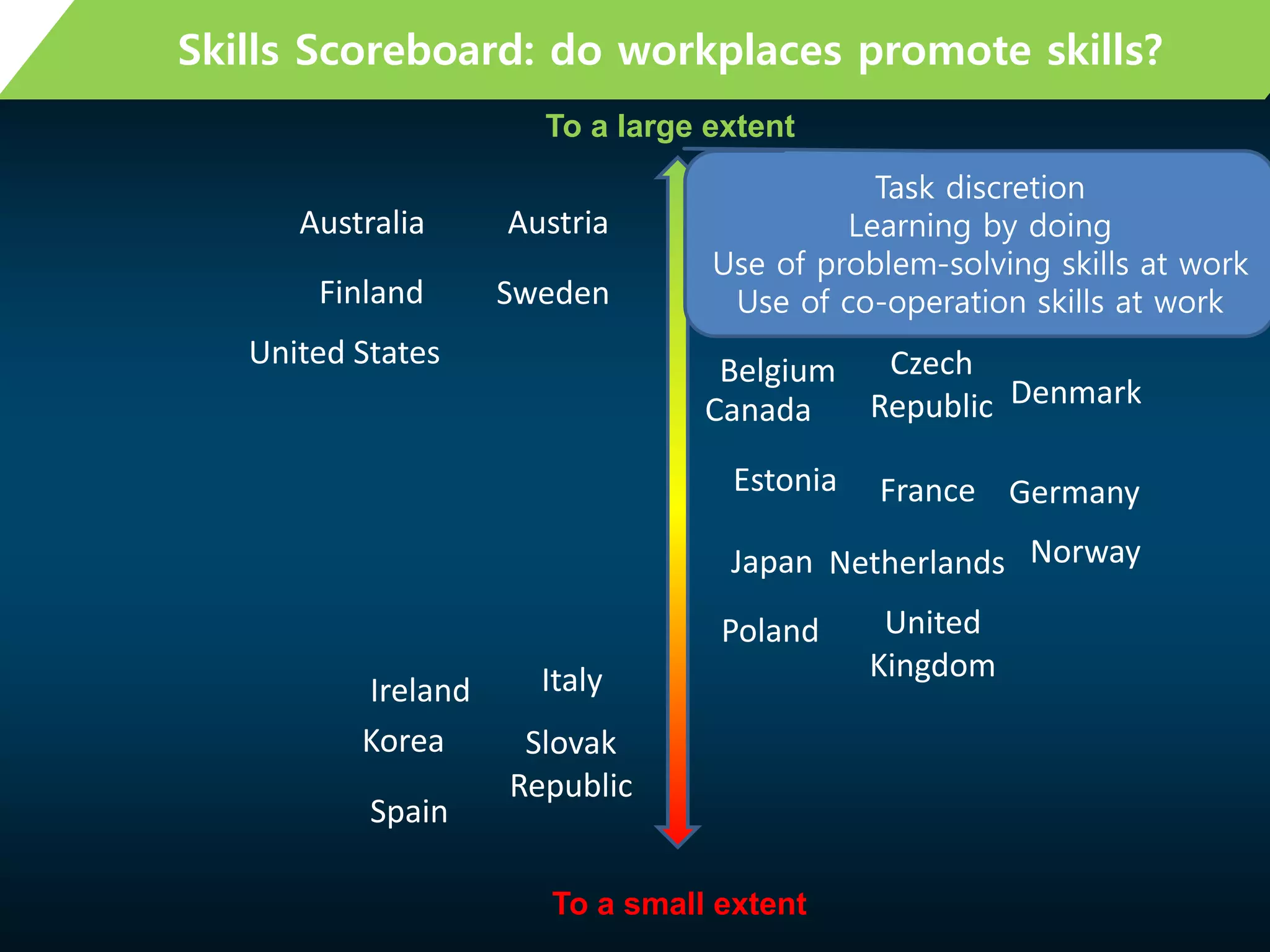
Skills Scoreboard: do workplaces promote skills?
Japan
United States
Australia
Netherlands
Italy
Finland
Germany
Canada
Belgium
Denmark
Ireland
Norway
Poland United
Kingdom
Spain
Estonia
Austria
Sweden
France
Korea Slovak
Republic
Czech
Republic
To a large extent
To a small extent
Task discretion
Learning by doing
Use of problem-solving skills at work
Use of co-operation skills at work
39
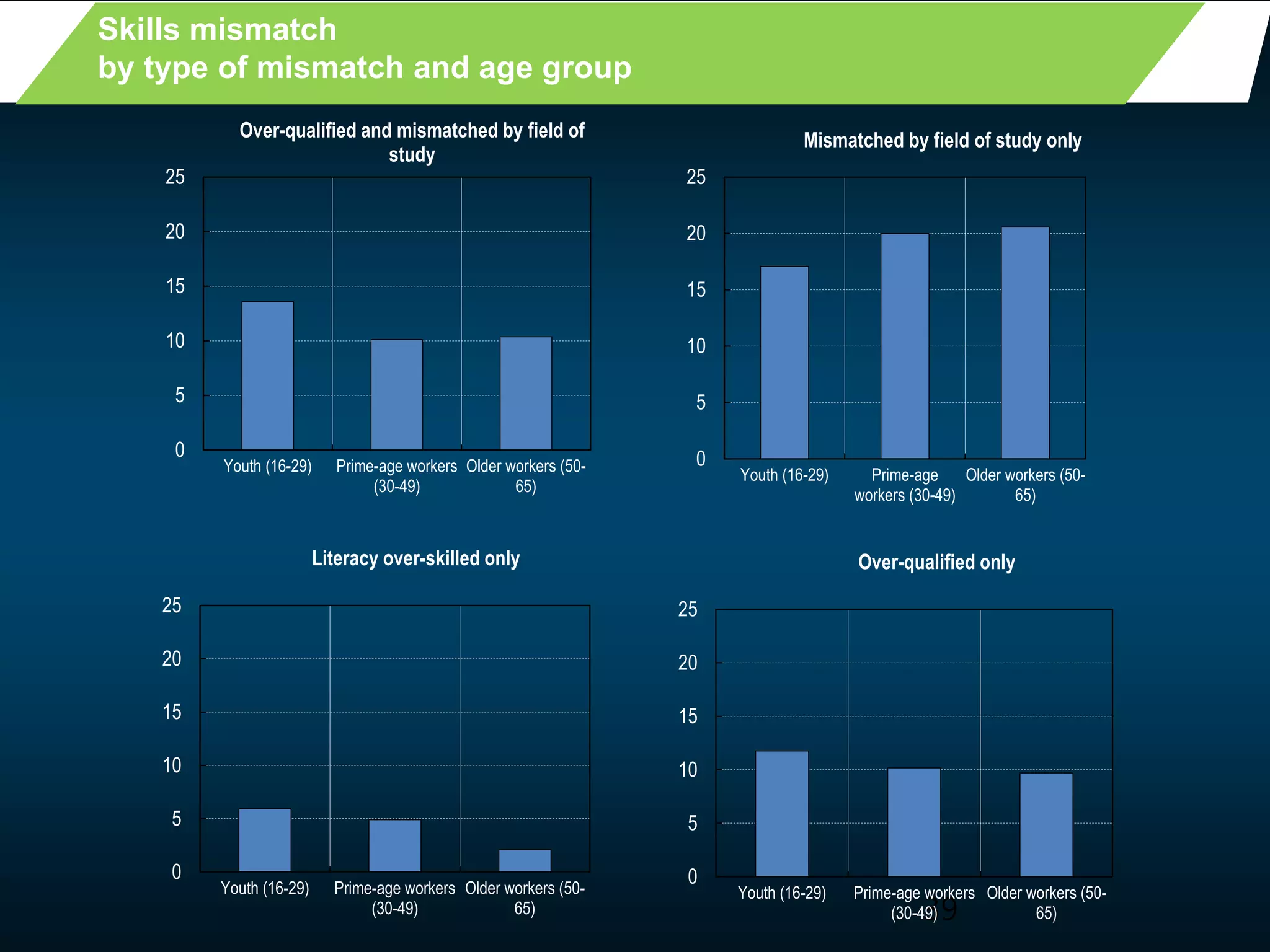
Skills mismatch
by type of mismatch and age group
0
5
10
15
20
25
Youth (16-29) Prime-age workers
(30-49)
Older workers (50-
65)
Over-qualified and mismatched by field of
study
0
5
10
15
20
25
Youth (16-29) Prime-age
workers (30-49)
Older workers (50-
65)
Mismatched by field of study only
0
5
10
15
20
25
Youth (16-29) Prime-age workers
(30-49)
Older workers (50-
65)
Over-qualified only
0
5
10
15
20
25
Youth (16-29) Prime-age workers
(30-49)
Older workers (50-
65)
Literacy over-skilled only
40
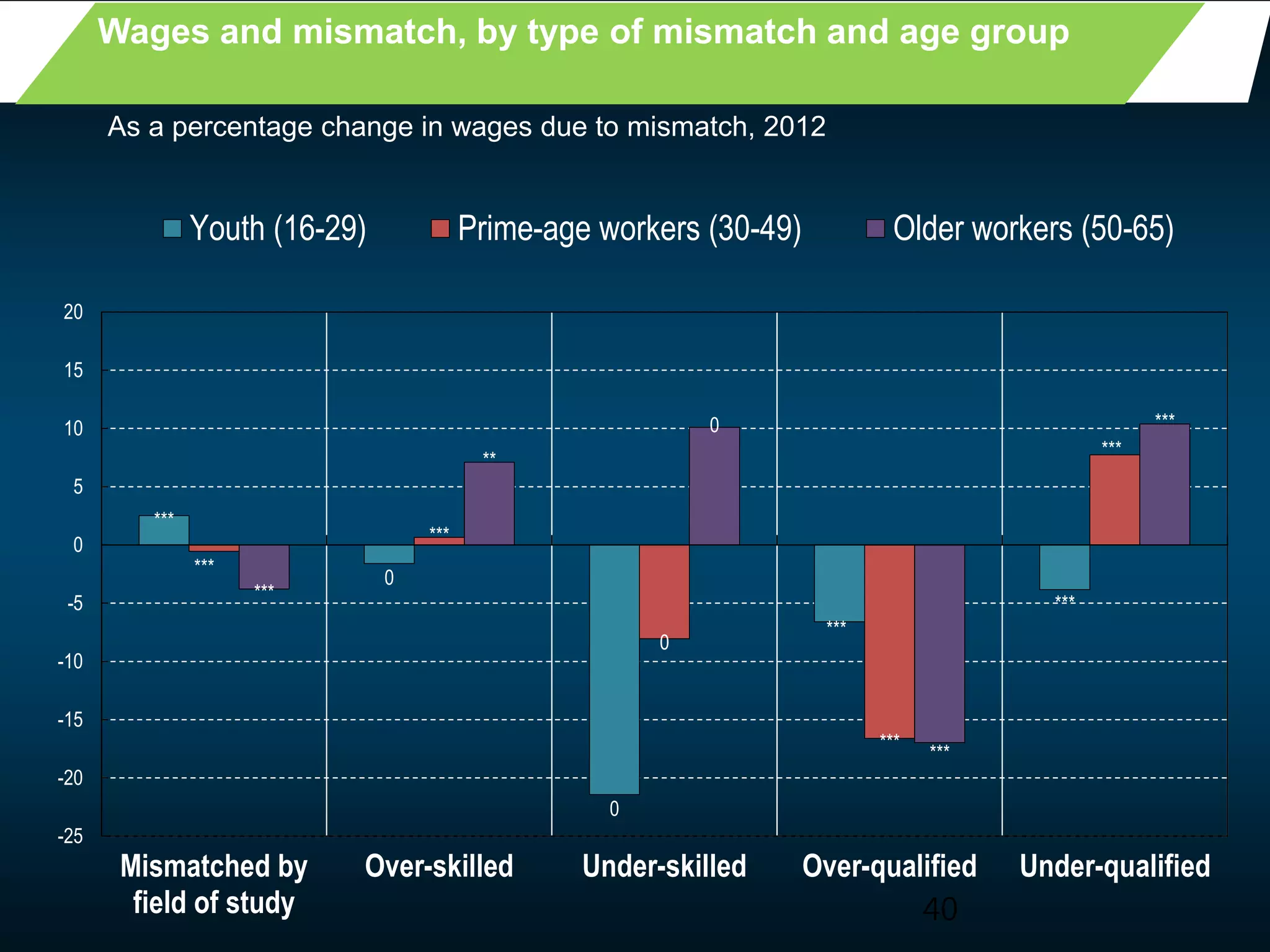
Wages and mismatch, by type of mismatch and age group
***
0
0
***
***
***
***
0
***
***
***
**
0
***
***
-25
-20
-15
-10
-5
0
5
10
15
20
Mismatched by
field of study
Over-skilled Under-skilled Over-qualified Under-qualified
Youth (16-29) Prime-age workers (30-49) Older workers (50-65)
As a percentage change in wages due to mismatch, 2012
41
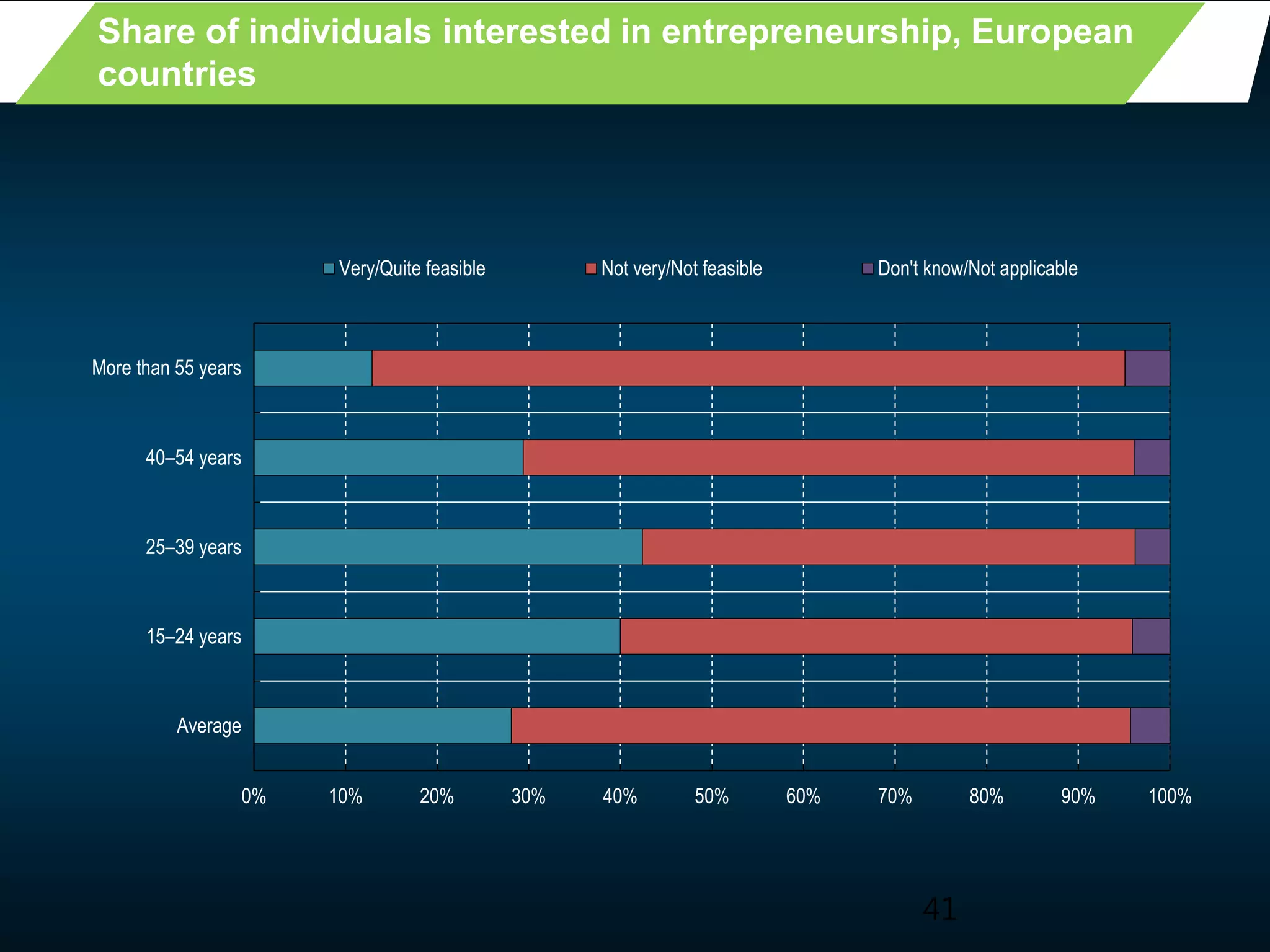
Share of individuals interested in entrepreneurship, European
countries
0% 10% 20% 30% 40% 50% 60% 70% 80% 90% 100%
Average
15–24 years
25–39 years
40–54 years
More than 55 years
Very/Quite feasible Not very/Not feasible Don't know/Not applicable
4
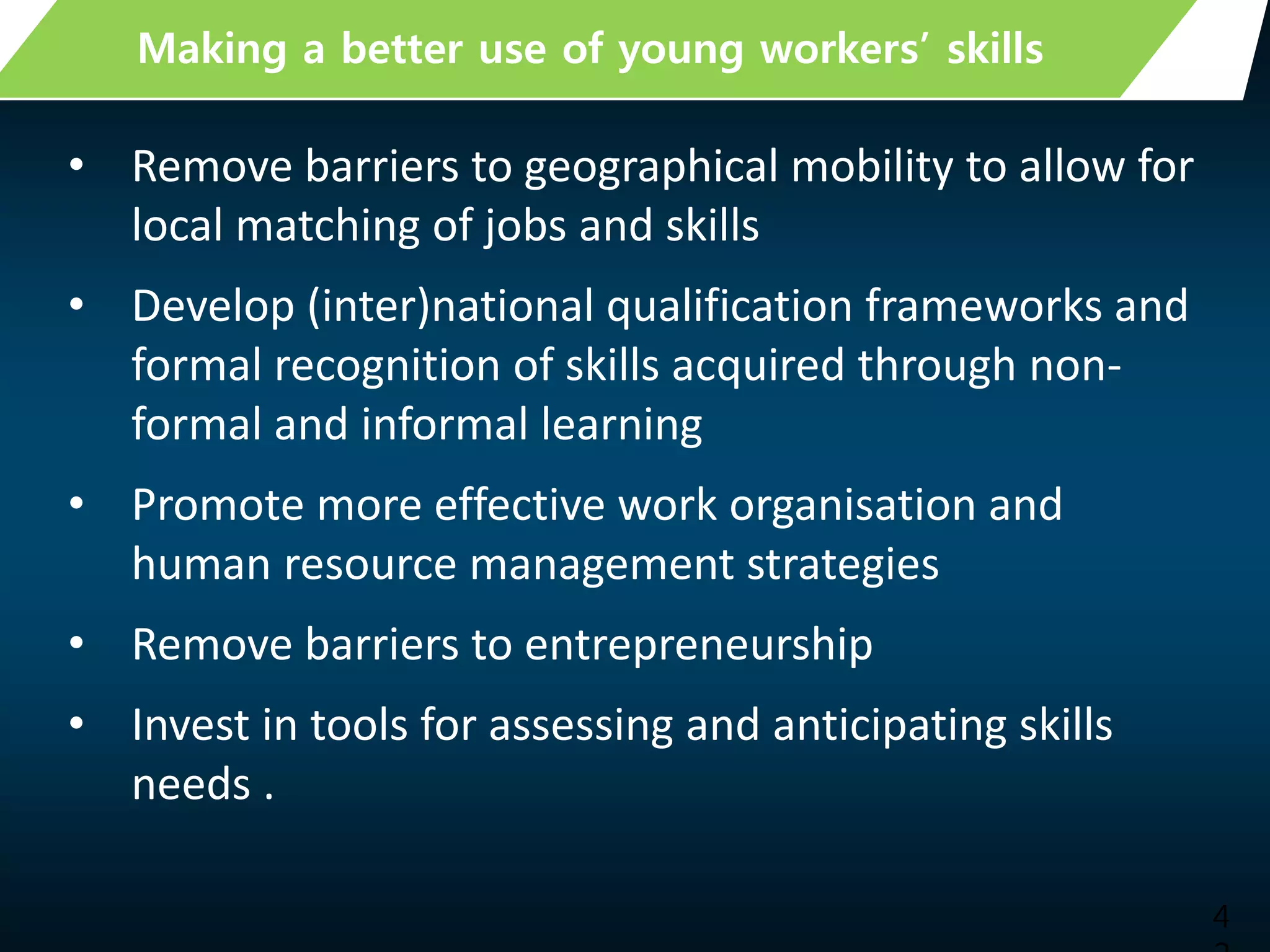
Making a better use of young workers’ skills
• Remove barriers to geographical mobility to allow for
local matching of jobs and skills
• Develop (inter)national qualification frameworks and
formal recognition of skills acquired through non-
formal and informal learning
• Promote more effective work organisation and
human resource management strategies
• Remove barriers to entrepreneurship
• Invest in tools for assessing and anticipating skills
needs .
Find Out More at:
http://skills.oecd.org/skillsoutlook.htm
All national and international publications
The complete micro-level database
Without data, you are just another person with an opinion
…and remember:
Email
Andreas.Schleicher@OECD.org
Twitter
@SchleicherEDU
43

Skills Outlook 2015: Youth, Skills and Employability

  • 1.
    May 2015 Andreas Schleicher SkillsOutlook 2015 Youth, Skills and Employability
  • 2.
    Young people inOECD countries Many young people struggle in their transition to the labour-market
  • 3.
    Youth who areneither employed nor in education (NEET) 0 5 10 15 20 25 30 35 2013 2008% As a percentage of population, 15-29 year-olds
  • 4.
    Young workers inroutine jobs Share of workers who consider they have little freedom to change the order of their tasks 0 5 10 15 20 25 30 35 16-29 year-olds 30-54 year-olds%
  • 5.
    Youth who arebadly prepared Share of individuals with low numeracy skills 0 5 10 15 20 25 30 35 % 16-29 year-olds 30-54 year-olds
  • 6.
    7 Share of youngNEET by parents’ place of birth 0 5 10 15 20 25 30 % Native-born offspring of immigrants Offspring of native-born
  • 7.
    8 What can wedo to strengthen young people’s skills and employability? Make a better use of young people’s skills at work Integrate youth into the labour market Improve young people education and skills Build a comprehensive approach
  • 8.
    Skills Scoreboard: strengthsand weaknesses Make a better use of young people’s skills at work Integrate youth into the labour market Improve young people education and skills Make a better use of young people’s skills at work Integrate youth into the labour market Improve young people education and skills Make a better use of young people’s skills at work Integrate youth into the labour market Improve young people education and skills France Ireland Italy Spain Denmark Korea Norway Poland Austria Check Rep. Slovak Rep. Sweden UK, US Australia Belgium Canada Estonia Finland Germany Japan Netherlands Improve young people education and skills Make a better use of young people’s skills at work Integrate youth into the labour market
  • 9.
    Preparing youths Ensure thatall youths leave school with relevant skills
  • 10.
    11 Gap in literacyand problem-solving skills between young NEETs and employed youth -14 -12 -10 -8 -6 -4 -2 0 % Literacy Problem solving in technology-rich environments
  • 11.
    New graduates (<2-years)with low numeracy skills (<226 points) 240 250 260 270 280 290 300 0 5 10 15 20 25 % Score Share of new graduates with low numeracy skills Average numeracy score (right axis)
  • 12.
    Students and theirexperience with the labour market 0 10 20 30 40 50 60 70 % Students combining studies and work (as a share of studying youth) Studying youth (as a share of total youth)
  • 13.
    18 Gap in numeracyskills between post-secondary VET students and students in academic programmes who have spent the same number of years in education -40 -30 -20 -10 0 10 20 30 40 Percentage points Level 1 and below Level 2 Level 3 Levels 4 and 5
  • 14.
    Students in uppersecondary vocational education who are participating in work-based learning 0% 10% 20% 30% 40% 50% 60% 70% 80% 90% 100% % apprenticeship working outside of apprenticeship studying only
  • 15.
    22 0 5 10 15 20 25 30 35 40 Below level1 Level1 Level 2 Level 3 Level 4 Level 5 16-29 year-olds 30-54 year-olds % Share of workers in routine jobs by level of numeracy skills
  • 16.
    Japan United States Australia Netherlands ItalyFinland Germany Canada BelgiumDenmark Ireland Norway Poland United KingdomSpain Estonia Austria Sweden France Korea Slovak Republic Czech Republic Skills Scoreboard: Is the development of skills inclusive? Inequity Equity Low performance at school Strong link between social background and student performance Strong influence of migration background
  • 17.
    Ensure that allyoung people leave school with relevant skills • Take a holistic approach to skills • Provide multiple pathways within the education system. Give disengaged youth a second chance to reintegrate into the education system • Develop work-based learning programmes across different types of education, including universities • Design high quality vocational education and training programmes that develop cognitive and social and emotional skills, and labour market experience • Base career guidance services on relevant assessment of the market returns of various career paths • Engage employers and other stakeholders in the education system at all levels .
  • 18.
    Reengage youths Identify andhelp NEETs to reengage
  • 19.
    Youth who riskof falling under the radar NEET who are not looking for a job 0 10 20 30 40 50 60 70 80 90 0 5 10 15 20 25 30 35 Unemployed NEETs Inactive NEETs Share of inactive NEETs in total NEETs% % Youth who are NEET and not looking for a job (inactive) or looking for a job (unemployed), 2013
  • 20.
    Skills scoreboard: Howclose are NEETs to the labour market? Japan United States Australia Netherlands Italy Finland Germany Canada Belgium Denmark Ireland Norway Poland United Kingdom Spain Estonia Austria Sweden France Korea Slovak Republic Czech Republic Close Far High share of inactive NEETs Share of NEETs with poor skills Share of NEETs without baseline qualifications Share of long-term unemployed NEETs
  • 21.
    2 Identify and helpthe NEETs to re-engage •Develop a system of mutual obligations between youth and institutions •Encourage employment through efficient job- search assistance and training, monitoring and financial incentives •Target places in training programmes and job subsidies to youth with low skills and those who face specific barriers in the labour market .
  • 22.
    Reengaging youths Remove institutionalbarriers to youth employment
  • 23.
    3 Remove institutional barriersto youth employment • Design skills-friendly tax policies to foster employment of low-skilled youth • Continue to lower the gap in employment protection legislation between temporary and permanent contracts • Encourage end-of-study internships within a framework that combines flexibility and obligations to firms .
  • 24.
    Using skills Make betteruse of young workers skills
  • 25.
    Young workers ontemporary contracts As a share of total employment in each age group, 2013 0 10 20 30 40 50 60 % 15-24 year-olds 25-54 year-olds
  • 26.
    35 Use of skillsat work, by type of employment contract OECD Average England/N. Ireland (UK) Flanders (Belgium) United States Sweden Spain Slovak Republic Poland Norway Netherlands Korea Japan Italy Ireland Germany France Finland Estonia Denmark Czech Republic Canada Austria Australia Indefiniteminus fixed-term (unadjusted) Indefiniteminus fixed-term (adjusted) -20 0 20 40 Numeracy % -20 0 20 40 ICT -20 0 20 40 Problem Solving %
  • 27.
    Skills Scoreboard: doworkplaces promote skills? Japan United States Australia Netherlands Italy Finland Germany Canada Belgium Denmark Ireland Norway Poland United Kingdom Spain Estonia Austria Sweden France Korea Slovak Republic Czech Republic To a large extent To a small extent Task discretion Learning by doing Use of problem-solving skills at work Use of co-operation skills at work
  • 28.
    39 Skills mismatch by typeof mismatch and age group 0 5 10 15 20 25 Youth (16-29) Prime-age workers (30-49) Older workers (50- 65) Over-qualified and mismatched by field of study 0 5 10 15 20 25 Youth (16-29) Prime-age workers (30-49) Older workers (50- 65) Mismatched by field of study only 0 5 10 15 20 25 Youth (16-29) Prime-age workers (30-49) Older workers (50- 65) Over-qualified only 0 5 10 15 20 25 Youth (16-29) Prime-age workers (30-49) Older workers (50- 65) Literacy over-skilled only
  • 29.
    40 Wages and mismatch,by type of mismatch and age group *** 0 0 *** *** *** *** 0 *** *** *** ** 0 *** *** -25 -20 -15 -10 -5 0 5 10 15 20 Mismatched by field of study Over-skilled Under-skilled Over-qualified Under-qualified Youth (16-29) Prime-age workers (30-49) Older workers (50-65) As a percentage change in wages due to mismatch, 2012
  • 30.
    41 Share of individualsinterested in entrepreneurship, European countries 0% 10% 20% 30% 40% 50% 60% 70% 80% 90% 100% Average 15–24 years 25–39 years 40–54 years More than 55 years Very/Quite feasible Not very/Not feasible Don't know/Not applicable
  • 31.
    4 Making a betteruse of young workers’ skills • Remove barriers to geographical mobility to allow for local matching of jobs and skills • Develop (inter)national qualification frameworks and formal recognition of skills acquired through non- formal and informal learning • Promote more effective work organisation and human resource management strategies • Remove barriers to entrepreneurship • Invest in tools for assessing and anticipating skills needs .
  • 32.
    Find Out Moreat: http://skills.oecd.org/skillsoutlook.htm All national and international publications The complete micro-level database Without data, you are just another person with an opinion …and remember: Email Andreas.Schleicher@OECD.org Twitter @SchleicherEDU 43

Editor's Notes

  • #24 To participate fully in society and to continue learning throughout their lives, all youth should have access to high-quality education and be given the opportunity to develop their skills. This does not imply that everyone should achieve the same learning outcomes, but that the share of youth who leave education with low skills should be minimised. Furthermore, youth from socio-economically disadvantaged, immigrant and minority backgrounds should have access to quality learning opportunities. An education system is more equitable, the smaller the differences in learning outcomes between youth from different socio-economic backgrounds and the smaller the share of low-skilled youth. To measure these concepts, the Skills Scoreboard uses five indicators showing the share of students with low skills and the impact of parental education and immigration background on learning outcomes. II.1. Share of students with mathematics proficiency at Level 1 or below, 15 years-old, 2012 Source: PISA 2012 Note: The inverse of the indicator is considered in the ranking. II.2. Share of students with reading proficiency at Level 1 or below, 15 years-old, 2012 Source: PISA 2012 Note: The inverse of the indicator is considered in the ranking. II.3. Students’ mathematics scores by parental education background, 15 years-old, 2012 Source: PISA 2012 Note: The indicator is calculated as the ratio of mathematics performance between students neither of whose parents has attained upper secondary education and students who have at least one parent who has attained tertiary education. II.4. Numeracy proficiency by parental education background, 16-29 years-old, 2012 Source: PIAAC 2012 Note: The indicator is calculated as the ratio of numeracy performance between youth neither of whose parents has attained upper secondary education and youth who have at least one parent who has attained tertiary education. II.5. Students’ reading scores by immigration status, 15 years-old, 2012 Source: PISA 2012 Note: The indicator is calculated as the ratio of reading performance between native students whose parents are of immigrant background and native students neither of whose parents has an immigrant background.
  • #28 Youth who are NEETs should be helped to reintegrate into the labour market or the education system in a timely manner; however, some NEET groups are more at risk of permanent detachment from the labour market than others. Education attainment and cognitive skills as well as the duration of unemployment and engagement with the labour market influence the likelihood of becoming and remaining a NEET. The Skills Scoreboard uses four indicators to measure the share of the NEETs who are more at risk of persistent detachment from the labour market. V.1. Share of the NEETs who are inactive, 15-29 years-old, 2013 Source: Education at a Glance 2015 (Interim Report) Note: The inverse of the indicator is considered in the ranking. Data for Japan refer to the NEETs group aged 15-24. The data reference for Korea is 2012. V.2. Share of the NEETs having literacy proficiency scores at Level 1 or below, 16-29 years-old, 2012 Source: PIAAC 2012 Note: The inverse of the indicator is considered in the ranking. V.3. Share of NEETs without an ISCED 3 educational attainment, 15-29 years-old, 2013 Source: Education at a Glance 2015 (Interim Report) Note: The inverse of the indicator is considered in the ranking. Japan has a missing value for this indicator, since data is available only for the age group 15-24. The data reference for Korea is 2012. V.4. Share of the NEETs who have been unemployed for more than six months, 15-29 years-old, 2012 Source: Education at a Glance 2015 Note: The inverse of the indicator is considered in the ranking. Data for Japan refer to the NEETs group aged 15-24.