K-12 Curriculum
EnhancedBasicEducationProgram
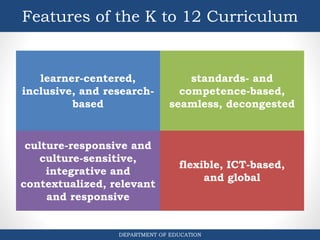
Features of the K to 12 Curriculum
DEPARTMENT OF EDUCATION
learner-centered,
inclusive, and research-
based
culture-responsive and
culture-sensitive,
integrative and
contextualized, relevant
and responsive
standards- and
competence-based,
seamless, decongested
flexible, ICT-based,
and global
DEPARTMENT OF EDUCATION
CONTEXT
PHILOSOPHICAL
& LEGAL BASES
 RA 10533 Enhanced Basic
Education Act of 2013
 Kindergarten Act
 The 1987 Phil. Constitution
 BP 232, Education Act of 1982
 RA 9155, Governance of Basic
Education Act of 2001
 The vision, mission statements
of DepEd
 SOUTELE, 1976
 The EDCOM Report of 1991
 Basic Education Sector Reform
Agenda (BESRA)
 The four pillars of education
(UNESCO)
NATURE OF
THE LEARNER
 Has a body and spirit, intellect,
free will, emotions, multiple
intelligence, learning styles
 Constructor of knowledge and
active maker of meaning, not a
passive recipient of information
NEEDS OF
THE LEARNER
 Life skills
 Self-actualization
 Preparation for the world of the
work, entrepreneurship, higher
education
NEEDS OF NATIONAL &
GLOBAL COMMUNITY
 Poverty reduction and human
development
 Strengthening the moral fiber of
the Filipino people
 Development of a strong sense of
nationalism
 Development of productive
citizens who contribute to the
building of a progressive, just, and
humane society
 Ensuring environmental
sustainability
 Global partnership for
development
The K to 12 Philippine Basic Education
Curriculum Framework
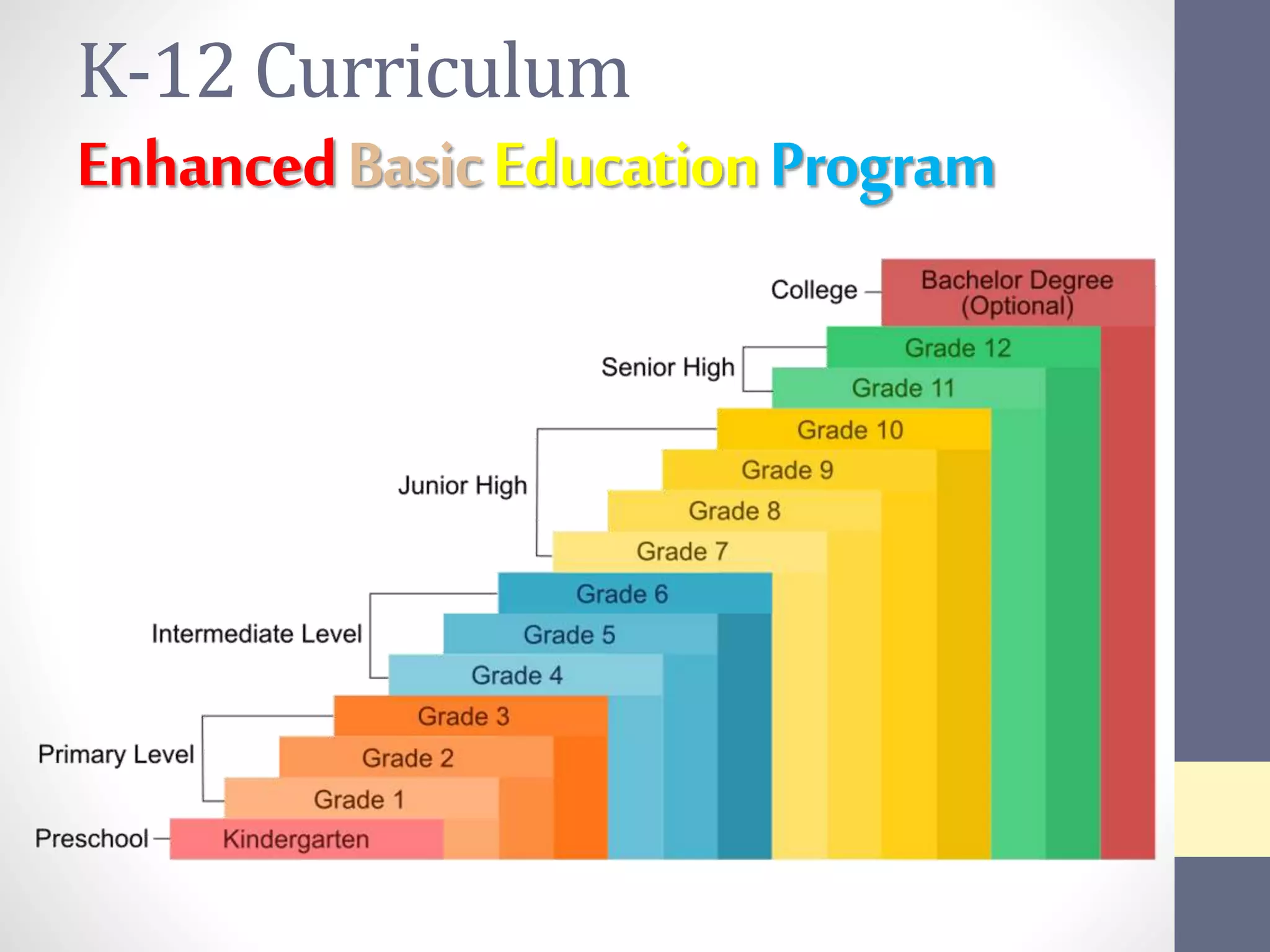
K-12 Curriculum
• K-12 adds two years, but more importantly, enhances
the quality of the entire G1-G12 curriculum. It is
streamlined and decongested to allow for better
mastery of competencies.
• DepEd's much vaunted K-12 curriculum is seen as the
country's response to the challenge of creating an
educational system that adheres to international
standards and produces graduates who can compete
in the global scene. With this program, students will
have to undergo 12 years of basic education instead of
the usual 10, in addition to the now mandatory
kindergarten, with 6 years in elementary, 4 years in
junior high school (JHS), and 2 years in senior high
school (SHS)
Advantages
• Integrating these subjects into basic education also
opens up an opportunity for the less privileged to gain
access to the same set of knowledge that, under the
previous educational system, could only be achieved by
getting into college.
• Upon finishing Grade 12, students are expected to have
the competencies that would allow them to be employed
in the fields of agriculture and trade, among others.
Advantages continuation
• The K-12 system is widely used by countries around the
world, making students who have gone through the said
program more likely to secure a job than those who have
not.
• The new system is also seen to attract more international
students as our curriculum is now aligned with theirs.
• Improve teaching through the use of enhanced
pedagogies (e.g. spiral progression in Science & Math)
and medium of instruction
• Expand job opportunities (by reducing jobs-skills
mismatch) and provide better preparation for higher
learning.
Disadvantages
• The transition between the old curriculums to the new
one can be quite challenging for stakeholders, that is,
the school administrators, teachers, parents, and
students. Such a drastic change in the system requires
long-term preparation and solid implementation. As of
yet, it is fair to say that a large number of teachers in
the country have not been fully prepared for the
program, which may have an impact on the overall
quality received by the students.
Disadvantages continuation
• The added two years in basic education will also cause a
low turnout of enrollees in colleges and universities for
school year 2016-2017. Current high schools that will
open up the senior high school department might lack
facilities and teachers to cater to the students. This has
led the Department of Education to allow the
employment of non-license holders in high school,
provided that they obtain one within the next five years.
Impact of the program to the students
• The disadvantages of implementing the curriculum are real
and urgent. Students need to adjust to the new curriculum
and have to condition themselves in spending a longer time
in school.
• SHS is relatively new so its efficiency is yet to be determined,
and this is one risk which may have dire consequences.
However, the advantages of the program far outweigh its
negatives. In the long run, students are being honed to be on
par with the rest of the world in terms of academic
excellence.
continuation
Impact of the program to the students
• By aligning our system with global benchmarks, students are
given the opportunity to be recognized as professionals
abroad, thereby lessening the unnecessary expenses of
having to obtain other degrees in the countries where they
wish to work.
• Students will be more aware on what courses are offered in
college and they can easily choose one that suits their
capabilities. This program in some term solves the problem
of the Department of Education in mismatched jobs in the
industry.
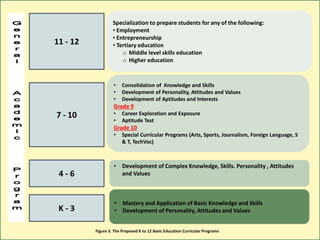
• Mastery and Application of Basic Knowledge and Skills
• Development of Personality, Attitudes and Values
• Development of Complex Knowledge, Skills. Personality , Attitudes
and Values
• Consolidation of Knowledge and Skills
• Development of Personality, Attitudes and Values
• Development of Aptitudes and Interests
Grade 9
• Career Exploration and Exposure
• Aptitude Test
Grade 10
• Special Curricular Programs (Arts, Sports, Journalism, Foreign Language, S
& T, TechVoc)
Specialization to prepare students for any of the following:
• Employment
• Entrepreneurship
• Tertiary education
o Middle level skills education
o Higher education
K - 3
4 - 6
7 - 10
11 - 12
Figure 3. The Proposed K to 12 Basic Education Curricular Programs
New Features of the K-12 Basic
Education Curriculum
• Mother Tongue as a learning area and medium of
instruction. [Mother Tongue-Based Multilingual Education
• (MTB-MLE) system]
• MAPEH (Music, Arts, Physical Education, and Health)
begins in Grade 1
• Use spiral progression approach especially in Science &
Math
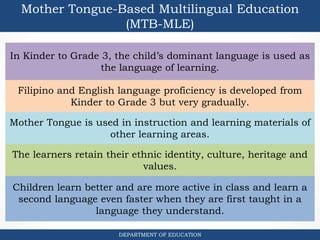
In Kinder to Grade 3, the child’s dominant language is used as
the language of learning.
Mother Tongue-Based Multilingual Education
(MTB-MLE)
DEPARTMENT OF EDUCATION
The learners retain their ethnic identity, culture, heritage and
values.
Children learn better and are more active in class and learn a
second language even faster when they are first taught in a
language they understand.
Filipino and English language proficiency is developed from
Kinder to Grade 3 but very gradually.
Mother Tongue is used in instruction and learning materials of
other learning areas.
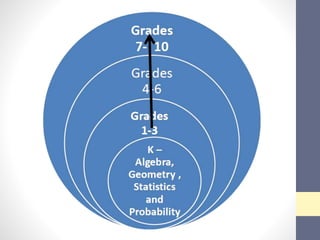
Advantages of Spiral Progression
• Avoids disjunctions between stages of schooling
• Allows learners to learn topics & skills appropriate to
their developmental/cognitive stages
• Strengthens retention & mastery of topics & skills as
they are revisited & consolidated
Contextualization and Localization
DEPARTMENT OF EDUCATION
“The curriculum shall be contextualized and
global;”
“The curriculum shall be flexible enough to
enable and allow schools to localize, indigenize
and enhance the [curriculum] based on their
respective educational and social contexts.”
‒Sec. 10.2 (d) and (h) RA 10533 Implementing Rules and Regulations
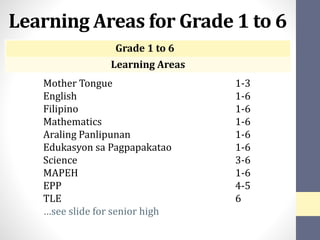
Learning Areas for Grade 1 to 6
Grade 1 to 6
Learning Areas
Mother Tongue 1-3
English 1-6
Filipino 1-6
Mathematics 1-6
Araling Panlipunan 1-6
Edukasyon sa Pagpapakatao 1-6
Science 3-6
MAPEH 1-6
EPP 4-5
TLE 6
…see slide for senior high

K-12 Curriculum (about)

  • 1.
  • 2.
    Features of theK to 12 Curriculum DEPARTMENT OF EDUCATION learner-centered, inclusive, and research- based culture-responsive and culture-sensitive, integrative and contextualized, relevant and responsive standards- and competence-based, seamless, decongested flexible, ICT-based, and global
  • 5.
    DEPARTMENT OF EDUCATION CONTEXT PHILOSOPHICAL &LEGAL BASES  RA 10533 Enhanced Basic Education Act of 2013  Kindergarten Act  The 1987 Phil. Constitution  BP 232, Education Act of 1982  RA 9155, Governance of Basic Education Act of 2001  The vision, mission statements of DepEd  SOUTELE, 1976  The EDCOM Report of 1991  Basic Education Sector Reform Agenda (BESRA)  The four pillars of education (UNESCO) NATURE OF THE LEARNER  Has a body and spirit, intellect, free will, emotions, multiple intelligence, learning styles  Constructor of knowledge and active maker of meaning, not a passive recipient of information NEEDS OF THE LEARNER  Life skills  Self-actualization  Preparation for the world of the work, entrepreneurship, higher education NEEDS OF NATIONAL & GLOBAL COMMUNITY  Poverty reduction and human development  Strengthening the moral fiber of the Filipino people  Development of a strong sense of nationalism  Development of productive citizens who contribute to the building of a progressive, just, and humane society  Ensuring environmental sustainability  Global partnership for development The K to 12 Philippine Basic Education Curriculum Framework
  • 6.
    K-12 Curriculum • K-12adds two years, but more importantly, enhances the quality of the entire G1-G12 curriculum. It is streamlined and decongested to allow for better mastery of competencies.
  • 7.
    • DepEd's muchvaunted K-12 curriculum is seen as the country's response to the challenge of creating an educational system that adheres to international standards and produces graduates who can compete in the global scene. With this program, students will have to undergo 12 years of basic education instead of the usual 10, in addition to the now mandatory kindergarten, with 6 years in elementary, 4 years in junior high school (JHS), and 2 years in senior high school (SHS)
  • 8.
    Advantages • Integrating thesesubjects into basic education also opens up an opportunity for the less privileged to gain access to the same set of knowledge that, under the previous educational system, could only be achieved by getting into college. • Upon finishing Grade 12, students are expected to have the competencies that would allow them to be employed in the fields of agriculture and trade, among others.
  • 9.
    Advantages continuation • TheK-12 system is widely used by countries around the world, making students who have gone through the said program more likely to secure a job than those who have not. • The new system is also seen to attract more international students as our curriculum is now aligned with theirs. • Improve teaching through the use of enhanced pedagogies (e.g. spiral progression in Science & Math) and medium of instruction • Expand job opportunities (by reducing jobs-skills mismatch) and provide better preparation for higher learning.
  • 10.
    Disadvantages • The transitionbetween the old curriculums to the new one can be quite challenging for stakeholders, that is, the school administrators, teachers, parents, and students. Such a drastic change in the system requires long-term preparation and solid implementation. As of yet, it is fair to say that a large number of teachers in the country have not been fully prepared for the program, which may have an impact on the overall quality received by the students.
  • 11.
    Disadvantages continuation • Theadded two years in basic education will also cause a low turnout of enrollees in colleges and universities for school year 2016-2017. Current high schools that will open up the senior high school department might lack facilities and teachers to cater to the students. This has led the Department of Education to allow the employment of non-license holders in high school, provided that they obtain one within the next five years.
  • 12.
    Impact of theprogram to the students • The disadvantages of implementing the curriculum are real and urgent. Students need to adjust to the new curriculum and have to condition themselves in spending a longer time in school. • SHS is relatively new so its efficiency is yet to be determined, and this is one risk which may have dire consequences. However, the advantages of the program far outweigh its negatives. In the long run, students are being honed to be on par with the rest of the world in terms of academic excellence.
  • 13.
    continuation Impact of theprogram to the students • By aligning our system with global benchmarks, students are given the opportunity to be recognized as professionals abroad, thereby lessening the unnecessary expenses of having to obtain other degrees in the countries where they wish to work. • Students will be more aware on what courses are offered in college and they can easily choose one that suits their capabilities. This program in some term solves the problem of the Department of Education in mismatched jobs in the industry.
  • 14.
    • Mastery andApplication of Basic Knowledge and Skills • Development of Personality, Attitudes and Values • Development of Complex Knowledge, Skills. Personality , Attitudes and Values • Consolidation of Knowledge and Skills • Development of Personality, Attitudes and Values • Development of Aptitudes and Interests Grade 9 • Career Exploration and Exposure • Aptitude Test Grade 10 • Special Curricular Programs (Arts, Sports, Journalism, Foreign Language, S & T, TechVoc) Specialization to prepare students for any of the following: • Employment • Entrepreneurship • Tertiary education o Middle level skills education o Higher education K - 3 4 - 6 7 - 10 11 - 12 Figure 3. The Proposed K to 12 Basic Education Curricular Programs
  • 15.
    New Features ofthe K-12 Basic Education Curriculum • Mother Tongue as a learning area and medium of instruction. [Mother Tongue-Based Multilingual Education • (MTB-MLE) system] • MAPEH (Music, Arts, Physical Education, and Health) begins in Grade 1 • Use spiral progression approach especially in Science & Math
  • 16.
    In Kinder toGrade 3, the child’s dominant language is used as the language of learning. Mother Tongue-Based Multilingual Education (MTB-MLE) DEPARTMENT OF EDUCATION The learners retain their ethnic identity, culture, heritage and values. Children learn better and are more active in class and learn a second language even faster when they are first taught in a language they understand. Filipino and English language proficiency is developed from Kinder to Grade 3 but very gradually. Mother Tongue is used in instruction and learning materials of other learning areas.
  • 18.
    Advantages of SpiralProgression • Avoids disjunctions between stages of schooling • Allows learners to learn topics & skills appropriate to their developmental/cognitive stages • Strengthens retention & mastery of topics & skills as they are revisited & consolidated
  • 19.
    Contextualization and Localization DEPARTMENTOF EDUCATION “The curriculum shall be contextualized and global;” “The curriculum shall be flexible enough to enable and allow schools to localize, indigenize and enhance the [curriculum] based on their respective educational and social contexts.” ‒Sec. 10.2 (d) and (h) RA 10533 Implementing Rules and Regulations
  • 21.
    Learning Areas forGrade 1 to 6 Grade 1 to 6 Learning Areas Mother Tongue 1-3 English 1-6 Filipino 1-6 Mathematics 1-6 Araling Panlipunan 1-6 Edukasyon sa Pagpapakatao 1-6 Science 3-6 MAPEH 1-6 EPP 4-5 TLE 6 …see slide for senior high

Editor's Notes

  • #3 All these are catchphrases from the law [discuss each quadrant] BALANCE between the ideal, the meaningful, the logistically feasible Allows for varied ways of delivery ONE STOP SHOP and inclusive Standards- and competence-based Built around the needs of the learner and the community
  • #6 K to 12 curriculum built on previous reform initiatives EDCOM Report of 1991 BESRA UNESCO four pillars of education MAIN legal bases: Republic Act No. 10533, the Enhanced Basic Education Act of 2013 Republic Act No. 10157, the Kindergarten Education Act Nature and needs of the learner Learner-centered Needs of the national and global community Curriculum is contextualized Addresses national and global needs Strategy to reduce poverty Consistent with ASEAN 2015 Leapfrog
  • #17 Mother tongue = child’s dominant language Field must be able to determine the real language of the child, not the ideal language Not the same as bilingual education. During K-3, the child is taught in his/her dominant language Learners materials written in 19 languages currently Children retain their ethnic identity, culture, heritage and values (Madrasah/ALIVE as an example)
  • #20 Contextualization and localization as stipulated in RA 10533 and its IRR