DR. RICO D. DE ASIS
Professor, University of Eastern Philippines
Pedro Rebadulla Memorial Campus
Catubig, Northern Samar
URRICULUM
EVELOPMENT
C
D
Curriculum refers to the
“total learning experiences of
individuals not only in school but
in society as well (Bilbao et al.,
2008)
Curriculum Development is
defined as planned, purposeful,
progressive, and systematic
process in order to create
positive improvements in the
educational system.
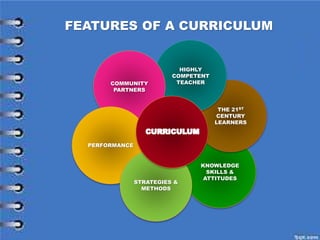
FEATURES OF A CURRICULUM
KNOWLEDGE
SKILLS &
ATTITUDES
THE 21ST
CENTURY
LEARNERS
HIGHLY
COMPETENT
TEACHERCOMMUNITY
PARTNERS
PERFORMANCE
STRATEGIES &
METHODS
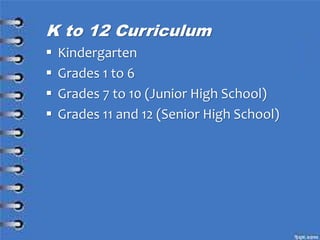
K to 12 Curriculum
 Kindergarten
 Grades 1 to 6
 Grades 7 to 10 (Junior High School)
 Grades 11 and 12 (Senior High School)
SENIOR HIGH SCHOOL
(Gearing Up for the Future)
Senior High School is two years of
specialized upper secondary education;
students may choose a specialization
whether based on aptitude, interests and
school policy. The choice of career track will
define the content of the subjects a student
will take in grade 11 and 12. SHS subjects fall
under either the Core Curriculum or Specific
Tracks.
CORE CURRICULUM
There are seven Learning Areas
under Core Curriculum. These are
Languages, Literature, Communication,
Mathematics, Natural Sciences, Current
content from some General Education
subjects are embedded in the SHS
Curriculum.
TRACKS
Each student in SHS can choose among
the tracks.
1. Academic track includes three strands:
a. Business Accountancy Management (BAM);
b. Humanities, Education, Social Sciences (HESS);
c. Science, Technology, Engineering, Mathematics (STEM)
Students undergo immersion to provide them relevant
exposure and actual experience in their chosen track.
2. Technical Vocational Education & Training (TVET):
After finishing Grade 10 a student can obtain
certificates of competency (COC) or National Certificate
Level 1 (NC1).
After finishing TVET in Grade 12, a student may
obtain a National Certificate Level II (NC II), provided
he/she passes the competency-based assessment of
TESDA.
NC1 and NC2 improves employability of graduates in
the field of Agriculture, Home Economics, Fisheries,
Industrial Arts, Electricity, Automotive and among others.
3. Sports
4. Arts and Design
Societal and Individual benefits
of K to 12 Program
1. An enhanced curriculum will decongest academic
workload.
2. Graduates will possess competences and skills relevant
to the sole market and legally eligible for employment.
3. Graduates will be better prepared for higher education.
4. Graduates will now be recognized abroad.
5. K to 12 will contribute to economic growth.
6. A better educated society provides a sound foundation
for a long-term socio- economic development.
-Sir Rico

Curriculum

  • 1.
    DR. RICO D.DE ASIS Professor, University of Eastern Philippines Pedro Rebadulla Memorial Campus Catubig, Northern Samar URRICULUM EVELOPMENT C D
  • 2.
    Curriculum refers tothe “total learning experiences of individuals not only in school but in society as well (Bilbao et al., 2008)
  • 3.
    Curriculum Development is definedas planned, purposeful, progressive, and systematic process in order to create positive improvements in the educational system.
  • 4.
    FEATURES OF ACURRICULUM KNOWLEDGE SKILLS & ATTITUDES THE 21ST CENTURY LEARNERS HIGHLY COMPETENT TEACHERCOMMUNITY PARTNERS PERFORMANCE STRATEGIES & METHODS
  • 5.
    K to 12Curriculum  Kindergarten  Grades 1 to 6  Grades 7 to 10 (Junior High School)  Grades 11 and 12 (Senior High School)
  • 6.
    SENIOR HIGH SCHOOL (GearingUp for the Future) Senior High School is two years of specialized upper secondary education; students may choose a specialization whether based on aptitude, interests and school policy. The choice of career track will define the content of the subjects a student will take in grade 11 and 12. SHS subjects fall under either the Core Curriculum or Specific Tracks.
  • 7.
    CORE CURRICULUM There areseven Learning Areas under Core Curriculum. These are Languages, Literature, Communication, Mathematics, Natural Sciences, Current content from some General Education subjects are embedded in the SHS Curriculum.
  • 8.
    TRACKS Each student inSHS can choose among the tracks. 1. Academic track includes three strands: a. Business Accountancy Management (BAM); b. Humanities, Education, Social Sciences (HESS); c. Science, Technology, Engineering, Mathematics (STEM) Students undergo immersion to provide them relevant exposure and actual experience in their chosen track.
  • 9.
    2. Technical VocationalEducation & Training (TVET): After finishing Grade 10 a student can obtain certificates of competency (COC) or National Certificate Level 1 (NC1). After finishing TVET in Grade 12, a student may obtain a National Certificate Level II (NC II), provided he/she passes the competency-based assessment of TESDA. NC1 and NC2 improves employability of graduates in the field of Agriculture, Home Economics, Fisheries, Industrial Arts, Electricity, Automotive and among others. 3. Sports 4. Arts and Design
  • 10.
    Societal and Individualbenefits of K to 12 Program 1. An enhanced curriculum will decongest academic workload. 2. Graduates will possess competences and skills relevant to the sole market and legally eligible for employment. 3. Graduates will be better prepared for higher education. 4. Graduates will now be recognized abroad. 5. K to 12 will contribute to economic growth. 6. A better educated society provides a sound foundation for a long-term socio- economic development.
  • 11.