In what ways does your media
product use, develop or challenge
forms and conventions of real media
products?
Research
• In preparation for the film trailer, I researched existing films within the genre of crime:
• The characters: Many crime films such as Pulp Fiction (1994), Lock, Stock and Two Smoking Barrels (1998),
American Hustle (2013) and The Usual Suspects (1995) feature the use of multiple characters which play
main character roles. A lot of times, this depends on the genre of film as a heist film may be more likely to
use multiple main characters while a more personal story such as Get Carter (1971) would only feature one.
These characters mainly operate on two sides of the law as either a policeman or a criminal.
• Setting: The setting of a crime film largely depends on the subgenre within the film. This can have an effect
on the quality of living for the characters and the heights of the story. For example Heat (1995) takes place in
a city within expensive structures and apartments. This is because the story is reflecting a successful bank
robber who is looking for the next big target. A more personal subgenre such as revenge has the possibility
to tailor the setting to the characters. For example Get Carter (1971) features a British character on a
personal revenge story to Newcastle. Because the stakes are smaller and the story is more personal, the
setting reflects it. It is also common for criminals to be depicted as lower class people who live on estates or
in bad areas.
• Props: The crime genre is immediately associated with a handful of props. Guns, cars, money and other
weapons have become integral to most films within the genre as they often depict scenes of violence.
• Special Effects: Classic exploitation crime films established the genre with a reliance on strong practical
effects such as squibs, fake blood, real explosions and stunts. This time of cinema within the 70s period
established these effects as an integral part of the genre, as CGI was not available. Within modern films, CGI
has become more common, however many directors attempt to utilize these strong practical effects.
• Sound: Crime has the ability to explore a range of tones from gritty and realistic to stylized (Pulp Fiction).
This means that directors such as Quentin Tarantino can craft soundtracks for their films that cover a range
of tones and can use pop songs in order to create a soundtrack. The more dramatic crime films such as
Goodfellas utilizes Martin Scorsese use of silence in order to play out intense scenes but then change it with
the use of an upbeat song within the next scene.
I attempted to create a film which would take inspiration from the popular films that helped to establish the
genre while creating an identity for my film.
Setting
Keeping with the idea of crime’s setting changing to serve the
narrative, I have chosen a setting which reflects the scale of the
story in which I am trying to tell. The story focuses on a group of
young, low-level criminals who are attempting to rise into the
higher levels of criminal activity. Since the characters are wanting to
become criminals like they have seen in films it would make sense
to show that their story takes place on a smaller scale. As a result,
instead of a city, the film takes place within a town. The story is
more personal, much like Get Carter as we focus on the main
characters’ journeys. The smaller scale reflects how the boys are
operating at a low level. This very small setting is not a convention
of the crime genre but the idea of scaling the setting depending on
the story is a convention which has been seen within crime films of
the past.
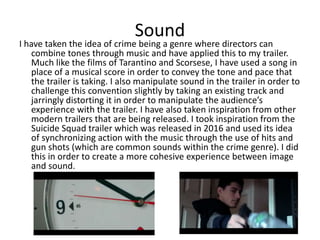
Sound
I have taken the idea of crime being a genre where directors can
combine tones through music and have applied this to my trailer.
Much like the films of Tarantino and Scorsese, I have used a song in
place of a musical score in order to convey the tone and pace that
the trailer is taking. I also manipulate sound in the trailer in order to
challenge this convention slightly by taking an existing track and
jarringly distorting it in order to manipulate the audience’s
experience with the trailer. I have also taken inspiration from other
modern trailers that are being released. I took inspiration from the
Suicide Squad trailer which was released in 2016 and used its idea
of synchronizing action with the music through the use of hits and
gun shots (which are common sounds within the crime genre). I did
this in order to create a more cohesive experience between image
and sound.
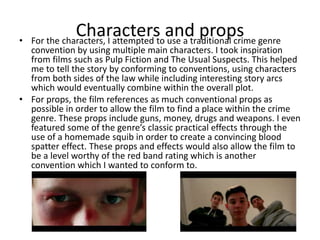
Characters and props• For the characters, I attempted to use a traditional crime genre
convention by using multiple main characters. I took inspiration
from films such as Pulp Fiction and The Usual Suspects. This helped
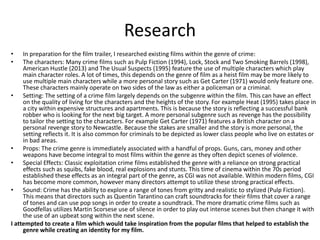
me to tell the story by conforming to conventions, using characters
from both sides of the law while including interesting story arcs
which would eventually combine within the overall plot.
• For props, the film references as much conventional props as
possible in order to allow the film to find a place within the crime
genre. These props include guns, money, drugs and weapons. I even
featured some of the genre’s classic practical effects through the
use of a homemade squib in order to create a convincing blood
spatter effect. These props and effects would also allow the film to
be a level worthy of the red band rating which is another
convention which I wanted to conform to.
Narrative
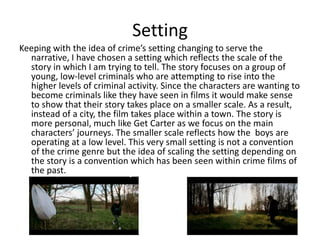
• I took inspiration from many different crime films when deciding how to
structure the narrative. I used a common convention within the genre of
using multiple characters for the purpose of telling multiple stories that
would eventually overlap in an overarching storyline. Films that use this
combination of multiple stories include Lock, Stock and Two Smoking
Barrels and Pulp Fiction, which served as massive influences on the
narrative structure. I used other platforms for story telling that have been
featured within the crime genre before such as the use of an interrogation
room to act as a means of the character going back and recalling the
events leading up to this situation (The Usual Suspects). I conform to the
genre’s narrative conventions by including elements such as rival gangs, a
crime boss, robbery and murder. I attempt to challenge the conventions by
adding a plot twist to change the audience’s perception of the characters,
revealing that the good characters are ultimately found out to be evil
while the bad character is revealed to have good motivations for what
they are doing.

Evaluation 1

  • 1.
    In what waysdoes your media product use, develop or challenge forms and conventions of real media products?
  • 2.
    Research • In preparationfor the film trailer, I researched existing films within the genre of crime: • The characters: Many crime films such as Pulp Fiction (1994), Lock, Stock and Two Smoking Barrels (1998), American Hustle (2013) and The Usual Suspects (1995) feature the use of multiple characters which play main character roles. A lot of times, this depends on the genre of film as a heist film may be more likely to use multiple main characters while a more personal story such as Get Carter (1971) would only feature one. These characters mainly operate on two sides of the law as either a policeman or a criminal. • Setting: The setting of a crime film largely depends on the subgenre within the film. This can have an effect on the quality of living for the characters and the heights of the story. For example Heat (1995) takes place in a city within expensive structures and apartments. This is because the story is reflecting a successful bank robber who is looking for the next big target. A more personal subgenre such as revenge has the possibility to tailor the setting to the characters. For example Get Carter (1971) features a British character on a personal revenge story to Newcastle. Because the stakes are smaller and the story is more personal, the setting reflects it. It is also common for criminals to be depicted as lower class people who live on estates or in bad areas. • Props: The crime genre is immediately associated with a handful of props. Guns, cars, money and other weapons have become integral to most films within the genre as they often depict scenes of violence. • Special Effects: Classic exploitation crime films established the genre with a reliance on strong practical effects such as squibs, fake blood, real explosions and stunts. This time of cinema within the 70s period established these effects as an integral part of the genre, as CGI was not available. Within modern films, CGI has become more common, however many directors attempt to utilize these strong practical effects. • Sound: Crime has the ability to explore a range of tones from gritty and realistic to stylized (Pulp Fiction). This means that directors such as Quentin Tarantino can craft soundtracks for their films that cover a range of tones and can use pop songs in order to create a soundtrack. The more dramatic crime films such as Goodfellas utilizes Martin Scorsese use of silence in order to play out intense scenes but then change it with the use of an upbeat song within the next scene. I attempted to create a film which would take inspiration from the popular films that helped to establish the genre while creating an identity for my film.
  • 3.
    Setting Keeping with theidea of crime’s setting changing to serve the narrative, I have chosen a setting which reflects the scale of the story in which I am trying to tell. The story focuses on a group of young, low-level criminals who are attempting to rise into the higher levels of criminal activity. Since the characters are wanting to become criminals like they have seen in films it would make sense to show that their story takes place on a smaller scale. As a result, instead of a city, the film takes place within a town. The story is more personal, much like Get Carter as we focus on the main characters’ journeys. The smaller scale reflects how the boys are operating at a low level. This very small setting is not a convention of the crime genre but the idea of scaling the setting depending on the story is a convention which has been seen within crime films of the past.
  • 4.
    Sound I have takenthe idea of crime being a genre where directors can combine tones through music and have applied this to my trailer. Much like the films of Tarantino and Scorsese, I have used a song in place of a musical score in order to convey the tone and pace that the trailer is taking. I also manipulate sound in the trailer in order to challenge this convention slightly by taking an existing track and jarringly distorting it in order to manipulate the audience’s experience with the trailer. I have also taken inspiration from other modern trailers that are being released. I took inspiration from the Suicide Squad trailer which was released in 2016 and used its idea of synchronizing action with the music through the use of hits and gun shots (which are common sounds within the crime genre). I did this in order to create a more cohesive experience between image and sound.
  • 5.
    Characters and props•For the characters, I attempted to use a traditional crime genre convention by using multiple main characters. I took inspiration from films such as Pulp Fiction and The Usual Suspects. This helped me to tell the story by conforming to conventions, using characters from both sides of the law while including interesting story arcs which would eventually combine within the overall plot. • For props, the film references as much conventional props as possible in order to allow the film to find a place within the crime genre. These props include guns, money, drugs and weapons. I even featured some of the genre’s classic practical effects through the use of a homemade squib in order to create a convincing blood spatter effect. These props and effects would also allow the film to be a level worthy of the red band rating which is another convention which I wanted to conform to.
  • 6.
    Narrative • I tookinspiration from many different crime films when deciding how to structure the narrative. I used a common convention within the genre of using multiple characters for the purpose of telling multiple stories that would eventually overlap in an overarching storyline. Films that use this combination of multiple stories include Lock, Stock and Two Smoking Barrels and Pulp Fiction, which served as massive influences on the narrative structure. I used other platforms for story telling that have been featured within the crime genre before such as the use of an interrogation room to act as a means of the character going back and recalling the events leading up to this situation (The Usual Suspects). I conform to the genre’s narrative conventions by including elements such as rival gangs, a crime boss, robbery and murder. I attempt to challenge the conventions by adding a plot twist to change the audience’s perception of the characters, revealing that the good characters are ultimately found out to be evil while the bad character is revealed to have good motivations for what they are doing.