COMBINED PREDICTIVE MODEL
F I N A L R E P O RT
D E C E M B E R 2 0 0 6
The following individuals are the principal contributors to
the development of the Combined Predictive Model:
Health Dialog
David Wennberg, MD, MPH
Matt Siegel
Bob Darin
Nadya Filipova, MS
Ronald Russell, MS
Linda Kenney
Klaus Steinort
Tae-Ryong Park, PhD
Gokhan Cakmakci
King’s Fund
Jennifer Dixon, MBChB, PhD
Natasha Curry
New York University
John Billings
We would like to acknowledge the invaluable support and
participation of numerous organisations involved in this
project including its funders, the Department of Health and
Essex Strategic Health Authority (acting on behalf of all 28
Strategic Health Authorities), as well as the National Health
Service staff who joined the project steering group. We
would also like to thank the Croydon and South
Warwickshire Primary Care Trusts for supplying the data
used in the development of the Combined Predictive
Model, as well as the Tower Hamlets and Southwark
Primary Care Trusts for their data collection efforts.
ACKNOWLEDGEMENTS
2page
Identifying risk along the
continuum 4
Background 6
the combined model 8
conclusion 20
appendices A & B 22
Notes 26
CONTENTS
page 3
IDENTIFYING RISK
along the continuum
Through identifying
relative risk along the
continuum, the Combined
Model allows NHS
organisations to develop
and tailor intervention
intensity to match the
expected ‘returns’.
*Analyses in the Final Report are
based on validation of the Combined
Model on a random 50% sample of
the total population of the two PCTs
which provided data for its
development. The validation analyses
were based on the time period of
1 April 2002-31 March 2004 to
predict emergency admissions in the
following 12 months of 1 April 2004-
31 March 2005. More information
on methodology is included in
Appendix A.
4PAGE
To meet national goals for reductions in emergency bed
days and effective administration of practice-based
commissioning, National Health Service (NHS)
organisations have highlighted the need for tools to assess
patient needs across the continuum of care. A risk
stratification tool called the Combined Predictive Model
(the Combined Model) has been developed to provide a
rich segmentation of patients at each section of the
continuum. The model is based on a comprehensive dataset
of patient information, including inpatient (IP), outpatient
(OP), and accident & emergency (A&E) data from secondary
care sources as well as general practice (GP) electronic
medical records.
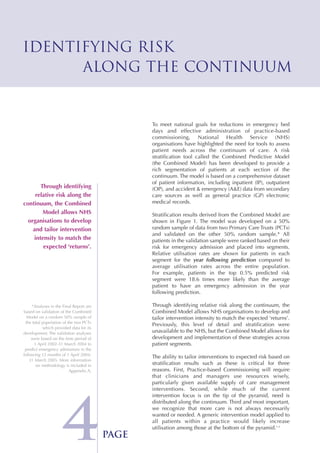
Stratification results derived from the Combined Model are
shown in Figure 1. The model was developed on a 50%
random sample of data from two Primary Care Trusts (PCTs)
and validated on the other 50% random sample.* All
patients in the validation sample were ranked based on their
risk for emergency admission and placed into segments.
Relative utilisation rates are shown for patients in each
segment for the year following prediction compared to
average utilisation rates across the entire population.
For example, patients in the top 0.5% predicted risk
segment were 18.6 times more likely than the average
patient to have an emergency admission in the year
following prediction.
Through identifying relative risk along the continuum, the
Combined Model allows NHS organisations to develop and
tailor intervention intensity to match the expected ‘returns’.
Previously, this level of detail and stratification were
unavailable to the NHS, but the Combined Model allows for
development and implementation of these strategies across
patient segments.
The ability to tailor interventions to expected risk based on
stratification results such as these is critical for three
reasons. First, Practice-based Commissioning will require
that clinicians and managers use resources wisely,
particularly given available supply of care management
interventions. Second, while much of the current
intervention focus is on the tip of the pyramid, need is
distributed along the continuum. Third and most important,
we recognize that more care is not always necessarily
wanted or needed. A generic intervention model applied to
all patients within a practice would likely increase
utilisation among those at the bottom of the pyramid.1-3
Population Average
Emergency admits = 63 per 1,000
OP visits = 735 per 1,000
A&E visits = 201 per 1,000
case
management
DISEASE management
Supported self-care
PREVENTION AND wellness promotion
Very High relative risk 0.5%
Emergency admits = 18.6 x average
OP visits = 5.8 x average
A&E visits = 8.5 x average
High relative risk 0.5 - 5%
Emergency admits = 5.5 x average
OP visits = 3.8 x average
A&E visits = 2.9 x average
moderate relative risk 6 - 20%
Emergency admits = 1.7 x average
OP visits = 1.9 x average
A&E visits = 1.4 x average
low relative risk 21 - 100%
Emergency admits = 0.5 x average
OP visits = 0.6 x average
A&E visits = 0.8 x average
PAGE 5
FIGURE 1
SEGMENTATION OF PATIENT POPULATION USING COMBINED MODEL
Source - Health Dialog UK
Case finding is essential
for effective long term
conditions management.
Predicting who is most at
risk of emergency
admissions is a critical
function of case finding.
6PAGE
The need for predictive case finding
The development of long term conditions management,
including case management, is becoming established
across England. These efforts have been ‘encouraged’ by
the release of various national strategic papers; a national
Public Service Agreement target has been set to improve
outcomes for people with long term conditions. This
agreement calls for a personalised care plan for vulnerable
people most at risk, and includes as a goal the reduction of
emergency bed days by 5% by March 2008.
Case finding is essential for effective long term conditions
management. Predicting who is most at risk of emergency
admissions is a critical function of case finding. Tools that
can identify those who can most benefit from outreach and
targeted interventions require a high degree of accuracy to
ensure that there is a match between intervention intensity
and risk.
To address this need, a package of predictive case finding
algorithms has been commissioned by the Department of
Health (DH)/Essex Strategic Health Authority from a
consortium of the King’s Fund, New York University and
Health Dialog. This consortium has developed three tools.
The first two are aimed at identifying Patients At Risk for Re-
hospitalisation (PARR1 and PARR2). PARR1 uses data on
prior hospitalisations for certain ‘reference conditions’ to
predict risk of re-hospitalisation while PARR2 uses data on
any prior hospitalisation to predict risk of re-hospitalisation.
The third tool is aimed at identifying risk along the
continuum (the Combined Model). The PARR models use IP
data only, while the Combined Model supplements these
data with OP, A&E and GP data. The Combined Model was
developed with two PCTs which supplied the data for its
development.
BACKGROUND
The need for additional
tools exists to identify
patients across a broader
spectrum of care needs
and levels of intervention.
The Patients At Risk for
Re-hospitalisation (PARR) model and
case management
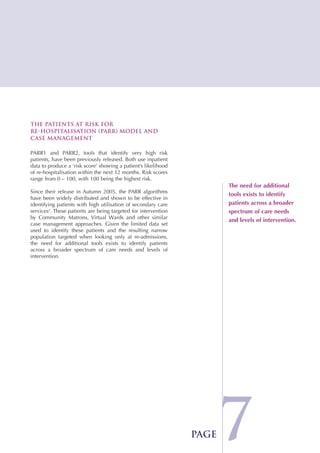
PARR1 and PARR2, tools that identify very high risk
patients, have been previously released. Both use inpatient
data to produce a ‘risk score’ showing a patient’s likelihood
of re-hospitalisation within the next 12 months. Risk scores
range from 0 – 100, with 100 being the highest risk.
Since their release in Autumn 2005, the PARR algorithms
have been widely distributed and shown to be effective in
identifying patients with high utilisation of secondary care
services4
. These patients are being targeted for intervention
by Community Matrons, Virtual Wards and other similar
case management approaches. Given the limited data set
used to identify these patients and the resulting narrow
population targeted when looking only at re-admissions,
the need for additional tools exists to identify patients
across a broader spectrum of care needs and levels of
intervention.
PAGE 7
8PAGE
The Combined Model and segmentation
strategies
To meet this broader need and to determine whether the
addition of further data sets improves predictive accuracy, a
third algorithm has been developed which combines
secondary care data with GP electronic records. This
Combined Model is able to:
. Improve predictive accuracy for very high risk
patients
. Predict risk of hospital admission for those patients
who have not experienced a recent emergency
admission
. Stratify risk across all patients in a given health
economy to help NHS organisations understand
drivers of utilisation at all levels
The ability to identify emerging risk patients will enable
NHS organisations to take a more strategic approach to
their care management interventions. For example, PCTs
will be able to design and implement interventions and care
pathways along the continuum of risk, ranging from:
. Prevention and wellness promotion for relatively
low risk patients
. Supported self-care interventions for moderate risk
patients
. Early intervention care management for patients
with emerging risk
. Intensive case management for very high risk
patients
The broad application of the Combined Model will allow
segmentation of an entire population into relative risk
segments and facilitate matching the intensity of outreach
and intervention with the risk of unwarranted secondary
care utilisation. The ability to apply the intervention in
a targeted fashion increases the likelihood that patients will
receive the care they want (and nothing more) and the care
they need (and nothing less).
The broad application
of the Combined Model
will allow segmentation of
an entire population into
relative risk segments and
facilitate matching the
intensity of outreach and
intervention with the risk
of unwarranted secondary
care utilisation.
THE COMBINED MODEL
PAGE 9
The Combined Model
offers a tool to help
design, commission and
implement an overall
long term conditions
programme strategy.
What does the Combined Model do?
The aim of the Combined Model is to use a broader and
more comprehensive set of data to identify patients who
may become frequent users of secondary care services.
Through prospectively identifying these patients, the
appropriate levels of outreach and intervention can be
applied; from helping patients at lower risk to manage their
conditions with information and self-management support,
to providing intensive case management support for patients
at the highest levels of risk.
The Combined Model was developed using a split sample
methodology on data from two PCTs with a total population
of 560,000. Details of the development methodology and
population can be found in Appendix A. The model takes
primary and secondary care data for an entire patient
population and stratifies those patients based upon their risk
of emergency admission in the next 12 months. With access
to this broader set of data beyond just inpatient data,
the Combined Model is not limited to identification of very
high risk patients based solely on past admissions.
The Combined Model offers a tool to help design,
commission and implement an overall long term conditions
programme strategy.
10PAGE
The Combined Model enhances
predictive ACCURACY
In addition to stratifying an entire patient population and
identifying emerging risk, the Combined Model is also
effective in identifying patients in the very high and high
risk segments of the population. In the sections below, we
discuss the clinical and utilisation profiles of patients who
fall into these segments, highlighting the opportunities for
impact. In the highest risk segments where the most
intensive outreach will be targeted, such as case
management interventions, the Combined Model improves
predictive performance over the PARR (i.e., PARR2) model
for the same populations. Figure 2 below shows the Positive
Predictive Value (PPV)* for different cuts of population size
identified by either the Combined or the PARR model.
THE COMBINED MODEL
FIGURE 2
POSITIVE PREDICTIVE VALUE
FOR COMBINED MODEL VS. PARR
*PPV is a reflection of the number of
patients who actually had an
emergency admission in the year
following prediction out of all of the
patients who were predicted to have
an emergency admission within that
segment. For example, 586 out of the
top 1000 patients predicted by the
Combined Model actually had an
emergency admission in the year
following prediction as compared
with 505 out of the top 1000 PARR
patients.
80
70
60
50
40
30
20
10
0
Percentagewithemergencyadmissioninyearfollowingprediction
Identified patients out of a population of 280,000
250 500 1000 5000 10000
COMBINED
PARR
PAGE 11
General practice data add to the
predictive accuracy
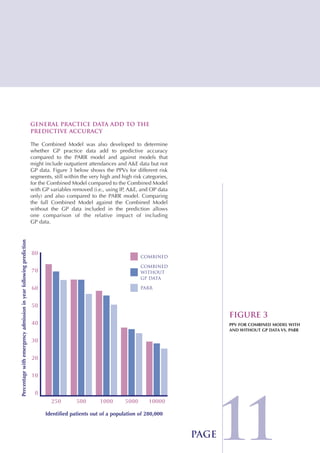
The Combined Model was also developed to determine
whether GP practice data add to predictive accuracy
compared to the PARR model and against models that
might include outpatient attendances and A&E data but not
GP data. Figure 3 below shows the PPVs for different risk
segments, still within the very high and high risk categories,
for the Combined Model compared to the Combined Model
with GP variables removed (i.e., using IP, A&E, and OP data
only) and also compared to the PARR model. Comparing
the full Combined Model against the Combined Model
without the GP data included in the prediction allows
one comparison of the relative impact of including
GP data.
FIGURE 3
PPV FOR COMBINED MODEL WITH
AND WITHOUT GP DATA VS. PARR
80
70
60
50
40
30
20
10
0
Percentagewithemergencyadmissioninyearfollowingprediction
Identified patients out of a population of 280,000
250 500 1000 5000 10000
COMBINED
COMBINED
without
GP Data
PARR
12page
As highlighted on page 11, Figure 3 shows that a more
inclusive model using inpatient, outpatient, and A&E data
alone outperforms PARR, and the full Combined Model
which also includes GP data outperforms both models at
almost all risk segments.
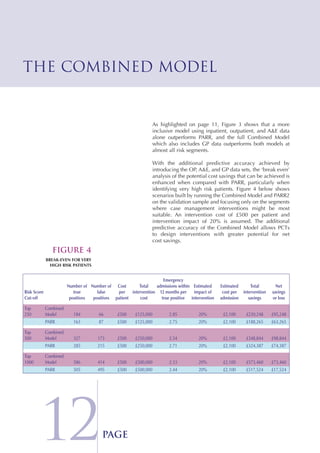
With the additional predictive accuracy achieved by
introducing the OP, A&E, and GP data sets, the ‘break even’
analysis of the potential cost savings that can be achieved is
enhanced when compared with PARR, particularly when
identifying very high risk patients. Figure 4 below shows
scenarios built by running the Combined Model and PARR2
on the validation sample and focusing only on the segments
where case management interventions might be most
suitable. An intervention cost of £500 per patient and
intervention impact of 20% is assumed. The additional
predictive accuracy of the Combined Model allows PCTs
to design interventions with greater potential for net
cost savings.
THE COMBINED MODEL
FIGURE 4
BREAK-EVEN FOR VERY
HIGH RISK PATIENTS
Emergency
Number of Number of Cost Total admissions within Estimated Estimated Total Net
Risk Score true false per intervention 12 months per impact of cost per intervention savings
Cut-off positives positives patient cost true positive intervention admission savings or loss
Top Combined
250 Model 184 66 £500 £125,000 2.85 20% £2,100 £220,248 £95,248
PARR 163 87 £500 £125,000 2.75 20% £2,100 £188,265 £63,265
Top Combined
500 Model 327 173 £500 £250,000 2.54 20% £2,100 £348,844 £98,844
PARR 285 215 £500 £250,000 2.71 20% £2,100 £324,387 £74,387
Top Combined
1000 Model 586 414 £500 £500,000 2.33 20% £2,100 £573,460 £73,460
PARR 505 495 £500 £500,000 2.44 20% £2,100 £517,524 £17,524
PAGE 13
With the additional
predictive accuracy
achieved by introducing
the OP, A&E, and GP data
sets, the ‘break even’
analysis of the potential
cost savings that can be
achieved is enhanced
when compared with
PARR, particularly when
identifying very high risk
patients (as shown in
Figure 4 on page 12).
The Combined Model introduces
a new patient population
The PARR and Combined Models identify different patients,
even at the highest risk levels. The Venn diagram in Figure
5a below demonstrates the overlap between the PARR and
Combined Models using the top 1,000 patients as an
example: those patients who are identified in PARR only,
those identified in the Combined Model only, and those
identified in both models.
FIGURE 5a
VENN DIAGRAM OF PARR AND
COMBINED MODEL PATIENT
POPULATIONS OUT OF TOP
1,000 IDENTIFIED
Overlap
484 patients
PARR only
516 patients
Combined only
516 patients
14PAGE
The addition of patients
who would have been
missed by PARR altogether,
due to lack of prior
inpatient admissions, and
patients who would have
been identified at much
lower risk levels by PARR,
due to its reliance on
inpatient data only,
is significant.
THE COMBINED MODEL
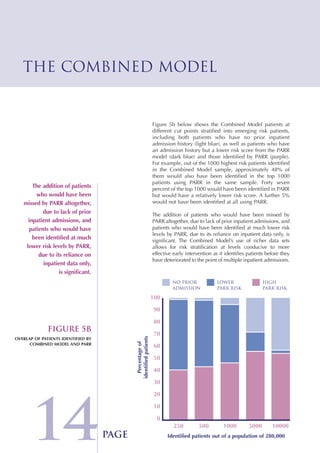
FIGURE 5B
OVERLAP OF PATIENTS IDENTIFIED BY
COMBINED MODEL AND PARR
Figure 5b below shows the Combined Model patients at
different cut points stratified into emerging risk patients,
including both patients who have no prior inpatient
admission history (light blue), as well as patients who have
an admission history but a lower risk score from the PARR
model (dark blue) and those identified by PARR (purple).
For example, out of the 1000 highest risk patients identified
in the Combined Model sample, approximately 48% of
them would also have been identified in the top 1000
patients using PARR in the same sample. Forty seven
percent of the top 1000 would have been identified in PARR
but would have a relatively lower risk score. A further 5%
would not have been identified at all using PARR.
The addition of patients who would have been missed by
PARR altogether, due to lack of prior inpatient admissions, and
patients who would have been identified at much lower risk
levels by PARR, due to its reliance on inpatient data only, is
significant. The Combined Model’s use of richer data sets
allows for risk stratification at levels conducive to more
effective early intervention as it identifies patients before they
have deteriorated to the point of multiple inpatient admissions.
100
90
80
70
60
50
40
30
20
10
0
Percentageof
identifiedpatients
Identified patients out of a population of 280,000
250 500 1000 5000 10000
NO PRIOR
ADMISSION
LOWER
PARR RISK
HIGH
PARR RISK
PAGE 15
The Combined Model identifies
patients with rich clinical profiles
and opportunities to impact future
utilisation and clinical care
The addition of GP, OP, and A&E data sources in the
Combined Model gives further clinical insights into the
status of identified patients and the factors that are
contributing significant risk for emergency admission. In
addition, the clinical profile that emerges from creating the
input data required to implement the Combined Model
provides a much more descriptive clinical roadmap of how
to tailor the intervention to the needs of the patients
identified.
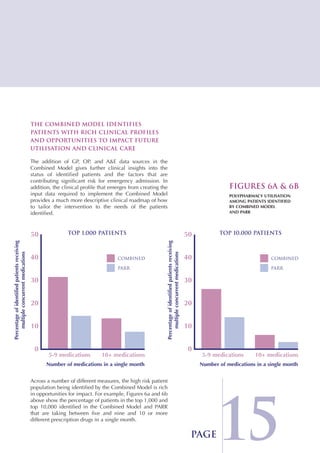
Across a number of different measures, the high risk patient
population being identified by the Combined Model is rich
in opportunities for impact. For example, Figures 6a and 6b
above show the percentage of patients in the top 1,000 and
top 10,000 identified in the Combined Model and PARR
that are taking between five and nine and 10 or more
different prescription drugs in a single month.
FIGURES 6A & 6B
POLYPHARMACY UTILISATION
AMONG PATIENTS IDENTIFIED
BY COMBINED MODEL
AND PARR
50
40
30
20
10
0
Percentageofidentifiedpatientsreceiving
multipleconcurrentmedications
Number of medications in a single month
TOP 1,000 PATIENTS
5-9 medications 10+ medications
COMBINED
PARR
50
40
30
20
10
0
Percentageofidentifiedpatientsreceiving
multipleconcurrentmedications
Number of medications in a single month
TOP 10,000 PATIENTS
5-9 medications 10+ medications
COMBINED
PARR
THE COMBINED MODEL
Polypharmacy issues are a significant area of focus for high
intensity and/or telephonic interventions; the Combined
Model identifies a set of patients with higher rates of
polypharmacy-related concerns than the PARR model. This
clinical information, only available through the linking of the
different data sets, will have a direct impact on the type and
intensity of intervention design planned, such as the use of
pharmacy experts to look at polypharmacy issues and how
to manage those for improved outcomes and lower cost.
Figures 7a and 7b below look at the prevalence of key
chronic diseases in the top 1,000 and top 10,000 patients (a
summary of clinical profile variables across cutpoints is
shown in Appendix B). The prevalence of impactable
conditions such as asthma, depression, and hypertension is
higher in the top 1,000 Combined Model patients than the
top 1,000 PARR patients.
This is consistent with the different patient population being
introduced using the more comprehensive data set and the
ability to identify emerging risk patients. Similarly, for the
top 10,000 patients, the Combined Model is consistently
identifying patients with higher long term condition
prevalence and more impactable opportunities across all
conditions (as shown in Appendix B).
FIGURES 7A & 7B
LONG TERM CONDITION
PREVALENCE AMONG PATIENTS
IDENTIFIED BY COMBINED
MODEL AND PARR
16PAGE
70
60
50
40
30
20
10
0
PercentageofidentifiedpatientswithLTC
Long term conditions
TOP 10,000 PATIENTS
Asthma Depression Hypertension
COMBINED
PARR
70
60
50
40
30
20
10
0
PercentageofidentifiedpatientswithLTC
Long term conditions
TOP 1,000 PATIENTS
Asthma Depression Hypertension
COMBINED
PARR
General practice data helps identify
patients with impactable conditions
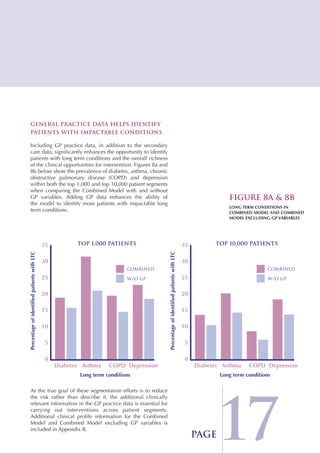
Including GP practice data, in addition to the secondary
care data, significantly enhances the opportunity to identify
patients with long term conditions and the overall richness
of the clinical opportunities for intervention. Figures 8a and
8b below show the prevalence of diabetes, asthma, chronic
obstructive pulmonary disease (COPD) and depression
within both the top 1,000 and top 10,000 patient segments
when comparing the Combined Model with and without
GP variables. Adding GP data enhances the ability of
the model to identify more patients with impactable long
term conditions.
As the true goal of these segmentation efforts is to reduce
the risk rather than describe it, the additional clinically
relevant information in the GP practice data is essential for
carrying out interventions across patient segments.
Additional clinical profile information for the Combined
Model and Combined Model excluding GP variables is
included in Appendix B.
FIGURE 8A & 8B
LONG TERM CONDITIONS IN
COMBINED MODEL AND COMBINED
MODEL EXCLUDING GP VARIABLES
PAGE 17
35
30
25
20
15
10
5
0
PercentageofidentifiedpatientswithLTC
Long term conditions
TOP 10,000 PATIENTS
Diabetes Asthma COPD Depression
COMBINED
W/O GP
35
30
25
20
15
10
5
0
PercentageofidentifiedpatientswithLTC
Long term conditions
TOP 1,000 PATIENTS
Diabetes Asthma COPD Depression
COMBINED
W/O GP
THE COMBINED MODEL
The Combined Model offers the
ability to identify opportunities
in other segments of the risk pyramid
As discussed earlier, the Combined Model identifies patients
across the continuum of risk. This allows NHS organisations
to tailor targeted outreach and intervention to the relative
risk of individual patients in each segment of the risk
pyramid (shown on page 5). Most of this document focuses
on those in the very high and high risk segments where case
management and disease management interventions
involving direct interaction with patients may be warranted.
However, there are also opportunities to design lower
intensity strategies for supported self-care for patients in the
moderate risk segment (6-20%) such as support via
telephone, mail, internet, text messaging and/or email.
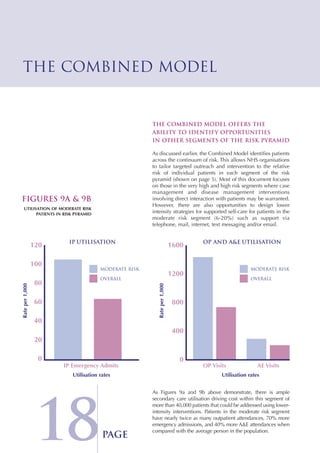
As Figures 9a and 9b above demonstrate, there is ample
secondary care utilisation driving cost within this segment of
more than 40,000 patients that could be addressed using lower-
intensity interventions. Patients in the moderate risk segment
have nearly twice as many outpatient attendances, 70% more
emergency admissions, and 40% more A&E attendances when
compared with the average person in the population.
FIGURES 9A & 9B
UTILISATION OF MODERATE RISK
PATIENTS IN RISK PYRAMID
18PAGE
120
100
80
60
40
20
0
Rateper1,000
Rateper1,000
Utilisation rates
IP UTILISATION
IP Emergency Admits
MODERATE RISK
OVERALL
1600
1200
800
400
0
Utilisation rates
OP and A&E UTILISATION
OP Visits AE Visits
MODERATE RISK
OVERALL
PAGE 19
Figure 10 below demonstrates that there is also significant
clinical opportunity within the moderate risk group. For
example, compared with population averages, patients in
the moderate risk segment are more than twice as likely to
have polypharmacy utilisation of between five and nine
different drugs in a single month. In addition, there is
relatively high prevalence of impactable long term
conditions in this segment which, if unmanaged, may lead
to patients progressing up the pyramid. For example,
hypertension prevalence in this group is 18% compared
with 9% in the overall population.
FIGURE 10
CLINICAL PROFILE OF MODERATE
RISK PATIENTS IN RISK PYRAMID
20
15
10
5
0
Percentageofidentifiedpatientswithcondition
Conditions/Medication use
Asthma Depression Hyper- 5-9
tension Concurrent
medications
MODERATE RISK
OVERALL
20PAGE
The Combined Model
offers an increase in
predictive power for the
highest risk patients, and
also facilitates the
identification of a much
broader population with
emerging risk.
CONCLUSION
The Combined Model significantly extends the range of
opportunities for the NHS and clinicians interested in long
term condition interventions. The ability to stratify the
entire population allows PCTs to develop intervention
strategies aimed at reducing immediate, intermediate and
longer term risk. Further, the addition of rich, clinical detail
allows PCTs to not only segment populations, but also
begin to assemble the clinical interventions for each of the
different segments.
The findings from the Combined Model show that it holds
significant potential value for NHS organisations seeking to
develop population-based strategies for utilisation
reduction and quality improvement. Whilst the PARR
model has offered the NHS a nationwide tool that allows
for quick identification of the very highest risk patients, it
has been limited to identifying only those individuals at the
highest end of the risk pyramid. The Combined Model
offers an increase in predictive power for the highest risk
patients, and also facilitates the identification of a much
broader population with emerging risk. An integrated
approach, using both tools, which matches interventions of
varying intensity to population needs across the continuum
of risk levels will be an essential component of PCTs’ care
management strategies, and the Combined Model offers an
important set of tools for PCTs to design and implement
these strategies.
PAGE 21
REFERENCES
1 Fisher, Wennberg, Stukel, et al, “The Implications of
Regional Variations in Medicare Spending. Part 1: The
Content, Quality, and Accessibility of Care,” Annals of
Internal Medicine, 2003; 138:273-287.
2 Fisher, Wennberg, Stukel, et al, “The Implications of
RegionalVariations in Medicare Spending. Part 2: Health
Outcomes and Satisfaction with Care,” Annals of
Internal Medicine, 2003; 138:288-298.
3 O’Connor, Llewellyn-Thomas, and Flood, “Modifying
Unwarranted Variations In Health Care: Shared Decision
Making Using Patient Decision Aids,” Health Affairs –
Web Exclusive, 2004; VAR 63-72.
4 Billings, Dixon, Mijanovich, and Wennberg, “Case
finding for patients at risk of readmission to hospital:
development of algorithm to identify high risk patients,”
British Medical Journal, 2006; 333:327-330.
Summary of Data Sources and
Methodology
The Combined Model was developed on a total population
of 560,000 patients from two PCTs using three years of
hospital data (April 2002 – March 2005), including
inpatient (IP), outpatient (OP), and accident and emergency
(A&E) attendance data. Additionally, primary care data for
the same time period were included from the two PCTs,
including lab, diagnosis, and encounter information from
general practices within those PCTs. Unfortunately,
pharmacy data were only included for one of the two PCTs
that supplied the primary care data. In addition, social
services data were requested from the PCTs participating in
the Combined Model development work. Health Dialog
was able to link the social services information to the
clinical data supplied for only one of the PCTs and only in
a very small percentage of patients due to complications
with the data. This proportion of linked social and clinical
service records at the patient-level was not sufficient for
inclusion in the Combined Model.
The model was developed using logistic regression on a
random selection of 50% of the available data (known as the
‘development sample’). Data for the period of April 2002
through March 2004 were mined for predictor variables
associated with risk of admission during the time period of
April 2004 through March 2005. The model was validated by
applying the variable beta weights resulting from the logistic
regression analyses to the remaining 50% of data (known as
the ‘validation sample’). All Combined Model results shown in
the Final Report are for this validation sample only and are
compared with PARR scores for patients from the same
validation sample and same time period.
APPENDIX A
22PAGE
In development, more than 850 variables were considered
for inclusion. These variables included a combination of
values from administrative records and derivations from
those values. Derived variables included proxy variables for
long-term conditions (drawn from GP and IP encounters),
polypharmacy (drawn from Read codes evaluated on a
monthly basis), and changes in lab values (derived from GP
encounters). Each variable was also coded into five
mutually exclusive time periods to account for recency of
occurrence and patterns of recurrence. Each variable was
assessed independently for its relationship with inpatient
emergency admission before being included in a
multivariate model.
PAGE 23
APPENDIX B
24PAGE
Long term condition Avg.
Identified Avg. 5 - 9 10+ length
patients Model Asthma COPD Depression Diabetes Hypertension Cancer CHD CHF age Medications Medications of stay*
10,000 Combined 20.1 8.2 17.9 13.7 45.2 14.9 15.5 6.5 67.3 26.0 6.0 11.4
PARR 14.3 5.1 11.8 9.3 29.0 9.4 12.0 4.6 55.4 14.1 3.0 10.4
5,000 Combined 23.3 11.0 20.6 16.2 51.4 15.3 18.5 9.4 69.7 29.5 8.6 11.5
PARR 16.6 8.8 13.7 12.9 38.7 15.1 18.8 8.3 66.2 17.6 4.3 11.0
1,000 Combined 31.4 19.6 22.7 18.8 61.2 16.4 24.5 15.9 71.6 31.5 13.4 10.3
PARR 24.3 20.6 16.9 19.9 47.7 20.0 24.8 19.2 69.5 14.6 7.4 9.9
500 Combined 34.0 22.6 25.2 19.2 63.2 16.4 28.8 19.4 70.7 30.6 14.6 9.8
PARR 28.4 24.6 16.4 23.0 49.0 21.0 28.8 24.4 69.1 14.8 8.6 9.4
250 Combined 40.8 28.4 24.4 21.2 62.8 17.6 29.6 23.2 69.5 32.0 18.0 8.9
PARR 30.8 26.8 20.0 22.8 52.4 20.8 30.8 29.2 68.8 14.4 10.0 9.8
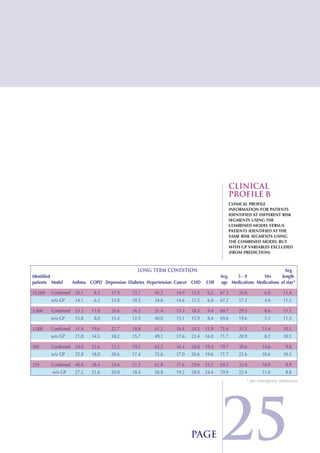
CLINICAL
PROFILE A
CLINICAL PROFILE
INFORMATION FOR PATIENTS
IDENTIFIED AT DIFFERENT RISK
SEGMENTS USING THE
COMBINED MODEL VERSUS
PATIENTS IDENTIFIED AT THE
SAME RISK SEGMENTS USING
THE PARR MODEL
* per emergency admission
PAGE 25
Long term condition Avg.
Identified Avg. 5 - 9 10+ length
patients Model Asthma COPD Depression Diabetes Hypertension Cancer CHD CHF age Medications Medications of stay*
10,000 Combined 20.1 8.2 17.9 13.7 45.2 14.9 15.5 6.5 67.3 26.0 6.0 11.4
w/o GP 14.1 6.2 13.8 10.5 34.6 14.6 13.5 6.0 67.2 17.3 4.0 11.3
5,000 Combined 23.3 11.0 20.6 16.2 51.4 15.3 18.5 9.4 69.7 29.5 8.6 11.5
w/o GP 15.8 8.0 15.4 12.5 40.0 15.1 15.9 8.4 69.6 19.6 5.3 11.3
1,000 Combined 31.4 19.6 22.7 18.8 61.2 16.4 24.5 15.9 71.6 31.5 13.4 10.3
w/o GP 21.0 14.5 18.2 15.7 49.1 17.6 22.4 16.0 71.7 20.9 8.2 10.5
500 Combined 34.0 22.6 25.2 19.2 63.2 16.4 28.8 19.4 70.7 30.6 14.6 9.8
w/o GP 25.8 18.0 20.6 17.4 55.6 17.0 26.6 19.6 71.7 22.6 10.6 10.3
250 Combined 40.8 28.4 24.4 21.2 62.8 17.6 29.6 23.2 69.5 32.0 18.0 8.9
w/o GP 27.2 21.6 20.0 18.4 56.8 19.2 28.0 24.4 70.9 22.4 11.6 8.8
CLINICAL
PROFILE B
CLINICAL PROFILE
INFORMATION FOR PATIENTS
IDENTIFIED AT DIFFERENT RISK
SEGMENTS USING THE
COMBINED MODEL VERSUS
PATIENTS IDENTIFIED AT THE
SAME RISK SEGMENTS USING
THE COMBINED MODEL BUT
WITH GP VARIABLES EXCLUDED
(FROM PREDICTION)
* per emergency admission
______________________________________
______________________________________
______________________________________
______________________________________
______________________________________
______________________________________
______________________________________
______________________________________
______________________________________
______________________________________
______________________________________
______________________________________
______________________________________
______________________________________
______________________________________
______________________________________
______________________________________
______________________________________
______________________________________
______________________________________
______________________________________
______________________________________
______________________________________
______________________________________
______________________________________
______________________________________
______________________________________
______________________________________
______________________________________
26PAGE
NOTES
______________________________________
______________________________________
______________________________________
______________________________________
______________________________________
______________________________________
______________________________________
______________________________________
______________________________________
______________________________________
______________________________________
______________________________________
______________________________________
______________________________________
______________________________________
______________________________________
______________________________________
______________________________________
______________________________________
______________________________________
______________________________________
______________________________________
______________________________________
______________________________________
______________________________________
______________________________________
______________________________________
______________________________________
______________________________________
PAGE 27
NOTES
Health Dialog is a leading provider of care management services,
including disease management. It is one of the fastest growing
privately held firms in the US, with a subsidiary company
headquartered in Cambridge, UK. The firm’s services include
analytic services and telephonic care management support for
individuals. Health Dialog helps individuals become more actively
engaged in their healthcare and have more effective relationships
with their clinicians.
The King’s Fund is an independent charitable foundation working
for better health, especially in London. We carry out research,
policy analysis and development activities, working on our own, in
partnerships, and through funding. We are a major resource to
people working in health and social care, offering leadership
development programmes; seminars and workshops; publications;
information and library services; and conference and meeting
facilities.
Established in 1938, the Robert F. Wagner Graduate School of
Public Service offers advanced programs leading to the professional
degrees of Master of Public Administration, Master of Urban
Planning, Master of Science in Management, and Doctor of
Philosophy. Through these rigorous programs, NYU Wagner
educates the future leaders of public, non-profit, and health
institutions as well as private organizations serving the public
sector.
NYU – Robert F. Wagner
Graduate School of Public Service

PARR-combined-predictive-model-final-report-dec06

  • 1.
    COMBINED PREDICTIVE MODEL FI N A L R E P O RT D E C E M B E R 2 0 0 6
  • 2.
    The following individualsare the principal contributors to the development of the Combined Predictive Model: Health Dialog David Wennberg, MD, MPH Matt Siegel Bob Darin Nadya Filipova, MS Ronald Russell, MS Linda Kenney Klaus Steinort Tae-Ryong Park, PhD Gokhan Cakmakci King’s Fund Jennifer Dixon, MBChB, PhD Natasha Curry New York University John Billings We would like to acknowledge the invaluable support and participation of numerous organisations involved in this project including its funders, the Department of Health and Essex Strategic Health Authority (acting on behalf of all 28 Strategic Health Authorities), as well as the National Health Service staff who joined the project steering group. We would also like to thank the Croydon and South Warwickshire Primary Care Trusts for supplying the data used in the development of the Combined Predictive Model, as well as the Tower Hamlets and Southwark Primary Care Trusts for their data collection efforts. ACKNOWLEDGEMENTS 2page
  • 3.
    Identifying risk alongthe continuum 4 Background 6 the combined model 8 conclusion 20 appendices A & B 22 Notes 26 CONTENTS page 3
  • 4.
    IDENTIFYING RISK along thecontinuum Through identifying relative risk along the continuum, the Combined Model allows NHS organisations to develop and tailor intervention intensity to match the expected ‘returns’. *Analyses in the Final Report are based on validation of the Combined Model on a random 50% sample of the total population of the two PCTs which provided data for its development. The validation analyses were based on the time period of 1 April 2002-31 March 2004 to predict emergency admissions in the following 12 months of 1 April 2004- 31 March 2005. More information on methodology is included in Appendix A. 4PAGE To meet national goals for reductions in emergency bed days and effective administration of practice-based commissioning, National Health Service (NHS) organisations have highlighted the need for tools to assess patient needs across the continuum of care. A risk stratification tool called the Combined Predictive Model (the Combined Model) has been developed to provide a rich segmentation of patients at each section of the continuum. The model is based on a comprehensive dataset of patient information, including inpatient (IP), outpatient (OP), and accident & emergency (A&E) data from secondary care sources as well as general practice (GP) electronic medical records. Stratification results derived from the Combined Model are shown in Figure 1. The model was developed on a 50% random sample of data from two Primary Care Trusts (PCTs) and validated on the other 50% random sample.* All patients in the validation sample were ranked based on their risk for emergency admission and placed into segments. Relative utilisation rates are shown for patients in each segment for the year following prediction compared to average utilisation rates across the entire population. For example, patients in the top 0.5% predicted risk segment were 18.6 times more likely than the average patient to have an emergency admission in the year following prediction. Through identifying relative risk along the continuum, the Combined Model allows NHS organisations to develop and tailor intervention intensity to match the expected ‘returns’. Previously, this level of detail and stratification were unavailable to the NHS, but the Combined Model allows for development and implementation of these strategies across patient segments. The ability to tailor interventions to expected risk based on stratification results such as these is critical for three reasons. First, Practice-based Commissioning will require that clinicians and managers use resources wisely, particularly given available supply of care management interventions. Second, while much of the current intervention focus is on the tip of the pyramid, need is distributed along the continuum. Third and most important, we recognize that more care is not always necessarily wanted or needed. A generic intervention model applied to all patients within a practice would likely increase utilisation among those at the bottom of the pyramid.1-3
  • 5.
    Population Average Emergency admits= 63 per 1,000 OP visits = 735 per 1,000 A&E visits = 201 per 1,000 case management DISEASE management Supported self-care PREVENTION AND wellness promotion Very High relative risk 0.5% Emergency admits = 18.6 x average OP visits = 5.8 x average A&E visits = 8.5 x average High relative risk 0.5 - 5% Emergency admits = 5.5 x average OP visits = 3.8 x average A&E visits = 2.9 x average moderate relative risk 6 - 20% Emergency admits = 1.7 x average OP visits = 1.9 x average A&E visits = 1.4 x average low relative risk 21 - 100% Emergency admits = 0.5 x average OP visits = 0.6 x average A&E visits = 0.8 x average PAGE 5 FIGURE 1 SEGMENTATION OF PATIENT POPULATION USING COMBINED MODEL Source - Health Dialog UK
  • 6.
    Case finding isessential for effective long term conditions management. Predicting who is most at risk of emergency admissions is a critical function of case finding. 6PAGE The need for predictive case finding The development of long term conditions management, including case management, is becoming established across England. These efforts have been ‘encouraged’ by the release of various national strategic papers; a national Public Service Agreement target has been set to improve outcomes for people with long term conditions. This agreement calls for a personalised care plan for vulnerable people most at risk, and includes as a goal the reduction of emergency bed days by 5% by March 2008. Case finding is essential for effective long term conditions management. Predicting who is most at risk of emergency admissions is a critical function of case finding. Tools that can identify those who can most benefit from outreach and targeted interventions require a high degree of accuracy to ensure that there is a match between intervention intensity and risk. To address this need, a package of predictive case finding algorithms has been commissioned by the Department of Health (DH)/Essex Strategic Health Authority from a consortium of the King’s Fund, New York University and Health Dialog. This consortium has developed three tools. The first two are aimed at identifying Patients At Risk for Re- hospitalisation (PARR1 and PARR2). PARR1 uses data on prior hospitalisations for certain ‘reference conditions’ to predict risk of re-hospitalisation while PARR2 uses data on any prior hospitalisation to predict risk of re-hospitalisation. The third tool is aimed at identifying risk along the continuum (the Combined Model). The PARR models use IP data only, while the Combined Model supplements these data with OP, A&E and GP data. The Combined Model was developed with two PCTs which supplied the data for its development. BACKGROUND
  • 7.
    The need foradditional tools exists to identify patients across a broader spectrum of care needs and levels of intervention. The Patients At Risk for Re-hospitalisation (PARR) model and case management PARR1 and PARR2, tools that identify very high risk patients, have been previously released. Both use inpatient data to produce a ‘risk score’ showing a patient’s likelihood of re-hospitalisation within the next 12 months. Risk scores range from 0 – 100, with 100 being the highest risk. Since their release in Autumn 2005, the PARR algorithms have been widely distributed and shown to be effective in identifying patients with high utilisation of secondary care services4 . These patients are being targeted for intervention by Community Matrons, Virtual Wards and other similar case management approaches. Given the limited data set used to identify these patients and the resulting narrow population targeted when looking only at re-admissions, the need for additional tools exists to identify patients across a broader spectrum of care needs and levels of intervention. PAGE 7
  • 8.
    8PAGE The Combined Modeland segmentation strategies To meet this broader need and to determine whether the addition of further data sets improves predictive accuracy, a third algorithm has been developed which combines secondary care data with GP electronic records. This Combined Model is able to: . Improve predictive accuracy for very high risk patients . Predict risk of hospital admission for those patients who have not experienced a recent emergency admission . Stratify risk across all patients in a given health economy to help NHS organisations understand drivers of utilisation at all levels The ability to identify emerging risk patients will enable NHS organisations to take a more strategic approach to their care management interventions. For example, PCTs will be able to design and implement interventions and care pathways along the continuum of risk, ranging from: . Prevention and wellness promotion for relatively low risk patients . Supported self-care interventions for moderate risk patients . Early intervention care management for patients with emerging risk . Intensive case management for very high risk patients The broad application of the Combined Model will allow segmentation of an entire population into relative risk segments and facilitate matching the intensity of outreach and intervention with the risk of unwarranted secondary care utilisation. The ability to apply the intervention in a targeted fashion increases the likelihood that patients will receive the care they want (and nothing more) and the care they need (and nothing less). The broad application of the Combined Model will allow segmentation of an entire population into relative risk segments and facilitate matching the intensity of outreach and intervention with the risk of unwarranted secondary care utilisation. THE COMBINED MODEL
  • 9.
    PAGE 9 The CombinedModel offers a tool to help design, commission and implement an overall long term conditions programme strategy. What does the Combined Model do? The aim of the Combined Model is to use a broader and more comprehensive set of data to identify patients who may become frequent users of secondary care services. Through prospectively identifying these patients, the appropriate levels of outreach and intervention can be applied; from helping patients at lower risk to manage their conditions with information and self-management support, to providing intensive case management support for patients at the highest levels of risk. The Combined Model was developed using a split sample methodology on data from two PCTs with a total population of 560,000. Details of the development methodology and population can be found in Appendix A. The model takes primary and secondary care data for an entire patient population and stratifies those patients based upon their risk of emergency admission in the next 12 months. With access to this broader set of data beyond just inpatient data, the Combined Model is not limited to identification of very high risk patients based solely on past admissions. The Combined Model offers a tool to help design, commission and implement an overall long term conditions programme strategy.
  • 10.
    10PAGE The Combined Modelenhances predictive ACCURACY In addition to stratifying an entire patient population and identifying emerging risk, the Combined Model is also effective in identifying patients in the very high and high risk segments of the population. In the sections below, we discuss the clinical and utilisation profiles of patients who fall into these segments, highlighting the opportunities for impact. In the highest risk segments where the most intensive outreach will be targeted, such as case management interventions, the Combined Model improves predictive performance over the PARR (i.e., PARR2) model for the same populations. Figure 2 below shows the Positive Predictive Value (PPV)* for different cuts of population size identified by either the Combined or the PARR model. THE COMBINED MODEL FIGURE 2 POSITIVE PREDICTIVE VALUE FOR COMBINED MODEL VS. PARR *PPV is a reflection of the number of patients who actually had an emergency admission in the year following prediction out of all of the patients who were predicted to have an emergency admission within that segment. For example, 586 out of the top 1000 patients predicted by the Combined Model actually had an emergency admission in the year following prediction as compared with 505 out of the top 1000 PARR patients. 80 70 60 50 40 30 20 10 0 Percentagewithemergencyadmissioninyearfollowingprediction Identified patients out of a population of 280,000 250 500 1000 5000 10000 COMBINED PARR
  • 11.
    PAGE 11 General practicedata add to the predictive accuracy The Combined Model was also developed to determine whether GP practice data add to predictive accuracy compared to the PARR model and against models that might include outpatient attendances and A&E data but not GP data. Figure 3 below shows the PPVs for different risk segments, still within the very high and high risk categories, for the Combined Model compared to the Combined Model with GP variables removed (i.e., using IP, A&E, and OP data only) and also compared to the PARR model. Comparing the full Combined Model against the Combined Model without the GP data included in the prediction allows one comparison of the relative impact of including GP data. FIGURE 3 PPV FOR COMBINED MODEL WITH AND WITHOUT GP DATA VS. PARR 80 70 60 50 40 30 20 10 0 Percentagewithemergencyadmissioninyearfollowingprediction Identified patients out of a population of 280,000 250 500 1000 5000 10000 COMBINED COMBINED without GP Data PARR
  • 12.
    12page As highlighted onpage 11, Figure 3 shows that a more inclusive model using inpatient, outpatient, and A&E data alone outperforms PARR, and the full Combined Model which also includes GP data outperforms both models at almost all risk segments. With the additional predictive accuracy achieved by introducing the OP, A&E, and GP data sets, the ‘break even’ analysis of the potential cost savings that can be achieved is enhanced when compared with PARR, particularly when identifying very high risk patients. Figure 4 below shows scenarios built by running the Combined Model and PARR2 on the validation sample and focusing only on the segments where case management interventions might be most suitable. An intervention cost of £500 per patient and intervention impact of 20% is assumed. The additional predictive accuracy of the Combined Model allows PCTs to design interventions with greater potential for net cost savings. THE COMBINED MODEL FIGURE 4 BREAK-EVEN FOR VERY HIGH RISK PATIENTS Emergency Number of Number of Cost Total admissions within Estimated Estimated Total Net Risk Score true false per intervention 12 months per impact of cost per intervention savings Cut-off positives positives patient cost true positive intervention admission savings or loss Top Combined 250 Model 184 66 £500 £125,000 2.85 20% £2,100 £220,248 £95,248 PARR 163 87 £500 £125,000 2.75 20% £2,100 £188,265 £63,265 Top Combined 500 Model 327 173 £500 £250,000 2.54 20% £2,100 £348,844 £98,844 PARR 285 215 £500 £250,000 2.71 20% £2,100 £324,387 £74,387 Top Combined 1000 Model 586 414 £500 £500,000 2.33 20% £2,100 £573,460 £73,460 PARR 505 495 £500 £500,000 2.44 20% £2,100 £517,524 £17,524
  • 13.
    PAGE 13 With theadditional predictive accuracy achieved by introducing the OP, A&E, and GP data sets, the ‘break even’ analysis of the potential cost savings that can be achieved is enhanced when compared with PARR, particularly when identifying very high risk patients (as shown in Figure 4 on page 12). The Combined Model introduces a new patient population The PARR and Combined Models identify different patients, even at the highest risk levels. The Venn diagram in Figure 5a below demonstrates the overlap between the PARR and Combined Models using the top 1,000 patients as an example: those patients who are identified in PARR only, those identified in the Combined Model only, and those identified in both models. FIGURE 5a VENN DIAGRAM OF PARR AND COMBINED MODEL PATIENT POPULATIONS OUT OF TOP 1,000 IDENTIFIED Overlap 484 patients PARR only 516 patients Combined only 516 patients
  • 14.
    14PAGE The addition ofpatients who would have been missed by PARR altogether, due to lack of prior inpatient admissions, and patients who would have been identified at much lower risk levels by PARR, due to its reliance on inpatient data only, is significant. THE COMBINED MODEL FIGURE 5B OVERLAP OF PATIENTS IDENTIFIED BY COMBINED MODEL AND PARR Figure 5b below shows the Combined Model patients at different cut points stratified into emerging risk patients, including both patients who have no prior inpatient admission history (light blue), as well as patients who have an admission history but a lower risk score from the PARR model (dark blue) and those identified by PARR (purple). For example, out of the 1000 highest risk patients identified in the Combined Model sample, approximately 48% of them would also have been identified in the top 1000 patients using PARR in the same sample. Forty seven percent of the top 1000 would have been identified in PARR but would have a relatively lower risk score. A further 5% would not have been identified at all using PARR. The addition of patients who would have been missed by PARR altogether, due to lack of prior inpatient admissions, and patients who would have been identified at much lower risk levels by PARR, due to its reliance on inpatient data only, is significant. The Combined Model’s use of richer data sets allows for risk stratification at levels conducive to more effective early intervention as it identifies patients before they have deteriorated to the point of multiple inpatient admissions. 100 90 80 70 60 50 40 30 20 10 0 Percentageof identifiedpatients Identified patients out of a population of 280,000 250 500 1000 5000 10000 NO PRIOR ADMISSION LOWER PARR RISK HIGH PARR RISK
  • 15.
    PAGE 15 The CombinedModel identifies patients with rich clinical profiles and opportunities to impact future utilisation and clinical care The addition of GP, OP, and A&E data sources in the Combined Model gives further clinical insights into the status of identified patients and the factors that are contributing significant risk for emergency admission. In addition, the clinical profile that emerges from creating the input data required to implement the Combined Model provides a much more descriptive clinical roadmap of how to tailor the intervention to the needs of the patients identified. Across a number of different measures, the high risk patient population being identified by the Combined Model is rich in opportunities for impact. For example, Figures 6a and 6b above show the percentage of patients in the top 1,000 and top 10,000 identified in the Combined Model and PARR that are taking between five and nine and 10 or more different prescription drugs in a single month. FIGURES 6A & 6B POLYPHARMACY UTILISATION AMONG PATIENTS IDENTIFIED BY COMBINED MODEL AND PARR 50 40 30 20 10 0 Percentageofidentifiedpatientsreceiving multipleconcurrentmedications Number of medications in a single month TOP 1,000 PATIENTS 5-9 medications 10+ medications COMBINED PARR 50 40 30 20 10 0 Percentageofidentifiedpatientsreceiving multipleconcurrentmedications Number of medications in a single month TOP 10,000 PATIENTS 5-9 medications 10+ medications COMBINED PARR
  • 16.
    THE COMBINED MODEL Polypharmacyissues are a significant area of focus for high intensity and/or telephonic interventions; the Combined Model identifies a set of patients with higher rates of polypharmacy-related concerns than the PARR model. This clinical information, only available through the linking of the different data sets, will have a direct impact on the type and intensity of intervention design planned, such as the use of pharmacy experts to look at polypharmacy issues and how to manage those for improved outcomes and lower cost. Figures 7a and 7b below look at the prevalence of key chronic diseases in the top 1,000 and top 10,000 patients (a summary of clinical profile variables across cutpoints is shown in Appendix B). The prevalence of impactable conditions such as asthma, depression, and hypertension is higher in the top 1,000 Combined Model patients than the top 1,000 PARR patients. This is consistent with the different patient population being introduced using the more comprehensive data set and the ability to identify emerging risk patients. Similarly, for the top 10,000 patients, the Combined Model is consistently identifying patients with higher long term condition prevalence and more impactable opportunities across all conditions (as shown in Appendix B). FIGURES 7A & 7B LONG TERM CONDITION PREVALENCE AMONG PATIENTS IDENTIFIED BY COMBINED MODEL AND PARR 16PAGE 70 60 50 40 30 20 10 0 PercentageofidentifiedpatientswithLTC Long term conditions TOP 10,000 PATIENTS Asthma Depression Hypertension COMBINED PARR 70 60 50 40 30 20 10 0 PercentageofidentifiedpatientswithLTC Long term conditions TOP 1,000 PATIENTS Asthma Depression Hypertension COMBINED PARR
  • 17.
    General practice datahelps identify patients with impactable conditions Including GP practice data, in addition to the secondary care data, significantly enhances the opportunity to identify patients with long term conditions and the overall richness of the clinical opportunities for intervention. Figures 8a and 8b below show the prevalence of diabetes, asthma, chronic obstructive pulmonary disease (COPD) and depression within both the top 1,000 and top 10,000 patient segments when comparing the Combined Model with and without GP variables. Adding GP data enhances the ability of the model to identify more patients with impactable long term conditions. As the true goal of these segmentation efforts is to reduce the risk rather than describe it, the additional clinically relevant information in the GP practice data is essential for carrying out interventions across patient segments. Additional clinical profile information for the Combined Model and Combined Model excluding GP variables is included in Appendix B. FIGURE 8A & 8B LONG TERM CONDITIONS IN COMBINED MODEL AND COMBINED MODEL EXCLUDING GP VARIABLES PAGE 17 35 30 25 20 15 10 5 0 PercentageofidentifiedpatientswithLTC Long term conditions TOP 10,000 PATIENTS Diabetes Asthma COPD Depression COMBINED W/O GP 35 30 25 20 15 10 5 0 PercentageofidentifiedpatientswithLTC Long term conditions TOP 1,000 PATIENTS Diabetes Asthma COPD Depression COMBINED W/O GP
  • 18.
    THE COMBINED MODEL TheCombined Model offers the ability to identify opportunities in other segments of the risk pyramid As discussed earlier, the Combined Model identifies patients across the continuum of risk. This allows NHS organisations to tailor targeted outreach and intervention to the relative risk of individual patients in each segment of the risk pyramid (shown on page 5). Most of this document focuses on those in the very high and high risk segments where case management and disease management interventions involving direct interaction with patients may be warranted. However, there are also opportunities to design lower intensity strategies for supported self-care for patients in the moderate risk segment (6-20%) such as support via telephone, mail, internet, text messaging and/or email. As Figures 9a and 9b above demonstrate, there is ample secondary care utilisation driving cost within this segment of more than 40,000 patients that could be addressed using lower- intensity interventions. Patients in the moderate risk segment have nearly twice as many outpatient attendances, 70% more emergency admissions, and 40% more A&E attendances when compared with the average person in the population. FIGURES 9A & 9B UTILISATION OF MODERATE RISK PATIENTS IN RISK PYRAMID 18PAGE 120 100 80 60 40 20 0 Rateper1,000 Rateper1,000 Utilisation rates IP UTILISATION IP Emergency Admits MODERATE RISK OVERALL 1600 1200 800 400 0 Utilisation rates OP and A&E UTILISATION OP Visits AE Visits MODERATE RISK OVERALL
  • 19.
    PAGE 19 Figure 10below demonstrates that there is also significant clinical opportunity within the moderate risk group. For example, compared with population averages, patients in the moderate risk segment are more than twice as likely to have polypharmacy utilisation of between five and nine different drugs in a single month. In addition, there is relatively high prevalence of impactable long term conditions in this segment which, if unmanaged, may lead to patients progressing up the pyramid. For example, hypertension prevalence in this group is 18% compared with 9% in the overall population. FIGURE 10 CLINICAL PROFILE OF MODERATE RISK PATIENTS IN RISK PYRAMID 20 15 10 5 0 Percentageofidentifiedpatientswithcondition Conditions/Medication use Asthma Depression Hyper- 5-9 tension Concurrent medications MODERATE RISK OVERALL
  • 20.
    20PAGE The Combined Model offersan increase in predictive power for the highest risk patients, and also facilitates the identification of a much broader population with emerging risk. CONCLUSION The Combined Model significantly extends the range of opportunities for the NHS and clinicians interested in long term condition interventions. The ability to stratify the entire population allows PCTs to develop intervention strategies aimed at reducing immediate, intermediate and longer term risk. Further, the addition of rich, clinical detail allows PCTs to not only segment populations, but also begin to assemble the clinical interventions for each of the different segments. The findings from the Combined Model show that it holds significant potential value for NHS organisations seeking to develop population-based strategies for utilisation reduction and quality improvement. Whilst the PARR model has offered the NHS a nationwide tool that allows for quick identification of the very highest risk patients, it has been limited to identifying only those individuals at the highest end of the risk pyramid. The Combined Model offers an increase in predictive power for the highest risk patients, and also facilitates the identification of a much broader population with emerging risk. An integrated approach, using both tools, which matches interventions of varying intensity to population needs across the continuum of risk levels will be an essential component of PCTs’ care management strategies, and the Combined Model offers an important set of tools for PCTs to design and implement these strategies.
  • 21.
    PAGE 21 REFERENCES 1 Fisher,Wennberg, Stukel, et al, “The Implications of Regional Variations in Medicare Spending. Part 1: The Content, Quality, and Accessibility of Care,” Annals of Internal Medicine, 2003; 138:273-287. 2 Fisher, Wennberg, Stukel, et al, “The Implications of RegionalVariations in Medicare Spending. Part 2: Health Outcomes and Satisfaction with Care,” Annals of Internal Medicine, 2003; 138:288-298. 3 O’Connor, Llewellyn-Thomas, and Flood, “Modifying Unwarranted Variations In Health Care: Shared Decision Making Using Patient Decision Aids,” Health Affairs – Web Exclusive, 2004; VAR 63-72. 4 Billings, Dixon, Mijanovich, and Wennberg, “Case finding for patients at risk of readmission to hospital: development of algorithm to identify high risk patients,” British Medical Journal, 2006; 333:327-330.
  • 22.
    Summary of DataSources and Methodology The Combined Model was developed on a total population of 560,000 patients from two PCTs using three years of hospital data (April 2002 – March 2005), including inpatient (IP), outpatient (OP), and accident and emergency (A&E) attendance data. Additionally, primary care data for the same time period were included from the two PCTs, including lab, diagnosis, and encounter information from general practices within those PCTs. Unfortunately, pharmacy data were only included for one of the two PCTs that supplied the primary care data. In addition, social services data were requested from the PCTs participating in the Combined Model development work. Health Dialog was able to link the social services information to the clinical data supplied for only one of the PCTs and only in a very small percentage of patients due to complications with the data. This proportion of linked social and clinical service records at the patient-level was not sufficient for inclusion in the Combined Model. The model was developed using logistic regression on a random selection of 50% of the available data (known as the ‘development sample’). Data for the period of April 2002 through March 2004 were mined for predictor variables associated with risk of admission during the time period of April 2004 through March 2005. The model was validated by applying the variable beta weights resulting from the logistic regression analyses to the remaining 50% of data (known as the ‘validation sample’). All Combined Model results shown in the Final Report are for this validation sample only and are compared with PARR scores for patients from the same validation sample and same time period. APPENDIX A 22PAGE
  • 23.
    In development, morethan 850 variables were considered for inclusion. These variables included a combination of values from administrative records and derivations from those values. Derived variables included proxy variables for long-term conditions (drawn from GP and IP encounters), polypharmacy (drawn from Read codes evaluated on a monthly basis), and changes in lab values (derived from GP encounters). Each variable was also coded into five mutually exclusive time periods to account for recency of occurrence and patterns of recurrence. Each variable was assessed independently for its relationship with inpatient emergency admission before being included in a multivariate model. PAGE 23
  • 24.
    APPENDIX B 24PAGE Long termcondition Avg. Identified Avg. 5 - 9 10+ length patients Model Asthma COPD Depression Diabetes Hypertension Cancer CHD CHF age Medications Medications of stay* 10,000 Combined 20.1 8.2 17.9 13.7 45.2 14.9 15.5 6.5 67.3 26.0 6.0 11.4 PARR 14.3 5.1 11.8 9.3 29.0 9.4 12.0 4.6 55.4 14.1 3.0 10.4 5,000 Combined 23.3 11.0 20.6 16.2 51.4 15.3 18.5 9.4 69.7 29.5 8.6 11.5 PARR 16.6 8.8 13.7 12.9 38.7 15.1 18.8 8.3 66.2 17.6 4.3 11.0 1,000 Combined 31.4 19.6 22.7 18.8 61.2 16.4 24.5 15.9 71.6 31.5 13.4 10.3 PARR 24.3 20.6 16.9 19.9 47.7 20.0 24.8 19.2 69.5 14.6 7.4 9.9 500 Combined 34.0 22.6 25.2 19.2 63.2 16.4 28.8 19.4 70.7 30.6 14.6 9.8 PARR 28.4 24.6 16.4 23.0 49.0 21.0 28.8 24.4 69.1 14.8 8.6 9.4 250 Combined 40.8 28.4 24.4 21.2 62.8 17.6 29.6 23.2 69.5 32.0 18.0 8.9 PARR 30.8 26.8 20.0 22.8 52.4 20.8 30.8 29.2 68.8 14.4 10.0 9.8 CLINICAL PROFILE A CLINICAL PROFILE INFORMATION FOR PATIENTS IDENTIFIED AT DIFFERENT RISK SEGMENTS USING THE COMBINED MODEL VERSUS PATIENTS IDENTIFIED AT THE SAME RISK SEGMENTS USING THE PARR MODEL * per emergency admission
  • 25.
    PAGE 25 Long termcondition Avg. Identified Avg. 5 - 9 10+ length patients Model Asthma COPD Depression Diabetes Hypertension Cancer CHD CHF age Medications Medications of stay* 10,000 Combined 20.1 8.2 17.9 13.7 45.2 14.9 15.5 6.5 67.3 26.0 6.0 11.4 w/o GP 14.1 6.2 13.8 10.5 34.6 14.6 13.5 6.0 67.2 17.3 4.0 11.3 5,000 Combined 23.3 11.0 20.6 16.2 51.4 15.3 18.5 9.4 69.7 29.5 8.6 11.5 w/o GP 15.8 8.0 15.4 12.5 40.0 15.1 15.9 8.4 69.6 19.6 5.3 11.3 1,000 Combined 31.4 19.6 22.7 18.8 61.2 16.4 24.5 15.9 71.6 31.5 13.4 10.3 w/o GP 21.0 14.5 18.2 15.7 49.1 17.6 22.4 16.0 71.7 20.9 8.2 10.5 500 Combined 34.0 22.6 25.2 19.2 63.2 16.4 28.8 19.4 70.7 30.6 14.6 9.8 w/o GP 25.8 18.0 20.6 17.4 55.6 17.0 26.6 19.6 71.7 22.6 10.6 10.3 250 Combined 40.8 28.4 24.4 21.2 62.8 17.6 29.6 23.2 69.5 32.0 18.0 8.9 w/o GP 27.2 21.6 20.0 18.4 56.8 19.2 28.0 24.4 70.9 22.4 11.6 8.8 CLINICAL PROFILE B CLINICAL PROFILE INFORMATION FOR PATIENTS IDENTIFIED AT DIFFERENT RISK SEGMENTS USING THE COMBINED MODEL VERSUS PATIENTS IDENTIFIED AT THE SAME RISK SEGMENTS USING THE COMBINED MODEL BUT WITH GP VARIABLES EXCLUDED (FROM PREDICTION) * per emergency admission
  • 26.
    ______________________________________ ______________________________________ ______________________________________ ______________________________________ ______________________________________ ______________________________________ ______________________________________ ______________________________________ ______________________________________ ______________________________________ ______________________________________ ______________________________________ ______________________________________ ______________________________________ ______________________________________ ______________________________________ ______________________________________ ______________________________________ ______________________________________ ______________________________________ ______________________________________ ______________________________________ ______________________________________ ______________________________________ ______________________________________ ______________________________________ ______________________________________ ______________________________________ ______________________________________ 26PAGE NOTES
  • 27.
    ______________________________________ ______________________________________ ______________________________________ ______________________________________ ______________________________________ ______________________________________ ______________________________________ ______________________________________ ______________________________________ ______________________________________ ______________________________________ ______________________________________ ______________________________________ ______________________________________ ______________________________________ ______________________________________ ______________________________________ ______________________________________ ______________________________________ ______________________________________ ______________________________________ ______________________________________ ______________________________________ ______________________________________ ______________________________________ ______________________________________ ______________________________________ ______________________________________ ______________________________________ PAGE 27 NOTES
  • 28.
    Health Dialog isa leading provider of care management services, including disease management. It is one of the fastest growing privately held firms in the US, with a subsidiary company headquartered in Cambridge, UK. The firm’s services include analytic services and telephonic care management support for individuals. Health Dialog helps individuals become more actively engaged in their healthcare and have more effective relationships with their clinicians. The King’s Fund is an independent charitable foundation working for better health, especially in London. We carry out research, policy analysis and development activities, working on our own, in partnerships, and through funding. We are a major resource to people working in health and social care, offering leadership development programmes; seminars and workshops; publications; information and library services; and conference and meeting facilities. Established in 1938, the Robert F. Wagner Graduate School of Public Service offers advanced programs leading to the professional degrees of Master of Public Administration, Master of Urban Planning, Master of Science in Management, and Doctor of Philosophy. Through these rigorous programs, NYU Wagner educates the future leaders of public, non-profit, and health institutions as well as private organizations serving the public sector. NYU – Robert F. Wagner Graduate School of Public Service