Delivering Quality and Value
Pathways to Success:
a self-improvement toolkit
Focus on normal birth and reducing
Caesarean section rates
DeliveringQualityandValue
PathwaystoSuccess:aself-improvementtoolkit
FocusonnormalbirthandreducingCaesareansectionrates
For further information please visit www.institute.nhs.uk
or email enquiries@institute.nhs.uk
NHS Institute for Innovation and Improvement
Coventry House
University of Warwick Campus
Coventry
CV4 7AL
To order further copies contact institute@newaudience.co.uk
and quote code NHSIDQVToolkit-C-Section
Version 1 - 2006, Version 2 - 2010
ISBN: 978-1-907045-93-6
NHS Institute product code: NHSIDQVToolkit-C-Section
Copyright © NHS Institute for Innovation and Improvement 2010
All rights reserved
Caesarean_FrontCover:Layout 2 10/6/10 17:02 Page 1
© Copyright NHS Institute for Innovation
and Improvement 2010
Focus on normal birth and reducing
Caesarean section rates is published by
the NHS Institute for Innovation and
Improvement, Coventry House, University
of Warwick Campus, Coventry, CV4 7AL
This publication may be reproduced and
circulated by and between NHS England
staff, related networks and officially
contracted third parties only, this includes
transmission in any form or by any means,
including photocopying, microfilming,
and recording.
This publication is copyright under the
Copyright, Designs and Patents Act 1988.
All rights reserved. Outside of NHS England
staff, related networks and officially
contracted third parties, no part of this
publication may be reproduced or
transmitted in any form or by any means,
including photocopying, microfilming, and
recording, without the written permission
of the copyright holder, application for
which should be in writing and addressed
to the Marketing Department (and marked
‘re: permissions’). Such written permission
must always be obtained before any part
of this publication is stored in a retrieval
system of any nature, or electronically.
ISBN: 978-1-907045-93-6
Caesarean_FrontCover:Layout 2 10/6/10 17:02 Page 2
1
Introduction
01-16
Practical advice on
using the toolkit
17-32
Running workshops:
facilitators guidance
33-54
Top Ten
55-62
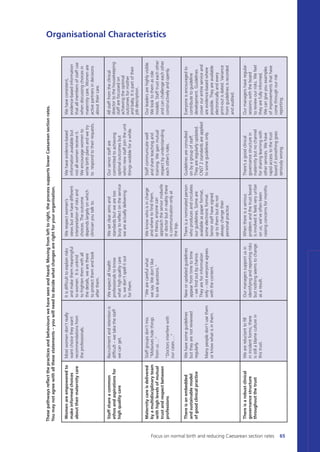
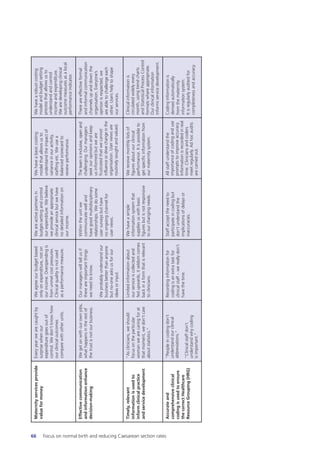
Organisational Characteristics
63-74
First Pregnancy and Labour
75-90
Vaginal Birth after Caesarean
91-104
Planned Caesarean Section
105-118
Acknowledgements, References
and Glossary
119-126
Introduction
Focus_On_Caesarean_16April10:Layout 1 10/6/10 16:34 Page 1
02 Focus on normal birth and reducing Caesarean section rates
Focus_On_Caesarean_16April10:Layout 1 10/6/10 16:34 Page 2
Introduction
‘This is a great toolkit that should really help
staff and user representatives in NHS trusts
to think about what affects their unit’s
Caesarean rate and work together on a
range of related actions to facilitate normal
birth and prevent unnecessary surgery’
Mary Newburn, Head of Policy Research,
National Childbirth Trust & Honorary Professor,
Thames Valley University
Focus on normal birth and reducing Caesarean section rates 03
Focus_On_Caesarean_16April10:Layout 1 10/6/10 16:34 Page 3
Pathways to Success:
a self-improvement toolkit
Focus on normal birth and reducing
Caesarean section rates to a safe minimum
Caesarean section (CS) has an important role in ensuring safe maternity care. How can we make
sure that every Caesarean is appropriate, effective and efficient?
The NHS Institute for Innovation and Improvement is working with NHS clinical staff to promote
best practice in achieving low CS rates while maintaining safe outcomes for mothers and babies.
This toolkit is designed to help maternity services review and assess their current practice in
promoting normal birth and reducing CS rates. The toolkit also provides practical techniques
to support sustainable changes in maternity services.
The NHS Institute for Innovation and Improvement
The NHS Institute for Innovation and Improvement (NHS Institute) was formed in 2005.
It supports the NHS to improve health outcomes and raise the quality of care by speeding
up the introduction of proven new ideas and improvements in healthcare delivery models
and processes, medical products and devices, and healthcare leadership.
The High Volume Care Project1 part of the Delivering Quality and Value Programme at
the NHS Institute, aims to discover how top performing healthcare organisations in the
NHS and elsewhere deliver the highest quality care with the best resource utilisation,
and to find effective ways of spreading that successful practice to other services.
The NHS Institute produced the ‘Focus on: Caesarean Section’2 document as one of a series
in the High Volume Care programme. This initial series of care pathways were chosen on
the basis that they occurred in large numbers and hence consumed high levels of resources.
There was also marked variation across England in the performance of individual services.
04 Focus on normal birth and reducing Caesarean section rates
Focus_On_Caesarean_16April10:Layout 1 10/6/10 16:34 Page 4
Why do Caesarean section rates matter?
• In 2005-2006, over 135,000 CS operations were carried out in England3
• In 1990, the national average CS rate was 12%, in 2006 the average CS rate was 24%4
• In 2005-2006, the CS rate for individual services varied from about 16% to well over 30%3
• Following CS, the average length of post-natal stay varies from 3.5 days to 7 days.3
This increase in Caesareans has not been accompanied by a measurable improvement in the
outcome for the baby.5
What should the Caesarean section rate be?
Many reasons have been put forward to explain the year on year rise in numbers of CS births.6
For instance, reduced working hours of trainee obstetricians may have limited their
opportunities to develop practical skills,7
the move to birth in a hospital setting8
and the
increased use of technology9,10 may have affected midwives’ confidence in managing normal
labour and birth. Fear of litigation is often cited as a major driver for increased intervention
rates in pregnancy and labour.11
Changes in evidence-based clinical practice, for example in
the management of women with breech presentations12
or women who are HIV positive,13
have led to an increase in the number of planned Caesarean sections recommended.
Consumer demand or women exercising choice and requesting CS in the absence of
any clear medical indication may also have played a part.14
No two maternity services are the same. However, variations in CS rates cannot be readily
explained by differences in size, complexity of caseload or demography.15,16
Maternity service professionals have a strong history of identifying evidence-based care.
For most, the debate is not about what constitutes best practice but about how to make
the changes necessary in order to achieve it.
When we worked with services achieving low CS rates, there were clear common themes
in their aims and approaches to delivering maternity care. They have shown that applying
evidence-based good practice and innovative models of care lead to lower CS rates and
a better experience for women when a CS is appropriate. There was a general belief
amongst clinicians involved in this project that maternity units applying best practice to the
management of pregnancy, labour and birth will achieve a CS rate consistently below 20%
and will have aspirations to reduce that rate to 15%.
Focus on normal birth and reducing Caesarean section rates 05
Focus_On_Caesarean_16April10:Layout 1 10/6/10 16:34 Page 5
Benefits of promoting normal birth and reducing
Caesarean section rates to a safe minimum
To women:
• No interventions without benefit to mother or baby
• Birth is seen as a positive experience
• Women receive support from staff to optimise the chance of normal birth
• Women in labour receive one-to-one professional support
• Women feel empowered in making decisions with support from staff
• Mortality and morbidity rates improve
• Women are able to return home more quickly to their families.
To staff:
• Staff derive a high level of satisfaction from providing high quality care and enabling
women to achieve the outcomes they want
• There is a sense of pride in units
• Working in a well-functioning team aids staff retention
• Midwives spend less time on non-clinical tasks
• Reduction in pressure of work on medical staff
• There is a greater opportunity to acquire and maintain a portfolio of skills.
To the organisation:
• Enhanced reputation attracts women to use the service
• Recruitment and retention improves through increased staff satisfaction
• Reduction in post-operative bed days gives opportunity for financial savings
• Enhanced risk management reduces litigation.
To the commissioner:
• Public money is spent according to clinical need
• Savings made on CS can be redirected into improving maternity services
• Savings from achieving optimal value for money in maternity services can be redirected
into other areas of need, e.g. children’s services, care of the elderly
• Improvements in the long-term health of mothers and babies reduces the chronic
care burden.
06 Focus on normal birth and reducing Caesarean section rates
Focus_On_Caesarean_16April10:Layout 1 10/6/10 16:34 Page 6
How was Focus on: Caesarean Section developed?
The NHS Institute worked in partnership with NHS colleagues to identify maternity services that had
succeeded in reducing or maintaining low Caesarean rates, and services that had high rates but had
recognised a need to reduce them. Our small team visited a number of these units, held formal and
informal interviews with a wide range of staff and users, and spent time observing the processes of
care. We identified with trusts those features that they believed have contributed to their success in
maintaining low CS rates.
The findings from the visits were validated in a co-production workshop where representatives of the
trusts met to discuss and prioritise the results. They identified three clinical pathways and a pathway
of organisational characteristics where changes in culture and practice might have the greatest
benefit in reducing CS rates. The pathways are:
• First pregnancy and labour
• Vaginal birth after Caesarean (VBAC)
• Planned Caesarean section
• Organisational Characteristics.
Each pathway describes a woman’s journey through maternity services, identifying the principles
of care at each stage. They illustrate the behaviours and practices that trusts believe have
contributed to their success. From these pathways we extracted the Top Ten Characteristics,
to provide an overview of the principles that were considered highly important to success.
Focus on normal birth and reducing Caesarean section rates 07
Focus_On_Caesarean_16April10:Layout 1 10/6/10 16:34 Page 7
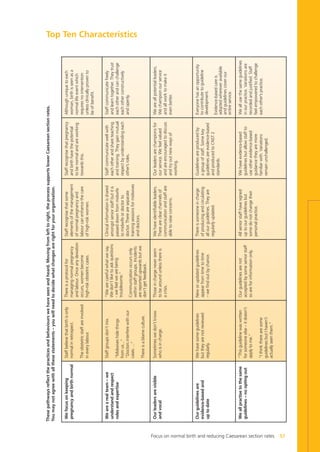
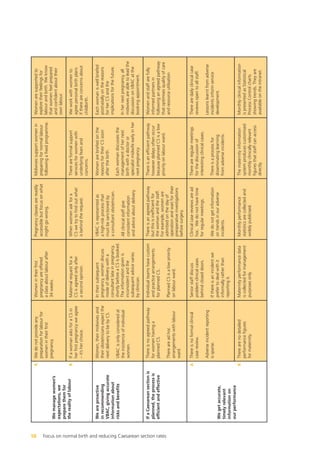
Top Ten Characteristics of services aspiring to
optimal care
‘We focus on keeping pregnancy and birth normal’
‘We are a real team – we understand and respect
roles and expertise’
‘Our leaders are visible and vocal’
‘Our guidelines are evidence-based and up to date’
‘We all practise to the same guidelines – no opting out’
‘We manage women’s expectations and prepare them
for the reality of labour’
‘We are proactive about VBAC, giving accurate information
about risks and benefits’
‘If a Caesarean section is planned, the process is efficient
and effective’
‘We get accurate, timely and relevant information on
our performance’
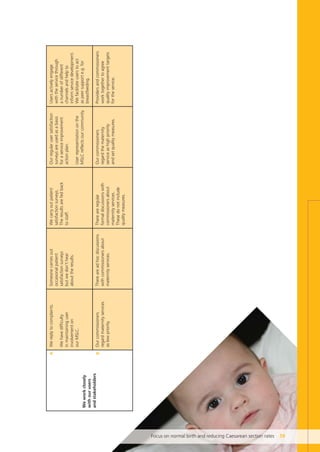
‘We work closely with our users and stakeholders’
The draft pathways were then circulated to other maternity units, professional representative
bodies, academic institutions and user representative groups for their comments before the
findings were published in Focus on: Caesarean Section.
08 Focus on normal birth and reducing Caesarean section rates
Focus_On_Caesarean_16April10:Layout 1 10/6/10 16:34 Page 8
Keeping first pregnancy and labour normal
Women who experience a normal birth in their first pregnancy are highly likely to do the same in
subsequent pregnancies. This pathway starts even before conception. Women are exposed to
messages about childbirth through family and friends, through the media and through existing
contact with health and social care professionals. Although it is difficult to influence the media, there
is an opportunity for all professionals within the health economy to promote and sustain practices
that are likely to lead to normal outcomes in pregnancy and labour.
The birth outcome is influenced throughout the process and provision of maternity care. Midwives
are ideally placed to offer a continuous and consistent message in preparing women for labour.
Although care for a normal birth is usually provided by midwives, optimising the chance for this to
occur requires genuine multidisciplinary teamwork.
This pathways ends with increasing the chance of normal birth for women who have risk factors.
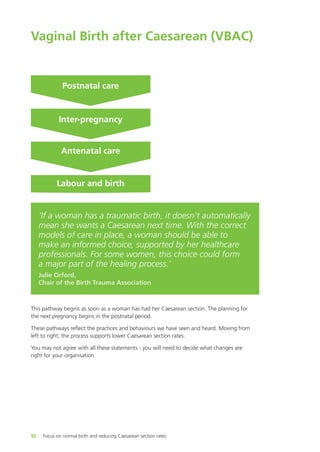
Improving opportunities for vaginal birth after
Caesarean (VBAC)
Maternity units identified the management of women who have had one previous Caesarean as
critical to reducing overall CS rates. There is accumulating evidence to support VBAC as a safe option
for most women. However, many professionals feel apprehensive about managing VBAC and women
often believe another Caesarean is inevitable or preferable to their previous experience.
Women need accurate information about the events of their labour and birth and how these
may affect their future births (including the possibility of VBAC), as soon as possible after the CS.
This pathway begins in the postnatal period of the CS and finishes with the management of the
next labour and birth. It focuses on optimising opportunities to give accurate information and
empowering clinicians to use their skills to support these women to increase the likelihood of
a vaginal birth.
The Pathways
Focus on normal birth and reducing Caesarean section rates 09
Focus_On_Caesarean_16April10:Layout 1 10/6/10 16:34 Page 9
Women having a planned Caesarean section
If a decision is made in the antenatal period that CS is the appropriate means of birth, the
process should be as efficient as possible to ensure optimal use of resources and to enhance
the experience for the woman and her family.
A planned CS has many requirements in common with other operations. There are important
opportunities to learn from best practice in pre-assessment, skill mix of theatre staff, early
mobilisation, pain relief and discharge planning derived from work in other specialties.
Length of post-operative stay is often used as an indicator for the efficient use of resources.
In CS, the picture is more complex as the service continues to deliver care regardless of the
setting. This pathway ends with transfer home.
Organisational Characteristics
Maternity services delivering high quality care that provides value for money cannot
sustain an existence in isolation. They must be supported by an organisational infrastructure
that provides accurate and relevant information, has effective communication pathways
upwards and downwards throughout the trust and fosters an open and just culture in
clinical governance.
High performing maternity services often provide positive role models within their trust for
adoption of evidence-based care, multidisciplinary team-working and involving their users
in evaluating and developing their service.
10 Focus on normal birth and reducing Caesarean section rates
Focus_On_Caesarean_16April10:Layout 1 10/6/10 16:34 Page 10
Developing Pathways to Success:
a self-improvement toolkit
The NHS Institute is committed to identifying successful health care practices and supporting
their rapid spread throughout the NHS.
Having identified the behaviours and practices that maternity services with low CS rates
believed were important in achieving this outcome, our team then addressed the task of
disseminating this information to other trusts across the country.
The team worked directly with maternity units offering a wide range of service configurations,
demographic characteristics and current CS rates to develop and test a tool that would assist
them to understand how their service works and to provide support in making sustainable
changes aimed at promoting normal birth and reducing CS rates to a safe minimum.
With their help, and advice from a number of other sources, we developed the Pathways to
Success: self-improvement toolkit that contains:
• A self-assessment tool for each pathway and the Top Ten Characteristics
• Self-improvement Action Plans
• Tools for improvement
• Measures for improvement
• Facilitator’s guidance.
Focus on normal birth and reducing Caesarean section rates 11
Focus_On_Caesarean_16April10:Layout 1 10/6/10 16:34 Page 11
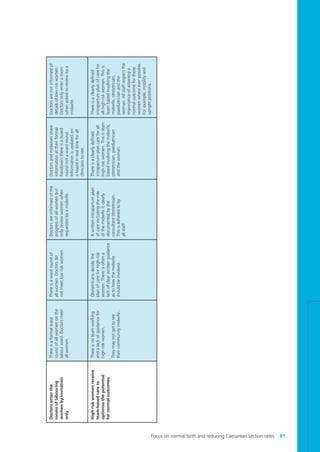
Pathways to Success: self-assessment tool
Focus on: Caesarean Section identified four pathways that were important in achieving
low CS rates:
• First pregnancy and labour
• Vaginal birth after Caesarean (VBAC)
• Planned Caesarean section
• Organisational Characteristics.
Each pathway lists principles of care and examples of the behaviours and processes that trusts believe
have contributed to their success.
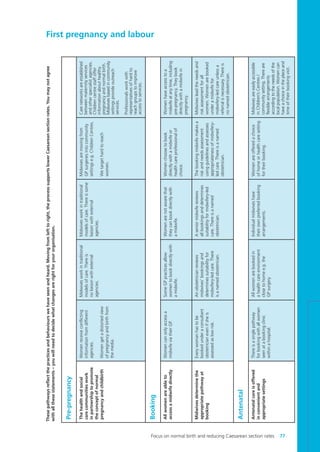
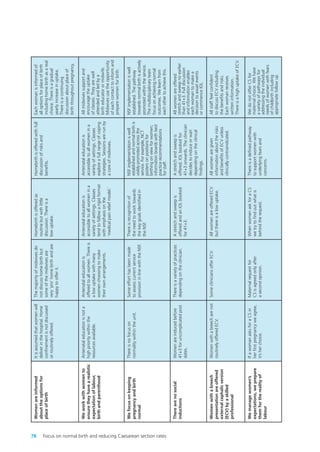
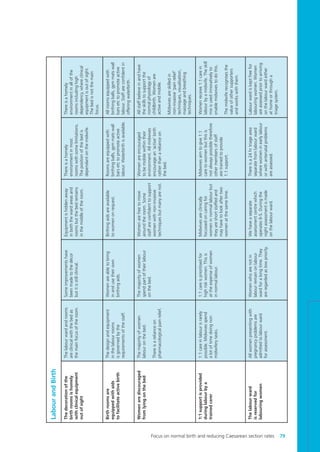
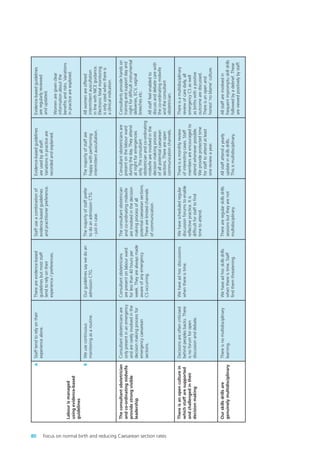
The self-improvement toolkit is based on the same pathways. In each of these ‘self-assessment
pathways’ the rows address individual principles and describe a range of behaviours and processes,
progressing from those associated with high CS rates on the left to those associated with low CS
rates on the right. Each pathway reflects the wide range of behaviours and processes that we have
seen or have been reported to us during our observations.
This does not mean that all the boxes on the right side are automatically ‘best practice’ or indeed
that it is possible to provide a sound evidence base, but that these units believed they made an
important contribution to their success in maintaining low CS rates.
The pathways tool is designed to assist units in defining their own current service and identifying
the characteristics of the service they aspire to. This will not necessarily be at the extreme of the
spectrum. Each trust should define its own targets, taking into consideration its service configuration,
priorities, resources etc.
When high performing maternity units reviewed the pathways we had described, they identified key
principles from each pathway that they considered to be of overarching importance in achieving
success. We have presented these Top Ten Characteristics in a similar self-assessment format.
“The pathways tell us what units saw as an important part of keeping the CS rate
low, not what is right or wrong.”
Cathy Walton,
Consultant Midwife, Kings College Hospital
12 Focus on normal birth and reducing Caesarean section rates
Focus_On_Caesarean_16April10:Layout 1 10/6/10 16:34 Page 12
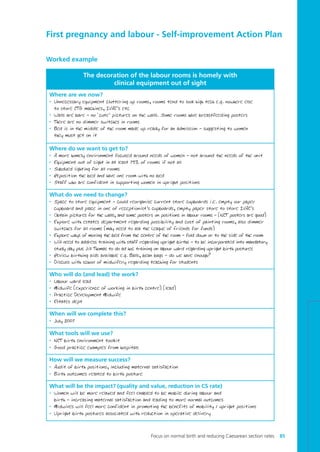
Self-improvement Action Plans
This template leads participants through the process of developing an action plan for each of
the pathways. Working in small multidisciplinary groups the action plan enables colleagues to
plan systematic changes to their service provision. It encourages participants to assess the gap
between their current position and their aspiration, focusing clearly on what must change and
how this can be achieved.
These plans can then be prioritised and co-ordinated to form the basis of a longer term action
plan for the service.
Tools for Improvement
This section describes a number of tools to support and assist services in making changes.
It includes examples of service improvement tools, scenarios, case studies reflecting successful
practice and of documents that can be adapted to specific needs.
Measures for Improvement
As part of any service development, it is important to know if the changes made have resulted
in real improvements. This section provides useful information on choosing suitable measures
with examples applied to specific pathways.
Running Workshops: Facilitator’s Guidance
The self-improvement toolkit has been developed for use in the context of multidisciplinary
workshops (see ‘field testing’ section). This section provides guidance useful to units wishing
to use the pathways in their own workshops. It contains:
• Guide for Facilitators
• Guide for Team members
• Suggested agenda and description of activities
• Do you know the answers? (a series of questions designed to help you kick start your
workshop and explore how much is known about your services)
• Frequently asked questions
• Additional resources are available in the Resource Pack.
Focus on normal birth and reducing Caesarean section rates 13
Focus_On_Caesarean_16April10:Layout 1 10/6/10 16:34 Page 13
Field testing the toolkit
The self-assessment workshop
At each stage of the development of the tool we asked people to comment and contribute to
its contents. Once the self-assessment pathways were completed in prototype we engaged
with a first wave of six trusts that were enthusiastic to review their practice and reduce their
CS rates. With each trust we carried out a workshop where groups of staff from all disciplines
and at all levels in the maternity service could come together to explore what their service was
really like and how it compared with the culture and practices in trusts that had low CS rates.
“We found it a great afternoon and a very useful discussion that continued
in the unit afterwards.”
Liz Ross,
Clinical Midwifery Manager, York Hospitals NHS Trust
Guidance for Facilitators
Our experience in conducting the first wave of testing provided us with the material to
develop a facilitator’s guide for staff to be able to run their own workshops unsupported.
The facilitator’s guide has been widely circulated to groups of maternity staff, educators,
managers, commissioners and lay representatives who have provided feedback on its content
and reviewed how they might use it in their own organisations. Several trusts successfully
hosted their own self-assessment workshop using the facilitator’s guidance. They have
provided feedback on the experience and in some cases the workshop has been directly
observed by a member of our team.
“I particularly liked the clear layout, in a ‘what to do and how to do it’ format.
The ’Frequently asked questions’ were particularly helpful.”
Susie Weekes,
Practice Development Midwife, Gloucester Hospitals NHS Trust
14 Focus on normal birth and reducing Caesarean section rates
Focus_On_Caesarean_16April10:Layout 1 10/6/10 16:34 Page 14
The self-improvement workshop
We further developed this process in a second wave of workshops, designed to support
services that have carried out the self-assessment process or have already identified a
priority area that they wish to address. This process combines individual preparation with
a multidisciplinary workshop to help staff and users define the gap between their current
service and the position on the pathway spectrum that they aspire to. Using the action
planning sheets and supporting tools, small groups of participants were able to work through
an action plan for one or two principles within an hour during the course of a workshop.
“It was a very positive experience. By the end of the session we had a clear
idea of what we had to do and some quick wins that we could get on with.”
Fiona Ghulastians,
Midwife Facilitator, West Middlesex University Hospital NHS Trust
Validation by high performers
We also tested the self-assessment pathways tool with high performing trusts that had not
participated in the development of Focus on: Caesarean Section. They were able to confirm
that their spectrum of behaviours and processes corresponded well with those on the right
side of the pathways. However, each trust was able to identify new ideas or possible changes
that would be of benefit to their service.
“We take ideas from anywhere, we are not always top-down. We are willing
to be different – we are very much a ‘can do’ trust”
Alison Whitham,
Midwifery and Gynaecology Manager, King’s Mill Hospital,
Sherwood Forest Hospitals NHS Foundation Trust
Focus on normal birth and reducing Caesarean section rates 15
Focus_On_Caesarean_16April10:Layout 1 10/6/10 16:34 Page 15
16 Focus on normal birth and reducing Caesarean section rates
Focus_On_Caesarean_16April10:Layout 1 10/6/10 16:34 Page 16
Practical advice on
using the toolkit 2
Introduction
01-16
Practical advice on
using the toolkit
17-32
Running workshops:
facilitators guidance
33-54
Top Ten
55-62
Organisational Characteristics
63-74
First Pregnancy and Labour
75-90
Vaginal Birth after Caesarean
91-104
Planned Caesarean Section
105-118
Acknowledgements, References
and Glossary
119-126
Focus_On_Caesarean_16April10:Layout 1 10/6/10 16:34 Page 17
How can you use Pathways to Success?
Practical advice on using the
self-improvement toolkit
To use this toolkit effectively, please consider the following points carefully.
Sustainable service change needs real commitment. Form a core team with:
• Multidisciplinary membership
• Clinical leaders
• Appropriate expert knowledge and support
• Clear reporting and communication pathways
Outcomes can be improved by preparation in advance:
• Decide what you aim to do
• Consider who should participate
• Decide what they should be briefed about in advance
• Do you need to appoint leaders and scribes ahead of the workshop?
The toolkit was designed to be used in a workshop environment. It can be used in other
ways but the best results come from:
• Multidisciplinary groups
• Representation from all levels of staff
• Input from all parts of your service (e.g. community, separate birth centres)
• User involvement
• Protected time
Remember; in your service, everyone knows and can contribute something,
no-one knows everything.
18 Focus on normal birth and reducing Caesarean section rates
Focus_On_Caesarean_16April10:Layout 1 10/6/10 16:34 Page 18
Self-assessment workshop
Initial steps for maternity services wishing to explore their current practices related to
Caesarean section rates.
Aims: To make a detailed assessment of current culture, behaviours and processes.
To stimulate ideas and aspirations for your future service.
Other benefits: an opportunity for enhanced multidisciplinary understanding of the
service you provide.
Self-improvement workshop
For services that have carried out an assessment of their current position or that have
identified specific issues on Caesarean section that they wish to address.
Aims: To position your current maternity services against services that are successful
in maintaining low CS rates.
To agree what your service should aspire to.
To agree priorities for change.
To develop a detailed action plan.
Other benefits: an opportunity to benefit from exchanging examples of successful
practice and using service development tools.
Focus on normal birth and reducing Caesarean section rates 19
There are different ways of using the workshops. Choose your agenda. Decide which
workshop or which elements of the process have most relevance for you.
Focus_On_Caesarean_16April10:Layout 1 10/6/10 16:34 Page 19
Decide with the core team which pathway to study. Your particular service or priorities may
point to specific pathways.
Whatever your priorities or interests, we recommend that you always carry out a Top Ten
Characteristics assessment. This tool has been used in a number of valuable ways:
• As an introduction to the process
• As an eye-opener to reveal your current position
• To provide a ‘helicopter view’ of the whole service
• To act as a barometer of progress by repeating this assessment at key points
in your journey.
“It helped us see how we vary in perceiving the same service.”
Manager,
The Princess Alexandra Hospital NHS Trust
Put participants at their ease:
• This can be an interesting and enjoyable experience
• Everyone’s contribution is valued
• Individual contributions in the workshops will be confidential and everyone owns
the final outputs.
Be clear about what the pathways are and are not:
• They describe practice seen or reported in a range of maternity services even when
there is no evidence base to support it
• The boxes on the right side reflect the position of units with low CS rates
• The pathways do not dictate how individual services should function.
20 Focus on normal birth and reducing Caesarean section rates
Focus_On_Caesarean_16April10:Layout 1 10/6/10 16:34 Page 20
Manage the expectations of participants:
• Share with participants the aims and priorities of the core team
• Be realistic about what can and cannot be achieved at a single session
• Be open about timescales and resources available to support their proposals.
At the end of each session:
• Identify some quick wins
• Celebrate the progress you have made
• Explain how the work will be taken forward
• Clarify how progress will be communicated to everyone.
The toolkit can:
• Share what has been learned from other trusts
• Facilitate reflection on the culture and care pathways of your organisation or team
• Stimulate discussion about the strengths and weaknesses of your service
• Show up any differences in perception between staff groups, managers or users
• Help you to understand the complexities of your organisation and how they contribute
to care
• Help you to understand how a service with a more progressive approach might look
• Identify practices or behaviours you would like to change
• Provide you with tools and case studies to share good practice and resources
• Question some of your current practices.
The toolkit is not intended:
• To be imposed for external audit or performance management (although it may
provide material to support these)
• To apportion blame when results show that an organisation or team would benefit
from development.
“The feedback from the session was extremely positive, they wanted more!”
Jacqueline Dunkley-Bent,
Head of Midwifery & Women’s Services, Consultant Midwife,
Guy’s and St Thomas’ Hospitals
Focus on normal birth and reducing Caesarean section rates 21
Focus_On_Caesarean_16April10:Layout 1 10/6/10 16:34 Page 21
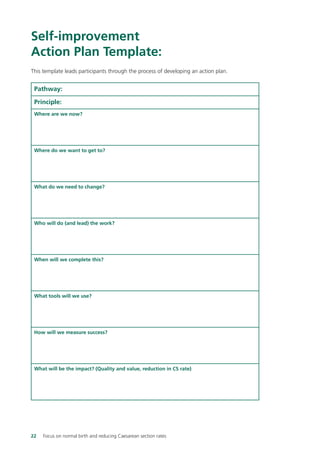
Self-improvement
Action Plan Template:
Pathway:
Principle:
Where are we now?
Where do we want to get to?
What do we need to change?
Who will do (and lead) the work?
When will we complete this?
What tools will we use?
How will we measure success?
What will be the impact? (Quality and value, reduction in CS rate)
22 Focus on normal birth and reducing Caesarean section rates
This template leads participants through the process of developing an action plan.
Focus_On_Caesarean_16April10:Layout 1 10/6/10 16:34 Page 22
Tools for Improvement
Once you have agreed where you want to get to it is important that you identify the right
solutions for your service. A selection of tools and ideas to help you make changes are
highlighted in this Toolkit. They provide evidence of success that you may be able to adapt
to your needs. Examples from each pathway are shown in the relevant pathway sections.
A more comprehensive range is available in the Resource Pack.
Scenarios
These stories are illustrations of behaviours and processes in maternity care.
They are pathway specific but often address more than one principle within a pathway.
Scenarios can be used to:
• Gain the engagement of participants at the start of a workshop or meeting
• Act as examples for the self-assessment process
• Provide a ‘safe’ platform for discussion of difficult topics where participants are unwilling
to discuss their own services initially
• Raise questions that you should answer in your self-improvement plans.
Example of scenario: VBAC
“Melanie had her first baby by emergency Caesarean section. She had a long labour but
did not progress beyond 8cm dilatation. The epidural sited for analgesia was not adequate
for the operation so she had a general anaesthetic.
After delivery she was tired and in pain. Her attempts to breastfeed left her with cracked
nipples so she abandoned this.
She is now booking with you at twelve weeks in her second pregnancy. She is adamant
that she does not wish to go through a similar experience of labour and delivery again.
Unless you can promise her a straightforward normal birth she wants a Caesarean section
and she certainly isn’t interested in breastfeeding.
Focus on normal birth and reducing Caesarean section rates 23
Focus_On_Caesarean_16April10:Layout 1 10/6/10 16:34 Page 23
What can you, as the midwife, offer her to increase her chances of a normal birth?
As the obstetrician or midwife, what information would you give her about the risks
and chances of success of VBAC?
How can you address her views on breastfeeding?”
Service improvement tools
Every single person is enabled, encouraged and capable to work with others to improve their
part in the service (Discipline of Improvement in Health and Social Care)
These tools draw on experience in a variety of areas including business and industry and have
already been applied successfully to other areas of healthcare.
They focus on processes and behaviours that are relevant to all the pathways but some techniques
have relevance to specific areas.
Service improvement tools can be used to:
• Identify what changes are needed
• Understand the processes needed to achieve change
• Ensure engagement of staff and users
• Demonstrate, celebrate and sustain success.
Case studies
The case studies are examples of practice in maternity services that we have seen or been
told about.
Most describe improvement journeys related to specific points in a pathway but the
underlying principles are relevant to many areas.
Case studies can be used to:
• Reflect on your practice
• Provide material for group discussion
• Identify key features and interventions that are relevant to your service.
24 Focus on normal birth and reducing Caesarean section rates
Focus_On_Caesarean_16April10:Layout 1 10/6/10 16:34 Page 24
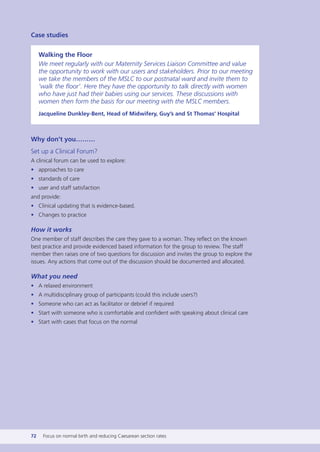
Example of Case study: ‘Walking the floor’
“We meet regularly with our Maternity Services Liaison Committee and value the opportunity to
work with our users and stakeholders. Prior to our meeting we take the members of the MSLC to
our postnatal ward and invite them to ‘walk the floor’. Here they have the opportunity to talk
directly with women who have just had their babies using our services. These discussions with
women then form the basis for our meeting with the MSLC members”.
Jacqueline Dunkley-Bent, Head of Midwifery,
Guys and St Thomas Hospital Foundation Trust
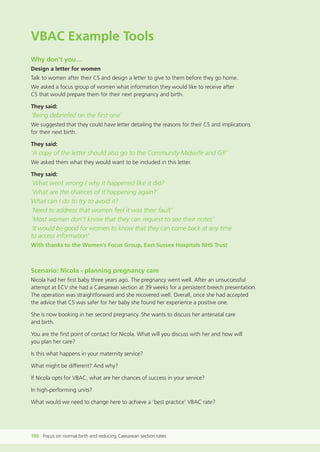
Why don’t you?
These are examples of innovations you could try in your organisation. They are often unstructured
examples of what you could do but with little detail. They are designed to provoke thoughts of what
might be possible rather than giving you a definitive message about what you should do. They
should help you to think ‘outside the box.’
Example of Why don’t you? Letter
Why don’t you …
... talk to women after their CS and design a letter to give to them before they go home.
We asked a focus group of women what information they would like to receive after
CS that would prepare them for their next pregnancy and birth. They said:
‘Being debriefed on the first one’
We suggested that they could have a letter detailing the reasons for their CS and implications
for their next birth. They said:
‘A copy of the letter should also go to the Community Midwife and GP.’
We asked them what they would want to be included in this letter. They said:
‘What went wrong / why it happened like it did?
‘What are the chances of it happening again?’
‘What can I could do to try to avoid it?’
‘Need to address that women feel it was their fault’
’Most women don’t know that they can request to see their notes’
‘It would be good for women to know that they can come back at any time to
access information’.
With thanks to the Women’s Focus Group,
East Sussex Hospitals NHS Trust
Focus on normal birth and reducing Caesarean section rates 25
Focus_On_Caesarean_16April10:Layout 1 10/6/10 16:34 Page 25
Examples of key documentation
These are documents that direct, support, challenge or inform current maternity care. They will
be useful as reference tools for standard setting or for ‘positioning’ your organisation within the
wider context.
Sources of information for users
These examples of user information demonstrate good practice in communication with and
involvement of users. They may be appropriate for direct use in your service or provide a
structure for your own local information.
Examples of information
MIDIRS Informed Choice
National Childbirth Trust: NCT Info centre
Understanding NICE guidance: Information for pregnant women, their families
and the public
Royal College of Obstetricians and Gynaecologists: Information for patients
Templates
Templates can be used to save you time in preparing documents. Most are already being
used somewhere within a maternity service but have been provided in a format so that
you can adapt them for your own use.
26 Focus on normal birth and reducing Caesarean section rates
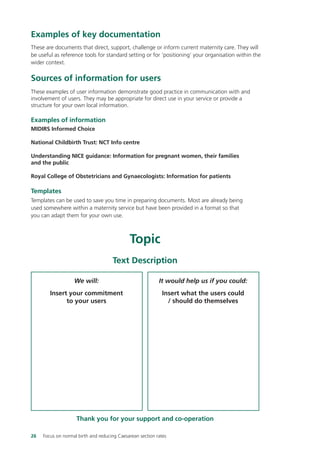
Topic
Text Description
We will:
Insert your commitment
to your users
It would help us if you could:
Insert what the users could
/ should do themselves
Thank you for your support and co-operation
Focus_On_Caesarean_16April10:Layout 1 10/6/10 16:34 Page 26
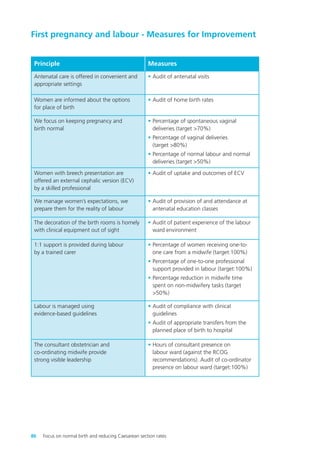
Measures for Improvement
As you work on the pathways it is important to know if the changes you have made have
resulted in real improvements. This section provides some useful tips and examples of
measures to help you along your improvement journey.
All improvements involve a change, but not all changes are improvements
(Goldratt)
Key Steps to Measurement
Follow these simple steps for a successful measurement plan:
It is important that you collect a mixture of both quantitative and qualitative data
to really understand your current services.
1. What is our aim?
As a team you need to decide what you want to improve (i.e. which principle?).
Example: Mothers and babies return home as soon as clinically safe and appropriate.
2. What do we want to focus on?
Once you have decided what your aim is you then need to decide which particular
aspect you wish to focus on.
Example: The length of stay for women undergoing a planned Caesarean section.
3. What are the appropriate measures?
Use the SMART technique when starting to think about developing measures
- make sure you apply these principles to your measures
S - Specific
M - Measurable
A - Attainable
R - Realistic
T - Timely
Example: Percentage of women discharged within 56 hours of a planned
Caesarean section.
Focus on normal birth and reducing Caesarean section rates 27
Focus_On_Caesarean_16April10:Layout 1 10/6/10 16:34 Page 27
4. What is the definition of the measure?
Is the data you need already collected through existing systems? Ensure you develop a clear
definition of what you want to measure. Failure to develop a clear definition can lead to
confusion and misunderstanding.
Example: Start of process: time and date of admission for a planned Caesarean section
(as recorded on information system).
End of process: time and date of discharge following a planned Caesarean section
(as recorded on information system).
5. What is our baseline?
It is important to understand how you are currently performing.
Example: 65% of women are discharged within 56 hours.
Just establishing your baselines and targets can really motivate and excite your teams.
6. What is our target?
Agree as a team what you want to achieve. Make sure your timescales are realistic.
You may want to consider incremental targets.
Example: 75% of women are discharged within 56 hours (short term goal).
90% of women are discharged within 56 hours (long term goal).
7. Over what period will we collect the data?
Ensure you collect a sufficient amount of data over a period of time to allow you to see
the changes.
Example: We want to look at 100 planned Caesarean births, we do 400 planned
Caesarean births a year and therefore will look at a three month period
(1st February to 30th April).
8. How will we collect the data?
Will you collect the data manually or from an existing information system? Is the data collected
routinely? Be careful to check that any data from an information system is what you really need.
Does it fit with your definition?
Example: Local maternity information system.
Remember, crude measures of the right things are better than precise measures of the
wrong things.
28 Focus on normal birth and reducing Caesarean section rates
Focus_On_Caesarean_16April10:Layout 1 10/6/10 16:34 Page 28
LengthofStay(hours)
Week
0
10
20
30
40
50
60
70
80
Target - 56 hours
9. How often will we collect it?
Example: Weekly.
10. Who will collect the data?
Designate someone to be responsible for the collection and collation of your data.
Example: Information lead.
11. How will I present the data?
How do you turn your data into useful information? A picture tells a thousand words and is
much easier to read than a table of numbers. Simple line graphs (or run charts) are easy to
produce and are very powerful.
Example: Run chart.
You may decide to undertake a simple audit of women who stayed longer than
56 hours to understand and categorise the reasons why this has happened.
Focus on normal birth and reducing Caesarean section rates 29
For further information on how to develop measures and how to present your data please
refer to the Improvement Leader’s Guide on ‘Measures for Improvement’. This can be found at:
www.institute.nhs.uk
Focus_On_Caesarean_16April10:Layout 1 10/6/10 16:34 Page 29
Measurement Plan Template
Principle
What is our aim?
Measure
Definition
Baseline
Target
Over what period will we collect the data?
How will we collect the data?
How often will we collect the data?
Who will collect the data?
How will we present the data?
30 Focus on normal birth and reducing Caesarean section rates
Focus_On_Caesarean_16April10:Layout 1 10/6/10 16:34 Page 30
Celebrating Success
It is important that you celebrate and share your successes - this will give an incredible boost
for further improvements.
How can we celebrate and share our successes?
Identify five things that you do really well
These may be from a clinical pathway or from the Top Ten or Organisational Characteristics.
• Which principles did staff identify you did well during the self assessment?
• What have you done that is different?
• Can you explain your success?
Next, think about who you can tell about your successes!
Share your successes with colleagues, users, stakeholders, networks, forums and other
maternity units.
• How about presenting your work at an event or writing an article?
• Explain the work that has been done, what has been achieved and what is hoped
to be achieved in the future.
Sharing your successes is a vital method of helping other maternity units learn from
you and ultimately, achieve results. Each NHS maternity service is at a different stage
on the journey towards providing optimal care. For most, the debate is not about
what constitutes best practice, but about how to make the changes necessary in order
to achieve it, with all the pressures and constraints that day-to-day working brings.
Sharing your success story will help strengthen practice and provide ideas for improving
it further.
Focus on normal birth and reducing Caesarean section rates 31
Focus_On_Caesarean_16April10:Layout 1 10/6/10 16:35 Page 31
32 Focus on normal birth and reducing Caesarean section rates
Focus_On_Caesarean_16April10:Layout 1 10/6/10 16:35 Page 32
Running workshops:
facilitators guidance
3
Introduction
01-16
Practical advice on
using the toolkit
17-32
Running workshops:
facilitators guidance
33-54
Top Ten
55-62
Organisational Characteristics
63-74
First Pregnancy and Labour
75-90
Vaginal Birth after Caesarean
91-104
Planned Caesarean Section
105-118
Acknowledgements, References
and Glossary
119-126
Focus_On_Caesarean_16April10:Layout 1 10/6/10 16:35 Page 33
Workshop Facilitators Notes
Running workshops - facilitators guidance
The self-improvement toolkit is designed to help you assess where your maternity service
currently is on a spectrum of processes and behaviours associated with achieving a low
Caesarean section rate.
It will allow you to debate how your unit could aspire to work in the future and what you
would have to change to achieve that. It also offers tools to assist you in developing your
services. These workshops are the first step on this journey.
The toolkit is constructed on the ‘Top Ten’ Characteristics and the four pathways developed
in Focus on: Caesarean section, published in October 2006.
The first part of the toolkit is a self-assessment tool. It is intended to be used within maternity
services at a multidisciplinary workshop, where each member of the team has the chance to
contribute equally. This pack contains the information you need to run your own workshops;
you may wish to adapt it for your own particular service.
The self-improvement workshop is the second step in the process, designed to help services
develop an action plan that is based on current position and a mutually owned vision of
the future.
34 Focus on normal birth and reducing Caesarean section rates
Focus_On_Caesarean_16April10:Layout 1 10/6/10 16:35 Page 34
Self-assessment workshop
Initial steps for maternity services wishing to explore their current practices related to
Caesarean section rates.
Aims:
• To make a detailed assessment of current culture, behaviours and processes.
• To identify aspirations for your future service.
Other benefits: An opportunity for enhanced multidisciplinary understanding of the
service you provide.
Self-improvement workshop
For services that have carried out an assessment of their current position or that have
identified specific issues on Caesarean section that they wish to address.
Aims:
• To position your current maternity services against services that are successful
in maintaining low CS rates.
• To agree what your service should aspire to.
• To agree priorities for change.
• To develop a detailed action plan.
Other benefits: An opportunity to benefit from exchanging examples of successful
practice and using service development tools.
Who will own the process?
Each maternity service should identify a small core team of committed professionals
who are prepared to lead and guide the process. As a minimum this team should
include a midwife leader, an obstetrician leader and a manager. Additional members
might include an educator or an information analyst. As facilitator, you may be part
of this team or will be working closely with it to ensure you share common goals.
Focus on normal birth and reducing Caesarean section rates 35
Focus_On_Caesarean_16April10:Layout 1 10/6/10 16:35 Page 35
Self-assessment workshop
What are we aiming for?
The core team should decide which pathway to discuss during the workshop. This may be influenced
by the configuration of your service, any existing priorities, or the mix of staff who will attend.
We recommend that you should always include the Top Ten Characteristics assessment.
How far down the improvement road can you reasonably expect to go? We suggest that in the first
workshop you should be able to achieve a detailed assessment of where you are now and to begin
to identify aspirations for your future service.
The core team should also identify how the work will proceed after the workshop and be prepared
to commit to next steps at the end of the sessions.
How do I organise a workshop?
The process works best with a diverse range of staff disciplines and grades.
• Identify the people that you think should attend (see below)
• Make sure they have enough notice to be able to do so
• Give them information on the aims of the workshop.
Think about your regular meetings, could you arrange the workshop as part of one?
Who should attend?
Think about all the people who contribute to your service. Make sure that all groups who deliver
first-hand care are invited:
• Clinical staff from all disciplines: midwives, nurses, maternity support workers,
obstetricians, anaesthetists, etc.
• Support staff: clerical, IT
• Managers
• Service users
It is helpful to involve trainees and staff who rotate between maternity units.
We have piloted this process with up to 40 people at a time.
How long will the process take?
Allow at least two hours. Participants have told us how much they valued the opportunity for
discussion. The toolkit contains a suggested timetable.
36 Focus on normal birth and reducing Caesarean section rates
Focus_On_Caesarean_16April10:Layout 1 10/6/10 16:35 Page 36
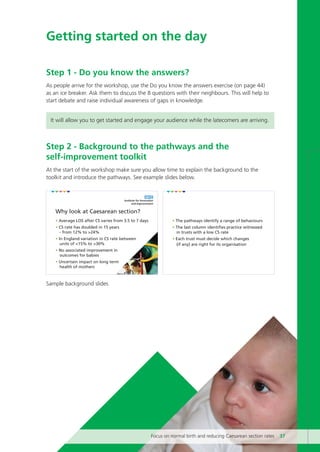
Sample background slides
• The pathways identify a range of behaviours
• The last column identifies practice witnessed
in trusts with a low CS rate
• Each trust must decide which changes
(if any) are right for its organisation
Why look at Caesarean section?
• Average LOS after CS varies from 3.5 to 7 days
• CS rate has doubled in 15 years
- from 12% to >24%
• In England variation in CS rate between
units of <15% to >30%
• No associated improvement in
outcomes for babies
• Uncertain impact on long term
health of mothers
Getting started on the day
Step 1 - Do you know the answers?
As people arrive for the workshop, use the Do you know the answers exercise (on page 44)
as an ice breaker. Ask them to discuss the 8 questions with their neighbours. This will help to
start debate and raise individual awareness of gaps in knowledge.
It will allow you to get started and engage your audience while the latecomers are arriving.
Step 2 - Background to the pathways and the
self-improvement toolkit
At the start of the workshop make sure you allow time to explain the background to the
toolkit and introduce the pathways. See example slides below.
Focus on normal birth and reducing Caesarean section rates 37
Focus_On_Caesarean_16April10:Layout 1 10/6/10 16:35 Page 37
Step 3 - Explaining the process
To get the maximum benefit from the workshop it is essential that all the participants feel
comfortable with the process. Please explain clearly that:
• Everyone is a valuable contributor
• There are no right and wrong answers
• It does not matter if part of the pathway is unfamiliar to individuals
• The workshop is a protected environment and comments from individuals will not be repeated
outside of the workshop.
Show the audience an example of a pathway. Explain that the white boxes look at individual
principles of care associated with the woman’s journey in that particular pathway. The shaded boxes
in each row show behaviours and processes from those associated with high CS rates on the left to
those associated with low CS rates on the right. This does not mean that all the boxes on the right
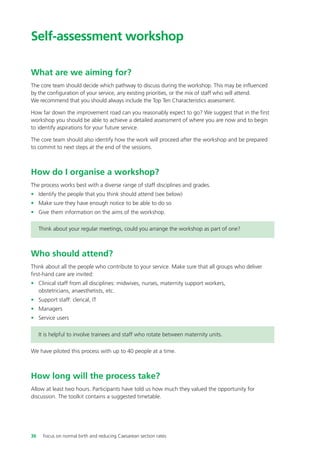
side are automatically ‘best practice’, simply that units believed they were important to their success
in maintaining low CS rates.
Explain again that the aim of the workshop is to establish where your organisation currently sits on
the pathways and to identify where you would like to be in the future.
The tool is not designed to dictate patterns of care to units, it is for each individual
organisation to decide what practice it should aim for and what changes should and
could be delivered to achieve this.
Finally, ensure everyone is aware of the time available for each task. See the Suggested Agenda
for timings.
38 Focus on normal birth and reducing Caesarean section rates
Focus_On_Caesarean_16April10:Layout 1 10/6/10 16:35 Page 38
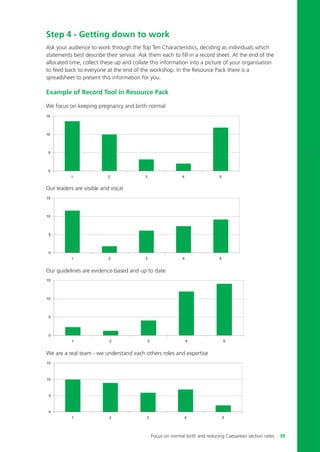
Step 4 - Getting down to work
Ask your audience to work through the Top Ten Characteristics, deciding as individuals which
statements best describe their service. Ask them each to fill in a record sheet. At the end of the
allocated time, collect these up and collate this information into a picture of your organisation
to feed back to everyone at the end of the workshop. In the Resource Pack there is a
spreadsheet to present this information for you.
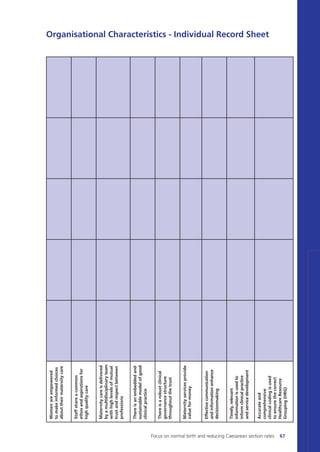
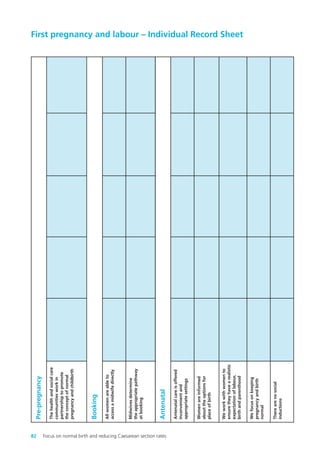
Example of Record Tool in Resource Pack
We focus on keeping pregnancy and birth normal
We are a real team - we understand each others roles and expertise
Our leaders are visible and vocal
Our guidelines are evidence-based and up to date
Focus on normal birth and reducing Caesarean section rates 39
Focus_On_Caesarean_16April10:Layout 1 10/6/10 16:35 Page 39
Then ask your participants to divide into small groups, we recommend groups of four to
eight people.
You may want to consider in advance who should be in each group to ensure a good
mixture of skills and experience and to manage any difference in expectations.
Give each group a copy of the ‘How to use the tool - a guide for team members’ (found on
page 45) and each member a copy of the chosen pathway.
Ask each group to identify a leader who will ensure everyone has an opportunity to contribute
and a scribe to make notes of their discussions.
When the groups are settled, ask each member to spend ten minutes looking individually at
the pathway and to make an assessment of where the service is currently. Then, as a group, to
look at each of the principles in turn, exploring the individual assessments and trying to reach
a consensus. Ask the groups to think specifically about any areas of difference or difficulty in
understanding. Why did they think this occurred?
The groups should then try to look at the behaviours and processes to the right of their current
position and debate where they would aim to move their service to.
As facilitator,
• try to keep an eye on how the discussions are going
• be prepared to prompt or question assumptions
• check that the group leaders are ensuring all participants have an opportunity to speak
• ensure that they are sticking to the task.
There will be different views; constructive challenge is part of mature organisational behaviour,
however, if this is hindering progress:
• encourage the group to look for areas where they can agree
• suggest that they move on to another area and return to the topic later
• recommend a separate meeting outside the workshop to address areas of concern.
40 Focus on normal birth and reducing Caesarean section rates
Focus_On_Caesarean_16April10:Layout 1 10/6/10 16:35 Page 40
Step 5 - Sharing the results
Give each group a chance to feed back to the whole workshop. Ask them about their
experience of working together on this task as well as the conclusions they came to.
Ask for the notes taken by the scribes so that you can review all the outputs later and
ensure nothing important was missed.
Step 6 - Agreeing next steps
Ask the members of your core team to speak for five minutes about how the work will be
taken forward. This should include agreeing the way forward, offering an opportunity for staff
and users to contribute to the work; and making a commitment to a timetable for progress.
Step 7 - Feedback of Top Ten profile
Focus on normal birth and reducing Caesarean section rates 41
Focus_On_Caesarean_16April10:Layout 1 10/6/10 16:35 Page 41
Suggested Agenda -
Description of Activities
Self-assessment Workshop
2 hour workshop
Participants: maternity services staff from all disciplines: midwives, obstetric doctors, maternity support
workers, administrative support staff, service managers, risk managers, students and
user representatives.
Recommended group size: 15 - 40 (for larger groups consider having two facilitators)
1. Do you know the answers? Informal discussion with neighbours before formal work begins.
10 minutes
2. Presentation: description of the pathways, brief background to the ‘Focus on’ methodology
and explanation of how the toolkit was made (what it is and what it isn’t).
10 minutes
3. All participants look at the Top Ten Characteristics individually and identify where on the pathway
they think their service is now. Collect up the assessment sheets and collate during step 5 below.
15 minutes
4. Divide into small groups (4-8 people), ensuring an appropriate multidisciplinary mix.
Each team appoints a leader and a scribe / raporteur.
5 minutes
5. Each small group chooses a single clinical pathway (or Organisational Characteristics
if desired). Individual members read through the pathway and make an assessment of
current position. The group then discusses and makes a group decision on their position.
30 minutes
6. The group looks at the pathway to decide where they would like their service to be.
Why have they made that choice? If not at far right column, why not? Prepare feedback.
20 minutes
7. Feedback from groups:
• What did we learn?
• Where are we now?
• Where would we like to be?
• Were there any surprises?
• Did the group reach consensus?
• What was good / not so good about the experience?
20 minutes
8. Next steps
5 minutes
9. Feeding back the results of the Top Ten Characteristics assessment
5 minutes
Any additional time available for the workshop should be allocated to steps 5, 6 & 7.
42 Focus on normal birth and reducing Caesarean section rates
Focus_On_Caesarean_16April10:Layout 1 10/6/10 16:35 Page 42
AGENDA - Self-assessment Workshop
Pathways to Success: Focus on normal birth and
reducing Caesarean section rates
(Trust name, department etc)
(Date and Place)
(Time from/to)
1. Do you know the answers?
2. Background to the pathways and how to use the
self-improvement toolkit
3. The Top Ten Characteristics. How does your service compare?
4. Group work: the pathways - where are we and where do we
want to be?
5. Feedback from the groups
6. Next steps
7. The Top Ten Characteristics - your answers
Focus on normal birth and reducing Caesarean section rates 43
Focus_On_Caesarean_16April10:Layout 1 10/6/10 16:35 Page 43
Do you know the answers?
1. The national average Caesarean section rate is 25%
Do you know what your CS rate is?
2. What percentage of your clients try for a VBAC and are
actually successful?
3. Do your facilities provide the right environment to support
normal labour and birth? Is medical equipment out of sight?
4. The labour ward should be used for women in labour only.
How many women on your labour ward last month were
not in labour?
5. How much time do your midwives spend on non-clinical tasks?
6. What percentage of clinical staff are aware of monthly CS rates
and trends?
7. Organising planned Caesarean sections efficiently minimises
delays and clinical risks.
Do you have a clearly defined process for managing planned
Caesarean sections?
8. Women should be able to make an informed choice about their
mode of birth.
Can you provide accurate facts and figures about risks and
benefits to support their decision?
Focus on: Normal birth and reducing
Caesarean sections
44 Focus on normal birth and reducing Caesarean section rates
Focus_On_Caesarean_16April10:Layout 1 10/6/10 16:35 Page 44
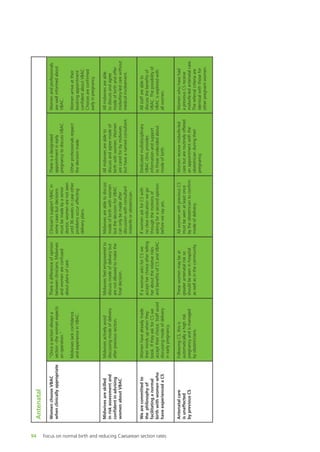
Each pathway has six columns. On each row, the first box states principles on which top
performing organisations base their care, allowing them to maintain low CS rates. The
corresponding boxes show a range of behaviours occurring in maternity units.
As you read across the rows you will see that there is a progression of ideas and practices.
The column on the far right represents behaviours adopted by trusts that are ‘high performers’
in keeping their CS rates low while achieving good outcomes.
Individual assessment
Each member of the group should start by making an individual assessment for each principle
in the pathway. Choose the description of behaviours you think best fits your organisation or
team. Do this on your own without discussion. This is your opinion of your service. If you can’t
decide between two of the descriptions tick both. This will give you an indication of the
current CS profile for your organisation.
Group assessment
Choose one of your group to lead the discussion and make sure that everyone has the
opportunity to contribute, and choose a scribe to make notes of your discussions. Look at
each principle in turn, explore the individual assessments and then try to reach a group
consensus. Once you have identified where you are compared to these ‘high performers’, start
discussing where you as an organisation want to be. Ask yourselves what can realistically be
taken forward and improved within your service? There are tools and case studies that can
help you achieve your goals and move towards those behaviours.
We do not expect that as an individual or a team you will agree with all the suggested
‘successful practice’ shown in column five. It is important that you discuss why these
behaviours are not appropriate to your service when you decide where your unit wants to go
and how you can get there.
The objective is to stimulate debate and enable you to focus on areas you would like to
change. The toolkit is not designed to dictate how you should run your own unit.
Be prepared to share your comments and views with the wider audience.
How to use the toolkit
- a guide for team members
Focus on normal birth and reducing Caesarean section rates 45
Focus_On_Caesarean_16April10:Layout 1 10/6/10 16:35 Page 45
Self-improvement workshop
This step follows on from the self-assessment workshop where groups of staff and users had the
opportunity to assess their present service against the behaviours and processes of a number of
maternity services with a range of CS rates.
That process may have helped you to agree priorities for service change.
You may have identified specific areas for improvement through other channels.
This workshop will help you achieve the next steps.
Before starting, take time to review your present situation. Have you got a core team (see page 35)
that is committed to driving this process and owning its outputs? Do you have good communication
channels for reporting the work you are doing?
The self-assessment process used the Top Ten Characteristics to help you produce an overview
of your service. A similar process looking at your chosen pathway will have given you information
about the variety of perceptions about your clinical behaviours and processes and offered your
staff examples of a wide range of practices reported or observed in other organisations to help
you decide on the service you aspire to.
What are we aiming for?
• To share an accurate overview of your service (Top Ten Characteristics)
• To describe your current service against each of the principles in the chosen pathway
• To determine where your service could and should aspire to move, using the processes
and behaviours described in the pathways
• To identify the barriers to success; what has to change?
• To agree an outline action plan that has tasks, timescales, named responsibilities and
outcome measures.
Identifying quick wins can be very motivating for getting the work started.
How do I organise this workshop?
In addition to the principles of multidisciplinary involvement and breadth of experience outlined
above, there may be key individuals whose involvement is critical to the process you wish to focus on.
For example, anaesthetic expertise is vital to the Planned Caesarean pathway. Consider where and
how you can engage users in your discussions.
Think carefully about numbers of people involved in any one pathway. The self-assessment process is
about broadening horizons and stimulating debate, this process is now about focusing on specific
objectives and tasks.
It is important that everyone leaves the workshop with a clear understanding
about the way forward and their role in it.
46 Focus on normal birth and reducing Caesarean section rates
Focus_On_Caesarean_16April10:Layout 1 10/6/10 16:35 Page 46
How long will the process take?
Working through a complete pathway to the production of an outline action plan will take
between two and six hours depending on the pathway chosen, the tools you look at and
the degree of detailed discussion. Realistically, you may decide to tackle only part of a
pathway or part of the process in one session. Alternatively you can divide the work up
amongst the small groups of participants as long as you allow ample time for feedback and
discussion in the whole group.
Preparation before the day
To make the best use of time together we recommend that your participants do some work
individually before the day of the workshop. Send each participant a copy of; ‘How to use the
toolkit - a guide for team members’, the Top Ten Characteristics, and the specific pathway you
plan to discuss in that particular group.
Ask everyone to make their own personal assessment of the current position of the service
and to start thinking about where on the pathway they aspire to be.
Decide, in discussion with the core team, who should lead the groups in the workshop.
Brief these people in advance about the aims of the workshop and the process you are
planning (see next section).
Focus on normal birth and reducing Caesarean section rates 47
Focus_On_Caesarean_16April10:Layout 1 10/6/10 16:35 Page 47
Step 1 - Introduce the workshop
• Present the aims for the workshop that have been agreed by the core team
• Ensure that all participants understand the aims
• Outline the stages in the process and the timetable for the session.
To get the maximum benefit from the workshop it is essential that all the participants feel
comfortable with the process. Please explain clearly that:
• Everyone is a valuable contributor
• There are no right and wrong answers
• It does not matter if part of the pathway is unfamiliar to individuals
• Participants are free to express themselves within the workshop but at the end of the
process must take responsibility for areas of the agreed action plan under their name.
Step 2 - Explaining the process
There may be people in the workshop who did not attend the self assessment workshop. It is
important that you provide a background to the work and explain how the pathways work.
This will also help as a refresher. See “Explaining the process” on page 38 for further information.
Also, if you have previously run a self assessment workshop you will already have a Top Ten profile
which you can share with participants and will help with explaining the background to the work.
Step 3 - Getting down to work
In the group, discuss together where your service currently sits in the spectrum of behaviours
illustrated. When you have reached agreement, use your own words to describe your service
in the Where are we now? boxes on the action plan. Then consider where you think the service
should aspire to move to and fill in the Where do we want to get to? boxes.
Step 4 - Setting priorities
If the core team has already determined some priority work streams to be taken forward in
the action planning, share these with the participants now. These are the ‘must do’s’.
Ask them to return to their small groups and assign all the priority areas amongst the groups
(depending on the time available). Ask them to work through the action planning sheet for each
priority area.
48 Focus on normal birth and reducing Caesarean section rates
Focus_On_Caesarean_16April10:Layout 1 10/6/10 16:35 Page 48
Step 5 - Sharing the results
Give every group a chance to feed back to the whole workshop. Ask them about their
experience of working together on this task as well as the conclusions they came to.
Ask for all the scribes’ notes and the action planning sheets so that you can review all
the information later and ensure that nothing important was missed.
Go back to the spreadsheet of the Top Ten Characteristics and highlight your service’s strengths
and weaknesses. Will the action plans improve your position as a whole service? You can
continue to use this tool following the workshop at key milestones in your action plans to
measure your progress.
Step 6 - Agreeing next steps
Ask the members of your core team to speak for five minutes about how the work will be
taken forward. This should include confirming priorities, ensuring that the most appropriate
people have committed to the plan, and making a commitment to a timetable for progress.
This should include a clear communication plan to everyone who has been involved.
Focus on normal birth and reducing Caesarean section rates 49
Focus_On_Caesarean_16April10:Layout 1 10/6/10 16:35 Page 49
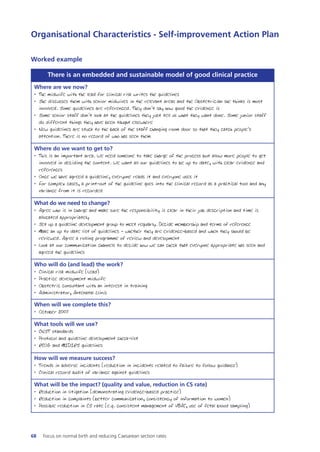
Example of Action Plan for the Planned
Caesarean section pathway
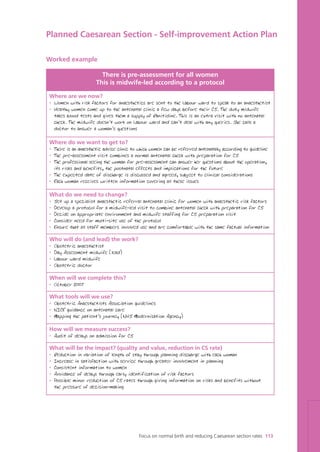
There is pre-assessment for all women.
This is midwife-led according to a protocol.
Where are we now?
Women with risk factors for anaesthetics are sent round to the Labour ward to speak to an anaesthetist.
Healthy women come up to the antenatal clinic a few days before their CS. The duty midwife takes
blood tests and gives them a supply of Ranitidine. This is an extra visit with no antenatal check.
The midwife doesn’t work on Labour ward and can’t deal with any queries. She calls a doctor to
answer a woman’s questions.
Where do we want to get to?
There is an anaesthetic advice clinic to which women can be referred antenatally according to guideline.
The pre-assessment visit combines a normal antenatal check with preparation for CS.
The professional seeing the woman for pre-assessment can answer her questions about the operation,
its risks and benefits, the postnatal effects and implications for the future.
The expected date of discharge is discussed and agreed, subject to clinical considerations.
Each woman receives written information covering all these issues.
What do we need to change?
Set up a specialist anaesthetic referral antenatal clinic for women with anaesthetic risk factors.
Develop a protocol for a midwife-led visit to combine antenatal check with preparation for CS.
Decide on appropriate environment and midwife staffing for CS preparation visit. Day Assessment
Unit (DAU)
Consider need for multi-site use of the protocol.
Ensure that all staff members involved use and are comfortable with the same factual information.
Who will do (and lead) the work?
Obstetric anaesthetist
Day Assessment midwife (lead)
Labour ward midwife
Obstetric doctor
When will we complete this?
October 2007
What tools will we use?
Obstetric Anaesthetists Association guidelines
NICE guidance on antenatal care
Mapping the patient’s journey (NHS Modernisation Agency)
How will we measure success?
Percentage of women who have a pre-assessment visit.
Audit of delays on admission for CS.
What will be the impact? (Quality and value, reduction in CS rate)
Reduction in variation of length of stay through planning discharge with each woman.
Increase in satisfaction with service through greater involvement in planning.
Consistent information to women.
Avoidance of delays through early identification of risk factors.
Possible minor reduction of CS rates through freeing midwife time to spend with women in labour.
50 Focus on normal birth and reducing Caesarean section rates
Focus_On_Caesarean_16April10:Layout 1 10/6/10 16:35 Page 50
Suggested Agenda -
Description of Activities
Self-improvement Workshop
2 hours 30 minutes to 4 hours
Participants: Targeted participants appropriate to the pathway you will address. Consider the
possible role of people from every discipline and at all levels in the service to ensure you have
full involvement.
Recommended group size: 10 – 25 (for larger groups consider having two facilitators or a
facilitator for each pathway)
1. Aims of the workshop: what you plan to achieve and how the work will be organised.
Reminder of how the pathways were derived and how they should be used.
10 minutes
2.Individuals record their own Top Ten Characteristics (TTC) assessment and hand it in.
Show previous summary slides of TTC if available or derive new summary slides.
(Discussion of pathway-specific scenario with neighbours).
20 minutes
3. Leaders gather their small groups of 4-8 people, ensuring an appropriate multidisciplinary skill
mix. Each group discusses the designated pathway and identifies where they think their service is
now and where they aspire to move to. They complete the Where are we now? in their own words
and Where do we want to get to? boxes on the action planning sheet.
30 minutes
4. Groups reviewing the same pathway come together to exchange views and reach a consensus
on their position and aspirations. These groups then agree the priority areas within their
pathway and allocate each one to a small group.
30 minutes
5. Small groups reconvene to work though the action planning sheet for each of the
priority areas.
30 to 120 minutes
6. Plenary session with feedback from each group on progress with action planning.
Each group identifies one quick win. Review of gaps in the Top Ten Characteristics
and how this will be addressed.
20 minutes
7. Next steps
10 minutes
Focus on normal birth and reducing Caesarean section rates 51
Focus_On_Caesarean_16April10:Layout 1 10/6/10 16:35 Page 51
AGENDA - Self-improvement Workshop
Pathways to Success: Focus on normal birth and
reducing Caesarean section rates
(Trust name, department etc)
(Date and Place)
(Time from/to)
1. Aims for the workshop
2. What does our service look like? Results of the Top
Ten Characteristics
3. Where are we now and where are we trying to get to?
4. Confirming the common vision: people who have worked on
the same pathway now get together
5. Action planning the priority areas
6. Feedback and review of the Top Ten Characteristics
7. Next steps
52 Focus on normal birth and reducing Caesarean section rates
Focus_On_Caesarean_16April10:Layout 1 10/6/10 16:35 Page 52
Does it matter which staff groups undertake the self-assessment?
The tool is designed to generate discussion and therefore it works best if there is a mix of
staff. This gives you the chance to get other professionals’ points of view and build a more
complete picture of how your service works. Involving a large cross section of staff
(midwives, doctors, managers, support workers, clerical staff and students) is likely to
make your assessment more accurate and give a clearer idea of where you want to be.
How large should each group be?
The tool has worked well when groups of four to eight people have discussed a pathway
in detail then fed back their thoughts and ideas to the whole workshop of up to forty
participants.
Our trust provides maternity services on more than one site, how
should we use the tool?
Many trusts provide a range of services across different geographical sites. The views and
experiences of all staff, whether working in a birthing centre or an acute unit, are
invaluable when looking at promoting normal outcomes for women. Behaviours and
processes on one site may influence outcomes on another. Giving staff prior information
about the aims of the workshop will help them to have a better understanding of how
they fit in and how they can contribute.
We didn’t always feel we could answer all the questions. Why was this?
Not all of the steps in the clinical pathways are relevant to every service but think carefully
before deciding that a statement doesn’t apply to you. It may be that you need a different
mix of people in your group to give you a broader picture of your whole service and how
it all fits together.
Sometimes we couldn’t agree on what the statements meant?
It is really important to take time to read the tool thoroughly as individuals, deciding where
you think you are before discussing it with your group. It is quite likely that individuals will
have different interpretations of the statements - sometimes this relates to different
perceptions from managers and clinicians and from midwives and obstetricians.
Generating discussions about these differences will add value to your conclusions.
We didn’t always feel there was a progression between the statements.
Focus your attention on teasing out what sort of behaviours might lie beneath the
statements and what that sort of service might look like. Even if you believe that there is
some inconsistency of progression you should be able to explore how you could move to
the next level.
What happens if we feel that we are between two columns, or that
more than one column applies?
This may well happen. Try to use similar ideas and language to make your own statement
about where your service is now and what you would like it to look like. The toolkit can
still help you to achieve the changes.
Frequently Asked Questions
Focus on normal birth and reducing Caesarean section rates 53
Focus_On_Caesarean_16April10:Layout 1 10/6/10 16:35 Page 53
We couldn’t always agree where we are. Does this matter?
Sometimes it can be difficult to pinpoint where you are. The tool highlights that you
don’t always know what happens in all areas of your service. It should still increase your
awareness and focus where you want to be.
What is the benefit of having the first boxes in the tool when the
behaviours are likely to be associated with higher CS rates?
The tool describes practices or beliefs that have been seen in maternity units. Most
people have a good idea as to what constitutes best practice but not all people can see
how to move from one set of behaviours to another.
Having a wide spectrum of behaviours to explore can help you identify what happens in
your own service and decide what you need to change to move on.
Is the final column always what we are aiming for?
The tool is not designed to dictate patterns of care to trusts but to share what we have
learned from others. It provides the opportunity for you to debate why the final column
may not be the place for you and to decide what changes are appropriate and feasible.
It should stimulate discussion about the strengths and weaknesses of your organisation
and make you aware of varying practices, as well as give you lots of food for thought.
Do we need to score where we are?
No. Staff using the tool have told us that attaching numbers to the boxes on the
pathways is not helpful. Not all the elements of the pathways are of equal importance
but each contributes to the wider picture.
If we all commit to doing the same thing with no opting out, does
this affect choices for women?
The tool enables you to explore the complexities of your organisation and understand
the care you provide. Consistency of approach doesn’t close down care options but
makes it clearer which options are available. If all your staff are consistently employing
the best practice and giving consistent information the women using your service will
receive good care. They in turn will be able to give you valuable feedback.
The guidance suggests that we can involve users in the assessment.
How do we do this?
Each discussion group would benefit from having an experienced maternity service user
in it. This will broaden discussions even further. It is useful to invite someone who
already has background information on your service such as your user member on your
labour ward forum or a member of your Maternity Services Liaison Committee.
What happens if we don’t have the resources to make changes?
Not all changes cost money. Many of the changes described in the tool do not require
additional funding. Sometimes it is not about changing what you do but when you do
it. Getting a fuller understanding of where your service is now and where you want to
go to will help you prioritise what resources you have. Using the toolkit will save you
time as we are able to share what others have already tried and tested. If other trusts
have made it work there is a good chance you can too.
Can other people audit our service using this tool?
No. The tool should be used to promote discussion and exploration of the way a service
functions by the people that work in it.
54 Focus on normal birth and reducing Caesarean section rates
Focus_On_Caesarean_16April10:Layout 1 10/6/10 16:35 Page 54
Top Ten
4
Introduction
01-16
Practical advice on
using the toolkit
17-32
Running workshops:
facilitators guidance
33-54
Top Ten
55-62
Organisational Characteristics
63-74
First Pregnancy and Labour
75-90
Vaginal Birth after Caesarean
91-104
Planned Caesarean Section
105-118
Acknowledgements, References
and Glossary
119-126
Focus_On_Caesarean_16April10:Layout 1 10/6/10 16:35 Page 55
Top Ten Characteristics
The Top Ten Characteristics brings together key features from all of the pathways to illustrate
the culture of your whole maternity service.
‘This is a powerful exercise that everyone should do.
It gives a helicopter view of your service and will help
you agree priorities and measure your progress.’
Richard Hallett
Co-chair, Maternity Services Liaison Committee,
East Sussex Hospitals NHS Trust
These pathways reflect the practices and behaviours we have seen and heard. Moving from
left to right, the process supports lower Caesarean section rates.
You may not agree with all these statements - you will need to decide what changes are right
for your organisation.
56 Focus on normal birth and reducing Caesarean section rates
Focus_On_Caesarean_16April10:Layout 1 10/6/10 16:35 Page 56
Focus on normal birth and reducing Caesarean section rates 57
Althoughuniquetoeach
woman,birthisseenasa
normallifeeventwhich
requiresnointervention
unlessclinicallyprovento
beofbenefit.
Staffcommunicatefreely
andlearntogether.Theytrust
eachotherandcanchallenge
eachotherconstructively
andopenly.
Weareallpotentialleaders.
Wechampionourservice
andallworktomakeit
evenbetter.
Everyonehasanopportunity
tocontributetoguideline
development.
Evidence-basedcareis
adoptedwhereveravailable
andguidelinescoverour
entireservice.
Weallusethesameguidelines
inourpractice.Variationsare
recordedandjustified.Staff
feelempoweredtochallenge
eachother’spractice.
Staffrecognisethatpregnancy
andbirthhavethepotential
tobenormalandareworking
towardsthis.
Staffcommunicatewellwith
eachotherandshareteaching
andtraining.Theygainmutual
respectbyunderstandingeach
other’sroles.
Ourleadersarechampionsfor
ourservice.Wefeelvalued
andareencouragedtodiscuss
andtryoutnewwaysof
working.
Guidelinesareproducedby
agroupofstaff.Somekey
guidelinesareevidence-based
andproducedtoCNST2
standards.
Wehaveevidence-based
guidelinesbutallowstaffto
useotherevidence-based
guidancetheyaremore
familiarwith.Variations
remainunchallenged.
Staffrecognisethatsome
elementsofthemanagement
ofnormalpregnancyand
labourcanenhancethecare
ofhigh-riskwomen.
Clinicalinformationisshared
amongstseniorstaffbutitis
passeddownfrommidwife
tomidwifeordoctorto
doctor.Thereareseparate
trainingsessionsformidwives
anddoctors.
Wehaveidentifiableleaders.
Thereareclearchannelsof
communicationandstaffare
abletoraiseconcerns.
Thereissomeoneincharge
ofproducingandcirculating
allourguidelines.Theyare
regularlyupdated.
Allseniorstaffhavesigned
uptoourguidelinesbut
somedonotchangetheir
personalpractice.
Thereisaprotocolfor
managingnormalpregnancy
andlabour.Onceanydeviation
occurs,womenbecome
high-riskobstetriccases.
“Wearecarefulwhatwesay.
Wedon’tliketoaskquestions
-wefeelwearebeing
troublesome.”
Communicationoccursonly
withinstaffgroups.Incidents
arereportedupwardsbutwe
don’tgetfeedback.
Thoseinchargeneverseem
tobearoundunlessthereis
acrisis.
Neworupdatedguidelines
appearfromtimetotime
–wefindoutbychance.
Ourguidelinesarenot
acceptedbysomeseniorstaff
soareforinformationonly.
Staffbelievethatbirthisonly
normalinretrospect.
Theobstetricstaffareinvolved
ineverylabour.
Staffgroupsdon’tmix.
“Midwiveshidethings
fromus...”
“Doctorsinterferewithour
cases….”
Thereisablameculture.
Sometimeswedon’tknow
whoisincharge.
Wehavesomeguidelines
buttheyarenotreviewed
regularly.
“Thisguidelinewaswritten
forsomeoneelse–itdoesn’t
applytome.”
“Ithinktherearesome
guidelinesbutIhaven’t
actuallyseenthem.”
Wefocusonkeeping
pregnancyandbirthnormal
Wearearealteam–we
understandandrespect
rolesandexpertise
Ourleadersarevisible
andvocal
Ourguidelinesare
evidence-basedand
uptodate
Weallpractisetothesame
guidelines–nooptingout
Top Ten Characteristics
Thesepathwaysreflectthepracticesandbehaviourswehaveseenandheard.Movingfromlefttoright,theprocesssupportslowerCaesareansectionrates.
Youmaynotagreewithallthesestatements–youwillneedtodecidewhatchangesarerightforyourorganisation.
Focus_On_Caesarean_16April10:Layout 1 10/6/10 16:35 Page 57
Womenaresupportedto
exploretheirfeelingsfor
labourandbirth.Weknow
thatwomenfeelprepared
andconfidentabouttheir
ownlabour.
Weworkwithwomento
agreepersonalbirthplans
ifthereareconcernsabout
childbirth.
Eachwomaniswellbriefed
postnatallyonthereasons
forherCSandthe
implicationsforthefuture.
Inhernextpregnancy,all
midwivesareabletoleadthe
discussiononVBACatthe
bookingappointment.
Womenandstaffarefully
informedpartnersin
followinganagreedpathway
thatoptimisesqualityofcare
andresourceutilisation.
Therearedailyclinicalcase
reviewsopentoallstaff.
Lessonslearntfromadverse
incidentsinformservice
development.
Monthlyclinicalinformation
ispresentedasStatistical
ProcessControlcharts
showingtrends.Theyare
availableontheintranet.
Midwivessupportwomenin
preparingfornormallabour
followingafixedprogramme.
Thereareformalsupport
servicesforwomenwith
underlyingfearsand
concerns.
Womenarebriefedonthe
reasonsfortheirCSsoon
afterthebirth.
Eachwomandiscussesthe
managementofhernext
birthwithadoctoror
specialistmidwifeearlyinher
nextpregnancy.
Thereisanefficientpathway
howeverdelaysoftenoccur
becauseplannedCSisalow
priorityonlabourward.
Thereareregularmeetings
forthediscussionof
interestingclinicalcases.
Thereisaprocessfor
disseminatinglearning
fromadverseincidents.
Thematernityinformation
systemproducescustomised
monthlyclinicallyrelevant
figuresthatstaffcanaccess
directly.
Pregnancyclassesarereadily
accessiblebutfocusonwhat
mightgowrong.
Whenwomenaskfora
CSwetrytofindoutwhat
isbehindtherequest.
VBACisrepresentedas
ahigh-riskprocessthat
mustbesanctionedby
aconsultantobstetrician.
Allclinicalstaffgive
consistentinformation
andadviceaboutdelivery.
Thereisanagreedpathway
butthisisinefficientfor
thewomanandthestaff.
Forexample,womenare
admittedonthedayof
operationandwaitfortheir
preoperativeinvestigations
beforesurgery.
Clinicalcasereviewsaread
hoc.Wedonothavetime
forregularmeetings.
Wedonotgetinformation
ontrendsinouradverse
incidents.
Monthlyperformance
statisticsarecollectedand
widelypublicised.
Womenintheirfirst
pregnancyareoffered
aclassaboutlabourafter
34weeks.
Maternalrequestfora
CSisagreedonlyafter
asecondopinion.
Intheirsubsequent
pregnancy,womendiscuss
modeofdeliverywitha
consultantlateinpregnancy,
shortlybeforeaCSisbooked.
Theinformationgivenis
inconsistentandthe
subsequentadvicevaries
byclinician.
Individualteamshavecustom
andpracticearrangements
forplannedCS.
PlannedCSisalowpriority
onlabourward.
Seniorstaffdiscuss
problemclinicalcases
behindcloseddoors.
Ifthereisanincidentwe
prefertodealwithit
informallyratherthan
reportingit.
Maternityperformancedata
iscollectedformanagement
purposesonly.
Wedonotprovideany
preparationforlabourfor
womenintheirfirst
pregnancy.
IfawomanasksforaCSin
herfirstpregnancyweagree
–it’sherchoice.
Women,theirmidwivesand
theirobstetriciansexpectthe
nextdeliverytobebyCS.
VBACisonlyconsideredat
theinsistenceofindividual
women.
Thereisnoagreedpathway
forwomenhavinga
plannedCS.
Thereareadhoc
arrangementswithlabour
ward.
Thereisnoformalclinical
casereview.
Adverseincidentreporting
issparse.
Therearenodetailed
performancefigures
formaternity.
Wemanagewomen’s
expectations,we
preparethemfor
therealityoflabour
Weareproactive
inrecommending
VBAC,givingaccurate
informationabout
risksandbenefits
IfaCaesareansectionis
planned,theprocessis
efficientandeffective
Wegetaccurate,
timelyrelevant
informationon
ourperformance
A
B
A
B
58 Focus on normal birth and reducing Caesarean section rates
Focus_On_Caesarean_16April10:Layout 1 10/6/10 16:35 Page 58
Usersactivelyengage
withtheservicethrough
anumberofdifferent
channelsandhelpto
informservicedevelopment.
Wefacilitateuserstoact
aspeersupporte.g.for
breastfeeding.
Providersandcommissioners
worktogethertoagree
qualityimprovementtargets
fortheservice.
Ourregularusersatisfaction
surveysareusedasabasis
foraserviceimprovement
actionplan.
Userrepresentationonthe
MSLCreflectsourcommunity.
Ourcommissioners
regardthematernity
serviceashighpriority
andsetqualitymeasures.
Wecarryoutpatient
satisfactionsurveys.
Theresultsarefedback
tostaff.
Thereareregular
formaldiscussionswith
commissionersabout
maternityservices.
Thesedonotinclude
qualitymeasures.
Someonecarriesout
occasionalpatient
satisfactionsurveys
butwedon’thear
abouttheresults.
Thereareadhocdiscussions
withcommissionersabout
maternityservices.
Wereplytocomplaints.
Wehavedifficulty
inmaintaininguser
involvementon
ourMSLC.
Ourcommissioners
regardmaternityservices
aslowpriority.
Weworkclosely
withourusers
andstakeholders
A
B
Focus on normal birth and reducing Caesarean section rates 59
Focus_On_Caesarean_16April10:Layout 1 10/6/10 16:35 Page 59
Top Ten Characteristics – Individual Record Sheet
Wefocuson
keepingpregnancy
andbirthnormal
Wearearealteam–we
understandandrespect
rolesandexpertise
Ourleadersarevisible
andvocal
Ourguidelinesare
evidence-basedand
uptodate
Weallpractiseto
thesameguidelines
–nooptingout
Wemanagewomen’s
expectations,we
preparethemfor
therealityoflabour
Weareproactivein
recommendingVBAC,
givingaccurateinformation
aboutrisksandbenefits
IfaCaesareansection
isplanned,theprocess
isefficientandeffective
Wegetaccurate,timely
relevantinformation
onourperformance
Weworkclosely
withourusersand
stakeholders
A
B
A
B
A
B
60 Focus on normal birth and reducing Caesarean section rates
Focus_On_Caesarean_16April10:Layout 1 10/6/10 16:35 Page 60
Top Ten Characteristics - Self-improvement Action Plan
We work closely with our users and stakeholders
Where are we now?
• We do an annual user satisfaction survey and present the results at staff meetings
• Our MSLC (Maternity Services Liaison Committee) meets irregularly
• There is a user representative on the Labour ward forum
• Meetings with the PCT are focused on activity only
Where do we want to get to?
• A range of channels for user input. Start a focus group to address specific areas of development
• All information leaflets to have user input
• Increase membership of MSLC to reflect local community
• Discussions with PCT include quality measures and opportunities for women’s choice
What do we need to change?
• Strategy for involving hard to reach groups of users
• Develop communication chain for publicising user feedback
• Develop quality indicators with PCT
Who will do (and lead) the work?
• Head of midwifery (lead)
• Clinical Director
• Maternity risk manager
• Lay chair MSLC
When will we complete this?
• March 2008
What tools will we use?
• Maternity services focus group case study and terms of reference
• User involvement audit
• Modernising maternity care - a commissioning toolkit for England
• Charter Mark Standards
• We will / you will poster template
How will we measure success?
• Audit of complaints
• Audit of MSLC (user involvement audit)
What will be the impact? (quality and value, reduction in CS rate)
• Reduction in complaints
• Improved job satisfaction for staff
• More effective relationship with commissioners
Worked example
Focus on normal birth and reducing Caesarean section rates 61
Focus_On_Caesarean_16April10:Layout 1 10/6/10 16:35 Page 61
For further information on how to develop measures and on how to present your data,
please refer to the Improvement Leaders Guide on ‘Measurement for Improvement.’
This can be found at: www.institute.nhs.uk
Why not revisit the results of the Top Ten Characteristics exercise to see how staff think you
have progressed since your first workshop? This is a very powerful tool to show your progress.
Initial Results
The health and social care communities work in partnership to promote the concept
of normal pregnancy and childbirth.
New Results
The health and social care communities work in partnership to promote the concept
of normal pregnancy and childbirth.
62 Focus on normal birth and reducing Caesarean section rates
Focus_On_Caesarean_16April10:Layout 1 10/6/10 16:35 Page 62
Organisational
Characteristics
5
Introduction
01-16
Practical advice on
using the toolkit
17-32
Running workshops:
facilitators guidance
33-54
Top Ten
55-62
Organisational Characteristics
63-74
First Pregnancy and Labour
75-90
Vaginal Birth after Caesarean
91-104
Planned Caesarean Section
105-118
Acknowledgements, References
and Glossary
119-126
Focus_On_Caesarean_16April10:Layout 1 10/6/10 16:35 Page 63
Organisational Characteristics
The Organisational Characteristics looks at how your maternity service fits together as a whole
and how it sits within your trust.
‘The pathways support issues that are not often
discussed or even acknowledged within an organisation
- the culture of your organisation is paramount in
reducing Caesarean section rates.’
Alison Whitham
Maternity and Gynaecology Manager, King’s Mill Hospital,
Sherwood Forest Hospitals NHS Foundation Trust (CS rate 14%)
These pathways reflect the practices and behaviours we have seen and heard. Moving from
left to right, the process supports lower Caesarean section rates.
You may not agree with all these statements - you will need to decide what changes are right
for your organisation.
64 Focus on normal birth and reducing Caesarean section rates
Focus_On_Caesarean_16April10:Layout 1 10/6/10 16:35 Page 64
Organisational Characteristics
Wehaveconsistent,
evidence-basedinformation
thatallmembersofstaffuse
whendiscussingchoicesin
maternitycare.Womenare
activepartnersindecisions
abouttheircare.
Allstafffromtheclinical
directortothehousekeeping
staffarefocussedon
achievingtheoptimal
outcomesformother
andbaby.Itispartoftheir
jobdescription.
Ourleadersarehighlyvisible.
Welooktothemasrole
models.Stafftrusteachother
andcanchallengeeachother
constructivelyandopenly.
Everyoneisencouragedto
contributetoguideline
development.Guidelines
coverourentireserviceand
areevidence-basedwhere
possible.Theyareavailable
electronicallyandevery
print-outisdated.Variance
fromguidelinesisrecorded
andaudited.
Ourmanagershaveregular
sessionswiththeboard
toreviewourrisks.Wefeel
theyarefullyinformed.
Wecangiveyouexamples
ofimprovementsthathave
comethroughourrisk
reporting.
Wehaveevidence-based
informationavailablebut
notallwomenreceiveit.
Weencouragewomento
writebirthplansandwetry
torespondtotheirrequests.
Ourseniorstaffare
committedtoachieving
optimaloutcomesbut
whennewstaffjointheunit
thingswobbleforawhile.
Staffcommunicatewell
andshareteachingand
training.Wegainmutual
respectbyunderstanding
eachother’sroles.
Guidelinesareconsulted
onbyagroupofstaff.
Theyareregularlyupdated.
CNST2standardsareapplied
tosomeguidelinesonly.
There’sagoodclinical
governancestructurein
maternitybutnochannel
forsharinglearningwith
otherservices.Wehave
rapidaccesstothetrust
boardifsomethinggoes
seriouslywrong.
Werespectwomen’s
viewsbutwehavedifferent
interpretationofrisksand
choices.Theoutcome
dependslargelyonwhich
clinicianyoutalkto.
Wesetclearaimsand
standardsbutwearetoo
busytoreflectontheservice
weareactuallydelivering.
Weknowwhoisincharge
andwheretofindthem.
Intheory,anyonecan
approachtheseniormidwife
ordoctorbutinrealitythere
iscommunicationonlyat
thetop.
Thereisanominatedperson
whoproducesandcirculates
ourguidelines.Someare
availableaspaperformat,
someelectronicformat.
Seniorstaffhavesigned
uptothembutdonot
alwayschangetheir
personalpractice.
Whenthereisaserious
problemandthetrustboard
isinvolveditfeelsveryunfair
onus;we’veoftenbeen
raisingconcernsformonths.
Itisdifficulttoexplainrisks
andmakethemmeaningful
towomen.Itisunkind
tofrightenthemwithall
thedetails,wearethere
toprotectthemandlook
afterthem.
Weexpectallhealth
professionalstoknow
whathighqualitycare
is,wedon’tspellitout
forthem.
“Wearecarefulwhat
wesay.Wedon’tlike
toaskquestions.”
Neworupdatedguidelines
appearfromtimetotime
–wefindoutbychance.
Theyareforinformation
only–noteveryoneagrees
withthecontent.
Ourmanagerssupportusin
identifyingandreportingrisks
butnothingseemstochange
asaresult.
Mostwomendon’treally
wantchoicetheywant
recommendationsfrom
theprofessionals.
Recruitmentandretentionis
difficult–wetakethestaff
wecanget.
Staffgroupsdon’tmix.
“Midwiveshidethings
fromus….”
“Doctorsinterferewith
ourcases….”
Wehavesomeguidelines
buttheyarenotreviewed
regularly.
Manypeopledon’tusethem
orknowwhatisinthem.
Wearereluctanttofill
inincidentforms;there
isstillablameculturein
thistrust.
Womenareempoweredto
makeinformedchoices
abouttheirmaternitycare
Staffshareacommon
ethosandaspirationsfor
highqualitycare
Maternitycareisdelivered
byamultidisciplinaryteam
withhighlevelsofmutual
trustandrespectbetween
professions
Thereisanembedded
andsustainablemodel
ofgoodclinicalpractice
Thereisarobustclinical
governancestructure
throughoutthetrust
Focus on normal birth and reducing Caesarean section rates 65
Thesepathwaysreflectthepracticesandbehaviourswehaveseenandheard.Movingfromlefttoright,theprocesssupportslowerCaesareansectionrates.
Youmaynotagreewithallthesestatements–youwillneedtodecidewhatchangesarerightforyourorganisation.
Focus_On_Caesarean_16April10:Layout 1 10/6/10 16:35 Page 65
Wehavearobustcosting
modelandbudgetsetting
processthatallowsusto
understandandcontrol
incomeandexpenditure.
Wearedevelopingclinical
outcomemeasuresasalocal
performanceindicator.
Thereareeffectiveformal
andinformalcommunication
channelsupanddownthe
organisation.Everyone’s
opinionisrespected,we
areabletochallengeeach
other.Usershelptoshape
ourservices.
Clinicalinformationis
circulatedwidelyevery
month,usingtrendcharts
andStatisticalProcessControl
formatswhereappropriate.
Ourclinicalinformation
informsservicedevelopment.
Codinginformationis
derivedautomatically
fromthematernity
informationsystem.
Itisregularlyauditedfor
completenessandaccuracy.
Wehaveabasiccosting
modelthatallowsusto
understandtheimpactof
varianceinouractivity,
staffingetc.Weusea
balancedscorecardto
reviewperformance.
Theteamisinclusive,openand
challenging.Ourmanagers
seekouropinionsandkeep
usinformedbutweare
frustratedthatwecannot
influenceordrivechangeinthe
organisation.Userviewsare
routinelysoughtandvalued.
Wereceivemonthlylistsof
figuresaboutourclinical
performance.Itispossibleto
getspecificinformationfrom
ourmaternitysystem.
Allstaffunderstandthe
importanceofcodinganduse
promptstoimproveaccuracy.
Informationisrecordedinreal
time.Cliniciansandcoders
meetregularly.Adhocaudits
arecarriedout.
Weareactivepartnersin
budget-settingandcontrol
ourexpenditure.Webelieve
weprovideanappropriate
clinicalservicebutwehave
nodetailedinformationon
ourincome.
Withintheunitwe
communicatewelland
havegoodmultidisciplinary
relationships.Wedosome
usersurveysbuthave
noongoingchannelfor
userviews.
Wehaveasimple
informationsystemthat
suppliesuswithbasic
figuresbutisnotresponsive
toourchangingneeds.
Staffaccepttheneedto
participateincodingbut
don’tunderstandthe
implicationsofdelaysor
inaccuracies.
Weagreeourbudgetbased
onlyonexpenditure,noton
ourincome.Overspendingis
fromunmetcostpressures.
Clinicalqualityisnotused
asaperformancemeasure.
Ourmanagerswilltellusif
thereareimportantthings
weneedtoknow.
Weprobablyunderstandour
businessbetterthananyone
butno-oneasksusforour
ideasorinput.
Limitedinformationabout
ourserviceiscollectedand
fedupwards,itseldomcomes
backinaformthatisrelevant
toclinicians.
Recordinginformationfor
codingisanextrataskfor
clinicalstaff–wereallydon’t
havethetime.
Everyyearwearecaughtby
surprisewhenour
expendituregoesoutof
control.Wedon’tknowhow
ourclinicaloutcomes
comparewithotherunits.
Wegetonwithourownjobs,
whathappensintherestof
thetrustisnotourbusiness.
“Asclinicians,weshould
focusontheparticular
womanwearecaringforat
thatmoment,wedon’tcare
aboutstatistics.”
“Peopleincodingdon’t
understandourclinical
abbreviations.”
“Clinicalstaffdon’t
understandwhycoding
isimportant.”
Maternityservicesprovide
valueformoney
Effectivecommunication
andinformationenhance
decision-making
Timely,relevant
informationisusedto
informclinicalpractice
andservicedevelopment
Accurateand
comprehensiveclinical
codingisusedtoensure
thecorrectHealthcare
ResourceGrouping(HRG)
66 Focus on normal birth and reducing Caesarean section rates
Focus_On_Caesarean_16April10:Layout 1 10/6/10 16:35 Page 66
Focus on normal birth and reducing Caesarean section rates 67
Organisational Characteristics - Individual Record Sheet
Womenareempowered
tomakeinformedchoices
abouttheirmaternitycare
Staffshareacommon
ethosandaspirationsfor
highqualitycare
Maternitycareisdelivered
byamultidisciplinaryteam
withhighlevelsofmutual
trustandrespectbetween
professions
Thereisanembeddedand
sustainablemodelofgood
clinicalpractice
Thereisarobustclinical
governancestructure
throughoutthetrust
Maternityservicesprovide
valueformoney
Effectivecommunication
andinformationenhance
decisionmaking
Timely,relevant
informationisusedto
informclinicalpractice
andservicedevelopment
Accurateand
comprehensive
clinicalcodingisused
toensurethecorrect
HealthcareResource
Grouping(HRG)
Focus_On_Caesarean_16April10:Layout 1 10/6/10 16:35 Page 67
Organisational Characteristics - Self-improvement Action Plan
There is an embedded and sustainable model of good clinical practice
Where are we now?
• The midwife with the lead for clinical risk writes the guidelines
• She discusses them with senior midwives in the relevant areas and the Obstetrician she thinks is most
involved. Some guidelines are referenced. They don’t say how good the evidence is
• Some senior staff don’t look at the guidelines they just tell us what they want done. Some junior staff
do different things they have been taught elsewhere
• New guidelines are stuck to the back of the staff changing room door so that they catch people’s
attention. There is no record of who has seen them
Where do we want to get to?
• This is an important area. We need someone to take charge of the process but allow more people to get
involved in deciding the content. We want all our guidelines to be up to date, with clear evidence and
references
• Once we have agreed a guideline, everyone reads it and everyone uses it
• For complex cases, a print-out of the guideline goes into the clinical record as a practical tool and any
variance from it is recorded
What do we need to change?
• Agree who is in charge and make sure the responsibility is clear in their job description and time is
allocated appropriately
• Set up a guideline development group to meet regularly. Decide membership and terms of reference
• Make an up to date list of guidelines - whether they are evidence-based and when they should be
reviewed. Agree a rolling programme of review and development
• Look at our communication channels to decide how we can check that everyone appropriate has seen and
agreed the guidelines
Who will do (and lead) the work?
• Clinical risk midwife (Lead)
• Practice development midwife
• Obstetric consultant with an interest in training
• Administrator, Antenatal clinic
When will we complete this?
• October 2007
What tools will we use?
• CNST standards
• Protocol and guideline development check-list
• RCOG and MIDIRS guidelines
How will we measure success?
• Trends in adverse incidents (reduction in incidents related to failure to follow guidance)
• Clinical record audit of variance against guidelines
What will be the impact? (quality and value, reduction in CS rate)
• Reduction in litigation (demonstrating evidence-based practice)
• Reduction in complaints (better communication, consistency of information to women)
• Possible reduction in CS rate (e.g. consistent management of VBAC, use of fetal blood sampling)
Worked example
68 Focus on normal birth and reducing Caesarean section rates
Focus_On_Caesarean_16April10:Layout 1 10/6/10 16:35 Page 68
Principle Measures
Women are empowered to make informed
choices about their maternity care
• Percentage of women who contribute to
their birth plan (target:100%)
Staff share a common ethos and aspirations
for high quality care
• Recruitment, retention and sickness
absence rates
Maternity care is delivered by a
multidisciplinary team with high levels
of mutual trust and respect between
professions
Effective communication and use of
information enhance decision making
• Multidisciplinary attendance at clinical
review meetings
• Multidisciplinary attendance at training
days
• Trends in complaints
There is an embedded and sustainable
model of good clinical practice
• Percentage of guidelines that are
referenced to best practice and reviewed
annually (target: 90%)
There is a robust clinical governance
structure throughout the trust
• Maternal and perinatal mortality and
morbidity rates
• Litigation claims
Maternity services provide value for money • Income and expenditure against HRG
4 definitions
Timely, relevant information is used
to inform clinical practice and service
development
• Percentage of clinical staff who are
aware of monthly CS rates and trends
(target: 90%)
Accurate and comprehensive clinical coding
is used to ensure the correct Healthcare
Resource Grouping
• Accuracy of HRG attributions
• Depth of coding (target: upper quartile)
Organisational Characteristics
Measures for Improvement
Focus on normal birth and reducing Caesarean section rates 69
Focus_On_Caesarean_16April10:Layout 1 10/6/10 16:35 Page 69
Organisational Culture Example Tools
Scenario: Eva - third degree tear
Eva presents on labour ward at term. She is in labour. The midwife looking after her notices that the
hand held notes mentions a 3rd degree tear with her last baby. The obstetrician is informed and in
order to prevent a further 3rd degree tear, recommends that Eva has a Caesarean section.
Following the CS the postnatal midwife reviews the previous delivery notes as detailed in the hospital
obstetric notes. There is no mention of a 3rd degree tear only a small 2nd degree stitched under local
by an SHO. Eva remembers being sutured in the labour room last time and says that apart from
having to have antibiotics for an infection she had no other problems.
• What organisational issues are reflected in this clinical incident?
• As the labour ward co-ordinator what immediate steps would you take to investigate the issues?
• Who should be involved in this discussion?
• How could you ensure it will not happen again?
Service Improvement Tools
Statistical Process Control
Use your data more effectively to help you understand your processes and identify change when
it occurs.
Run charts display a particular measurement serially over time. (e.g monthly CS rate). This is easier
to see than referring to sheets of printed figures.
Statistical process control (SPC) charts are a method of displaying data over time that can help
you understand whether your performance is changing and why. The technique, invented 80 years
ago by Walter Shewhart uses a run chart to plot data against time. The chart also shows the average
(mean) of the readings and upper and lower control limits, usually set as three standard deviations
from the mean.
Common cause variation is the random variation that occurs in any particular measurement as an
intrinsic part of the process (e.g. daily postnatal bed occupancy).
Special cause variation is when the process varies outside the upper or lower control limits. This
indicates that something unusual has happened. By identifying this quickly and studying the reasons,
you may be able to identify improvements that will prevent a recurrence. Over time you will reduce
variation and the upper and lower control limits will get closer together.
If there are eight or more consecutive points above or below the centre line or heading consistently
in one direction, that indicates a change in the process. The mean and the control limits are then
re-plotted from the start of the change noted.
70 Focus on normal birth and reducing Caesarean section rates
Focus_On_Caesarean_16April10:Layout 1 10/6/10 16:35 Page 70
Looking at this another way,
• single point variations only matter if they fall outside the control limits.
• there is a trend in the data only when seven or more consecutive points fall on one side
of the mean or consistently rise or fall.
The advantage of this technique is that it can alert you quickly when something goes wrong
and prevent you assuming something has changed when it probably hasn’t!
Template: Return on investment Prioritisation Grid
Impact (increased Quality, reduced CS rates) x Resources required (what do we need to change)
Focus on normal birth and reducing Caesarean section rates 71
1 2 3
Large impact 3
Moderate impact 2
Small impact 1
High resources Moderate resources Low resources
Focus_On_Caesarean_16April10:Layout 1 10/6/10 16:35 Page 71
Case studies
Walking the Floor
We meet regularly with our Maternity Services Liaison Committee and value
the opportunity to work with our users and stakeholders. Prior to our meeting
we take the members of the MSLC to our postnatal ward and invite them to
‘walk the floor’. Here they have the opportunity to talk directly with women
who have just had their babies using our services. These discussions with
women then form the basis for our meeting with the MSLC members.
Jacqueline Dunkley-Bent, Head of Midwifery, Guy’s and St Thomas’ Hospital
Why don’t you………
Set up a Clinical Forum?
A clinical forum can be used to explore:
• approaches to care
• standards of care
• user and staff satisfaction
and provide:
• Clinical updating that is evidence-based.
• Changes to practice
How it works
One member of staff describes the care they gave to a woman. They reflect on the known
best practice and provide evidenced based information for the group to review. The staff
member then raises one of two questions for discussion and invites the group to explore the
issues. Any actions that come out of the discussion should be documented and allocated.
What you need
• A relaxed environment
• A multidisciplinary group of participants (could this include users?)
• Someone who can act as facilitator or debrief if required
• Start with someone who is comfortable and confident with speaking about clinical care
• Start with cases that focus on the normal
72 Focus on normal birth and reducing Caesarean section rates
Focus_On_Caesarean_16April10:Layout 1 10/6/10 16:35 Page 72
Key documents
Department of Health (1999), Making a Difference: strengthening the nursing, midwifery
and health visiting contribution to health and healthcare, HMSO: London
Department of Health (2000), The NHS Plan: a plan for investment, a plan for reform,
HMSO: London
Department of Health (2006), Our Health Our Care Our Say, HMSO: London House
of Commons Health Committee Report (2003), Choice in Maternity Services Ninth
Report of Session 2002-03 Volume 1, HMSO: London)
NHS Litigation Authority, Clinical Negligence Scheme for Trusts Maternity Standards
National Patient Safety Agency, (See January 2007 issue for maternity concerns)
Royal College of Midwives (2000), Vision 2000, London: Royal College of Midwives
Royal College of Midwives (2002), Working Better Together - a good employment guide for
midwives (3rd ed), Royal College of Midwives: London
Royal College of Obstetricians and Gynaecologists / Royal College of Midwives (1999), Towards
Safer Childbirth: Minimum Standards for the Organisation of Labour Wards, London:
RCOG/RCM
User involvement
MIDIRS Informed Choice, (www.infochoice.org/)
Royal College of Obstetricians and Gynaecologists, Information for Patients, (www.rcog.org.uk)
National Childbirth Trust (www.nct.org.uk)
User involvement: North East Wales NHS Trust
To find ways in which women could become more closely involved in service planning a
communications group was set up whose activity included running focus groups of women
who had recently used the maternity services. The work was developed in Partnership with the
NCT and the public and patient manager at the Trust. This has built stronger relationships
between service users, staff and partner organisations. The women involved said they felt
empowered and valued.
Dawn Cooper, Head of Midwifery & RCM award winner 2006
Focus on normal birth and reducing Caesarean section rates 73
Focus_On_Caesarean_16April10:Layout 1 10/6/10 16:35 Page 73
74 Focus on normal birth and reducing Caesarean section rates
Focus_On_Caesarean_16April10:Layout 1 10/6/10 16:35 Page 74
First Pregnancy
and Labour
6
Introduction
01-16
Practical advice on
using the toolkit
17-32
Running workshops:
facilitators guidance
33-54
Top Ten
55-62
Organisational Characteristics
63-74
First Pregnancy and Labour
75-90
Vaginal Birth after Caesarean
91-104
Planned Caesarean Section
105-118
Acknowledgements, References
and Glossary
119-126
Focus_On_Caesarean_16April10:Layout 1 10/6/10 16:35 Page 75
Keeping first pregnancy and
labour normal
‘Following the pathway initiated good debate between
doctors and midwives which you don’t often have time
or the opportunity for.’
Obstetrician,
York Hospitals NHS Trust
This pathway begins even before a woman is pregnant and ends with the birth of her baby.
These pathways reflect the practices and behaviours we have seen and heard. Moving from
left to right, the process supports lower Caesarean section rates.
You may not agree with all these statements - you will need to decide what changes are right
for your organisation.
Pre-pregnancy
Booking
Antenatal care
Labour and birth
76 Focus on normal birth and reducing Caesarean section rates
Focus_On_Caesarean_16April10:Layout 1 10/6/10 16:35 Page 76
Pre-pregnancy
Carenetworksareestablished
betweenmaternityservices
andotherspecialistagencies.
Childrencentrestaffoffer
informationabouthealthy
pregnancyandnormalbirth.
Midwivesbasedincommunity
settingsprovideoutreach
services.
Professionalsworkwith
representativesofhardto
reachgroupstoimprove
accesstoservices.
Booking
Womenhaveaccesstoa
midwifeatanytime,including
pre-pregnancy.Theybook
directlywithamidwifein
pregnancy.
Midwivesleadtheneedsand
riskassessmentforall
women.Womenarebooked
underamidwifefor
midwifery-ledcareunlessa
referralisnecessary.Thereis
nonamedobstetrician.
Antenatal
Midwivesareeasilyaccessible
inChildren’sCentres/
communitysetting.Thereare
flexiblearrangements
accordingtotheneedsofthe
localpopulation.Womencan
haveachoiceintheplaceand
timeoftheirbookingvisit.
Midwivesaremovingfrom
GPsurgeriesintocommunity
settingse.g.ChildrenCentres.
Wetargethardtoreach
women.
Womenchoosetobook
directlywithamidwifeor
healthcareprofessionalof
choice.
Thebookingmidwifemakesa
riskandneedsassessment
usingguidelinesandassesses
appropriatenessofmidwifery-
ledcare.Thereisanamed
obstetrician.
Womenareofferedachoice
ofhomeorhealthcaresetting
fortheirbooking.
Midwivesworkintraditional
modelsofcare.Thereissome
liaisonwithexternal
agencies.
Womenarenotawarethat
theycanbookdirectlywith
amidwife.
Aseniormidwifereviews
allbookingsanddetermines
suitabilityformidwifery-led
care.Thereisanamed
obstetrician.
Individualmidwiveshave
theirownpreferredbooking
arrangements.
Midwivesworkintraditional
modelsofcare.Thereis
noliaisonwithexternal
agencies.
SomeGPpracticesallow
womentobookdirectlywith
amidwife.
Anobstetricianreviews
midwives’bookingsand
determinessuitabilityfor
midwifery-ledcare.There
isanamedobstetrician.
Allwomenarebookedin
ahealthcareenvironment
closetohomee.g.the
GPsurgery.
Womenreceiveconflicting
informationfromdifferent
agencies.
Womengetadistortedview
ofpregnancyandbirthfrom
themedia.
Womencanonlyaccessa
midwifeviatheirGP.
Everywomanhastobe
bookedunderaconsultant
obstetricianevenifsheis
assessedaslowrisk.
Thereisasinglepathway
forbookingwithallwomen
seenatabookingclinic
withinahospital.
Thehealthandsocial
carecommunitieswork
inpartnershiptopromote
theconceptofnormal
pregnancyandchildbirth
Allwomenareableto
accessamidwifedirectly
Midwivesdeterminethe
appropriatepathwayat
booking
Antenatalcareisoffered
inconvenientand
appropriatesettings
First pregnancy and labour
Thesepathwaysreflectthepracticesandbehaviourswehaveseenandheard.Movingfromlefttoright,theprocesssupportslowerCaesareansectionrates.Youmaynotagree
withallthesestatements–youwillneedtodecidewhatchangesarerightforyourorganisation.
Focus on normal birth and reducing Caesarean section rates 77
Focus_On_Caesarean_16April10:Layout 1 10/6/10 16:35 Page 77
Eachwomanisinformedof
alloptionsforplaceofbirth
includinghomebirthasareal
choice.Thereisagradual
yearlyincreaseinuptake.
Thereisacontinuing
discussionaboutplaceof
birththroughoutpregnancy.
Allmidwivessupportand
encouragetheuptake
ofclasses.Theyarewell
attendedandledbya
birtheducatorormidwife.
Midwivesusetheopportunity
ofeachcontacttoinformand
preparewomenforbirth.
NSFimplementationiswell
established.Thepathway
towardsnormalbirthisactively
promotedwithintheservice.
Themultidisciplinaryteam
focusonachievingnormal
outcomes.Welearnfrom
eachothertoachievethis.
Allwomenareoffered
stretchandsweepnoearlier
than41+3.Fulldiscussion
andinformationenables
eachwomantomakea
decisiontoawaitevents
orcommenceIOL.
Allstafffeelconfident
todiscussECVincluding
thebenefitsandrisks.
Eachwomanreceives
writteninformation.
ThereisahighuptakeofECV.
WedonotofferCSfor
maternalchoice.Wehave
avarietyofpathwaysfor
addressingtheindividual
needsofwomenwithfears
ofchildbirthincluding
appropriatefollowup.
Homebirthisofferedwithfull
discussionofrisksand
benefits.
Antenataleducationis
accessibletoallwomenina
varietyofsettings.Classes
exploreafullrangeofcoping
strategies.Sessionsarerunby
acoreofmidwives.
NSFimplementationiswell
establishedandnormalbirthis
visiblypromotedacrossthe
service.Forexample,NCT
postersonpositionsfor
birthingonviewforwomen;
informationboardswithbest
practicerecommendations
forstaff.
Astretchandsweepis
offered.IOLbookedfor
41+3onwards.Theclinician
decidestoinduceorwait
dependingontheclinical
findings.
Allwomenaregiven
informationabouttherisks
andbenefitsofECVunless
clinicallycontraindicated.
Thereisadefinedpathway
tosupportwomenwith
underlyingfearsand
concerns.
Homebirthisofferedas
routinebutwithlittle
discussion.Thereisa
lowuptake.
Antenataleducationis
accessibletoallwomenina
varietyofsettings.Classes
tendtofollowarigidformat
withemphasisonthe
‘medicalpainreliefmodel.’
Thereisrecognitionof
theneedtoworktowards
thekeygoalsidentifiedin
theNSF.
Astretchandsweepis
offeredandanIOLbooked
for41+3.
AllwomenareofferedECV
butthereisalowuptake.
WhenwomenaskforaCS
wetrytofindoutwhatis
behindtherequest.
Themajorityofmidwivesdo
notdiscusshomebirthbut
someofthemidwivesare
very‘pro’homebirthandare
happytoofferit.
Antenataleducationis
offeredtoallwomen.Thereis
alowuptakewithmany
womenchoosingtomake
theirownarrangements.
Someefforthasbeenmade
toassesscurrentservice
provisioninlinewiththeNSF.
Thereisavarietyofpractices
dependingontheclinician.
SomecliniciansofferECV.
Maternalrequestfor
CSisagreedonlyafter
asecondopinion.
Itisassumedthatwomenwill
deliverinthehospital.Home
confinementisnotdiscussed
orroutinelyoffered.
Antenataleducationisnota
highprioritywithinthe
resourcesavailable.
Thereisnofocuson
normalitywithintheunit.
Womenareinducedbefore
41+3foruncomplicatedpost
dates.
Womenwithabreecharenot
routinelyofferedECV.
IfawomanasksforaCSin
herfirstpregnancyweagree,
it’sherchoice.
Womenareinformed
abouttheoptionsfor
placeofbirth
Weworkwithwomento
ensuretheyhavearealistic
expectationoflabour,
birthandparenthood
Wefocusonkeeping
pregnancyandbirth
normal
Therearenosocial
inductions
Womenwithabreech
presentationareoffered
externalcephalicversion
(ECV)byaskilled
professional
Wemanagewomen’s
expectations,weprepare
themfortherealityof
labour
78 Focus on normal birth and reducing Caesarean section rates
Focus_On_Caesarean_16April10:Layout 1 10/6/10 16:35 Page 78
LabourandBirth
Thereisahomely
environmentinallofthe
roomsincludinghigh
dependency,whereclinical
equipmentisoutofsight.
Thebedisnotthemain
focus.
Allroomsequippedwith
birthingballs,gymmatswall
barsetctopromoteactive
labour.Staffareconfidentin
offeringwaterbirth.
Allstaffbelieveinandhave
theskillstosupportthe
normalphysiologyof
childbirth.Womenare
activeandmobile.
Midwivesareskilledin
non-invasive‘painrelief’
techniques,visualisation,
massageandbreathing
techniques.
Womenreceive1:1carein
labourbyamidwife.Theskill
mixisusedinnovativelyto
enablemidwivestodothis.
Themidwiferecognisesthe
valueofothersupporters
andworkswiththem.
Labourwardiskeptfreefor
labouringwomen.Women
areassessedpriortoarriving
onthelabourwardeither
athomeorthrougha
triagesystem.
Thereisahomely
environmentinmost
roomswithsomelimitations.
Thepositionofthebedis
dependantonthemidwife.
Roomsareequippedwith
birthingballs,gymmatswall
barsetctopromoteactive
labour.Waterbirthisavailable.
Womenareencouraged
tobemobilewithintheir
environment.Allmidwives
encouragean‘active’birth
ratherthanarelianceon
thebed.
Midwivesaimtogive1:1
caretowomenbutthisis
notalwayspossibletherefore
othermembersofstaff
aretrainedtoprovide
1:1support.
Thereisa24hrtriagearea
separatefromlabourward
wherewomeninearlylabour
orwithantenatalproblems
areassessed.
Equipmentishiddenaway
inboththewardareasand
roomsbutthebedremains
inthemiddleoftheroom.
Birthingaidsareavailable
towomenonrequest.
Womenarefreetomove
aroundtheroom.Some
staffareconfidenttosupport
womenwithnon-invasive
techniquesbutmanyarenot.
Midwivesareclinically
focussedoncaringfor
womeninnormallabourbut
theyareshortstaffedand
mayhavetolookaftertwo
womenatthesametime.
Wehaveaseparate
assessmentcentrewhich
operates9-5.Duringthe
nightassessmentismade
onthelabourward.
Someimprovementshave
beenmadetothedécor
butitisstillclinical.
Womenareabletobring
inandusetheirown
birthingaids.
Themajorityofwomen
spendpartoftheirlabour
onthebed.
1:1careisprioritisedfor
highriskwomen.Thisis
attheexpenseofwomen
innormallabour.
Womenwhoarenotin
labourremainonlabour
wardforalongtime.They
areregardedaslowpriority.
Thelabourwardandrooms
areclinicalwiththebedas
themainfocusoftheroom.
Thedesignandequipment
inthelabourrooms
isgovernedbythe
requirementsofthestaff.
Themajorityofwomen
labouronthebed.
Thereisarelianceon
pharmacologicalpainrelief.
1:1careinlabourisrarely
possible.Midwivesspend
alotoftimedoingnon
midwiferytasks.
Allwomenpresentingwith
pregnancyproblemsare
admittedtolabourward
forassessment.
Thedecorationofthe
birthroomsishomely
withclinicalequipment
outofsight
Birthroomsare
equippedwithaids
tofacilitateactivebirth
Womenarediscouraged
fromlyingonthebed
1:1supportisprovided
duringlabourbya
trainedcarer
Thelabourward
isreservedfor
labouringwomen
Focus on normal birth and reducing Caesarean section rates 79
Focus_On_Caesarean_16April10:Layout 1 10/6/10 16:35 Page 79
Evidence-basedguidelines
areregularlyreviewed
andupdated.
Womenaregivenclear
informationaboutthe
benefitsandrisks.Variations
inpracticeareexplored.
Allwomenareoffered
intermittentauscultation
inlinewithNICEguidance.
Electronicfetalmonitoring
isonlyusedwhenthereis
aclinicalindication.
Consultantsprovidehandson
trainingandsupportdayand
nightfordifficultinstrumental
deliveries,ECV,vaginal
breechesetc.
Allstafffeelenabledto
discussanddebatecarewith
theco-ordinatingmidwife
andtheconsultant
obstetrician.
Thereisamultidisciplinary
reviewofcaredaily,all
emergencyCSaswell
asbirthswithapositive
outcomearediscussed.
Thereisanopenand
honest‘noblame’culture.
Allstaffareinvolvedin
frequentimpromptuskilldrills
followedbyadebrief.These
areviewedpositivelybystaff.
Evidence-basedguidelines
areusedbyallstaff.
Variationsinpracticeare
recordedandexplained.
Themajorityofstaffare
happywithperforming
intermittentauscultation.
Consultantobstetriciansare
presentonthelabourward
duringtheday.Theyattend
atnightforemergencies
only.Theconsultant
obstetricianandco-ordinating
midwifeareinvolvedinthe
decisionmakingprocess
ofallpotentialcaesarean
sections.Thereareopen
communicationchannels.
Thereisamonthlyreview
ofinterestingcases.Staff
membersareencouragedto
attendwheneverpossible.
Weprovideprotectedtime
forstafftoattendatleast
onereviewayear.
Allstaffattendayearly
updateinskillsdrills.
Thisismultidisciplinary.
Staffuseacombinationof
evidence-basedguidelines
andpractitionerpreference.
Themajorityofstaffprefer
todoanadmissionCTG
-justincase.
Theconsultantobstetrician
andco-ordinatingmidwife
areinvolvedinthedecision
makingprocessofall
potentialcaesareansections.
Therearelimitedchannels
ofcommunication.
Wehavescheduledregular
discussionforumstoenable
reflectivepractice.Itis
difficultforstafftofind
timetoattend.
Thereareregularskillsdrills
sessionsbuttheyarenot
multidisciplinary.
Thereareevidence-based
guidelinesbutmoststaff
tendtorelyontheir
experience/preferences.
Ourguidelinessaywedoan
admissionCTG.
Consultantobstetricians
arepresentonlabourward
forlessthan40hoursper
week.Theyarealwaysmade
awareofanyemergency
CSoccurring.
Wehaveadhocdiscussions
whenthereistime.
Wehaveadhocskillsdrills
whenthereistime.Staff
findthemthreatening.
Stafftendtorelyontheir
experiencealone.
Weusecontinuous
monitoringasaroutine.
Consultantobstetriciansare
onlypresentinanemergency
andarerarelyinvolvedinthe
decisionmakingprocessfor
emergencycaesarean
sections.
Decisionsareoftencriticised
behindpeoplesbacks.There
isnoforumforopen
discussionanddebate.
Thereisnomultidisciplinary
learning.
Labourismanaged
usingevidence-based
guidelines
Theconsultantobstetrician
andco-ordinatingmidwife
providestrongvisible
leadership
Thereisanopenculturein
whichstaffaresupported
andchallengedintheir
decisionmaking
Ourskillsdrillsare
genuinelymultidisciplinary
A
B
80 Focus on normal birth and reducing Caesarean section rates
Focus_On_Caesarean_16April10:Layout 1 10/6/10 16:35 Page 80
Doctorsarenotinformedof
detailsoflowriskwomen.
Doctorsonlyenteraroom
whenaskedtoreviewbya
midwife.
Thereisaclearlydefined
intrapartumplanofcarefor
allhighriskwomen.Thisis
teambasedinvolvingthe
midwife,obstetrician,
paediatricianandthe
woman.Allstaffrespectthe
importanceofattaininga
normaloutcomeforthese
womenwhereeverpossible.
Forexample,mobilityand
uprightpositions.
Doctorsandmidwivesshare
informationattheirformal
handoversthereisaboard
roundnotawardround.
Informationisupdatedon
aboardinrealtimeforall
clinicianstosee.
Thereisaclearlydefined
intrapartumplancareforall
highriskwomen.Thisisteam
basedinvolvingthemidwife,
obstetrician,paediatrician
andthewoman.
Doctorsareinformedofthe
progressofallwomenbut
onlyreviewwomenwhen
requestedbyamidwife.
Awrittenintrapartumplan
ofcareincludingtherole
ofthemidwifeisclearly
documentedbythe
consultantobstetrician.
Thisisadheredtoby
allstaff.
Thereisawardroundof
allwomen.Doctorsdo
notmeetlowriskwomen.
Obstetriciansdecidethe
planofcareforhigh-risk
women.Thereisoftena
lackofclearwrittenguidance
astohowthemidwife
shouldbeinvolved.
Thereisaformalward
roundofallwomenonthe
labourward.Doctorsmeet
allwomen.
Thereisnoteamworking
andalackofguidancefor
highriskwomen.
Theymaynotgettosee
theircommunitymidwife.
Doctorsenterthe
roomsoflabouring
womenbyinvitation
only
Highriskwomenreceive
team-basedcareto
optimisethepotential
fornormaloutcomes.
Focus on normal birth and reducing Caesarean section rates 81
Focus_On_Caesarean_16April10:Layout 1 10/6/10 16:35 Page 81
82 Focus on normal birth and reducing Caesarean section rates
Pre-pregnancy
Booking
Thehealthandsocialcare
communitiesworkin
partnershiptopromote
theconceptofnormal
pregnancyandchildbirth
Allwomenareableto
accessamidwifedirectly
Midwivesdetermine
theappropriatepathway
atbooking
First pregnancy and labour – Individual Record Sheet
Antenatal
Antenatalcareisoffered
inconvenientand
appropriatesettings
Womenareinformed
abouttheoptionsfor
placeofbirth
Weworkwithwomento
ensuretheyhavearealistic
expectationoflabour,
birthandparenthood
Wefocusonkeeping
pregnancyandbirth
normal
Therearenosocial
inductions
Focus_On_Caesarean_16April10:Layout 1 10/6/10 16:36 Page 82
Focus on normal birth and reducing Caesarean section rates 83
Antenatalcontinued
Womenwithabreech
presentationareoffered
externalcephalicversion
(ECV)byaskilled
professional
Wemanagewomen’s
expectations,weprepare
themforthereality
oflabour
LabourandBirth
Thedecorationofthe
birthroomsishomely
withclinicalequipment
outofsight
Birthroomsareequipped
withaidstofacilitate
activebirth
Womenarediscouraged
fromlyingonthebed
1:1supportisprovided
duringlabourbyatrained
carer
Thelabourwardis
reservedforlabouring
women
Labourismanaged
usingevidence-based
guidelines
A
B
Focus_On_Caesarean_16April10:Layout 1 10/6/10 16:36 Page 83
LabourandBirthcontinued
Theconsultantobstetrician
andco-ordinatingmidwife
providestrongvisible
leadership
Thereisanopenculturein
whichstaffaresupported
andchallengedintheir
decisionmaking
Ourskillsdrillsare
genuinelymultidisciplinary
Doctorsentertherooms
oflabouringwomenby
invitationonly
Highriskwomenreceive
teambasedcareto
optimisethepotential
fornormaloutcomes.
84 Focus on normal birth and reducing Caesarean section rates
Focus_On_Caesarean_16April10:Layout 1 10/6/10 16:36 Page 84
First pregnancy and labour - Self-improvement Action Plan
The decoration of the labour rooms is homely with
clinical equipment out of sight
Where are we now?
• Unnecessary equipment cluttering up rooms, rooms tend to look high tech e.g. nowhere else
to store CTG machines, IVAC’s etc
• Walls are bare - no ‘cute’ pictures on the walls. Some rooms have breastfeeding posters
• There are no dimmer switches in rooms
• Bed is in the middle of the room made up ready for an admission - suggesting to women
they must get on it
Where do we want to get to?
• A more homely environment focused around needs of women - not around the needs of the unit
• Equipment out of sight in at least 75% of rooms if not all
• Subdued lighting for all rooms
• Reposition the bed and have one room with no bed
• Staff who are confident in supporting women in upright positions
What do we need to change?
• Space to store equipment - could reorganise current store cupboards i.e. empty our paper
cupboard and place in one of receptionist’s cupboards, empty paper store to store IVAC’s
• Obtain pictures for the walls, and some posters on positions in labour rooms - (NCT posters are good)
• Explore with estates department regarding possibility and cost of painting rooms, also dimmer
switches for all rooms (may need to ask the League of Friends for funds)
• Explore ways of moving the bed from the centre of the room - fold down or to the side of the room
• Will need to address training with staff regarding upright births - to be incorporated into mandatory
study day plus Jill Thomas to do ad hoc training on labour ward regarding upright birth postures
• Review birthing aids available e.g. Balls, bean bags - do we have enough?
• Discuss with school of midwifery regarding teaching for students
Who will do (and lead) the work?
• Labour ward lead
• Midwife (experience of working in birth centre) (lead)
• Practice Development Midwife
• Estates dept
When will we complete this?
• July 2007
What tools will we use?
• NCT birth environment toolkit
• Good practice examples from hospitals
How will we measure success?
• Audit of birth positions, including maternal satisfaction
• Birth outcomes related to birth posture
What will be the impact? (quality and value, reduction in CS rate)
• Women will be more relaxed and feel enabled to be mobile during labour and
birth - increasing maternal satisfaction and leading to more normal outcomes
• Midwives will feel more confident in promoting the benefits of mobility / upright positions
• Upright birth postures associated with reduction in operative delivery
Worked example
Focus on normal birth and reducing Caesarean section rates 85
Focus_On_Caesarean_16April10:Layout 1 10/6/10 16:36 Page 85
Principle Measures
Antenatal care is offered in convenient and
appropriate settings
• Audit of antenatal visits
Women are informed about the options
for place of birth
• Audit of home birth rates
We focus on keeping pregnancy and
birth normal
• Percentage of spontaneous vaginal
deliveries (target >70%)
• Percentage of vaginal deliveries
(target >80%)
• Percentage of normal labour and normal
deliveries (target >50%)
Women with breech presentation are
offered an external cephalic version (ECV)
by a skilled professional
• Audit of uptake and outcomes of ECV
We manage women’s expectations, we
prepare them for the reality of labour
• Audit of provision of and attendance at
antenatal education classes
The decoration of the birth rooms is homely
with clinical equipment out of sight
• Audit of patient experience of the labour
ward environment
1:1 support is provided during labour
by a trained carer
• Percentage of women receiving one-to-
one care from a midwife (target:100%)
• Percentage of one-to-one professional
support provided in labour (target:100%)
• Percentage reduction in midwife time
spent on non-midwifery tasks (target
>50%)
Labour is managed using
evidence-based guidelines
• Audit of compliance with clinical
guidelines
• Audit of appropriate transfers from the
planned place of birth to hospital
The consultant obstetrician and
co-ordinating midwife provide
strong visible leadership
• Hours of consultant presence on
labour ward (against the RCOG
recommendations). Audit of co-ordinator
presence on labour ward (target:100%)
First pregnancy and labour - Measures for Improvement
86 Focus on normal birth and reducing Caesarean section rates
Focus_On_Caesarean_16April10:Layout 1 10/6/10 16:36 Page 86
Case Study: Midwife-led ECV Clinic
At Nottingham City Hospital, the consultant midwife had set up a midwife led ECV clinic.
This involved setting up a training package, leading to a competency based assessment.
Outcomes from the midwife-led EVC clinic have been audited and demonstrated an improved
success rate associated with this procedure.
Things to consider in setting up a midwife-led EVC clinic:
• Multidisciplinary support
• Involvement of risk management team /midwife
• Information for women
• PGD for tocolytics
• Skills in ultra-sonography.
For details of how to train for ECV including a shortened USS course and how to set up a
midwife led ECV service contact
Carol McCormack, Midwife, Nottingham City Hospital
Case Study: Alternative labour pain strategies
Oxford Radcliffe Hospital NHS Trust
Following a feasibility study involving 35 couples using a massage programme to help cope
with pain during labour, a RCT was completed covering 90 participants. Couples were taught
the massage programme during the last month of pregnancy. The result has been a steady
increase in the normal birth rate and the use of baby/mother skin contact immediately
after birth.
Anne Haines (Associate Midwifery Manager) and Linda Kimber (Research Midwife),
Oxford Radcliffe Hospital NHS Trust & RCM award winner 2006
Case Study: Setting up antenatal clinics in Sainsbury’s
East Kent Hospital NHS Trust
As a result of a nine month project, antenatal clinics have been provided in a Sainsburys
supermarket. The scheme has been recognised nationally as the first of its kind and received
extensive publicity. The clinic is run by community midwives once a week in the health room
at the supermarket from 8am to 10pm with each appointment lasting 20 minutes. Women
attending the clinic can make use of a free bus service and appreciate the easy access,
comfortable environment and work-friendly hours.
Susan Eve (Community Midwife Manager) and Carol Kenning (Community Midwife),
East Kent Hospitals NHS Trust & RCM award winner 2006
Focus on normal birth and reducing Caesarean section rates 87
First pregnancy and labour
Example Tools
Focus_On_Caesarean_16April10:Layout 1 10/6/10 16:36 Page 87
Case Study: Stand and deliver - promoting upright postures in birth
NHS Lanarkshire
Midwives at Lanarkshire produced posters and leaflets using Davina McCall’s photograph with the
slogan ‘Stand and deliver’ to help promote mobility during labour. These were distributed in
healthcare and leisure facilities and also in supermarkets; local and national press and radio have also
taken up the campaign. They ran a second stage study day for over 200 doctors, midwives, health
educationalists and physiotherapist which facilitated multi-disciplinary discussion about achieving
normality.
Maureen McSherry & Elizabeth Walsh, Midwives, NHS Lanarkshire
& RCM award winners 2006
Case Study: Removing the bed as the main focus of the labour room
(creating the right environment for birth)
One of the biggest problems with our labour rooms is that they are designed to have the bed
positioned in the middle of the room. We felt strongly that women needed to be ‘allowed’ to move
freely in labour because as Gould (2000) states, movement is a core attribute of physiological labour.
The advantages of this in terms of increasing pelvic diameters, shorter second stage and reduction
in operative delivery are well documented (Michel et al 2002; Gardosi et al 1989; Gupta & Hofmeyr
2005). There is also the need for women to feel in control, confident to behave and move according
to their body’s need, rather than be passive recipients of care restricted to the bed. Midwives will
argue that the woman chooses the bed and in many instances this may be true however studies
have shown that it is the midwife who is the principle determiner of posture in labour (De Jonge
et al 2004).
Attempts to move the bed to the side of the rooms resulted in health and safety issues being raised
and considerable resistance from staff. Eventually it was agreed that the beds stay in the middle of
the room but they are pumped up high and left in the ‘closed down’ position (the portion of bed
which folds away for lithotomy procedures is left under the bed). This gives women much more
room to mobilise and ensures women are encouraged to adopt upright positions for birth.
Jane Kania, Supervisor of midwives, Lincoln County Hospital
Case Study: Setting up a triage service
The successful implementation of a maternity triage at West Middlesex
University Hospital
The Problem
We had a projected 1500 increase in our annual births with no extra delivery rooms or antenatal
beds. Women were attending labour ward very early in labour or with a variety of non-labour
complaints. This led to inappropriate antenatal admissions or blocked labour ward rooms. Staff
were diverted from care of labouring women and occasionally had to close the unit. We already
had a Day Assessment Unit for monitoring high risk pregnancies from
9 to 5, Monday to Friday.
The Solution
Conversion of a four bed room situated between Labour ward and the antenatal ward to
a midwife-run triage area. This was staffed and equipped from existing resources. It opened
in January 2006 and for a three week pilot was run 9 to 5 Monday to Friday by the Triage
Coordinator in order to establish access criteria and to overcome initial staff reluctance.
88 Focus on normal birth and reducing Caesarean section rates
Focus_On_Caesarean_16April10:Layout 1 10/6/10 16:36 Page 88
Focus on normal birth and reducing Caesarean section rates 89
After the pilot, triage was opened for 24 hours seven days per week. The service is staffed by
the coordinator or an experienced labour ward midwife on every shift. All new staff, junior or
student midwives and medical students have the opportunity to work in triage alongside a
senior colleague. If obstetric involvement is required, the duty SHO or SpR is available close by.
Who uses the service?
Women self-refer, usually by walking in. Referrals also come through GPs, community
midwives and labour ward staff following telephone calls. Ambulance admissions and women
with serious problems, e.g. heavy bleeding, go straight to Labour ward.
Outcomes
• Activity, casemix and outcome were audited at six and twelve months.
• Daily attendance is between 20 and 30 women
• 60% - 75% attendees returned home.
• Many antenatal admissions were safely avoided
• Marked reduction in numbers of non-labouring women on labour ward.
• No unit closures through inappropriate bed occupancy
• Triage sometimes too busy for a single midwife
• Perceived good service causing inappropriate referrals from GPs or women inappropriately
bypassing GPs.
Secrets of Success
• Location adjacent to but separate from Labour Ward
• Separate from but working closely with Day Assessment Unit
• Staffing by experienced labour ward midwives
• Labour ward coordinators closely involved
• Management team that is supportive
• Receptionists are part of the team
• Obstetric team appreciate the well-equipped single location with experienced
midwife presence.
Carrie Whitehurst, Triage Co-ordinator, West Middlesex University Hospital
User information
• The Royal College of Midwives, Campaign for Normal Birth,
(http://www.rcmnormalbirth.org.uk/)
• NCT Birth Position Posters (www.nct.org.uk)
• NCT Info centre (http://www.nct.org.uk/info/)
• MIDIRS Informed Choice, (www.infochoice.org/). Contains useful leaflets on:
• Positions in labour and delivery
• Breech presentation - options for care
• Place of birth
• The use of water during childbirth
• Prolonged pregnancy
• Non-epidural strategies for pain relief during labour
Focus_On_Caesarean_16April10:Layout 1 10/6/10 16:36 Page 89
90 Focus on normal birth and reducing Caesarean section rates
Focus_On_Caesarean_16April10:Layout 1 10/6/10 16:36 Page 90
Vaginal Birth
after Caesarean
7
Introduction
01-16
Practical advice on
using the toolkit
17-32
Running workshops:
facilitators guidance
33-54
Top Ten
55-62
Organisational Characteristics
63-74
First Pregnancy and Labour
75-90
Vaginal Birth after Caesarean
91-104
Planned Caesarean Section
105-118
Acknowledgements, References
and Glossary
119-126
Focus_On_Caesarean_16April10:Layout 1 10/6/10 16:36 Page 91
Vaginal Birth after Caesarean (VBAC)
‘If a woman has a traumatic birth, it doesn't automatically
mean she wants a Caesarean next time. With the correct
models of care in place, a woman should be able to
make an informed choice, supported by her healthcare
professionals. For some women, this choice could form
a major part of the healing process.’
Julie Orford,
Chair of the Birth Trauma Association
This pathway begins as soon as a woman has had her Caesarean section. The planning for
the next pregnancy begins in the postnatal period.
These pathways reflect the practices and behaviours we have seen and heard. Moving from
left to right, the process supports lower Caesarean section rates.
You may not agree with all these statements - you will need to decide what changes are
right for your organisation.
Postnatal care
Inter-pregnancy
Antenatal care
Labour and birth
92 Focus on normal birth and reducing Caesarean section rates
Focus_On_Caesarean_16April10:Layout 1 10/6/10 16:36 Page 92
Vaginal Birth after Caesarean (VBAC)
PostnatalPeriodFollowingtheCaesareanBirth
Doctorsandmidwives
discussthebirthevents
witheachwomanand
documentthediscussion
andoutcomesinthe
record.
Womenreceivewritten
informationaboutthe
reasonsfortheirCS.
ThisiscopiedtotheGP
andcommunitymidwife.
Lengthofstayisconfirmed
oradjustedinthelightof
birthevents.Womenand
familiesareinvolvedin
lengthofstaydiscussion.
Nearpatientdispensingof
dischargemedication.
Inter-pregnancy
Thereisaclearlydefined
processforproviding
supportandinformation.
Allwomenaregiven
contactinformation
forarangeofagencies.
Thereareformaland
informalroutesforuser
involvementthroughout
theservice.
Doctorsandmidwivesdiscuss
thebirtheventswitheach
womananddocumentthe
discussionandoutcomesin
therecord.Theinformationis
notincludedinthedischarge
summary.
Thereisagooddischarge
processwithintheunitbut
delaysoccurwithpharmacy,
porteringetc.
Leafletsprovidinginformation
aboutVBACandobtaining
supportarewidelyavailable
fromChildren’sCentresetc.
Userrepresentationreflects
thelocalcommunity.
Aninformaldiscussiontakes
placewitheachwomanbutis
notdocumentedandnoplan
forthefutureismade.
Midwivesarenotallowedto
dischargewomenpostCS.
Communitymidwivesare
reluctanttotakeovercare.
Thereisnodedicated
follow-upservicethatcan
beaccessedbyallwomen
withconcernsaboutbirth.
Thereissomeuser
representationinthe
service(e.g.MSLC).
Thedutydoctorseesthe
womanforapostnatal
medicalreviewandanswers
anyquestionsshemayraise.
Womenaretoldontheday
thattheywillbedischarged
butplansmaybedisruptedby
otherinfluencese.g.bed
shortages.
Ifwethinkwomenwillneed
follow-uporsupportwegive
themamaternitycontact
numberbutthereisno
organisedprocessifthey
doring.
Wereacttocomplaintsand
patientsatisfactionsurveys.
Womenaregiveninformation
onlyiftheyask.Usually,itis
thepostnatalmidwifewhois
lefttoansweranyquestions.
Thereisnoformalrecordof
plansfornextpregnancy.
Womendonotknowwhen
theyareexpectedtogohome.
Delaysindischargeprocessare
causedbylackofplanning
(e.g.drugdelays).
Oncewedischargewomen
postnatallywearenot
responsibleforthemany
more.Iftheywantadviceor
helptheyshouldgototheir
ownGP.
Userrepresentationisa
nuisance-wedoitto
tickthebox.
Womenwhohavehad
aCSoratraumatic
birthexperiencereceive
informationabout
maternityeventstoallow
themtomakeinformed
choicesaboutcareina
futurepregnancy
Thereisaclearlydefined
dischargeprocess
Womenhaveaccess
tosupport,adviceand
informationaboutpast
andfuturepregnancies
Users’experiencesand
feedbackinformservice
development
Thesepathwaysreflectthepracticesandbehaviourswehaveseenandheard.Movingfromlefttoright,theprocesssupportslowerCaesareansectionrates.
Youmaynotagreewithallthesestatements–youwillneedtodecidewhatchangesarerightforyourorganisation.
Focus on normal birth and reducing Caesarean section rates 93
Focus_On_Caesarean_16April10:Layout 1 10/6/10 16:36 Page 93
Antenatal
Womenandprofessionals
arewellinformedabout
VBAC.
Womenarriveattheir
bookingappointment
confidentaboutVBAC.
Choicesareconfirmed
earlyinpregnancy.
Allmidwivesareable
todiscussandagree
modeofbirthandoffer
midwifery-ledcarewithout
medicalinvolvement.
Allstaffareableto
discussthebenefitsof
VBAC.Thepossibilityof
VBACisexploredwith
allwomen.
Womenwhohavehad
apreviousCSreceive
midwife-ledantenatalcare.
Thereferralcriteriaare
identicalwiththosefor
otherpregnantwomen.
Thereisadesignated
appointmentinearly
pregnancytodiscussVBAC.
Otherprofessionalsrespect
thedecisionmade.
Allmidwivesareableto
discussandagreemodeof
birthwithwomen.Women
arecaredforbymidwives
buthaveanamedconsultant.
Dedicatedmultidisciplinary
VBACclinicprovides
informationandsupport
tothoseundecidedabout
modeofbirth.
Womenreceivemidwife-led
carebutareroutinelyoffered
anappointmentwiththe
obstetricianduringtheir
pregnancy.
Clinician’ssupportVBACin
somecasesbutdecisions
mustbemadebyasenior
doctor,womenarenotseen
until36weeksincaseother
problemsoccuraffecting
deliveryplans.
Midwivesareabletodiscuss
modeofbirthwithwomen
butthedecisionforVBAC
canonlybemadeafter
discussionwithconsultant
midwifeorobstetrician.
IfwomenaskforCSwith
noclearindicationwego
throughthemotionsof
askingforasecondopinion
beforewesayyes.
AllwomenwithpreviousCS
mustbeseenatleastonce
bytheobstetriciantoconfirm
modeofdelivery.
Thereisdifferenceofopinion
betweenclinicians.Midwives
andwomenareconfused
aboutplansofcare.
Midwivesfeelempoweredto
discussmodeofdeliverybut
arenotallowedtomakethe
finaldecision.
IfawomanasksforCSwe
acceptherchoiceaftertelling
herabouttherelativerisks
andbenefitsofCSandVBAC.
Thesewomenmaybeat
greaterantenatalriskso
shouldbeseeninhospital
aswellasinthecommunity.
“Onceasectionalwaysa
section–thewomanexpects
anoperation.”
Midwiveslackconfidence
andexperienceinVBAC.
Midwivesactivelyavoid
discussingmodeofdelivery
afterprevioussection.
Womenhavealreadymade
theirmindsupwhenthey
book.IftheyaskforCSwe
accepttheirchoice.Staffavoid
discussingmodeofdelivery
inearlypregnancy.
FollowingCS,thisis
automaticallyahighrisk
pregnancyandismanaged
byobstetricians.
WomenchooseVBAC
whenclinicallyappropriate
Midwivesareskilled
inriskassessmentand
confidentinadvising
womenaboutVBAC
Wearecommittedto
thephilosophyof
facilitatinganormal
birthwithwomenwho
haveexperiencedaCS
Antenatalcare
isunaffected
bypreviousCS
94 Focus on normal birth and reducing Caesarean section rates
Focus_On_Caesarean_16April10:Layout 1 10/6/10 16:36 Page 94
LabourandBirth
Staffreceiveregular
statisticsdetailingthe
CSrateandtheVBAC
rate.Womenalso
receiveinformation.
Allstafffollowagreed
goodpracticeguidelines.
Womenreceivewritten
informationaboutthe
guidelinesforVBAC.
Inductionisofferedat
42weeksifconservative
managementnot
appropriate.
Theguidelinesfor
IOLareidenticalfor
allwomen.
Weapplythesame
rulesforaugmentation
toallwomeninlabour.
InformationaboutVBACrates
isdisplayedonnoticeboards.
Wehavewrittenguidelines
butnotalltheclinicians
usetheminpractice.
Ifnotinlabourby42weeks
wewoulddoaCS.
ARMandsyntocinonisused
regardlessofwhetherthe
cervixisfavourable.
Prostaglandinsarenotused
forIOL.
Weusethestandard
syntocinonregimenbut
allowlesstimeforitto
workbeforedoingaCS.
Wecangetinformation
onVBACratesifweask.
Individualcliniciansvary
intheirapproach.Each
womanhasadifferent
managementplan.
Ifnotinlabourby41weeks
wewoulddoanplannedCS.
WeuseARMandsyntocinon
ifthecervixisfavourable.
Weusesyntocinonbutmodify
thedosageregimenifthereis
ascarontheuterus.
Themajorityofstaffdonot
knowwhatourVBACrateis.
Thesewomenareclearly
moreatrisk.Iflabourslows
downforanyreasonitis
anindicationforCS.
Iflabourhasn’tstarted
spontaneouslybytheduedate
wewoulddoanplannedCS.
WewouldconsiderARM
ifcervixfavourable.
Wearecautiousabout
syntocinonuse–iflabour
isnotprogressingnormally
itisanindicationforCS.
Wedon’troutinelycollectany
figuresonVBACrates.
Womenaretreatedashighrisk
obstetriccases–continuous
monitoring,earlyepidural‘just
incase.’
Thebabymustbedelivered
withinsixhours.
VBACmaybeconsideredif
labourbeginsbeforeplanned
CSdateat39weeks.
WomenwithpreviousCS
areneverinduced.
Wedonotusesyntocinonfor
augmentation–itisdangerous.
Wetakepridein
ourVBACrate
Labourismanaged
tooptimiseanormal
outcome
Interventionsare
minimisedtooptimise
VBACoutcomes
Managementof
inductionoflabour
Managementof
augmentationoflabour
Focus on normal birth and reducing Caesarean section rates 95
Focus_On_Caesarean_16April10:Layout 1 10/6/10 16:36 Page 95
96 Focus on normal birth and reducing Caesarean section rates
PostnatalPeriodFollowingtheCaesareanBirth
Inter-pregnancy
Womenwhohavehada
CSoratraumaticbirth
experiencereceive
informationabout
maternityeventstoallow
themtomakeinformed
choicesaboutcareina
futurepregnancy
Thereisaclearlydefined
dischargeprocess
Womenhaveaccessto
support,adviceand
informationaboutpast
andfuturepregnancies
Users’experiencesand
feedbackinformservice
development
Antenatal
WomenchooseVBAC
whenclinicallyappropriate
Midwivesareskilledinrisk
assessmentandconfident
inadvisingwomenabout
VBAC
Wearecommittedtothe
philosophyoffacilitatinga
normalbirthwithwomen
whohaveexperiencedaCS
Antenatalcareis
unaffectedbypreviousCS
Vaginal Birth after Caesarean (VBAC) – Individual Record Sheet
Focus_On_Caesarean_16April10:Layout 1 10/6/10 16:36 Page 96
LabourandBirth
Wetakeprideinour
VBACrate
Labourismanagedto
optimiseanormaloutcome
Interventionsareminimised
tooptimiseVBACoutcomes
Managementof
inductionoflabour
Managementof
augmentationoflabour
Focus on normal birth and reducing Caesarean section rates 97
Focus_On_Caesarean_16April10:Layout 1 10/6/10 16:36 Page 97
Vaginal birth after Caesarean - Self-improvement Action Plan
Women who have had a CS or a traumatic birth experience receive
information about maternity events to allow them to make informed
choices about care in a future pregnancy
Where are we now?
• The midwife who has been with the woman during her caesarean section usually takes time to do an informal
debrief to check that the woman knows why she has had a CS and that she is OK. This isn’t formally
documented. The midwife that has gone to theatre with the woman isn’t always the midwife who has done the
majority of the labour care. The obstetrician who performed the CS will usually catch up with the woman and
/ or her partner and will explain their theatre findings. This discussion isn’t formally documented
• The obstetricians will review all women on the first day post CS and inform them as to why they had the CS.
Generic information is given about VBAC and the woman is informed that decisions regarding this can be
made in the next pregnancy
Where do we want to get to?
• All doctors and midwives feel they have the skills to discuss birth events
• Each woman will have the opportunity to discuss their birth events very soon after their CS and this
discussion will be recorded in the woman’s notes. The implications for the next pregnancy will also
be documented and each woman will know if she is likely to have a good chance of VBAC next time
• Each woman will be given a letter which is personal to her and captures this information. A copy will
be sent to her community midwife and GP
What do we need to change?
• Set up workshop regarding giving information on labour events and identifying women who need
formal debriefing
• Develop a guideline for staff to use to give information on labour events
• Explore pathway for women who require formal debriefing
• Set up question on IT system to collect incidence of these discussions
• Design letter for women
Who will do (and lead) the work?
• Training and guideline - Practice Development Midwife
• Debriefing pathway - Head of Midwifery and Clinical Director (lead)
• Letter to women - Labour Ward lead and Labour Ward Forum
• IT question - IT Midwife
When will we complete this?
• Training - within 6 months
• Guideline - within 3 months
• Debriefing pathway - within 6 months
• Letter to woman - next LWF meeting (1 month)
• IT - 1 month
What tools will we use?
• Guideline on Clinical debriefing
• Case Studies - setting up workshops on Birth Trauma
• ‘Why don’t you’ scenario on designing a letter for women
How will we measure success?
• Audit from IT system of explanation of birth events
• Random sample notes audit of topics of discussion of birth events against guideline
• Community Midwives audit of letters received by women (at postnatal check)
What will be the impact? (quality and value, reduction in CS rate)
• Women are likely to feel clear about their birth events and confident about what is possible next time
Less feelings of inadequacy through discussion of events
• Early discussion of birth events will identify women who may need formal debriefing and may prevent
some women from needing formal debriefing
• All staff will be skilled in providing information on birth events and able to identify women who have
experienced a traumatic birth. Specialist services can be targeted
Worked example
98 Focus on normal birth and reducing Caesarean section rates
Focus_On_Caesarean_16April10:Layout 1 10/6/10 16:36 Page 98
Principle Measures
Women who have had a CS or a traumatic
birth experience receive information about
maternity events to allow them to make
informed choices about care in a future
pregnancy
• Percentage of women with delivery
problems or CS receiving a verbal
debriefing (target:100%)
• Percentage of women with delivery
problems or CS receiving written
information (target:100%)
There is a clearly defined discharge process • Audit of delays against discharge plan
Users’ experiences and feedback inform
service development
• Audit of women following first CS
- satisfaction, quality of information
and intentions for next birth
Women choose VBAC when clinically
appropriate
• Percentage of women opting for
VBAC (target >80%)
• Audit of reasons for women opting
for a CS
Midwives are skilled in risk assessment and
confident in advising women about VBAC
We are committed to the philosophy of
facilitating a normal birth with women who
have experienced a CS
• Percentage of women receiving VBAC
advice before the 16th week of pregnancy
(target >75%)
• Percentage of health records of women
with a previous CS that are available at
the booking appointment (target >100%)
We take pride in our VBAC rate • Percentage of clinical staff aware of
unit’s figures and trends in VBAC
Labour is managed to optimise a
normal outcome
• Percentage of women choosing VBAC
who go on to have a vaginal delivery
(target >80%)
• Audit of practice against VBAC guidelines
Vaginal birth after Caesarean - Measures for Improvement
Focus on normal birth and reducing Caesarean section rates 99
Focus_On_Caesarean_16April10:Layout 1 10/6/10 16:36 Page 99
VBAC Example Tools
Why don’t you…
Design a letter for women
Talk to women after their CS and design a letter to give to them before they go home.
We asked a focus group of women what information they would like to receive after
CS that would prepare them for their next pregnancy and birth.
They said:
‘Being debriefed on the first one’
We suggested that they could have letter detailing the reasons for their CS and implications
for their next birth.
They said:
‘A copy of the letter should also go to the Community Midwife and GP.’
We asked them what they would want to be included in this letter.
They said:
‘What went wrong / why it happened like it did?
‘What are the chances of it happening again?’
What can I do to try to avoid it?
‘Need to address that women feel it was their fault’
’Most women don’t know that they can request to see their notes’
‘It would be good for women to know that they can come back at any time
to access information’
With thanks to the Women’s Focus Group, East Sussex Hospitals NHS Trust
Scenario: Nicola - planning pregnancy care
Nicola had her first baby three years ago. The pregnancy went well. After an unsuccessful
attempt at ECV she had a Caesarean section at 39 weeks for a persistent breech presentation.
The operation was straightforward and she recovered well. Overall, once she had accepted
the advice that CS was safer for her baby she found her experience a positive one.
She is now booking in her second pregnancy. She wants to discuss her antenatal care
and birth.
You are the first point of contact for Nicola. What will you discuss with her and how will
you plan her care?
Is this what happens in your maternity service?
What might be different? And why?
If Nicola opts for VBAC, what are her chances of success in your service?
In high-performing units?
What would we need to change here to achieve a ‘best practice’ VBAC rate?
100 Focus on normal birth and reducing Caesarean section rates
Focus_On_Caesarean_16April10:Layout 1 10/6/10 16:36 Page 100
Focus on normal birth and reducing Caesarean section rates 101
Template: Post CS Audit tool
Telephone Questionnaire: Post-natal satisfaction survey following emergency caesarean section and
views on mode of future birth
Name
Hospital number
Date of delivery
Date of interview
Reason for emergency CS
Breech Failure to progress
Distressed baby Failed instrumental delivery
Unknown
Other: (specify)
Satisfaction with birth experience
Below expectations Met expectations
Above expectations Satisfaction with service provided
Below expectations Met expectations
Above expectations
Have you had a previous vaginal delivery? Yes / No
Were you told clearly why a CS was recommended? Yes / No
Do you agree with the following statements:
• During my labour I felt cared for by the staff Yes / No
• During my labour my personal wishes were listened to Yes / No
• I got clear information on the health of my baby and myself Yes / No
• I am happy with my experience of labour Yes / No
• I got the pain relief I wanted in labour Yes / No
• Doctors explained why I needed CS Yes / No
• Midwives explained why I needed CS Yes / No
Focus_On_Caesarean_16April10:Layout 1 10/6/10 16:36 Page 101
What aspects did you not like about your birth?
• Loss of control over what was happening Yes / No
• Unable to achieve birth plan Yes / No
• Having an operation Yes / No
• Poor communication with staff Yes / No
• Separation from your baby Yes / No
When would you like to discuss your next birth?
• Before leaving hospital? Yes / No
• Six weeks after the CS? Yes / No
• Six months after CS? Yes / No
• At your booking in your next pregnancy? Yes / No
• At 36 weeks in your next pregnancy Yes / No
• Other: please specify
In your next pregnancy would you like…..
An elective Caesarean
A vaginal birth
Don’t know
What would help you decide on your type of birth?
Appointment with an obstetrician
Leaflets
Antenatal counseling
What factor would be most likely to make you consider VBAC?
• Good antenatal preparation
• Chance to experience a vaginal birth
• Opportunity to choose type of birth
• Good pain control in labour
• Fewer maternal complications
102 Focus on normal birth and reducing Caesarean section rates
Focus_On_Caesarean_16April10:Layout 1 10/6/10 16:36 Page 102
Focus on normal birth and reducing Caesarean section rates 103
What factor would be most likely to make you consider CS?
• Worry about risks (scar rupture)
• Need for continuous monitoring in labour
• Concerns about pain in labour
• Might go through labour and still need a CS
• CS would give certainty about the birth
• Fewer complications for the baby
About the risks of VBAC, do you know that…
Scar rupture in spontaneous labour happens to fewer than 1:200 women Yes / No
Scar rupture with Prostaglandin induction happens to about 1:45 women Yes / No
About 20% women who plan VBAC will actually have a CS Yes / No
Is there anything else you would like to tell us about your experience or your
thoughts for the future?
Catherine Mammen, Michelle Wu, West Middlesex University Hospital NHS Trust
Focus_On_Caesarean_16April10:Layout 1 10/6/10 16:36 Page 103
104 Focus on normal birth and reducing Caesarean section rates
Focus_On_Caesarean_16April10:Layout 1 10/6/10 16:36 Page 104
Planned Caesarean
Section
8
Introduction
01-16
Practical advice on
using the toolkit
17-32
Running workshops:
facilitators guidance
33-54
Top Ten
55-62
Organisational Characteristics
63-74
First Pregnancy and Labour
75-90
Vaginal Birth after Caesarean
91-104
Planned Caesarean Section
105-118
Acknowledgements, References
and Glossary
119-126
Focus_On_Caesarean_16April10:Layout 1 10/6/10 16:36 Page 105
Planned Caesarean section
‘Reducing length of stay after CS is not really about
making women go home when they don’t want to,
it’s about making sure the system works properly so
they get home when they do want to. We often hide
behind issues of patient choice instead of confronting
our own inefficiencies.’
Janet Baldwin,
Clinical Lead, Caesarean Section team
This pathway is for women who are going to have a planned Caesarean section. It looks at
streamlining the process rather than reducing the number of Caesarean sections performed.
These pathways reflect the practices and behaviours we have seen and heard. Moving from
left to right, the process supports lower Caesarean section rates.
You may not agree with all these statements - you will need to decide what changes are right
for your organisation.
Antenatal care
Birth
Postnatal care
106 Focus on normal birth and reducing Caesarean section rates
Focus_On_Caesarean_16April10:Layout 1 10/6/10 16:36 Page 106
Antenatal
Allwomenhavingan
plannedCSareseenby
amidwifetwoorthree
daysbeforesurgery.
Themidwifedoesthe
wholepre-assessment
accordingtoagreed
guidelinesandcallsthe
anaesthetistsorsurgeon
onlyifaproblemis
identified.
Theconsentpathway
isinitiatedinthe
antenatalclinicand
thedecisionisconfirmed
bythesurgeonon
dayofoperation.
Inotherwise
uncomplicated
pregnanciesallwomen
aregivenadateforCS
forwhentheyare39
weekspregnant.
Allwomenhavea
pre-assessmentvisit.
Pre-operativeassessment
isprovidedbya
multidisciplinaryteam
intheDayAssessmentUnit.
Womenreceivefullwritten
andverbalinformationon
risksandbenefitsantenatally.
Theconsentprocessisnot
formallyinitiatedpriorto
admission.
Mostwomenarebookedfor
operationat39weeksbut
thereisvariationbetween
obstetricians.
Themajorityofwomenhave
apreoperativeassessment.
Pre-operativeassessment
isdoctor-led.
Discussionofrisksand
benefitstakesplace
antenatallybutisnot
documentedformally.
Inotherwiseuncomplicated
pregnancieswomenaregiven
adateforCSfrom38weeks.
Highriskwomenhave
apre-assessmentvisit.
Thisisdoctor-ledandcarried
outintheantenatalclinic.
Risksandbenefitsare
explainedwhenconsentis
obtainedbyanappropriately
experiencedhealthcare
professionalondayof
operation.
Womenreceivenowritten
informationantenatally.
Womenarenotassessed
priortoadmission.
Womenareaskedforconsent
ondayofoperationbyajunior
doctorwithminimaldiscussion
ofrisksandbenefits.
Womenreceivenowritten
informationantenatally.
Inotherwiseuncomplicated
pregnancieswomenaregiven
adateforCSfrom37weeks
onwards.
Fullyinformedwomen
areactivepartnersin
thedecisiontohaveCS
Informationleading
toconsentisan
ongoingprocess
Theplannedcaesarean
isbookedforagestation
thatminimisesrisksfor
motherandbaby
Planned Caesarean Section
Thesepathwaysreflectthepracticesandbehaviourswehaveseenandheard.Movingfromlefttoright,theprocesssupportslowerCaesareansectionrates.
Youmaynotagreewithallthesestatements–youwillneedtodecidewhatchangesarerightforyourorganisation.
A
B
Focus on normal birth and reducing Caesarean section rates 107
Pre-assessmenttakes
placeforallwomen.
Thisismidwife-led
accordingtoan
agreedprotocol.
Focus_On_Caesarean_16April10:Layout 1 10/6/10 16:36 Page 107
Birth
Protectedfacilitiesare
providedforplannedCSin
themostappropriateplace.
Listsarenotdisruptedby
emergencywork.
Womenareadmittedon
thedayoftheoperation
totherecoveryareaora
postnatalward.
Theobstetricteamis
separatefromthestaff
onlabourward.
Maternitycareassistantsare
trainedforrolesintheatre
(running,scrubbing,assisting
etc).Theatrenursesscrub
ratherthanmidwives.There
isanoperatingdepartment
assistantdedicatedto
maternity.
Followingtheoperation
womenremaininasingle
locationonthepostnatal
ward.
Themidwifeadmitsthe
womanandaccompanies
herthroughtheoperation
andtothepostnatalward.
Weregularlyaudit
infectionrates,antibiotic
andthromboprophylaxis;
resultsarefedback
promptlytothestaff.
Therearededicatedplanned
lists.Labourwardormain
theatresareused.
Womenareadmittedon
thedayoftheoperation
tothepostnatalward.
Atheatrenursescrubsfor
plannedCS.
Maternitycareassistantshave
takenonextendedroles.
Followingtheoperation
womenremaininasingle
locationonthepostnatal
ward.Thepostnatalmidwife
recoversthewomanpost-
operativelyandcontinuesher
careonthepostnatalward.
Wehighlightsignificant
complicationsastheyoccur
anddiscusstheminour
labourwardforum.
Therearededicated
plannedlists.
Womenareadmittedon
thedayoftheoperation
tothelabourward.
Atheatrenursescrubsfor
plannedCS.
Midwiveshavetakenon
extendedroles.
Themidwifeadmittingthe
womanaccompaniesher
throughtheoperation.
Ourdoctorsdoperiodic
auditsaspartofouraudit
programme.
Labourwardtheatresare
usedforplannedCS.
Womenareadmittedonthe
dayoftheoperationtothe
antenatalward.
AseparateCSteamis
sometimesavailable.
Seriouscomplicationsare
pickedupthroughourrisk
managementprocesses.
Themanagementof
plannedproceduresis
seenaslowpriority.
Womenareadmittedbefore
thedayoftheoperationto
theantenatalward.
TheCSteamisnotseparate
fromtheLabourWardteam.
Thereisresistanceto
changingthetraditional
rolesofhealthcarestaff.
Duringtheirstaywomenare
transferredtoaseriesof
differentlocationswith
nocontinuityofstaff.
Wedon’tauditour
complications.
PlannedCSisorganised
efficientlytominimise
delaysandclinicalrisk
Womenareadmittedon
thedayoftheoperation
Thepersonnelandskill
mixinoperatingtheatres
isoptimisedtoreduce
impactonthe
managementof
labouringwomen
Duringtheadmission,
transfersofcareare
minimisedtoavoiddelays,
risksandcommunication
problems
Complicationsarekept
toaminimum
108 Focus on normal birth and reducing Caesarean section rates
Focus_On_Caesarean_16April10:Layout 1 10/6/10 16:36 Page 108
Postnatal
Planningfordischarge
startspre-admission.
Theexpecteddateof
dischargeisagreedat
thepre-assessmentvisit.
PostCSstayisnot
expectedtobelonger
than56hours.
Doctorsseewomenwho
havehadaCSonday
one.Midwivesdischarge
themondaytwoor
threeaccordingto
agreedprotocol.
Thereisclear
informationaboutany
implicationsforafuture
pregnancy.Identical
informationis
communicatedtothe
womanandherGPand
communitymidwifein
writing.
Therearespecific
guidelinesforpost-CS
analgesia.
PatientGroupDirectives
(PGD)aresetupto
reducethetimewaiting
fordischarge
medications.
Pre-packeddischarge
medicationis
standardisedand
availableontheward.
Theexpecteddateofdischarge
isdiscussedatpre-assessment
andconfirmedthedaybefore
discharge.
Doctorsseewomenwhohave
hadaCSondayone.Midwives
maydischargewomenwho
havehadanuneventful
recovery;thereisnoformal
protocolinplace.
Thewomanisgivenverbal
informationaboutherCSand
thepossibleimplicationsfor
thenextpregnancy.
Thereisgeneralguidancefor
post-CSanalgesiaandthese
areroutinelyprescribedand
administered.
Thereisguidanceon
medicationstotakehome.
Theyareprescribedbydoctors.
Pre-packeddischarge
medicationisstandardisedand
availableatasinglelocation
withinthematernityunit.
Theexpecteddateof
dischargeisdiscussedatpre-
assessmentbutnotagreedor
confirmeduntilthedayof
discharge.
Midwivesmaydischarge
womenwhohavehadan
uneventfulrecoveryfollowing
discussionwiththeon-call
obstetrician.
DetailednotesabouttheCS
canbefoundinthewoman’s
records.Theyinclude
implicationsforthenext
pregnancy.
Analgesiaprescribed
accordingtotheguidanceis
notroutinelyadministered.
Thereisnospecificguidance
formedicationstotakehome.
Doctorsmakeindividual
choices.
Somepre-packagedmedicines
areavailablebuttheydonot
coverthewiderangeof
medicationsprescribed.
Womenaregiveninformation
aboutexpectedlengthofstay
followingaCSatparent
educationsessions.
Medicalstaffmustreview
womenonthedayof
dischargebeforetheyare
allowedhome.
DetailednotesabouttheCS
canbefoundinthewoman’s
records.
Analgesiaisnotroutinely
prescribedaccordingtothe
guidance.
Dischargemedicationis
obtainedfrompharmacythe
daybeforedischarge.
Nospecificinformationisgiven
aboutexpectedlengthofstay.
Medicalstaffreviewallwomen
onadailybasis.
Thereisnoinformationabout
anyimplicationsforfuture
pregnancies.
Therearenoguidelinesfor
analgesiafollowingplannedCS.
Allmedicationsareprescribed
onanindividualbasisandare
obtainedfrompharmacyonthe
dayofdischarge.
Mothersandbabies
returnhomeassoon
asclinicallyindicated
Midwivesleadthe
dischargeprocessaccording
toanagreedprotocol
Thereisclearinformation
aboutanyimplicationsfor
afuturepregnancy
Effectiveanalgesia
guidelinesareprovidedto
promoteearlymobilisation
Thereisanearpatient
supplyofdischarge
medicationinthe
maternityunit
Focus on normal birth and reducing Caesarean section rates 109
Focus_On_Caesarean_16April10:Layout 1 10/6/10 16:36 Page 109
Thereareclear
channelsof
communication
betweenthe
inpatientunitand
communitycare.
Eachwoman,her
midwifeandherGP
haveidentical
information.
Womenknowhowto
contacttheir
communitymidwife
atalltimes.
Communitystaffare
proactivein
identifyingwomen
forearly
postoperativecareat
home.Theyare
skilledatoptimising
breastfeeding
outcomes.
Thereisgoodcommunication
betweenwardandcommunity
staffatalltimes.Women
knowhowtocontacttheir
midwife.TheGPcontributes
appropriatelytopostnatalcare.
Communitystaffaccept
womenforearlydischarge.
Theyaretrainedtomanage
post-CScare.
Thereisgoodcommunication
betweentheinpatientunit
andcommunitycare.Outof
hoursadviceisviaDelivery
Suite.Allwomenwith
problemsreturntothe
maternityunit.
Membersofthecommunity
teamvaryintheirwillingness
toacceptwomenforearly
discharge.Advicetopost-CS
womenisinconsistent.There
isanexpectationthat
breastfeedingmayfail.
Whenawomangoeshome,
outofhoursadviceisvia
DeliverySuite,notbythe
communitymidwives.
TheGPdoesnotcontribute
topostnatalcare.
Communitystaffarereluctant
toacceptwomenforearly
discharge.Thereisaverylow
thresholdtoreadmitwomen
fromthecommunity.
Thereisnodefinedprocess
ofcommunicationbetween
theinpatientunitand
communitycare.
Communitymidwiferystaffare
unskilledinpostoperativecare
anddonotseeitaspartof
theirrole.
Communitycare
isco-ordinated
A
B
110 Focus on normal birth and reducing Caesarean section rates
Focus_On_Caesarean_16April10:Layout 1 10/6/10 16:36 Page 110
Antenatal
Birth
Pre-assessmenttakes
placeforallwomen.
Thesearemidwife-led
accordingtoanagreed
protocol
Fullyinformedwomen
areactivepartnersinthe
decisiontohaveCS
Informationleadingto
consentisanongoing
process
Theplannedcaesareanis
bookedforagestation
thatminimisesrisksfor
otherandbaby
PlannedCSisorganised
efficientlytominimise
delaysandclinicalrisk
Womenareadmittedon
thedayoftheoperation
Thepersonnelandskillmix
inoperatingtheatresis
optimisedtoreduceimpact
onthemanagementof
labouringwomen
Duringtheadmission,
transfersofcareare
minimisedtoavoid
delays,risksand
communicationproblems
Complicationsarekeptto
aminimum
Planned Caesarean Section – Individual Record Sheet
Focus on normal birth and reducing Caesarean section rates 111
A
B
Focus_On_Caesarean_16April10:Layout 1 10/6/10 16:36 Page 111
112 Focus on normal birth and reducing Caesarean section rates
Postnatal
Mothersandbabiesare
returnedhomeassoon
asclinicallyindicated
Midwivesleadthe
dischargeprocess
accordingtoan
agreedprotocol
Thereisclearinformation
aboutanyimplicationsfor
afuturepregnancy
Effectiveanalgesia
guidelinesareprovided
topromoteearly
mobilisation
Thereisanearpatient
supplyofdischarge
medicationinthe
maternityunit
Communitycareis
co-ordinated
A
B
Focus_On_Caesarean_16April10:Layout 1 10/6/10 16:36 Page 112
Focus on normal birth and reducing Caesarean section rates 113
Planned Caesarean Section - Self-improvement Action Plan
There is pre-assessment for all women
This is midwife-led according to a protocol
Where are we now?
• Women with risk factors for anaesthetics are sent to the Labour ward to speak to an anaesthetist
• Healthy women come up to the antenatal clinic a few days before their CS. The duty midwife
takes blood tests and gives them a supply of Ranitidine. This is an extra visit with no antenatal
check. The midwife doesn’t work on Labour ward and can’t deal with any queries. She calls a
doctor to answer a woman’s questions
Where do we want to get to?
• There is an anaesthetic advice clinic to which women can be referred antenatally according to guideline
• The pre-assessment visit combines a normal antenatal check with preparation for CS
• The professional seeing the woman for pre-assessment can answer her questions about the operation,
its risks and benefits, the postnatal effects and implications for the future
• The expected date of discharge is discussed and agreed, subject to clinical considerations
• Each woman receives written information covering all these issues
What do we need to change?
• Set up a specialist anaesthetic referral antenatal clinic for women with anaesthetic risk factors
• Develop a protocol for a midwife-led visit to combine antenatal check with preparation for CS
• Decide on appropriate environment and midwife staffing for CS preparation visit
• Consider need for multi-site use of the protocol
• Ensure that all staff members involved use and are comfortable with the same factual information
Who will do (and lead) the work?
• Obstetric anaesthetist
• Day Assessment midwife (lead)
• Labour ward midwife
• Obstetric doctor
When will we complete this?
• October 2007
What tools will we use?
• Obstetric Anaesthetists Association guidelines
• NICE guidance on antenatal care
• Mapping the patient’s journey (NHS Modernisation Agency)
How will we measure success?
• Audit of delays on admission for CS
What will be the impact? (quality and value, reduction in CS rate)
• Reduction in variation of length of stay through planning discharge with each woman
• Increase in satisfaction with service through greater involvement in planning
• Consistent information to women
• Avoidance of delays through early identification of risk factors
• Possible minor reduction of CS rates through giving information on risks and benefits without
the pressure of decision-making
Worked example
Focus_On_Caesarean_16April10:Layout 1 10/6/10 16:36 Page 113
Principle Measures
Pre-assessment takes place for all women • Percentage of women who have a
pre-assessment visit within one week
of operation date (target:100%)
Planned CS is organised efficiently to minimise
delays and clinical risk
• Audit of gestation at date of operation
• Audit of delays in planned operations
Women are admitted on the day of the
operation
• Percentage of women who are admitted on
the day of the operation (target:100%)
Complications are kept to a minimum • Audit of post-operative infection rates
• Audit of compliance with thromboprophylaxis
guidelines
Mothers and babies are returned home
as soon as clinically indicated
• Percentage of women who have
agreed a discharge date prior to
admission (target:100%)
Midwives lead the discharge process according
to an agreed protocol
• Percentage of women who are discharged
on the planned date (target >90%)
Planned Caesarean Section - Measures for Improvement
114 Focus on normal birth and reducing Caesarean section rates
Focus_On_Caesarean_16April10:Layout 1 10/6/10 16:36 Page 114
Planned Caesarean Section
Example Tools
Scenario: Jane - pre-assessment
After an uneventful second pregnancy Jane is having an elective CS for a breech presentation.
It is booked for 38 weeks gestation.
She has a supply of ranitidine prescribed by her GP ready at home.
On the afternoon before the operation she attends the Antenatal ward for pre-assessment.
Labour ward is busy and the duty SHO and anaesthetist are delayed. The midwife takes blood
for Group and save and full blood count. When he arrives the anaesthetist confirms that Jane
is fit for operation and recommends an epidural anaesthetic.
Jane’s partner has to go home to look after their child. When the SHO arrives at 20.00 he
notes that Jane’s blood pressure is up (for the first time). He requests further blood tests for
pre-eclampsia and blood clotting. Jane asks what sort of stitches will be used and the doctor
tells her it will depend on who is doing the operation. He asks her to sign a consent form.
It is now late and Jane has no transport. She has to stay the night. The midwife is annoyed the
Jane has left her ranitidine at home. There s a further delay waiting for the doctor to prescribe
it on the ward. At 02.30 Jane is woken to take the tablet ‘because a general anaesthetic will
be dangerous without it’.
Jane is transferred to the labour ward at 08.30 and is prepared for theatre by the midwife.
Theatre is busy so they chat to the midwife until 11.00 when the anaesthetic registrar and
obstetric registrar arrive to speak to her. Jane says she is confused about the sort of anaesthetic
she will be having. The doctors tell her that it’s her choice but if she has a general anaesthetic
her partner will not be allowed into the operating theatre.
• Could this pathway have been more effective?
• Could any of these things have happened in you service?
• What were Jane’s expectations and were they met?
• How could communications be improved?
Service improvement tools
Mapping the woman’s journey
As a multidisciplinary team, map out the stages that women go through in your service
from the time of decision for planned CS is made to a woman returning home after the birth.
Think about where each stage happens and which different members of staff a woman meets.
Ask yourselves:
• Does this process flow (are the steps in a logical order)?
• Is the process consistent (does it happen this way every time)?
• Are there bottlenecks (where do delays occur and why)?
• Does every stage in the journey add value to the woman or to the staff
(could you miss steps out or combine steps)?
Focus on normal birth and reducing Caesarean section rates 115
Focus_On_Caesarean_16April10:Layout 1 10/6/10 16:36 Page 115
Try mapping the Jane’s case scenario above and compare it with your own.
• Lean
• NHS Institute for Innovation and Improvement (2006), Going Lean in the NHS
(available at: www.institute.nhs.uk)
Case study: Maternity Care Assistants assisting at CS
Since I have been in post (December 2006) I have been working with the MCAs to facilitate their
extending their skills to assist the obstetricians at CS operations. They are supported by a consultant
obstetrician and by me until they are competent to perform this extended skill.
The MCSAs who perform this role either volunteered for the programme or were appointed to the
scheme. They are very keen, willing and conscientious in this role. Most of them gained competency
within 6 to 12 weeks.
Jenny Burton, Clinical Skills Facilitator, East Sussex Hospitals NHS Trust
Why don’t you………
Form a partnership with women having planned CS?
Preparation for your Caesarean Birth
We will:
Do everything we can to carry out your operation on the day and time planned.
Provide you with clear information about…………
Agree an expected date to return home before you come into hospital………etc.
You can help by:
Being patient if an emergency delays the time of your operation.
Reading the information we provide and thinking about any questions…………….
Making sure you have prepared to go home on the expected day………….etc
When we make a commitment to a shared responsibility, there is more likelihood that these things
will happen.
116 Focus on normal birth and reducing Caesarean section rates
Focus_On_Caesarean_16April10:Layout 1 10/6/10 16:36 Page 116
Focus on normal birth and reducing Caesarean section rates 117
Key documents
National Collaborating Centre for Women’s and Children’s Health (2004), Caesarean section:
Clinical guideline, RCOG Press, London, (www.nice.org.uk)
NHS Employers (2006), Maternity Support Workers: enhancing the work of the maternity
team, NHS Confederation
(https://www.nhsemployers.org/restricted/downloads/download.asp?ref=759&hash=80a36fa8
71b65815d77b0522ee6f37fa)
Ontario Women’s Health Council (2002), Attaining and maintaining best practices in the use of
Caesarean sections, OWHC, Ontario, Canada, (www.womenshealthcouncil.on.ca)
Royal College of Midwives (2002), Understanding the national sentinel Caesarean section audit
report 2001: an RCM topical briefing for midwives, RCM, London
Royal College of Obstetricians and Gynaecologists (2006), Obtaining Consent for Caesarean
Section, (http://www.rcog.org.uk/resources/Public/pdf/consent7_csection.pdf)
The Obstetric Anaesthetists Association (2005), Guidelines for Obstetric Anaesthetist Services
(revised edition), (http://www.oaa-anaes.ac.uk/pdfs/obstetric-guidelines.pdf).
Thomas, J., and Paranjothy, S., (RCOG clinical effectiveness support unit) (2001), The national
sentinel Caesarean section audit report, RCOG Press, London
(http://www.rcog.org.uk/resources/public/pdf/nscs_audit.pdf
User Information
MIDIRS Informed Choice, (www.infochoice.org/).
Caesarean Section and VBAC (Vaginal birth after Caesarean)
National Childbirth Trust, Leaflets – Caesarean Section, (www.nct.org.uk)
National Collaborating Centre for Women’s and Children’s Health (2004), Understanding NICE
guidance. Information for pregnant women, their partners and the public, RCOG Press,
London, (http://guidance.nice.org.uk/CG13)
Focus_On_Caesarean_16April10:Layout 1 10/6/10 16:36 Page 117
118 Focus on normal birth and reducing Caesarean section rates
Focus_On_Caesarean_16April10:Layout 1 10/6/10 16:36 Page 118
Acknowledgements,
References and Glossary
8
Introduction
01-16
Practical advice on
using the toolkit
17-32
Running workshops:
facilitators guidance
33-54
Top Ten
55-62
Organisational Characteristics
63-74
First Pregnancy and Labour
75-90
Vaginal Birth after Caesarean
91-104
Planned Caesarean Section
105-118
Acknowledgements, References
and Glossary
119-126
Focus_On_Caesarean_16April10:Layout 1 10/6/10 16:36 Page 119
120 Focus on normal birth and reducing Caesarean section rates
Acknowledgments
We wish to thank everyone who has contributed their time to enable us to develop this toolkit,
and in particular the frontline staff who took time out from their busy schedules to show us
how they work and for all the information they shared.
We would like to thank the following for their contribution to Focus on: Caesarean Section
and the Pathways to Success Toolkit:
• Bradford Teaching Hospitals NHS Foundation Trust
• Central Manchester and Manchester Children’s University Hospitals NHS Trust
• East Kent Hospitals NHS Trust
• East Sussex Hospitals NHS Trust
• Gloucestershire Hospitals NHS Foundation Trust
• Guy’s & St Thomas’ NHS Foundation Trust
• King’s College Hospital NHS Foundation Trust
• Kingston Hospital NHS Trust
• Liverpool Women’s NHS Foundation Trust
• Milton Keynes General NHS Trust
• Northern Lincolnshire and Goole Hospitals NHS Trust
• Nottingham University Hospitals NHS Trust
• Royal Devon and Exeter NHS Foundation Trust
• Royal United Hospital Bath NHS Trust
• Salisbury NHS Foundation Trust
• Sherwood Forest Hospitals NHS Foundation Trust
• South Devon Healthcare NHS Foundation Trust
• Tameside and Glossop NHS Trust
• Taunton and Somerset NHS Trust
• The Princess Alexandra Hospital NHS Trust
• The Shrewsbury and Telford Hospital NHS Trust
• United Lincolnshire Hospitals NHS Trust
• University Hospitals of Leicester NHS Trust
• West Middlesex University Hospital NHS Trust
• Worcestershire Acute Hospitals NHS Trust
• Worthing & Southlands Hospitals NHS Trust
• York Hospitals NHS Trust
Focus_On_Caesarean_16April10:Layout 1 10/6/10 16:36 Page 120
Focus on normal birth and reducing Caesarean section rates 121
We would also like to thank:
• Birth Trauma Association
• Care Services Improvement Partnership
• Eastbourne Women’s Focus Group at East Sussex Hospitals Trust
• Foundation Trust Network
• Heads of Midwifery Network
• Local Supervising Authority Midwifery Officers UK
• Maternity Services External Working Group (Department of Health)
• Maternity Services Liaison Committees
• Midwifery Advisors (Department of Health)
• National Childbirth Trust
• National Institute for Health and Clinical Excellence
• NHS Employers
• North West London Midwifery Strategy Group
• Royal College of Midwives
• Royal College of Obstetricians and Gynaecologists
• Trauma and Birth Stress Charitable Trust (New Zealand)
Focus_On_Caesarean_16April10:Layout 1 10/6/10 16:36 Page 121
122 Focus on normal birth and reducing Caesarean section rates
References
1. NHS Institute for Innovation and Improvement (2006), Delivering Quality and Value: Focus
on: High Volume Care Executive Summary
2. NHS Institute for Innovation and Improvement (2006), Delivering Quality and Value: Focus
on: Caesarean section
3. Department of Health (2006), Hospital episode statistics 2005/2006, Department of Health,
London
4. Department of Health (2006), NHS Maternity Statistics, England: 2004-2005, Department
of Health, London
5. Confidential Enquiry into Maternal and Child Health (2005), Stillbirth, neonatal and post-
neonatal mortality 2000-2003: England, Wales and Northern Ireland, RCOG Press, London
6. Thomas, J. and Paranjothy, S. (RCOG clinical effectiveness support unit) (2001), The national
sentinel Caesarean section audit report, RCOG Press, London
7. RCOG , RCM (1999), Towards safer childbirth: minimum standards for the organisation of
labour wards, RCOG Press, London
8. Hodnett, E. (2000), Caregiver support for women during childbirth, The Cochrane Library
Issue 1, Oxford
9. Thacker, S., Stroup, D., Chang, M. (2001), Continuous electronic heart rate monitoring for
fetal assessment in labour, Cochrane review
10. RCOG (2001), The use of electronic fetal monitoring: the use and interpretation of
cardiotocography in intrapartum fetal monitoring. Evidence-based clinical guidelines,
RCOG Press, London
11. Vincent, C., Davy, C., Esmail, A., et al. (2004), Learning from litigation: an analysis of claims
for clinical negligence, Victoria University, Manchester
12. Hannah, M., Hannah, W., Hewson, S., Hodnett, E., Saigal, S., Willan, A. (2000),
Planned caesarean section versus planned vaginal birth for breech presentation at term;
a randomised multicentre trial, Lancet 2000; 356: 1375-83
13. European mode of delivery collaboration, Elective caesarean section versus vaginal
delivery in prevention of vertical HIV1 transmission: a randomised clinical trial, Lancet 1999;
353:1035-9
14. National Collaborating Centre for Women’s and Children’s Health (2004),
Caesarean section: Clinical guideline, RCOG Press, London
15. Robson, M., Scudamore, I., Walsh, S. (1996), Using the medical audit cycle to
reduce cesarean section rates, Am J Obstet Gynecol 1996; 174: 199-205
16. Paranjothy, S., Frost, C., Thomas, J. (2005), How much variation in CS rates can be explained
by case mix differences, BJOG: An International Journal of Obstetrics and Gynaecology,
No. 112, pp. 658–66
Focus_On_Caesarean_16April10:Layout 1 10/6/10 16:36 Page 122
Focus on normal birth and reducing Caesarean section rates 123
General bibliography
Ball, J.A., Washbrook, M. (1996), Birthrate plus: a framework for workforce planning and
decision-making for maternity services, Books for Midwives, Hale, Cheshire
Confidential Enquiry into Maternal and Child Health (2005), Stillbirth, neonatal and post-
neonatal mortality 2000-2003: England, Wales and Northern Ireland, RCOG Press, London
Department for Education and Skills and Department of Health (2004), Joint planning and
commissioning framework for children, young people and maternity services, Department of
Health, London
Department of Health (2004), National Service Framework for children, young people and
maternity services, Department of Health, London
Department of Health, Hospital episode statistics 2005/2006, Department of Health, London
Department of Health (2006), National Tariff 2005–06, Department of Health, London
Flamm, B., Kabcenell, A., Berwick, D., Roessner, J. (1997), Reducing Cesarean section rates while
maintaining maternal and infant outcomes, Institute for Healthcare Improvement, Cambridge
MA
Lewis, G., Drife, J. (Eds)(2004), Why mothers die 2000-2002: the sixth report of the Confidential
Enquires into Maternal Deaths in the United Kingdom, GCOG Press, London
National Childbirth Trust conference proceedings (1999), The rising Caesarean rate: a public
health issue, Royal College of Midwives and RCOG Press, London
National Childbirth Trust conference proceedings (2000), The rising Caesarean rate: causes and
effects for public health, Royal College of Midwives and RCOG Press, London
National Childbirth Trust conference proceedings (2002), The rising Caesarean rate: from audit
to action, Royal College of Midwives and RCOG Press, London
National Childbirth Trust conference proceedings (2003), Making normal birth a reality: sharing
good practice and strategies that work, NCT, London.
National Childbirth Trust, The Royal College of Midwives and The Royal College of Obstetricians
and Gynaecologists, Maternity Care Working Party (2006), Modernising Maternity Care – A
Commissioning Toolkit for England (2nd ed), NCT and Royal College of Obstetricians and
Gynaecologists (RCOG) Press, London.
National Collaborating Centre for Women’s and Children’s Health (2004), Caesarean section:
Clinical guideline, RCOG Press, London.
National Collaborating Centre for Women’s and Children’s Health (2003), Antenatal care:
routine care for the healthy pregnant woman. Clinical guideline, RCOG Press, London
National Institute for Health and Clinical Excellence (2004), Caesarean section: Understanding
NICE guidance. Information for pregnant women, their partners and the public, NICE, London
Newburn, M., Singh, D. (2003), Creating a better birth environment: women’s views about the
design and facilities in maternity units; a national survey. An audit toolkit, National Childbirth
Trust, London
NHS Institute for Innovation and Improvement (2006), Delivering quality and value: Focus on
Caesarean section.
Focus_On_Caesarean_16April10:Layout 1 10/6/10 16:36 Page 123
124 Focus on normal birth and reducing Caesarean section rates
Ontario Women’s Health Council (2002), Attaining and maintaining best practices in the use of
Caesarean sections, OWHC, Ontario, Canada
Ontario Women’s Health Council (2002), Caesarean section best practices project: impact and
analysis, OWHC, Ontario, Canada
Paranjothy, S., Frost, C., Thomas, J. (2005), How much variation in CS rates can be explained by
case mix differences, BJOG: An International Journal of Obstetrics and Gynaecology, No. 112,
pp. 658–66
Parliamentary Office of Science and Technology (POST) (2002), Caesarean sections, Postnote,
No. 184, POST, London (www.parliament.uk/post/pn184.pdf).
Royal College of Midwives (2002), Understanding the national sentinel Caesarean section audit
report 2001: an RCM topical briefing for midwives, RCM, London
RCOG (2001), The use of electronic fetal monitoring: the use and interpretation of
cardiotocography in intrapartum fetal monitoring. Evidence-based clinical guidelines,
RCOG Press, London
RCOG, RCM (1999), Towards safer childbirth: minimum standards for the organisation
of labour wards, RCOG Press, London
Thomas, J. and Paranjothy, S. (RCOG clinical effectiveness support unit) (2001),
The national sentinel Caesarean section audit report, RCOG Press, London
Focus_On_Caesarean_16April10:Layout 1 10/6/10 16:36 Page 124
Focus on normal birth and reducing Caesarean section rates 125
Glossary and list of abbreviations
CS toolkit
ARM: artificial rupture of the membranes performed prior to or during labour
Children’s Centre: locality-based hub for the provision of integrated services to children
under 5 years and their families
CNST: Clinical Negligence Scheme for Trusts; a centralised resource pooling to meet clinical
negligence claims against the NHS.
Ctg: Cardiotocograph; automated recording of fetal heart rate and maternal uterine
contractions.
Admission Ctg: automated recording of fetal heart rate and maternal uterine contraction
performed when a woman is admitted to the unit in labour
ECV: external cephalic version; manipulation of the fetus through the maternal abdomen
into a cephalic presentation
GP: General Practitioner; a primary care physician
HRG: Health Resource Groups: classifications used by the English NHS to describe healthcare
activity. They form the basis of the costing and payment system.
IOL: Induction of Labour; procedure to initiate labour artificially using mechanical
or pharmacological agents.
MSLC: Maternity Services Liaison Committee; a forum established by statute in which for
maternity services users, providers and commissioners come together to design services
that meet the needs of local women.
NCT: National Childbirth Trust; a charitable organisation providing information and support
for pregnancy childbirth and early parenthood.
NHS: National Health Service; publicly funded health care for residents of the United Kingdom
NICE: National Institute for Health and Clinical Excellence; an independent organisation
responsible for providing national guidance on promoting good health and preventing
and treating ill health
NSF: National Service Framework; Department of Health guidance for a ten year programme
of service improvement.
PCT: Primary Care Trust: statutory bodies under the NHS responsible for managing primary
care health services and commissioning hospital care for their population
PGD: Patient Group Direction; agreement under which nurses may supply and administer
prescription-only medication to patients using their own assessment of patient need
without referring to a doctor or pharmacist.
.
Focus_On_Caesarean_16April10:Layout 1 10/6/10 16:36 Page 125
Delivering Quality and Value
Pathways to Success:
a self-improvement toolkit
Focus on normal birth and reducing
Caesarean section rates
DeliveringQualityandValue
PathwaystoSuccess:aself-improvementtoolkit
FocusonnormalbirthandreducingCaesareansectionrates
For further information please visit www.institute.nhs.uk
or email enquiries@institute.nhs.uk
NHS Institute for Innovation and Improvement
Coventry House
University of Warwick Campus
Coventry
CV4 7AL
To order further copies contact institute@newaudience.co.uk
and quote code NHSIDQVToolkit-C-Section
Version 1 - 2006, Version 2 - 2010
ISBN: 978-1-907045-93-6
NHS Institute product code: NHSIDQVToolkit-C-Section
Copyright © NHS Institute for Innovation and Improvement 2010
All rights reserved
Caesarean_FrontCover:Layout 2 10/6/10 17:02 Page 1

Pathways to success focus on normal birth