Unikernels
Before, now, next
UnikernelsUnikernels
Ayoub El Majjodi
16-07-2020
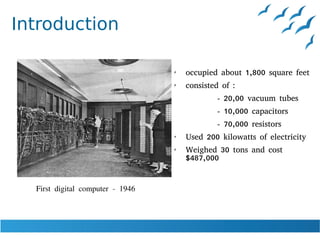
Introduction
First digital computer - 1946
✗
occupied about 1,800 square feet
✗
consisted of :
- 20,00 vacuum tubes
- 10,000 capacitors
- 70,000 resistors
✗
Used 200 kilowatts of electricity
✗
Weighed 30 tons and cost
$487,000
●
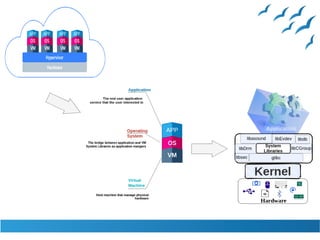
VM software layer not well isolate many
application services and users, and there is a
high level of redundancy
●
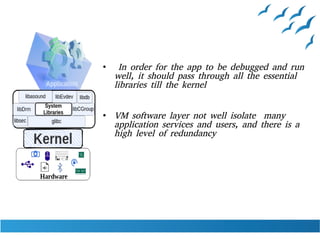
In order for the app to be debugged and run
well, it should pass through all the essential
libraries till the kernel
Unikernels
Unikernels are specialised, single-address-space machine images constructed by using library operating
systems.
●
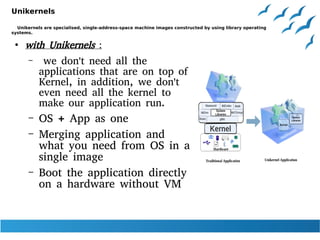
with Unikernels :
– we don't need all the
applications that are on top of
Kernel, in addition, we don't
even need all the kernel to
make our application run.
– OS + App as one
– Merging application and
what you need from OS in a
single image
– Boot the application directly
on a hardware without VM
●
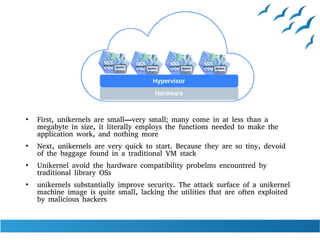
First, unikernels are small—very small; many come in at less than a
megabyte in size, it literally employs the functions needed to make the
application work, and nothing more
●
Next, unikernels are very quick to start. Because they are so tiny, devoid
of the baggage found in a traditional VM stack
●
Unikernel avoid the hardware compatibility probelms encountred by
traditional library OSs
●
unikernels substantially improve security. The attack surface of a unikernel
machine image is quite small, lacking the utilities that are often exploited
by malicious hackers
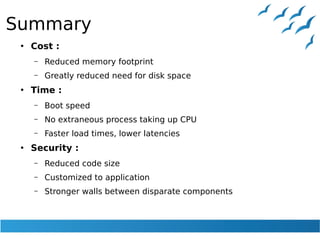
Summary
●
Cost :
– Reduced memory footprint
– Greatly reduced need for disk space
●
Time :
– Boot speed
– No extraneous process taking up CPU
– Faster load times, lower latencies
●
Security :
– Reduced code size
– Customized to application
– Stronger walls between disparate components

Unikernels,before, now and next

  • 1.
  • 2.
    Introduction First digital computer- 1946 ✗ occupied about 1,800 square feet ✗ consisted of : - 20,00 vacuum tubes - 10,000 capacitors - 70,000 resistors ✗ Used 200 kilowatts of electricity ✗ Weighed 30 tons and cost $487,000
  • 5.
    ● VM software layernot well isolate many application services and users, and there is a high level of redundancy ● In order for the app to be debugged and run well, it should pass through all the essential libraries till the kernel
  • 6.
    Unikernels Unikernels are specialised,single-address-space machine images constructed by using library operating systems. ● with Unikernels : – we don't need all the applications that are on top of Kernel, in addition, we don't even need all the kernel to make our application run. – OS + App as one – Merging application and what you need from OS in a single image – Boot the application directly on a hardware without VM
  • 7.
    ● First, unikernels aresmall—very small; many come in at less than a megabyte in size, it literally employs the functions needed to make the application work, and nothing more ● Next, unikernels are very quick to start. Because they are so tiny, devoid of the baggage found in a traditional VM stack ● Unikernel avoid the hardware compatibility probelms encountred by traditional library OSs ● unikernels substantially improve security. The attack surface of a unikernel machine image is quite small, lacking the utilities that are often exploited by malicious hackers
  • 8.
    Summary ● Cost : – Reducedmemory footprint – Greatly reduced need for disk space ● Time : – Boot speed – No extraneous process taking up CPU – Faster load times, lower latencies ● Security : – Reduced code size – Customized to application – Stronger walls between disparate components