By Matthew
Higgins
OUTLINE
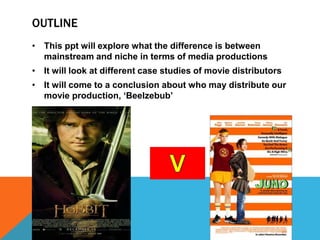
• This ppt will explore what the difference is between
mainstream and niche in terms of media productions
• It will look at different case studies of movie distributors
• It will come to a conclusion about who may distribute our
movie production, ‘Beelzebub’
WHAT IS MAINSTREAM?
• Mainstream is a style of movie that caters to every demographic and
has a wide appeal.
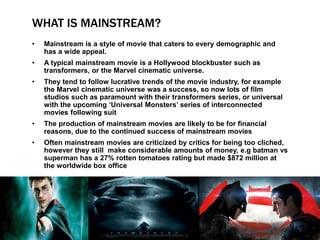
• A typical mainstream movie is a Hollywood blockbuster such as
transformers, or the Marvel cinematic universe.
• They tend to follow lucrative trends of the movie industry, for example
the Marvel cinematic universe was a success, so now lots of film
studios such as paramount with their transformers series, or universal
with the upcoming ‘Universal Monsters’ series of interconnected
movies following suit
• The production of mainstream movies are likely to be for financial
reasons, due to the continued success of mainstream movies
• Often mainstream movies are criticized by critics for being too cliched,
however they still make considerable amounts of money, e.g batman vs
superman has a 27% rotten tomatoes rating but made $872 million at
the worldwide box office
WHAT IS NICHE
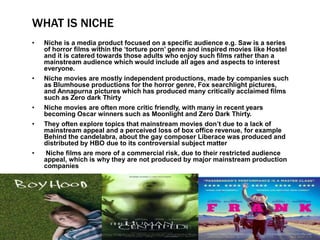
• Niche is a media product focused on a specific audience e.g. Saw is a series
of horror films within the ‘torture porn’ genre and inspired movies like Hostel
and it is catered towards those adults who enjoy such films rather than a
mainstream audience which would include all ages and aspects to interest
everyone.
• Niche movies are mostly independent productions, made by companies such
as Blumhouse productions for the horror genre, Fox searchlight pictures,
and Annapurna pictures which has produced many critically acclaimed films
such as Zero dark Thirty
• Niche movies are often more critic friendly, with many in recent years
becoming Oscar winners such as Moonlight and Zero Dark Thirty.
• They often explore topics that mainstream movies don’t due to a lack of
mainstream appeal and a perceived loss of box office revenue, for example
Behind the candelabra, about the gay composer Liberace was produced and
distributed by HBO due to its controversial subject matter
• Niche films are more of a commercial risk, due to their restricted audience
appeal, which is why they are not produced by major mainstream production
companies
MAINSTREAM PRODUCTION COMPANY
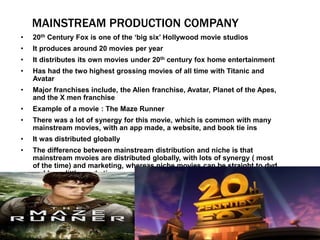
• 20th Century Fox is one of the ‘big six’ Hollywood movie studios
• It produces around 20 movies per year
• It distributes its own movies under 20th century fox home entertainment
• Has had the two highest grossing movies of all time with Titanic and
Avatar
• Major franchises include, the Alien franchise, Avatar, Planet of the Apes,
and the X men franchise
• Example of a movie : The Maze Runner
• There was a lot of synergy for this movie, which is common with many
mainstream movies, with an app made, a website, and book tie ins
• It was distributed globally
• The difference between mainstream distribution and niche is that
mainstream mvoies are distributed globally, with lots of synergy ( most
of the time) and marketing, whereas niche movies can be straight to dvd
and have little marketing power
NICHE PRODUCTION COMPANY
• Blumhouse productions is an American production company founded in 2004
by Jason Blum, that makes low budget ‘niche’ movies
• It is mainly known for its horror films, however it has also produced critically
acclaimed movies such as Whiplash
• Their model is to produce niche movies on a low budget, but release them
through a studio distributor to reach a wider audience
• This is a perfect example of a niche company, as it has produced movies that
may not appeal to a wide audience demographic, and requires another
company to help fund and distribute their movie.
• Their most famous franchises are the Insidious, Paranormal activity, sinister,
and the purge franchises, all of which are horror due to Blumhouse
productions being very horror orientated.
• They have a ‘first look’ deal with Universal who distribute many of their movies
• Paranormal Activity made over $193 million on a $15,000 budget
• In September 2014 they created ‘Blumhouse Tilt’ a part of the company that
releases their movies via multiple platforms
• This is an interesting example as it defies the idea of niche films, which are
only appealing to a specfic audience, not being financially lucrative, although
it does rely upon studio distribution
• Other companies such as A24, a very successful niche distributor of films such
as ‘The Witch’ do not rely on a studio distributor
FEATURES OF A MAINSTREAM AND NICHE
PRODUCTION
• Mainstream
• Large budget
• Star Personality
• Mass audience appeal
• Lots of synergy in promotion
• Niche
• Low budget
• Lesser known actors and directors
• Can be financed via a variety of companies
• Usually doesn’t get a wide global release in the same way a mainstream film
would, although it may be released globally
• Subject matter which will appeal to a smaller demographic than mainstream
films
‘BEELZEBUB’ FEATURES
• Made on zero budget, using props and cameras and editing software
given to us
• It is within the horror genre so won’t have as wide appeal as a
superhero or comedy movie
• However, within the horror genre, it is more conventional and
mainstream due its use of genre tropes
• It tackles controversial issues such as mental illness and troubled
youth
• Wouldn’t be suitable for young children and families, but perfect for
teens and adults
• Doesn’t have any well known actors, directors, or producers
THE CHOSEN DISTRIBUTOR
• Beelzebub is a niche movie due to its subject matter and genre
• I would suggest it would be a 15 rating in the UK due to its use of blood,
satanic imagery, and psychological style of horror making it unsuitable
for children
• However within the horror genre it is a ‘mainstream’ horror such as The
Conjuring or insidious as it deals with the conventions of horror.
• Therefore it is perfect for a distributor such as Blumhouse Productions
which produces low budget movies and distributes the movies via
multiple platforms, and through their deal with universal, to a wider
audience in cinemas

Mainstream vs niche

  • 1.
  • 2.
    OUTLINE • This pptwill explore what the difference is between mainstream and niche in terms of media productions • It will look at different case studies of movie distributors • It will come to a conclusion about who may distribute our movie production, ‘Beelzebub’
  • 3.
    WHAT IS MAINSTREAM? •Mainstream is a style of movie that caters to every demographic and has a wide appeal. • A typical mainstream movie is a Hollywood blockbuster such as transformers, or the Marvel cinematic universe. • They tend to follow lucrative trends of the movie industry, for example the Marvel cinematic universe was a success, so now lots of film studios such as paramount with their transformers series, or universal with the upcoming ‘Universal Monsters’ series of interconnected movies following suit • The production of mainstream movies are likely to be for financial reasons, due to the continued success of mainstream movies • Often mainstream movies are criticized by critics for being too cliched, however they still make considerable amounts of money, e.g batman vs superman has a 27% rotten tomatoes rating but made $872 million at the worldwide box office
  • 4.
    WHAT IS NICHE •Niche is a media product focused on a specific audience e.g. Saw is a series of horror films within the ‘torture porn’ genre and inspired movies like Hostel and it is catered towards those adults who enjoy such films rather than a mainstream audience which would include all ages and aspects to interest everyone. • Niche movies are mostly independent productions, made by companies such as Blumhouse productions for the horror genre, Fox searchlight pictures, and Annapurna pictures which has produced many critically acclaimed films such as Zero dark Thirty • Niche movies are often more critic friendly, with many in recent years becoming Oscar winners such as Moonlight and Zero Dark Thirty. • They often explore topics that mainstream movies don’t due to a lack of mainstream appeal and a perceived loss of box office revenue, for example Behind the candelabra, about the gay composer Liberace was produced and distributed by HBO due to its controversial subject matter • Niche films are more of a commercial risk, due to their restricted audience appeal, which is why they are not produced by major mainstream production companies
  • 5.
    MAINSTREAM PRODUCTION COMPANY •20th Century Fox is one of the ‘big six’ Hollywood movie studios • It produces around 20 movies per year • It distributes its own movies under 20th century fox home entertainment • Has had the two highest grossing movies of all time with Titanic and Avatar • Major franchises include, the Alien franchise, Avatar, Planet of the Apes, and the X men franchise • Example of a movie : The Maze Runner • There was a lot of synergy for this movie, which is common with many mainstream movies, with an app made, a website, and book tie ins • It was distributed globally • The difference between mainstream distribution and niche is that mainstream mvoies are distributed globally, with lots of synergy ( most of the time) and marketing, whereas niche movies can be straight to dvd and have little marketing power
  • 6.
    NICHE PRODUCTION COMPANY •Blumhouse productions is an American production company founded in 2004 by Jason Blum, that makes low budget ‘niche’ movies • It is mainly known for its horror films, however it has also produced critically acclaimed movies such as Whiplash • Their model is to produce niche movies on a low budget, but release them through a studio distributor to reach a wider audience • This is a perfect example of a niche company, as it has produced movies that may not appeal to a wide audience demographic, and requires another company to help fund and distribute their movie. • Their most famous franchises are the Insidious, Paranormal activity, sinister, and the purge franchises, all of which are horror due to Blumhouse productions being very horror orientated. • They have a ‘first look’ deal with Universal who distribute many of their movies • Paranormal Activity made over $193 million on a $15,000 budget • In September 2014 they created ‘Blumhouse Tilt’ a part of the company that releases their movies via multiple platforms • This is an interesting example as it defies the idea of niche films, which are only appealing to a specfic audience, not being financially lucrative, although it does rely upon studio distribution • Other companies such as A24, a very successful niche distributor of films such as ‘The Witch’ do not rely on a studio distributor
  • 7.
    FEATURES OF AMAINSTREAM AND NICHE PRODUCTION • Mainstream • Large budget • Star Personality • Mass audience appeal • Lots of synergy in promotion • Niche • Low budget • Lesser known actors and directors • Can be financed via a variety of companies • Usually doesn’t get a wide global release in the same way a mainstream film would, although it may be released globally • Subject matter which will appeal to a smaller demographic than mainstream films
  • 8.
    ‘BEELZEBUB’ FEATURES • Madeon zero budget, using props and cameras and editing software given to us • It is within the horror genre so won’t have as wide appeal as a superhero or comedy movie • However, within the horror genre, it is more conventional and mainstream due its use of genre tropes • It tackles controversial issues such as mental illness and troubled youth • Wouldn’t be suitable for young children and families, but perfect for teens and adults • Doesn’t have any well known actors, directors, or producers
  • 9.
    THE CHOSEN DISTRIBUTOR •Beelzebub is a niche movie due to its subject matter and genre • I would suggest it would be a 15 rating in the UK due to its use of blood, satanic imagery, and psychological style of horror making it unsuitable for children • However within the horror genre it is a ‘mainstream’ horror such as The Conjuring or insidious as it deals with the conventions of horror. • Therefore it is perfect for a distributor such as Blumhouse Productions which produces low budget movies and distributes the movies via multiple platforms, and through their deal with universal, to a wider audience in cinemas