Reduce Your
Technical Debt
Mark Niebergall - https://joind.in/talk/a3f07
Thank You Sponsors
About Mark Niebergall
● PHP since 2005
● Masters degree in MIS
● Senior Software Engineer
● Drug screening project
● UPHPU President
● SSCP, CSSLP Certified and SME
● Drones, fishing, skiing, father, husband
UPHPU
● 3rd Thursday of each month in Lehi
● PHP and related topics
○ Friday 6pm OpenWest review
○ August - Git
○ September - PHP TestFest
○ October - Defensive Coding
● Networking, community
● Pizza, pop, dessert, swag
About Mark Niebergall
● German
● Ancestry.com: nickname for someone who
habitually failed to repay his debts
Reduce Your Technical Debt
● Definition
● How it is introduced
● Impact on a project
● Avoid adding
● Paying off existing debt
Audience Survey
● Roles on projects
● Languages used
Disclaimer
● PHP technologies
● Concepts apply to other languages and
projects
Definition
Definition
● Metaphor coined by Ward Cunningham
● Explained further by Martin Fowler, others
Definition
● Consequences of poor design, architecture
● Prudent vs reckless
● Incurred knowingly and inadvertently
● Work needed to complete job properly
Examples
Examples
● Unused code (dead wood)
● Old versions
● Dated technology
● Deprecated functionality
Examples
● Buggy code
● Overly complicated code
● Insecure code
● “Smelly” code
Examples
● Doesn’t meet requirements
● Insufficient features
● No documentation
● No unit tests
Examples
● Incomplete coding standards
● Missing database constraints
● Missing validation
● Tightly coupled code
Clearance Rack
● Food about to expire
● Questionable dairy and bread
● Items that have been sitting on the shelf a
little too long
University Bid Sales
● Aging computers and hardware
● Obsolete items
● Never opened items
● Broken items needing repair or parts
● Piles of cables and adapters
The Problem
The Problem - Updates
return a + b
The Problem - Updates
return (a + b).toFixed(2)
The Problem - Updates
if ( !isNaN(parseFloat(a))
|| isFinite(a)
|| !isNaN(parseFloat(b))
|| isFinite(b)
) {
throw “Not a number”;
}
return (a + b).toFixed(2)
The Problem - Files
index.html
stuff.js
morestuff.js
moreawesomestuff.js
utilities.js
core.js
The Problem - Database
Table: person
Columns: name, address, address1, city, state,
zip, phone, phone2, phone3, email, email2,
address_mailing, address1_mailing,
city_mailing, state_mailing, zip_mailing,
create_timestamp_string, …
The Problem - Database
Table: thing
Columns: name, description, image,
what_it_does, hours, location, cost, time,
owner, obscure_field, ts, sd, or, qa, ei, num, +
50 more columns
The Problem - Security
$sql = “SELECT * FROM big_table WHERE
something = “ $_POST[‘from_user’];
$result = mysqli_query($sql);
The Problem - Architecture
$value = [
‘some_key’ => [
‘another_key’ => [‘maybe_key’ => ‘alice’, 1 => ‘super awesome’],
‘questionable’ => [‘bob’, ‘cat’ => ‘kittens’, ‘mixed’ => new stdClass]
];
Sources of Technical Debt
● New versions of libraries
● New versions of languages
● New versions of frameworks
Sources of Technical Debt
● Inexperience
Sources of Technical Debt
● Architecture changes
Sources of Technical Debt
● Time
● Resources
● Scope creep
Sources of Technical Debt
● Ignorance
● Misunderstanding of requirements
● Understanding of project
Sources of Technical Debt
● Unwillingness
● Lack of motivation
Impact
Impact
● Increased time to deliver new features
● Increased time to maintain application
● Increased time paying off debts
● Increased code complexity
Impact
● Software brittleness
● Software bloat
● Software rot
● Magic in application
Avoid Debt
Avoid Debt
● Avoid excessive debt
● Minimize risk
● Stay within means
● Use available resources
● Iron Triangle: Scope, Resources, Time
Avoid Debt - Operational
● Planning
● Requirements gathering
● Analyze project
● Documentation
● Acceptance tests
Avoid Debt - Technical
● Use a framework
● Be open to new technologies
Avoid Debt - Technical
● Package Manager
● Move 3rd party library out of project code
● Keep libraries, software up-to-date
● “Life is too short for old software” - Sebastian
Bergmann
Avoid Debt - Technical
● Unit tests
● Loosely coupled code
● Code reusability
● Reduce code complexity
● Leverage language features
Avoid Debt - Technical
● Static code analysis tools
○ Automated way to check code health
○ Unit test coverage
○ Coding standards
○ Unused code
○ Design patterns
○ Metrics
○ Methods doing too much
Avoid Debt - Technical
● Dynamic code review
○ Review by a human
○ Security reviews
○ Architecture
○ Linked functionality
○ Business rules
○ Functional bugs
Avoid Debt - Technical
● Continuous integration tools
● Configuration management tools
Avoid Debt - Technical
● Code reviews and feedback
● Coding standards
● Design patterns
● General best practices
Paying off Debt
Paying off Debt
● My experience with a big project
● Included PM, developers, devops, DBAs,
system administrators, QA, IT leadership
● Buy-in from upper management
● Application is faster, more stable, more
secure, modernized, easier to maintain
Paying off Debt
● Identified pain points
● Created epics
● Set priorities
● Defined user stories
Paying off Debt
● Assigned work, ownership
● Regular reporting as a team
● Regular reporting to management
Paying off Debt
● Defined goals for quarters, years
Paying off Debt
● Data migration out of database and into
cloud storage
● Data consolidation
● Data restructuring
Paying off Debt
● Adding middleware
● Framework upgrades
● Software upgrades
● Library upgrades
Paying off Debt
● Major overhauls in painful areas
Paying off Debt
● Moving processes to queue manager
● Cleaning up technology stack
Paying off Debt
● Security updates
● Auditing improvements
Paying off Debt
● Work spread out over time
● Measurable successes and milestones
● Very successful and still ongoing
Paying off Debt
● Make a plan
● Set goals
● Stay inside your budget
Paying off Debt
● Consistency
● Pay off some debt each sprint or regular
interval
Paying off Debt
● Repeating process
○ Identify debt
○ Make a plan
○ Take action
Taking on Debt
Taking on Debt
Four Rights
● Reason
● Time
● Terms
● Amount
Professional Development
● Participate in local user groups
● Find experienced mentors
● Attend conferences
● Read blogs
● Learn
Rewrite vs Refactor
Rewrite
● New project to replace current solution
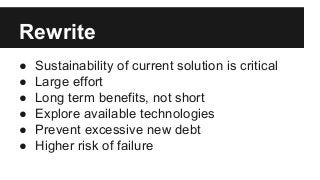
Rewrite
● Sustainability of current solution is critical
● Large effort
● Long term benefits, not short
● Explore available technologies
● Prevent excessive new debt
● Higher risk of failure
Refactor
● Replace pieces of project in-place
Refactor
● Break effort up over time
● Results both short and long term
● Prioritize what to rework first
● Lower risk of failure
Rewrite vs Refactor
● Sustainability of current solution
● Level of effort
● Short and long term benefits
● Feasibility
● Technology stack
● Team capabilities
Review
Technical Debt
● Metaphor
● Reduce your debt
● Pay off debt using repeating process
● Tools available for your project
● Apply understanding to improve architecture
Questions?
● https://joind.in/talk/a3f07
References
● Ancestry.com http://www.ancestry.com/name-origin?surname=niebergall
● Ward Cunningham https://www.youtube.com/watch?v=pqeJFYwnkjE
● Martin Fowler http://martinfowler.com/bliki/TechnicalDebt.html
● David Laribee https://msdn.microsoft.com/en-us/magazine/ee819135.aspx
● Mark Noneman https://www.youtube.com/watch?v=cb5fkftdD9k

Technical Debt Management

  • 1.
    Reduce Your Technical Debt MarkNiebergall - https://joind.in/talk/a3f07
  • 2.
  • 3.
    About Mark Niebergall ●PHP since 2005 ● Masters degree in MIS ● Senior Software Engineer ● Drug screening project ● UPHPU President ● SSCP, CSSLP Certified and SME ● Drones, fishing, skiing, father, husband
  • 4.
    UPHPU ● 3rd Thursdayof each month in Lehi ● PHP and related topics ○ Friday 6pm OpenWest review ○ August - Git ○ September - PHP TestFest ○ October - Defensive Coding ● Networking, community ● Pizza, pop, dessert, swag
  • 5.
    About Mark Niebergall ●German ● Ancestry.com: nickname for someone who habitually failed to repay his debts
  • 6.
  • 7.
    Reduce Your TechnicalDebt ● Definition ● How it is introduced ● Impact on a project ● Avoid adding ● Paying off existing debt
  • 8.
    Audience Survey ● Roleson projects ● Languages used
  • 9.
    Disclaimer ● PHP technologies ●Concepts apply to other languages and projects
  • 10.
  • 11.
    Definition ● Metaphor coinedby Ward Cunningham ● Explained further by Martin Fowler, others
  • 12.
    Definition ● Consequences ofpoor design, architecture ● Prudent vs reckless ● Incurred knowingly and inadvertently ● Work needed to complete job properly
  • 13.
  • 14.
    Examples ● Unused code(dead wood) ● Old versions ● Dated technology ● Deprecated functionality
  • 15.
    Examples ● Buggy code ●Overly complicated code ● Insecure code ● “Smelly” code
  • 16.
    Examples ● Doesn’t meetrequirements ● Insufficient features ● No documentation ● No unit tests
  • 17.
    Examples ● Incomplete codingstandards ● Missing database constraints ● Missing validation ● Tightly coupled code
  • 18.
    Clearance Rack ● Foodabout to expire ● Questionable dairy and bread ● Items that have been sitting on the shelf a little too long
  • 19.
    University Bid Sales ●Aging computers and hardware ● Obsolete items ● Never opened items ● Broken items needing repair or parts ● Piles of cables and adapters
  • 20.
  • 21.
    The Problem -Updates return a + b
  • 22.
    The Problem -Updates return (a + b).toFixed(2)
  • 23.
    The Problem -Updates if ( !isNaN(parseFloat(a)) || isFinite(a) || !isNaN(parseFloat(b)) || isFinite(b) ) { throw “Not a number”; } return (a + b).toFixed(2)
  • 24.
    The Problem -Files index.html stuff.js morestuff.js moreawesomestuff.js utilities.js core.js
  • 25.
    The Problem -Database Table: person Columns: name, address, address1, city, state, zip, phone, phone2, phone3, email, email2, address_mailing, address1_mailing, city_mailing, state_mailing, zip_mailing, create_timestamp_string, …
  • 26.
    The Problem -Database Table: thing Columns: name, description, image, what_it_does, hours, location, cost, time, owner, obscure_field, ts, sd, or, qa, ei, num, + 50 more columns
  • 27.
    The Problem -Security $sql = “SELECT * FROM big_table WHERE something = “ $_POST[‘from_user’]; $result = mysqli_query($sql);
  • 28.
    The Problem -Architecture $value = [ ‘some_key’ => [ ‘another_key’ => [‘maybe_key’ => ‘alice’, 1 => ‘super awesome’], ‘questionable’ => [‘bob’, ‘cat’ => ‘kittens’, ‘mixed’ => new stdClass] ];
  • 29.
  • 30.
    Sources of TechnicalDebt ● New versions of libraries ● New versions of languages ● New versions of frameworks
  • 31.
    Sources of TechnicalDebt ● Inexperience
  • 32.
    Sources of TechnicalDebt ● Architecture changes
  • 33.
    Sources of TechnicalDebt ● Time ● Resources ● Scope creep
  • 34.
    Sources of TechnicalDebt ● Ignorance ● Misunderstanding of requirements ● Understanding of project
  • 35.
    Sources of TechnicalDebt ● Unwillingness ● Lack of motivation
  • 36.
  • 37.
    Impact ● Increased timeto deliver new features ● Increased time to maintain application ● Increased time paying off debts ● Increased code complexity
  • 38.
    Impact ● Software brittleness ●Software bloat ● Software rot ● Magic in application
  • 39.
  • 40.
    Avoid Debt ● Avoidexcessive debt ● Minimize risk ● Stay within means ● Use available resources ● Iron Triangle: Scope, Resources, Time
  • 41.
    Avoid Debt -Operational ● Planning ● Requirements gathering ● Analyze project ● Documentation ● Acceptance tests
  • 42.
    Avoid Debt -Technical ● Use a framework ● Be open to new technologies
  • 43.
    Avoid Debt -Technical ● Package Manager ● Move 3rd party library out of project code ● Keep libraries, software up-to-date ● “Life is too short for old software” - Sebastian Bergmann
  • 44.
    Avoid Debt -Technical ● Unit tests ● Loosely coupled code ● Code reusability ● Reduce code complexity ● Leverage language features
  • 45.
    Avoid Debt -Technical ● Static code analysis tools ○ Automated way to check code health ○ Unit test coverage ○ Coding standards ○ Unused code ○ Design patterns ○ Metrics ○ Methods doing too much
  • 46.
    Avoid Debt -Technical ● Dynamic code review ○ Review by a human ○ Security reviews ○ Architecture ○ Linked functionality ○ Business rules ○ Functional bugs
  • 47.
    Avoid Debt -Technical ● Continuous integration tools ● Configuration management tools
  • 48.
    Avoid Debt -Technical ● Code reviews and feedback ● Coding standards ● Design patterns ● General best practices
  • 49.
  • 50.
    Paying off Debt ●My experience with a big project ● Included PM, developers, devops, DBAs, system administrators, QA, IT leadership ● Buy-in from upper management ● Application is faster, more stable, more secure, modernized, easier to maintain
  • 51.
    Paying off Debt ●Identified pain points ● Created epics ● Set priorities ● Defined user stories
  • 52.
    Paying off Debt ●Assigned work, ownership ● Regular reporting as a team ● Regular reporting to management
  • 53.
    Paying off Debt ●Defined goals for quarters, years
  • 54.
    Paying off Debt ●Data migration out of database and into cloud storage ● Data consolidation ● Data restructuring
  • 55.
    Paying off Debt ●Adding middleware ● Framework upgrades ● Software upgrades ● Library upgrades
  • 56.
    Paying off Debt ●Major overhauls in painful areas
  • 57.
    Paying off Debt ●Moving processes to queue manager ● Cleaning up technology stack
  • 58.
    Paying off Debt ●Security updates ● Auditing improvements
  • 59.
    Paying off Debt ●Work spread out over time ● Measurable successes and milestones ● Very successful and still ongoing
  • 60.
    Paying off Debt ●Make a plan ● Set goals ● Stay inside your budget
  • 61.
    Paying off Debt ●Consistency ● Pay off some debt each sprint or regular interval
  • 62.
    Paying off Debt ●Repeating process ○ Identify debt ○ Make a plan ○ Take action
  • 63.
  • 64.
    Taking on Debt FourRights ● Reason ● Time ● Terms ● Amount
  • 65.
    Professional Development ● Participatein local user groups ● Find experienced mentors ● Attend conferences ● Read blogs ● Learn
  • 66.
  • 67.
    Rewrite ● New projectto replace current solution
  • 68.
    Rewrite ● Sustainability ofcurrent solution is critical ● Large effort ● Long term benefits, not short ● Explore available technologies ● Prevent excessive new debt ● Higher risk of failure
  • 69.
    Refactor ● Replace piecesof project in-place
  • 70.
    Refactor ● Break effortup over time ● Results both short and long term ● Prioritize what to rework first ● Lower risk of failure
  • 71.
    Rewrite vs Refactor ●Sustainability of current solution ● Level of effort ● Short and long term benefits ● Feasibility ● Technology stack ● Team capabilities
  • 72.
  • 73.
    Technical Debt ● Metaphor ●Reduce your debt ● Pay off debt using repeating process ● Tools available for your project ● Apply understanding to improve architecture
  • 74.
  • 75.
    References ● Ancestry.com http://www.ancestry.com/name-origin?surname=niebergall ●Ward Cunningham https://www.youtube.com/watch?v=pqeJFYwnkjE ● Martin Fowler http://martinfowler.com/bliki/TechnicalDebt.html ● David Laribee https://msdn.microsoft.com/en-us/magazine/ee819135.aspx ● Mark Noneman https://www.youtube.com/watch?v=cb5fkftdD9k