Balancing
Technical Debt
and Clean Code
@dave1010
Dave Hulbert
@wearebase
@phpdorset
@dave1010
Dave Hulbert
istockphoto.com
tensionnot.com
shutterstock.com
Good things
●
Delivering fast
●
Clean code
Bad things
●
Technical debt
●
Delivering slow
Code of Conduct
Carry out your professional
responsibilities with due care and
diligence in accordance with the
Relevant Authority’s requirements
whilst exercising your
professional judgement at all
times
How to develop
quickly
Developers
●
Skilled, Passionate, Healthy,
Focused, Disciplined
●
Conferences, user groups, meet ups
●
Read books, blogs, code
●
Write code, Open Source
contributions
Projects
●
Good requirements
●
Good specifications
●
Fast feedback
How to develop
quickly
(in the short term)
●
Less testing
●
Less planning
●
Less communication
●
Don't improve tools /
processes
●
Overtime
●
Outsource
Technical Debt
Shipping code
before it's ready
Shipping code
without enough
architecture
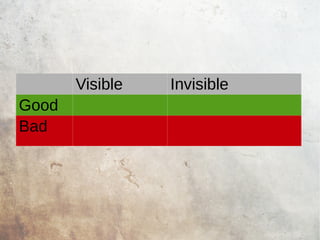
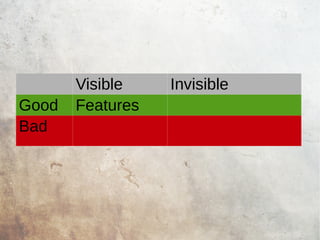
Visible Invisible
Good
Bad
thetruthaboutcars.com
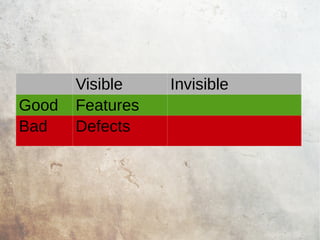
Visible Invisible
Good Features
Bad
uberhumor.com
flickr.com/dangelophoto1
Visible Invisible
Good Features
Bad Defects
wikimedia.org
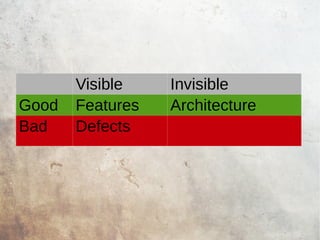
Visible Invisible
Good Features Architecture
Bad Defects
amazon.com
mirror.co.uk
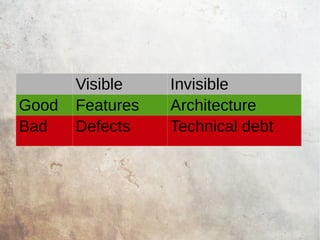
Visible Invisible
Good Features Architecture
Bad Defects Technical debt
Technical Debt
thisismoney.co.uk
Good idea
●
You think you'll be better off
in the future
●
The risk (interest) is
manageable
Interest
●
More user support needed
●
Manual tasks
●
Complete rewrite in future
Consequences
●
Less time on new features
●
Higher cost of new features
●
Harder to estimate new
features
bbc.co.uk
Complexity
Tests
●
Not comprehensive
●
Incorrect
●
Slow
We need to recognize that our job
isn't about producing more code in
less time, it's about creating
software that is stable, performant,
maintainable and understandable
(to you or someone else, a few
months or years down the road).
Matthew Gertner
Invest in
architecture
Invest in
code
TDD
●
Run every bit of code that you
write, ASAP
Write a test when
you fix a bug
Domain-Driven
Design
●
Model the domain completely
in classes that don't touch the
UI, database or framework
How do you keep
technical debt to a
minimum?
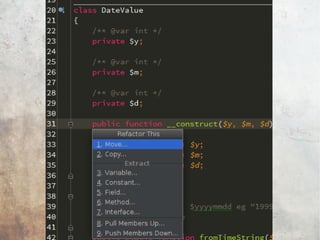
Refactoring
wikimedia.org
Refactoring
●
Restructuring without
changing behaviour
●
Makes it easier to read,
understand, test, change, add
new features to
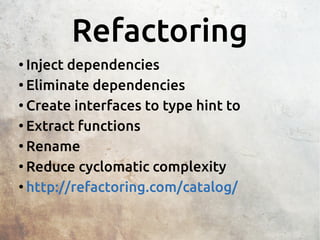
Refactoring
●
Inject dependencies
●
Eliminate dependencies
●
Create interfaces to type hint to
●
Extract functions
●
Rename
●
Reduce cyclomatic complexity
●
http://refactoring.com/catalog/
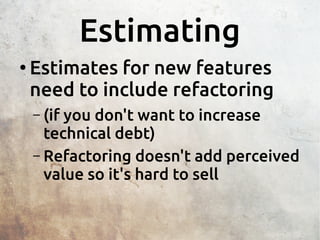
Estimating
●
Estimates for new features
need to include refactoring
– (if you don't want to increase
technical debt)
– Refactoring doesn't add perceived
value so it's hard to sell
Debt is expensive
●
Paying technical debt with
interest takes more time than
continual refactoring
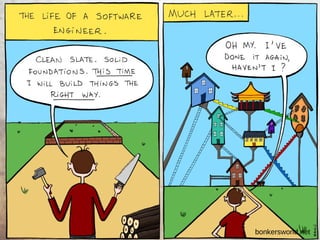
bonkersworld.net
Break the rules
●
Help you deliver faster in the
short term
●
Long term strategy
●
Disposable prototype
●
Just don't need to write clean
code
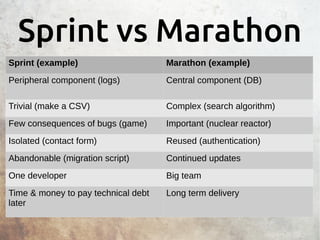
Sprint vs Marathon
Sprint (example) Marathon (example)
Peripheral component (logs) Central component (DB)
Trivial (make a CSV) Complex (search algorithm)
Few consequences of bugs (game) Important (nuclear reactor)
Isolated (contact form) Reused (authentication)
Abandonable (migration script) Continued updates
One developer Big team
Time & money to pay technical debt
later
Long term delivery
Investment in code
is a balance
Thanks!
bitly.com/tech-debt-
feedback
@dave1010
Dave Hulbert

Balancing Technical Debt and Clean Code