Advanced Re
fl
ection:
MetaLinks
Marcus Denker, Inria
http://marcusdenker.de
Lecture at VUB Brussels, March 31, 2022
What we know…
• Smalltalk is re
fl
ective
• Classes, Methods, Stack-Frames… are Objects
• Re
fl
ective API on all Objects
Re
fl
ection in Smalltalk
• Re
fl
ection is based on the Metaclass model, thus it is
inherently structural
• Behavioral Re
fl
ection limited to:
• Method lookup on failure (#doesNotUndersand:)
• Rei
fi
ed stack (thisContext)
Can we do better?
• A more
fi
ne-grained re
fl
ective mechanism seems to be
missing
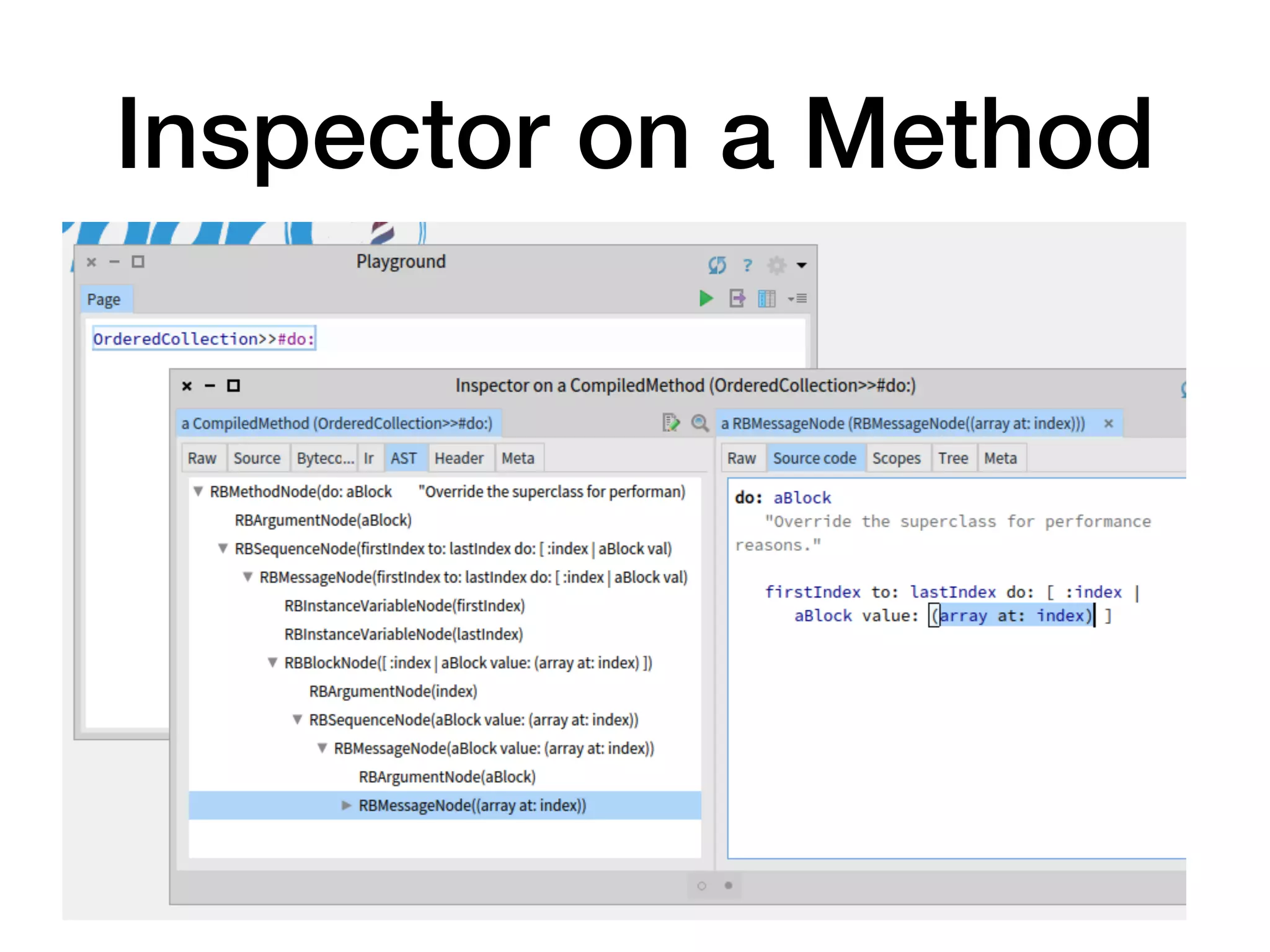
• Let’s look again at a Method in the Inspector
Inspector on a Method
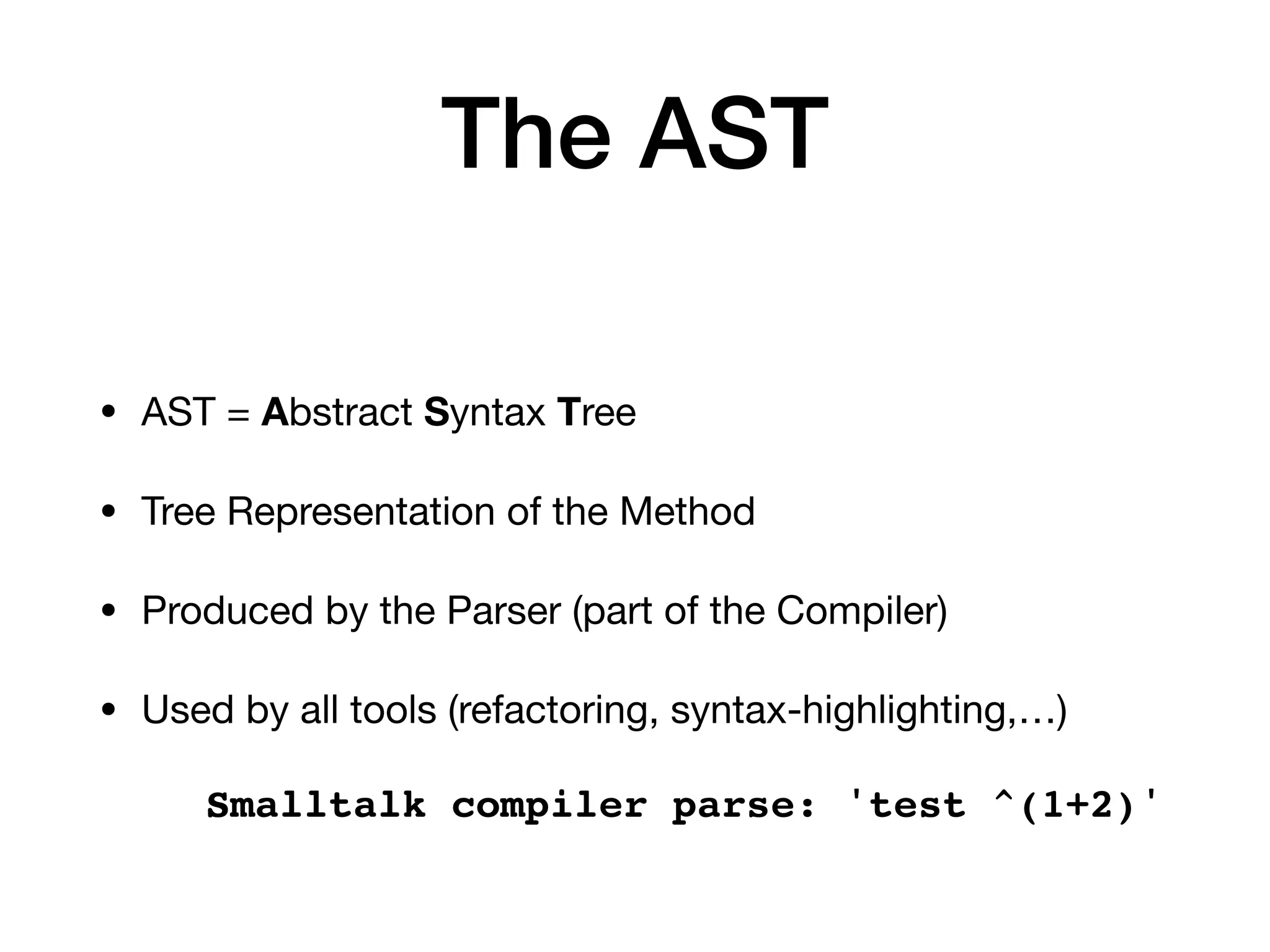
The AST
• AST = Abstract Syntax Tree
• Tree Representation of the Method
• Produced by the Parser (part of the Compiler)
• Used by all tools (refactoring, syntax-highlighting,…)
Smalltalk compiler parse: 'test ^(1+2)'
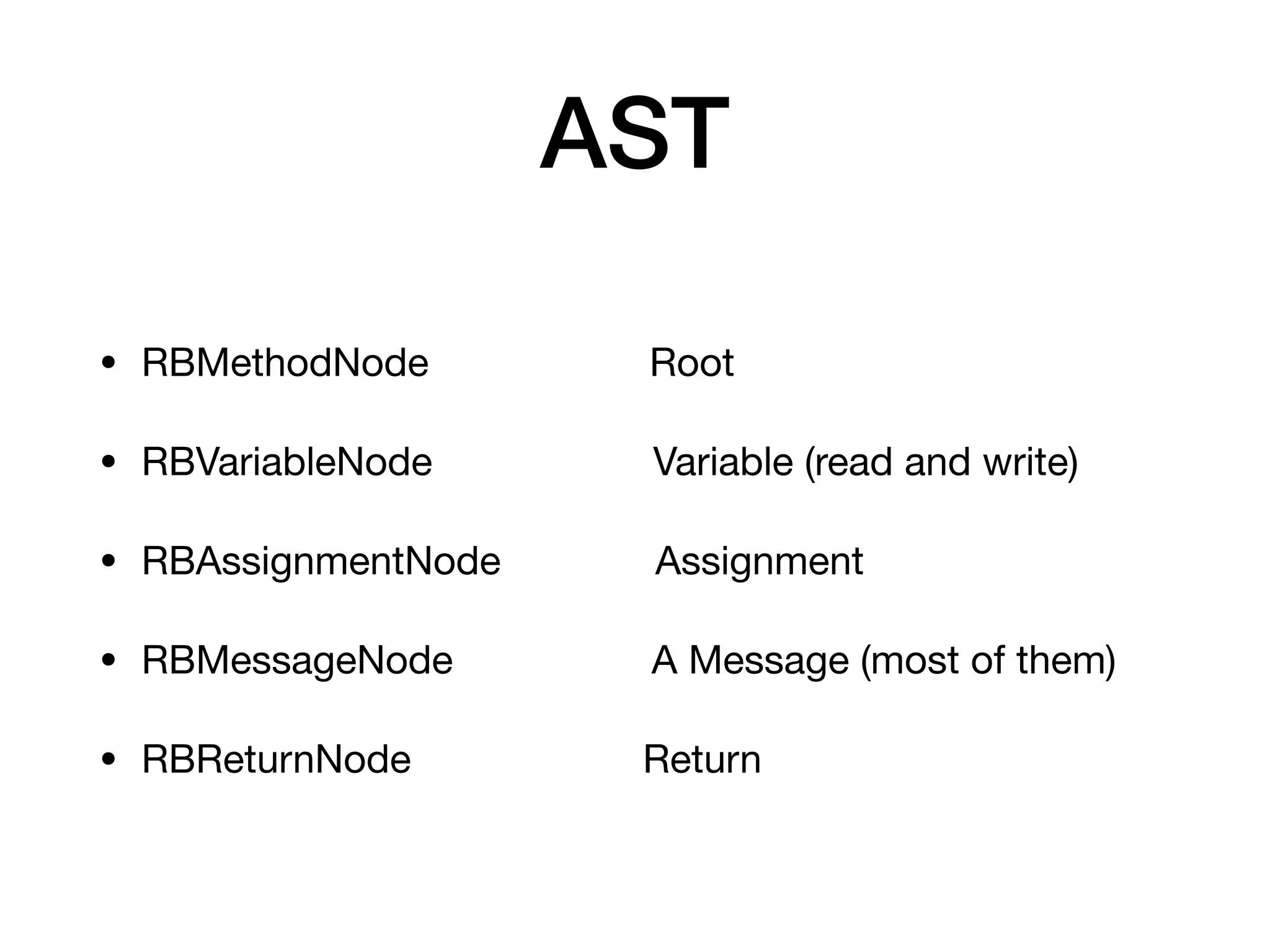
AST
• RBMethodNode Root
• RBVariableNode Variable (read and write)
• RBAssignmentNode Assignment
• RBMessageNode A Message (most of them)
• RBReturnNode Return
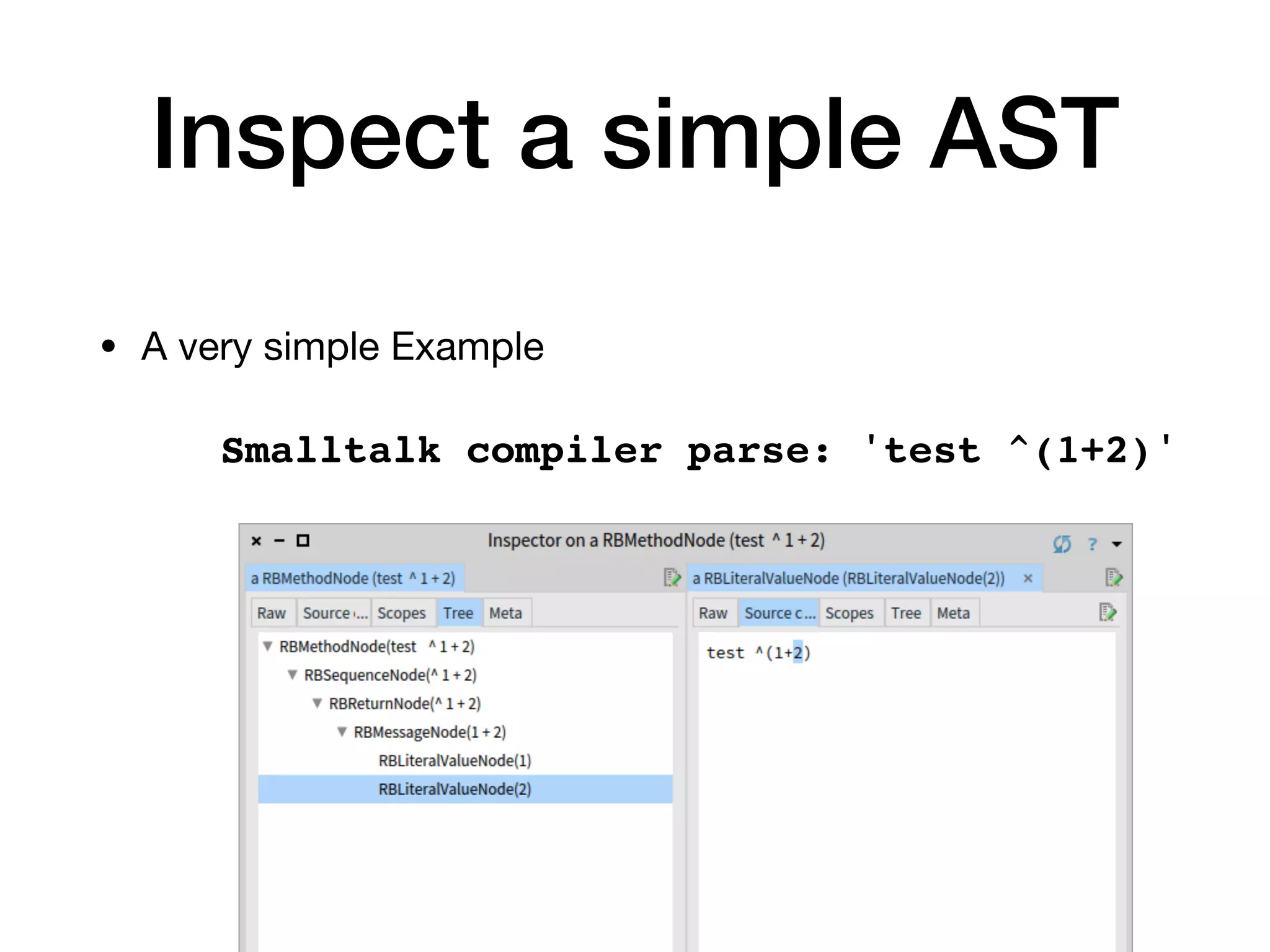
Inspect a simple AST
• A very simple Example
Smalltalk compiler parse: 'test ^(1+2)'
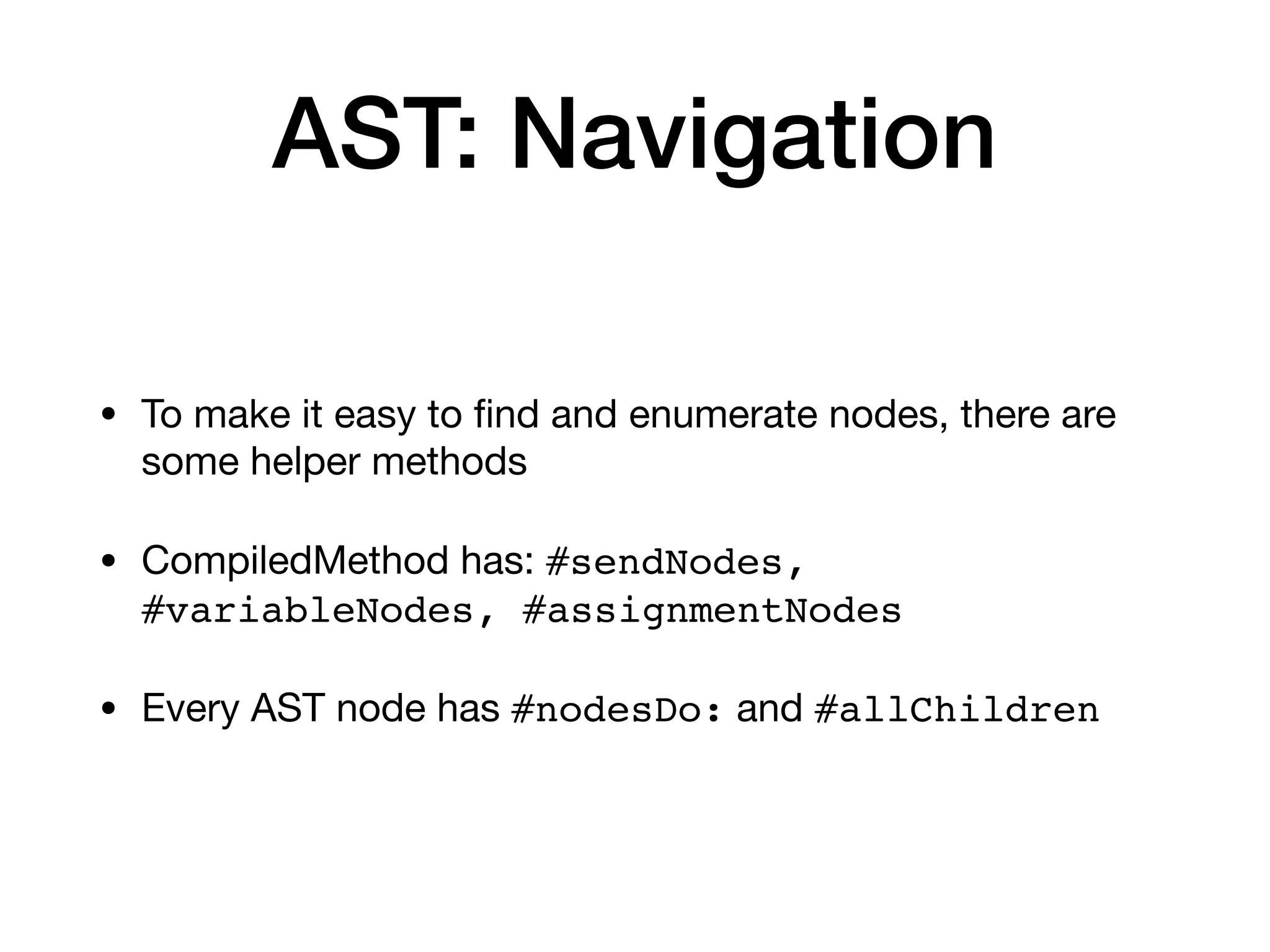
AST: Navigation
• To make it easy to
fi
nd and enumerate nodes, there are
some helper methods
• CompiledMethod has: #sendNodes,
#variableNodes, #assignmentNodes
• Every AST node has #nodesDo: and #allChildren
AST: Visitor
• RBProgramNodeVisitor: Visitor Pattern for the AST
• Make subclass, override visit… methods
• Let’s see it in action: Count Message sends
Demo: Visitor
Repeat:The AST
• AST = Abstract Syntax Tree
• Tree Representation of the Method
• Produced by the Parser (part of the Compiler)
• Used by all tools (refactoring, syntax-highlighting,…)
Smalltalk compiler parse: 'test ^(1+2)'
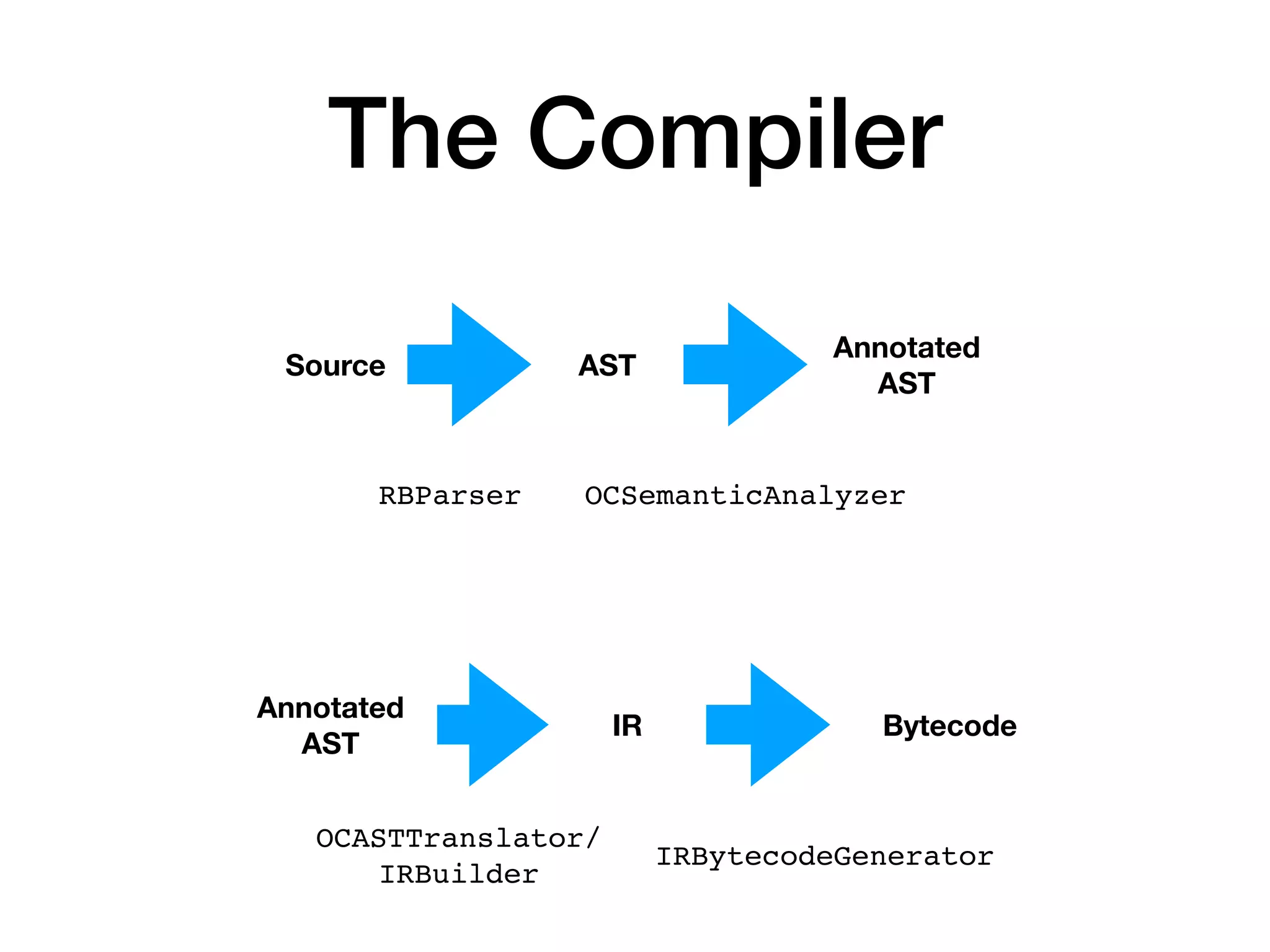
The Compiler
• Smalltalk compiler -> Compiler Facade
• Classes de
fi
ne the compiler to use
• You can override method #compiler
• Behind: Compiler Chain
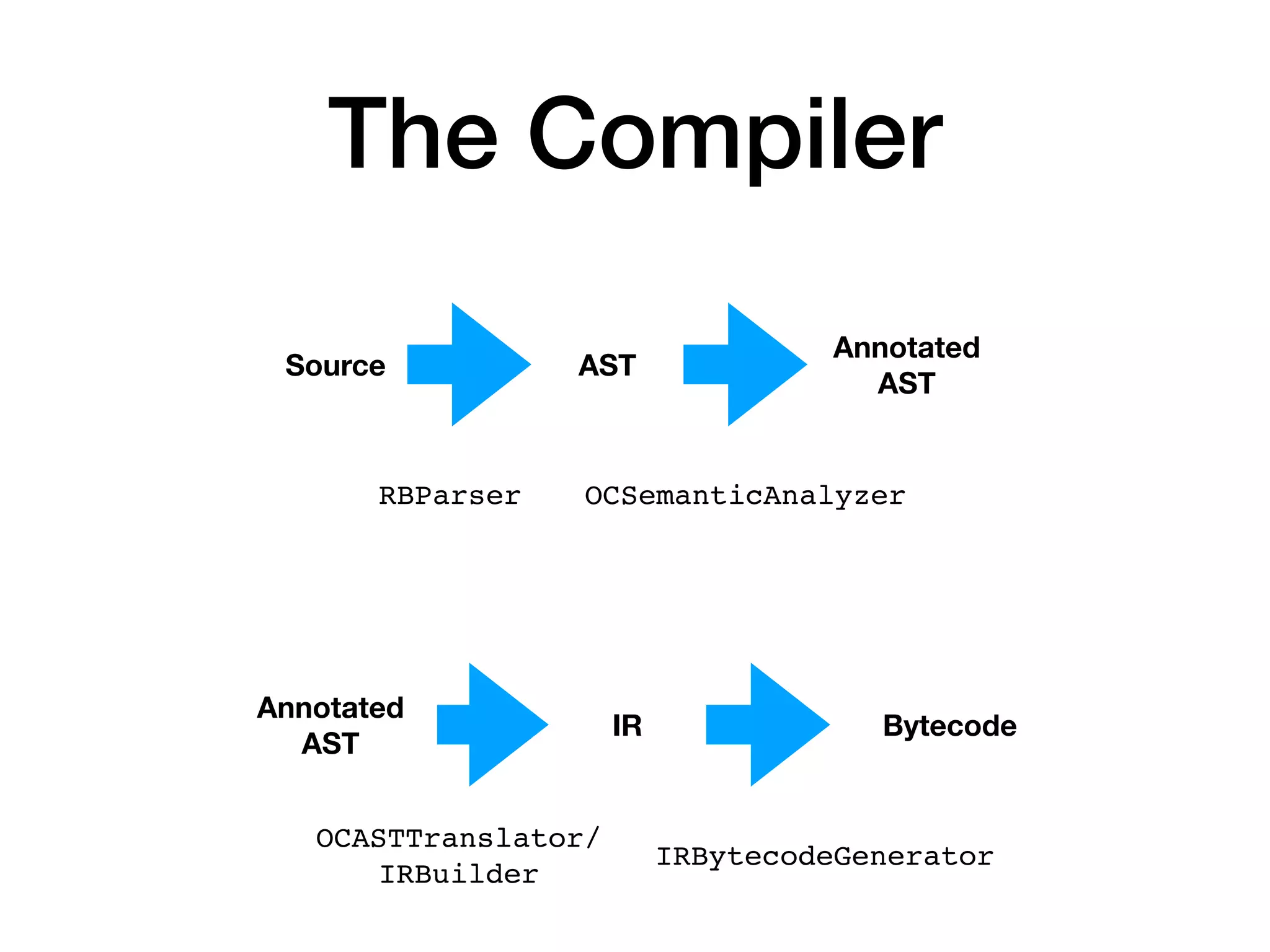
The Compiler
Source AST
Annotated
AST
IR
Annotated
AST
Bytecode
RBParser OCSemanticAnalyzer
OCASTTranslator/
IRBuilder
IRBytecodeGenerator
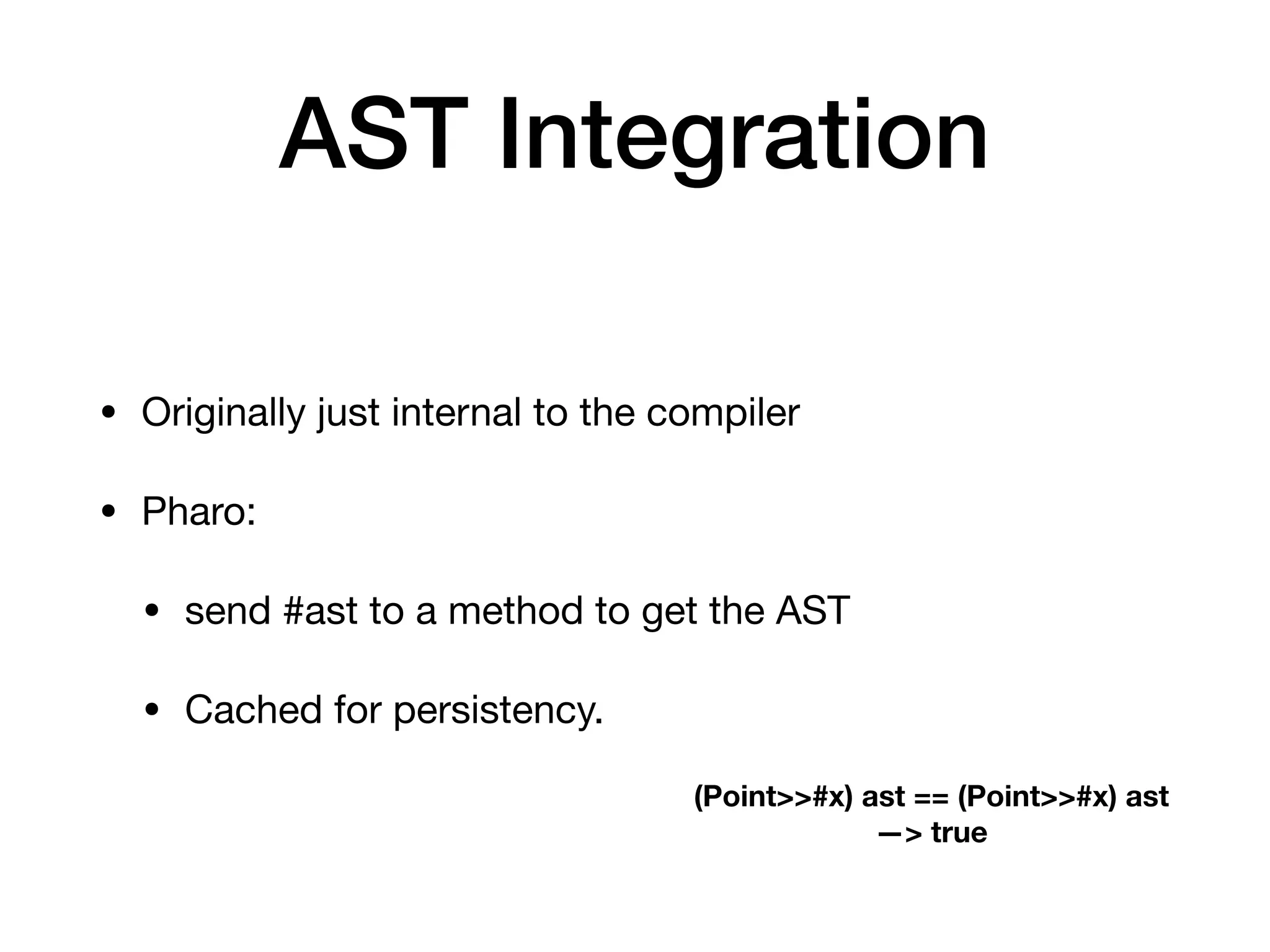
AST Integration
• Originally just internal to the compiler
• Pharo:
• send #ast to a method to get the AST
• Cached for persistency.
(Point>>#x) ast == (Point>>#x) ast
—> true
AST Integration
• We can navigate from execution to AST
• Example:
[ 1 + 2 ] sourceNode ==
thisContext method sourceNode blockNodes first
Compiler: Extensible
• All parts can be subclassed
• Compiler instance can be setup to use the subclass for
any part (parser, name analysis, translator…)
• enable for a class only by implementing #compiler on the
class side
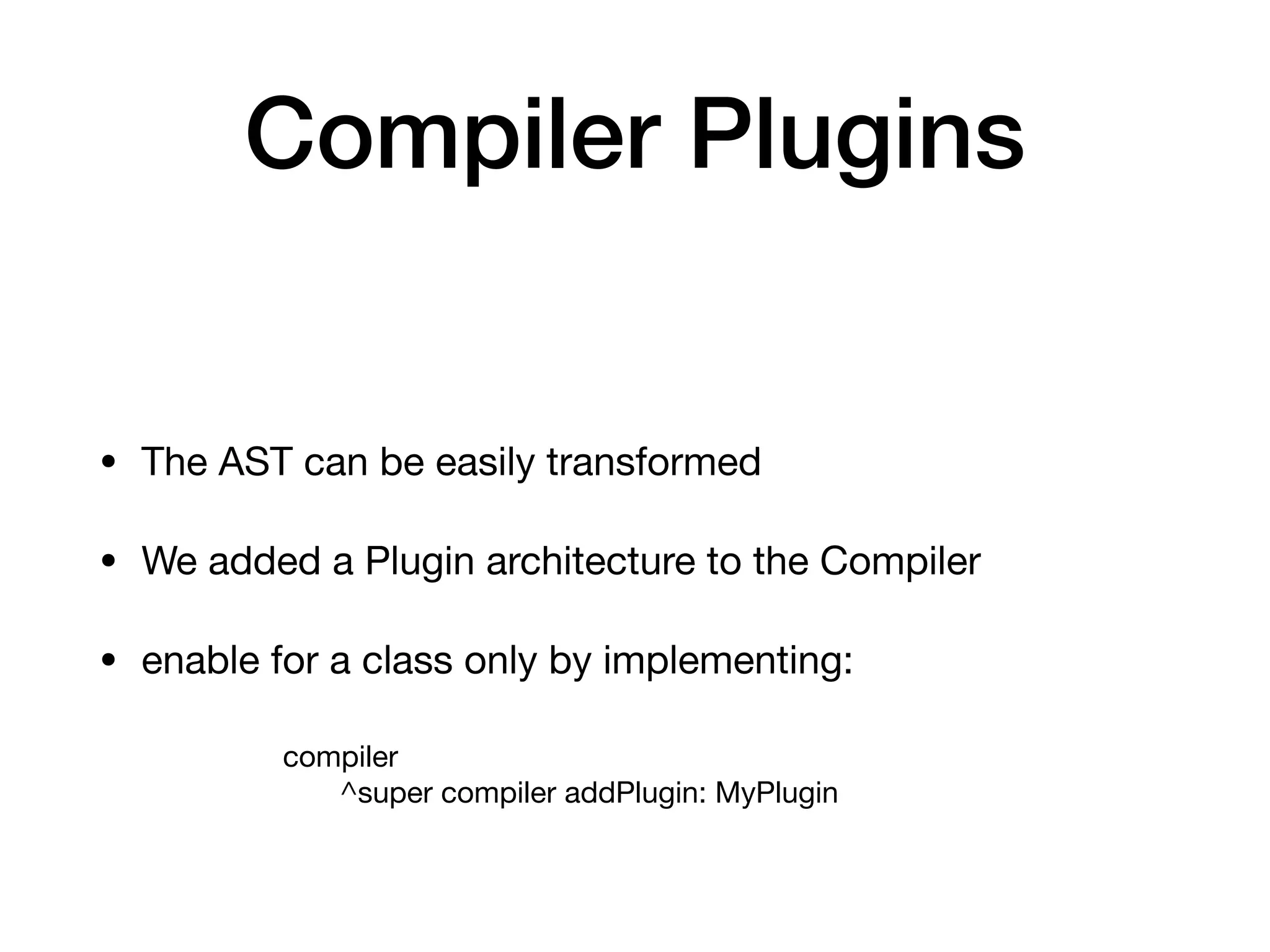
Compiler Plugins
• The AST can be easily transformed
• We added a Plugin architecture to the Compiler
• enable for a class only by implementing:
compiler
^super compiler addPlugin: MyPlugin
The Compiler
Source AST
Annotated
AST
IR
Annotated
AST
Bytecode
RBParser OCSemanticAnalyzer
OCASTTranslator/
IRBuilder
IRBytecodeGenerator
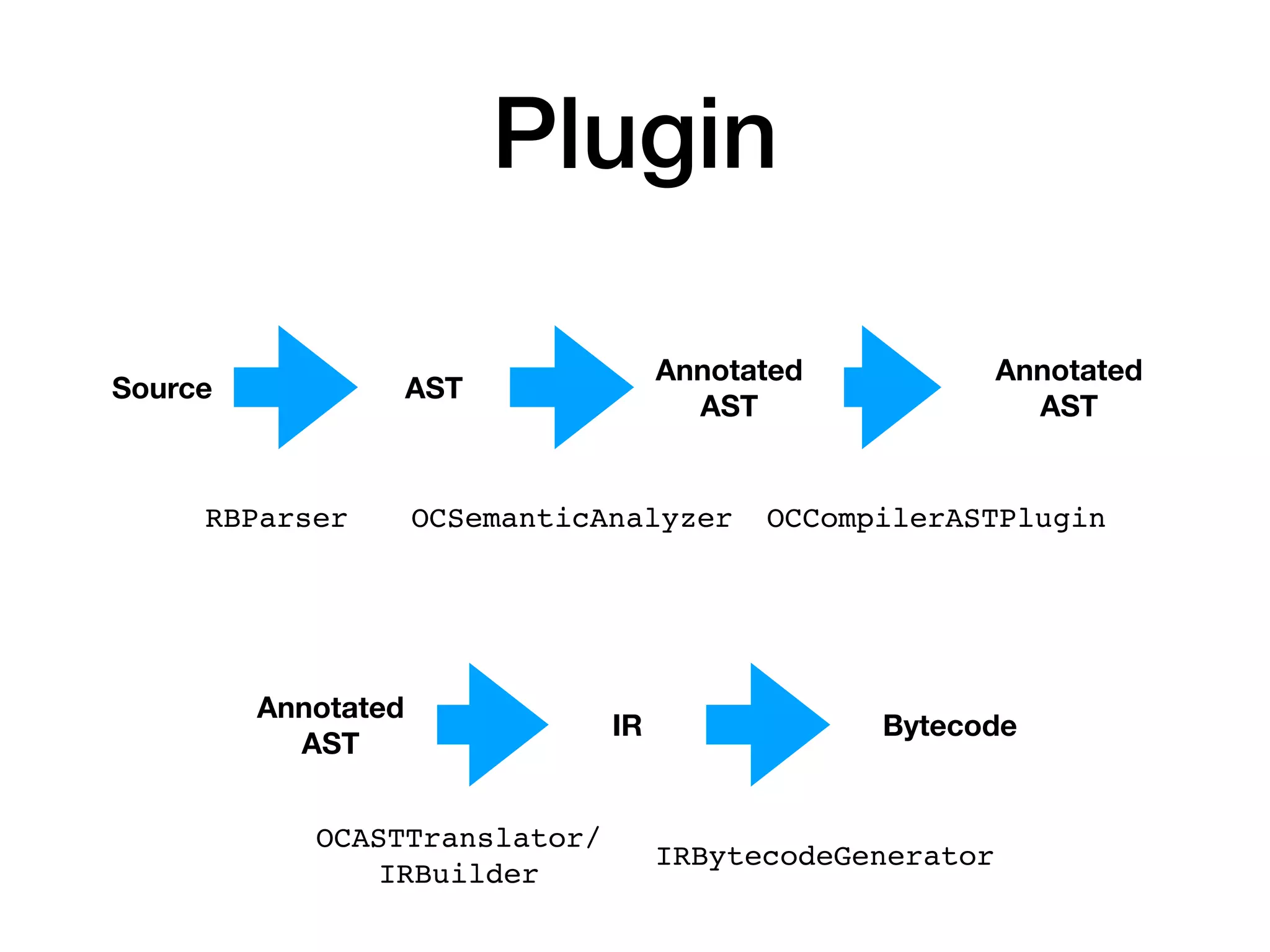
Plugin
Source AST
Annotated
AST
IR
Annotated
AST
Bytecode
RBParser OCSemanticAnalyzer
OCASTTranslator/
IRBuilder
IRBytecodeGenerator
OCCompilerASTPlugin
Annotated
AST
Plugin: Example
• We get all ifTrue: sends
• replace them with true
DemoPlugin>>transform
transform
| sends |
sends := ast sendNodes.
sends := sends select: [ :each | each selector = #ifTrue: ].
sends do: [:each | each replaceWith:
(RBLiteralNode value: true)].
^ast
Back to the topic…
• A more
fi
ne-grained re
fl
ective mechanism seems to be
missing
• Can’t we do something with the AST?
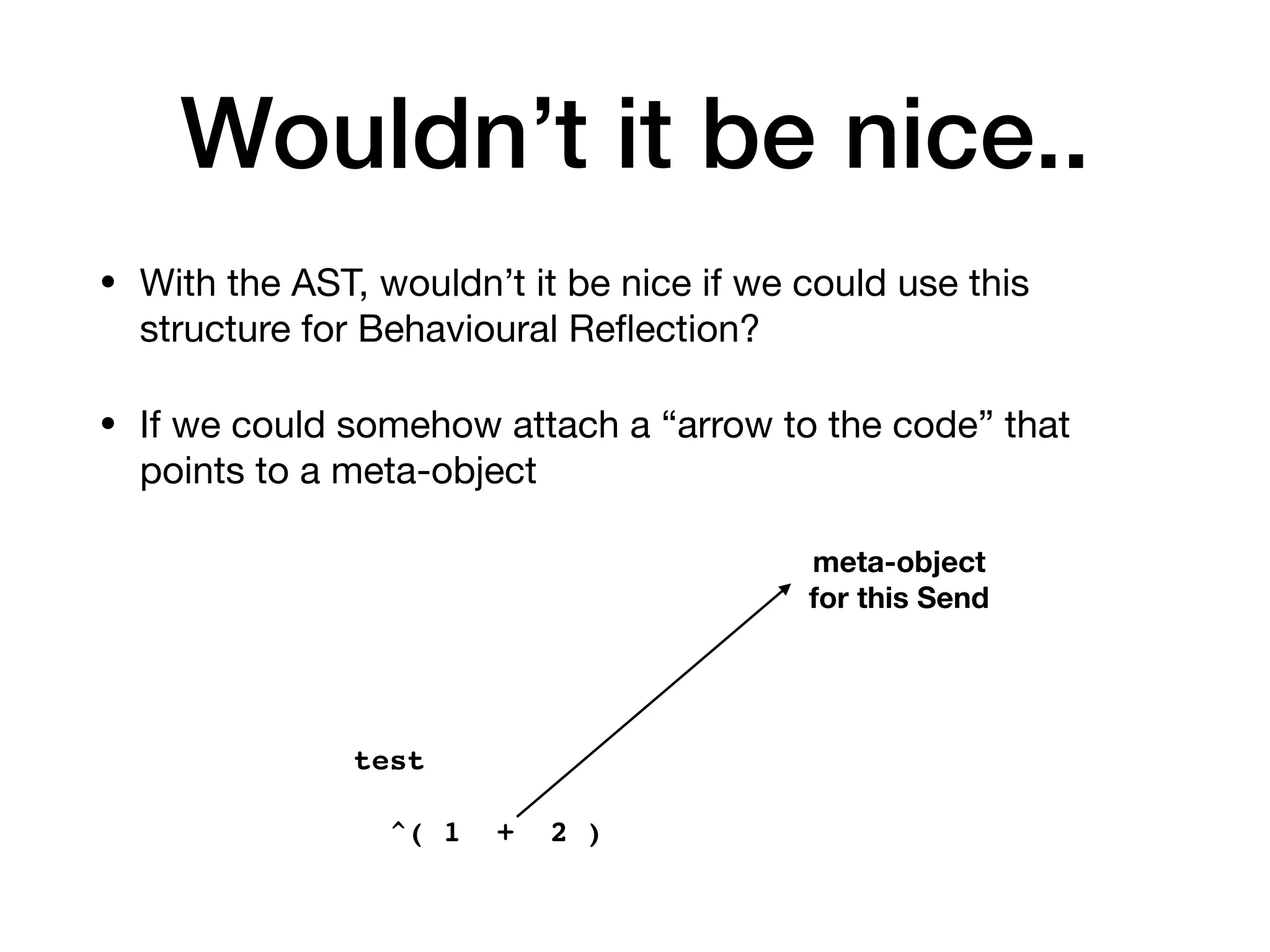
Wouldn’t it be nice..
• With the AST, wouldn’t it be nice if we could use this
structure for Behavioural Re
fl
ection?
• If we could somehow attach a “arrow to the code” that
points to a meta-object
test
^( 1 + 2 )
meta-object
for this Send
We have all pieces…
• We have the AST for each method
• It is quite simple
• We have a compiler in the system
• So this should be possible…
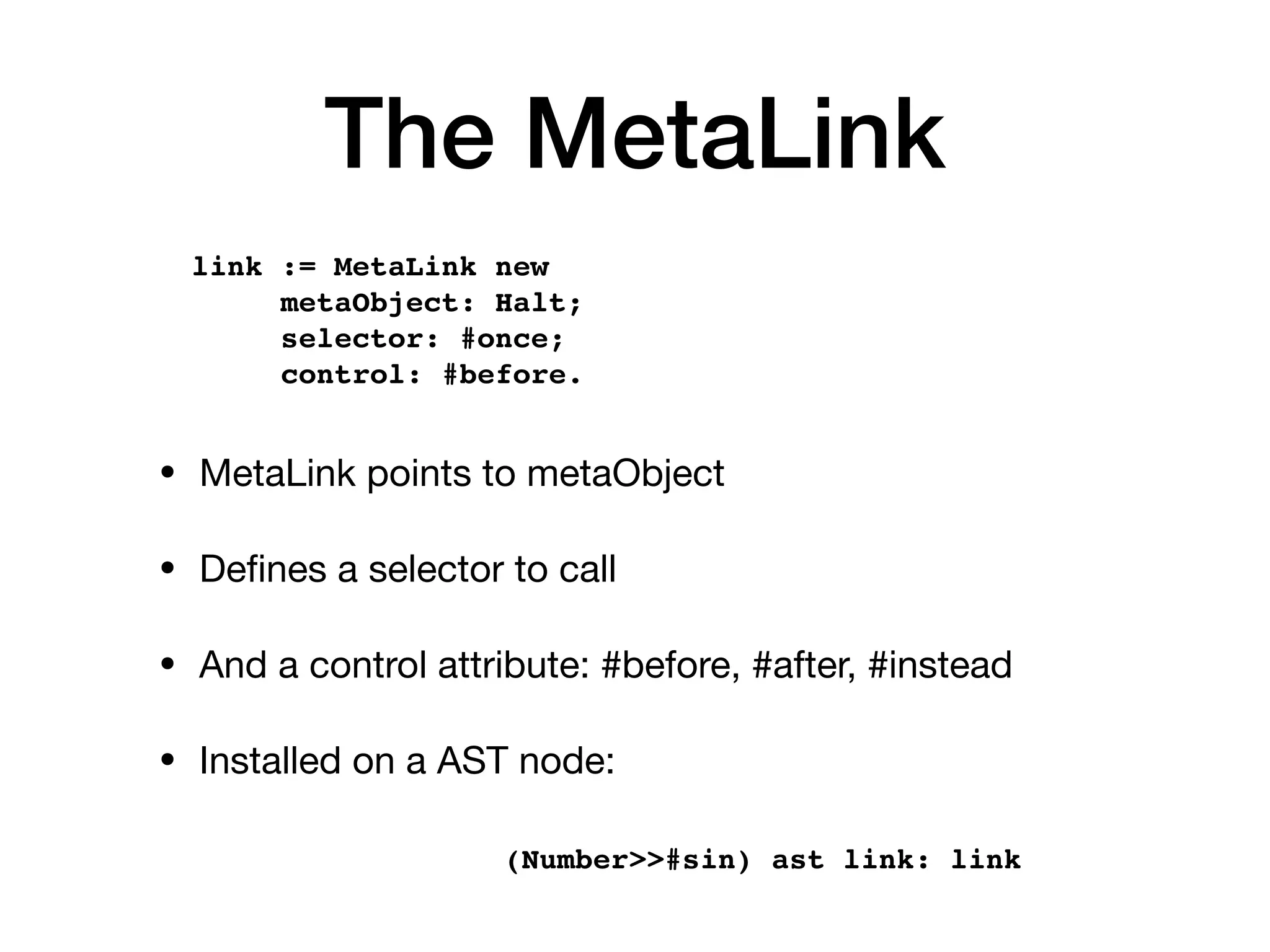
The MetaLink
• MetaLink points to metaObject
• De
fi
nes a selector to call
• And a control attribute: #before, #after, #instead
• Installed on a AST node:
link := MetaLink new
metaObject: Halt;
selector: #once;
control: #before.
(Number>>#sin) ast link: link
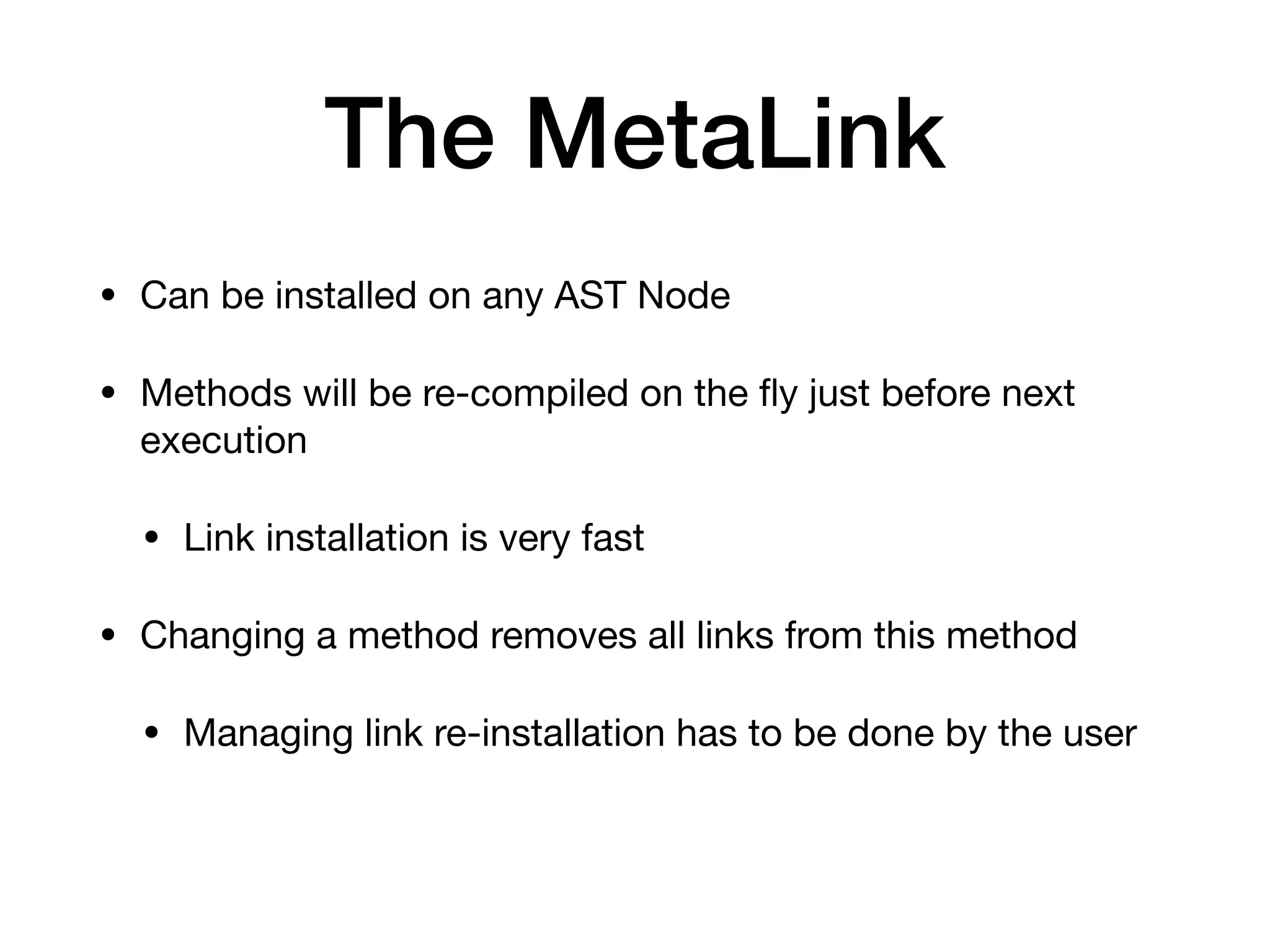
The MetaLink
• Can be installed on any AST Node
• Methods will be re-compiled on the
fl
y just before next
execution
• Link installation is very fast
• Changing a method removes all links from this method
• Managing link re-installation has to be done by the user
MetaLink: MetaObject
• MetaObject can be any object
• Even a Block: [Transcript show ‘hello’]
• Install on any Node with #link:
• de-install a link with #uninstall
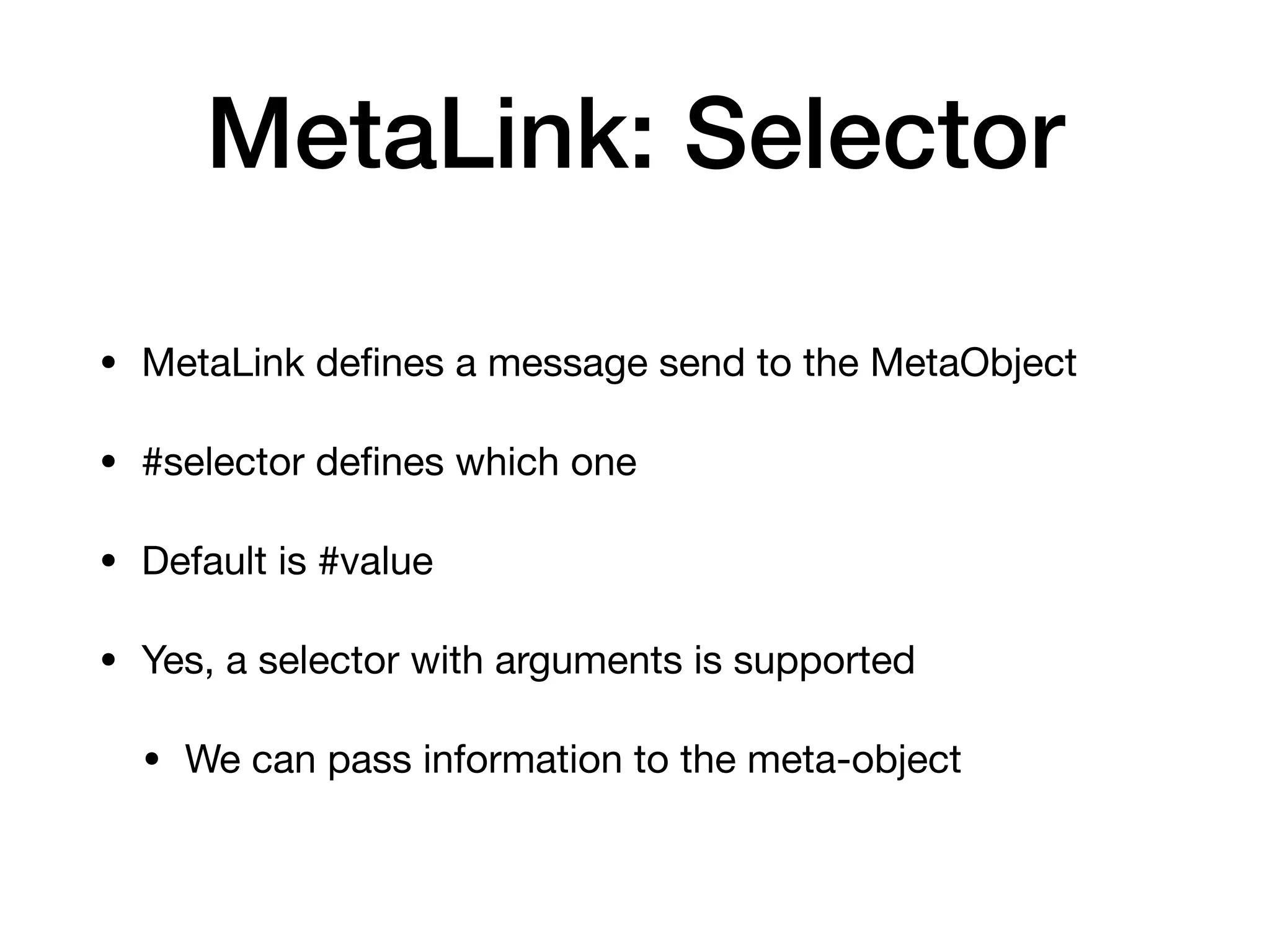
MetaLink: Selector
• MetaLink de
fi
nes a message send to the MetaObject
• #selector de
fi
nes which one
• Default is #value
• Yes, a selector with arguments is supported
• We can pass information to the meta-object
MetaLink: Argument
• The arguments de
fi
ne which arguments to pass
• We support a number of rei
fi
cations
Rei
fi
cations
• Rei
fi
cations de
fi
ne data to be passed as arguments
• Reify —> Make something into an object that is not one
normally
• Example: “All arguments of this message”
Rei
fi
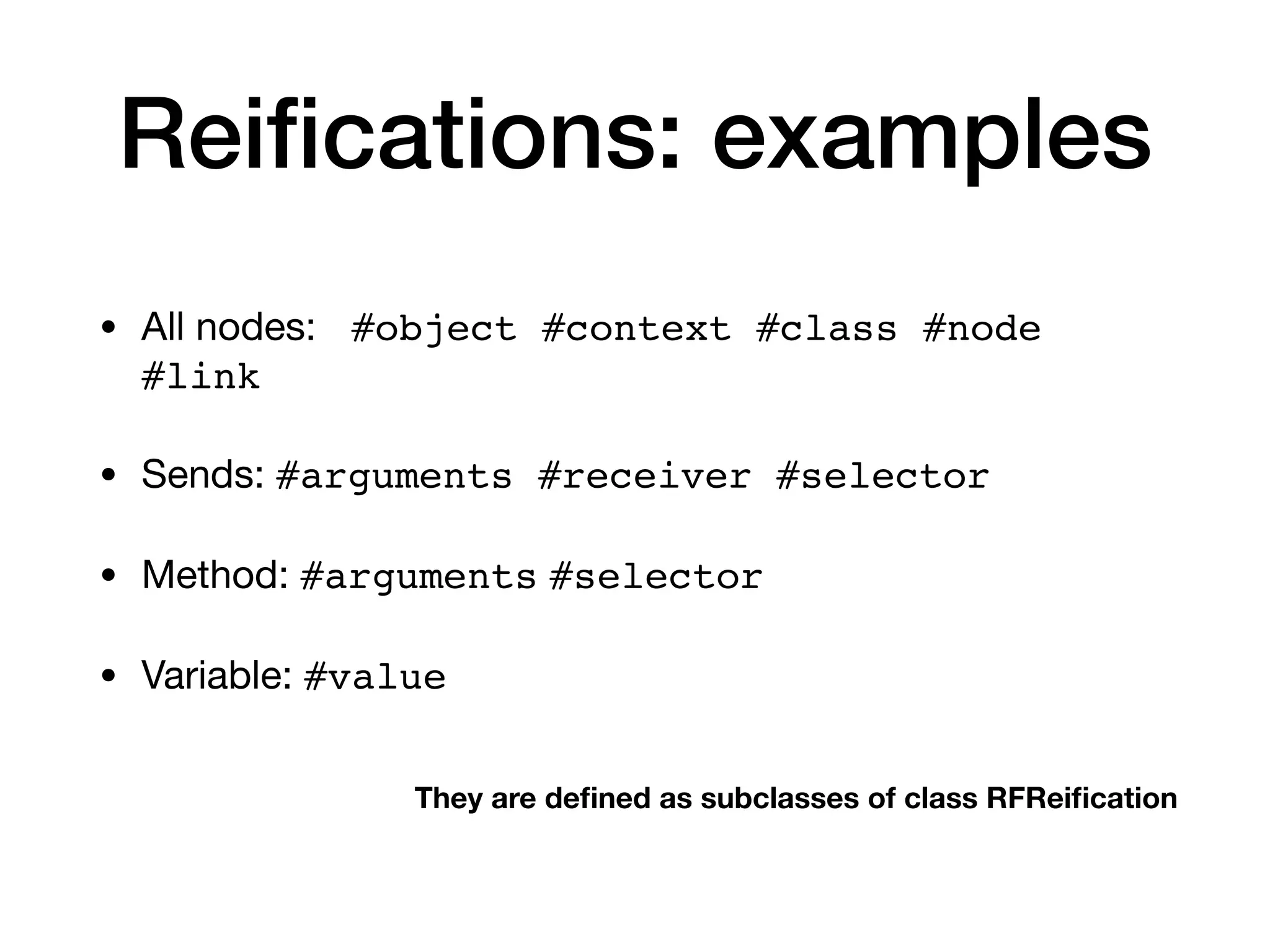
cations: examples
• All nodes: #object #context #class #node
#link
• Sends: #arguments #receiver #selector
• Method: #arguments #selector
• Variable: #value
They are de
fi
ned as subclasses of class RFRei
fi
cation
Rei
fi
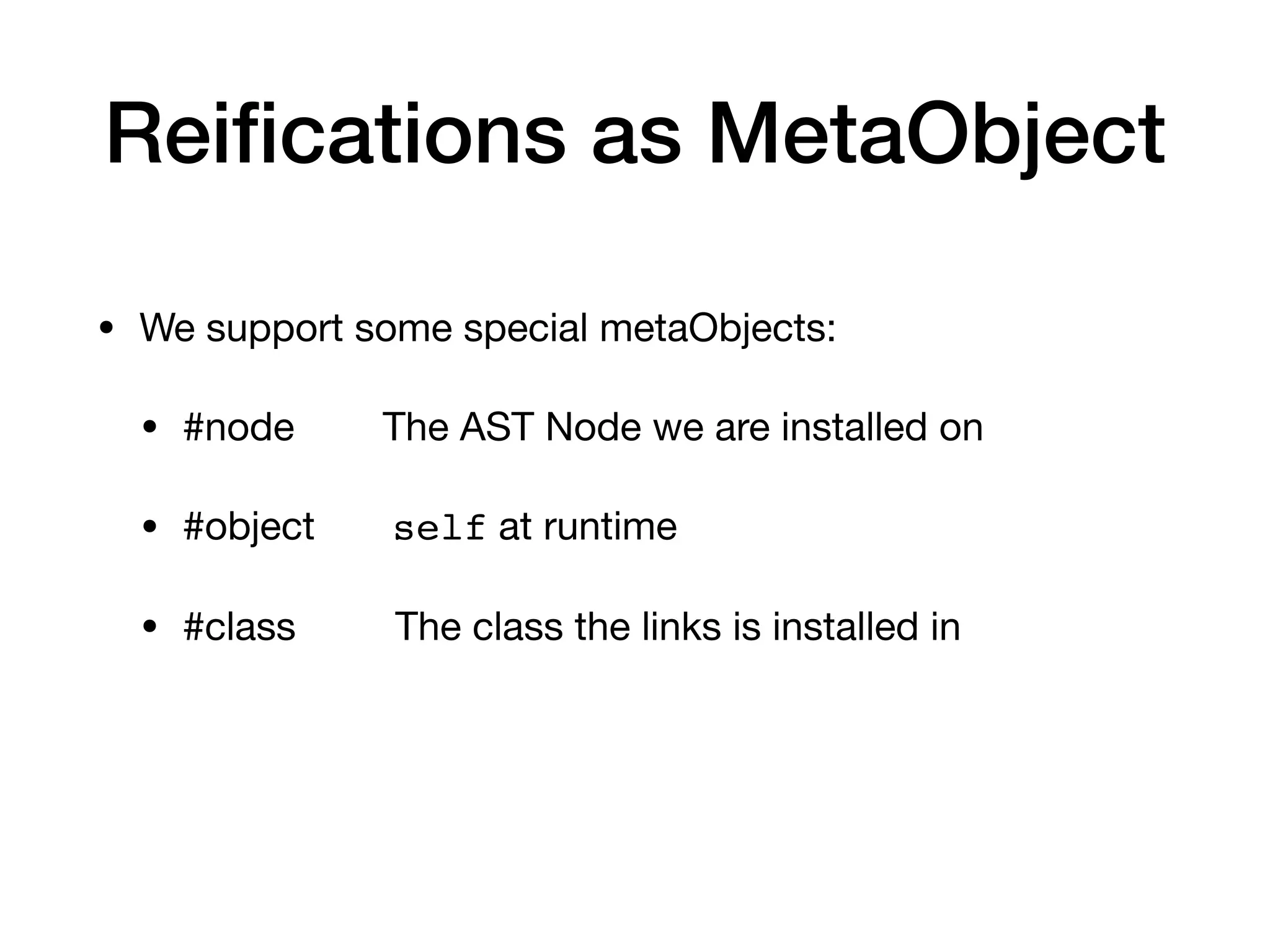
cations as MetaObject
• We support some special metaObjects:
• #node The AST Node we are installed on
• #object self at runtime
• #class The class the links is installed in
MetaLink: Condition
• We can specify a condition for the MetaLink
• Link is active if the condition evaluates to true
• We can pass rei
fi
cations as arguments
link := MetaLink new
metaObject: Halt;
selector: #once;
condition: [:object | object == 5] arguments: #(object).
(Number>>#sin) ast link: link.
MetaLink: control
• We can specify when to call the meta-object
• We support #before, #after and #instead
• The instead is very simple: last one wins
Example: Log
• We want to just print something to the Transcript
link := MetaLink new
metaObject: [Transcript show: 'Reached Here'].
(Number>>#sin) ast link: link
Recursion Problem
• Before we see more examples: There is a problem
• Imagine we put a MetaLink on some method deep in the
System (e.g new, +, do: ).
• Our Meta-Object might use exactly that method, too
Endless Loop!!
Recursion Problem
• Solution: Meta-Level
• We encode the a level in the execution of the system
• Every Link Activation increases the level
• A meta-link is just active for one level. (e.g. 0)
link := MetaLink new
metaObject: [ Object new ];
level: 0.
(Behavior>>#new) ast link: link.
Example: Log
• Better use #level: 0
• Nevertheless: be careful! If you add this to method called
often it can be very slow.
link := MetaLink new
metaObject: [Transcript show: 'Reached Here’];
level: 0.
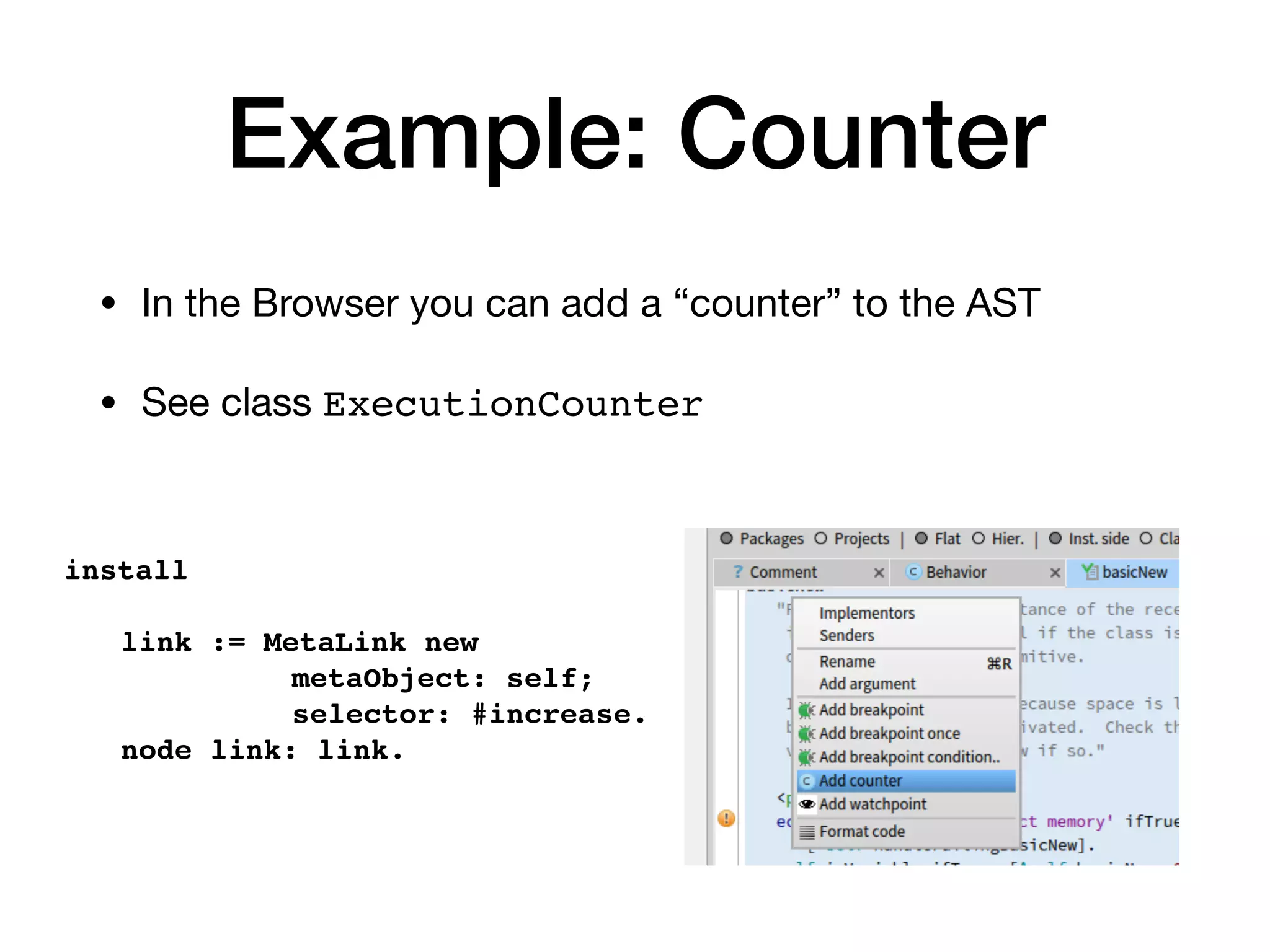
Example: Counter
• In the Browser you can add a “counter” to the AST
• See class ExecutionCounter
install
link := MetaLink new
metaObject: self;
selector: #increase.
node link: link.
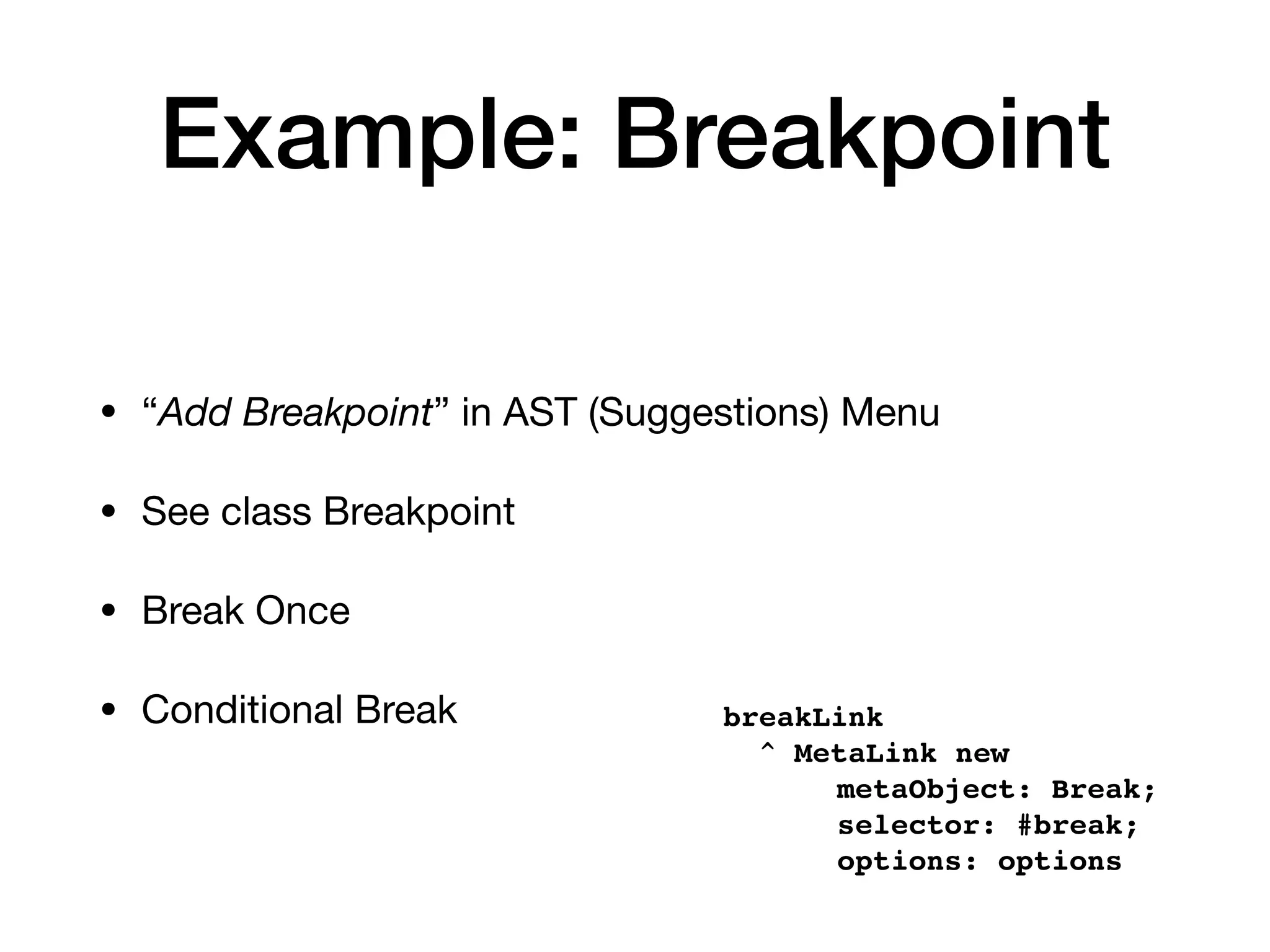
Example: Breakpoint
• “Add Breakpoint” in AST (Suggestions) Menu
• See class Breakpoint
• Break Once
• Conditional Break breakLink
^ MetaLink new
metaObject: Break;
selector: #break;
options: options
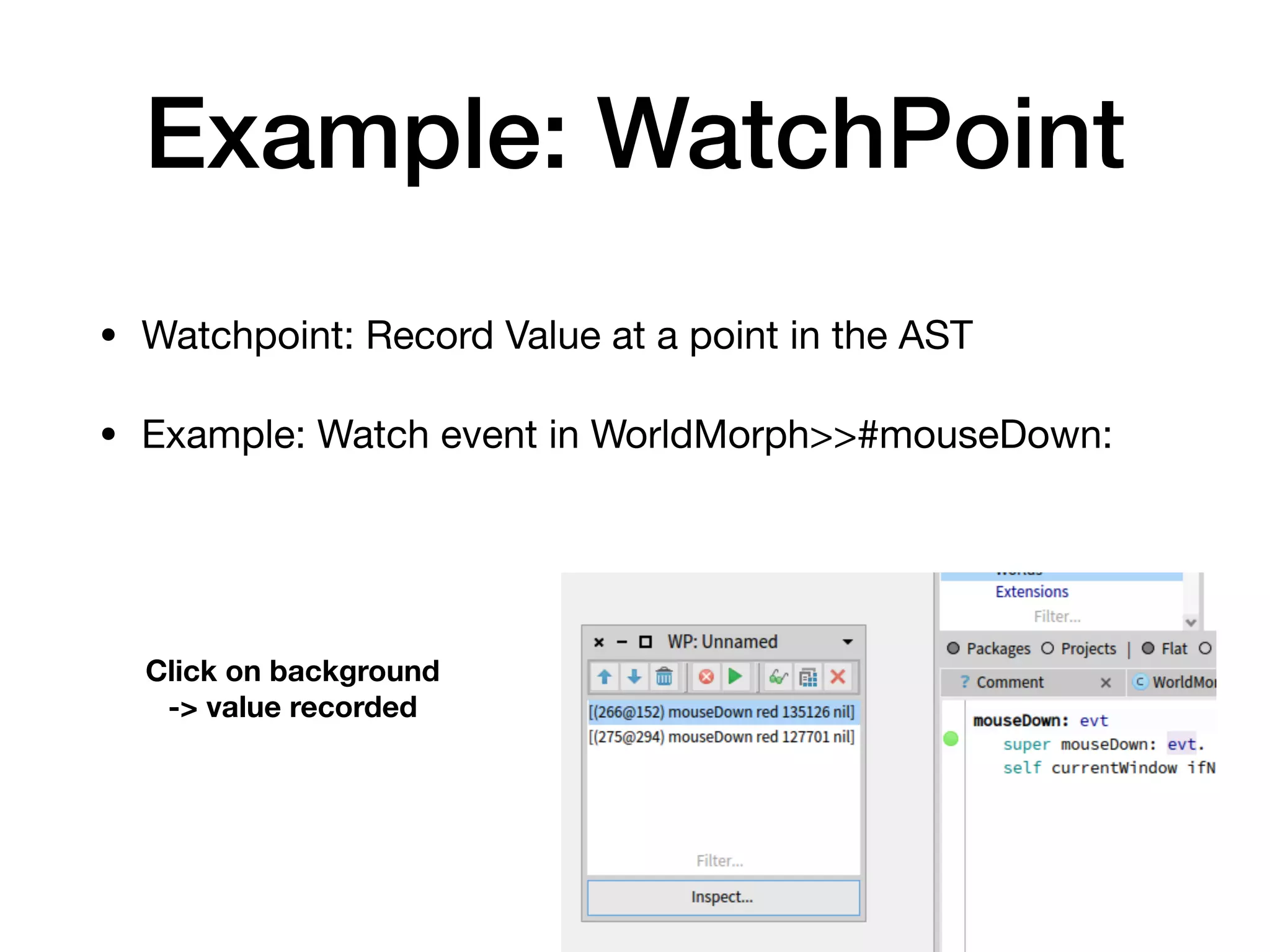
Example: WatchPoint
• Watchpoint: Record Value at a point in the AST
• Example: Watch event in WorldMorph>>#mouseDown:
Click on background
-> value recorded
Example: WatchPoint
• Implementation: class Watchpoint, method install
• example of a #after link with a condition
link := MetaLink new
metaObject: self;
selector: #addValue:;
arguments: #(value);
control: #after;
condition: [ recording ].
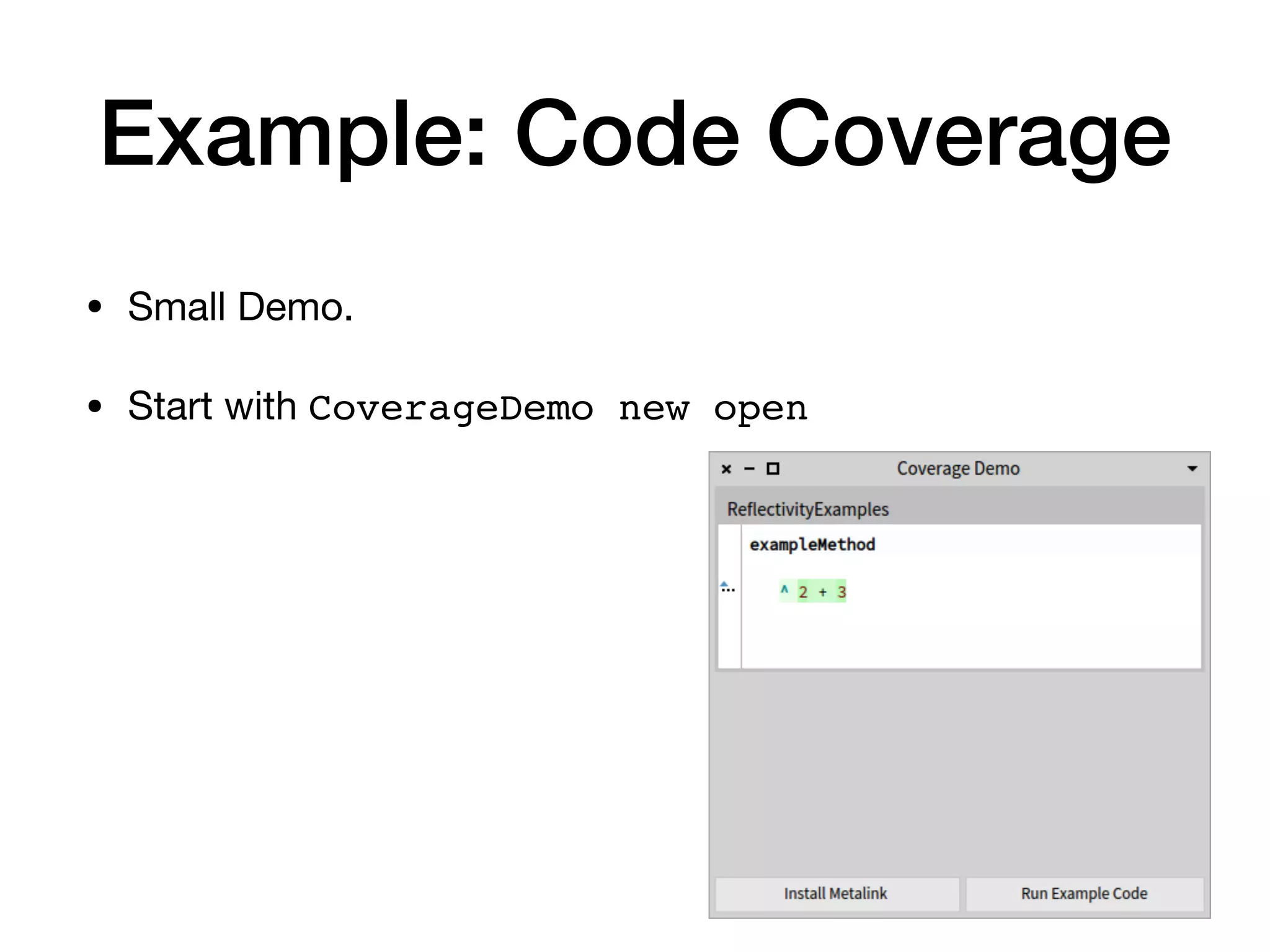
Example: Code Coverage
• Small Demo.
• Start with CoverageDemo new open
Example: Code Coverage
• Example of a MetaLink with a #node MetaObject
• Meta-Object is the node that the link is installed on
link := MetaLink new
metaObject: #node;
selector: #tagExecuted.
Interesting Properties
• Cross Cutting
• One Link can be installed multiple times
• Over multiple methods and even Classes
• And across operations (e.g., Send and Assignment) as
long as all rei
fi
cations requested are compatible
• Fully Dynamic: Links can be added and removed at runtime
• Even by the meta-object of another meta-link!
Example: Accept for Test
• Imagine we want to edit a method that is called often by
the System.
• How do we test it?
• It would be nice if we could “Accept for Test”
Example: Accept for Test
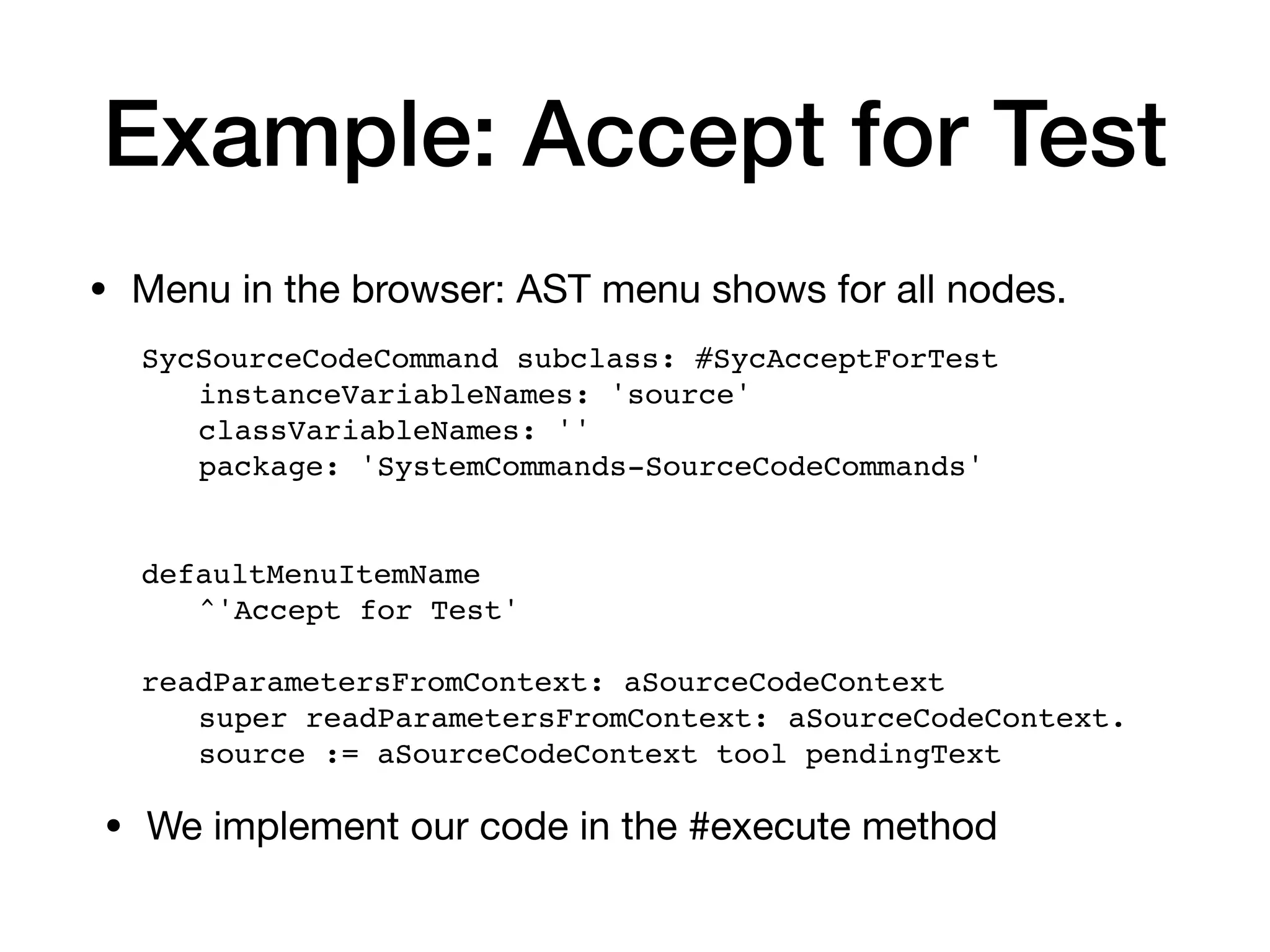
• Menu in the browser: AST menu shows for all nodes.
SycSourceCodeCommand subclass: #SycAcceptForTest
instanceVariableNames: 'source'
classVariableNames: ''
package: 'SystemCommands-SourceCodeCommands'
defaultMenuItemName
^'Accept for Test'
readParametersFromContext: aSourceCodeContext
super readParametersFromContext: aSourceCodeContext.
source := aSourceCodeContext tool pendingText
• We implement our code in the #execute method
Example: Accept for Test
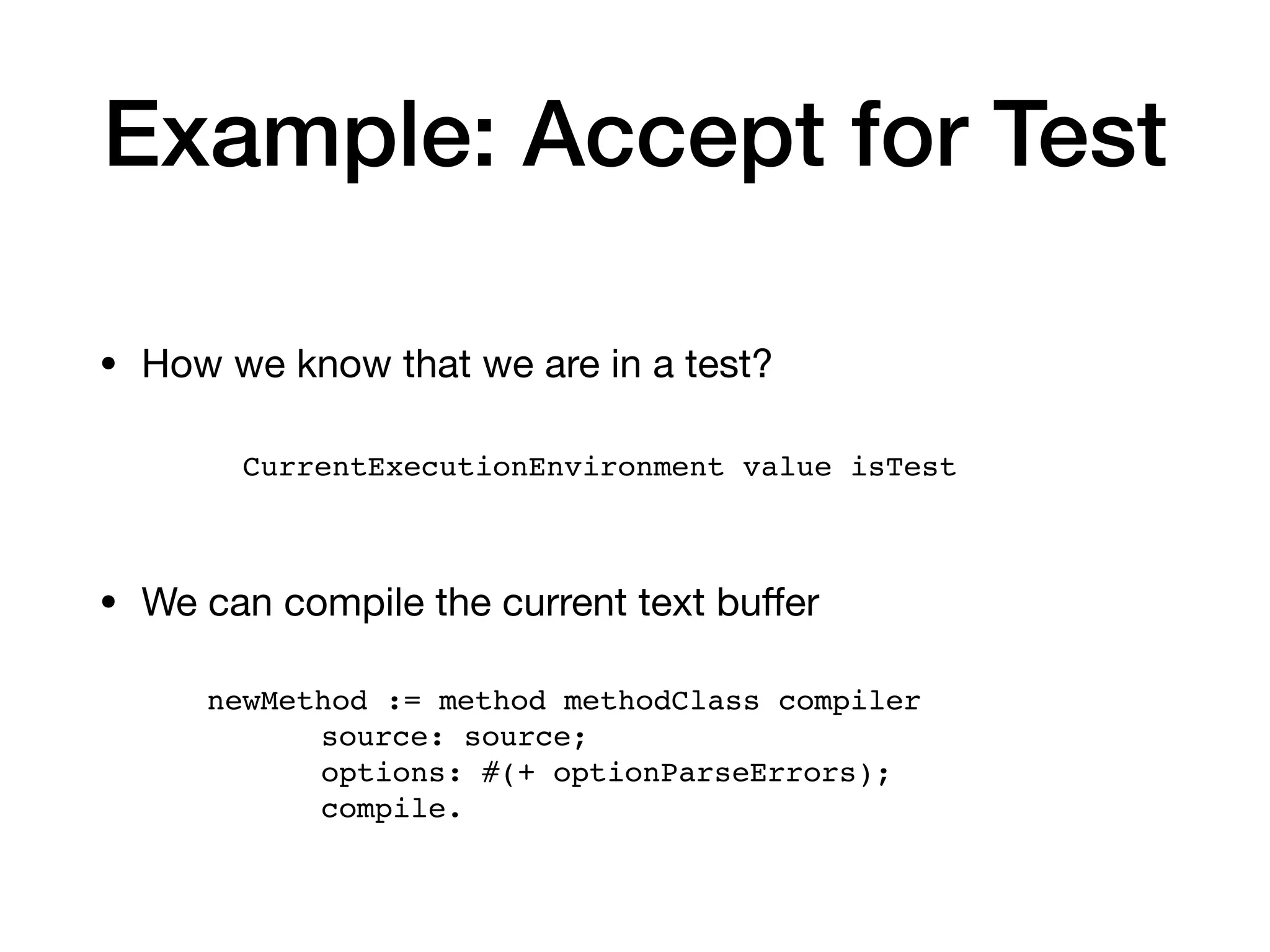
• How we know that we are in a test?
CurrentExecutionEnvironment value isTest
• We can compile the current text bu
ff
er
newMethod := method methodClass compiler
source: source;
options: #(+ optionParseErrors);
compile.
Example: Accept for Test
• Add this code to the beginning of the method:
[:aContext :args |
CurrentExecutionEnvironment value isTest ifTrue: [
aContext return: (newMethod
valueWithReceiver: aContext
receiver
arguments: args) ]]
• Let’s do that with a MetaLink!
Example: Accept for Test
execute
| newMethod metaLink |
newMethod := method methodClass compiler
source: source;
options: #(+ optionParseErrors);
compile.
"the link executes the method we just created and returns"
metaLink := MetaLink new
metaObject: [ :aContext :args |
CurrentExecutionEnvironment value isTest
ifTrue: [ aContext return: (newMethod
valueWithReceiver: aContext receiver
arguments: args) ] ];
selector: #value:value:;
arguments: #(context arguments).
self method ast link: metaLink
What did we see?
• ASTs and AST Visitors
• Compiler and Compiler Plugins
• MetaLinks
• Recursion Problem
• Examples: Counter, Breakpoint, Coverage
• Accept for Test
Limitations
• #instead needs more work (e.g to support conditions)
• Keep in mind: next metaLink taken into account for next
method activation
• Take care with long running loops!
Help Wanted
• We are always interested in improvements!
• Pharo 10 will be released soon!
• Pull Requests Welcome!
Questions?

Lecture: "Advanced Reflection: MetaLinks"

  • 1.
    Advanced Re fl ection: MetaLinks Marcus Denker,Inria http://marcusdenker.de Lecture at VUB Brussels, March 31, 2022
  • 2.
    What we know… •Smalltalk is re fl ective • Classes, Methods, Stack-Frames… are Objects • Re fl ective API on all Objects
  • 3.
    Re fl ection in Smalltalk •Re fl ection is based on the Metaclass model, thus it is inherently structural • Behavioral Re fl ection limited to: • Method lookup on failure (#doesNotUndersand:) • Rei fi ed stack (thisContext)
  • 4.
    Can we dobetter? • A more fi ne-grained re fl ective mechanism seems to be missing • Let’s look again at a Method in the Inspector
  • 5.
  • 6.
    The AST • AST= Abstract Syntax Tree • Tree Representation of the Method • Produced by the Parser (part of the Compiler) • Used by all tools (refactoring, syntax-highlighting,…) Smalltalk compiler parse: 'test ^(1+2)'
  • 7.
    AST • RBMethodNode Root •RBVariableNode Variable (read and write) • RBAssignmentNode Assignment • RBMessageNode A Message (most of them) • RBReturnNode Return
  • 8.
    Inspect a simpleAST • A very simple Example Smalltalk compiler parse: 'test ^(1+2)'
  • 9.
    AST: Navigation • Tomake it easy to fi nd and enumerate nodes, there are some helper methods • CompiledMethod has: #sendNodes, #variableNodes, #assignmentNodes • Every AST node has #nodesDo: and #allChildren
  • 10.
    AST: Visitor • RBProgramNodeVisitor:Visitor Pattern for the AST • Make subclass, override visit… methods • Let’s see it in action: Count Message sends
  • 11.
  • 12.
    Repeat:The AST • AST= Abstract Syntax Tree • Tree Representation of the Method • Produced by the Parser (part of the Compiler) • Used by all tools (refactoring, syntax-highlighting,…) Smalltalk compiler parse: 'test ^(1+2)'
  • 13.
    The Compiler • Smalltalkcompiler -> Compiler Facade • Classes de fi ne the compiler to use • You can override method #compiler • Behind: Compiler Chain
  • 14.
    The Compiler Source AST Annotated AST IR Annotated AST Bytecode RBParserOCSemanticAnalyzer OCASTTranslator/ IRBuilder IRBytecodeGenerator
  • 15.
    AST Integration • Originallyjust internal to the compiler • Pharo: • send #ast to a method to get the AST • Cached for persistency. (Point>>#x) ast == (Point>>#x) ast —> true
  • 16.
    AST Integration • Wecan navigate from execution to AST • Example: [ 1 + 2 ] sourceNode == thisContext method sourceNode blockNodes first
  • 17.
    Compiler: Extensible • Allparts can be subclassed • Compiler instance can be setup to use the subclass for any part (parser, name analysis, translator…) • enable for a class only by implementing #compiler on the class side
  • 18.
    Compiler Plugins • TheAST can be easily transformed • We added a Plugin architecture to the Compiler • enable for a class only by implementing: compiler ^super compiler addPlugin: MyPlugin
  • 19.
    The Compiler Source AST Annotated AST IR Annotated AST Bytecode RBParserOCSemanticAnalyzer OCASTTranslator/ IRBuilder IRBytecodeGenerator
  • 20.
  • 21.
    Plugin: Example • Weget all ifTrue: sends • replace them with true DemoPlugin>>transform transform | sends | sends := ast sendNodes. sends := sends select: [ :each | each selector = #ifTrue: ]. sends do: [:each | each replaceWith: (RBLiteralNode value: true)]. ^ast
  • 22.
    Back to thetopic… • A more fi ne-grained re fl ective mechanism seems to be missing • Can’t we do something with the AST?
  • 23.
    Wouldn’t it benice.. • With the AST, wouldn’t it be nice if we could use this structure for Behavioural Re fl ection? • If we could somehow attach a “arrow to the code” that points to a meta-object test ^( 1 + 2 ) meta-object for this Send
  • 24.
    We have allpieces… • We have the AST for each method • It is quite simple • We have a compiler in the system • So this should be possible…
  • 25.
    The MetaLink • MetaLinkpoints to metaObject • De fi nes a selector to call • And a control attribute: #before, #after, #instead • Installed on a AST node: link := MetaLink new metaObject: Halt; selector: #once; control: #before. (Number>>#sin) ast link: link
  • 26.
    The MetaLink • Canbe installed on any AST Node • Methods will be re-compiled on the fl y just before next execution • Link installation is very fast • Changing a method removes all links from this method • Managing link re-installation has to be done by the user
  • 27.
    MetaLink: MetaObject • MetaObjectcan be any object • Even a Block: [Transcript show ‘hello’] • Install on any Node with #link: • de-install a link with #uninstall
  • 28.
    MetaLink: Selector • MetaLinkde fi nes a message send to the MetaObject • #selector de fi nes which one • Default is #value • Yes, a selector with arguments is supported • We can pass information to the meta-object
  • 29.
    MetaLink: Argument • Thearguments de fi ne which arguments to pass • We support a number of rei fi cations
  • 30.
    Rei fi cations • Rei fi cations de fi nedata to be passed as arguments • Reify —> Make something into an object that is not one normally • Example: “All arguments of this message”
  • 31.
    Rei fi cations: examples • Allnodes: #object #context #class #node #link • Sends: #arguments #receiver #selector • Method: #arguments #selector • Variable: #value They are de fi ned as subclasses of class RFRei fi cation
  • 32.
    Rei fi cations as MetaObject •We support some special metaObjects: • #node The AST Node we are installed on • #object self at runtime • #class The class the links is installed in
  • 33.
    MetaLink: Condition • Wecan specify a condition for the MetaLink • Link is active if the condition evaluates to true • We can pass rei fi cations as arguments link := MetaLink new metaObject: Halt; selector: #once; condition: [:object | object == 5] arguments: #(object). (Number>>#sin) ast link: link.
  • 34.
    MetaLink: control • Wecan specify when to call the meta-object • We support #before, #after and #instead • The instead is very simple: last one wins
  • 35.
    Example: Log • Wewant to just print something to the Transcript link := MetaLink new metaObject: [Transcript show: 'Reached Here']. (Number>>#sin) ast link: link
  • 36.
    Recursion Problem • Beforewe see more examples: There is a problem • Imagine we put a MetaLink on some method deep in the System (e.g new, +, do: ). • Our Meta-Object might use exactly that method, too Endless Loop!!
  • 37.
    Recursion Problem • Solution:Meta-Level • We encode the a level in the execution of the system • Every Link Activation increases the level • A meta-link is just active for one level. (e.g. 0) link := MetaLink new metaObject: [ Object new ]; level: 0. (Behavior>>#new) ast link: link.
  • 38.
    Example: Log • Betteruse #level: 0 • Nevertheless: be careful! If you add this to method called often it can be very slow. link := MetaLink new metaObject: [Transcript show: 'Reached Here’]; level: 0.
  • 39.
    Example: Counter • Inthe Browser you can add a “counter” to the AST • See class ExecutionCounter install link := MetaLink new metaObject: self; selector: #increase. node link: link.
  • 40.
    Example: Breakpoint • “AddBreakpoint” in AST (Suggestions) Menu • See class Breakpoint • Break Once • Conditional Break breakLink ^ MetaLink new metaObject: Break; selector: #break; options: options
  • 41.
    Example: WatchPoint • Watchpoint:Record Value at a point in the AST • Example: Watch event in WorldMorph>>#mouseDown: Click on background -> value recorded
  • 42.
    Example: WatchPoint • Implementation:class Watchpoint, method install • example of a #after link with a condition link := MetaLink new metaObject: self; selector: #addValue:; arguments: #(value); control: #after; condition: [ recording ].
  • 43.
    Example: Code Coverage •Small Demo. • Start with CoverageDemo new open
  • 44.
    Example: Code Coverage •Example of a MetaLink with a #node MetaObject • Meta-Object is the node that the link is installed on link := MetaLink new metaObject: #node; selector: #tagExecuted.
  • 45.
    Interesting Properties • CrossCutting • One Link can be installed multiple times • Over multiple methods and even Classes • And across operations (e.g., Send and Assignment) as long as all rei fi cations requested are compatible • Fully Dynamic: Links can be added and removed at runtime • Even by the meta-object of another meta-link!
  • 46.
    Example: Accept forTest • Imagine we want to edit a method that is called often by the System. • How do we test it? • It would be nice if we could “Accept for Test”
  • 47.
    Example: Accept forTest • Menu in the browser: AST menu shows for all nodes. SycSourceCodeCommand subclass: #SycAcceptForTest instanceVariableNames: 'source' classVariableNames: '' package: 'SystemCommands-SourceCodeCommands' defaultMenuItemName ^'Accept for Test' readParametersFromContext: aSourceCodeContext super readParametersFromContext: aSourceCodeContext. source := aSourceCodeContext tool pendingText • We implement our code in the #execute method
  • 48.
    Example: Accept forTest • How we know that we are in a test? CurrentExecutionEnvironment value isTest • We can compile the current text bu ff er newMethod := method methodClass compiler source: source; options: #(+ optionParseErrors); compile.
  • 49.
    Example: Accept forTest • Add this code to the beginning of the method: [:aContext :args | CurrentExecutionEnvironment value isTest ifTrue: [ aContext return: (newMethod valueWithReceiver: aContext receiver arguments: args) ]] • Let’s do that with a MetaLink!
  • 50.
    Example: Accept forTest execute | newMethod metaLink | newMethod := method methodClass compiler source: source; options: #(+ optionParseErrors); compile. "the link executes the method we just created and returns" metaLink := MetaLink new metaObject: [ :aContext :args | CurrentExecutionEnvironment value isTest ifTrue: [ aContext return: (newMethod valueWithReceiver: aContext receiver arguments: args) ] ]; selector: #value:value:; arguments: #(context arguments). self method ast link: metaLink
  • 51.
    What did wesee? • ASTs and AST Visitors • Compiler and Compiler Plugins • MetaLinks • Recursion Problem • Examples: Counter, Breakpoint, Coverage • Accept for Test
  • 52.
    Limitations • #instead needsmore work (e.g to support conditions) • Keep in mind: next metaLink taken into account for next method activation • Take care with long running loops!
  • 53.
    Help Wanted • Weare always interested in improvements! • Pharo 10 will be released soon! • Pull Requests Welcome!
  • 54.