environmental
management
centre LLP
environmental
management
centre LLP
SQraising the Sustainability Quotient
Editorial
“Bombay Chamber of Commerce and Industry and Environment
Management Centre had started publishing SQ – raising the
Sustainability Quotient in 2011 to bring forth the various dimensions
and challenges of Sustainable Development of business
organizations. This publication contained knowledge based articles,
success stories, best practices, legal & policy updates which were
beneficial to business organizations. The select articles from the
published SQ have been updated and revised with the guidance of experts; this
Sustainability Kaleidoscope will further encourage mainstreaming sustainability into
business. This should prove useful to members of the Chamber, Government,
Practitioners,Academiciansandgeneralreaders.”
- Vijay Srirangan
“Business today is faced with many challenges. The limited resources
we have are dwindling and are under threat due to over-extraction
and uncontrolled pollution. Further, intense urbanization has led to
polarization of population with consumption rising. Due to
unevennessinthegovernanceandeconomies,askewhasemergedin
the global material flows. These issues in nexus with climate change
call for immediate action from the business for its survival as well as
for SUSTAINABLE DEVELOPMENT. This call to action is very relevant to developing
country like India. The Indian businesses has not viewed this looming risk of
unsustainabilitywithalltheseriousnessitdeserves.
The Sustainability Committee of Bombay Chamber of Commerce and Industries (BCCI),
therefore felt a need to generate awareness towards action on SUSTAINABILITY. Since
then,BCCIandEnvironmentalManagementCentreLLP(EMC),havebeenbringingouta
quarterlyNewslettercaptioned"RaisingtheSustainabilityQuotient"or“SQ”.
Over the past 5 years, through SQ, we have endeavoured to bring forth various
perspectives on sustainability. The newsletter includes knowledge based articles,
success stories, best practices and policy updates to benefit all member companies on
variousthematicissues.
In this issue
100 Smart Cities: Is It Possible?
- Suresh Kotla
Sustainable & Smart City: Case of Gujarat
International Finance Tech-City (GIFT)
- Prakash Gaur
Creating Sustainable Habitats @
Mahindra Lifespaces
- Amit Pal
Indoor Environmental quality and
occupant well-being in India: A paradigm
shift
- Priyanka Kulshreshtha and Geetika Mishra
E-Waste: An Urban Mine and Untapped
Business Opportunity
- Vibhuti Agarwal
Sustainability priorities of the Cement
Industry in India
- Philippe Fonta
Greening your Procurement
- Dr. Prasad Modak
The Transparency Curve: Understanding
‘Green’ Communication Needs
- Scot Case
Promoting Environmentally Sound
Technologies: UNEP’s International
Environmental Technology Centre
- Surendra Shreshtha &
Mushtaq Ahmed Memon
How Natural Capital Risks are
Increasingly Relevant for Financial
Institutions
- Simone Dettling
What is the business case for biodiversity
offsets?
- Marianne Darbi
Deciphering Sustainable Finance in India
- Lucille Andrade
Environmental and Social Risk
Management at IDFC
- Alok Dayal
Till today 20 issues of SQ have been published with more than 75 articles. Each SQ is
based on a Sustainability theme. The themes covered till now are – Sustainable
Infrastructure, Sustainable Technologies, Sustainability Appraisals, Waste to Energy,
Corporate Social Responsibility, Sustainability Initiatives by Corporates, Environment-
HealthandSafety,SustainabilityReporting,SustainableConsumptionandProduction,
Sustainable Supply Chains, Sustainable Transport, Sustainability and Biodiversity,
Water, Indoor Air Quality, Waste Management, E-Waste, Climate Change, Sustainable
Cities etc. To read all the issues, please visit http://www.bombaychamber.com/
about?sustainabilityQuotient.html
There is a wealth of information and knowledge in all the issues of SQ. We have found
that many articles provide tremendous value to all sizes of Businesses by providing
best practices with practical tips. We therefore thought of curating a special issue
withsomeofthekeyarticlesforthebenefitforall.
In order to do so, we invited a panel of jury for the selection of the articles for such a
publication.TheJuryinvolvedsixeminentpersonalitieswhoworkinthe'sustainability
arena' representing a Corporate, Academia, Non-Government Organisation and
professional services. Evaluation of the articles was done based on the (i) relevance of
the article in present times (ii) its informative and innovative content (iii) articulation
andguidance.
TheJurymemberswere–
1. ArvindSharma,Partner,PricewaterhouseCoopers(PwCIndia)
2. Meena Galliara, Professor, Narsee Moonji Institute of Management Studies
(NMIMS)
3. AnjuSingh,Professor,NationalInstituteofIndustrialEngineering(NITIE)
4. YashmiYadav,CorporateCommunications,HindustanUnileverLimited
5. EstherFernandes,GodrejPropertiesLtd.
6. PrasadModak,ExecutivePresident,EnvironmentalManagementCentreLLP
Based on this evaluation, 13 articles were selected. These articles represent some of
the topical themes such as Sustainable Procurement, Sustainable Technologies,
Sustainable Infrastructure, Sustainable Cities, E-waste, business and Biodiversity,
IndoorAirQualityandSustainableFinance.
Today, urbanization has led to the formation of mega-cities that have become engines
ofeconomicgrowthandatthesametimeguzzlersofourpreciousresourcesandspew
wastes and emissions. At the same time, cities are repositories of knowledge, show
cases of technology, and the culture. We need to be in sync with the global
developmentandmanagethemetabolismincitiesontheprinciplesofsustainability.
'Sustainable and smart cities' can be viewed as one such opportunity. Cities need
infrastructure, services, financing, businesses and use of sustainable materials and
technologies. This special issue of SQ covers these aspects with the help of a case
study. Thecasestudyfocusesonurbansustainabilityondifferentscalesanddescribes
Editorial Board :
Dr. Prasad Modak
Executive President
Environmental Management Centre LLP
Ms. Sonal Pareek Kaushik
Vice President
Environmental Management Centre LLP
Bombay Chamber :
Mr. Vijay Srirangan
Director General
Ms. Usha Maheshwari
Additional Director
Supported by :
Ms. Suchita Rale
Assistant Manager-Publications
Bombay Chamber
Published & Printed by :
Bombay Chamber
of Commerce and Industry
th
‘The Ruby’, 4 Floor, NW
29, Senapati Bapat Marg, Dadar (W),
Mumbai 400 028
Tel.: 61200200 Fax : 61200213
Email: bcci@bombaychamber.com
Reader's Column
We invite feedback suggestions and articles
from our readers, please write to:
sustainability@bombaychamber.com
Note : General articles published in this
Bulletin do not necessarily reflect the views
of the Bombay Chamber of Commerce and
Industry
www.bombaychamber.com
Knowledge Partner
2
Editorial contd....
the processes followed, plans and the projects developed
revolving around sustainability. Another article touches
upon sustainable infrastructure and the townships
developed based on the principles of sustainability following
the'greendesign'and'healthyliving'asthenewmantra!
Consideration to the Indoor Air Quality (IAQ) in planning
green buildings is of paramount importance. India does not
have IAQ standards. Often buildings are poorly designed to
ensure adequate ventilation. As a result, micro-pollutants
get accumulated – sometimes overshooting the acceptable
concentrations. In managing IAQ, it is important to bring
together the key stakeholders such as architects, planners,
paint manufacturers, furniture makers, HVAC
manufacturers, green building rating agencies, medical
professionals etc. We have included an article that stresses
suchamulti-stakeholderapproach.
E-waste has become a big challenge in the growing urban
centresandwillbeevenabiggerchallengeinthesmartcities,
where both the infrastructure and services will be digital or
technology driven. E-waste, can be however considered as
an opportunity towards economic gains and sustainable
waste management. The article on E-waste provides an
overview of E-waste situation in India, case studies, business
modelsandinternationalexperiencesinthisperspective.
The publication also touches upon the subject of Sustainable
Consumption and Production(SCP).Indian consumer is now
aware and has started showing preference to purchasing of
Green Products. Green products in many ways form an
important interface between the elements of SCP. The
concept of green product promotes life cycle thinking –
somethingveryessentialintoday'scontext.Weneedtobring
this thinking in environmental education, practice,
management and policies. Here all the three key
stakeholders and the drivers viz. Government, Business and
Communities (consumers in specific) must come together
and act. The Ministry of Environment & Forests & Climate
Change (MoEFCC), Government of India needs to pay more
attention to green products and Sustainable Public
Procurement (SPP). We hope that the articles related to SCP
and SPP will help readers to understand the importance of
thissubjectaswellastheopportunity.
The business has started recognizing the adverse impacts
and dependencies of business on biodiversity. Efforts are
being made to measure the economic value of natural
resources as the 'Natural Capital'. The depletion and
degradation of natural capital is a financial risk to the
businesses. It is high time, India Inc. took steps to understand
the importance of biodiversity. There are articles in this
publication that explains about this crucial topic and also
suggests how biodiversity offsets can prove to be a good
businesscase.
Environmental and Social Governance in India is driven
throughenforcementofregulations.Financinginstitutionsin
India have always been at the “bay” of Environmental and
Social Governance (ESG). The general approach has been to
ensure that the borrower or investee is compliant to the law
of the land following a “checklist approach”. Lately,
Environmental and social considerations have slowly started
emerging from the international investor community. India
needs to consider establishing a a common code of practice
on ESG similar to the one established by the Bangladesh
Bankers Association (BBA). A commonly agreed ESG will
certainly help in creating a level playing field, make the
investmentsmoresustainableandbeneficialtothesociety.A
clear directive on sustainable finance for Indian Financing
Institutions is needed. This publication has few articles
outlining Sustainable finance opportunities in India and case
study of ESG practices followed by an infrastructure
company.
We hope that this special publication of SQ provides our
readers a glimpse of various dimensions of Sustainability to
increase their awareness, provide inspiration and guidance
towardsaction.
HappyReading!
- Prasad Modak
3
100 Smart Cities: Is It Possible?
Surekha Kotla
Interim Country Director, India, Institute for Sustainable Communities
skotla@india.iscvt.org
Context
Globalization has moved us towards global uniformity, and
our cities have become centers of economic growth that
disseminate knowledge, technology, and culture. In 2008, for
the first time in history, half of the world's population was
living in urban areas, and it's predicted to reach 70% by 2050.
Given that such a huge human population will live in cities by
2050, sustainable urbanization is the need of the present for
thefuturetobepossible.
In India at present, 377 million people (31% of India's
population) are living in urban areas. In the next 15 years, this
will increase by another 157 million and by yet another 500
million by 2050, by then more than half of the country's
population will be living in urban areas for the first time. More
than 70% of urban people live in 468 cities/towns with more
thanonelakhpopulation.
The share of GDP from urban areas in India has been growing
consistently. The urban population is at 31% of the total
population, and it contributes 60% of India's GDP. It is also
projected that urban India will contribute 75% of the national
GDP in the next 15 years. For this reason the cities are also
referredtoasthe“enginesofeconomicgrowth.”
NeedforSmartCities
Tobeabletomanagetheincreasedrateof urbanization,cities
need smart infrastructure, smart administration of services,
smart businesses and smart citizens with better technological
capacity. These values, along with other social values, such as
integration, transparency, equal participation, social
cohesionandsustainability,willleadtomorelivablecities.
Today, cities face a long list of challenges: wanting
governance, unaffordable housing, long hours of commute to
work, burdened suburban transportation systems,
encroached footpaths, bad roads, poor quality and supply of
water, high electricity prices, and unmanageable waste,
continuous influx of population, and upscale residential areas
facingpoorlyadministeredurbanslums.
In India, different cities have different needs. All the major
cities have reached a stage of maturity and saturation in
whichaginginfrastructurerequiresretrofitandupgrades,and
where high value-added services need to be provided to
residents. Some cities are in a growth phase and require
ongoing expansion and new infrastructure. These differences
make it important to look at cities in terms of their lifecycles,
and to manage urban development appropriately by taking a
long-termapproach.
Howdowegothere?
We know where we are currently, we know where we want to
go, but the question we need to collaboratively try and
answerishowdowegothere?
In this context the Modi-led new Government announced its
plan to develop 100 "Smart Cities" across India. The Finance
MinisterstatedinhisbudgetspeechofJuly2014:
"As the fruits of development reach an increasingly large
number of people, the pace of migration from the rural areas
tothecitiesisincreasing.Aneomiddleclassisemergingwhich
has the aspiration of better living standards. Unless new cities
are developed to accommodate the burgeoning number of
people, the existing cities would soon become unlivable. The
Prime Minister has a vision of developing 'one hundred Smart
Cities', as satellite towns of larger cities and by modernizing
theexistingmid-sizedcities."
Some cities will be made smarter, and some new cities will be
designed smartly from the beginning. A common goal of
smart cities is to provide cost efficient services to their
residents. Another goal is to make cities that are attractive,
vibrant, and environmentally friendly. As environmental and
energy problems grow increasingly severe, and the need for
sustainable growth increases, smart cities will have to be
designedanddevelopedsustainably.
Fundingof"SmartCities"Initiative
The Indian Finance Minister announced a funding
requirement target of INR 70,600 million to help create 100
4
5
1
The KfW, formerly KfW Bankengruppe, is a German government-owned development bank, based in Frankfurt.
smart cities (US$113 billion). It is expected that most of the
infrastructure will be taken up either as complete private
investmentorthroughPublic-PrivatePartnerships.
Additional incentives may come in the form of a capital
expenditure subsidy for projects via a 'Viability Gap Funding'
(VGF) mechanism, which involves an up to 90% reduction in
project cost for cities in hilly areas and 40% reduction in
project cost for cities on the plains. This is a mechanism that
has also been used in recent phases of the National Solar
Mission.
There have been many announcements of inward investment
intoIndia:
 USA: $41 billion Private investment pathways into India;
partnership on clean water & solid waste management for
500cities
 Japan:$35billion-MixofPrivate&Publicinvestment
 China:$20billion-MixofPrivate&Publicinvestment

1
Germany (KfW ): EU 1 billion on solar capacity for next ten
years
 Asian Development Bank (ADB): $2.5 billion to establish 5
Industrial Zones for Andhra Pradesh, $63.3 million for
NorthKarnatakaUrbanSectorInvestmentProgram
There is a tremendous interest already generated over the
project since its announcement and now every Tier I, Tier II,
and Tier III cities want to become part of the Smart City
project. While the majority of existing cities will be developed
as Smart Cities, some new cities will also be carved out of new
regionstobepartoftheproject.
What is a Smart City, and what are its building
blocks?
At its fifth meeting in June 2014, the Focus Group on Smart
Sustainable Cities (FG-SSC) at International
Telecommunication Union (ITU) is the United Nations
specialized agency for information and communication
technologies-ICTs.
ITU agreed on the definition of Smart Sustainable City which
readsasfollows:
“A smart sustainable city is an innovative city that uses
information and communication technologies (ICTs) and other
means to improve quality of life, efficiency of urban operation
and services, and competitiveness, while ensuring that it
meets the needs of present and future generations with
respecttoeconomic,socialandenvironmentalaspects.”
But building a city that fits this definition is no easy task. Cities
are complex, interconnected systems of people, transit,
buildings, schools, healthcare, energy, water, wastewater, and
much more. Inadequate municipal budgets, aging
infrastructure, and a lack of vision, planning, and coordination
can pose significant challenges. These challenges can be
addressed through comprehensive planning and a holistic
approach to designing and developing a city. Technology can
ensure that systems are interconnected, data is collected and
analyzed, and can help assess how resources are being
deployed and utilized. In short, steps are taken to make the
city operate more efficiently, more intelligently, and more
sustainably,whileimprovingthequalityoflifeforitscitizens.
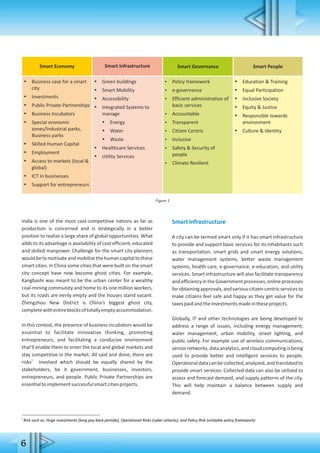
Four main building blocks and components of a smart city are
listedinFigure1.
SmartEconomy
In building an ecosystem of a smart city, it's essential to
develop a business case. Unless there are opportunities and
resources for attracting existing businesses, or setting up new
businesses, it'll be a daunting task to mobilize investments for
these smart cities to become a reality. No sensible investor
invests, no sensible banker finances and no sensible builder
constructs an infrastructure that won't fetch decent returns
on investment. The other important question to be answered
or analyzed is how soon a smart city can mature to start
giving returns to its stakeholders.
Firstly, a smart city is possible only if it makes an economic
sense. It is important for a city to have business support
infrastructure such as special economic zones, industrial
parks, and IT parks with access to its supply chain and markets
tofacilitateitseconomicdevelopment.
6
India is one of the most cost-competitive nations as far as
production is concerned and is strategically in a better
position to realize a large share of global opportunities. What
adds to its advantage is availability of cost efficient, educated
and skilled manpower. Challenge for the smart city planners
wouldbetomotivateandmobilizethehumancapitaltothese
smart cities. In China some cities that were built on the smart
city concept have now become ghost cities. For example,
Kangbashi was meant to be the urban center for a wealthy
coal-mining community and home to its one million workers,
but its roads are eerily empty and the houses stand vacant.
Zhengzhou New District is China's biggest ghost city,
completewithentireblocksoftotallyemptyaccommodation.
In this context, the presence of business incubators would be
essential to facilitate innovative thinking, promoting
entrepreneurs, and facilitating a conducive environment
that'll enable them to enter the local and global markets and
stay competitive in the market. All said and done, there are
2
risks involved which should be equally shared by the
stakeholders, be it government, businesses, investors,
entrepreneurs, and people. Public Private Partnerships are
essentialtoimplementsuccessfulsmartcitiesprojects.
SmartInfrastructure
A city can be termed smart only if it has smart infrastructure
to provide and support basic services for its inhabitants such
as transportation, smart grids and smart energy solutions,
water management systems, better waste management
systems, health care, e-governance, e-education, and utility
services. Smart infrastructure will also facilitate transparency
andefficiencyintheGovernmentprocesses,onlineprocesses
forobtainingapprovals,andvariouscitizen-centricservicesto
make citizens feel safe and happy as they get value for the
taxespaidandtheinvestmentsmadeintheseprojects.
Globally, IT and other technologies are being developed to
address a range of issues, including energy management,
water management, urban mobility, street lighting, and
public safety. For example use of wireless communications,
sensornetworks,dataanalytics,andcloudcomputingisbeing
used to provide better and intelligent services to people.
Operationaldatacanbecollected,analyzed,andtranslatedto
provide smart services. Collected data can also be utilized to
assess and forecast demand, and supply patterns of the city.
This will help maintain a balance between supply and
demand.
Smart Economy Smart Infrastructure Smart Governance Smart People
 Business case for a smart
city
 Investments
 Public Private Partnerships
 Business Incubators
 Special economic
zones/Industrial parks,
Business parks
 Skilled Human Capital
 Employment
 Access to markets (local &
global)
 ICT in businesses
 Support for entrepreneurs
 Green buildings
 Smart Mobility
 Accessibility
 Integrated Systems to
manage
 Energy
 Water
 Waste
 Healthcare Services
 Utility Services
 Policy framework
 e-governance
 Efficient administration of
basic services
 Accountable
 Transparent
 Citizen Centric
 Inclusive
 Safety & Security of
people
 Climate Resilient
 Education & Training
 Equal Participation
 Inclusive Society
 Equity & Justice
 Responsible towards
environment
 Culture & Identity
Figure 1
2
Risk such as: Huge investments (long pay back periods), Operational Risks (cyber-attacks), and Policy Risk (unstable policy framework)
7
Mobility from one place to another is at the core of a "Smart
City". Seoul, Singapore, Yokohama and Barcelona (all
considered Smart Cities) have a sound transport system as
the core of their "Smartness". A traffic system supported by
ICT to collect data from sensors located at traffic signals could
determine traffic conditions, and also collect information on
car locations and speeds to better manage the traffic and
enforcesafedrivingpractices.
For Indian cities to become engines of economic growth, it is
important that goods and services are able to move from
factories to its consumers at low cost and high speed.
Therefore efficient mobility is the key to a smart city. These
approachesareessentialfromIndianperspective;
 Improvements in public transport - Suburban rail, Metro
Rail,BRT,Monorail,Tramsetc.
 Improvements in infrastructure of other motor vehicles -
ring roads, bypasses, underpasses, elevated roads,
improvementsintheexistingroadways
 Improvements in infrastructure for walking, cycling and
waterways
The huge amount of data collected opens up possibilities for
innovationsandnewservicestoimprovethequalityoflifeina
smart city. In addition to commercial innovations, health and
welfare services can use the data to better focus their limited
resources on those most in need. This open approach to use
ofdataprovidesbothpublicandpersonalbenefits.
DigitalDivide
One of the key issues with data driven decision making in
cities is that it often leaves out the poor and
disproportionatelytiltsservicestowardthewealthy.InIndiaa
dividebetweentherichandpoorhasexistedfromtheancient
times. As information technologies become the primary,
sometimesexclusive,meansofcommunicationinoursociety,
a massive digital divide is bound to happen unless we plan
smart policies for smart cities to promote an inclusive social
and economic growth for all. In my opinion, in a smart city,
access to information and technology will become necessary
foracitizentoexercisebasichumanrights.
GreenBuildings
Buildings will be a very important component in Smart City
infrastructure. According to Centre for Science and
Environment,
 Buildings in India consume around 40 percent of total energy
generated,and20percentofwater
 Buildings in India generate 40 percent of the carbon
emissions, 30 percent of solid waste, and 20 percent of water
effluents
 Buildings in a smart city should be designed and built to
greenbuildingstandards.
The Indian Green Building Council is already doing great work in
this direction. Globally there are different standards for green
buildings. It is estimated that India can save around US$ 42
billion every year with efficient management of lighting,
heating, air-conditioning, etc. (McKinsey & Company). Smart
building technologies reduce maintenance costs by 10-30
percent, and enhance the comfort, health and safety of the
occupants.
Asanillustration,acasestudyofIBMhasbeendiscussedinBox1
toexplaintheroleofcorporatesinmakingcitiessmart.
Box 1 Case Study: IBM and its role in making
citiessmart
In the utility sector, IBM has "smart grid" programs
under way with several governments and companies,
using sensors, software and computerized household
meters to maintain power lines and reduce energy
consumption. In the U.S.A, Brazil, and China, IBM is
collaborating with The Nature Conservancy on the
Water for Tomorrow project, which is monitoring and
creating computer modeling for large river basins to
helpguidelanduseandwaterpolicies.
At a National Conclave on Smart Cities, Minister of Urban
Development and Housing & Urban Poverty Alleviation, Shri. M.
Venkaiah Naidu, recently said that effective urban governance
should aim at prudent utilization of natural resources, minimum
waste generation, recycling, water harvesting and efficient
energyuse.
Governance has been one of India's biggest challenges to date.
The current governance structures do not encourage citizen
participation. People do not get the feel of ownership of their
city. In this context, smart governance has to start with active
Government and Citizen Participation in decision making
processes using technology and other social networking
platforms. This will enable a new relationship between local
8
governments and citizens. There has to be a combination of
top-down and bottom-up approaches. City officials'
engagement and drive of participatory conversations with
citizens, and citizen conversations, participation, and
feedback to be used by city officials for informed decision
making.
Smartgovernance would also mean smart policiesto provide
the framework enabling smart cities to come to existence.
Existing legal frameworks and policies that regulate the
urban sector need to be reviewed by the state and urban
localbodiestoseewhatchanges,ifany,arerequired.Referto
Box2.
Box 2
Excerpt from the examples of policy revisions
recommended in the draft smart city concept note
preparedbytheMinistryofUrbanDevelopment:
 Floor Area Ratio norms need to be rationalized and
made more granular rather than city wide, to allow
very high densities to be interspersed with
adequategreenareas;
 The existing Urban & Regional Development Plans
Formulation and Implementation Guidelines
(URDPFI) need to be updated to reflect the higher
standardsexpectedinasmartcity;
 The current standards for water supply, sewerage
and drainage need to be reviewed to aim at higher
standardsexpectedinasmartcity;
 Framework related to investment by the private
sector need to be reviewed so that a higher level of
privateinvestmentinurbaninfrastructurebecomes
possible;
 Framework for making changes in land use need to
bereviewedandproceduressimplified,buildingby-
lawsneedtobecitizenfriendly.
ClimateResilience
India's geographic location and its demographics make it
vulnerable to various climate change events, natural
disasters, and other man-made events. How collective
decisions are made, interpreted, implemented, challenged
will enable or impede a country's resilience ability. By
utilizingtechnology,thelocalgovernmentsandthecitizens
can be better informed, connected, and prepared to
respond to such extreme events. A smart city has to
integrateresilienceintoitsdesigntobesmart.
SmartPeople
The differentiating element between a city and a smart city
is smart people. "Smart leadership and smart people are
essential prerequisites for making cities smart," noted
Minister of Urban Development and Housing & Urban
Poverty Alleviation Shri. M. Venkaiah Naidu. Prime
Minister Narendra Modi's 100 Smart Cities initiative is an
example of how smart leadership can make smart ideas
possible. It is a daunting task to implement and make the
100 smart cities possible unless we as people decide to be
smarttomakethesesmartcitieshappen.
One of the key issues with data driven decision making in
cities is that it often leaves out the poor and
disproportionately tilts services toward the wealthy. As
information technologies become the primary, sometimes
exclusive, means of communication in our society, a
massive digital divide is bound to happen unless we plan
smart policies for smart cities to promote an inclusive
socialandeconomicgrowthforall.Inasmartcity,accessto
information and technology will become necessary for a
citizentoexercisebasichumanrights.
Smart governance and smart people, both play an equally
important role. With good leadership and responsible
citizens who participate, collaborate and work with the
government,100smartcitiesarepossible.
References:
 Concept note on Smart Cities by Indian Smart Cities Forum
underMinistryofUrbanDevelopment.
 http://www.dailymail.co.uk/news/article-1339536/
Ghost-towns-China-Satellite-images-cities-lying-
completely-deserted.html#ixzz3PXNap3w4
 http://sustainablecitiescollective.com/david-
thorpe/1005851/indian-business-leaders-slam-
government-bad-guidelines-smart-cities-and-proposev
 http://www.nytimes.com/2009/04/30/business/energy-
environment/30smart.html?pagewanted=all&_r=0
 http://indiansmartcities.in/downloads/Press_release_12
9141.pdf
 http://thekarmayogi.com/smart-cities-smart-people-
india/
9
Sustainable & Smart City:
Case of Gujarat International Finance Tec-City (GIFT)
Prakash Gaur
Vice President, IIDC Ltd.
prakash.gaur@ilfsindia.com
Background
Gujarat International Finance Tec-City (GIFT) is a globally
benchmarked International Financial Service Centre (IFSC)
developed by Government of Gujarat (GoG) through Gujarat
International Finance Tec-City Company Limited (GIFTCL), a
joint venture between its undertaking Gujarat Urban
Development Company Ltd. (GUDCL) and Infrastructure
Leasing & Financial Services Ltd. (IL&FS). GIFT is a global
Financial and IT Services Hub, a first of its kind in India,
designedtobeatoraboveparwithglobalfinancialcenters.
VisionandPositioning
GIFT is positioned as a Global Financial Hub and is being
characterized to be a Central Business District (CBD)
developed on "Smart and Sustainable Development"
principles for international and domestic financial services
thereby acting as a catalyst for all round development in the
entire region and thus holds very high economic and strategic
significance.
The vision of GIFT Project is - "To develop a global financial
hub for international and domestic financial services which
will serve as a paradigm for next class development in terms
of quality of life, infrastructure and ambience, utilizing land as
apreciousresource."
GIFT's vision and its value propositions for development,
business and living are the driving factors in defining and
implementingSmartCity.
MasterPlanforDevelopment
GIFT is a green field development and is
located at a distance of about 12 kms from the
Ahmedabad International Airport and 8 kms
from the State Capital City, Gandhinagar. The
site is in close proximity to the National
Highway (NH8) and Expressway and connects
Ahmedabad and Gandhinagar. The western
periphery of the site abuts the Sabarmati
River.
The master plan incorporates planning along the Sabarmati
River with green belts interspersed between city and
neighborhood areas. It incorporates features to achieve a
pleasantblendofqualitylifeandbusinessenvironment.
As an integrated smart city development, it will host facilities
for sustainable 'business' and 'living' on 886 acres of land
including Multi Services SEZ (Special Economic Zone) of 261
acre and Domestic Tariff Area. GIFT SEZ is the only Multi
Service SEZ with International Financial Services Centre (IFSC)
statusinIndia.
Commercial development is the primary focus of
development with major built up space dedicated to offices
for various target business segments of domestic and
international financial services, general business and
commerce, retail, district center, community center, local
shopping, hotels etc. Due emphasis is given towards essential
housing facilities, which shall be provided in the form of
studiosandapartmentsforemployeesworkinginGIFT.
The provisioning of quality infrastructure shall play a pivotal
roleinsupportingthebusinessenvironmentandqualityoflife
in GIFT Area. The highest quality of infrastructure and level of
services is being developed and provided for GIFT. The
services provided are comprehensive with higher service
levels and planned delivery. A judicious combination with the
latest technology and global best sustainability practices in
infrastructureservicedeliveryarebeingprovided.
GIFT is supported by state-of-the-art internal infrastructure.
The infrastructure components include transport
infrastructure along with excellent external connectivity by
roads and proposed Mass Rapid Transit System (MRTS), Bus
Rapid Transit system (BRTS), etc., power receiving station,
emergency supply and distribution infrastructure, district
cooling system (DCS), water supply and treatment, sewerage
collection and treatment, solid waste management by
automated waste collection and transportation system with
centralized waste handling facility, domestic gas, ICT
(Information and Communication Technology) services,
utility corridor, fire fighting system, city central command and
controlcenter.
The key environmental and social features of the
infrastructure components that needs a mention here are the
following:
(a) Transportation: A transit oriented development is
planned that would encourage usage of
public transport, which would reduce the
greenhousegasemissionsfromtraveltowork
in GIFT City. The city would aim at zero fatal
accidents.
(b) Energy efficiency through District Cooling
Systemand Solar PV Plants: The
efficiencies gained by central chilled water
facilities result in lower overall energy
consumption, increased reliability, increased
diversification of cooling load, and reduced
environmental impact. The cooling
requirement of GIFT would be met by District
CoolingSystem(DCS)thatwill supply
chilled water to the buildings from a
centralized chilling plant. A 10 MW solar PV plant has
been installed within GIFT City on pilot basis. Similar
plants with higher capacities may be installed in
futureasGIFTCitydevelops.
(c) Water and wastewater management: Water and.....
wastewater issues have been addressed by
employing various measures such as: (a) Installing
SCADA system for improving overall efficiency of
utility services including water supply. (b) Recycling
and reuse of treated sewage for various purposes
such as district cooling, landscaping, flushing etc. The
design vision for water infrastructure in GIFT is to
providepotablequalitywaterinalltapsinthecityand
being "Water Neutral". All wastewater generated
fromdomesticandcommercialusewillbecollectedand
sent to a centralized Sewage Treatment Plant (STP) in
utility area. The treated sewage is planned to be reused
for various purposes such as district cooling,
landscaping, flushing etc. aiming GIFT a "Zero Discharge
City".
(d) Solid Waste Management: The value improvements
for the system includes minimizing human intervention
in the process, reduce adverse environmental & health
impacts, improving the aesthetic value of the project in
the long run. The chute system shall be provided in each
building for collection of waste to minimize human
intervention. Automatic waste collection system
(AWCS) is planned to be incorporated in
buildingdesign. All solid waste collected through
AWCSwillbecollected centrally and treated before
disposal.
10
11
(e) Green and safe city: For reducing urban heat island
effect, measures have been undertaken such as
contiguous landscape planning (green cover) in
preparationofthemasterplanforGIFTCity.
Eachofthe building in GIFT shall be equipped with
Intelligent Building Management System (IBMS) and
sameshallbe connected to central control and command
centerto provide interface between user and utility
service providers. The IBMS monitors fire, energy,
HVAC, lighting, access, closed circuit television
andelevator.
(f) Disaster management: Firefighting provisions have
been mandated for all buildings which comprise of fire
detection, early warning, firefighting equipment and
evacuation routes. During preparation of the master
plan for GIFT City, the risk has been addressed through
design of storm water drainage around and within GIFT
City. Central Command Center has been planned to
control various services, provide security and assistance
indisastermanagementandemergencysituations.
Further, the social infrastructure planned is such that it
promotes: wellness for the whole community, recreation,
health,education,safetyandsecurityforthecity.
The General Development Control Rules (GDCR) for GIFT City
has incorporated all requirements applicable to buildings for
human comfort and safety including mandating LEED
certification of all buildings by developers. Refer to Box 1 for
some of the urban design objectives achieved at master
planning,blockandbuildingscales.
As a result of sustained efforts towards creating a smarter
environment, GIFT City has been conferred as “Smart City of
Future” by Cisco Technology Award 2014. In August 2012,
GIFT won the most prestigious award in the category of 'Best
Industrial Development & Expansion' at the 'Infrastructure
Investment Awards - 2012' organized by World Finance Group
based in London. GIFT Project was considered of world class
value in terms of its potential for enabling economy growth in
the region – through the relocation and centralization of
India'sfinancialandITsectors.
GIFT would have multiplier effect on the Indian economy. It is
estimated that GIFT infrastructure (development and
operations) would provide 500,000 direct and an equal
number of indirect jobs. The demand of various
infrastructures (commercial, residential, schools & colleges,
medicalfacilities)insurroundingregionofGIFTisenvisagedto
boom.
Box 1 Smart and Sustainable Development
Masterplanningscale:
 Due emphasis given on creation of open & green area
for public purpose and ensuring hierarchical
distributionofopenspace
 For legible and coherent urban form, master planning
included careful distribution of building types
accordingtouse,heightsandcharacter
 Landscaping has been an integral part of master
planning and ample provision of open space has been
provided
 Transit oriented development included distribution of
overall density by minimizing distances between
transportnodesanddestinations
 Defined building footprints aided development
withoutboundarywalls
 Pedestrian friendly urban space created which are
contiguous
Blockplanningscale:
 Provisions were made for tree lined shaded
pedestrian walkways, plazas dotted with small scale
amenities such as gardens, street lighting,
communicationnetwork,electricsupplyetc.
 Large percentage of the block area was dedicated to
openandgreenspace
 Guidelines for landscape, illumination and signage
were followed for creating a sense of harmony in
publicspace
 Facade guidelines were followed for making facades
porousandinteractive
Buildingplanningscale:
 Responsive built environment achieved through
defined extents of building envelopes, defined
ingress-egressprovisions
 Buildings were made climate responsive through
mandatory green certification in addition to
prevention of glass facades on south and west
directions
 Building, transport and infrastructure were efficiently
coordinated
 Open spaces within buildings were encouraged, for
exampleskygardens
The above list of initiatives continues to get appended and
guidelines continue to mature through market response
analysis,validationprocessandtechnologicalvalueaddition.
Catalyticurbanizationcoupledwithquicksilverinfrastructural
development, an exodus of populace into metros for better
lifestyles and careers - India's growth curve is moving ahead
rapidly. Yet, such exponential growth can continue to happen
smoothly only when the wealth of natural resources is
harnessed, sensibly and carefully. Therefore, it is crucial to
maintain a harmonious balance between all round progress
and environmental stability. At Mahindra Lifespaces, we
understand the need for sustainable economic growth. While
participating in India's growth saga, we also want to emerge
as the flag bearers for environmental sustainability. With this
philosophy ingrained in our conscience, we espoused 'Green
Design' and 'Healthy Living' as the foundations for all the
projectsatMahindraLifespacesandMahindraWorldCity.
'Green Design' is our selfless way of giving back to the
environment what we take from it. Splendidly showcased in
our residential projects such as Aqualily, Splendour, Royale,
Chloris, Eminente, etc., it is also evident in our commercial
properties like Great Eastern Plaza, HDFC Bank, Great Eastern
Centre and Mahindra Towers. Residential or commercial, all
our structures are energy efficient, environment friendly and
cost effective. So, while the environment revels in good
health,peoplebaskintheglowofhealthylifestyles.
Taking the motto of sustainability a step further Mahindra
World City builds communities on the concept of "work, live,
learnandplay."
Mahindra Lifespaces specializes in real estate development
and is an integral part of the Mahindra Group. Mahindra
Lifespaces, as the name signifies creates spaces for healthy
living, focussing on quality and true value offerings to
customers. Mahindra World City spread across 4,600 acres
has two Integrated Business Cities with futuristic amenities,
facilities and numerous career opportunities that stem from
the prestigious Multi-National Companies (MNCs) housed
here. By improving lifestyles and work-styles, we strive to
bringthebesttoourdiscerningcustomers.
GreenInitiatives
The present article discusses the initiatives that are taken
while designing and planning our projects. Some of these
initiativesarediscussedbelow-
I Energy Efficiency:
Use low emissivity (low-e) glasses for building
fenestration (See Figure 1). It has high light transmission
ratio with low shading coefficient and hence induces
more day light effect than normal glasses. Due to low
Solar Heat Gain Coefficient (SHGC), the entire
fenestration system reduces the heat ingress thereby
reducing the energy requirement for indoor air-
conditioning substantially in comparison with normal
fenestration.
DesignedanddevelopedlowenergydensityFlyashbricks
(see Figure 2) for internal as well as external walls of the
buildings. The brick has been tested by Indian Institute of
Technology (IIT) -Bombay and the average thermal
conductivity is 0.19 W/meter Kelvin. These bricks
envelope and protect the building from water leakage
and act as a better insulator thereby reducing the energy
demandforair-conditioning.
Cover the terrace roof with high albedo insulating
material having SRI (Solar Reflectance Index) value
greater than 78 to reduce the heat absorption and
energydemandforair-conditioning.
Otherenergyefficientproductsusedare-
- Use BEE 3-star rated products for external lighting
and sprinklers in gardens to minimise the energy
requirementofbuildings.
- UseofCFCfreerefrigerantsinairconditioners
- Use timer based sensors for external lights and
sprinklersingardens
All the above initiatives help achieve the energy efficiency
in our buildings.
Creating Sustainable Habitats @ Mahindra Lifespaces
Amit Pal
Sr. General Manager, Quality Assurance & Innovation,
Mahindra Lifespaces Developers Limitted
pal.amit@mahindralifespaces.com
12
Otherthantheabovewehavecommissioneda75KWrooftop
solar plant at Mahindra World City, Chennai, a step towards
harnessing green energy resource. This is expected to
generate approximately 1,16,000 units (kWh) of clean
electrical energy annually and offset emissions of nearly 60
tonsofcarbondioxideperyear.
II. MaintainingHealthyIndoorEnvironmentalQuality:
Initiatives taken to achieve healthy indoor environment
qualityare-
- Provide more open-able window space to floor ratio
than the stipulated norms to improve the ventilation
effectiveness.
- Use of low VOC (Volatile Organic Compound) paints,
adhesives and insulations inside the flat for improved
moisture management. It also helps in increasing the
occupantsproductivity.
- Design in a way that day lighting for at least 75% of the
regularlyoccupiedarea
- Providecrossventilationbetweeneachdwellingunit
III. PreservationandConservationofSoilandWater:
Some of the initiatives that are observed in all our
buildingsare-
- We preserve the top soil during and post construction
and build innovative erosion and sedimentation
controlmanagementsystems
- Rain water harvesting systems and storm water
managementtorechargethegroundwatertable
- Reuse of the treated wastewater for flushing and
landscaping thereby reducing the municipal water
demand
- Lowflowwater faucets and fixtures in every flat of the
residentialbuilding
- Use drought tolerant species with xeriscaping in
landscapingtoreducewaterdemandingardening
IV. MaterialManagement:
We prefer selecting the manufacturer and supplier from
within a 250 km radial distance from the site. We give
much emphasis to use of materials with recycled content
withoutcompromisingonquality.
V. WasteManagement:
Someoftheinitiativesunderwastemanagementare-
- All sites reutilize more than 75% of construction
waste;theseareusedinbuildingroads&pavements.
- An in-house solid waste management plant is
constructed to take care of all the municipal waste.
The waste is processed and recycled as manure and
usedforlandscapingpurposes.
- An in-house STP (Sewage Treatment Plan) is also
constructedfortreatmentofsewage
VI. LabourWelfare:
During the time of construction, we not only provide
basic facilities to our labourers but also additional
facilitiessuchas-
- Establish informal schools and crèches aimed at
providing basic education and a safe environment for
children of construction labourers when the parents
areatwork
- Imparting vocational training to labourers in trades
like electrical maintenance, electronic goods repair,
computer fundamentals, garment design & stitching,
beautytreatmentandhairdressing
- Conduct health campsin labour camps (i) vaccination
camps for labourers and their family members (ii)
Regular health check ups and mobile medical
facilities.
CaseStudy:'MahindraChloris', Faridabad
We employed most of the above mentioned initiatives in one
of our projects 'Mahindra Chloris', Faridabad which is
Platinum rated under the CII - IGBC green home rating system
(India's second completed residential development to
achieve the highest rating in the multi-dwelling units
category).
The following impacts have been measured for Mahindra
Chloris, Faridabad as per the IGBC Green Homes Rating
systemduringthedesignphase.
EnvironmentalImpact:
- Reduction in energy demand upto 144 KW as 80%
requirement for hot water is met through solar water
heatingsystems
- Reduction in energy demand upto 11.34 KW through
solarstreetlighting
- Reduction in GHG emissions as more than 90% of the
construction material is purchased within a radius of 250
kmfromthesite
- Reduction in water consumption as 100% of the waste
waterisreusedposttreatment
- Water conservation due to rain water harvesting systems
for100%oftherunoffvolumefromtheroof
- Reduction in fresh water use of more than 30% due to
installationofwaterefficientfixtures
- Reduction in waste as more than 75% is reused within the
site
EconomicImpact:
- Savings in energy upto 20% as green homes are more
efficientthantheirconventionalcounterparts
- The company was able to negotiate Home Loans for its
customers from State Bank of India (SBI) at 0.25% less
than the prevailing interest rate resulting in an economic
benefittothosecustomerswhoavailedthisfacility.
SocialImpact:
- Improvement in the quality of living of all contract
labourers due to the provision of healthy dwelling
facilitiesintheformoflabourcamps
- Improvement in health due to regular health checkups
andmedicalcampsforlabourers
ConcludingRemarks
Developing green buildings for achieving mere 'ratings' is not
an end in itself; instead, it is the beginning of the journey
towardsahigherpurposeandalargerend.
It is a myth that 'green necessarily means higher cost'. It was
realized that an innovative approach and application of
technologycoupled withstretched targets and fixed timelines
can not only create opportunities for innovations, but also
savecapitalcostaswellaslife-cyclecosts.
The measure of our success is not the 7 million sq. ft. of
projects we have completed nor is the ongoing over 8 million
sq.ft. of new projects under construction. Instead, it is the
smileswecreateoneveryfaceandthelivesweimprove.
References
 http://www.mahindralifespaces.com/mlyf_corp_aboutus.as
px
 Yan Ji and Stellios Plainiotis (2006): Design for Sustainability.
Beijing: China Architecture and Building Press. ISBN 7-112-
08390-7
 Mayra Portalatin, Kristina Koepke, Maureen Roskoski and
TeenaShouse(October2010):GreenBuildingRatingSystems
14
15
Indoor Environment quality and occupant well-being in India:
A paradigm shift
Priyanka Kulshreshtha and Geetika Mishra
Department of Resource Management and Design Application
Lady Irwin College, Delhi University, New Delhi
Just a week back I was asked to review a book for an
undergraduate course in environmental science. Since my
area of research has been air quality ,I promptly jumped on to
the section of air pollution .The author had talked in detail
about the treacherous air pollution playing havoc in metro
cities of India and provided terrifying data on the mortality
rate due to ambient air pollution, which with due respect, I
agreed to. However, to my surprise, not a single mention was
made about the importance of indoor environmental quality
in modern India. This incident is enough to tell us about the
level of awareness and status of research on indoor
environmentalqualityinIndia.
Indoor Environment Quality (IEQ) is one of the important
factors for ensuring health, comfort, safety and productivity
of the population. It refers to the quality of environment
inside the building that is determined by many factors such as
indoor air quality (IAQ), thermal comfort, lighting quality,
acoustic conditions as well as furniture and space layout.
Research has linked the concentration of pollutants indoors
with productivity, sense of well being and occupant's health.
In the long term, poor IEQ may give rise to a set of symptoms
and health problems to the occupants of the building
collectively known as Sick Building Syndrome (SBS). The
various symptoms associated with SBS are irritation of eyes,
nose and throat, headache, cough, wheezing, cognitive
disturbances, light sensitivity, gastrointestinal distress and
other flu like symptoms. The factors inducing SBS in an
enclosed environment could be uncomfortable temperature
and humidity, chemical and biological pollution, physical
condition,andpsychosocialstatus.
The concept of IEQ was born in urban India around the
initiation of the term 'green' building brought on by LEED
(Leadership in Energy and environmental design) almost a
decadeago.Ironically,astudywhichcomparedthesymptoms
of SBS in different categories of LEED certified buildings,
concluded that LEED certification had no correlation with the
SBS symptoms and making the buildings 'green' did not
reduceSBSsymptoms(Mohan2012).
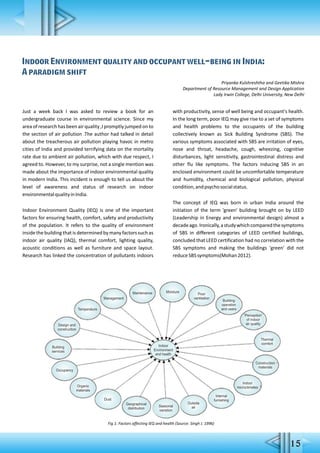
Fig 1: Factors affecting IEQ and health (Source: Singh J. 1996)
Maintenance Moisture
Poor
ventilation
Building
operation
and users
'Perception'
of indoor
air quality
Thermal
comfort
Construction
materials
Indoor
microclimates
Internal
furnishing
Outside
air
Indoor
Environment
and health
Geographical
distribution
Dust
Seasonal
variation
Organic
materials
Occupancy
Management
Temperature
Design and
construction
Building
services
The thrust areas in IEQ then started concentrating on
IAQ, which is a sub-set of IEQ. Some of the pollutants of
concern in indoor environment, include respirable
suspended particulate matter (RSPM), asbestos, Radon,
environmental tobacco smoke (ETS), volatile organic
compounds (VOCs) and formaldehyde. It has been
proved consistently that children under five years of age
in developing countries are at a higher risk of chronic
obstructive pulmonary diseases, acute respiratory
infections and mortality. In order to ascertain a healthy
IAQ, some countries like Canada, Japan, Korea,
Singapore, Sweden, UK and USA have established
international standards. But, India has no such
standards developed for IAQ and sadly, the country's
top advisory body, the Planning Commission wants
more epidemiological studies to agree on national
indoor air pollution norms and are in no hurry to do so
despitethefactthatabout1.3milliondeathsinIndiaare
attributed to indoor air pollution. On the other hand,
the vulnerability of the population to air pollution
related diseases in the Indian sub-continent is very high
due to higher exposure to the air pollutants both in the
indoorsaswellasoutdoors.
In developing countries like India the major source of
energy at the household level is acquired through the
burningofcoalandbiomassintheformofwood,animal
dung and crop residues. On a global scale, it is also the
largest source of indoor air pollution. In simple cooking
stoves, toxic pollutants are emitted in the substantial
quantities. Often, the food is cooked in an open
combustion scenario and no chimney is used to
minimize the indoor suspension of air pollutants. There
is no provision of ventilation in the kitchens, especially
in the cold climatic conditions. The incomplete
combustion of biomass fuels leads to very high levels of
indoorairpollutionandthemostvulnerablearewomen
andchildren.
Currently India is facing an air quality crisis and research
has revealed horrific results that two Indians die every
minute due to air pollution. Keeping in mind India's
heavy dependence on wood and biomass as domestic
fuel, Government of India initiated the National
Program on Improved Chulha (NPIC) in 1984-85. It is
aimed at popularizing the use of improved cooking
devices in rural areas of the country. The secondary
objectives of the program involved reducing the
drudgery for rural women and to create income-
generating opportunities. This has played a role in
improving the IAQ of rural households to some extent.
In the same way many non-government organizations
haveworkedontheimprovementofcookstovesinrural
areas. For example, in Bundelkhand 980 improved
chimney cook stoves (Sukhad stoves) were distributed
resultingin70%reductioninCO concentrationand44%2
reduction in PM concentration. In urban areas, factors2.5
like fuel adulteration, vehicle emission and traffic
congestion also contribute to indoor air pollution. As
the diffusion is lower, the concentration of pollutants
increases and other building factors also add to the
ambient pollutants. In terms of air pollution, India is
ranked highest amongst the world's most polluted
countries.
A major intervention that needs to be brought to the
forefront to tackle the problem of indoor air pollution is
to sensitize the masses regarding its severity and
magnitude. This would enable policymakers to
recognize its importance in indoctrinating it as a
mandate. More cohort studies need to be carried out to
understand the epidemiology of indoor air and relevant
impacts to human health. Prevention will be the key rid
this menace and placing both ambient air and indoor air
as high priority research areas would help address the
challenge. Smaller steps, but consistent ones, need to
be taken for India to have a national set of standards for
healthyindoorairquality.
16
E-waste is discarded, damaged and obsolete electrical and
electronic equipment such as mobile phones, IT equipment,
household appliances etc. It is one of the fastest growing
waste streams in the World. Increase in disposable income,
rapid improvements in technology and competitive prices of
electronic goods have exponentially boosted the electronics
market while consequently generating e-waste at the end of
theproducts'usefullife.
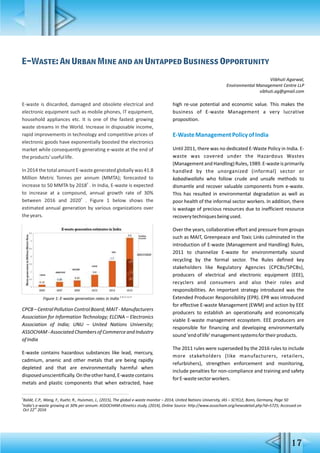
In 2014 the total amount E-waste generated globally was 41.8
Million Metric Tonnes per annum (MMTA); forecasted to
3
increase to 50 MMTA by 2018 . In India, E-waste is expected
to increase at a compound, annual growth rate of 30%
4
between 2016 and 2020 . Figure 1 below shows the
estimated annual generation by various organizations over
theyears.
CPCB–CentralPollutionControlBoard;MAIT-Manufacturers
Association for Information Technology; ELCINA – Electronics
Association of India; UNU – United Nations University;
ASSOCHAM-AssociatedChambersofCommerceandIndustry
ofIndia
E-waste contains hazardous substances like lead, mercury,
cadmium, arsenic and other metals that are being rapidly
depleted and that are environmentally harmful when
disposedunscientifically.Ontheotherhand,E-wastecontains
metals and plastic components that when extracted, have
high re-use potential and economic value. This makes the
business of E-waste Management a very lucrative
proposition.
E-WasteManagementPolicyofIndia
Until 2011, there was no dedicated E-Waste Policy in India. E-
waste was covered under the Hazardous Wastes
(Management and Handling) Rules, 1989. E-waste is primarily
handled by the unorganized (informal) sector or
kabadiwallahs who follow crude and unsafe methods to
dismantle and recover valuable components from e-waste.
This has resulted in environmental degradation as well as
poor health of the informal sector workers. In addition, there
is wastage of precious resources due to inefficient resource
recoverytechniquesbeingused.
Over the years, collaborative effort and pressure from groups
such as MAIT, Greenpeace and Toxic Links culminated in the
introduction of E-waste (Management and Handling) Rules,
2011 to channelize E-waste for environmentally sound
recycling by the formal sector. The Rules defined key
stakeholders like Regulatory Agencies (CPCBs/SPCBs),
producers of electrical and electronic equipment (EEE),
recyclers and consumers and also their roles and
responsibilities. An important strategy introduced was the
Extended Producer Responsibility (EPR). EPR was introduced
for effective E-waste Management (EWM) and action by EEE
producers to establish an operationally and economically
viable E-waste management ecosystem. EEE producers are
responsible for financing and developing environmentally
sound'endoflife'managementsystemsfortheirproducts.
The 2011 rules were superseded by the 2016 rules to include
more stakeholders (like manufacturers, retailers,
refurbishers), strengthen enforcement and monitoring,
include penalties for non-compliance and training and safety
forE-wastesectorworkers.
E-Waste: An Urban Mine and an Untapped Business Opportunity
Viibhuti Agarwal,
Environmental Management Centre LLP
vibhuti.ag@gmail.com
5, 8, 5, 1,2, 4
Figure 1: E-waste generation rates in India
3
Baldé, C.P., Wang, F., Kuehr, R., Huisman, J., (2015), The global e-waste monitor – 2014, United Nations University, IAS – SCYCLE, Bonn, Germany, Page 50
4
India's e-waste growing at 30% per annum: ASSOCHAM-cKinetics study, (2014), Online Source: http://www.assocham.org/newsdetail.php?id=5725; Accessed on
nd
Oct 22 2016
17
E-Waste: An urban mine and a lucrative business
opportunityinIndia
India is a massive consumer of electronics. In 2014-2015,
5
electronics worth $63.6 billion were consumed in India .
These electronics will turn into e-waste at the end of their
useful life. E-waste is an urban mine that contains iron, steel,
copper, aluminum and precious metals like gold, silver,
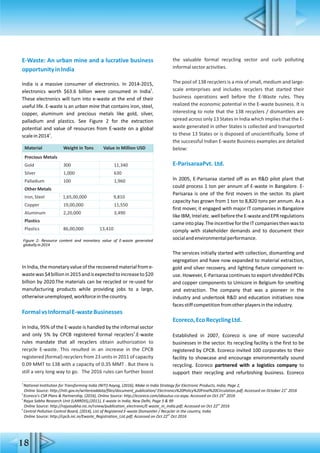
palladium and plastics. See Figure 2 for the extraction
potential and value of resources from E-waste on a global
1
scalein2014 .
In India, the monetary value of the recovered material from e-
wastewas$4billionin2015andisexpectedtoincreaseto$20
billion by 2020.The materials can be recycled or re-used for
manufacturing products while providing jobs to a large,
otherwiseunemployed,workforceinthecountry.
FormalvsInformalE-wasteBusinesses
In India, 95% of the E-waste is handled by the informal sector
2
and only 5% by CPCB registered formal recyclers .E-waste
rules mandate that all recyclers obtain authorization to
recycle E-waste. This resulted in an increase in the CPCB
registered (formal) recyclers from 23 units in 2011 of capacity
0.09 MMT to 138 with a capacity of 0.35 MMT . But there is
still a very long way to go. The 2016 rules can further boost
the valuable formal recycling sector and curb polluting
informalsectoractivities.
The pool of 138 recyclers is a mix of small, medium and large-
scale enterprises and includes recyclers that started their
business operations well before the E-Waste rules. They
realized the economic potential in the E-waste business. It is
interesting to note that the 138 recyclers / dismantlers are
spread across only 13 States in India which implies that the E-
waste generated in other States is collected and transported
to these 13 States or is disposed of unscientifically. Some of
the successful Indian E-waste Business examples are detailed
below:
E-ParisaraaPvt. Ltd.
In 2005, E-Parisaraa started off as an R&D pilot plant that
could process 1 ton per annum of E-waste in Bangalore. E-
Parisaraa is one of the first movers in the sector. Its plant
capacity has grown from 1 ton to 8,820 tons per annum. As a
first mover, it engaged with major IT companies in Bangalore
likeIBM,Inteletc.wellbeforetheE-wasteandEPRregulations
cameintoplay.TheincentivefortheITcompaniesthenwasto
comply with stakeholder demands and to document their
socialandenvironmentalperformance.
The services initially started with collection, dismantling and
segregation and have now expanded to material extraction,
gold and silver recovery, and lighting fixture component re-
use. However, E-Parisaraa continues to export shredded PCBs
and copper components to Umicore in Belgium for smelting
and extraction. The company that was a pioneer in the
industry and undertook R&D and education initiatives now
facesstiffcompetitionfromotherplayersintheindustry.
Ecoreco,EcoRecyclingLtd.
Established in 2007, Ecoreco is one of more successful
businesses in the sector. Its recycling facility is the first to be
registered by CPCB. Ecoreco invited 100 corporates to their
facility to showcase and encourage environmentally sound
recycling. Ecoreco partnered with a logistics company to
support their recycling and refurbishing business. Ecoreco
Figure 2: Resource content and monetary value of E-waste generated
globallyin2014
Material Weight in Tons Value in Million USD
Precious Metals
Gold 300 11,340
Silver 1,000 630
Palladium 100 1,960
OtherMetals
Iron,Steel 1,65,00,000 9,810
Copper 19,00,000 11,550
Aluminum 2,20,000 3,490
Plastics
Plastics 86,00,000 13,410
3
National Institution for Transforming India (NITI) Aayog, (2016), Make in India Strategy for Electronic Products, India, Page 2,
st
Online Source: http://niti.gov.in/writereaddata/files/document_publication/ Electronics%20Policy%20Final%20Circulation.pdf; Accessed on October 21 2016
4 th
Ecoreco's CSR Plans & Partnership, (2016), Online Source: http://ecoreco.com/aboutus-csr.aspx; Accessed on Oct 25 2016
5
Rajya Sabha Research Unit (LARRDIS),(2011), E-waste in India, New Delhi, Page 5 & 99
nd
Online Source: http://rajyasabha.nic.in/rsnew/publication_electronic/E-waste_in_india.pdf; Accessed on Oct 22 2016
6
Central Pollution Control Board, (2014), List of Registered E-waste Dismantler / Recycler in the country, India
nd
Online Source: http://cpcb.nic.in/Ewaste_Registration_List.pdf; Accessed on Oct 22 Oct 2016
18
provides its clients with onsite and offsite lighting recycling
services. It supports manufacturers' with their EPR
responsibilitiesviaitstake-backandrecyclingservices.
E-waste Mukta Bharat (E-waste free India) Program - One of
the key businesses challenges any recycler faces is collection
of E-waste from the source of generation. Ecoreco recognizes
that collection is the most crucial step of the E-waste
management business strategy. To tackle this issue, Ecoreco
launched a social program to set-up accessible E-waste
collection centers for the masses. Ecoreco targets to install
100,000 bins and 5,000 Take Back Points (collection centers)
across India by 2020 to help collect E-waste from corporates
and the masses. In addition to the corporates, Ecoreco will
installbinsinstrategiclocationssuchaseducationalinstitutes
andplacesofworshiptoreachouttothemasses.
Ecoreco's Franchise model: Ecoreco is inviting NGOs,
recyclers, dismantlers, collectors, informal sector workers
and young entrepreneurs to partner with them in the
'Ecoreco Take Back Point' initiative as a franchise. Every
franchise should set-up its own Take Back Point, a facility of
minimum 1,000 sqft, which will require an investment of
$8,200orINR550,000.
AtteroRecycling Pvt. Ltd.
Founded in 2008, Attero'srevenue increased 8 times from $1
million in 2009-2010 to $8 million in 2011-2012. 85% of their
revenuecomesfromsaleofre-usablepreciousmetalsfromE-
waste. Attero has a wide collection network across the
country with over 25 warehouses and collection centers
across21states.
With low-cost high efficiency technology that is relatively
nascent in India, they recycle mobile phones, CRT and flat
panel display units, batteries, PCBs and IT equipment. They
refurbish mobiles and IT equipment and sell them under their
brand, Gobol. To enhance their collection rates, Attero
launched Atterobay, their e-commerce platform where
consumers can sell their gadgets like smart phones with free
shippingthatarerefurbishedorrecycledbyAttero.
OperationsandBusinessmodel
They collect 35% of their raw material from manufacturers or
directly from their consumers, 35% from 500 large
corporates who prefer Attero due to their nation-wide
collection network and the remaining 30% from household or
individual consumers via the informal sector. In order to
streamline the informal sector, Attero educates them and
incentivizes them by offering one and half times more value
9
ofE-wastethanwhattheywouldotherwisemake.
GreenDust
Founded in 2008, GreenDust is a reverse logistics company
that collects and refurbishes electronics that are returned
due to damage or defect by customers to their manufacturers
or are collecting dust in warehouses. GreenDust had the first
mover advantage since few companies had heard of or
practiced reserve logistics. With a return rate of 4-6% in India,
electronics worth $12-$15 billion are returned every year.
GreenDust conducted a study that helped companies realize
that the cost to get back a returned product was higher than
its original value and demonstrated the value in tying up with
10
a reverse logistics firm. All the collected products undergo a
50-point quality check before being put up for re-sale with a
GreenDustcertification.
GreenDust has partnered with brands like Apple, Samsung,
Dell, Philips, Whirlpool and retailers like Croma, Homehop18
to refurbish rejected or damaged electronics and re-sell them
at a 30% lower cost than the market price. GreenDust's main
customer base is Tier II and Tier III cities where people are
vying for brands. In three years, the company set-up 200
stores and 14 warehouses and repair units across the country
andboastsofacustomerbaseworth25crores.
BusinessChallenges
Inventorization, collection, channelization and efficient
extraction of E-waste are some of the key challenges faced in
thehandlingandmanagementofE-waste.Let'sbrieflylookat
them:
9 th
Online Source: http://attero.in/latest_news.php?link=%20115 ; Accessed on October 28 2016
10 th
OnlineSource:http://attero.in/latest_news.php?link=%20115;AccessedonOctober28 2016
19
Inventorization - There is no established and agreed upon
methodology to conduct e-waste inventory on a national or
state level. Various public and private organizations provide
significantly varying annual volumes of generation. Issues like
outflow to the informal sector, varying product obsolescence
rates, lack of adequate data on product sales, storage and
disposal makes inventorization an even bigger challenge. This
issue is particularly challenging for E-waste businesses as
unpredictable supply can lead to underutilized or insufficient
recycling plant capacities; Collection & Channelization -
Recyclers say that collection of E-waste is their primary
business challenge. A mere 1.5% of the e-waste gets recycled
2
due to poor collection efficiency . E-waste is land filled,
illegally burnt or handled by informal recyclers or stored for
prolonged periods and does not get channelized for recycling
affecting profit margins; High Efficiency Technology
Availability - Manual extraction or burning of e-waste by the
informal sector, technologies with poor resource extraction
efficiencies lead to reduced profit. Many recyclers use
inefficient technologies or export complex e-waste
components. Some have developed their own technologies
in-house. Importing high efficiency technology is a risk
becauseofhighcapitalcostsandunreliablematerialsupply.
Future Potential of E-waste businesses
Given the rapid growth of E-waste generation in the country,
penetration of the electronics market in rural areas, the
evolution of E-waste rules, increased stakeholder
responsibilities and local technology development there is
immensepotentialtoset-upE-wastebusinessesallacrossthe
country. The challenges mentioned above have to be
addressed in order to make a business economically viable
andsustainable.Box1includesexamplesofpotentialE-waste
business models that can be successful in the current E-waste
sectorlandscape:
Box 1 – E-waste Business Models
Model 1 - Business tied with Producers Practicing
EPRandBusinesswithBulkConsumers
A company can be set-up to provide EPR management
services to EEE Producers that need to comply with EPR
mandates such as Dell, HP, and Apple. They can start by
helping the Producers develop an EPR management plan
and assist in implementation. The company can use
operational and financial instruments to incentivize bulk
consumersandindividualconsumersandset-upa
reverse logistics ecosystem. Contractual agreements
with bulk consumers and economic incentives for
individual consumers can abate the risk of unreliable
materialsupply.
Model 2 - Business tied with Software Technology
ParksofIndia(STPI)andIndustrialparks(IP)
STPI and IP are bulk generators of E-waste. Companies
can set-up shop in an STPI (53 locations across India) or
Industrial Parks in cities like Pune, Bangalore, and
HyderabadwheretheycollectandprocessalltheE-waste
generatedbytheorganizationsintheSTPIorIP.
Model 3 - Business focusing on PRO that operates
C o l l e c t i o n C e n t r e s w i t h P r o d u c e r s ,
Recyclers/Refurbishers
A Producer Responsibility Organization (PRO) can be set-
up as a co-operative of Producers who are obliged to
meet their EPR. Companies that provide collection,
dismantling, recycling and/or refurbishing services can
operatethePRO.Producerscanpoolinfundstokick-start
the process until the business becomes self-sustainable.
Producers can benefit from this model by sharing their
legislative, operational and financial responsibilities
amongstallPROmembers.
Model 4 - Business involving Informal Sector, their
role&contributioninthevaluechain
One of the focuses of the E-waste sector stakeholders like
government, recyclers, NGOs is the integration of the
informal sector into the formal sector. This strategy has
the potential to arrest outflow of E-waste to the informal
sector and also to improve the working conditions and
health of the informal sector employees. Companies can
beset-uptofocusonthebusinessoftrainingandbuilding
capacity of the unskilled labor so they can become part of
theformalworkforce.
The above business examples and illustrations of potential
business models demonstrate the high growth potential,
economic potential and attractive profit margins in the E-
waste management sector. Like in other sectors, E-waste
businesses have their own set of challenges and business
risks that need to be assessed and overcome to achieve
success.
20
21
Sustainability Priorities of the Cement Industry in India
Philippe Fonta,
Managing Director, Cement Sustainability Initiative, WBCSD
11
fonta@wbcsd.org
India is one of the most important regions for the cement
industry around the world, second only to China in terms of
installed capacity. At the same time, the country is enhancing
continuouslyitssustainabilityperformance.
The World Business Council for Sustainable Development's
12
(WBCSD) Cement Sustainability Initiative (CSI) is working
actively in various fronts of sustainable development for the
Indian cement industry. 10 cement producers, including 3
India based companies and 7 subsidiaries of international
groups,contributetotheencouragingresultsdeliveredbythe
CSI'sregionalworkprogrammeinIndia.
Being one of the most energy efficient performers amongst
cement producers in the world, Indian cement producers are
buildingnewplantswithlatesttechnologiesandthereisazeal
to create the most efficient plants in the world. This is an
industry which does not believe in resting on its laurels, but
rather continues to relentlessly seek out newer, better and
breakthrough technologies to further improve their
performance. The Indian cement industry has successfully
reduced total CO emissions from a substantially higher level2
of1.12tCO /tcementin1996toanindustrialaverageof0.7192
tonnes (t) of CO /t cement in 2010 (latest publicly available2
13
data) .
CSI India plans to focus on managing safety and climate
change issues initially, being consistent with the overall work
program developed at CSI worldwide. It will progressively
covertheotherissues,henceforth.
Safety is the number one priority for CSI member
companies
A key priority area for CSI work globally and in India is Safety.
Through the years, CSI members have made notable progress
in improving safety and reducing fatalities amongst their
employees. Having said that, companies around the world
and in India agreed that more work is required to improve
contractorandlogisticssafety.
Ensuring safety of drivers and vehicles on roads continues to
be a challenge for India as a country. India is one of the most
densely populated nations in the world; its roads are often
choked with traffic and have become increasingly perilous. In
addition,roughly60to70%ofroadcrashesinIndiaarerelated
to commercial vehicles and hence improving fleet safety
management can contribute significantly to overall road
14
safety . CSI members in India are working collaboratively to
put in place the highest standards of safety not only within
their plant boundaries but also along their logistics chain,
whiledealingwithvariouslocalchallenges.
One of the high risk factors identified is fatigue and tiredness
around driving. Unfortunately many drivers, particularly
commercial drivers do not adequately realize the importance
of this, or for various reasons do not take into consideration
the impact of fatigue and tiredness during driving, and
sometimes push themselves to the limit. To address this
issue, the CSI India working group on safety has developed a
document to highlight good practices for fatigue
management.
11
Readers may contact Esha Sar, Coordinator (India operations), CSI at sar@wbcsd.org
12
CSI is an initiative of the World Business Council for Sustainable Development (WBCSD). CSI is a global effort by 24 leading cement producers, with operations
inmorethan100countries.Collectivelythesecompaniesaccountforaround30%oftheworld'scementproduction(inIndia,CSImembersrepresentaround60%of
thenationalproduction)andrangeinsizefromverylargemultinationalstosmallerlocalproducers.AllCSImembershaveintegratedsustainabledevelopmentinto
their business strategies and operations, as they seek strong financial performance with an equally strong commitment to social and environmental responsibility.
13
GlobalCementTechnologyRoadmap:LowCarbonTechnologyfortheIndianCementIndustry,WBCSD-CSI,IEA
14
Source:GlobalRoadSafetyPartnershipwebsite:http://www.grsproadsafety.org/
The safety working group is also collaborating with
transporters, drivers and companies of other industrial
sectors to enhance safety awareness through training and
motivation, to ensure better working conditions for drivers,
better enforcement of regulations, and to improve the safety
and quality of vehicles. A culture of knowledge sharing is
promoted within the group, on both success stories and
pitfalls, to help members learn from the good practices and
mistakes of peers so to improve the overall safety
performance.
In addition, CSI India is collaborating with Global Road Safety
Partnership (GRSP), which is working under the umbrella of
the Red Cross and Red Crescent. Some local projects and
initiatives are currently being taken with GSRP which will
benefit CSI India and add to their knowledge experience. One
such successful initiative is forming of a multi-sectoral
discussions platform bringing together actors from the
private sector, civil societies and governments, focusing
particularlyonreducingroadcrashinjuryanddeath.
Low-Carbon Technology for the Indian Cement
Industry
15
Following the Global Cement Technology Roadmap
developedin2009throughapartnershipbetweentheCSIand
the International Energy Agency (IEA), CSI members in India
joined hands with IEA in early 2013 to develop a 'Low-Carbon
16
Technology for the Indian Cement Industry' . The country
specific adaptation was required to better address the local
issues and develop targeted actions. The initiative in India is
supported by the International Finance Corporation (IFC), a
memberoftheWorldBankGroup.
The Roadmap outlines existing and potential technologies,
and how they may help the industry support a halving of
globalCO emissionsacrossallareasofbusinessandsociety.It2
aims to help policy-makers and financial institutions work
with the cement industry to adapt for a carbon-constrained
world.
The India roadmap outlines a low-carbon growth pathway for
the Indian cement industry that could lead to carbon intensity
reductions of 45% by 2050, from the 2010 level. It proposes
that these reductions could come from increased clinker
substitution and alternative fuel use; further improvements
to energy efficiency, and the development and widespread
implementationofnewertechnologies.
The roadmap is based on a set of technical papers entitled
'Existing and potential technologies for carbon emissions
17
reductions in the Indian cement industry' , developed by the
Confederation of Indian Industry (CII) Green Business Centre
and National Council for Cement and Building Materials
(NCB). The modelled results projected in the roadmap are a
combinationofinformationfromthesepapers,andemissions
data from about 65% of the India cement industry, gathered
through the CSI “Getting the Numbers Right” (GNR)
18
database .
Partners supporting this project brought different kinds of
expertise and contributions to the table: IEA brought
expertise in data analysis and modelling capabilities and
roadmap development; technical consultancy was provided
by the CII and NCB; IFC supported the development
financially; and the CSI provided a platform to solicit
participationofkeyIndiacementproducers.
The Roadmap lays out the way forward for the industry along
a low carbon trajectory, it identifies key levers for reducing
emissions, outlines technologies, policy frameworks and
investmentneedstoreduceCO intensityintheIndiancement2
industry. Through wide consultation amongst different
players, roadmaps allow for greater buy-in amongst
15
Refer the link for the Global Cement Technology Roadmap : http://www.wbcsdcement.org/pdf/technology/WBCSD-IEA_
Cement%20Roadmap_centre_spread_actual_size.pdf
16
Refer the link for Low Carbon Technology for the Indian Cement industry: http://www.wbcsdcement.org/index.php/technology/india-roadmap
17
To read the technical papers, visit the link: http://www.wbcsdcement.org/index.php?option=com_chronocontact&chronoformname
=ExistingandPotentialTechnologiesforCarbonEmissionsReductionsintheIndianCementIndustry
18
To see the GNR database, visit the link: http://www.wbcsdcement.org/index.php/key-issues/climate-protection/gnr-database
22
23
stakeholdersontheactionsneededtoachieveagivengoal.
TheRoadmaphasprovidedtheindustrywithatooltoidentify
itsfuturepathway.
AnumberofCSImembercompaniesinIndiahave
commissionedstudiestoassessthepotentialandfeasibilityof
implementingthetechnologiesoutlinedinthetechnical
papers.Thereareplanstodisseminatetheknowledge
capturedinthetechnicalpaperstoawideraudiencespanning
theentirecementindustryinIndiainordertoscaleupactions.
Learningsfromthefeasibilitystudieswouldalsobeshared
withtheindustrytoenablegreaterreplicationandreduce
timespentbyothercompaniesonthelearningcurve.Non-
CSImembercompanieshavealsoapproachedIFCtoexplore
thepossibilityofconductingfeasibilitystudiesintheirplants,
adevelopmentthatisfullyencouragedbytheCEOsoftheCSI
membersinIndiaandbearstestamenttotheutilityand
importanceoftheworkundertakenbytheRoadmapproject.
Venturingintonewworkareastoaddress
emergingsustainabilityissuesinIndia
CSImembersinIndiaarealsoexploringnewerareasfor
collaborativeactionviz.biodiversitymanagement,water
managementandemissionscontrol.Withsupportfromthe
InternationalUnionforConservationofNature(IUCN),afirst
workshopinIndiaonWBCSDBusinessEcosystemsTraining
(BET)willtakeplaceinearlyMay2014.Similaractivitiesfor
otherareaswillbeorganizedincoordinationwiththeCSI
globaltaskforces.
TheworkprogrammeforCSIinIndiahasbeengrowing
continuouslytorespondtotheneedsofanexpanding
membershipandenlargedworkscopeandtomatchthe
overallCSIworkprogram.Companiesacknowledgethefact
thatoursocietiesexpectbusinessnotonlytomanageitsown
sustainabilityissues,buttohelpsocietymanagewiderissues.
MembersoftheCSIarecommittedtotheirstakeholdersby
becomingpartofthesolutionthroughdrivingprogressand
sustainabilityofthecementindustryinIndia.
Wasteheatrecovery(WHR)isoneofthekeyleversidentified
inthetechnologyroadmap–WHRboiler
TrainingCoursesofferedbytheChamber
Bombay Chamber of Commerce and Industry is 178 years old organisation, an oldest Chamber in the Country. It has
been understood that the Sustainability of the business is dependent on the human resource of the organisation. The
corporateareinvestingontheirveryimportantHumanResourcetoenhancetheirknowledgeandskills.Asaserviceto
themembersandpotentialmembers,theChamberisofferingfollowingtrainingcourses.
1.WomenSafetyandSelfDefence
2.RoadandTravelSafety
3.OfficeSafety
4.FireSafety
5.CorporateSocialResponsibilityforBusinessSustainability
Wearesureofcorporatewilltakeadvantageoftheopportunity.
For more details contact:
Aneeha Neeraja Rajan, Assistant Manager
Tel.:022 61200214 / 227 Email: sustainability@bombaychamber.com / csr@bombaychamber.com
Ms. Usha Maheshwari , Additonal Director / Ms.
Green Procurement (GP) is one of the key strategies towards
SustainableConsumption&Production(SCP).
Many countries have recognized the importance of GP and
have formulated policies, regulations and guidance for its
promotion. Examples of countries leading in GP include
China, the European Union, Korea, Japan, Taiwan and
Thailand. Movement to GP in Asia is picking up, especially
under support from UNEP and EU supported SPIN-Asia
program and initiatives such as International Green
Purchasing Network (IGPN). However, where there are no
national policies on GP, there is not much impetus as well as
guidance to the corporations, either in the form of
recognition or financial incentives. Having a national
framework on GP in place, is therefore important to trigger
and sustain greenprocurement. In the absenceof such policy
frameworks, green procurement is often adopted by
businessesduetopressuresfromthesupplychain.
Introducing and practicing GP is however a long process and
requires a strategic approach. Ad-hoc approaches can pose
risks, especially if the launch is ambitious. There are concerns
whether change in the procurement will work at all on the
account of quality and whether there will be availability in
quantities and in time. Vendor capacity to ensure green
supplies is also a concern. Definition of green itself has been a
nebulous area. In its absence, especially at the operational
level,skepticsoftencallgreenprocurementasgreenwashing.
A rounded approach is needed supported by top
management and that includes building of vendor
understanding and capacities with deliberate efforts of
influencing the market. This article presents a 16 step process
for greening of procurement. Each of these 16 steps is
describedbelow:
1. Get management buy-in: Such initiatives are successful
iftheorganisation'stopmanagementbelievesinit.
2. Reflect the spirit of GP in Vision/Mission and Principles:
It is important that the spirit of GP, especially of SCP, is
wellreflectedinvision/missionoftheorganization.
3. Find a leader: In order to succeed, organization needs to
appoint a leader who will take on responsibility of
introducingGP.
4. Establish a Multi-Disciplinary and Multi-Departmental
Team: Given the wide canvas of GP that encompasses
environmental, social and economic dimensions, a team
that brings together core understanding of these
dimensions needs to be built within the organisation. In
addition, representatives of key departments such as
accounts, finance, human resources, public relations and
legal apart from procurement and environment divisions
arealsorequired.
5. Formulate GP Policy: Develop GP policy based on
organisation's vision/mission statement. This policy
shouldbesignedupbyorganisation'sCEO.
6. Define what is green? : Greenness of a product or a
service is hard to define given the broad canvas of
sustainability. Green Purchasing Network of India (GPNI)
under a project “Harmonization of Criteria for Eco-
labels” reviewed 143 eco-labels across the world and
came up with 8 common core criteria (See Figure 1).
Table1presentsthecriteriaandtheirrelevancetoGP.
7. Assess current purchases: Establish a baseline of the
existing situation before starting the process. Compile
information on procurement statistics (items, quantities,
quality/standards, timing, vendor details, client
feedback,pastexperienceetc.)
8. Start small: It is important not to embark into an
ambitious plan at the start. Based on assessment done,
scope and prioritize the products/components that need
tobegreenedinaphasedapproach.
9. Consider a thematic for a Product: Choose green
themes across products or product categories. For
example, GP may be introduced by focusing on
purchasing recycled content products. Such products
include office papers and envelopes, packaging, plastic
lumber, traffic cones, re-refined motor oil, antifreeze,
and toner cartridges, just to name a few. Another
possibility could be to focus first on energy efficient
products. Such products could be labelled (e.g. Energy
Star) and help reduce operational costs through reduced
electricity consumption and decrease the Greenhouse
Gas (GHG) emissions. Here, greening the procurement
helps save monies. Other possibilities include focusing
Greening your Procurement
Dr. Prasad Modak,
Chairman, Green Purchasing Network of India, Mumbai,
info@gpnindia.org, prasad.modak@emcentre.com
24
Table 1: List of 8 Common Core Criteria for Green Product and their Relevance to GP
Relevance to GP
Products should be sourced only when they meet compliance requirement
acrossthelifecycle. Lifecycleconsiderationofcomplianceisthekeyhere.
Example here could be opting for less or no recalcitrant materials or avoid
materialswithhighembodiedenergy
Asking for minimum Energy Star rating, ensuring that water consumption is
closetobenchmarksandwaste/emissionsperunitproductionarelow
Ensuring that depletion / degradation of forest resources is avoided through
sustainableforestry
Creation of datasheet based on green criteria and making it mandatory for
labelling/websitesetc.
Use of biodegradable materials, factoring Design for Sustainability (D4S), take
backpolicyforrecycling
Made compulsive for large scale vendors or component suppliers having high
impactinggoods/services
Ensuringthatlabourismanagedonfairbasis,withelementsofbenefitsharing
Criteria
Compliance to environmental
regulations and pollution control
standards
Exclusions and Preferences based on
LifeCycleAssessment
ResourceConservationandEfficiency
Conservation of Biodiversity and
OverallEnvironmentalProtection
Reporting and Responsible Disclosure
ofProductInformation
BiodegradabilityandRecyclability
Implementation of Environmental
ManagementSystems(EMS)
SocialInclusion
S.N.
1.
2.
3.
4.
5.
6.
7.
8.
on green cleaning products to improve health & safety of
staffandconsumers.
10. Strategizeprocurement:Onceproductfocusandphasing
is decided, various strategies on procurement need to be
aligned with the organisation's procurement guidelines
or corporate procurement systems or the national
procurement framework. Broadly, for mainstreaming, a
special approach needs to be adopted where green
procurement is treated as a category. In mainstreaming,
elements of resource efficiency, exclusions,
biodegradability, and recyclability need to be included in
the product specification itself. In a special approach, one
can introduce 'Green tenders' as a category. Green
tenders become in a way "pilots" to understand and learn
about operationalizing the concept of "greening". Green
tenders help build a targeted vendor database around
certain priority products and services, build internal
processes and staff capacities, send signals of phase wise
greening to the market. Again, both these strategies cited
above should not be looked at as "silos". In practice a
hybrid solution that is scaled up in phases, is
recommended.
11. Involve stakeholders: It is very important that
stakeholders are consulted in deciding the
implementation strategies. Stakeholders could involve
internal team members of various departments, existing
vendors, buyers, environmental NGOs, green specialists,
eco-label representatives and certifiers, regulators etc.
Involvement could be sought through discussion
meetingsandbi-lateralconsultationsetc.
12. Choose Right Vendors: Organisations may have to
approach new vendors or build capacities of the existing
vendors. Vendor selection criteria could include -
consistent record of meeting environmental and social
compliance,acertaindegreeofcommitmenttoproactive
environmental management e.g. asking for EMS ISO
14001certificationetc.
13. Build Vendor Capacities: Building of vendor capacity to
respond to the newly set green requirements is very
important. This should ideally be preferred instead of
working with entirely new set of vendors. Building
capacity could involve vendor audits, technical assistance
(training, piloting, knowledge dissemination), organizing
visitsetc.
14. Track progress to learn, assess the benefits of greening
and make a business case: Allocating time and effort for
measuring and tracking the changes the changes taking
place, will keep the project implementation on track and
help in identifying possible issues. Tracking data will also
provide a basis for assessing the overall cost savings,
health and environmental benefits of greening on a life
cycle basis. The progress status must be put forth for
ManagementReview.
25
15. Reward supporter and Celebrate Success: Once a phase
of greening is complete, be generous in sharing the
results and the credit for its success. Recognize and
reward the Team, supporters, even if their contribution
was small. Such recognition, whether it is done through a
personal thank-you letter, company award or additional
"brownie" points to the employee in promotions, will
helpbuildsupportforfuturegreeningefforts.
16. Record and Move on: Record the GP journey in various
forms, through newsletters that are easy to understand,
through technical reports containing metrics that
technical staff will appreciate and one or two specific
pagers that apprise management about the triple
bottom line benefits of GP. Move on with the next phase
ofGParmedwithlearningsfromthefirstphase.
Figure 2 shows schematic of the above 16 steps. These
stepsarehowevermoreofguidelineandmayneedtobe
adaptedtoanorganizationalcontextandneeds.
Most corporates today want to go green in their
procurement. The hesitation comes in as they many
believe that green procurement will cost more. This is
understandable because examples where green
procurement has been competitive or has added to
benefits in material terms or a brand image are not
many.
In the next few years, however GP may perhaps not be
optional anymore. It will be asked for or demanded and
may become an integral element of the business
strategyandoperations.
26
The Transparency Curve: Understanding ‘Green’ Communication Needs
19
Scot Case
Market Development Director for UL Environment
scot.case@ul.com, Twitter: @scotcase
Consumersaroundtheworldareincreasinglyrecognizingthat
every purchase has hidden human health, environmental,
and social impacts. Every purchase has potential impacts on
our health or the health of the broader environment. The
goodsandserviceswebuyallcontributeinsomewaytoissues
like climate change, air and water pollution, toxins in the
environment, and resource depletion. Consumers are also
recognizing that the companies and suppliers making the
products exert control over many of these human health and
environmental impacts along with social impacts such as
labourstandardsandpractices.
As this understanding has grown and expanded from one
consumer to another, from one industry to another, and from
one region of the world to another, a variety of transparency
20
tools has emerged . The tools make it easier for individual
consumers, large government or institutional purchasers,
retailers, and manufacturers to better understand the
individual and collective impacts of their purchasing
decisions. They make it easier to identify and buy “greener,”
moresustainableproductsandservices.
The transparency tools range from declarations of a specific
environmental attribute like 'recycled content' or 'energy
efficiency' to more complex standard-based assessments of
multiple environmental indicators. They also include
standardized reporting of environmental data and the
collection of massive amounts of environmental, human
health, and social data in searchable databases. All the tools
are designed to communicate sustainability information
aboutaproductorserviceandenablebetterdecisionmaking.
For35years,eversincetheGermangovernmentlaunchedthe
German Blue Angel environmental label in 1978, various
transparency tools competed with one another to provide
“the” product transparency solution. Multi-attribute,
standard-based environmental labels and certification
programs like Blue Angel, Nordic Swan, UL ECOLOGO, and
Green Seal claimed to provide a better solution than 'simple'
labels that identified a specific human health or
environmental benefit, such as UL GREENGUARD's focus on
indoor air quality, or the Energy Star program's focus on
energyefficiency.
Advocates for the 'simple' labels claimed they provided more
specific or more relevant and, therefore, more useful
information than the multi-attribute labels. More recent
approaches such as lifecycle assessments (LCAs) and the
associated Environmental Product Declarations (EPDs) claim
tobebetterthantheearlierapproachesbecausetheyprovide
even more information, while proponents of the more
traditional environmental labels claim LCAs and EPDs are too
complextobeusefulwhenmakingpurchasingdecisions.
Historically, each of the product transparency tools was
provided and promoted by a government agency, non-profit
organization, or company that only offered one of the tools.
Each promoted the approach it offered as “the” solution,
whether it was a recycled content label, a fair trade label, a
multi-attributelabel,EPDs,orothersimilarapproach.
UL Environment, a part of the 120 year old UL global safety
certification company, approaches transparency at the
product, company, and supplier levels from a different
perspective. Rather than adopting any single approach, UL
Environment recognizes that each of the transparency tools is
useful for communicating sustainability information to a
specificaudience.
Different audiences have different understandings of
sustainabilityissuesand,therefore,havedifferentdesiresand
needs for sustainability information. The transparency tools
19
Scot Case has been researching and promoting responsible purchasing since 1993. This article represents the views of the author only and do not necessarily
reflect the views of UL Environment or its affiliates or subsidiaries.
20
Note: The meaning of transparency has evolved over the last two decades. In the early 1990s, a time in which there was very little public information about the
environmental impacts of products, the U.S. Environmental Protection Agency and others believed providing information on attributes such as the recycled
content of a product made purchasing impacts “more transparent.” They believed this increased transparency made it possible for consumers to make better
purchasing decisions. Transparency proponents today expect much greater information disclosure to be considered transparent. For purposes of this article, the
author views all of these efforts as steps towards greater and greater transparency.
27
28
appropriate for one audience might differ from the needs of
other audiences. The needs might also differ from industry to
industry.
To help clients determine which transparency tool is most
appropriate to reach their customers, UL Environment has
adoptedtheTransparencyCurve.
TheTransparencyCurve
The Transparency Curve, depicted in Figure 1, illustrates how
different groups of customers desire different levels of
transparency. It shows that a customer's desire for additional
sustainability information about products and services
increases with an increase in the customer's knowledge of
sustainabilityissues.
The more a consumer, purchaser, retailer, manufacturer, or
industry learns about the connection between global
sustainability issues and their purchase decisions, the more
product-specific or company-specific sustainability
information they want to review. Greater sustainability
knowledge drives a need for increasing levels of transparency
aboutproducts,services,companies,andsupplychains.
The Transparency Curve highlights five customer segments,
each of which has different needs and expectations for the
type of sustainability information a company should provide
aboutitselfanditsproductsorservices.
▪ SegmentOne:“Don'tKnow;Don'tCare”
Some customers do not know much about sustainability
issues and, as a result, they do not want or need any
sustainability information. Providing sustainability
informationisnotlikelytohelpsalesandmightevenhave
a negative impact on sales if customers assume that
“greener”productsperformpoorly.
▪ SegmentTwo:IssueSpecificInterest
Customers with limited knowledge of sustainability
issues or deep knowledge or interest in a particular issue
wantsustainabilityclaimswithclear,specificconnections
to human health or environmental concerns.
Transparency tools for this customer segment focus on
single attribute claims like indoor air quality (UL
GREENGUARD), energy efficiency (Energy Star), water
efficiency(WaterSense),recycledcontent,andfairtrade,
among others. Most claims are based on meeting a
clearly defined threshold. Products meeting the
established threshold earn a mark or badge that can be
displayedontheproduct.
▪ SegmentThree:Multi-AttributeFocus
As a customer's interest broadens, they recognize that
every purchase has multiple sustainability impacts and
that a focus on any single attribute might obscure other
important sustainability attributes. At this point along
the Transparency Curve, multi-attribute sustainability
labels like Blue Angel, Nordic Swan, UL ECOLOGO, and
Green Seal become a more appropriate transparency
tool to communicate sustainability information to
customers. These tools balance multiple environmental
and social issues in publicly available, consensus-based
environmental standards that establish clear thresholds
for each of the attributes addressed by the standard.
Products or services meeting the standards earn the
relevantcertificationmark.
▪ SegmentFour:StructuredDataReporting
As customers migrate towards the next segment, there is
an important change in their expectations. Rather than
looking for others to establish sustainability thresholds,
these customers want to see the sustainability data
reportedinastructuredformat.Theywantmoredetailed
information about multiple sustainability indicators.
Rather than relying on an environmental label to identify
“greener,” more sustainable products, services, or
companies, they want access to specific indicators that
they can use to make their own judgments based on the
attributestheythinkaremostimportant.
There are several existing and emerging transparency
tools to facilitate this need. Environmental Product
Declarations (EPDs), based on Lifecycle Assessments
(LCAs) that follow approved Product Category Rules
(PCRs), and the emerging use of Health Product
Declarations (HPDs) do not make value judgments about
whether a product or service is “greener” or more
sustainable than competing products or services.
Instead, they provide information in a standardized
reporting format, analogous to the nutrition information
found on food packaging. Customers then make their
own determinations about which products, services, or
companiesarebest.
EPDs are growing in popularity in Japan and Europe. In
France, the government-backed Environment Round
Table (Le Grenelle Environnement) has proposed that all
highvolumeconsumerproductsimportedtoFrancehave
an EPD. They are also gaining traction in the United
States,particularlyinthegreenbuildingsector.
▪ SegmentFive:DataMining
The final segment includes even more sophisticated
customers who want access to significant volumes of
sustainability information in formats that permit them to
determine which attributes are most important to them,
combine them with other attributes, and create their
own framework for determining which products or
services are most sustainable. This part of the
Transparency Curve currently includes a handful of
retailers and large manufacturers with sophisticated
supply chains. They have the ability to ask customized
sustainability-related questions to their suppliers,
combine it with existing information, and use the
resultinginformationtomakebetterdecisions.
ValueoftheTransparencyCurve
The Transparency Curve helps companies sell more products
and services by identifying which transparency tools best
meetthesustainabilityinformationneedsoftheircustomers.
All customers can be located on the Transparency Curve. At
any point in time for any company within any industry, there
are customers with varying understandings of sustainability
issues who desire varying degrees of transparency about the
human health, environmental, and social impacts of a
product,service,orcompany.
This makes communicating environmental information very
challenging because different customers want different
information. Communicating too simply using simple
transparency tools puts a company at risk by alienating its
more sophisticated customers. Communicating too much
information with more complex transparency tools puts a
companyatriskofconfusingitscustomers.
The Transparency Curve helps companies match their
customers' sustainability information needs with the
appropriate communication tool. It also helps companies
understand how their customers' sustainability information
needs will change as those customers increase their
understandingofsustainabilityissues.
It also makes it more clear that all the transparency tools are
actually interdependent. The sustainability information
contained in the more sophisticated data-based transparency
tools support the sustainability information contained in the
threshold-basedtransparencytools.
UL Environment can manage all the product- and company-
level sustainability information and help companies share
relevant information with relevant customer segments in a
format that meets the sophistication and needs of those
customers. By combining all the approaches within a single
set of offerings under a single brand, UL Environment has
made it possible for companies and their customers to easily
transition from one point on the Transparency Curve to the
next without having to hop from one brand or service
providertothenext.
ConcludingThoughts
Consumers around the world are learning that their
purchases have impacts on their health and the health of
communitiesandthebroaderenvironment.Theyarelearning
that it is possible to buy affordable paint or furniture products
without the harsh smells and chemical emissions associated
with some products, appliances that are more energy
efficient, electronic products that are more durable with
fewer hazardous materials, and buildings that are more
resource efficient and more pleasant places to live and work.
Thedemandforgreenerproductscontinuestogrow.
As consumers continue climbing the Transparency Curve,
they will want and expect better information about the
sustainability performance of the products they buy.
Companies that understand the Transparency Curve and that
know where their customers and competitors are along the
curve have an advantage in today's market. They will have an
evengreateradvantageinthefuture.
29
Promoting Environmentally Sound Technologies: UNEP’s International
Environmental Technology Centre
Surendra Shreshtha,
21
Director, UNEP-IETC
Surendra.Shrestha@unep.org
and
Mushtag Ahmed Memon, Programme Officer, UNEP IETC
Mushtaq.Memon@unep.org
At the Earth Summit in Rio de Janeiro, Brazil, in 1992,
governmentsagreedonAgenda21,anactionplantopromote
sustainable development. Central to Agenda 21 is the
promotion of environmentally sound technologies (ESTs). As
defined in Agenda 21, ESTs protect the environment, are less
polluting, use less resources in a more sustainable manner,
recycle more of their wastes and products, and handle
residual wastes in a more efficient manner than the
technologiesforwhichtheyweresubstitutes.
In 2004, the Bali Strategic Plan for Technology Support and
22
Capacity-building reinforced the need for the provision of
technology support and capacity-building to developing
countries as well as to countries with economies in transition.
In 2012, the UN Conference on Sustainable Development
(UNCSD),orRio+20,initsoutcomedocument“TheFutureWe
Want”, again emphasized the importance of technology
transfertodevelopingcountries.
Technology transfer remains one of the important topics in
the international arena as it is seen as playing a critical role in
the global response to the challenges in sustainable
development. It is important to remember that achieving this
goal will not just be a matter of bringing new tools to a new
location, but will also bring in suitable policy environment,
unobstructed markets, adequate financing, and capacity
building.
For more than 20 years, UNEP's International Environmental
Technology Centre (IETC) has had a comprehensive and
leading involvement in promoting the development, transfer,
uptakeanduseofenvironmentallysoundtechnologies(ESTs).
This involves data gathering and information management in
relation to ESTs, as well as the development of decision
support tools to assess life cycle performance and the
environmental benefits of ESTs. It also facilitates technology
transfer and supports capacity building initiatives to assist in
thedevelopment,demonstrationanddisseminationofESTs.
IETC'sroleinthetransferofESTs
Inaugurated in 1992, IETC's mandate is the transfer of
environmentally sound technologies (ESTs) to developing
countries and countries with economies in transition. Over
the course of time, IETC has worked on urban development,
including disaster management and water and sanitation. In
recent years, IETC has focused on waste management. IETC is
committed to further work on this area to become a global
centre of excellence on waste management in the future. The
holistic definition of waste defines waste as the unwanted by-
product of human activities in solid, liquid and gaseous form.
IETC is promoting this holistic approach to waste, considering
waste as a resource and supporting proactive prevention
policies.
Whywaste?
The world is going through an unprecedented transition
setting new trends for the 21st century. With the global
population increasing from currently around 7.3 billion to 9
billion by 2050 and 11 billion by the end of the 21st century,
the urbanization trend is expected to continue with more
than 80 per cent of humanity living in cities by 2050. Most of
these people will live in African and Asian cities where city
growth rates are the highest, followed by Latin America and
theCaribbean.
The industrial revolution has pursued a linear path of
extracting natural resources, putting it through an industrial
process for goods and services with the end product as waste.
Waste is generated at all stages of the production and
consumption chain. With increasing income levels, there will
be 3 billion new middle class consumers in the coming
decades. The demand for goods and services and
consequently the waste generation will grow exponentially.
TheWorldBankestimatesthatthe1.3billiontonnes(2012)of
municipal solid waste (MSW) will increase to approximately
2.2 billion tonnes per year by 2025. Waste characteristics are
21
United Nations Environment Programme (UNEP), International Environmental Technology Centre (IETC)
22
To know about the Bali Strategic Plan for Technology Support and Capacity building, visit the page -
http://www.unep.org/GC/GC23/documents/GC23-6-add-1.pdf
30
also changing from mainly organic to containing more
hazardous substances having a negative impact on human
healthandenvironment.
Waste management poses an important challenge for
governments and the cost of inaction is high. Improper waste
management impedes the provision of basic necessities for
public health such as clean water, clean air and safe food.
Untreated waste contaminates soil and water through
leachate. Burning of waste significantly increases the air
pollution having adverse impacts to human health. Like most
environmental hazards, deficiencies in waste management
also disproportionately affect poorer communities more as
wastes are often dumped in land adjacent to slums and waste
pickersareexposedtohazardoussubstances.
Opportunities:resources,growth,jobs
The emerging problem of waste is an opportunity making a
contribution for growth and jobs. If waste is considered a
resource,itacquiresavaluetobeused.Withapreventiveand
precautionary approach and the application of new
environmentally sound technologies, it is possible to manage
wasteinasustainableway.
The opportunities and benefits of sustainable waste
management include: less environmental pollution, reduced
costs in managing waste, reduced greenhouse gas emissions,
contributions to equity and poverty alleviation. Improved
health, health costs that are avoided, water contamination
that is prevented, and the ensuing cost of alternative water
supplyarealsoimportantbenefits.
In addition to environmental benefits, sustainable waste
management can also facilitate economic opportunities and
growth. Economic benefits of proper waste management will
mainly come from considering waste as a resource, that is, by
reusing products, recycling waste and recovering materials
and energy including converting waste to biogas. Converting
waste into energy can assist countries in meeting their energy
needs and thus has significant benefits for energy security.
The benefits of sustainable waste management for job
creation can also be significant. UNEP's Green Economy
Report shows that recycling creates more jobs than it
replaces. Sorting and processing recyclables alone sustain ten
times more jobs than land filling or incineration on a per ton
basis.
IETC'sexperience
Over the past couple of years, IETC has assisted countries in
transitioning to sustainable waste management through
technical assistance, guidance, and pilot projects. IETC has
advisedaroundadozencitiesinAsia,AfricaandLatinAmerica
in devising integrated waste management plans. In this
context, IETC developed guidelines, built the capacity of local
authorities in developing the plans and carrying out
demonstration projects. In India, IETC assisted the City of
Pune in developing its integrated waste management plan, in
cooperation with the Pune Municipal Corporation and the
EnvironmentalManagementCentre(EMC),Mumbai.
IETC has been working on converting agricultural waste
(biomass) into energy. Converting agricultural waste into
energy can provide a decentralized energy source in rural
areas while simultaneously achieving a cost effective solution
to waste disposal, and a reduction in greenhouse gas
emissions.
One of the examples, IETC built the local capacity in six Asian
countries to identify and implement environmentally sound
technologies (ESTs) for waste agricultural biomass and assess
their potential for resource conservation and greenhouse gas
emission reduction. A compendium of sustainable
technologies was developed that demonstrated these
technologies as pilot projects. Sub-regional workshops were
organized to share and exchange experience on the projects.
In India, IETC worked with the Birla Institute of Management
Technology (BIMTECH). In the replication of the project in
Costa Rica, IETC facilitated the dissemination of Indian
technologies.
Photo: Open burning of waste
31
Project on converting waste agricultural biomass into energy
32
In its endeavor to assist countries in assessing and choosing
environmentally sound technologies that match their needs,
IETC has developed a methodology, the Sustainability
Assessment of Technologies (SAT), as well as a number of
reports on waste management technologies, a compendia of
technologies. These are intended to provide information on
technology options as well as to assist the policymakers and
technology decision makers in the identification of
appropriate technologies with respect to local economic,
environmental, social and technical characteristics. See Box 1
an illustration of one of the ESTs that IETC is working on in
Penang,Malaysia.
In response to an increasing need to manage growing
amounts of e-waste, IETC also prepared a series of user-
friendly manuals, to assist developing countries in developing
e-waste management systems, including assessing e-waste
and its risks, evaluating current e-waste management
practices, and designing environmentally sound e-waste
policyframeworks.
Most recently, in collaboration with the United Nations
Institute for Training and Research (UNITAR), IETC developed
"Guidelines for the development, review and updating of
national waste management strategies". These guidelines
provide a conceptual and methodological framework for
national planning that countries may adapt to their particular
circumstances. It also establishes a clear rationale for making
waste management a national priority. The guidelines are
currentlybeingpilottestedin6Asiancountries.Theobjective
of this project is to assist countries in developing national and
city-level waste management strategies. Once the initial
piloting has taken place, lessons will be collected for
replication and up-scaling in a next phase. In India, IETC is
working with the City of Kota, Rajasthan, to support the
developmentofacity-levelwastemanagementstrategy.
On the global level, IETC, in collaboration with the
International Solid Waste Association (ISWA), is developing a
Global Waste Management Outlook. The Outlook will
provide an overview, analysis and recommendations for
action of policy instruments and financing models for waste
management.
ConcludingRemarks
IETC's experience shows that its approach to technology
transferisholistic,includingcapacitybuilding,knowledgeand
organizationaldevelopmentaswellasdevelopinganenabling
environment for the uptake of technologies. To be successful,
transfer of technology requires more than just the moving of
equipment from point A to point B. Other requirements
include enhanced knowledge, management skills and
technical and maintenance capabilities of those receiving the
technology. Integrating human skills, organisational
development and information networks is also essential for
effective technology transfer. Thus technology transfer is a
broad and complex process if it is to contribute to sustainable
andequitabledevelopment.
With the experience of working with government and private
sector from many different countries, IETC will be a good
partner for the Indian private sector to facilitate knowledge
exchange, business partnershipsand to providea platform for
cooperationwithotherAsiancountries.
India, one of the biggest countries in the world, is at a very
important crossroads. The country faces a dual challenge:
rapid urbanization and economic growth on the one hand;
and enormous pressure on natural resources to keep up with
demand for production and consumption on the other hand.
Tocreateawin-winsituationforeconomicgrowthandnatural
resources, ESTs can play a vital role. India can capitalize on
ESTs to reduce waste during the production process. Based on
its vast engineering base, India can also innovate and produce
ESTs for local and overseas markets to further boost economic
andjobgrowth.
The waste sector has huge potential for adoption of ESTs to
promote sustainable development as ESTs reduce waste and
improve the production efficiency. ESTs can also convert
waste into a resource to further boost economic activities and
living standards. To materialize these ideas, policy makers,
scientists and engineers, private sector and investors, and
citizens' representatives may form a team to assess the
current and future needs for ESTs for local and international
markets and then to draw up a roadmap to produce and
implementESTs.
Workshop on national waste management strategies
How Natural Capital Risks are Increasingly Relevant for Financial
Institutions
Simone Dettling,
Advisor at GIZ, Emerging Markets Dialogue Programme
simone.dettling@giz.de
Dependence of our Economy on Natural Capital
Our economies are dependent on inputs provided by nature -
on Natural Capital. From soil, nutrient cycling and pollination
needed for agriculture to water usage in thermal power
plants, pulp & paper production or manufacturing of semi-
conductors for electronic devices, Natural Capital forms the
basis for any economic activity - either as a direct input for a
business or through its value chains. In 2010, the UN
Environmental Programme (UNEP) estimated the annual
value of nature's inputs for the global economy at USD 45
23
trillion,approximately80%ofglobalGDP.
Consequences of Natural Capital Depletion for
Businesses
To date, however, markets neither capture nor adequately
measure the value created by Natural Capital in terms
comparable to economic services or manufactured goods.
ThisneglectinvaluingNaturalCapitalhascontributedtoover-
exploitation of, for example, fresh-water sources and forests.
Climate change, population growth, continuous resource-
intensive economic growth, land conversion, pollution and
over-exploitation of natural resources all contribute to a rapid
degradation of ecosystems worldwide and hence the
continuous depletion of the Natural Capital our economies
depend on. The result is that businesses face an increased
volatility or scarcity in the supply of needed Natural Capital,
rising prices along their value chains, additional fees or
penalties for environmental externalities they create, and a
potential loss of market share, as customers opt for more
sustainableproducts.
Water Risks as an Example for Natural Capital
Risks
One striking example of increasing risks from Natural Capital
depletion for businesses is water, which strongly affected by
both regional over-exploitation and global climate change. At
the beginning of 2014, the South of Brazil experienced a
drought – an extreme weather event that has been occurring
in the region with increasing frequency and severity over the
last 15 years. Both Bloomberg and Reuters covered the
consequences this drought had for businesses in the region
quite extensively, reporting on production interruptions in
the beverage, pulp&paper, and the petrochemical industries.
Notonlyregionalbusinesseswereaffected,butalsotheworld
market for crops like coffee, of which Brazil is the largest
producer. Prices for Arabica coffee rose by 40% as a result of
this drought, leading Bloomberg to speculate on the
consequences these rising input costs will have for businesses
24
like Starbucks. Extreme weather events, such as droughts,
are becoming more frequent and severe
worldwide (see graph) and generally, changes in
rainfall patterns and temperatures are already
and will increasingly lead to water supply
volatilityandscarcityinmanyregionsaroundthe
world. In India, for example, many areas already
experience water stress, and an increase in the
variability of monsoon rainfall due to climate
change is expected to exacerbate these water
25
shortagessignificantly.
RelevanceforFinancialInstitutions
AsoneexampleofNaturalCapitaldependencies,
this increasing water stress has proven to be a
significant operational risk for companies in
sectors for which it is a key input, such as power
plants, utilities, mining, pulp & paper,
petro-chemicals,or food and beverage. Supply
23
UNEP 2010: Dead Planet – Living Planet, http://www.unep.org/pdf/RRAecosystems_screen.pdf
24
Bloomberg, 19.02.2014, “Coffee to Soybeans Surge as Brazil Drought Damages Crops”, http://www.bloomberg.com/news/2014-02-18/starbucks-
favored-coffee-jumps-most-since-2004-on-weather.html.
25
The World Bank, http://www.worldbank.org/en/news/featyre/2013/06/19/india-climate-change-impacts.
33
Businesses face:
 Increasing volatility/scarcity of needed ecosystem services (e.g. less water decreases
output of hydropower, fewer pollinators lead to decreased harvest)
 Increasing prices along value chains (e.g. water-intensive cotton in clothes manufacuring)
 Increasing fees for externalities (such as pollution or waste) as regulations become stricter
 Loss of market share as customers move to more sustainable products (e.g. eco-energy)
Higher costs Less profitability loss of competitiveness loss in shareholder
Consequences of Natural Capital Depletion
Business Perspective
 Climate Change
 Population Growth
 Overuse of resources (e.g. fish)
 Land coversion (e.g. from
forest to farmland)
 Pollution
 Invasive species
Depletion of Natural Capital = the Stock of Ecosystems
(for example: forests, marine ecosystems)
Provides less
ecosystem
services
volatility and scarcity of this key input lead not only to
operational risk, as production inputs are not secure, but also
to business risk, as overall production costs increase once
regulators put a higher price on scarce water resources or
capital expenditures need to be made for securing alternative
water sources. Both lead to a decline in profitability and
competitiveness and a reduction of free cash-flows,
increasing the risk faced by banks and investors providing
finance for the company. Water risk is already considered by
rating agencies as a factor impacting the creditworthiness of
companies, as illustrated by the downgrade of the energy
producer AES by Fitch in April, for which hydrological risk was
26
givenasoneofthemainreasons.
TheFinancialSectorasaLever
While Natural Capital risks can be a material factor for
financial institutions to consider and to price into their
lending and investment decisions, a financial sector that
integrates Natural Capital risks can be an important lever to
increase resource efficiency and sustainable production
methods throughout the economy. Once Natural Capital risks
becomeafactorthatinfluences,forexample,theinterestrate
for a business loan and businesses more heavily exposed to
Natural Capital risks than their peers face a higher cost of
capital, there is a strong incentive to invest in resource
efficiencyandmoresustainableproductionmethods.
TheGap
However, at present few financial institutions are aware of
and understand material Natural Capital risks in their
portfolios. Those who understand these risks lack the data,
methodologies and tools to estimate impacts from Natural
Capital risks on the cash flows and profitability of companies
andonprobabilityofdefault.
The Emerging Markets Dialogue Programme on
GreenFinance
The Emerging Markets Dialogue Programme on Green
Finance (EMD) is commissioned by the German Ministry for
Economic Cooperation and Development and
implemented by the Deutsche Gesellschaft für
Internationale Zusammenarbeit (GIZ). The purpose of the
EMD is to work with financial institutions from G20
Emerging Markets as well as developed countries on
market-based mechanisms to increase investment in
resource-efficientandsustainablebusinesspractices.
Currently, the EMD works with financial institutions from
Brazil, India, Germany, Switzerland and the US to address
the gap in awareness as well as methodologies and tools to
integrate Natural Capital risks, such as water risks, into
lending and investment decisions and valuation procedures.
Specifically,
 together with the Natural Capital Declaration
(represented by UNEP-FI and the Global Canopy
Programme), the German Association for Environmental
Management and Sustainability in Financial Institutions
(VfU) and several financial institutions, EMD has set up a
pilot project on quantifying water risks and developing
and testing a tool to integrate them into corporate bond
valuation. The Project will start in mid-August and the
finalizedtoolisplannedtobepublishedinsummer2015.
 the Sustainable Finance Working Group of CEBDS (the
Brazilian chapter of the World Sustainable Business
Council) and EMD are jointly organizing a series of three
workshops on Natural Capital and its Relevance for
Financial Institutions in Brazil and will launch two studies
on “Quantifying the Natural Capital Risk Exposure of
Financial Institutions in Brazil” and “Seizing Business
Opportunities: Investing in Eco-friendly Markets and
Sustainable Business Models” during these workshops.
rd
The first workshop will take place on September 23 2014
inSaoPaulo.
 together with several Indian financial institutions, the
EMD is planning a series of workshops on Natural Capital
RisksandOpportunitiesinFinanceinIndia.
Should you be interested in finding out more about
participating in EMD activities or have any further questions,
please do not hesitate to contact: simone.dettling@giz.de.
This article reflects the personal opinion of the author,
Simone Dettling. Simone Dettling works on the Emerging
MarketsDialogueProgrammeinherroleasanadvisoratGIZ.
Source: Munich RE
26
http://www.businesswire.com/news/home/20140430007017/en/Fitch-Downgrades-AES-Panama-BB-Outlook-Revised
34
35
A broad consensus exists among scientists, politicians,
businesses and civil society that biodiversity loss is one of the
biggest challenges that we are facing. Therefore, actions need
tobetakentohaltthisgloballossurgentlyandimmediately.In
this regard the use of new and innovative instruments and
strategies to achieve 'no net loss' of biodiversity and
ecosystem services is being explored. One such tool,
Biodiversity Offsets - a mechanism that allows for
compensation of impact on biodiversity - is gaining wide
acceptancearoundtheworld(Darbi,2014).
Biodiversityoffsetsaredefinedas:
"measurable conservation outcomes resulting from
actions designed to compensate for significant residual
adverse biodiversity impacts arising from project
development after appropriate prevention and mitigation
measures have been taken. The goal of biodiversity offsets
is to achieve no net loss and preferably a net gain of
biodiversity on the ground with respect to species
composition, habitat structure, ecosystem function and
people's use and cultural values associated with
biodiversity"(BBOP,2009)."
To put it simply, the negative impacts of business operations
on biological diversity need to be compensated or
counterbalanced by conservation or restoration measures in
order to ensure there is 'No Net Loss' of biodiversity. ('No Net
Loss' has become internationally-accepted as a principle of
biodiversityimpactmitigation).
Biodiversity Offsets were promoted for the first time on a
global scale by the Business and Biodiversity Offset Program
(BBOP) of the international non-profit Forest Trends
Association. The BBOP platform has been in place since 2004
and it has engaged business, NGOs, administration and
academia, through its community of practice, for evolving a
standard and implementation toolkit for biodiversity offsets -
these are being tested through biodiversity offset pilots with
business partners around the world. Some of BBOP's pilot
offset projects include Ambatovy Project (nickel mine) in
Madagascar, Newmont Ghana (gold mine) in Ghana, and
AngloAmerican(platinummine)inSouthAfrica.
An important question that has become a cornerstone of the
discourseonbiodiversityoffsetsis-Isthereabusinesscasefor
biodiversity offsets i.e. does it make good business sense for
companies to offset their biodiversity impact, does it boost
their bottomlines? When looking at the 'business case' for
biodiversityoffsets,BBOPasks:
"Why should businesses voluntarily 'go the extra mile'
and take on biodiversity offsets? What's in it for them?"
(BBOP,2015)"
A study by PricewaterhouseCoopers LLP notes a gradual
increase in the number of organizations and initiatives that
are beginning to recognize the business benefits of
biodiversity offsets, i.e. understanding potential advantages
for companies, and working to integrate biodiversity
considerations into business and commercial activities
(PricewaterhouseCoopers,L.L.P.,2010).
tenKate,Bishop&Bayon,2004citeanumberofopportunities
offered by voluntary biodiversity offsets for companies and
developers. Businesses can benefit from the implementation
of compensation measures e.g. in terms of reputation and
better acceptance of their projects. Figure 1 shows benefits
that make biodiversity offsets worthwhile from the business
perspective.
What is the business case for biodiversity offsets?
Marianne Darbi,
Researcher at Leibniz Institute of Ecological Urban and Regional Development,
m.darbi@ioer.de
Figure 1: Benefits of biodiversity offsets for business
(after ten Kate, 2005 and Howard 2007)
The Business Case for Biodiversity Offsets
License to operate access to land and resources, speeding up
approval processes and avoiding costly
delays, political Influence
Reputation good PR, improved relationship with the
local population and decision-makers, status
of a "preferred partner"
Access to capital Increased demands and standards of
international financial institutions and donors
Efficience Management of risks and liability
obligations
Efficiency Management of risks and liability obligations
New markets First Mover advantage
36
A broad consensus exists among scientists, politicians,
businesses and civil society that biodiversity loss is one of the
biggest challenges that we are facing. Therefore, actions need
tobetakentohaltthisgloballossurgentlyandimmediately.In
this regard the use of new and innovative instruments and
strategies to achieve 'no net loss' of biodiversity and
ecosystem services is being explored. One such tool,
Biodiversity Offsets - a mechanism that allows for
compensation of impact on biodiversity - is gaining wide
acceptancearoundtheworld(Darbi,2014).
Biodiversityoffsetsaredefinedas:
"measurable conservation outcomes resulting from
actions designed to compensate for significant residual
adverse biodiversity impacts arising from project
development after appropriate prevention and mitigation
measures have been taken. The goal of biodiversity offsets
is to achieve no net loss and preferably a net gain of
biodiversity on the ground with respect to species
composition, habitat structure, ecosystem function and
people's use and cultural values associated with
biodiversity"(BBOP,2009)."
To put it simply, the negative impacts of business operations
on biological diversity need to be compensated or
counterbalanced by conservation or restoration measures in
order to ensure there is 'No Net Loss' of biodiversity. ('No Net
Loss' has become internationally-accepted as a principle of
biodiversityimpactmitigation).
Biodiversity Offsets were promoted for the first time on a
global scale by the Business and Biodiversity Offset Program
(BBOP) of the international non-profit Forest Trends
Association. The BBOP platform has been in place since 2004
and it has engaged business, NGOs, administration and
academia, through its community of practice, for evolving a
standard and implementation toolkit for biodiversity offsets -
these are being tested through biodiversity offset pilots with
business partners around the world. Some of BBOP's pilot
offset projects include Ambatovy Project (nickel mine) in
Madagascar, Newmont Ghana (gold mine) in Ghana, and
AngloAmerican(platinummine)inSouthAfrica.
An important question that has become a cornerstone of the
discourse on biodiversity offsets is - Is there a business case
for biodiversity offsets i.e. does it make good business sense
for companies to offset their biodiversity impact, does it
boost their bottomlines? When looking at the 'business case'
forbiodiversityoffsets,BBOPasks:
"Why should businesses voluntarily 'go the extra mile'
and take on biodiversity offsets? What's in it for them?"
(BBOP,2015)"
A study by PricewaterhouseCoopers LLP notes a gradual
increase in the number of organizations and initiatives that
are beginning to recognize the business benefits of
biodiversity offsets, i.e. understanding potential advantages
for companies, and working to integrate biodiversity
considerations into business and commercial activities
(PricewaterhouseCoopers,L.L.P.,2010).
ten Kate, Bishop & Bayon, 2004 cite a number of
opportunities offered by voluntary biodiversity offsets for
companies and developers. Businesses can benefit from the
implementation of compensation measures e.g. in terms of
reputation and better acceptance of their projects. Figure 1
shows benefits that make biodiversity offsets worthwhile
fromthebusinessperspective.
In general terms, there are two types of motivations for
business to adopt biodiversity offsets, which align with the
valuesassignedtobiodiversitybyhumans:
1. Ethical value: altruistic motivation for the
implementationofbiodiversityoffsets.
2. Value of benefit: improvement in business and
enhancementofprofit
The most obvious case for such benefit is when biodiversity is
theprerequisiteforthebusinessactivities(e.g.tourism).
"The business case for biodiversity conservation is most
easily made when the business in question depends
directlyonbiodiversitytooperateandsurvive[…]Formany
other businesses the case for investing in biodiversity
conservationislessclear.Understandingwhatbiodiversity
means and how it affects business value is not always
straightforward."(Bishop,2006)
In the public, however, a rather negative view of biodiversity
offsets (and in particular of related business activities
initiatives)dominates,withbusinessesbeingaccusedof
37
A broad consensus exists among scientists, politicians,
businesses and civil society that biodiversity loss is one of the
biggest challenges that we are facing. Therefore, actions need
tobetakentohaltthisgloballossurgentlyandimmediately.In
this regard the use of new and innovative instruments and
strategies to achieve 'no net loss' of biodiversity and
ecosystem services is being explored. One such tool,
Biodiversity Offsets - a mechanism that allows for
compensation of impact on biodiversity - is gaining wide
acceptancearoundtheworld(Darbi,2014).
Biodiversityoffsetsaredefinedas:
"measurable conservation outcomes resulting from
actions designed to compensate for significant residual
adverse biodiversity impacts arising from project
development after appropriate prevention and mitigation
measures have been taken. The goal of biodiversity offsets
is to achieve no net loss and preferably a net gain of
biodiversity on the ground with respect to species
composition, habitat structure, ecosystem function and
people's use and cultural values associated with
biodiversity"(BBOP,2009)."
To put it simply, the negative impacts of business operations
on biological diversity need to be compensated or
counterbalanced by conservation or restoration measures in
order to ensure there is 'No Net Loss' of
biodiversity. ('No Net Loss' has become
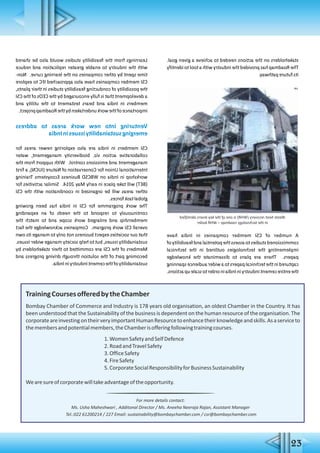
internationally-accepted as a principle of
biodiversityimpactmitigation).
Biodiversity Offsets were promoted for the first
time on a global scale by the Business and
Biodiversity Offset Program (BBOP) of the
international non-profit Forest Trends
Association. The BBOP platform has been in
place since 2004 and it has engaged business,
NGOs, administration and academia, through
its community of practice, for evolving a
standard and implementation toolkit for
biodiversity offsets - these are being tested
through biodiversity offset pilots with business
partners around the world. Some of BBOP's
pilot offset projects include Ambatovy Project
(nickel mine) in Madagascar, Newmont Ghana
(gold mine) in Ghana, and Anglo American
(platinummine)inSouthAfrica.
An important question that has become a cornerstone of the
discourseonbiodiversityoffsetsis-Isthereabusinesscasefor
biodiversity offsets i.e. does it make good business sense for
companies to offset their biodiversity impact, does it boost
their bottomlines? When looking at the 'business case' for
biodiversityoffsets,BBOPasks:
"Why should businesses voluntarily 'go the extra mile'
and take on biodiversity offsets? What's in it for them?"
(BBOP,2015)"
A study by PricewaterhouseCoopers LLP notes a gradual
increase in the number of organizations and initiatives that
are beginning to recognize the business benefits of
biodiversity offsets, i.e. understanding potential advantages
for companies, and working to integrate biodiversity
considerations into business and commercial activities
(PricewaterhouseCoopers,L.L.P.,2010).
tenKate,Bishop&Bayon,2004citeanumberofopportunities
offered by voluntary biodiversity offsets for companies and
developers. Businesses can benefit from the implementation
of compensation measures e.g. in terms of reputation and
better acceptance of their projects. Figure 1 shows benefits
that make biodiversity offsets worthwhile from the business
perspective.
Figure 2: Cascade of biodiversity offsets (author's own)
38
Deciphering Sustainable Finance in India
Lucille Andrade,
Asst. Vice President, Environmental Management Centre LLP
Lucille.andrade@encentre.com
Investments in various sectors, instruments, products that
createenvironmentaland/orsocialvaluecouldbeconstruedas
sustainable finance. Financial Inclusion initiatives undertaken
by Reserve Bank of India (RBI); rural finance; and extending
financetoMicro,SmallandMediumEnterprisesbybanksinthe
public and private sector constitute sustainable finance.
Similarly, reserving a portion of funds for investment in
particular sectors construed as environmentally friendly such
as renewable energy is also sustainable finance. Weather
based insurance schemes; impact funds investing in social
enterprises; institutional financing for particular sectors; green
bonds; and the most recent modality of finance under
Corporate Social Responsibility are various forms of
sustainablefinance.
Sustainable finance also incorporates the mechanisms and
systems adopted by financial institutions to ensure
sustainability of their investments. A few important forms of
sustainable finance operational in India have been described in
briefinthisarticle.
SustainableFinancethroughFinancialInclusion
Financial Inclusion is defined as 'the process of ensuring access
to financial services and timely and adequate credit where
needed by vulnerable groups such as weaker sections and low
income groups at an affordable cost' (The Committee on
Financial Inclusion, Chairman: Dr. C. Rangarajan). The RBI
adopted a bank-led model for achieving financial inclusion in
India while permitting non-bank entities to partner banks in
their financial inclusion initiatives. Since January 2006 various
policy measures have been undertaken by the RBI for creating
conducive regulatory environment and providing institutional
support for banks in accelerating the process of financial
inclusion.
RBI's Policy Initiatives to foster Financial
Inclusion
(a) Reach
Branch expansion in rural areas - Branch
authorization has been relaxed such that banks do
not require prior permission to open branches in
centres with population less than 1 lakh, subject to
reporting. Banks have been mandated to open at
least 25 % of their new branches in unbanked rural
centres.
Agent Banking - Business Correspondent/ Business
Facilitator Model - In January 2006, RBI permitted
banks to utilize the services of intermediaries in
providing banking services through the use of
business facilitators and business correspondents
(BC). This model allows banks to do 'cash in - cash out'
transactions at a location much closer to the rural
population.
Combination of Branch and BC Structure to deliver
Financial Inclusion - To ensure increased banking
penetration and control over operations of BCs,
banks have been advised to establish low cost
branches in the form of intermediate brick and
mortar structures in rural centres between the
present base branch and BC locations, so as to
providesupporttoaclusterofBCs(about8-10BCs)at
areasonabledistanceofabout3-4kilometers.
(b) Access
Relaxed KYC norms - Know Your Customer (KYC)
requirements have been simplified such that small
accounts can be opened with self-certification in the
presence of bank officials and 'Aadhaar' cards have
beenallowedasoneoftheeligibledocuments.
Contd......
Sustainablefinancecanbedefinedas,'thepracticeofcreatingeconomicandsocialvalue
throughfinancialmodels,productsandmarketsthataresustainableovertime’.
Definition by - Centre for Responsible Finance, Haas School of Business, University of California (Berkeley)
39
RBI's Policy Initiatives to foster Financial
Inclusion Contd......
Roadmap for Banking Services in unbanked Villages - In
the first phase, banks were advised to draw up a
roadmap for providing banking services in every village
having a population of over 2,000 by March 2010. In
the second phase, roadmap has been prepared for
covering remaining unbanked villages i.e. with
populationlessthan2000inatimeboundmanner.
(C) Products
In order to ensure that all the financial needs of the
customers are met, RBI has advised banks to offer a
minimum of four basic products – (i) a savings cum
overdraft account; (ii) a pure savings account, ideally a
recurring or variable recurring deposit; (iii) a
remittance product to facilitate EBT and other
remittances; and (iv) entrepreneurial credit products
like a General Purpose Credit Card (GCC) or a Kisan
CreditCard(KCC)
(d) Transactions
The introduction of direct benefit transfer will leverage
the Aadhaar platform and help facilitate delivery of
social welfare benefits by direct credit to the bank
accountsofbeneficiaries.
Source: Keynote address delivered by Dr. K.C. Chakrabarty, Deputy
Governor, Reserve Bank of India at the Finance Inclusion Conclave
organizedbyCNBC TV18atNewDelhionSeptember6,2013
ImpactInvesting
The Global Impact Investing Network defines Impact investing
as 'investments made into companies, organizations, and
funds with the intention to generate social and
environmentalimpactalongsideafinancialreturn'.
CorecharacteristicsofImpactInvestingare:
 Intentionality – The intent of the investor to generate
social and/or environmental value. These investments are
made into enterprises and funds that expand access to
critical goods and services, and/or generate positive
impactthroughtheiroperations.
 Investment with return expectations – Impact
investments are expected to generate a financial return
on capital and, at a minimum, a return of capital. While
grants are not themselves impact investments, they can
play an important role in enabling impact investing – for
instance, through incubating early-stage business models,
providing certain forms of credit enhancement, providing
technical assistance, or funding needed research and
development.
 Range of return expectations and asset classes – Impact
investments generate returns that range from below
market to risk-adjusted market rate. Impact investments
can be made across asset classes, including but not limited
to cash equivalents, fixed income, venture capital and
private equity. Impact investors may also earn fees through
theprovisionofcatalyticinstrumentssuchasguarantees.
 Impact measurement – A hallmark of impact investing is
the commitment of the investor to measure and report the
social and environmental performance and progress of
underlyinginvestments.
Impact investors encompass a wide range of players in the
investing space – Angel investors, FamilyOffices,Venture Capital
funds, private equity funds, Development Finance Institutions,
and Foundations. The Government of India, through the
Department of Science and Technology, also directly funds
entrepreneurs as well as through incubators at various
educationalinstitutions.
WeatherBasedInsurance
Agriculture is the backbone of Indian economy and is
significantly impacted due to droughts in one region and floods
in another at the same time. The erratic pattern of rainfall
destroys the harvest with a severe impact on farmer's
livelihoods. Insurance is the tool for farmers to hedge risks of
cropandyieldlosses.
Weather based crop insurance scheme has been piloted by
Agriculture Insurance Company of India Ltd. (AIC) in India since
2003 to mitigate the hardship of the insured farmers against the
likelihood of financial loss on account of anticipated crop loss
resulting from incidence of adverse conditions of weather
parameters like rainfall, temperature, frost, humidity etc. While
Crop Insurance specifically indemnifies the cultivator against
shortfall in crop yield, Weather based Crop Insurance is based
on the fact that weather conditions affect crop production
even when a cultivator has taken all the care to ensure good
27
harvest .Weatherbasedschemeshavealsobeenintroducedby
privateinsurancecompanieslikeICICILombardandHDFCERGO.
27
Refer the WBCIS, Frequently Asked Questions page for further details at http://www.aicofindia.com/AICEng/General_Documents/Product_Profiles/WBCIS_FAQ.pdf
40
Case Study – Acumen Fund
Acumen, founded in 2001, was the first foreign social
venture fund to invest in India. They raised funds from US
based investors through the venture philanthropy route.
Acumen made its first impact investment in 2004 and
opened its local office in India around 2005. A snapshot of
the criteria, process and principles of Acumen's investment
modelinIndiaisgivenbelow.
InvestmentCriteria
 Sectors: Operate in one of our investment sectors of
Agriculture, Education, Energy, Health, Housing, or
Water.
 Stage: Be an early-mid stage company that is in the
processofscaling.
 Investment Size: Be seeking investment capital in the
range of $0.25M-$3M, structured as either debt or
equity.
 Strong Management Team: Have a strong and
experienced management team with the skills, will,
and vision to execute the business plan, an unwavering
commitmenttoservethepoor,andunyieldingethics.
 Potential for Significant Social Impact: Make a product
ordeliveraservicethataddressesacriticalneedforthe
poor in our sectors and geographic focus. These
products or services must be economically better or
create greater social impact than what is available
currently through the market, aid, or charitable
distribution.
InvestmentProcess
 Potential for Financial Sustainability: Have a clear
business model that demonstrates the potential for
financial sustainability within a five to seven year
period; including the ability to cover operating
expenseswithoperatingrevenues.
 Potential to Achieve Scale: Be able to demonstrate a
clearpath to scale for the number of end users over the
period of our investment, and be positioned as one of
theleadingserviceprovidersinthemarket.
Source: Acumen Fund website http://acumen.org/investments/
investment-model-2/, accessed in August 2014
Case Study – HDFC ERGO Weather Insurance
Policy
HDFC ERGO offers a comprehensive Weather Insurance
Policytodealwithadverselychangingclimatictrends.Itis
an index based product that covers the losses to the crop
occurring due to varying weather conditions such as
temperature,windspeed,rainfall,humidityetc.
The insurance policy is available to farmers; banks; and
financial institutions / companies extending credit facility
foragricultural/non-agriculturalseasonaloperations.
ThePolicycovers:
(a) Cost of input - Covers the diminished agricultural
output/yield resulting due to deviation from
optimum weather requirement of a crop within a
specific geo graphical location and specified time
period;and
(b) Increased operational costs of agricultural or non-
agricultural economic activity resulting from
deviation of Observed Weather index from Strike
index.
Source: HDFC ERGO website http://www.hdfcergo.com/rural-
insurance/weather-insurance.html,accessedinAugust2014.
CorporateSocialResponsibility(CSR)
The CSR Rules 2014 drafted under Section 135 of the
Companies Act 2013 requires large and medium sized
companies to spend every financial year 2% of their average
net profits during the three immediately preceding financial
years on activitiesthat create environmental and social value.
Schedule VII of the Companies Act, 2013 lists a number of
activitiesthatcouldbeincludedunderCSR.
It is perceived that, investing in these activities would lead to
social welfare and overall sustainable development thus
formingapartofsustainablefinance.
41
Frameworks by Development Finance
28
Institutions and Foreign Banks
Multilateral, regional and bilateral Development Finance
Institutions (DFIs) work across various regions of the world
fostering economic growth and sustainable development.
They provide a broad range of financial services such as loans
or guarantees to investors and entrepreneurs, taking equity
participationinfirmsorsettinginvestmentfundsforfinancing
publicinfrastructureprojects.
As part of their mandate, DFIs require that their financing
activities are conducted in conformance to their
environmental and social safeguards. When DFIs initiate a
dialoguewithgovernmentinstitutions,privateentrepreneurs
or financial intermediaries, an Environmental and Social
Management System (ESMS) is stipulated. The system is so
designed that the host country environmental and social
regulations as well as lending agency's environmental and
social safeguards are addressed in parallel. A monitoring and
reportingmechanismisestablishedto reviewtheconformance
to the ESMS. For situations where the financial institution
enters the project cycle at a later stage such as refinancing
transactions, and environmental and social due diligence is
conducted by an Independent Reviewer to establish
conformance of the borrower to the lending agency's
environmental and social safeguards. The disbursement
conditionstobeimplementedduringthelifeoftheprojectsare
drawn based on the level of conformance. Majority of the
bilateral DFIs subscribe to IFC Performance Standards for the
implementation of their environmental and social safeguards.
Almost all DFIs refer to World Bank Group's Environmental,
Health& Safety Guidelines for general application as well as
sectorspecificforimplementationintheborrower'sprojects.
Similar procedures are implemented by Equator Principles
29
FinancialInstitutions(EPFIs) investinginIndia.Theobjectiveis
to provide a minimum standard for due diligence to support
responsible risk decision-making. The Principles are based on
the IFC Performance Standards and World Bank Group's EHS
Guidelines. These apply globally, to all industry sectors and to
four financial products 1) Project Finance Advisory Services
2) Project Finance 3) Project-Related Corporate Loans and 4)
Bridge Loans based on thresholds and specific criteria. A
number of foreign and Indian Private Equity funds also follow
suit.
OtherModesofSustainableFinance
The subsidies and discounts available to entrepreneurs and
companies by the National Solar Mission under the aegis of
Ministry of New and Renewable Energy; financing available to
renewable energy and energy efficiency projects by Indian
Renewable Energy Development Agency Ltd; financing
activities undertaken by National Bank for Agriculture and
Rural Development; finance extended to micro, small and
medium enterprises by public and private sector banks;
investments made through green bonds to finance
environment-friendly projects by IFC in renewable energy
sectorinIndia,allconstitutesustainablefinance.
Promoting gender
equality and
empowering
women
Contribution to
Prime Minister's
Relief Fund or
other Central Fund
Ensuring
environmental
sustainability
Employment
enhancing
vocational skills
Such other
matters as
prescribed
Social business
projects
Combating HIV,
AIDS, malaria and
other diseases
Eradicating
extreme hunger
and poverty
Reducing child
mortality and
improving
maternal health
Promotion of
education
Figure 1: Activities under CSR
28
TextadoptedfromthePaper'CanwehaveaGlobalStandardonEnvironmental,SocialandGovernance?',PrasadModak,RahulDatar,LucilleAndrade;
presentedinIAIA2013
29
Visithttp://www.equator-principles.com/forfurtherdetailsregardingEquatorPrinciplesFinancialInstitutions.
Environmental and Social Risk Management at IDFC
Alok Dayal,
Senior Director, Credit & Environment Risk, IDFC
Alok.dayal@idfc.com
Background
IDFC Ltd is one of India's leading project financiers. It was
formed in 1997 for leading private capital to infrastructure
sectors in India. Project Finance is a method of funding in
whichthelenderlooksprimarilytotherevenuesgeneratedby
a single project, both as the source of repayment and as
security for the exposure. Project financiers are therefore
concerned with minimizing the dangers of any events which
could have an adverse impact on the financial performance of
theproject,inparticular,eventswhichcouldresultin:
(1) the project not being completed on time and within
budget,
(2) theprojectnotoperatingatitsfullcapacity,
(3) the project failing to generate sufficient revenue to
servicethedebt
The performance of a project is intrinsically linked to its
environmental and social contours and associated risks.
Environmental and Social (E&S) risks in a project play a major
role in determining its timely completion and satisfactory
operations. Early engagement with project proponents on
identifying potential environment and social issues and
mechanisms to address and mitigate the same is important
for ensuring effective project development. Project financiers
therefore need to ensure effective environment risk
mitigation by building requisite environmental and social
covenants as part of their loan agreements and implementing
the E&S mitigation measures for projects funded by them.
The key to timely and cost effective project implementation is
mainstreaming E&S Risk due diligence and monitoring in the
project appraisal and post sanction monitoring process by
projectlenders.
Since its inception IDFC has been a pioneer in integrating
environmental and social risk management and good
governance into its business operations. The Environment,
Socialand Governance(ESG) agenda of IDFC has been built on
an edifice of a sound risk culture that includes a
comprehensive E&S risk management framework and an
inclusive approach of working with project promoters in
adopting “best in class” sustainability practices. This includes
encouraging our borrowers to adopt good practices on
governance, environment and social safeguards in their
projects. IDFC has successfully mainstreamed environmental and
social risk management into its business operations and
instituted a dedicated environment risk group (ERG) to conduct
E&S due diligence for projects financed by it. ERG is part of the
risk team at IDFC Ltd and incorporates best in class Environment
& Social Due Diligence and monitoring mechanisms for IDFC's
lendingoperations.
IDFC adopted the Equator Principles (EP) on 3rd June 2013. It was
the first and till date the only Indian financial institution to do so.
The Equator Principles are a credit risk management framework
for identifying, assessing, and managing environmental and
social risk in project finance. IDFC has since then re-aligned its
E&S systems and procedures to the principles as espoused by the
EquatorPrinciplesAssociation.
IDFC'sE&SPolicy
IDFC's rigorous E&S policy along with its commitment to the
Equator Principles (EP) is reflected in its environment and social
policy. IDFC's E&S policy ensures that its lending is made to
environmentally sustainable, socially acceptable and
economically viable projects. IDFC suitably addresses a project's
environmental and social risks throughout its investment tenure
asdescribedinthefollowingparagraphs.
ManagingEnvironmentalandSocialRiskatIDFC
The ERG group is responsible for managing E&S risk in IDFC's
lending business. ERG identifies the environmental risk
dependingontheprojecstageatwhichitisconsideredatIDFC.
I) Environmentcategorisation
The first step in IDFC's E&S due diligence begins with the
environment categorisation. IDFC categorizes all projects
funded by it as either Category A or B or C. This
categorization is based entirely on the extent of impacts and
not on type of the sector or project and is in accordance with
the environmental and social screening criteria of the
International Finance Corporation (IFC). The following
criteria are used at IDFC to classify projects as either
CategoryAorBorC:
 Category A – Use of proceeds is expected to have
significant adverse environmental and social risks
and/or impacts that are diverse, irreversible or
unprecedented;
42
 Category B – Use of proceeds is expected to have
limited adverse environmental and social risks and/or
impacts that are few in number, generally site-specific,
largely reversible and readily addressed through
mitigationmeasures;and
 Category C – Use of proceeds is expected to have
minimal or no adverse environmental and social risks
and/orimpacts.
IDFC has devised an in –house toolkit which can be
used by its business executives in categorizing projects
attheinitialstagesoftheduediligenceprocess.
ii) Environment and social due diligence and Monitoring of
Projects
The ERG conducts environment risk assessment of all
category A and category B projects at two stages as
describedbelow:
a) Appraisal / Sanction stage: ERG works closely with the
borrower, project finance, legal and credit teams to
comprehensively evaluate the environmental and
social risks of projects as per the Environment and
Socialduediligence(ESDD)processdevelopedbyIDFC.
The ESDD and monitoring process in IDFC is depicted in
followingflowchart.
ESDDcoversthefollowingsaspectsofaproject:
 Whether the project meets the extant requirements
of Indian Environmental Legislations and EP in its
design and the likely scenario in the operational
phase.
 List of significant environmental and social impacts
that include involuntary resettlement, loss of
biodiversity, impacts on indigenous and / or local
communities, worker safety, pollution,
contamination,andothers.
 Publicdisputesoftheproject,ifany
 Health & Safety issues associated with the project and
an assessment of the borrower's managerial capacity
tohandlethesame.
 GrievanceredressalMechanismfortheproject
 StakeholderEngagementmechanism
 Identifying the requirement of additional E&S studies
andmitigationmeasuresfortheproject
 Potential for Green House Gas emissions and
reductions, if applicable and available information on
thesame.
Suitable E&S related loan covenants arising out of the
ESDD process are stipulated and incorporated in loan
agreements with clients which are then closely
monitored at time of loan disbursements and during
thelifeoftheloan.
b) Post sanction stage: ERG undertakes Environment and
Social Monitoring & Review (ESMR) of portfolio projects
after sanction to monitor and ensure compliances to the
requirements of applicable Indian Environmental
Legislations, Equator Principles and E&S related loan
covenantsonanongoingbasis.
ESMRcoversthefollowingsaspectsofaproject:
 Compliance to E&S conditions stipulated in the loan
agreement
 On-goingcompliancewithstatutoryrequirements
 Status of any new/emerging Environment, Health, Safety
and Social (EHSS) development involving the project and
consequentrisksassociatedwithit.
43
 Status of implementation of Environmental Management
Plan(EMP)andResettlementActionPlan(RAP)
 Informationonexpansionplansetc,ifany
This entire process is documented in an ESMR report
prepared as part of our annual review of porfolio projects in
IDFC Ltd. The Projects not confirming to E&S covenants are
reviewed and depending upon the significance of
environment risk, such cases are included in the E&S watch
list and discussed with senior management at IDFC Ltd.
Regular follow up with client is carried out to ensure that the
non-compliances are rectified and corrective measures are
implemented.
SustainabilityDrivenInfrastructureDevelopment
IDFC's environment & social management system which has
been refined over the years has ensured that the
environmental and social risks associated with the projects
areidentifiedattheprojectappraisalstageitself.Thisenables
IDFC to constructively engage with the project proponents
and address and mitigate identified E&S risks through
appropriate action plan and measures. This approach has
been productive in promoting a culture of E&S risk redressal
at the project level and also ensuring that our lending is
directed towards sustainability driven infrastructure
development.
IDFC's sustainability focus has led it to identify low-carbon
infrastructure businesses as an area of strategic focus. IDFC
has funded close to Rs. 4200 crore as on March 2014 in
renewable energy projects in India. IDFC's focus on
renewable energy has enabled it to reach out to new
committed project promoters in the Renewable Energy (RE)
space and influence them to adopt good construction and
labour practices and initiate community welfare activities in
their project areas. IDFC is today preferred by most of the
developmentbanksandmultilateralinstitutionsasastrategic
partner for their lines of credit in the renewable energy and
low carbon economy space. These institutions include and
are not limited to International Finance Corporation (IFC),
Asian Development Bank (ADB), Overseas Private Investment
Corporation(OPIC),DEG(KfWBankengruppe)andDFID,UK.
Benefits experienced by IDFC through ESG
integration
There are various examples that could be quoted bringing out
thebenefitsaccruingtoIDFCasaresultofthecommitmentto
E&S issues. There have been cases where IDFC has been able
to bring to light E&S risks due to presence of sensitive
receptors in close vicinity to the project area which was not
very evident to the project promoters. These sensitive
receptorsareoverlookedduringexecutionoftheprojectthrough
several layers of contractors and sub-contractors. Timely
identification by IDFC has helped in avoiding unnecessary delays
in project design and implementation. There has been a marked
improvement in the labour practices and amenities that are
provided by project developers in projects financed by IDFC,
mainly as a result of IDFC's monitoring and due diligence process.
IDFC has been able to identify and flag social issues relating to
land acquisition and rehabilitation process that have been
factored in the assessment of the project's execution. This has
enabled IDFC to predict project cashflows more accurately and
suitable structure the lending. The E&S risk appraisal in IDFC has
been of immense help in identifying E&S issues related to
associated facilities that impact the timely completion of the
mainproject.Thisincludesassociatedfacilitieslikeaccessroadto
project site, transmission corridors of power lines, water supply,
issues relating to fuel availability and transportation, land
availability for ash handling, regulatory permissions for land
diversion and transfer, and social and livelihood issues connected
with land acquisition. IDFC's experience demonstrates that a
lackofproperE&Smanagementsystemandprocessinprojectsis
a strong indicator of a deeper malaise affecting the projects
execution.Itistheproverbialcanaryinthecagewhichisaredflag
forIDFCinanyproject.
Summarizing in a nutshell, a strong environment and social
management system has enabled IDFC to better understand the
various E&S risks that impact a project's execution and cash flows
and take suitable mitigative measures as a result of the same.
This in turn has helped IDFC in developing a more robust lending
portfolio.
TheRoadAhead
IDFC continues to lead from the front as far as ESG issues are
concerned. IDFC Ltd truly believes that development and
environment are two sides of the same coin and need not be in
conflict with each other. Adoption of EP and its implementation
has strengthened IDFC's belief that the ESG agenda can be
balanced with the development agenda. IDFC is fully committed
to ensuring a more sustainable framework for developing and
executing projects in India. IDFC strongly feels that this not only
benefits the local community and the environment at large but is
also beneficialfor the long termsustainabilityof the projects that
are financed. A focused engagement with clients not only
ensures effective progress in meeting IDFC's sustainability goals
but also those of the clients. The strong track record
demonstrated by IDFC in this matter is a testimony to the
commitment to this cause. IDFC is hopeful that other banks and
financial institutions will also realize the benefits of sustainable
financing and take immediate measures to mainstream it in their
lendingoperations.
44
Sustainability quotient

Sustainability quotient

  • 1.
  • 2.
  • 3.
    SQraising the SustainabilityQuotient Editorial “Bombay Chamber of Commerce and Industry and Environment Management Centre had started publishing SQ – raising the Sustainability Quotient in 2011 to bring forth the various dimensions and challenges of Sustainable Development of business organizations. This publication contained knowledge based articles, success stories, best practices, legal & policy updates which were beneficial to business organizations. The select articles from the published SQ have been updated and revised with the guidance of experts; this Sustainability Kaleidoscope will further encourage mainstreaming sustainability into business. This should prove useful to members of the Chamber, Government, Practitioners,Academiciansandgeneralreaders.” - Vijay Srirangan “Business today is faced with many challenges. The limited resources we have are dwindling and are under threat due to over-extraction and uncontrolled pollution. Further, intense urbanization has led to polarization of population with consumption rising. Due to unevennessinthegovernanceandeconomies,askewhasemergedin the global material flows. These issues in nexus with climate change call for immediate action from the business for its survival as well as for SUSTAINABLE DEVELOPMENT. This call to action is very relevant to developing country like India. The Indian businesses has not viewed this looming risk of unsustainabilitywithalltheseriousnessitdeserves. The Sustainability Committee of Bombay Chamber of Commerce and Industries (BCCI), therefore felt a need to generate awareness towards action on SUSTAINABILITY. Since then,BCCIandEnvironmentalManagementCentreLLP(EMC),havebeenbringingouta quarterlyNewslettercaptioned"RaisingtheSustainabilityQuotient"or“SQ”. Over the past 5 years, through SQ, we have endeavoured to bring forth various perspectives on sustainability. The newsletter includes knowledge based articles, success stories, best practices and policy updates to benefit all member companies on variousthematicissues. In this issue 100 Smart Cities: Is It Possible? - Suresh Kotla Sustainable & Smart City: Case of Gujarat International Finance Tech-City (GIFT) - Prakash Gaur Creating Sustainable Habitats @ Mahindra Lifespaces - Amit Pal Indoor Environmental quality and occupant well-being in India: A paradigm shift - Priyanka Kulshreshtha and Geetika Mishra E-Waste: An Urban Mine and Untapped Business Opportunity - Vibhuti Agarwal Sustainability priorities of the Cement Industry in India - Philippe Fonta Greening your Procurement - Dr. Prasad Modak The Transparency Curve: Understanding ‘Green’ Communication Needs - Scot Case Promoting Environmentally Sound Technologies: UNEP’s International Environmental Technology Centre - Surendra Shreshtha & Mushtaq Ahmed Memon How Natural Capital Risks are Increasingly Relevant for Financial Institutions - Simone Dettling What is the business case for biodiversity offsets? - Marianne Darbi Deciphering Sustainable Finance in India - Lucille Andrade Environmental and Social Risk Management at IDFC - Alok Dayal
  • 4.
    Till today 20issues of SQ have been published with more than 75 articles. Each SQ is based on a Sustainability theme. The themes covered till now are – Sustainable Infrastructure, Sustainable Technologies, Sustainability Appraisals, Waste to Energy, Corporate Social Responsibility, Sustainability Initiatives by Corporates, Environment- HealthandSafety,SustainabilityReporting,SustainableConsumptionandProduction, Sustainable Supply Chains, Sustainable Transport, Sustainability and Biodiversity, Water, Indoor Air Quality, Waste Management, E-Waste, Climate Change, Sustainable Cities etc. To read all the issues, please visit http://www.bombaychamber.com/ about?sustainabilityQuotient.html There is a wealth of information and knowledge in all the issues of SQ. We have found that many articles provide tremendous value to all sizes of Businesses by providing best practices with practical tips. We therefore thought of curating a special issue withsomeofthekeyarticlesforthebenefitforall. In order to do so, we invited a panel of jury for the selection of the articles for such a publication.TheJuryinvolvedsixeminentpersonalitieswhoworkinthe'sustainability arena' representing a Corporate, Academia, Non-Government Organisation and professional services. Evaluation of the articles was done based on the (i) relevance of the article in present times (ii) its informative and innovative content (iii) articulation andguidance. TheJurymemberswere– 1. ArvindSharma,Partner,PricewaterhouseCoopers(PwCIndia) 2. Meena Galliara, Professor, Narsee Moonji Institute of Management Studies (NMIMS) 3. AnjuSingh,Professor,NationalInstituteofIndustrialEngineering(NITIE) 4. YashmiYadav,CorporateCommunications,HindustanUnileverLimited 5. EstherFernandes,GodrejPropertiesLtd. 6. PrasadModak,ExecutivePresident,EnvironmentalManagementCentreLLP Based on this evaluation, 13 articles were selected. These articles represent some of the topical themes such as Sustainable Procurement, Sustainable Technologies, Sustainable Infrastructure, Sustainable Cities, E-waste, business and Biodiversity, IndoorAirQualityandSustainableFinance. Today, urbanization has led to the formation of mega-cities that have become engines ofeconomicgrowthandatthesametimeguzzlersofourpreciousresourcesandspew wastes and emissions. At the same time, cities are repositories of knowledge, show cases of technology, and the culture. We need to be in sync with the global developmentandmanagethemetabolismincitiesontheprinciplesofsustainability. 'Sustainable and smart cities' can be viewed as one such opportunity. Cities need infrastructure, services, financing, businesses and use of sustainable materials and technologies. This special issue of SQ covers these aspects with the help of a case study. Thecasestudyfocusesonurbansustainabilityondifferentscalesanddescribes Editorial Board : Dr. Prasad Modak Executive President Environmental Management Centre LLP Ms. Sonal Pareek Kaushik Vice President Environmental Management Centre LLP Bombay Chamber : Mr. Vijay Srirangan Director General Ms. Usha Maheshwari Additional Director Supported by : Ms. Suchita Rale Assistant Manager-Publications Bombay Chamber Published & Printed by : Bombay Chamber of Commerce and Industry th ‘The Ruby’, 4 Floor, NW 29, Senapati Bapat Marg, Dadar (W), Mumbai 400 028 Tel.: 61200200 Fax : 61200213 Email: bcci@bombaychamber.com Reader's Column We invite feedback suggestions and articles from our readers, please write to: sustainability@bombaychamber.com Note : General articles published in this Bulletin do not necessarily reflect the views of the Bombay Chamber of Commerce and Industry www.bombaychamber.com Knowledge Partner 2 Editorial contd....
  • 5.
    the processes followed,plans and the projects developed revolving around sustainability. Another article touches upon sustainable infrastructure and the townships developed based on the principles of sustainability following the'greendesign'and'healthyliving'asthenewmantra! Consideration to the Indoor Air Quality (IAQ) in planning green buildings is of paramount importance. India does not have IAQ standards. Often buildings are poorly designed to ensure adequate ventilation. As a result, micro-pollutants get accumulated – sometimes overshooting the acceptable concentrations. In managing IAQ, it is important to bring together the key stakeholders such as architects, planners, paint manufacturers, furniture makers, HVAC manufacturers, green building rating agencies, medical professionals etc. We have included an article that stresses suchamulti-stakeholderapproach. E-waste has become a big challenge in the growing urban centresandwillbeevenabiggerchallengeinthesmartcities, where both the infrastructure and services will be digital or technology driven. E-waste, can be however considered as an opportunity towards economic gains and sustainable waste management. The article on E-waste provides an overview of E-waste situation in India, case studies, business modelsandinternationalexperiencesinthisperspective. The publication also touches upon the subject of Sustainable Consumption and Production(SCP).Indian consumer is now aware and has started showing preference to purchasing of Green Products. Green products in many ways form an important interface between the elements of SCP. The concept of green product promotes life cycle thinking – somethingveryessentialintoday'scontext.Weneedtobring this thinking in environmental education, practice, management and policies. Here all the three key stakeholders and the drivers viz. Government, Business and Communities (consumers in specific) must come together and act. The Ministry of Environment & Forests & Climate Change (MoEFCC), Government of India needs to pay more attention to green products and Sustainable Public Procurement (SPP). We hope that the articles related to SCP and SPP will help readers to understand the importance of thissubjectaswellastheopportunity. The business has started recognizing the adverse impacts and dependencies of business on biodiversity. Efforts are being made to measure the economic value of natural resources as the 'Natural Capital'. The depletion and degradation of natural capital is a financial risk to the businesses. It is high time, India Inc. took steps to understand the importance of biodiversity. There are articles in this publication that explains about this crucial topic and also suggests how biodiversity offsets can prove to be a good businesscase. Environmental and Social Governance in India is driven throughenforcementofregulations.Financinginstitutionsin India have always been at the “bay” of Environmental and Social Governance (ESG). The general approach has been to ensure that the borrower or investee is compliant to the law of the land following a “checklist approach”. Lately, Environmental and social considerations have slowly started emerging from the international investor community. India needs to consider establishing a a common code of practice on ESG similar to the one established by the Bangladesh Bankers Association (BBA). A commonly agreed ESG will certainly help in creating a level playing field, make the investmentsmoresustainableandbeneficialtothesociety.A clear directive on sustainable finance for Indian Financing Institutions is needed. This publication has few articles outlining Sustainable finance opportunities in India and case study of ESG practices followed by an infrastructure company. We hope that this special publication of SQ provides our readers a glimpse of various dimensions of Sustainability to increase their awareness, provide inspiration and guidance towardsaction. HappyReading! - Prasad Modak 3
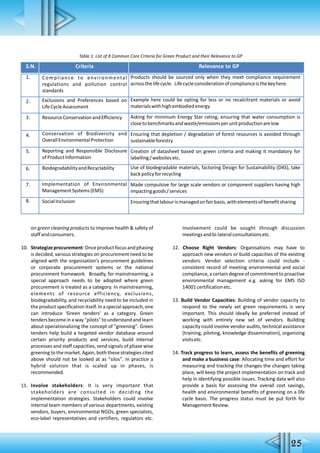
  • 6.
    100 Smart Cities:Is It Possible? Surekha Kotla Interim Country Director, India, Institute for Sustainable Communities skotla@india.iscvt.org Context Globalization has moved us towards global uniformity, and our cities have become centers of economic growth that disseminate knowledge, technology, and culture. In 2008, for the first time in history, half of the world's population was living in urban areas, and it's predicted to reach 70% by 2050. Given that such a huge human population will live in cities by 2050, sustainable urbanization is the need of the present for thefuturetobepossible. In India at present, 377 million people (31% of India's population) are living in urban areas. In the next 15 years, this will increase by another 157 million and by yet another 500 million by 2050, by then more than half of the country's population will be living in urban areas for the first time. More than 70% of urban people live in 468 cities/towns with more thanonelakhpopulation. The share of GDP from urban areas in India has been growing consistently. The urban population is at 31% of the total population, and it contributes 60% of India's GDP. It is also projected that urban India will contribute 75% of the national GDP in the next 15 years. For this reason the cities are also referredtoasthe“enginesofeconomicgrowth.” NeedforSmartCities Tobeabletomanagetheincreasedrateof urbanization,cities need smart infrastructure, smart administration of services, smart businesses and smart citizens with better technological capacity. These values, along with other social values, such as integration, transparency, equal participation, social cohesionandsustainability,willleadtomorelivablecities. Today, cities face a long list of challenges: wanting governance, unaffordable housing, long hours of commute to work, burdened suburban transportation systems, encroached footpaths, bad roads, poor quality and supply of water, high electricity prices, and unmanageable waste, continuous influx of population, and upscale residential areas facingpoorlyadministeredurbanslums. In India, different cities have different needs. All the major cities have reached a stage of maturity and saturation in whichaginginfrastructurerequiresretrofitandupgrades,and where high value-added services need to be provided to residents. Some cities are in a growth phase and require ongoing expansion and new infrastructure. These differences make it important to look at cities in terms of their lifecycles, and to manage urban development appropriately by taking a long-termapproach. Howdowegothere? We know where we are currently, we know where we want to go, but the question we need to collaboratively try and answerishowdowegothere? In this context the Modi-led new Government announced its plan to develop 100 "Smart Cities" across India. The Finance MinisterstatedinhisbudgetspeechofJuly2014: "As the fruits of development reach an increasingly large number of people, the pace of migration from the rural areas tothecitiesisincreasing.Aneomiddleclassisemergingwhich has the aspiration of better living standards. Unless new cities are developed to accommodate the burgeoning number of people, the existing cities would soon become unlivable. The Prime Minister has a vision of developing 'one hundred Smart Cities', as satellite towns of larger cities and by modernizing theexistingmid-sizedcities." Some cities will be made smarter, and some new cities will be designed smartly from the beginning. A common goal of smart cities is to provide cost efficient services to their residents. Another goal is to make cities that are attractive, vibrant, and environmentally friendly. As environmental and energy problems grow increasingly severe, and the need for sustainable growth increases, smart cities will have to be designedanddevelopedsustainably. Fundingof"SmartCities"Initiative The Indian Finance Minister announced a funding requirement target of INR 70,600 million to help create 100 4
  • 7.
    5 1 The KfW, formerlyKfW Bankengruppe, is a German government-owned development bank, based in Frankfurt. smart cities (US$113 billion). It is expected that most of the infrastructure will be taken up either as complete private investmentorthroughPublic-PrivatePartnerships. Additional incentives may come in the form of a capital expenditure subsidy for projects via a 'Viability Gap Funding' (VGF) mechanism, which involves an up to 90% reduction in project cost for cities in hilly areas and 40% reduction in project cost for cities on the plains. This is a mechanism that has also been used in recent phases of the National Solar Mission. There have been many announcements of inward investment intoIndia:  USA: $41 billion Private investment pathways into India; partnership on clean water & solid waste management for 500cities  Japan:$35billion-MixofPrivate&Publicinvestment  China:$20billion-MixofPrivate&Publicinvestment  1 Germany (KfW ): EU 1 billion on solar capacity for next ten years  Asian Development Bank (ADB): $2.5 billion to establish 5 Industrial Zones for Andhra Pradesh, $63.3 million for NorthKarnatakaUrbanSectorInvestmentProgram There is a tremendous interest already generated over the project since its announcement and now every Tier I, Tier II, and Tier III cities want to become part of the Smart City project. While the majority of existing cities will be developed as Smart Cities, some new cities will also be carved out of new regionstobepartoftheproject. What is a Smart City, and what are its building blocks? At its fifth meeting in June 2014, the Focus Group on Smart Sustainable Cities (FG-SSC) at International Telecommunication Union (ITU) is the United Nations specialized agency for information and communication technologies-ICTs. ITU agreed on the definition of Smart Sustainable City which readsasfollows: “A smart sustainable city is an innovative city that uses information and communication technologies (ICTs) and other means to improve quality of life, efficiency of urban operation and services, and competitiveness, while ensuring that it meets the needs of present and future generations with respecttoeconomic,socialandenvironmentalaspects.” But building a city that fits this definition is no easy task. Cities are complex, interconnected systems of people, transit, buildings, schools, healthcare, energy, water, wastewater, and much more. Inadequate municipal budgets, aging infrastructure, and a lack of vision, planning, and coordination can pose significant challenges. These challenges can be addressed through comprehensive planning and a holistic approach to designing and developing a city. Technology can ensure that systems are interconnected, data is collected and analyzed, and can help assess how resources are being deployed and utilized. In short, steps are taken to make the city operate more efficiently, more intelligently, and more sustainably,whileimprovingthequalityoflifeforitscitizens. Four main building blocks and components of a smart city are listedinFigure1. SmartEconomy In building an ecosystem of a smart city, it's essential to develop a business case. Unless there are opportunities and resources for attracting existing businesses, or setting up new businesses, it'll be a daunting task to mobilize investments for these smart cities to become a reality. No sensible investor invests, no sensible banker finances and no sensible builder constructs an infrastructure that won't fetch decent returns on investment. The other important question to be answered or analyzed is how soon a smart city can mature to start giving returns to its stakeholders. Firstly, a smart city is possible only if it makes an economic sense. It is important for a city to have business support infrastructure such as special economic zones, industrial parks, and IT parks with access to its supply chain and markets tofacilitateitseconomicdevelopment.
  • 8.
    6 India is oneof the most cost-competitive nations as far as production is concerned and is strategically in a better position to realize a large share of global opportunities. What adds to its advantage is availability of cost efficient, educated and skilled manpower. Challenge for the smart city planners wouldbetomotivateandmobilizethehumancapitaltothese smart cities. In China some cities that were built on the smart city concept have now become ghost cities. For example, Kangbashi was meant to be the urban center for a wealthy coal-mining community and home to its one million workers, but its roads are eerily empty and the houses stand vacant. Zhengzhou New District is China's biggest ghost city, completewithentireblocksoftotallyemptyaccommodation. In this context, the presence of business incubators would be essential to facilitate innovative thinking, promoting entrepreneurs, and facilitating a conducive environment that'll enable them to enter the local and global markets and stay competitive in the market. All said and done, there are 2 risks involved which should be equally shared by the stakeholders, be it government, businesses, investors, entrepreneurs, and people. Public Private Partnerships are essentialtoimplementsuccessfulsmartcitiesprojects. SmartInfrastructure A city can be termed smart only if it has smart infrastructure to provide and support basic services for its inhabitants such as transportation, smart grids and smart energy solutions, water management systems, better waste management systems, health care, e-governance, e-education, and utility services. Smart infrastructure will also facilitate transparency andefficiencyintheGovernmentprocesses,onlineprocesses forobtainingapprovals,andvariouscitizen-centricservicesto make citizens feel safe and happy as they get value for the taxespaidandtheinvestmentsmadeintheseprojects. Globally, IT and other technologies are being developed to address a range of issues, including energy management, water management, urban mobility, street lighting, and public safety. For example use of wireless communications, sensornetworks,dataanalytics,andcloudcomputingisbeing used to provide better and intelligent services to people. Operationaldatacanbecollected,analyzed,andtranslatedto provide smart services. Collected data can also be utilized to assess and forecast demand, and supply patterns of the city. This will help maintain a balance between supply and demand. Smart Economy Smart Infrastructure Smart Governance Smart People  Business case for a smart city  Investments  Public Private Partnerships  Business Incubators  Special economic zones/Industrial parks, Business parks  Skilled Human Capital  Employment  Access to markets (local & global)  ICT in businesses  Support for entrepreneurs  Green buildings  Smart Mobility  Accessibility  Integrated Systems to manage  Energy  Water  Waste  Healthcare Services  Utility Services  Policy framework  e-governance  Efficient administration of basic services  Accountable  Transparent  Citizen Centric  Inclusive  Safety & Security of people  Climate Resilient  Education & Training  Equal Participation  Inclusive Society  Equity & Justice  Responsible towards environment  Culture & Identity Figure 1 2 Risk such as: Huge investments (long pay back periods), Operational Risks (cyber-attacks), and Policy Risk (unstable policy framework)
  • 9.
    7 Mobility from oneplace to another is at the core of a "Smart City". Seoul, Singapore, Yokohama and Barcelona (all considered Smart Cities) have a sound transport system as the core of their "Smartness". A traffic system supported by ICT to collect data from sensors located at traffic signals could determine traffic conditions, and also collect information on car locations and speeds to better manage the traffic and enforcesafedrivingpractices. For Indian cities to become engines of economic growth, it is important that goods and services are able to move from factories to its consumers at low cost and high speed. Therefore efficient mobility is the key to a smart city. These approachesareessentialfromIndianperspective;  Improvements in public transport - Suburban rail, Metro Rail,BRT,Monorail,Tramsetc.  Improvements in infrastructure of other motor vehicles - ring roads, bypasses, underpasses, elevated roads, improvementsintheexistingroadways  Improvements in infrastructure for walking, cycling and waterways The huge amount of data collected opens up possibilities for innovationsandnewservicestoimprovethequalityoflifeina smart city. In addition to commercial innovations, health and welfare services can use the data to better focus their limited resources on those most in need. This open approach to use ofdataprovidesbothpublicandpersonalbenefits. DigitalDivide One of the key issues with data driven decision making in cities is that it often leaves out the poor and disproportionatelytiltsservicestowardthewealthy.InIndiaa dividebetweentherichandpoorhasexistedfromtheancient times. As information technologies become the primary, sometimesexclusive,meansofcommunicationinoursociety, a massive digital divide is bound to happen unless we plan smart policies for smart cities to promote an inclusive social and economic growth for all. In my opinion, in a smart city, access to information and technology will become necessary foracitizentoexercisebasichumanrights. GreenBuildings Buildings will be a very important component in Smart City infrastructure. According to Centre for Science and Environment,  Buildings in India consume around 40 percent of total energy generated,and20percentofwater  Buildings in India generate 40 percent of the carbon emissions, 30 percent of solid waste, and 20 percent of water effluents  Buildings in a smart city should be designed and built to greenbuildingstandards. The Indian Green Building Council is already doing great work in this direction. Globally there are different standards for green buildings. It is estimated that India can save around US$ 42 billion every year with efficient management of lighting, heating, air-conditioning, etc. (McKinsey & Company). Smart building technologies reduce maintenance costs by 10-30 percent, and enhance the comfort, health and safety of the occupants. Asanillustration,acasestudyofIBMhasbeendiscussedinBox1 toexplaintheroleofcorporatesinmakingcitiessmart. Box 1 Case Study: IBM and its role in making citiessmart In the utility sector, IBM has "smart grid" programs under way with several governments and companies, using sensors, software and computerized household meters to maintain power lines and reduce energy consumption. In the U.S.A, Brazil, and China, IBM is collaborating with The Nature Conservancy on the Water for Tomorrow project, which is monitoring and creating computer modeling for large river basins to helpguidelanduseandwaterpolicies. At a National Conclave on Smart Cities, Minister of Urban Development and Housing & Urban Poverty Alleviation, Shri. M. Venkaiah Naidu, recently said that effective urban governance should aim at prudent utilization of natural resources, minimum waste generation, recycling, water harvesting and efficient energyuse. Governance has been one of India's biggest challenges to date. The current governance structures do not encourage citizen participation. People do not get the feel of ownership of their city. In this context, smart governance has to start with active Government and Citizen Participation in decision making processes using technology and other social networking platforms. This will enable a new relationship between local
  • 10.
    8 governments and citizens.There has to be a combination of top-down and bottom-up approaches. City officials' engagement and drive of participatory conversations with citizens, and citizen conversations, participation, and feedback to be used by city officials for informed decision making. Smartgovernance would also mean smart policiesto provide the framework enabling smart cities to come to existence. Existing legal frameworks and policies that regulate the urban sector need to be reviewed by the state and urban localbodiestoseewhatchanges,ifany,arerequired.Referto Box2. Box 2 Excerpt from the examples of policy revisions recommended in the draft smart city concept note preparedbytheMinistryofUrbanDevelopment:  Floor Area Ratio norms need to be rationalized and made more granular rather than city wide, to allow very high densities to be interspersed with adequategreenareas;  The existing Urban & Regional Development Plans Formulation and Implementation Guidelines (URDPFI) need to be updated to reflect the higher standardsexpectedinasmartcity;  The current standards for water supply, sewerage and drainage need to be reviewed to aim at higher standardsexpectedinasmartcity;  Framework related to investment by the private sector need to be reviewed so that a higher level of privateinvestmentinurbaninfrastructurebecomes possible;  Framework for making changes in land use need to bereviewedandproceduressimplified,buildingby- lawsneedtobecitizenfriendly. ClimateResilience India's geographic location and its demographics make it vulnerable to various climate change events, natural disasters, and other man-made events. How collective decisions are made, interpreted, implemented, challenged will enable or impede a country's resilience ability. By utilizingtechnology,thelocalgovernmentsandthecitizens can be better informed, connected, and prepared to respond to such extreme events. A smart city has to integrateresilienceintoitsdesigntobesmart. SmartPeople The differentiating element between a city and a smart city is smart people. "Smart leadership and smart people are essential prerequisites for making cities smart," noted Minister of Urban Development and Housing & Urban Poverty Alleviation Shri. M. Venkaiah Naidu. Prime Minister Narendra Modi's 100 Smart Cities initiative is an example of how smart leadership can make smart ideas possible. It is a daunting task to implement and make the 100 smart cities possible unless we as people decide to be smarttomakethesesmartcitieshappen. One of the key issues with data driven decision making in cities is that it often leaves out the poor and disproportionately tilts services toward the wealthy. As information technologies become the primary, sometimes exclusive, means of communication in our society, a massive digital divide is bound to happen unless we plan smart policies for smart cities to promote an inclusive socialandeconomicgrowthforall.Inasmartcity,accessto information and technology will become necessary for a citizentoexercisebasichumanrights. Smart governance and smart people, both play an equally important role. With good leadership and responsible citizens who participate, collaborate and work with the government,100smartcitiesarepossible. References:  Concept note on Smart Cities by Indian Smart Cities Forum underMinistryofUrbanDevelopment.  http://www.dailymail.co.uk/news/article-1339536/ Ghost-towns-China-Satellite-images-cities-lying- completely-deserted.html#ixzz3PXNap3w4  http://sustainablecitiescollective.com/david- thorpe/1005851/indian-business-leaders-slam- government-bad-guidelines-smart-cities-and-proposev  http://www.nytimes.com/2009/04/30/business/energy- environment/30smart.html?pagewanted=all&_r=0  http://indiansmartcities.in/downloads/Press_release_12 9141.pdf  http://thekarmayogi.com/smart-cities-smart-people- india/
  • 11.
    9 Sustainable & SmartCity: Case of Gujarat International Finance Tec-City (GIFT) Prakash Gaur Vice President, IIDC Ltd. prakash.gaur@ilfsindia.com Background Gujarat International Finance Tec-City (GIFT) is a globally benchmarked International Financial Service Centre (IFSC) developed by Government of Gujarat (GoG) through Gujarat International Finance Tec-City Company Limited (GIFTCL), a joint venture between its undertaking Gujarat Urban Development Company Ltd. (GUDCL) and Infrastructure Leasing & Financial Services Ltd. (IL&FS). GIFT is a global Financial and IT Services Hub, a first of its kind in India, designedtobeatoraboveparwithglobalfinancialcenters. VisionandPositioning GIFT is positioned as a Global Financial Hub and is being characterized to be a Central Business District (CBD) developed on "Smart and Sustainable Development" principles for international and domestic financial services thereby acting as a catalyst for all round development in the entire region and thus holds very high economic and strategic significance. The vision of GIFT Project is - "To develop a global financial hub for international and domestic financial services which will serve as a paradigm for next class development in terms of quality of life, infrastructure and ambience, utilizing land as apreciousresource." GIFT's vision and its value propositions for development, business and living are the driving factors in defining and implementingSmartCity. MasterPlanforDevelopment GIFT is a green field development and is located at a distance of about 12 kms from the Ahmedabad International Airport and 8 kms from the State Capital City, Gandhinagar. The site is in close proximity to the National Highway (NH8) and Expressway and connects Ahmedabad and Gandhinagar. The western periphery of the site abuts the Sabarmati River. The master plan incorporates planning along the Sabarmati River with green belts interspersed between city and neighborhood areas. It incorporates features to achieve a pleasantblendofqualitylifeandbusinessenvironment. As an integrated smart city development, it will host facilities for sustainable 'business' and 'living' on 886 acres of land including Multi Services SEZ (Special Economic Zone) of 261 acre and Domestic Tariff Area. GIFT SEZ is the only Multi Service SEZ with International Financial Services Centre (IFSC) statusinIndia. Commercial development is the primary focus of development with major built up space dedicated to offices for various target business segments of domestic and international financial services, general business and commerce, retail, district center, community center, local shopping, hotels etc. Due emphasis is given towards essential housing facilities, which shall be provided in the form of studiosandapartmentsforemployeesworkinginGIFT. The provisioning of quality infrastructure shall play a pivotal roleinsupportingthebusinessenvironmentandqualityoflife in GIFT Area. The highest quality of infrastructure and level of services is being developed and provided for GIFT. The services provided are comprehensive with higher service levels and planned delivery. A judicious combination with the latest technology and global best sustainability practices in infrastructureservicedeliveryarebeingprovided.
  • 12.
    GIFT is supportedby state-of-the-art internal infrastructure. The infrastructure components include transport infrastructure along with excellent external connectivity by roads and proposed Mass Rapid Transit System (MRTS), Bus Rapid Transit system (BRTS), etc., power receiving station, emergency supply and distribution infrastructure, district cooling system (DCS), water supply and treatment, sewerage collection and treatment, solid waste management by automated waste collection and transportation system with centralized waste handling facility, domestic gas, ICT (Information and Communication Technology) services, utility corridor, fire fighting system, city central command and controlcenter. The key environmental and social features of the infrastructure components that needs a mention here are the following: (a) Transportation: A transit oriented development is planned that would encourage usage of public transport, which would reduce the greenhousegasemissionsfromtraveltowork in GIFT City. The city would aim at zero fatal accidents. (b) Energy efficiency through District Cooling Systemand Solar PV Plants: The efficiencies gained by central chilled water facilities result in lower overall energy consumption, increased reliability, increased diversification of cooling load, and reduced environmental impact. The cooling requirement of GIFT would be met by District CoolingSystem(DCS)thatwill supply chilled water to the buildings from a centralized chilling plant. A 10 MW solar PV plant has been installed within GIFT City on pilot basis. Similar plants with higher capacities may be installed in futureasGIFTCitydevelops. (c) Water and wastewater management: Water and..... wastewater issues have been addressed by employing various measures such as: (a) Installing SCADA system for improving overall efficiency of utility services including water supply. (b) Recycling and reuse of treated sewage for various purposes such as district cooling, landscaping, flushing etc. The design vision for water infrastructure in GIFT is to providepotablequalitywaterinalltapsinthecityand being "Water Neutral". All wastewater generated fromdomesticandcommercialusewillbecollectedand sent to a centralized Sewage Treatment Plant (STP) in utility area. The treated sewage is planned to be reused for various purposes such as district cooling, landscaping, flushing etc. aiming GIFT a "Zero Discharge City". (d) Solid Waste Management: The value improvements for the system includes minimizing human intervention in the process, reduce adverse environmental & health impacts, improving the aesthetic value of the project in the long run. The chute system shall be provided in each building for collection of waste to minimize human intervention. Automatic waste collection system (AWCS) is planned to be incorporated in buildingdesign. All solid waste collected through AWCSwillbecollected centrally and treated before disposal. 10
  • 13.
    11 (e) Green andsafe city: For reducing urban heat island effect, measures have been undertaken such as contiguous landscape planning (green cover) in preparationofthemasterplanforGIFTCity. Eachofthe building in GIFT shall be equipped with Intelligent Building Management System (IBMS) and sameshallbe connected to central control and command centerto provide interface between user and utility service providers. The IBMS monitors fire, energy, HVAC, lighting, access, closed circuit television andelevator. (f) Disaster management: Firefighting provisions have been mandated for all buildings which comprise of fire detection, early warning, firefighting equipment and evacuation routes. During preparation of the master plan for GIFT City, the risk has been addressed through design of storm water drainage around and within GIFT City. Central Command Center has been planned to control various services, provide security and assistance indisastermanagementandemergencysituations. Further, the social infrastructure planned is such that it promotes: wellness for the whole community, recreation, health,education,safetyandsecurityforthecity. The General Development Control Rules (GDCR) for GIFT City has incorporated all requirements applicable to buildings for human comfort and safety including mandating LEED certification of all buildings by developers. Refer to Box 1 for some of the urban design objectives achieved at master planning,blockandbuildingscales. As a result of sustained efforts towards creating a smarter environment, GIFT City has been conferred as “Smart City of Future” by Cisco Technology Award 2014. In August 2012, GIFT won the most prestigious award in the category of 'Best Industrial Development & Expansion' at the 'Infrastructure Investment Awards - 2012' organized by World Finance Group based in London. GIFT Project was considered of world class value in terms of its potential for enabling economy growth in the region – through the relocation and centralization of India'sfinancialandITsectors. GIFT would have multiplier effect on the Indian economy. It is estimated that GIFT infrastructure (development and operations) would provide 500,000 direct and an equal number of indirect jobs. The demand of various infrastructures (commercial, residential, schools & colleges, medicalfacilities)insurroundingregionofGIFTisenvisagedto boom. Box 1 Smart and Sustainable Development Masterplanningscale:  Due emphasis given on creation of open & green area for public purpose and ensuring hierarchical distributionofopenspace  For legible and coherent urban form, master planning included careful distribution of building types accordingtouse,heightsandcharacter  Landscaping has been an integral part of master planning and ample provision of open space has been provided  Transit oriented development included distribution of overall density by minimizing distances between transportnodesanddestinations  Defined building footprints aided development withoutboundarywalls  Pedestrian friendly urban space created which are contiguous Blockplanningscale:  Provisions were made for tree lined shaded pedestrian walkways, plazas dotted with small scale amenities such as gardens, street lighting, communicationnetwork,electricsupplyetc.  Large percentage of the block area was dedicated to openandgreenspace  Guidelines for landscape, illumination and signage were followed for creating a sense of harmony in publicspace  Facade guidelines were followed for making facades porousandinteractive Buildingplanningscale:  Responsive built environment achieved through defined extents of building envelopes, defined ingress-egressprovisions  Buildings were made climate responsive through mandatory green certification in addition to prevention of glass facades on south and west directions  Building, transport and infrastructure were efficiently coordinated  Open spaces within buildings were encouraged, for exampleskygardens The above list of initiatives continues to get appended and guidelines continue to mature through market response analysis,validationprocessandtechnologicalvalueaddition.
  • 14.
    Catalyticurbanizationcoupledwithquicksilverinfrastructural development, an exodusof populace into metros for better lifestyles and careers - India's growth curve is moving ahead rapidly. Yet, such exponential growth can continue to happen smoothly only when the wealth of natural resources is harnessed, sensibly and carefully. Therefore, it is crucial to maintain a harmonious balance between all round progress and environmental stability. At Mahindra Lifespaces, we understand the need for sustainable economic growth. While participating in India's growth saga, we also want to emerge as the flag bearers for environmental sustainability. With this philosophy ingrained in our conscience, we espoused 'Green Design' and 'Healthy Living' as the foundations for all the projectsatMahindraLifespacesandMahindraWorldCity. 'Green Design' is our selfless way of giving back to the environment what we take from it. Splendidly showcased in our residential projects such as Aqualily, Splendour, Royale, Chloris, Eminente, etc., it is also evident in our commercial properties like Great Eastern Plaza, HDFC Bank, Great Eastern Centre and Mahindra Towers. Residential or commercial, all our structures are energy efficient, environment friendly and cost effective. So, while the environment revels in good health,peoplebaskintheglowofhealthylifestyles. Taking the motto of sustainability a step further Mahindra World City builds communities on the concept of "work, live, learnandplay." Mahindra Lifespaces specializes in real estate development and is an integral part of the Mahindra Group. Mahindra Lifespaces, as the name signifies creates spaces for healthy living, focussing on quality and true value offerings to customers. Mahindra World City spread across 4,600 acres has two Integrated Business Cities with futuristic amenities, facilities and numerous career opportunities that stem from the prestigious Multi-National Companies (MNCs) housed here. By improving lifestyles and work-styles, we strive to bringthebesttoourdiscerningcustomers. GreenInitiatives The present article discusses the initiatives that are taken while designing and planning our projects. Some of these initiativesarediscussedbelow- I Energy Efficiency: Use low emissivity (low-e) glasses for building fenestration (See Figure 1). It has high light transmission ratio with low shading coefficient and hence induces more day light effect than normal glasses. Due to low Solar Heat Gain Coefficient (SHGC), the entire fenestration system reduces the heat ingress thereby reducing the energy requirement for indoor air- conditioning substantially in comparison with normal fenestration. DesignedanddevelopedlowenergydensityFlyashbricks (see Figure 2) for internal as well as external walls of the buildings. The brick has been tested by Indian Institute of Technology (IIT) -Bombay and the average thermal conductivity is 0.19 W/meter Kelvin. These bricks envelope and protect the building from water leakage and act as a better insulator thereby reducing the energy demandforair-conditioning. Cover the terrace roof with high albedo insulating material having SRI (Solar Reflectance Index) value greater than 78 to reduce the heat absorption and energydemandforair-conditioning. Otherenergyefficientproductsusedare- - Use BEE 3-star rated products for external lighting and sprinklers in gardens to minimise the energy requirementofbuildings. - UseofCFCfreerefrigerantsinairconditioners - Use timer based sensors for external lights and sprinklersingardens All the above initiatives help achieve the energy efficiency in our buildings. Creating Sustainable Habitats @ Mahindra Lifespaces Amit Pal Sr. General Manager, Quality Assurance & Innovation, Mahindra Lifespaces Developers Limitted pal.amit@mahindralifespaces.com 12
  • 15.
    Otherthantheabovewehavecommissioneda75KWrooftop solar plant atMahindra World City, Chennai, a step towards harnessing green energy resource. This is expected to generate approximately 1,16,000 units (kWh) of clean electrical energy annually and offset emissions of nearly 60 tonsofcarbondioxideperyear. II. MaintainingHealthyIndoorEnvironmentalQuality: Initiatives taken to achieve healthy indoor environment qualityare- - Provide more open-able window space to floor ratio than the stipulated norms to improve the ventilation effectiveness. - Use of low VOC (Volatile Organic Compound) paints, adhesives and insulations inside the flat for improved moisture management. It also helps in increasing the occupantsproductivity. - Design in a way that day lighting for at least 75% of the regularlyoccupiedarea - Providecrossventilationbetweeneachdwellingunit III. PreservationandConservationofSoilandWater: Some of the initiatives that are observed in all our buildingsare- - We preserve the top soil during and post construction and build innovative erosion and sedimentation controlmanagementsystems - Rain water harvesting systems and storm water managementtorechargethegroundwatertable - Reuse of the treated wastewater for flushing and landscaping thereby reducing the municipal water demand - Lowflowwater faucets and fixtures in every flat of the residentialbuilding - Use drought tolerant species with xeriscaping in landscapingtoreducewaterdemandingardening IV. MaterialManagement: We prefer selecting the manufacturer and supplier from within a 250 km radial distance from the site. We give much emphasis to use of materials with recycled content withoutcompromisingonquality. V. WasteManagement: Someoftheinitiativesunderwastemanagementare- - All sites reutilize more than 75% of construction waste;theseareusedinbuildingroads&pavements. - An in-house solid waste management plant is constructed to take care of all the municipal waste. The waste is processed and recycled as manure and usedforlandscapingpurposes. - An in-house STP (Sewage Treatment Plan) is also constructedfortreatmentofsewage VI. LabourWelfare: During the time of construction, we not only provide basic facilities to our labourers but also additional facilitiessuchas- - Establish informal schools and crèches aimed at providing basic education and a safe environment for children of construction labourers when the parents areatwork - Imparting vocational training to labourers in trades like electrical maintenance, electronic goods repair, computer fundamentals, garment design & stitching, beautytreatmentandhairdressing - Conduct health campsin labour camps (i) vaccination camps for labourers and their family members (ii) Regular health check ups and mobile medical facilities. CaseStudy:'MahindraChloris', Faridabad We employed most of the above mentioned initiatives in one of our projects 'Mahindra Chloris', Faridabad which is Platinum rated under the CII - IGBC green home rating system (India's second completed residential development to achieve the highest rating in the multi-dwelling units category). The following impacts have been measured for Mahindra Chloris, Faridabad as per the IGBC Green Homes Rating systemduringthedesignphase. EnvironmentalImpact: - Reduction in energy demand upto 144 KW as 80% requirement for hot water is met through solar water heatingsystems
  • 16.
    - Reduction inenergy demand upto 11.34 KW through solarstreetlighting - Reduction in GHG emissions as more than 90% of the construction material is purchased within a radius of 250 kmfromthesite - Reduction in water consumption as 100% of the waste waterisreusedposttreatment - Water conservation due to rain water harvesting systems for100%oftherunoffvolumefromtheroof - Reduction in fresh water use of more than 30% due to installationofwaterefficientfixtures - Reduction in waste as more than 75% is reused within the site EconomicImpact: - Savings in energy upto 20% as green homes are more efficientthantheirconventionalcounterparts - The company was able to negotiate Home Loans for its customers from State Bank of India (SBI) at 0.25% less than the prevailing interest rate resulting in an economic benefittothosecustomerswhoavailedthisfacility. SocialImpact: - Improvement in the quality of living of all contract labourers due to the provision of healthy dwelling facilitiesintheformoflabourcamps - Improvement in health due to regular health checkups andmedicalcampsforlabourers ConcludingRemarks Developing green buildings for achieving mere 'ratings' is not an end in itself; instead, it is the beginning of the journey towardsahigherpurposeandalargerend. It is a myth that 'green necessarily means higher cost'. It was realized that an innovative approach and application of technologycoupled withstretched targets and fixed timelines can not only create opportunities for innovations, but also savecapitalcostaswellaslife-cyclecosts. The measure of our success is not the 7 million sq. ft. of projects we have completed nor is the ongoing over 8 million sq.ft. of new projects under construction. Instead, it is the smileswecreateoneveryfaceandthelivesweimprove. References  http://www.mahindralifespaces.com/mlyf_corp_aboutus.as px  Yan Ji and Stellios Plainiotis (2006): Design for Sustainability. Beijing: China Architecture and Building Press. ISBN 7-112- 08390-7  Mayra Portalatin, Kristina Koepke, Maureen Roskoski and TeenaShouse(October2010):GreenBuildingRatingSystems 14
  • 17.
    15 Indoor Environment qualityand occupant well-being in India: A paradigm shift Priyanka Kulshreshtha and Geetika Mishra Department of Resource Management and Design Application Lady Irwin College, Delhi University, New Delhi Just a week back I was asked to review a book for an undergraduate course in environmental science. Since my area of research has been air quality ,I promptly jumped on to the section of air pollution .The author had talked in detail about the treacherous air pollution playing havoc in metro cities of India and provided terrifying data on the mortality rate due to ambient air pollution, which with due respect, I agreed to. However, to my surprise, not a single mention was made about the importance of indoor environmental quality in modern India. This incident is enough to tell us about the level of awareness and status of research on indoor environmentalqualityinIndia. Indoor Environment Quality (IEQ) is one of the important factors for ensuring health, comfort, safety and productivity of the population. It refers to the quality of environment inside the building that is determined by many factors such as indoor air quality (IAQ), thermal comfort, lighting quality, acoustic conditions as well as furniture and space layout. Research has linked the concentration of pollutants indoors with productivity, sense of well being and occupant's health. In the long term, poor IEQ may give rise to a set of symptoms and health problems to the occupants of the building collectively known as Sick Building Syndrome (SBS). The various symptoms associated with SBS are irritation of eyes, nose and throat, headache, cough, wheezing, cognitive disturbances, light sensitivity, gastrointestinal distress and other flu like symptoms. The factors inducing SBS in an enclosed environment could be uncomfortable temperature and humidity, chemical and biological pollution, physical condition,andpsychosocialstatus. The concept of IEQ was born in urban India around the initiation of the term 'green' building brought on by LEED (Leadership in Energy and environmental design) almost a decadeago.Ironically,astudywhichcomparedthesymptoms of SBS in different categories of LEED certified buildings, concluded that LEED certification had no correlation with the SBS symptoms and making the buildings 'green' did not reduceSBSsymptoms(Mohan2012). Fig 1: Factors affecting IEQ and health (Source: Singh J. 1996) Maintenance Moisture Poor ventilation Building operation and users 'Perception' of indoor air quality Thermal comfort Construction materials Indoor microclimates Internal furnishing Outside air Indoor Environment and health Geographical distribution Dust Seasonal variation Organic materials Occupancy Management Temperature Design and construction Building services
  • 18.
    The thrust areasin IEQ then started concentrating on IAQ, which is a sub-set of IEQ. Some of the pollutants of concern in indoor environment, include respirable suspended particulate matter (RSPM), asbestos, Radon, environmental tobacco smoke (ETS), volatile organic compounds (VOCs) and formaldehyde. It has been proved consistently that children under five years of age in developing countries are at a higher risk of chronic obstructive pulmonary diseases, acute respiratory infections and mortality. In order to ascertain a healthy IAQ, some countries like Canada, Japan, Korea, Singapore, Sweden, UK and USA have established international standards. But, India has no such standards developed for IAQ and sadly, the country's top advisory body, the Planning Commission wants more epidemiological studies to agree on national indoor air pollution norms and are in no hurry to do so despitethefactthatabout1.3milliondeathsinIndiaare attributed to indoor air pollution. On the other hand, the vulnerability of the population to air pollution related diseases in the Indian sub-continent is very high due to higher exposure to the air pollutants both in the indoorsaswellasoutdoors. In developing countries like India the major source of energy at the household level is acquired through the burningofcoalandbiomassintheformofwood,animal dung and crop residues. On a global scale, it is also the largest source of indoor air pollution. In simple cooking stoves, toxic pollutants are emitted in the substantial quantities. Often, the food is cooked in an open combustion scenario and no chimney is used to minimize the indoor suspension of air pollutants. There is no provision of ventilation in the kitchens, especially in the cold climatic conditions. The incomplete combustion of biomass fuels leads to very high levels of indoorairpollutionandthemostvulnerablearewomen andchildren. Currently India is facing an air quality crisis and research has revealed horrific results that two Indians die every minute due to air pollution. Keeping in mind India's heavy dependence on wood and biomass as domestic fuel, Government of India initiated the National Program on Improved Chulha (NPIC) in 1984-85. It is aimed at popularizing the use of improved cooking devices in rural areas of the country. The secondary objectives of the program involved reducing the drudgery for rural women and to create income- generating opportunities. This has played a role in improving the IAQ of rural households to some extent. In the same way many non-government organizations haveworkedontheimprovementofcookstovesinrural areas. For example, in Bundelkhand 980 improved chimney cook stoves (Sukhad stoves) were distributed resultingin70%reductioninCO concentrationand44%2 reduction in PM concentration. In urban areas, factors2.5 like fuel adulteration, vehicle emission and traffic congestion also contribute to indoor air pollution. As the diffusion is lower, the concentration of pollutants increases and other building factors also add to the ambient pollutants. In terms of air pollution, India is ranked highest amongst the world's most polluted countries. A major intervention that needs to be brought to the forefront to tackle the problem of indoor air pollution is to sensitize the masses regarding its severity and magnitude. This would enable policymakers to recognize its importance in indoctrinating it as a mandate. More cohort studies need to be carried out to understand the epidemiology of indoor air and relevant impacts to human health. Prevention will be the key rid this menace and placing both ambient air and indoor air as high priority research areas would help address the challenge. Smaller steps, but consistent ones, need to be taken for India to have a national set of standards for healthyindoorairquality. 16
  • 19.
    E-waste is discarded,damaged and obsolete electrical and electronic equipment such as mobile phones, IT equipment, household appliances etc. It is one of the fastest growing waste streams in the World. Increase in disposable income, rapid improvements in technology and competitive prices of electronic goods have exponentially boosted the electronics market while consequently generating e-waste at the end of theproducts'usefullife. In 2014 the total amount E-waste generated globally was 41.8 Million Metric Tonnes per annum (MMTA); forecasted to 3 increase to 50 MMTA by 2018 . In India, E-waste is expected to increase at a compound, annual growth rate of 30% 4 between 2016 and 2020 . Figure 1 below shows the estimated annual generation by various organizations over theyears. CPCB–CentralPollutionControlBoard;MAIT-Manufacturers Association for Information Technology; ELCINA – Electronics Association of India; UNU – United Nations University; ASSOCHAM-AssociatedChambersofCommerceandIndustry ofIndia E-waste contains hazardous substances like lead, mercury, cadmium, arsenic and other metals that are being rapidly depleted and that are environmentally harmful when disposedunscientifically.Ontheotherhand,E-wastecontains metals and plastic components that when extracted, have high re-use potential and economic value. This makes the business of E-waste Management a very lucrative proposition. E-WasteManagementPolicyofIndia Until 2011, there was no dedicated E-Waste Policy in India. E- waste was covered under the Hazardous Wastes (Management and Handling) Rules, 1989. E-waste is primarily handled by the unorganized (informal) sector or kabadiwallahs who follow crude and unsafe methods to dismantle and recover valuable components from e-waste. This has resulted in environmental degradation as well as poor health of the informal sector workers. In addition, there is wastage of precious resources due to inefficient resource recoverytechniquesbeingused. Over the years, collaborative effort and pressure from groups such as MAIT, Greenpeace and Toxic Links culminated in the introduction of E-waste (Management and Handling) Rules, 2011 to channelize E-waste for environmentally sound recycling by the formal sector. The Rules defined key stakeholders like Regulatory Agencies (CPCBs/SPCBs), producers of electrical and electronic equipment (EEE), recyclers and consumers and also their roles and responsibilities. An important strategy introduced was the Extended Producer Responsibility (EPR). EPR was introduced for effective E-waste Management (EWM) and action by EEE producers to establish an operationally and economically viable E-waste management ecosystem. EEE producers are responsible for financing and developing environmentally sound'endoflife'managementsystemsfortheirproducts. The 2011 rules were superseded by the 2016 rules to include more stakeholders (like manufacturers, retailers, refurbishers), strengthen enforcement and monitoring, include penalties for non-compliance and training and safety forE-wastesectorworkers. E-Waste: An Urban Mine and an Untapped Business Opportunity Viibhuti Agarwal, Environmental Management Centre LLP vibhuti.ag@gmail.com 5, 8, 5, 1,2, 4 Figure 1: E-waste generation rates in India 3 Baldé, C.P., Wang, F., Kuehr, R., Huisman, J., (2015), The global e-waste monitor – 2014, United Nations University, IAS – SCYCLE, Bonn, Germany, Page 50 4 India's e-waste growing at 30% per annum: ASSOCHAM-cKinetics study, (2014), Online Source: http://www.assocham.org/newsdetail.php?id=5725; Accessed on nd Oct 22 2016 17
  • 20.
    E-Waste: An urbanmine and a lucrative business opportunityinIndia India is a massive consumer of electronics. In 2014-2015, 5 electronics worth $63.6 billion were consumed in India . These electronics will turn into e-waste at the end of their useful life. E-waste is an urban mine that contains iron, steel, copper, aluminum and precious metals like gold, silver, palladium and plastics. See Figure 2 for the extraction potential and value of resources from E-waste on a global 1 scalein2014 . In India, the monetary value of the recovered material from e- wastewas$4billionin2015andisexpectedtoincreaseto$20 billion by 2020.The materials can be recycled or re-used for manufacturing products while providing jobs to a large, otherwiseunemployed,workforceinthecountry. FormalvsInformalE-wasteBusinesses In India, 95% of the E-waste is handled by the informal sector 2 and only 5% by CPCB registered formal recyclers .E-waste rules mandate that all recyclers obtain authorization to recycle E-waste. This resulted in an increase in the CPCB registered (formal) recyclers from 23 units in 2011 of capacity 0.09 MMT to 138 with a capacity of 0.35 MMT . But there is still a very long way to go. The 2016 rules can further boost the valuable formal recycling sector and curb polluting informalsectoractivities. The pool of 138 recyclers is a mix of small, medium and large- scale enterprises and includes recyclers that started their business operations well before the E-Waste rules. They realized the economic potential in the E-waste business. It is interesting to note that the 138 recyclers / dismantlers are spread across only 13 States in India which implies that the E- waste generated in other States is collected and transported to these 13 States or is disposed of unscientifically. Some of the successful Indian E-waste Business examples are detailed below: E-ParisaraaPvt. Ltd. In 2005, E-Parisaraa started off as an R&D pilot plant that could process 1 ton per annum of E-waste in Bangalore. E- Parisaraa is one of the first movers in the sector. Its plant capacity has grown from 1 ton to 8,820 tons per annum. As a first mover, it engaged with major IT companies in Bangalore likeIBM,Inteletc.wellbeforetheE-wasteandEPRregulations cameintoplay.TheincentivefortheITcompaniesthenwasto comply with stakeholder demands and to document their socialandenvironmentalperformance. The services initially started with collection, dismantling and segregation and have now expanded to material extraction, gold and silver recovery, and lighting fixture component re- use. However, E-Parisaraa continues to export shredded PCBs and copper components to Umicore in Belgium for smelting and extraction. The company that was a pioneer in the industry and undertook R&D and education initiatives now facesstiffcompetitionfromotherplayersintheindustry. Ecoreco,EcoRecyclingLtd. Established in 2007, Ecoreco is one of more successful businesses in the sector. Its recycling facility is the first to be registered by CPCB. Ecoreco invited 100 corporates to their facility to showcase and encourage environmentally sound recycling. Ecoreco partnered with a logistics company to support their recycling and refurbishing business. Ecoreco Figure 2: Resource content and monetary value of E-waste generated globallyin2014 Material Weight in Tons Value in Million USD Precious Metals Gold 300 11,340 Silver 1,000 630 Palladium 100 1,960 OtherMetals Iron,Steel 1,65,00,000 9,810 Copper 19,00,000 11,550 Aluminum 2,20,000 3,490 Plastics Plastics 86,00,000 13,410 3 National Institution for Transforming India (NITI) Aayog, (2016), Make in India Strategy for Electronic Products, India, Page 2, st Online Source: http://niti.gov.in/writereaddata/files/document_publication/ Electronics%20Policy%20Final%20Circulation.pdf; Accessed on October 21 2016 4 th Ecoreco's CSR Plans & Partnership, (2016), Online Source: http://ecoreco.com/aboutus-csr.aspx; Accessed on Oct 25 2016 5 Rajya Sabha Research Unit (LARRDIS),(2011), E-waste in India, New Delhi, Page 5 & 99 nd Online Source: http://rajyasabha.nic.in/rsnew/publication_electronic/E-waste_in_india.pdf; Accessed on Oct 22 2016 6 Central Pollution Control Board, (2014), List of Registered E-waste Dismantler / Recycler in the country, India nd Online Source: http://cpcb.nic.in/Ewaste_Registration_List.pdf; Accessed on Oct 22 Oct 2016 18
  • 21.
    provides its clientswith onsite and offsite lighting recycling services. It supports manufacturers' with their EPR responsibilitiesviaitstake-backandrecyclingservices. E-waste Mukta Bharat (E-waste free India) Program - One of the key businesses challenges any recycler faces is collection of E-waste from the source of generation. Ecoreco recognizes that collection is the most crucial step of the E-waste management business strategy. To tackle this issue, Ecoreco launched a social program to set-up accessible E-waste collection centers for the masses. Ecoreco targets to install 100,000 bins and 5,000 Take Back Points (collection centers) across India by 2020 to help collect E-waste from corporates and the masses. In addition to the corporates, Ecoreco will installbinsinstrategiclocationssuchaseducationalinstitutes andplacesofworshiptoreachouttothemasses. Ecoreco's Franchise model: Ecoreco is inviting NGOs, recyclers, dismantlers, collectors, informal sector workers and young entrepreneurs to partner with them in the 'Ecoreco Take Back Point' initiative as a franchise. Every franchise should set-up its own Take Back Point, a facility of minimum 1,000 sqft, which will require an investment of $8,200orINR550,000. AtteroRecycling Pvt. Ltd. Founded in 2008, Attero'srevenue increased 8 times from $1 million in 2009-2010 to $8 million in 2011-2012. 85% of their revenuecomesfromsaleofre-usablepreciousmetalsfromE- waste. Attero has a wide collection network across the country with over 25 warehouses and collection centers across21states. With low-cost high efficiency technology that is relatively nascent in India, they recycle mobile phones, CRT and flat panel display units, batteries, PCBs and IT equipment. They refurbish mobiles and IT equipment and sell them under their brand, Gobol. To enhance their collection rates, Attero launched Atterobay, their e-commerce platform where consumers can sell their gadgets like smart phones with free shippingthatarerefurbishedorrecycledbyAttero. OperationsandBusinessmodel They collect 35% of their raw material from manufacturers or directly from their consumers, 35% from 500 large corporates who prefer Attero due to their nation-wide collection network and the remaining 30% from household or individual consumers via the informal sector. In order to streamline the informal sector, Attero educates them and incentivizes them by offering one and half times more value 9 ofE-wastethanwhattheywouldotherwisemake. GreenDust Founded in 2008, GreenDust is a reverse logistics company that collects and refurbishes electronics that are returned due to damage or defect by customers to their manufacturers or are collecting dust in warehouses. GreenDust had the first mover advantage since few companies had heard of or practiced reserve logistics. With a return rate of 4-6% in India, electronics worth $12-$15 billion are returned every year. GreenDust conducted a study that helped companies realize that the cost to get back a returned product was higher than its original value and demonstrated the value in tying up with 10 a reverse logistics firm. All the collected products undergo a 50-point quality check before being put up for re-sale with a GreenDustcertification. GreenDust has partnered with brands like Apple, Samsung, Dell, Philips, Whirlpool and retailers like Croma, Homehop18 to refurbish rejected or damaged electronics and re-sell them at a 30% lower cost than the market price. GreenDust's main customer base is Tier II and Tier III cities where people are vying for brands. In three years, the company set-up 200 stores and 14 warehouses and repair units across the country andboastsofacustomerbaseworth25crores. BusinessChallenges Inventorization, collection, channelization and efficient extraction of E-waste are some of the key challenges faced in thehandlingandmanagementofE-waste.Let'sbrieflylookat them: 9 th Online Source: http://attero.in/latest_news.php?link=%20115 ; Accessed on October 28 2016 10 th OnlineSource:http://attero.in/latest_news.php?link=%20115;AccessedonOctober28 2016 19
  • 22.
    Inventorization - Thereis no established and agreed upon methodology to conduct e-waste inventory on a national or state level. Various public and private organizations provide significantly varying annual volumes of generation. Issues like outflow to the informal sector, varying product obsolescence rates, lack of adequate data on product sales, storage and disposal makes inventorization an even bigger challenge. This issue is particularly challenging for E-waste businesses as unpredictable supply can lead to underutilized or insufficient recycling plant capacities; Collection & Channelization - Recyclers say that collection of E-waste is their primary business challenge. A mere 1.5% of the e-waste gets recycled 2 due to poor collection efficiency . E-waste is land filled, illegally burnt or handled by informal recyclers or stored for prolonged periods and does not get channelized for recycling affecting profit margins; High Efficiency Technology Availability - Manual extraction or burning of e-waste by the informal sector, technologies with poor resource extraction efficiencies lead to reduced profit. Many recyclers use inefficient technologies or export complex e-waste components. Some have developed their own technologies in-house. Importing high efficiency technology is a risk becauseofhighcapitalcostsandunreliablematerialsupply. Future Potential of E-waste businesses Given the rapid growth of E-waste generation in the country, penetration of the electronics market in rural areas, the evolution of E-waste rules, increased stakeholder responsibilities and local technology development there is immensepotentialtoset-upE-wastebusinessesallacrossthe country. The challenges mentioned above have to be addressed in order to make a business economically viable andsustainable.Box1includesexamplesofpotentialE-waste business models that can be successful in the current E-waste sectorlandscape: Box 1 – E-waste Business Models Model 1 - Business tied with Producers Practicing EPRandBusinesswithBulkConsumers A company can be set-up to provide EPR management services to EEE Producers that need to comply with EPR mandates such as Dell, HP, and Apple. They can start by helping the Producers develop an EPR management plan and assist in implementation. The company can use operational and financial instruments to incentivize bulk consumersandindividualconsumersandset-upa reverse logistics ecosystem. Contractual agreements with bulk consumers and economic incentives for individual consumers can abate the risk of unreliable materialsupply. Model 2 - Business tied with Software Technology ParksofIndia(STPI)andIndustrialparks(IP) STPI and IP are bulk generators of E-waste. Companies can set-up shop in an STPI (53 locations across India) or Industrial Parks in cities like Pune, Bangalore, and HyderabadwheretheycollectandprocessalltheE-waste generatedbytheorganizationsintheSTPIorIP. Model 3 - Business focusing on PRO that operates C o l l e c t i o n C e n t r e s w i t h P r o d u c e r s , Recyclers/Refurbishers A Producer Responsibility Organization (PRO) can be set- up as a co-operative of Producers who are obliged to meet their EPR. Companies that provide collection, dismantling, recycling and/or refurbishing services can operatethePRO.Producerscanpoolinfundstokick-start the process until the business becomes self-sustainable. Producers can benefit from this model by sharing their legislative, operational and financial responsibilities amongstallPROmembers. Model 4 - Business involving Informal Sector, their role&contributioninthevaluechain One of the focuses of the E-waste sector stakeholders like government, recyclers, NGOs is the integration of the informal sector into the formal sector. This strategy has the potential to arrest outflow of E-waste to the informal sector and also to improve the working conditions and health of the informal sector employees. Companies can beset-uptofocusonthebusinessoftrainingandbuilding capacity of the unskilled labor so they can become part of theformalworkforce. The above business examples and illustrations of potential business models demonstrate the high growth potential, economic potential and attractive profit margins in the E- waste management sector. Like in other sectors, E-waste businesses have their own set of challenges and business risks that need to be assessed and overcome to achieve success. 20
  • 23.
    21 Sustainability Priorities ofthe Cement Industry in India Philippe Fonta, Managing Director, Cement Sustainability Initiative, WBCSD 11 fonta@wbcsd.org India is one of the most important regions for the cement industry around the world, second only to China in terms of installed capacity. At the same time, the country is enhancing continuouslyitssustainabilityperformance. The World Business Council for Sustainable Development's 12 (WBCSD) Cement Sustainability Initiative (CSI) is working actively in various fronts of sustainable development for the Indian cement industry. 10 cement producers, including 3 India based companies and 7 subsidiaries of international groups,contributetotheencouragingresultsdeliveredbythe CSI'sregionalworkprogrammeinIndia. Being one of the most energy efficient performers amongst cement producers in the world, Indian cement producers are buildingnewplantswithlatesttechnologiesandthereisazeal to create the most efficient plants in the world. This is an industry which does not believe in resting on its laurels, but rather continues to relentlessly seek out newer, better and breakthrough technologies to further improve their performance. The Indian cement industry has successfully reduced total CO emissions from a substantially higher level2 of1.12tCO /tcementin1996toanindustrialaverageof0.7192 tonnes (t) of CO /t cement in 2010 (latest publicly available2 13 data) . CSI India plans to focus on managing safety and climate change issues initially, being consistent with the overall work program developed at CSI worldwide. It will progressively covertheotherissues,henceforth. Safety is the number one priority for CSI member companies A key priority area for CSI work globally and in India is Safety. Through the years, CSI members have made notable progress in improving safety and reducing fatalities amongst their employees. Having said that, companies around the world and in India agreed that more work is required to improve contractorandlogisticssafety. Ensuring safety of drivers and vehicles on roads continues to be a challenge for India as a country. India is one of the most densely populated nations in the world; its roads are often choked with traffic and have become increasingly perilous. In addition,roughly60to70%ofroadcrashesinIndiaarerelated to commercial vehicles and hence improving fleet safety management can contribute significantly to overall road 14 safety . CSI members in India are working collaboratively to put in place the highest standards of safety not only within their plant boundaries but also along their logistics chain, whiledealingwithvariouslocalchallenges. One of the high risk factors identified is fatigue and tiredness around driving. Unfortunately many drivers, particularly commercial drivers do not adequately realize the importance of this, or for various reasons do not take into consideration the impact of fatigue and tiredness during driving, and sometimes push themselves to the limit. To address this issue, the CSI India working group on safety has developed a document to highlight good practices for fatigue management. 11 Readers may contact Esha Sar, Coordinator (India operations), CSI at sar@wbcsd.org 12 CSI is an initiative of the World Business Council for Sustainable Development (WBCSD). CSI is a global effort by 24 leading cement producers, with operations inmorethan100countries.Collectivelythesecompaniesaccountforaround30%oftheworld'scementproduction(inIndia,CSImembersrepresentaround60%of thenationalproduction)andrangeinsizefromverylargemultinationalstosmallerlocalproducers.AllCSImembershaveintegratedsustainabledevelopmentinto their business strategies and operations, as they seek strong financial performance with an equally strong commitment to social and environmental responsibility. 13 GlobalCementTechnologyRoadmap:LowCarbonTechnologyfortheIndianCementIndustry,WBCSD-CSI,IEA 14 Source:GlobalRoadSafetyPartnershipwebsite:http://www.grsproadsafety.org/
  • 24.
    The safety workinggroup is also collaborating with transporters, drivers and companies of other industrial sectors to enhance safety awareness through training and motivation, to ensure better working conditions for drivers, better enforcement of regulations, and to improve the safety and quality of vehicles. A culture of knowledge sharing is promoted within the group, on both success stories and pitfalls, to help members learn from the good practices and mistakes of peers so to improve the overall safety performance. In addition, CSI India is collaborating with Global Road Safety Partnership (GRSP), which is working under the umbrella of the Red Cross and Red Crescent. Some local projects and initiatives are currently being taken with GSRP which will benefit CSI India and add to their knowledge experience. One such successful initiative is forming of a multi-sectoral discussions platform bringing together actors from the private sector, civil societies and governments, focusing particularlyonreducingroadcrashinjuryanddeath. Low-Carbon Technology for the Indian Cement Industry 15 Following the Global Cement Technology Roadmap developedin2009throughapartnershipbetweentheCSIand the International Energy Agency (IEA), CSI members in India joined hands with IEA in early 2013 to develop a 'Low-Carbon 16 Technology for the Indian Cement Industry' . The country specific adaptation was required to better address the local issues and develop targeted actions. The initiative in India is supported by the International Finance Corporation (IFC), a memberoftheWorldBankGroup. The Roadmap outlines existing and potential technologies, and how they may help the industry support a halving of globalCO emissionsacrossallareasofbusinessandsociety.It2 aims to help policy-makers and financial institutions work with the cement industry to adapt for a carbon-constrained world. The India roadmap outlines a low-carbon growth pathway for the Indian cement industry that could lead to carbon intensity reductions of 45% by 2050, from the 2010 level. It proposes that these reductions could come from increased clinker substitution and alternative fuel use; further improvements to energy efficiency, and the development and widespread implementationofnewertechnologies. The roadmap is based on a set of technical papers entitled 'Existing and potential technologies for carbon emissions 17 reductions in the Indian cement industry' , developed by the Confederation of Indian Industry (CII) Green Business Centre and National Council for Cement and Building Materials (NCB). The modelled results projected in the roadmap are a combinationofinformationfromthesepapers,andemissions data from about 65% of the India cement industry, gathered through the CSI “Getting the Numbers Right” (GNR) 18 database . Partners supporting this project brought different kinds of expertise and contributions to the table: IEA brought expertise in data analysis and modelling capabilities and roadmap development; technical consultancy was provided by the CII and NCB; IFC supported the development financially; and the CSI provided a platform to solicit participationofkeyIndiacementproducers. The Roadmap lays out the way forward for the industry along a low carbon trajectory, it identifies key levers for reducing emissions, outlines technologies, policy frameworks and investmentneedstoreduceCO intensityintheIndiancement2 industry. Through wide consultation amongst different players, roadmaps allow for greater buy-in amongst 15 Refer the link for the Global Cement Technology Roadmap : http://www.wbcsdcement.org/pdf/technology/WBCSD-IEA_ Cement%20Roadmap_centre_spread_actual_size.pdf 16 Refer the link for Low Carbon Technology for the Indian Cement industry: http://www.wbcsdcement.org/index.php/technology/india-roadmap 17 To read the technical papers, visit the link: http://www.wbcsdcement.org/index.php?option=com_chronocontact&chronoformname =ExistingandPotentialTechnologiesforCarbonEmissionsReductionsintheIndianCementIndustry 18 To see the GNR database, visit the link: http://www.wbcsdcement.org/index.php/key-issues/climate-protection/gnr-database 22
  • 25.
    23 stakeholdersontheactionsneededtoachieveagivengoal. TheRoadmaphasprovidedtheindustrywithatooltoidentify itsfuturepathway. AnumberofCSImembercompaniesinIndiahave commissionedstudiestoassessthepotentialandfeasibilityof implementingthetechnologiesoutlinedinthetechnical papers.Thereareplanstodisseminatetheknowledge capturedinthetechnicalpaperstoawideraudiencespanning theentirecementindustryinIndiainordertoscaleupactions. Learningsfromthefeasibilitystudieswouldalsobeshared withtheindustrytoenablegreaterreplicationandreduce timespentbyothercompaniesonthelearningcurve.Non- CSImembercompanieshavealsoapproachedIFCtoexplore thepossibilityofconductingfeasibilitystudiesintheirplants, adevelopmentthatisfullyencouragedbytheCEOsoftheCSI membersinIndiaandbearstestamenttotheutilityand importanceoftheworkundertakenbytheRoadmapproject. Venturingintonewworkareastoaddress emergingsustainabilityissuesinIndia CSImembersinIndiaarealsoexploringnewerareasfor collaborativeactionviz.biodiversitymanagement,water managementandemissionscontrol.Withsupportfromthe InternationalUnionforConservationofNature(IUCN),afirst workshopinIndiaonWBCSDBusinessEcosystemsTraining (BET)willtakeplaceinearlyMay2014.Similaractivitiesfor otherareaswillbeorganizedincoordinationwiththeCSI globaltaskforces. TheworkprogrammeforCSIinIndiahasbeengrowing continuouslytorespondtotheneedsofanexpanding membershipandenlargedworkscopeandtomatchthe overallCSIworkprogram.Companiesacknowledgethefact thatoursocietiesexpectbusinessnotonlytomanageitsown sustainabilityissues,buttohelpsocietymanagewiderissues. MembersoftheCSIarecommittedtotheirstakeholdersby becomingpartofthesolutionthroughdrivingprogressand sustainabilityofthecementindustryinIndia. Wasteheatrecovery(WHR)isoneofthekeyleversidentified inthetechnologyroadmap–WHRboiler TrainingCoursesofferedbytheChamber Bombay Chamber ofCommerce and Industry is 178 years old organisation, an oldest Chamber in the Country. It has been understood that the Sustainability of the business is dependent on the human resource of the organisation. The corporateareinvestingontheirveryimportantHumanResourcetoenhancetheirknowledgeandskills.Asaserviceto themembersandpotentialmembers,theChamberisofferingfollowingtrainingcourses. 1.WomenSafetyandSelfDefence 2.RoadandTravelSafety 3.OfficeSafety 4.FireSafety 5.CorporateSocialResponsibilityforBusinessSustainability Wearesureofcorporatewilltakeadvantageoftheopportunity. For more details contact: Aneeha Neeraja Rajan, Assistant Manager Tel.:022 61200214 / 227 Email: sustainability@bombaychamber.com / csr@bombaychamber.com Ms. Usha Maheshwari , Additonal Director / Ms.
  • 26.
    Green Procurement (GP)is one of the key strategies towards SustainableConsumption&Production(SCP). Many countries have recognized the importance of GP and have formulated policies, regulations and guidance for its promotion. Examples of countries leading in GP include China, the European Union, Korea, Japan, Taiwan and Thailand. Movement to GP in Asia is picking up, especially under support from UNEP and EU supported SPIN-Asia program and initiatives such as International Green Purchasing Network (IGPN). However, where there are no national policies on GP, there is not much impetus as well as guidance to the corporations, either in the form of recognition or financial incentives. Having a national framework on GP in place, is therefore important to trigger and sustain greenprocurement. In the absenceof such policy frameworks, green procurement is often adopted by businessesduetopressuresfromthesupplychain. Introducing and practicing GP is however a long process and requires a strategic approach. Ad-hoc approaches can pose risks, especially if the launch is ambitious. There are concerns whether change in the procurement will work at all on the account of quality and whether there will be availability in quantities and in time. Vendor capacity to ensure green supplies is also a concern. Definition of green itself has been a nebulous area. In its absence, especially at the operational level,skepticsoftencallgreenprocurementasgreenwashing. A rounded approach is needed supported by top management and that includes building of vendor understanding and capacities with deliberate efforts of influencing the market. This article presents a 16 step process for greening of procurement. Each of these 16 steps is describedbelow: 1. Get management buy-in: Such initiatives are successful iftheorganisation'stopmanagementbelievesinit. 2. Reflect the spirit of GP in Vision/Mission and Principles: It is important that the spirit of GP, especially of SCP, is wellreflectedinvision/missionoftheorganization. 3. Find a leader: In order to succeed, organization needs to appoint a leader who will take on responsibility of introducingGP. 4. Establish a Multi-Disciplinary and Multi-Departmental Team: Given the wide canvas of GP that encompasses environmental, social and economic dimensions, a team that brings together core understanding of these dimensions needs to be built within the organisation. In addition, representatives of key departments such as accounts, finance, human resources, public relations and legal apart from procurement and environment divisions arealsorequired. 5. Formulate GP Policy: Develop GP policy based on organisation's vision/mission statement. This policy shouldbesignedupbyorganisation'sCEO. 6. Define what is green? : Greenness of a product or a service is hard to define given the broad canvas of sustainability. Green Purchasing Network of India (GPNI) under a project “Harmonization of Criteria for Eco- labels” reviewed 143 eco-labels across the world and came up with 8 common core criteria (See Figure 1). Table1presentsthecriteriaandtheirrelevancetoGP. 7. Assess current purchases: Establish a baseline of the existing situation before starting the process. Compile information on procurement statistics (items, quantities, quality/standards, timing, vendor details, client feedback,pastexperienceetc.) 8. Start small: It is important not to embark into an ambitious plan at the start. Based on assessment done, scope and prioritize the products/components that need tobegreenedinaphasedapproach. 9. Consider a thematic for a Product: Choose green themes across products or product categories. For example, GP may be introduced by focusing on purchasing recycled content products. Such products include office papers and envelopes, packaging, plastic lumber, traffic cones, re-refined motor oil, antifreeze, and toner cartridges, just to name a few. Another possibility could be to focus first on energy efficient products. Such products could be labelled (e.g. Energy Star) and help reduce operational costs through reduced electricity consumption and decrease the Greenhouse Gas (GHG) emissions. Here, greening the procurement helps save monies. Other possibilities include focusing Greening your Procurement Dr. Prasad Modak, Chairman, Green Purchasing Network of India, Mumbai, info@gpnindia.org, prasad.modak@emcentre.com 24
  • 27.
    Table 1: Listof 8 Common Core Criteria for Green Product and their Relevance to GP Relevance to GP Products should be sourced only when they meet compliance requirement acrossthelifecycle. Lifecycleconsiderationofcomplianceisthekeyhere. Example here could be opting for less or no recalcitrant materials or avoid materialswithhighembodiedenergy Asking for minimum Energy Star rating, ensuring that water consumption is closetobenchmarksandwaste/emissionsperunitproductionarelow Ensuring that depletion / degradation of forest resources is avoided through sustainableforestry Creation of datasheet based on green criteria and making it mandatory for labelling/websitesetc. Use of biodegradable materials, factoring Design for Sustainability (D4S), take backpolicyforrecycling Made compulsive for large scale vendors or component suppliers having high impactinggoods/services Ensuringthatlabourismanagedonfairbasis,withelementsofbenefitsharing Criteria Compliance to environmental regulations and pollution control standards Exclusions and Preferences based on LifeCycleAssessment ResourceConservationandEfficiency Conservation of Biodiversity and OverallEnvironmentalProtection Reporting and Responsible Disclosure ofProductInformation BiodegradabilityandRecyclability Implementation of Environmental ManagementSystems(EMS) SocialInclusion S.N. 1. 2. 3. 4. 5. 6. 7. 8. on green cleaning products to improve health & safety of staffandconsumers. 10. Strategizeprocurement:Onceproductfocusandphasing is decided, various strategies on procurement need to be aligned with the organisation's procurement guidelines or corporate procurement systems or the national procurement framework. Broadly, for mainstreaming, a special approach needs to be adopted where green procurement is treated as a category. In mainstreaming, elements of resource efficiency, exclusions, biodegradability, and recyclability need to be included in the product specification itself. In a special approach, one can introduce 'Green tenders' as a category. Green tenders become in a way "pilots" to understand and learn about operationalizing the concept of "greening". Green tenders help build a targeted vendor database around certain priority products and services, build internal processes and staff capacities, send signals of phase wise greening to the market. Again, both these strategies cited above should not be looked at as "silos". In practice a hybrid solution that is scaled up in phases, is recommended. 11. Involve stakeholders: It is very important that stakeholders are consulted in deciding the implementation strategies. Stakeholders could involve internal team members of various departments, existing vendors, buyers, environmental NGOs, green specialists, eco-label representatives and certifiers, regulators etc. Involvement could be sought through discussion meetingsandbi-lateralconsultationsetc. 12. Choose Right Vendors: Organisations may have to approach new vendors or build capacities of the existing vendors. Vendor selection criteria could include - consistent record of meeting environmental and social compliance,acertaindegreeofcommitmenttoproactive environmental management e.g. asking for EMS ISO 14001certificationetc. 13. Build Vendor Capacities: Building of vendor capacity to respond to the newly set green requirements is very important. This should ideally be preferred instead of working with entirely new set of vendors. Building capacity could involve vendor audits, technical assistance (training, piloting, knowledge dissemination), organizing visitsetc. 14. Track progress to learn, assess the benefits of greening and make a business case: Allocating time and effort for measuring and tracking the changes the changes taking place, will keep the project implementation on track and help in identifying possible issues. Tracking data will also provide a basis for assessing the overall cost savings, health and environmental benefits of greening on a life cycle basis. The progress status must be put forth for ManagementReview. 25
  • 28.
    15. Reward supporterand Celebrate Success: Once a phase of greening is complete, be generous in sharing the results and the credit for its success. Recognize and reward the Team, supporters, even if their contribution was small. Such recognition, whether it is done through a personal thank-you letter, company award or additional "brownie" points to the employee in promotions, will helpbuildsupportforfuturegreeningefforts. 16. Record and Move on: Record the GP journey in various forms, through newsletters that are easy to understand, through technical reports containing metrics that technical staff will appreciate and one or two specific pagers that apprise management about the triple bottom line benefits of GP. Move on with the next phase ofGParmedwithlearningsfromthefirstphase. Figure 2 shows schematic of the above 16 steps. These stepsarehowevermoreofguidelineandmayneedtobe adaptedtoanorganizationalcontextandneeds. Most corporates today want to go green in their procurement. The hesitation comes in as they many believe that green procurement will cost more. This is understandable because examples where green procurement has been competitive or has added to benefits in material terms or a brand image are not many. In the next few years, however GP may perhaps not be optional anymore. It will be asked for or demanded and may become an integral element of the business strategyandoperations. 26
  • 29.
    The Transparency Curve:Understanding ‘Green’ Communication Needs 19 Scot Case Market Development Director for UL Environment scot.case@ul.com, Twitter: @scotcase Consumersaroundtheworldareincreasinglyrecognizingthat every purchase has hidden human health, environmental, and social impacts. Every purchase has potential impacts on our health or the health of the broader environment. The goodsandserviceswebuyallcontributeinsomewaytoissues like climate change, air and water pollution, toxins in the environment, and resource depletion. Consumers are also recognizing that the companies and suppliers making the products exert control over many of these human health and environmental impacts along with social impacts such as labourstandardsandpractices. As this understanding has grown and expanded from one consumer to another, from one industry to another, and from one region of the world to another, a variety of transparency 20 tools has emerged . The tools make it easier for individual consumers, large government or institutional purchasers, retailers, and manufacturers to better understand the individual and collective impacts of their purchasing decisions. They make it easier to identify and buy “greener,” moresustainableproductsandservices. The transparency tools range from declarations of a specific environmental attribute like 'recycled content' or 'energy efficiency' to more complex standard-based assessments of multiple environmental indicators. They also include standardized reporting of environmental data and the collection of massive amounts of environmental, human health, and social data in searchable databases. All the tools are designed to communicate sustainability information aboutaproductorserviceandenablebetterdecisionmaking. For35years,eversincetheGermangovernmentlaunchedthe German Blue Angel environmental label in 1978, various transparency tools competed with one another to provide “the” product transparency solution. Multi-attribute, standard-based environmental labels and certification programs like Blue Angel, Nordic Swan, UL ECOLOGO, and Green Seal claimed to provide a better solution than 'simple' labels that identified a specific human health or environmental benefit, such as UL GREENGUARD's focus on indoor air quality, or the Energy Star program's focus on energyefficiency. Advocates for the 'simple' labels claimed they provided more specific or more relevant and, therefore, more useful information than the multi-attribute labels. More recent approaches such as lifecycle assessments (LCAs) and the associated Environmental Product Declarations (EPDs) claim tobebetterthantheearlierapproachesbecausetheyprovide even more information, while proponents of the more traditional environmental labels claim LCAs and EPDs are too complextobeusefulwhenmakingpurchasingdecisions. Historically, each of the product transparency tools was provided and promoted by a government agency, non-profit organization, or company that only offered one of the tools. Each promoted the approach it offered as “the” solution, whether it was a recycled content label, a fair trade label, a multi-attributelabel,EPDs,orothersimilarapproach. UL Environment, a part of the 120 year old UL global safety certification company, approaches transparency at the product, company, and supplier levels from a different perspective. Rather than adopting any single approach, UL Environment recognizes that each of the transparency tools is useful for communicating sustainability information to a specificaudience. Different audiences have different understandings of sustainabilityissuesand,therefore,havedifferentdesiresand needs for sustainability information. The transparency tools 19 Scot Case has been researching and promoting responsible purchasing since 1993. This article represents the views of the author only and do not necessarily reflect the views of UL Environment or its affiliates or subsidiaries. 20 Note: The meaning of transparency has evolved over the last two decades. In the early 1990s, a time in which there was very little public information about the environmental impacts of products, the U.S. Environmental Protection Agency and others believed providing information on attributes such as the recycled content of a product made purchasing impacts “more transparent.” They believed this increased transparency made it possible for consumers to make better purchasing decisions. Transparency proponents today expect much greater information disclosure to be considered transparent. For purposes of this article, the author views all of these efforts as steps towards greater and greater transparency. 27
  • 30.
    28 appropriate for oneaudience might differ from the needs of other audiences. The needs might also differ from industry to industry. To help clients determine which transparency tool is most appropriate to reach their customers, UL Environment has adoptedtheTransparencyCurve. TheTransparencyCurve The Transparency Curve, depicted in Figure 1, illustrates how different groups of customers desire different levels of transparency. It shows that a customer's desire for additional sustainability information about products and services increases with an increase in the customer's knowledge of sustainabilityissues. The more a consumer, purchaser, retailer, manufacturer, or industry learns about the connection between global sustainability issues and their purchase decisions, the more product-specific or company-specific sustainability information they want to review. Greater sustainability knowledge drives a need for increasing levels of transparency aboutproducts,services,companies,andsupplychains. The Transparency Curve highlights five customer segments, each of which has different needs and expectations for the type of sustainability information a company should provide aboutitselfanditsproductsorservices. ▪ SegmentOne:“Don'tKnow;Don'tCare” Some customers do not know much about sustainability issues and, as a result, they do not want or need any sustainability information. Providing sustainability informationisnotlikelytohelpsalesandmightevenhave a negative impact on sales if customers assume that “greener”productsperformpoorly. ▪ SegmentTwo:IssueSpecificInterest Customers with limited knowledge of sustainability issues or deep knowledge or interest in a particular issue wantsustainabilityclaimswithclear,specificconnections to human health or environmental concerns. Transparency tools for this customer segment focus on single attribute claims like indoor air quality (UL GREENGUARD), energy efficiency (Energy Star), water efficiency(WaterSense),recycledcontent,andfairtrade, among others. Most claims are based on meeting a clearly defined threshold. Products meeting the established threshold earn a mark or badge that can be displayedontheproduct. ▪ SegmentThree:Multi-AttributeFocus As a customer's interest broadens, they recognize that every purchase has multiple sustainability impacts and that a focus on any single attribute might obscure other important sustainability attributes. At this point along the Transparency Curve, multi-attribute sustainability labels like Blue Angel, Nordic Swan, UL ECOLOGO, and Green Seal become a more appropriate transparency tool to communicate sustainability information to customers. These tools balance multiple environmental and social issues in publicly available, consensus-based environmental standards that establish clear thresholds for each of the attributes addressed by the standard. Products or services meeting the standards earn the relevantcertificationmark. ▪ SegmentFour:StructuredDataReporting As customers migrate towards the next segment, there is an important change in their expectations. Rather than looking for others to establish sustainability thresholds, these customers want to see the sustainability data reportedinastructuredformat.Theywantmoredetailed information about multiple sustainability indicators. Rather than relying on an environmental label to identify “greener,” more sustainable products, services, or companies, they want access to specific indicators that they can use to make their own judgments based on the attributestheythinkaremostimportant. There are several existing and emerging transparency tools to facilitate this need. Environmental Product Declarations (EPDs), based on Lifecycle Assessments
  • 31.
    (LCAs) that followapproved Product Category Rules (PCRs), and the emerging use of Health Product Declarations (HPDs) do not make value judgments about whether a product or service is “greener” or more sustainable than competing products or services. Instead, they provide information in a standardized reporting format, analogous to the nutrition information found on food packaging. Customers then make their own determinations about which products, services, or companiesarebest. EPDs are growing in popularity in Japan and Europe. In France, the government-backed Environment Round Table (Le Grenelle Environnement) has proposed that all highvolumeconsumerproductsimportedtoFrancehave an EPD. They are also gaining traction in the United States,particularlyinthegreenbuildingsector. ▪ SegmentFive:DataMining The final segment includes even more sophisticated customers who want access to significant volumes of sustainability information in formats that permit them to determine which attributes are most important to them, combine them with other attributes, and create their own framework for determining which products or services are most sustainable. This part of the Transparency Curve currently includes a handful of retailers and large manufacturers with sophisticated supply chains. They have the ability to ask customized sustainability-related questions to their suppliers, combine it with existing information, and use the resultinginformationtomakebetterdecisions. ValueoftheTransparencyCurve The Transparency Curve helps companies sell more products and services by identifying which transparency tools best meetthesustainabilityinformationneedsoftheircustomers. All customers can be located on the Transparency Curve. At any point in time for any company within any industry, there are customers with varying understandings of sustainability issues who desire varying degrees of transparency about the human health, environmental, and social impacts of a product,service,orcompany. This makes communicating environmental information very challenging because different customers want different information. Communicating too simply using simple transparency tools puts a company at risk by alienating its more sophisticated customers. Communicating too much information with more complex transparency tools puts a companyatriskofconfusingitscustomers. The Transparency Curve helps companies match their customers' sustainability information needs with the appropriate communication tool. It also helps companies understand how their customers' sustainability information needs will change as those customers increase their understandingofsustainabilityissues. It also makes it more clear that all the transparency tools are actually interdependent. The sustainability information contained in the more sophisticated data-based transparency tools support the sustainability information contained in the threshold-basedtransparencytools. UL Environment can manage all the product- and company- level sustainability information and help companies share relevant information with relevant customer segments in a format that meets the sophistication and needs of those customers. By combining all the approaches within a single set of offerings under a single brand, UL Environment has made it possible for companies and their customers to easily transition from one point on the Transparency Curve to the next without having to hop from one brand or service providertothenext. ConcludingThoughts Consumers around the world are learning that their purchases have impacts on their health and the health of communitiesandthebroaderenvironment.Theyarelearning that it is possible to buy affordable paint or furniture products without the harsh smells and chemical emissions associated with some products, appliances that are more energy efficient, electronic products that are more durable with fewer hazardous materials, and buildings that are more resource efficient and more pleasant places to live and work. Thedemandforgreenerproductscontinuestogrow. As consumers continue climbing the Transparency Curve, they will want and expect better information about the sustainability performance of the products they buy. Companies that understand the Transparency Curve and that know where their customers and competitors are along the curve have an advantage in today's market. They will have an evengreateradvantageinthefuture. 29
  • 32.
    Promoting Environmentally SoundTechnologies: UNEP’s International Environmental Technology Centre Surendra Shreshtha, 21 Director, UNEP-IETC Surendra.Shrestha@unep.org and Mushtag Ahmed Memon, Programme Officer, UNEP IETC Mushtaq.Memon@unep.org At the Earth Summit in Rio de Janeiro, Brazil, in 1992, governmentsagreedonAgenda21,anactionplantopromote sustainable development. Central to Agenda 21 is the promotion of environmentally sound technologies (ESTs). As defined in Agenda 21, ESTs protect the environment, are less polluting, use less resources in a more sustainable manner, recycle more of their wastes and products, and handle residual wastes in a more efficient manner than the technologiesforwhichtheyweresubstitutes. In 2004, the Bali Strategic Plan for Technology Support and 22 Capacity-building reinforced the need for the provision of technology support and capacity-building to developing countries as well as to countries with economies in transition. In 2012, the UN Conference on Sustainable Development (UNCSD),orRio+20,initsoutcomedocument“TheFutureWe Want”, again emphasized the importance of technology transfertodevelopingcountries. Technology transfer remains one of the important topics in the international arena as it is seen as playing a critical role in the global response to the challenges in sustainable development. It is important to remember that achieving this goal will not just be a matter of bringing new tools to a new location, but will also bring in suitable policy environment, unobstructed markets, adequate financing, and capacity building. For more than 20 years, UNEP's International Environmental Technology Centre (IETC) has had a comprehensive and leading involvement in promoting the development, transfer, uptakeanduseofenvironmentallysoundtechnologies(ESTs). This involves data gathering and information management in relation to ESTs, as well as the development of decision support tools to assess life cycle performance and the environmental benefits of ESTs. It also facilitates technology transfer and supports capacity building initiatives to assist in thedevelopment,demonstrationanddisseminationofESTs. IETC'sroleinthetransferofESTs Inaugurated in 1992, IETC's mandate is the transfer of environmentally sound technologies (ESTs) to developing countries and countries with economies in transition. Over the course of time, IETC has worked on urban development, including disaster management and water and sanitation. In recent years, IETC has focused on waste management. IETC is committed to further work on this area to become a global centre of excellence on waste management in the future. The holistic definition of waste defines waste as the unwanted by- product of human activities in solid, liquid and gaseous form. IETC is promoting this holistic approach to waste, considering waste as a resource and supporting proactive prevention policies. Whywaste? The world is going through an unprecedented transition setting new trends for the 21st century. With the global population increasing from currently around 7.3 billion to 9 billion by 2050 and 11 billion by the end of the 21st century, the urbanization trend is expected to continue with more than 80 per cent of humanity living in cities by 2050. Most of these people will live in African and Asian cities where city growth rates are the highest, followed by Latin America and theCaribbean. The industrial revolution has pursued a linear path of extracting natural resources, putting it through an industrial process for goods and services with the end product as waste. Waste is generated at all stages of the production and consumption chain. With increasing income levels, there will be 3 billion new middle class consumers in the coming decades. The demand for goods and services and consequently the waste generation will grow exponentially. TheWorldBankestimatesthatthe1.3billiontonnes(2012)of municipal solid waste (MSW) will increase to approximately 2.2 billion tonnes per year by 2025. Waste characteristics are 21 United Nations Environment Programme (UNEP), International Environmental Technology Centre (IETC) 22 To know about the Bali Strategic Plan for Technology Support and Capacity building, visit the page - http://www.unep.org/GC/GC23/documents/GC23-6-add-1.pdf 30
  • 33.
    also changing frommainly organic to containing more hazardous substances having a negative impact on human healthandenvironment. Waste management poses an important challenge for governments and the cost of inaction is high. Improper waste management impedes the provision of basic necessities for public health such as clean water, clean air and safe food. Untreated waste contaminates soil and water through leachate. Burning of waste significantly increases the air pollution having adverse impacts to human health. Like most environmental hazards, deficiencies in waste management also disproportionately affect poorer communities more as wastes are often dumped in land adjacent to slums and waste pickersareexposedtohazardoussubstances. Opportunities:resources,growth,jobs The emerging problem of waste is an opportunity making a contribution for growth and jobs. If waste is considered a resource,itacquiresavaluetobeused.Withapreventiveand precautionary approach and the application of new environmentally sound technologies, it is possible to manage wasteinasustainableway. The opportunities and benefits of sustainable waste management include: less environmental pollution, reduced costs in managing waste, reduced greenhouse gas emissions, contributions to equity and poverty alleviation. Improved health, health costs that are avoided, water contamination that is prevented, and the ensuing cost of alternative water supplyarealsoimportantbenefits. In addition to environmental benefits, sustainable waste management can also facilitate economic opportunities and growth. Economic benefits of proper waste management will mainly come from considering waste as a resource, that is, by reusing products, recycling waste and recovering materials and energy including converting waste to biogas. Converting waste into energy can assist countries in meeting their energy needs and thus has significant benefits for energy security. The benefits of sustainable waste management for job creation can also be significant. UNEP's Green Economy Report shows that recycling creates more jobs than it replaces. Sorting and processing recyclables alone sustain ten times more jobs than land filling or incineration on a per ton basis. IETC'sexperience Over the past couple of years, IETC has assisted countries in transitioning to sustainable waste management through technical assistance, guidance, and pilot projects. IETC has advisedaroundadozencitiesinAsia,AfricaandLatinAmerica in devising integrated waste management plans. In this context, IETC developed guidelines, built the capacity of local authorities in developing the plans and carrying out demonstration projects. In India, IETC assisted the City of Pune in developing its integrated waste management plan, in cooperation with the Pune Municipal Corporation and the EnvironmentalManagementCentre(EMC),Mumbai. IETC has been working on converting agricultural waste (biomass) into energy. Converting agricultural waste into energy can provide a decentralized energy source in rural areas while simultaneously achieving a cost effective solution to waste disposal, and a reduction in greenhouse gas emissions. One of the examples, IETC built the local capacity in six Asian countries to identify and implement environmentally sound technologies (ESTs) for waste agricultural biomass and assess their potential for resource conservation and greenhouse gas emission reduction. A compendium of sustainable technologies was developed that demonstrated these technologies as pilot projects. Sub-regional workshops were organized to share and exchange experience on the projects. In India, IETC worked with the Birla Institute of Management Technology (BIMTECH). In the replication of the project in Costa Rica, IETC facilitated the dissemination of Indian technologies. Photo: Open burning of waste 31 Project on converting waste agricultural biomass into energy
  • 34.
    32 In its endeavorto assist countries in assessing and choosing environmentally sound technologies that match their needs, IETC has developed a methodology, the Sustainability Assessment of Technologies (SAT), as well as a number of reports on waste management technologies, a compendia of technologies. These are intended to provide information on technology options as well as to assist the policymakers and technology decision makers in the identification of appropriate technologies with respect to local economic, environmental, social and technical characteristics. See Box 1 an illustration of one of the ESTs that IETC is working on in Penang,Malaysia. In response to an increasing need to manage growing amounts of e-waste, IETC also prepared a series of user- friendly manuals, to assist developing countries in developing e-waste management systems, including assessing e-waste and its risks, evaluating current e-waste management practices, and designing environmentally sound e-waste policyframeworks. Most recently, in collaboration with the United Nations Institute for Training and Research (UNITAR), IETC developed "Guidelines for the development, review and updating of national waste management strategies". These guidelines provide a conceptual and methodological framework for national planning that countries may adapt to their particular circumstances. It also establishes a clear rationale for making waste management a national priority. The guidelines are currentlybeingpilottestedin6Asiancountries.Theobjective of this project is to assist countries in developing national and city-level waste management strategies. Once the initial piloting has taken place, lessons will be collected for replication and up-scaling in a next phase. In India, IETC is working with the City of Kota, Rajasthan, to support the developmentofacity-levelwastemanagementstrategy. On the global level, IETC, in collaboration with the International Solid Waste Association (ISWA), is developing a Global Waste Management Outlook. The Outlook will provide an overview, analysis and recommendations for action of policy instruments and financing models for waste management. ConcludingRemarks IETC's experience shows that its approach to technology transferisholistic,includingcapacitybuilding,knowledgeand organizationaldevelopmentaswellasdevelopinganenabling environment for the uptake of technologies. To be successful, transfer of technology requires more than just the moving of equipment from point A to point B. Other requirements include enhanced knowledge, management skills and technical and maintenance capabilities of those receiving the technology. Integrating human skills, organisational development and information networks is also essential for effective technology transfer. Thus technology transfer is a broad and complex process if it is to contribute to sustainable andequitabledevelopment. With the experience of working with government and private sector from many different countries, IETC will be a good partner for the Indian private sector to facilitate knowledge exchange, business partnershipsand to providea platform for cooperationwithotherAsiancountries. India, one of the biggest countries in the world, is at a very important crossroads. The country faces a dual challenge: rapid urbanization and economic growth on the one hand; and enormous pressure on natural resources to keep up with demand for production and consumption on the other hand. Tocreateawin-winsituationforeconomicgrowthandnatural resources, ESTs can play a vital role. India can capitalize on ESTs to reduce waste during the production process. Based on its vast engineering base, India can also innovate and produce ESTs for local and overseas markets to further boost economic andjobgrowth. The waste sector has huge potential for adoption of ESTs to promote sustainable development as ESTs reduce waste and improve the production efficiency. ESTs can also convert waste into a resource to further boost economic activities and living standards. To materialize these ideas, policy makers, scientists and engineers, private sector and investors, and citizens' representatives may form a team to assess the current and future needs for ESTs for local and international markets and then to draw up a roadmap to produce and implementESTs. Workshop on national waste management strategies
  • 35.
    How Natural CapitalRisks are Increasingly Relevant for Financial Institutions Simone Dettling, Advisor at GIZ, Emerging Markets Dialogue Programme simone.dettling@giz.de Dependence of our Economy on Natural Capital Our economies are dependent on inputs provided by nature - on Natural Capital. From soil, nutrient cycling and pollination needed for agriculture to water usage in thermal power plants, pulp & paper production or manufacturing of semi- conductors for electronic devices, Natural Capital forms the basis for any economic activity - either as a direct input for a business or through its value chains. In 2010, the UN Environmental Programme (UNEP) estimated the annual value of nature's inputs for the global economy at USD 45 23 trillion,approximately80%ofglobalGDP. Consequences of Natural Capital Depletion for Businesses To date, however, markets neither capture nor adequately measure the value created by Natural Capital in terms comparable to economic services or manufactured goods. ThisneglectinvaluingNaturalCapitalhascontributedtoover- exploitation of, for example, fresh-water sources and forests. Climate change, population growth, continuous resource- intensive economic growth, land conversion, pollution and over-exploitation of natural resources all contribute to a rapid degradation of ecosystems worldwide and hence the continuous depletion of the Natural Capital our economies depend on. The result is that businesses face an increased volatility or scarcity in the supply of needed Natural Capital, rising prices along their value chains, additional fees or penalties for environmental externalities they create, and a potential loss of market share, as customers opt for more sustainableproducts. Water Risks as an Example for Natural Capital Risks One striking example of increasing risks from Natural Capital depletion for businesses is water, which strongly affected by both regional over-exploitation and global climate change. At the beginning of 2014, the South of Brazil experienced a drought – an extreme weather event that has been occurring in the region with increasing frequency and severity over the last 15 years. Both Bloomberg and Reuters covered the consequences this drought had for businesses in the region quite extensively, reporting on production interruptions in the beverage, pulp&paper, and the petrochemical industries. Notonlyregionalbusinesseswereaffected,butalsotheworld market for crops like coffee, of which Brazil is the largest producer. Prices for Arabica coffee rose by 40% as a result of this drought, leading Bloomberg to speculate on the consequences these rising input costs will have for businesses 24 like Starbucks. Extreme weather events, such as droughts, are becoming more frequent and severe worldwide (see graph) and generally, changes in rainfall patterns and temperatures are already and will increasingly lead to water supply volatilityandscarcityinmanyregionsaroundthe world. In India, for example, many areas already experience water stress, and an increase in the variability of monsoon rainfall due to climate change is expected to exacerbate these water 25 shortagessignificantly. RelevanceforFinancialInstitutions AsoneexampleofNaturalCapitaldependencies, this increasing water stress has proven to be a significant operational risk for companies in sectors for which it is a key input, such as power plants, utilities, mining, pulp & paper, petro-chemicals,or food and beverage. Supply 23 UNEP 2010: Dead Planet – Living Planet, http://www.unep.org/pdf/RRAecosystems_screen.pdf 24 Bloomberg, 19.02.2014, “Coffee to Soybeans Surge as Brazil Drought Damages Crops”, http://www.bloomberg.com/news/2014-02-18/starbucks- favored-coffee-jumps-most-since-2004-on-weather.html. 25 The World Bank, http://www.worldbank.org/en/news/featyre/2013/06/19/india-climate-change-impacts. 33 Businesses face:  Increasing volatility/scarcity of needed ecosystem services (e.g. less water decreases output of hydropower, fewer pollinators lead to decreased harvest)  Increasing prices along value chains (e.g. water-intensive cotton in clothes manufacuring)  Increasing fees for externalities (such as pollution or waste) as regulations become stricter  Loss of market share as customers move to more sustainable products (e.g. eco-energy) Higher costs Less profitability loss of competitiveness loss in shareholder Consequences of Natural Capital Depletion Business Perspective  Climate Change  Population Growth  Overuse of resources (e.g. fish)  Land coversion (e.g. from forest to farmland)  Pollution  Invasive species Depletion of Natural Capital = the Stock of Ecosystems (for example: forests, marine ecosystems) Provides less ecosystem services
  • 36.
    volatility and scarcityof this key input lead not only to operational risk, as production inputs are not secure, but also to business risk, as overall production costs increase once regulators put a higher price on scarce water resources or capital expenditures need to be made for securing alternative water sources. Both lead to a decline in profitability and competitiveness and a reduction of free cash-flows, increasing the risk faced by banks and investors providing finance for the company. Water risk is already considered by rating agencies as a factor impacting the creditworthiness of companies, as illustrated by the downgrade of the energy producer AES by Fitch in April, for which hydrological risk was 26 givenasoneofthemainreasons. TheFinancialSectorasaLever While Natural Capital risks can be a material factor for financial institutions to consider and to price into their lending and investment decisions, a financial sector that integrates Natural Capital risks can be an important lever to increase resource efficiency and sustainable production methods throughout the economy. Once Natural Capital risks becomeafactorthatinfluences,forexample,theinterestrate for a business loan and businesses more heavily exposed to Natural Capital risks than their peers face a higher cost of capital, there is a strong incentive to invest in resource efficiencyandmoresustainableproductionmethods. TheGap However, at present few financial institutions are aware of and understand material Natural Capital risks in their portfolios. Those who understand these risks lack the data, methodologies and tools to estimate impacts from Natural Capital risks on the cash flows and profitability of companies andonprobabilityofdefault. The Emerging Markets Dialogue Programme on GreenFinance The Emerging Markets Dialogue Programme on Green Finance (EMD) is commissioned by the German Ministry for Economic Cooperation and Development and implemented by the Deutsche Gesellschaft für Internationale Zusammenarbeit (GIZ). The purpose of the EMD is to work with financial institutions from G20 Emerging Markets as well as developed countries on market-based mechanisms to increase investment in resource-efficientandsustainablebusinesspractices. Currently, the EMD works with financial institutions from Brazil, India, Germany, Switzerland and the US to address the gap in awareness as well as methodologies and tools to integrate Natural Capital risks, such as water risks, into lending and investment decisions and valuation procedures. Specifically,  together with the Natural Capital Declaration (represented by UNEP-FI and the Global Canopy Programme), the German Association for Environmental Management and Sustainability in Financial Institutions (VfU) and several financial institutions, EMD has set up a pilot project on quantifying water risks and developing and testing a tool to integrate them into corporate bond valuation. The Project will start in mid-August and the finalizedtoolisplannedtobepublishedinsummer2015.  the Sustainable Finance Working Group of CEBDS (the Brazilian chapter of the World Sustainable Business Council) and EMD are jointly organizing a series of three workshops on Natural Capital and its Relevance for Financial Institutions in Brazil and will launch two studies on “Quantifying the Natural Capital Risk Exposure of Financial Institutions in Brazil” and “Seizing Business Opportunities: Investing in Eco-friendly Markets and Sustainable Business Models” during these workshops. rd The first workshop will take place on September 23 2014 inSaoPaulo.  together with several Indian financial institutions, the EMD is planning a series of workshops on Natural Capital RisksandOpportunitiesinFinanceinIndia. Should you be interested in finding out more about participating in EMD activities or have any further questions, please do not hesitate to contact: simone.dettling@giz.de. This article reflects the personal opinion of the author, Simone Dettling. Simone Dettling works on the Emerging MarketsDialogueProgrammeinherroleasanadvisoratGIZ. Source: Munich RE 26 http://www.businesswire.com/news/home/20140430007017/en/Fitch-Downgrades-AES-Panama-BB-Outlook-Revised 34
  • 37.
    35 A broad consensusexists among scientists, politicians, businesses and civil society that biodiversity loss is one of the biggest challenges that we are facing. Therefore, actions need tobetakentohaltthisgloballossurgentlyandimmediately.In this regard the use of new and innovative instruments and strategies to achieve 'no net loss' of biodiversity and ecosystem services is being explored. One such tool, Biodiversity Offsets - a mechanism that allows for compensation of impact on biodiversity - is gaining wide acceptancearoundtheworld(Darbi,2014). Biodiversityoffsetsaredefinedas: "measurable conservation outcomes resulting from actions designed to compensate for significant residual adverse biodiversity impacts arising from project development after appropriate prevention and mitigation measures have been taken. The goal of biodiversity offsets is to achieve no net loss and preferably a net gain of biodiversity on the ground with respect to species composition, habitat structure, ecosystem function and people's use and cultural values associated with biodiversity"(BBOP,2009)." To put it simply, the negative impacts of business operations on biological diversity need to be compensated or counterbalanced by conservation or restoration measures in order to ensure there is 'No Net Loss' of biodiversity. ('No Net Loss' has become internationally-accepted as a principle of biodiversityimpactmitigation). Biodiversity Offsets were promoted for the first time on a global scale by the Business and Biodiversity Offset Program (BBOP) of the international non-profit Forest Trends Association. The BBOP platform has been in place since 2004 and it has engaged business, NGOs, administration and academia, through its community of practice, for evolving a standard and implementation toolkit for biodiversity offsets - these are being tested through biodiversity offset pilots with business partners around the world. Some of BBOP's pilot offset projects include Ambatovy Project (nickel mine) in Madagascar, Newmont Ghana (gold mine) in Ghana, and AngloAmerican(platinummine)inSouthAfrica. An important question that has become a cornerstone of the discourseonbiodiversityoffsetsis-Isthereabusinesscasefor biodiversity offsets i.e. does it make good business sense for companies to offset their biodiversity impact, does it boost their bottomlines? When looking at the 'business case' for biodiversityoffsets,BBOPasks: "Why should businesses voluntarily 'go the extra mile' and take on biodiversity offsets? What's in it for them?" (BBOP,2015)" A study by PricewaterhouseCoopers LLP notes a gradual increase in the number of organizations and initiatives that are beginning to recognize the business benefits of biodiversity offsets, i.e. understanding potential advantages for companies, and working to integrate biodiversity considerations into business and commercial activities (PricewaterhouseCoopers,L.L.P.,2010). tenKate,Bishop&Bayon,2004citeanumberofopportunities offered by voluntary biodiversity offsets for companies and developers. Businesses can benefit from the implementation of compensation measures e.g. in terms of reputation and better acceptance of their projects. Figure 1 shows benefits that make biodiversity offsets worthwhile from the business perspective. What is the business case for biodiversity offsets? Marianne Darbi, Researcher at Leibniz Institute of Ecological Urban and Regional Development, m.darbi@ioer.de Figure 1: Benefits of biodiversity offsets for business (after ten Kate, 2005 and Howard 2007) The Business Case for Biodiversity Offsets License to operate access to land and resources, speeding up approval processes and avoiding costly delays, political Influence Reputation good PR, improved relationship with the local population and decision-makers, status of a "preferred partner" Access to capital Increased demands and standards of international financial institutions and donors Efficience Management of risks and liability obligations Efficiency Management of risks and liability obligations New markets First Mover advantage
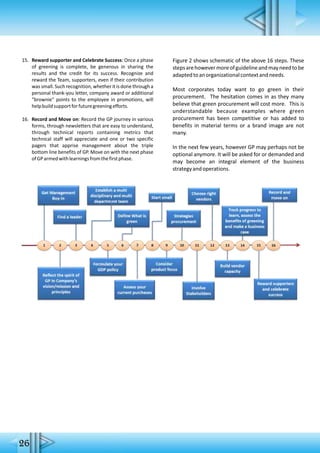
  • 38.
    36 A broad consensusexists among scientists, politicians, businesses and civil society that biodiversity loss is one of the biggest challenges that we are facing. Therefore, actions need tobetakentohaltthisgloballossurgentlyandimmediately.In this regard the use of new and innovative instruments and strategies to achieve 'no net loss' of biodiversity and ecosystem services is being explored. One such tool, Biodiversity Offsets - a mechanism that allows for compensation of impact on biodiversity - is gaining wide acceptancearoundtheworld(Darbi,2014). Biodiversityoffsetsaredefinedas: "measurable conservation outcomes resulting from actions designed to compensate for significant residual adverse biodiversity impacts arising from project development after appropriate prevention and mitigation measures have been taken. The goal of biodiversity offsets is to achieve no net loss and preferably a net gain of biodiversity on the ground with respect to species composition, habitat structure, ecosystem function and people's use and cultural values associated with biodiversity"(BBOP,2009)." To put it simply, the negative impacts of business operations on biological diversity need to be compensated or counterbalanced by conservation or restoration measures in order to ensure there is 'No Net Loss' of biodiversity. ('No Net Loss' has become internationally-accepted as a principle of biodiversityimpactmitigation). Biodiversity Offsets were promoted for the first time on a global scale by the Business and Biodiversity Offset Program (BBOP) of the international non-profit Forest Trends Association. The BBOP platform has been in place since 2004 and it has engaged business, NGOs, administration and academia, through its community of practice, for evolving a standard and implementation toolkit for biodiversity offsets - these are being tested through biodiversity offset pilots with business partners around the world. Some of BBOP's pilot offset projects include Ambatovy Project (nickel mine) in Madagascar, Newmont Ghana (gold mine) in Ghana, and AngloAmerican(platinummine)inSouthAfrica. An important question that has become a cornerstone of the discourse on biodiversity offsets is - Is there a business case for biodiversity offsets i.e. does it make good business sense for companies to offset their biodiversity impact, does it boost their bottomlines? When looking at the 'business case' forbiodiversityoffsets,BBOPasks: "Why should businesses voluntarily 'go the extra mile' and take on biodiversity offsets? What's in it for them?" (BBOP,2015)" A study by PricewaterhouseCoopers LLP notes a gradual increase in the number of organizations and initiatives that are beginning to recognize the business benefits of biodiversity offsets, i.e. understanding potential advantages for companies, and working to integrate biodiversity considerations into business and commercial activities (PricewaterhouseCoopers,L.L.P.,2010). ten Kate, Bishop & Bayon, 2004 cite a number of opportunities offered by voluntary biodiversity offsets for companies and developers. Businesses can benefit from the implementation of compensation measures e.g. in terms of reputation and better acceptance of their projects. Figure 1 shows benefits that make biodiversity offsets worthwhile fromthebusinessperspective. In general terms, there are two types of motivations for business to adopt biodiversity offsets, which align with the valuesassignedtobiodiversitybyhumans: 1. Ethical value: altruistic motivation for the implementationofbiodiversityoffsets. 2. Value of benefit: improvement in business and enhancementofprofit The most obvious case for such benefit is when biodiversity is theprerequisiteforthebusinessactivities(e.g.tourism). "The business case for biodiversity conservation is most easily made when the business in question depends directlyonbiodiversitytooperateandsurvive[…]Formany other businesses the case for investing in biodiversity conservationislessclear.Understandingwhatbiodiversity means and how it affects business value is not always straightforward."(Bishop,2006) In the public, however, a rather negative view of biodiversity offsets (and in particular of related business activities initiatives)dominates,withbusinessesbeingaccusedof
  • 39.
    37 A broad consensusexists among scientists, politicians, businesses and civil society that biodiversity loss is one of the biggest challenges that we are facing. Therefore, actions need tobetakentohaltthisgloballossurgentlyandimmediately.In this regard the use of new and innovative instruments and strategies to achieve 'no net loss' of biodiversity and ecosystem services is being explored. One such tool, Biodiversity Offsets - a mechanism that allows for compensation of impact on biodiversity - is gaining wide acceptancearoundtheworld(Darbi,2014). Biodiversityoffsetsaredefinedas: "measurable conservation outcomes resulting from actions designed to compensate for significant residual adverse biodiversity impacts arising from project development after appropriate prevention and mitigation measures have been taken. The goal of biodiversity offsets is to achieve no net loss and preferably a net gain of biodiversity on the ground with respect to species composition, habitat structure, ecosystem function and people's use and cultural values associated with biodiversity"(BBOP,2009)." To put it simply, the negative impacts of business operations on biological diversity need to be compensated or counterbalanced by conservation or restoration measures in order to ensure there is 'No Net Loss' of biodiversity. ('No Net Loss' has become internationally-accepted as a principle of biodiversityimpactmitigation). Biodiversity Offsets were promoted for the first time on a global scale by the Business and Biodiversity Offset Program (BBOP) of the international non-profit Forest Trends Association. The BBOP platform has been in place since 2004 and it has engaged business, NGOs, administration and academia, through its community of practice, for evolving a standard and implementation toolkit for biodiversity offsets - these are being tested through biodiversity offset pilots with business partners around the world. Some of BBOP's pilot offset projects include Ambatovy Project (nickel mine) in Madagascar, Newmont Ghana (gold mine) in Ghana, and Anglo American (platinummine)inSouthAfrica. An important question that has become a cornerstone of the discourseonbiodiversityoffsetsis-Isthereabusinesscasefor biodiversity offsets i.e. does it make good business sense for companies to offset their biodiversity impact, does it boost their bottomlines? When looking at the 'business case' for biodiversityoffsets,BBOPasks: "Why should businesses voluntarily 'go the extra mile' and take on biodiversity offsets? What's in it for them?" (BBOP,2015)" A study by PricewaterhouseCoopers LLP notes a gradual increase in the number of organizations and initiatives that are beginning to recognize the business benefits of biodiversity offsets, i.e. understanding potential advantages for companies, and working to integrate biodiversity considerations into business and commercial activities (PricewaterhouseCoopers,L.L.P.,2010). tenKate,Bishop&Bayon,2004citeanumberofopportunities offered by voluntary biodiversity offsets for companies and developers. Businesses can benefit from the implementation of compensation measures e.g. in terms of reputation and better acceptance of their projects. Figure 1 shows benefits that make biodiversity offsets worthwhile from the business perspective. Figure 2: Cascade of biodiversity offsets (author's own)
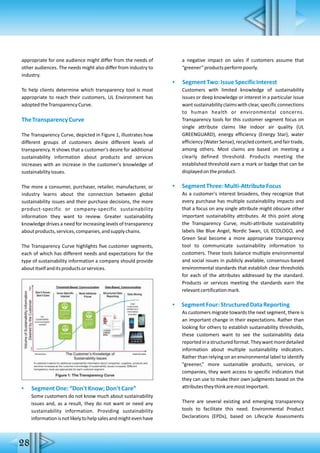
  • 40.
    38 Deciphering Sustainable Financein India Lucille Andrade, Asst. Vice President, Environmental Management Centre LLP Lucille.andrade@encentre.com Investments in various sectors, instruments, products that createenvironmentaland/orsocialvaluecouldbeconstruedas sustainable finance. Financial Inclusion initiatives undertaken by Reserve Bank of India (RBI); rural finance; and extending financetoMicro,SmallandMediumEnterprisesbybanksinthe public and private sector constitute sustainable finance. Similarly, reserving a portion of funds for investment in particular sectors construed as environmentally friendly such as renewable energy is also sustainable finance. Weather based insurance schemes; impact funds investing in social enterprises; institutional financing for particular sectors; green bonds; and the most recent modality of finance under Corporate Social Responsibility are various forms of sustainablefinance. Sustainable finance also incorporates the mechanisms and systems adopted by financial institutions to ensure sustainability of their investments. A few important forms of sustainable finance operational in India have been described in briefinthisarticle. SustainableFinancethroughFinancialInclusion Financial Inclusion is defined as 'the process of ensuring access to financial services and timely and adequate credit where needed by vulnerable groups such as weaker sections and low income groups at an affordable cost' (The Committee on Financial Inclusion, Chairman: Dr. C. Rangarajan). The RBI adopted a bank-led model for achieving financial inclusion in India while permitting non-bank entities to partner banks in their financial inclusion initiatives. Since January 2006 various policy measures have been undertaken by the RBI for creating conducive regulatory environment and providing institutional support for banks in accelerating the process of financial inclusion. RBI's Policy Initiatives to foster Financial Inclusion (a) Reach Branch expansion in rural areas - Branch authorization has been relaxed such that banks do not require prior permission to open branches in centres with population less than 1 lakh, subject to reporting. Banks have been mandated to open at least 25 % of their new branches in unbanked rural centres. Agent Banking - Business Correspondent/ Business Facilitator Model - In January 2006, RBI permitted banks to utilize the services of intermediaries in providing banking services through the use of business facilitators and business correspondents (BC). This model allows banks to do 'cash in - cash out' transactions at a location much closer to the rural population. Combination of Branch and BC Structure to deliver Financial Inclusion - To ensure increased banking penetration and control over operations of BCs, banks have been advised to establish low cost branches in the form of intermediate brick and mortar structures in rural centres between the present base branch and BC locations, so as to providesupporttoaclusterofBCs(about8-10BCs)at areasonabledistanceofabout3-4kilometers. (b) Access Relaxed KYC norms - Know Your Customer (KYC) requirements have been simplified such that small accounts can be opened with self-certification in the presence of bank officials and 'Aadhaar' cards have beenallowedasoneoftheeligibledocuments. Contd...... Sustainablefinancecanbedefinedas,'thepracticeofcreatingeconomicandsocialvalue throughfinancialmodels,productsandmarketsthataresustainableovertime’. Definition by - Centre for Responsible Finance, Haas School of Business, University of California (Berkeley)
  • 41.
    39 RBI's Policy Initiativesto foster Financial Inclusion Contd...... Roadmap for Banking Services in unbanked Villages - In the first phase, banks were advised to draw up a roadmap for providing banking services in every village having a population of over 2,000 by March 2010. In the second phase, roadmap has been prepared for covering remaining unbanked villages i.e. with populationlessthan2000inatimeboundmanner. (C) Products In order to ensure that all the financial needs of the customers are met, RBI has advised banks to offer a minimum of four basic products – (i) a savings cum overdraft account; (ii) a pure savings account, ideally a recurring or variable recurring deposit; (iii) a remittance product to facilitate EBT and other remittances; and (iv) entrepreneurial credit products like a General Purpose Credit Card (GCC) or a Kisan CreditCard(KCC) (d) Transactions The introduction of direct benefit transfer will leverage the Aadhaar platform and help facilitate delivery of social welfare benefits by direct credit to the bank accountsofbeneficiaries. Source: Keynote address delivered by Dr. K.C. Chakrabarty, Deputy Governor, Reserve Bank of India at the Finance Inclusion Conclave organizedbyCNBC TV18atNewDelhionSeptember6,2013 ImpactInvesting The Global Impact Investing Network defines Impact investing as 'investments made into companies, organizations, and funds with the intention to generate social and environmentalimpactalongsideafinancialreturn'. CorecharacteristicsofImpactInvestingare:  Intentionality – The intent of the investor to generate social and/or environmental value. These investments are made into enterprises and funds that expand access to critical goods and services, and/or generate positive impactthroughtheiroperations.  Investment with return expectations – Impact investments are expected to generate a financial return on capital and, at a minimum, a return of capital. While grants are not themselves impact investments, they can play an important role in enabling impact investing – for instance, through incubating early-stage business models, providing certain forms of credit enhancement, providing technical assistance, or funding needed research and development.  Range of return expectations and asset classes – Impact investments generate returns that range from below market to risk-adjusted market rate. Impact investments can be made across asset classes, including but not limited to cash equivalents, fixed income, venture capital and private equity. Impact investors may also earn fees through theprovisionofcatalyticinstrumentssuchasguarantees.  Impact measurement – A hallmark of impact investing is the commitment of the investor to measure and report the social and environmental performance and progress of underlyinginvestments. Impact investors encompass a wide range of players in the investing space – Angel investors, FamilyOffices,Venture Capital funds, private equity funds, Development Finance Institutions, and Foundations. The Government of India, through the Department of Science and Technology, also directly funds entrepreneurs as well as through incubators at various educationalinstitutions. WeatherBasedInsurance Agriculture is the backbone of Indian economy and is significantly impacted due to droughts in one region and floods in another at the same time. The erratic pattern of rainfall destroys the harvest with a severe impact on farmer's livelihoods. Insurance is the tool for farmers to hedge risks of cropandyieldlosses. Weather based crop insurance scheme has been piloted by Agriculture Insurance Company of India Ltd. (AIC) in India since 2003 to mitigate the hardship of the insured farmers against the likelihood of financial loss on account of anticipated crop loss resulting from incidence of adverse conditions of weather parameters like rainfall, temperature, frost, humidity etc. While Crop Insurance specifically indemnifies the cultivator against shortfall in crop yield, Weather based Crop Insurance is based on the fact that weather conditions affect crop production even when a cultivator has taken all the care to ensure good 27 harvest .Weatherbasedschemeshavealsobeenintroducedby privateinsurancecompanieslikeICICILombardandHDFCERGO. 27 Refer the WBCIS, Frequently Asked Questions page for further details at http://www.aicofindia.com/AICEng/General_Documents/Product_Profiles/WBCIS_FAQ.pdf
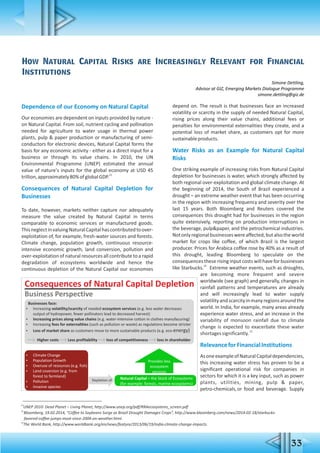
  • 42.
    40 Case Study –Acumen Fund Acumen, founded in 2001, was the first foreign social venture fund to invest in India. They raised funds from US based investors through the venture philanthropy route. Acumen made its first impact investment in 2004 and opened its local office in India around 2005. A snapshot of the criteria, process and principles of Acumen's investment modelinIndiaisgivenbelow. InvestmentCriteria  Sectors: Operate in one of our investment sectors of Agriculture, Education, Energy, Health, Housing, or Water.  Stage: Be an early-mid stage company that is in the processofscaling.  Investment Size: Be seeking investment capital in the range of $0.25M-$3M, structured as either debt or equity.  Strong Management Team: Have a strong and experienced management team with the skills, will, and vision to execute the business plan, an unwavering commitmenttoservethepoor,andunyieldingethics.  Potential for Significant Social Impact: Make a product ordeliveraservicethataddressesacriticalneedforthe poor in our sectors and geographic focus. These products or services must be economically better or create greater social impact than what is available currently through the market, aid, or charitable distribution. InvestmentProcess  Potential for Financial Sustainability: Have a clear business model that demonstrates the potential for financial sustainability within a five to seven year period; including the ability to cover operating expenseswithoperatingrevenues.  Potential to Achieve Scale: Be able to demonstrate a clearpath to scale for the number of end users over the period of our investment, and be positioned as one of theleadingserviceprovidersinthemarket. Source: Acumen Fund website http://acumen.org/investments/ investment-model-2/, accessed in August 2014 Case Study – HDFC ERGO Weather Insurance Policy HDFC ERGO offers a comprehensive Weather Insurance Policytodealwithadverselychangingclimatictrends.Itis an index based product that covers the losses to the crop occurring due to varying weather conditions such as temperature,windspeed,rainfall,humidityetc. The insurance policy is available to farmers; banks; and financial institutions / companies extending credit facility foragricultural/non-agriculturalseasonaloperations. ThePolicycovers: (a) Cost of input - Covers the diminished agricultural output/yield resulting due to deviation from optimum weather requirement of a crop within a specific geo graphical location and specified time period;and (b) Increased operational costs of agricultural or non- agricultural economic activity resulting from deviation of Observed Weather index from Strike index. Source: HDFC ERGO website http://www.hdfcergo.com/rural- insurance/weather-insurance.html,accessedinAugust2014. CorporateSocialResponsibility(CSR) The CSR Rules 2014 drafted under Section 135 of the Companies Act 2013 requires large and medium sized companies to spend every financial year 2% of their average net profits during the three immediately preceding financial years on activitiesthat create environmental and social value. Schedule VII of the Companies Act, 2013 lists a number of activitiesthatcouldbeincludedunderCSR. It is perceived that, investing in these activities would lead to social welfare and overall sustainable development thus formingapartofsustainablefinance.
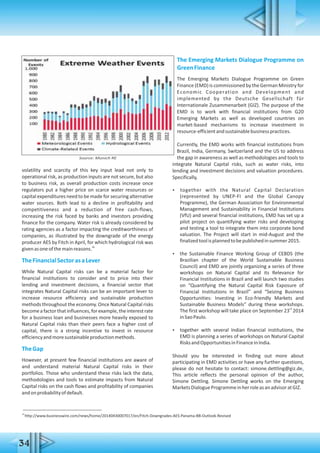
  • 43.
    41 Frameworks by DevelopmentFinance 28 Institutions and Foreign Banks Multilateral, regional and bilateral Development Finance Institutions (DFIs) work across various regions of the world fostering economic growth and sustainable development. They provide a broad range of financial services such as loans or guarantees to investors and entrepreneurs, taking equity participationinfirmsorsettinginvestmentfundsforfinancing publicinfrastructureprojects. As part of their mandate, DFIs require that their financing activities are conducted in conformance to their environmental and social safeguards. When DFIs initiate a dialoguewithgovernmentinstitutions,privateentrepreneurs or financial intermediaries, an Environmental and Social Management System (ESMS) is stipulated. The system is so designed that the host country environmental and social regulations as well as lending agency's environmental and social safeguards are addressed in parallel. A monitoring and reportingmechanismisestablishedto reviewtheconformance to the ESMS. For situations where the financial institution enters the project cycle at a later stage such as refinancing transactions, and environmental and social due diligence is conducted by an Independent Reviewer to establish conformance of the borrower to the lending agency's environmental and social safeguards. The disbursement conditionstobeimplementedduringthelifeoftheprojectsare drawn based on the level of conformance. Majority of the bilateral DFIs subscribe to IFC Performance Standards for the implementation of their environmental and social safeguards. Almost all DFIs refer to World Bank Group's Environmental, Health& Safety Guidelines for general application as well as sectorspecificforimplementationintheborrower'sprojects. Similar procedures are implemented by Equator Principles 29 FinancialInstitutions(EPFIs) investinginIndia.Theobjectiveis to provide a minimum standard for due diligence to support responsible risk decision-making. The Principles are based on the IFC Performance Standards and World Bank Group's EHS Guidelines. These apply globally, to all industry sectors and to four financial products 1) Project Finance Advisory Services 2) Project Finance 3) Project-Related Corporate Loans and 4) Bridge Loans based on thresholds and specific criteria. A number of foreign and Indian Private Equity funds also follow suit. OtherModesofSustainableFinance The subsidies and discounts available to entrepreneurs and companies by the National Solar Mission under the aegis of Ministry of New and Renewable Energy; financing available to renewable energy and energy efficiency projects by Indian Renewable Energy Development Agency Ltd; financing activities undertaken by National Bank for Agriculture and Rural Development; finance extended to micro, small and medium enterprises by public and private sector banks; investments made through green bonds to finance environment-friendly projects by IFC in renewable energy sectorinIndia,allconstitutesustainablefinance. Promoting gender equality and empowering women Contribution to Prime Minister's Relief Fund or other Central Fund Ensuring environmental sustainability Employment enhancing vocational skills Such other matters as prescribed Social business projects Combating HIV, AIDS, malaria and other diseases Eradicating extreme hunger and poverty Reducing child mortality and improving maternal health Promotion of education Figure 1: Activities under CSR 28 TextadoptedfromthePaper'CanwehaveaGlobalStandardonEnvironmental,SocialandGovernance?',PrasadModak,RahulDatar,LucilleAndrade; presentedinIAIA2013 29 Visithttp://www.equator-principles.com/forfurtherdetailsregardingEquatorPrinciplesFinancialInstitutions.
  • 44.
    Environmental and SocialRisk Management at IDFC Alok Dayal, Senior Director, Credit & Environment Risk, IDFC Alok.dayal@idfc.com Background IDFC Ltd is one of India's leading project financiers. It was formed in 1997 for leading private capital to infrastructure sectors in India. Project Finance is a method of funding in whichthelenderlooksprimarilytotherevenuesgeneratedby a single project, both as the source of repayment and as security for the exposure. Project financiers are therefore concerned with minimizing the dangers of any events which could have an adverse impact on the financial performance of theproject,inparticular,eventswhichcouldresultin: (1) the project not being completed on time and within budget, (2) theprojectnotoperatingatitsfullcapacity, (3) the project failing to generate sufficient revenue to servicethedebt The performance of a project is intrinsically linked to its environmental and social contours and associated risks. Environmental and Social (E&S) risks in a project play a major role in determining its timely completion and satisfactory operations. Early engagement with project proponents on identifying potential environment and social issues and mechanisms to address and mitigate the same is important for ensuring effective project development. Project financiers therefore need to ensure effective environment risk mitigation by building requisite environmental and social covenants as part of their loan agreements and implementing the E&S mitigation measures for projects funded by them. The key to timely and cost effective project implementation is mainstreaming E&S Risk due diligence and monitoring in the project appraisal and post sanction monitoring process by projectlenders. Since its inception IDFC has been a pioneer in integrating environmental and social risk management and good governance into its business operations. The Environment, Socialand Governance(ESG) agenda of IDFC has been built on an edifice of a sound risk culture that includes a comprehensive E&S risk management framework and an inclusive approach of working with project promoters in adopting “best in class” sustainability practices. This includes encouraging our borrowers to adopt good practices on governance, environment and social safeguards in their projects. IDFC has successfully mainstreamed environmental and social risk management into its business operations and instituted a dedicated environment risk group (ERG) to conduct E&S due diligence for projects financed by it. ERG is part of the risk team at IDFC Ltd and incorporates best in class Environment & Social Due Diligence and monitoring mechanisms for IDFC's lendingoperations. IDFC adopted the Equator Principles (EP) on 3rd June 2013. It was the first and till date the only Indian financial institution to do so. The Equator Principles are a credit risk management framework for identifying, assessing, and managing environmental and social risk in project finance. IDFC has since then re-aligned its E&S systems and procedures to the principles as espoused by the EquatorPrinciplesAssociation. IDFC'sE&SPolicy IDFC's rigorous E&S policy along with its commitment to the Equator Principles (EP) is reflected in its environment and social policy. IDFC's E&S policy ensures that its lending is made to environmentally sustainable, socially acceptable and economically viable projects. IDFC suitably addresses a project's environmental and social risks throughout its investment tenure asdescribedinthefollowingparagraphs. ManagingEnvironmentalandSocialRiskatIDFC The ERG group is responsible for managing E&S risk in IDFC's lending business. ERG identifies the environmental risk dependingontheprojecstageatwhichitisconsideredatIDFC. I) Environmentcategorisation The first step in IDFC's E&S due diligence begins with the environment categorisation. IDFC categorizes all projects funded by it as either Category A or B or C. This categorization is based entirely on the extent of impacts and not on type of the sector or project and is in accordance with the environmental and social screening criteria of the International Finance Corporation (IFC). The following criteria are used at IDFC to classify projects as either CategoryAorBorC:  Category A – Use of proceeds is expected to have significant adverse environmental and social risks and/or impacts that are diverse, irreversible or unprecedented; 42
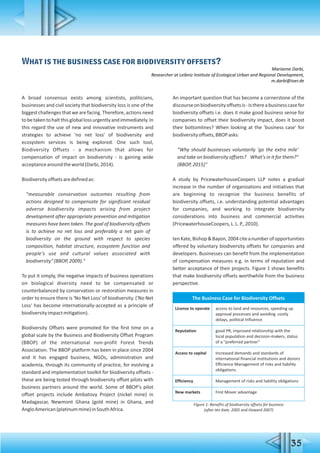
  • 45.
     Category B– Use of proceeds is expected to have limited adverse environmental and social risks and/or impacts that are few in number, generally site-specific, largely reversible and readily addressed through mitigationmeasures;and  Category C – Use of proceeds is expected to have minimal or no adverse environmental and social risks and/orimpacts. IDFC has devised an in –house toolkit which can be used by its business executives in categorizing projects attheinitialstagesoftheduediligenceprocess. ii) Environment and social due diligence and Monitoring of Projects The ERG conducts environment risk assessment of all category A and category B projects at two stages as describedbelow: a) Appraisal / Sanction stage: ERG works closely with the borrower, project finance, legal and credit teams to comprehensively evaluate the environmental and social risks of projects as per the Environment and Socialduediligence(ESDD)processdevelopedbyIDFC. The ESDD and monitoring process in IDFC is depicted in followingflowchart. ESDDcoversthefollowingsaspectsofaproject:  Whether the project meets the extant requirements of Indian Environmental Legislations and EP in its design and the likely scenario in the operational phase.  List of significant environmental and social impacts that include involuntary resettlement, loss of biodiversity, impacts on indigenous and / or local communities, worker safety, pollution, contamination,andothers.  Publicdisputesoftheproject,ifany  Health & Safety issues associated with the project and an assessment of the borrower's managerial capacity tohandlethesame.  GrievanceredressalMechanismfortheproject  StakeholderEngagementmechanism  Identifying the requirement of additional E&S studies andmitigationmeasuresfortheproject  Potential for Green House Gas emissions and reductions, if applicable and available information on thesame. Suitable E&S related loan covenants arising out of the ESDD process are stipulated and incorporated in loan agreements with clients which are then closely monitored at time of loan disbursements and during thelifeoftheloan. b) Post sanction stage: ERG undertakes Environment and Social Monitoring & Review (ESMR) of portfolio projects after sanction to monitor and ensure compliances to the requirements of applicable Indian Environmental Legislations, Equator Principles and E&S related loan covenantsonanongoingbasis. ESMRcoversthefollowingsaspectsofaproject:  Compliance to E&S conditions stipulated in the loan agreement  On-goingcompliancewithstatutoryrequirements  Status of any new/emerging Environment, Health, Safety and Social (EHSS) development involving the project and consequentrisksassociatedwithit. 43
  • 46.
     Status ofimplementation of Environmental Management Plan(EMP)andResettlementActionPlan(RAP)  Informationonexpansionplansetc,ifany This entire process is documented in an ESMR report prepared as part of our annual review of porfolio projects in IDFC Ltd. The Projects not confirming to E&S covenants are reviewed and depending upon the significance of environment risk, such cases are included in the E&S watch list and discussed with senior management at IDFC Ltd. Regular follow up with client is carried out to ensure that the non-compliances are rectified and corrective measures are implemented. SustainabilityDrivenInfrastructureDevelopment IDFC's environment & social management system which has been refined over the years has ensured that the environmental and social risks associated with the projects areidentifiedattheprojectappraisalstageitself.Thisenables IDFC to constructively engage with the project proponents and address and mitigate identified E&S risks through appropriate action plan and measures. This approach has been productive in promoting a culture of E&S risk redressal at the project level and also ensuring that our lending is directed towards sustainability driven infrastructure development. IDFC's sustainability focus has led it to identify low-carbon infrastructure businesses as an area of strategic focus. IDFC has funded close to Rs. 4200 crore as on March 2014 in renewable energy projects in India. IDFC's focus on renewable energy has enabled it to reach out to new committed project promoters in the Renewable Energy (RE) space and influence them to adopt good construction and labour practices and initiate community welfare activities in their project areas. IDFC is today preferred by most of the developmentbanksandmultilateralinstitutionsasastrategic partner for their lines of credit in the renewable energy and low carbon economy space. These institutions include and are not limited to International Finance Corporation (IFC), Asian Development Bank (ADB), Overseas Private Investment Corporation(OPIC),DEG(KfWBankengruppe)andDFID,UK. Benefits experienced by IDFC through ESG integration There are various examples that could be quoted bringing out thebenefitsaccruingtoIDFCasaresultofthecommitmentto E&S issues. There have been cases where IDFC has been able to bring to light E&S risks due to presence of sensitive receptors in close vicinity to the project area which was not very evident to the project promoters. These sensitive receptorsareoverlookedduringexecutionoftheprojectthrough several layers of contractors and sub-contractors. Timely identification by IDFC has helped in avoiding unnecessary delays in project design and implementation. There has been a marked improvement in the labour practices and amenities that are provided by project developers in projects financed by IDFC, mainly as a result of IDFC's monitoring and due diligence process. IDFC has been able to identify and flag social issues relating to land acquisition and rehabilitation process that have been factored in the assessment of the project's execution. This has enabled IDFC to predict project cashflows more accurately and suitable structure the lending. The E&S risk appraisal in IDFC has been of immense help in identifying E&S issues related to associated facilities that impact the timely completion of the mainproject.Thisincludesassociatedfacilitieslikeaccessroadto project site, transmission corridors of power lines, water supply, issues relating to fuel availability and transportation, land availability for ash handling, regulatory permissions for land diversion and transfer, and social and livelihood issues connected with land acquisition. IDFC's experience demonstrates that a lackofproperE&Smanagementsystemandprocessinprojectsis a strong indicator of a deeper malaise affecting the projects execution.Itistheproverbialcanaryinthecagewhichisaredflag forIDFCinanyproject. Summarizing in a nutshell, a strong environment and social management system has enabled IDFC to better understand the various E&S risks that impact a project's execution and cash flows and take suitable mitigative measures as a result of the same. This in turn has helped IDFC in developing a more robust lending portfolio. TheRoadAhead IDFC continues to lead from the front as far as ESG issues are concerned. IDFC Ltd truly believes that development and environment are two sides of the same coin and need not be in conflict with each other. Adoption of EP and its implementation has strengthened IDFC's belief that the ESG agenda can be balanced with the development agenda. IDFC is fully committed to ensuring a more sustainable framework for developing and executing projects in India. IDFC strongly feels that this not only benefits the local community and the environment at large but is also beneficialfor the long termsustainabilityof the projects that are financed. A focused engagement with clients not only ensures effective progress in meeting IDFC's sustainability goals but also those of the clients. The strong track record demonstrated by IDFC in this matter is a testimony to the commitment to this cause. IDFC is hopeful that other banks and financial institutions will also realize the benefits of sustainable financing and take immediate measures to mainstream it in their lendingoperations. 44