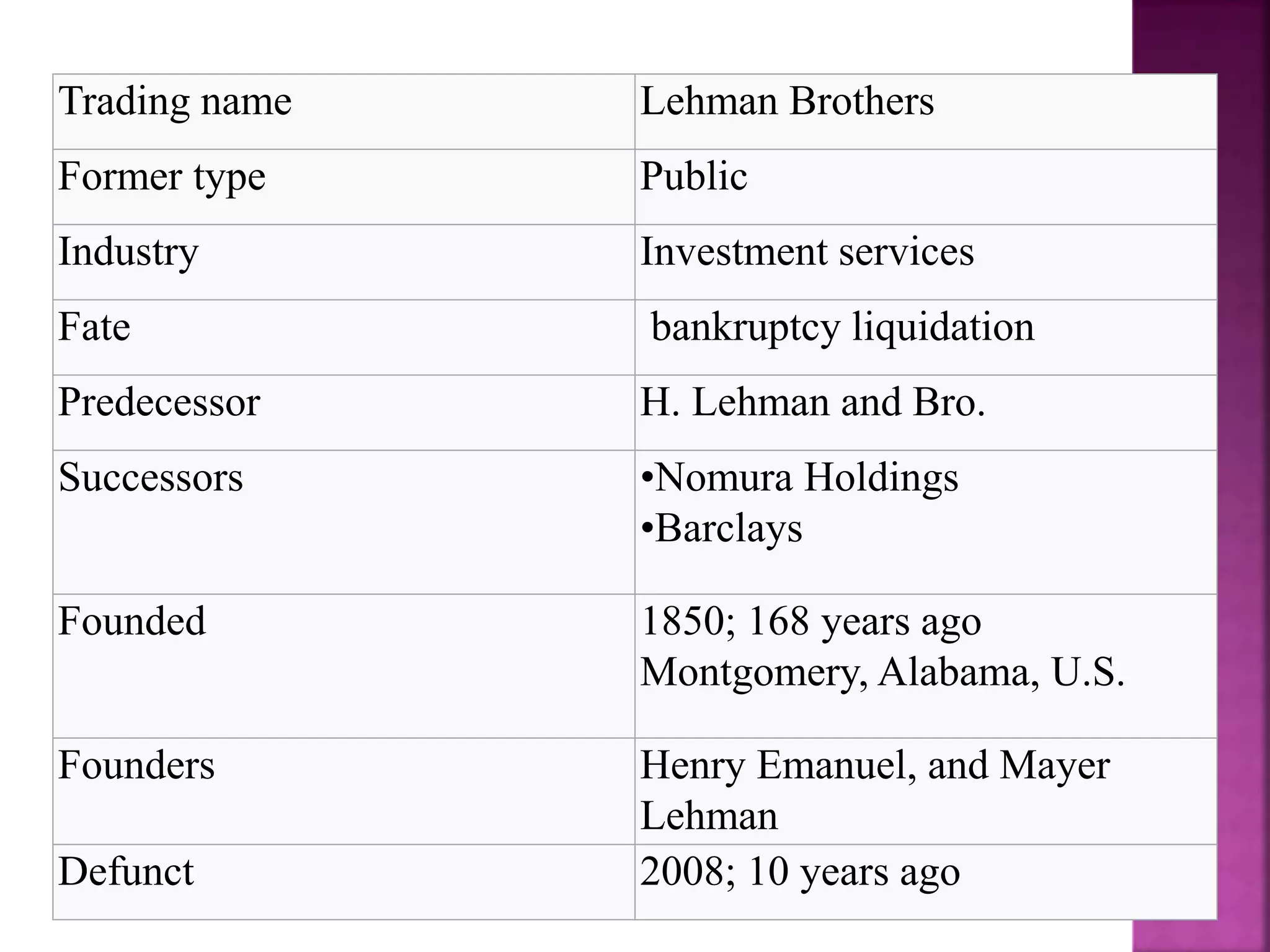
Trading name Lehman Brothers
Former type Public
Industry Investment services
Fate bankruptcy liquidation
Predecessor H. Lehman and Bro.
Successors •Nomura Holdings
•Barclays
Founded 1850; 168 years ago
Montgomery, Alabama, U.S.
Founders Henry Emanuel, and Mayer
Lehman
Defunct 2008; 10 years ago
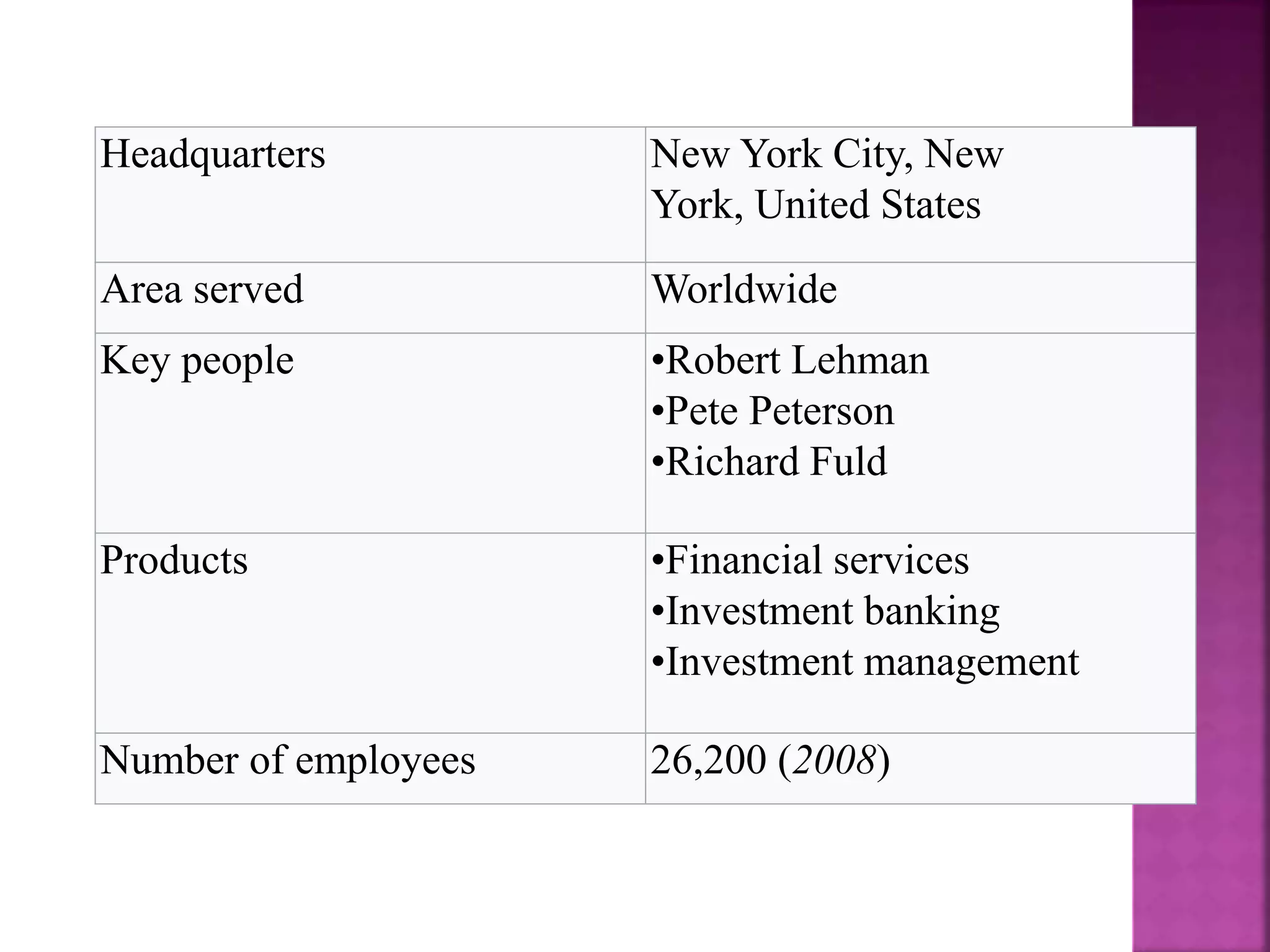
Headquarters New York City, New
York, United States
Area served Worldwide
Key people •Robert Lehman
•Pete Peterson
•Richard Fuld
Products •Financial services
•Investment banking
•Investment management
Number of employees 26,200 (2008)
 Lehman Brothers was a global financial services firm
whose bankruptcy in 2008 was largely caused by and
accelerated the subprime mortgage crisis.
 The firm was at the time the fourth-largest investment
bank in the United States; its bankruptcy remains the
largest ever.
 At the time of its Sept. 15, 2008 Chapter 11 bankruptcy
filing, Lehman Brothers had been in operation for 158
years.
 It provided investment banking, trading, investment
management, private banking, research, brokerage,
private equity and associated services.
 Lehman Brothers' failure placed the subprime mortgage
crisis of 2007-2009 prominently into the public eye and
 On September 15, 2008, Lehman Brothers filed for
bankruptcy.
 With $639 billion in assets and $619 billion in debt,
Lehman's bankruptcy filing was the largest in history, as its
assets far surpassed those of previous bankrupt giants such
as WorldCom and Enron.
 Lehman was the fourth-largest U.S. investment bank at the
time of its collapse, with 25,000 employees worldwide.
 Lehman's demise also made it the largest victim of the
U.S. subprime mortgage-induced financial crisis that swept
through global financial markets in 2008.
 Lehman's collapse was a seminal event that greatly
intensified the 2008 crisis and contributed to the erosion of
close to $10 trillion in market capitalization from
global equity markets in October 2008 – the biggest
monthly decline on record at the time.
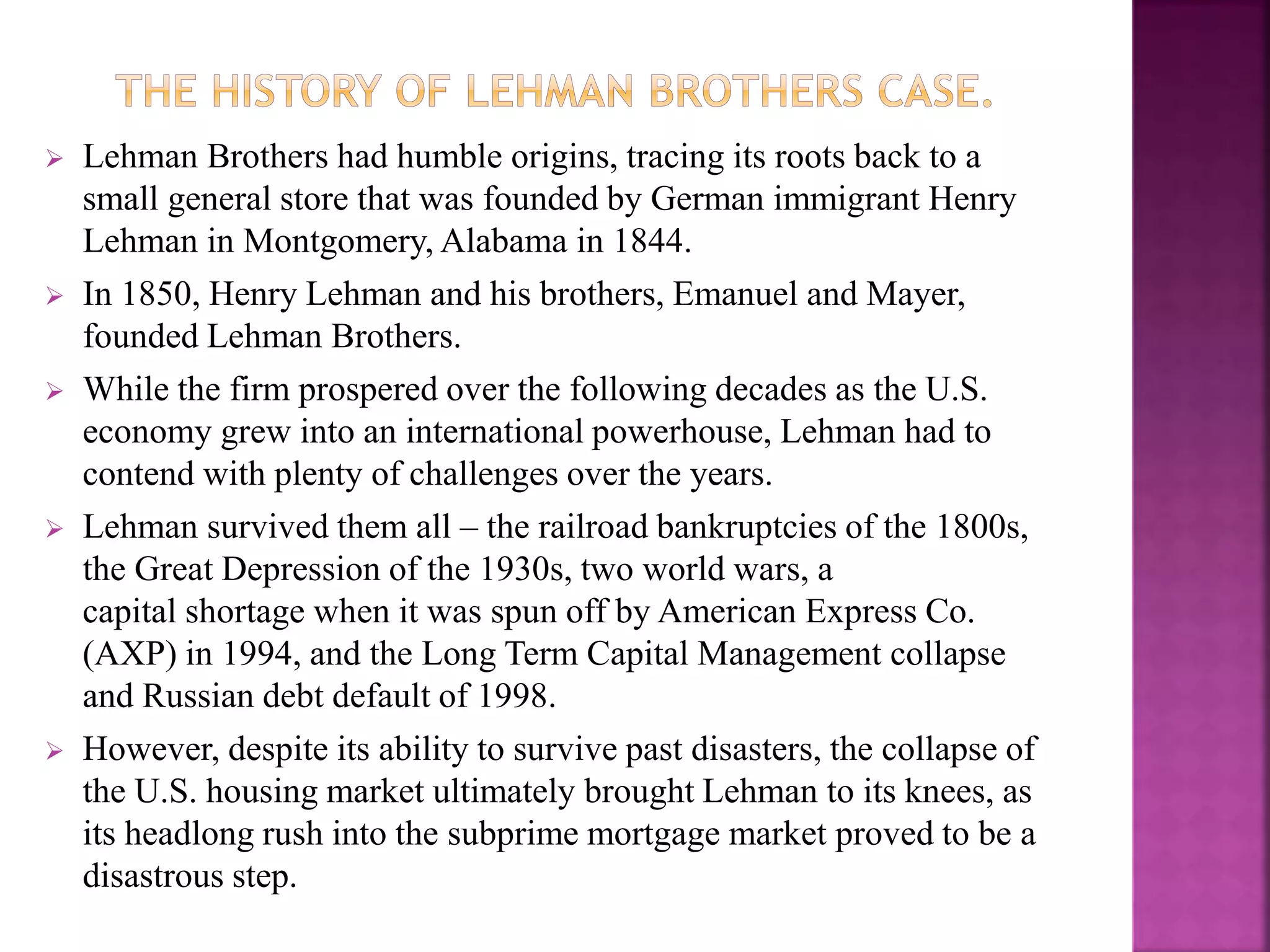
 Lehman Brothers had humble origins, tracing its roots back to a
small general store that was founded by German immigrant Henry
Lehman in Montgomery, Alabama in 1844.
 In 1850, Henry Lehman and his brothers, Emanuel and Mayer,
founded Lehman Brothers.
 While the firm prospered over the following decades as the U.S.
economy grew into an international powerhouse, Lehman had to
contend with plenty of challenges over the years.
 Lehman survived them all – the railroad bankruptcies of the 1800s,
the Great Depression of the 1930s, two world wars, a
capital shortage when it was spun off by American Express Co.
(AXP) in 1994, and the Long Term Capital Management collapse
and Russian debt default of 1998.
 However, despite its ability to survive past disasters, the collapse of
the U.S. housing market ultimately brought Lehman to its knees, as
its headlong rush into the subprime mortgage market proved to be a
disastrous step.
 In 2003 and 2004, with the U.S. housing boom well under way,
Lehman acquired five mortgage lenders, including subprime
lender, BNC Mortgage and Aurora Loan Services, which
specialized in Alt-A loans (made to borrowers without full
documentation).
 Lehman's acquisitions at first seemed prescient; record revenues
from Lehman's real estate businesses enabled revenues in the
capital markets unit to surge 56% from 2004 to 2006, a faster rate
of growth than other businesses in investment banking or asset
management.
 The firm securitized $146 billion of mortgages in 2006, a 10%
increase from 2005.
 Lehman reported record profits every year from 2005 to 2007. In
2007, the firm reported net income of a record $4.2 billion
on revenues of $19.3 billion.
 Asset-backed securities (ABS) and Collateral debt
obligations(CDOs)
 Lehman underwrote mortgage-backed securities more than any
other firm, accumulating an $85-billion portfolio, or four times
its shareholders 'equity
 Leverage levels up to 20-35 percent of their equity capital in
order to invest on securitized products using debt capital.
 Excessive risk-taking.
 Passing the investment risks through unregulated ‘credit default
swaps’ (CDS) where they didn’t have any adequate capital behind
them.(AIG case)
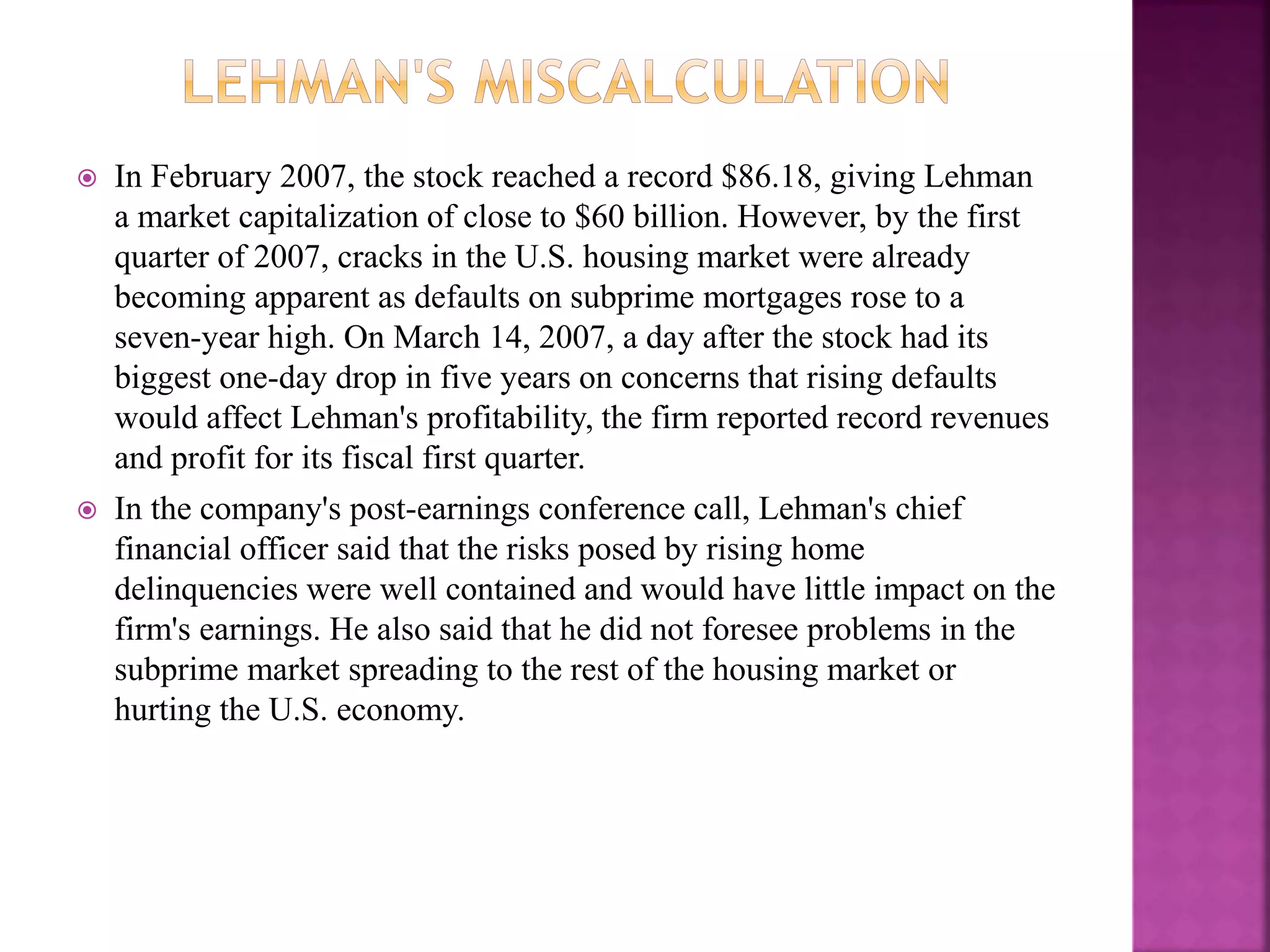
 In February 2007, the stock reached a record $86.18, giving Lehman
a market capitalization of close to $60 billion. However, by the first
quarter of 2007, cracks in the U.S. housing market were already
becoming apparent as defaults on subprime mortgages rose to a
seven-year high. On March 14, 2007, a day after the stock had its
biggest one-day drop in five years on concerns that rising defaults
would affect Lehman's profitability, the firm reported record revenues
and profit for its fiscal first quarter.
 In the company's post-earnings conference call, Lehman's chief
financial officer said that the risks posed by rising home
delinquencies were well contained and would have little impact on the
firm's earnings. He also said that he did not foresee problems in the
subprime market spreading to the rest of the housing market or
hurting the U.S. economy.
 As the credit crisis erupted in August 2007 with the failure
of two Bear Stearns hedge funds, Lehman's stock fell
sharply. During that month, the company eliminated 2,500
mortgage-related jobs and shut down its BNC unit. In
addition, it also closed offices of Alt-A lender Aurora in
three states. Even as the correction in the U.S. housing
market gained momentum, Lehman continued to be a major
player in the mortgage market.
 In 2007, Lehman underwrote more mortgage-backed
securities than any other firm, accumulating an $85 billion
portfolio, or four times its shareholders' equity. In the fourth
quarter of 2007, Lehman's stock rebounded, as global equity
markets reached new highs and prices for fixed-income
assets staged a temporary rebound. However, the firm did
not take the opportunity to trim its massive mortgage
portfolio, which in retrospect, would turn out to be its last
chance.
 Lehman's high degree of leverage – the ratio of total assets to
shareholders equity – was 31 in 2007, and its huge portfolio of
mortgage securities made it increasingly vulnerable to
deteriorating market conditions.
 On March 17, 2008, following the near-collapse of Bear Stearns –
the second-largest underwriter of mortgage-backed securities –
Lehman shares fell as much as 48% on concern it would be the
next Wall Street firm to fail.
 Confidence in the company returned to some extent in April, after
it raised $4 billion through an issue of preferred stock that was
convertible into Lehman shares at a 32% premium to its price at
the time.
 However, the stock resumed its decline as hedge fund
managers began questioning the valuation of Lehman's mortgage
portfolio.
 On June 9, Lehman announced a second-quarter loss of
$2.8 billion, its first loss since being spun off by
American Express, and reported that it had raised
another $6 billion from investors.
 The firm also said that it had boosted its liquidity pool
to an estimated $45 billion, decreased gross assets by
$147 billion, reduced its exposure to residential and
commercial mortgages by 20%, and cut down leverage
from a factor of 32 to about 25.
 Lehman's collapse roiled global financial markets for
weeks, given the size of the company and its status as a
major player in the U.S. and internationally.
 Many questioned the U.S. government's decision to let
Lehman fail, compared with its tacit support for Bear
Stearns, which was acquired by JPMorgan Chase & Co.
(JPM) in March 2008.
 Lehman's bankruptcy led to more than $46 billion of
its market value being wiped out.
 Its collapse also served as the catalyst for the purchase of
Merrill Lynch by Bank of America in an emergency deal
that was also announced on Sept. 15.
 New York Attorney General Andrew Cuomo has slapped Big Four audit
firm Ernst & Young with civil fraud charges for its alleged role in the
collapse of Lehman Brothers. The theory is simple: Lehman Brothers
committed a massive accounting fraud, and E&Y went along with it
when they signed clean audit opinions.
 The press release from the Attorney General's office puts it nicely,
saying that E&Y helped "Lehman Brothers Holding, Inc. ('Lehman')
engage in an accounting fraud involving the surreptitious removal of
tens of billions of dollars of fixed income securities from Lehman's
balance sheet in order to deceive the public about Lehman's true
liquidity condition.“
 The clean audit opinions were a longstanding tradition, as E&Y audited
Lehman brothers from 2001 until its bankruptcy filing in 2008. During
that time, E&Y reportedly earned more than $150 million in fees from
Lehman Brothers. The suit is asking for those fees to be returned, plus
damages.
Lehman brothers scam

Lehman brothers scam

  • 2.
    Trading name LehmanBrothers Former type Public Industry Investment services Fate bankruptcy liquidation Predecessor H. Lehman and Bro. Successors •Nomura Holdings •Barclays Founded 1850; 168 years ago Montgomery, Alabama, U.S. Founders Henry Emanuel, and Mayer Lehman Defunct 2008; 10 years ago
  • 3.
    Headquarters New YorkCity, New York, United States Area served Worldwide Key people •Robert Lehman •Pete Peterson •Richard Fuld Products •Financial services •Investment banking •Investment management Number of employees 26,200 (2008)
  • 4.
     Lehman Brotherswas a global financial services firm whose bankruptcy in 2008 was largely caused by and accelerated the subprime mortgage crisis.  The firm was at the time the fourth-largest investment bank in the United States; its bankruptcy remains the largest ever.  At the time of its Sept. 15, 2008 Chapter 11 bankruptcy filing, Lehman Brothers had been in operation for 158 years.  It provided investment banking, trading, investment management, private banking, research, brokerage, private equity and associated services.  Lehman Brothers' failure placed the subprime mortgage crisis of 2007-2009 prominently into the public eye and
  • 5.
     On September15, 2008, Lehman Brothers filed for bankruptcy.  With $639 billion in assets and $619 billion in debt, Lehman's bankruptcy filing was the largest in history, as its assets far surpassed those of previous bankrupt giants such as WorldCom and Enron.  Lehman was the fourth-largest U.S. investment bank at the time of its collapse, with 25,000 employees worldwide.  Lehman's demise also made it the largest victim of the U.S. subprime mortgage-induced financial crisis that swept through global financial markets in 2008.  Lehman's collapse was a seminal event that greatly intensified the 2008 crisis and contributed to the erosion of close to $10 trillion in market capitalization from global equity markets in October 2008 – the biggest monthly decline on record at the time.
  • 6.
     Lehman Brothershad humble origins, tracing its roots back to a small general store that was founded by German immigrant Henry Lehman in Montgomery, Alabama in 1844.  In 1850, Henry Lehman and his brothers, Emanuel and Mayer, founded Lehman Brothers.  While the firm prospered over the following decades as the U.S. economy grew into an international powerhouse, Lehman had to contend with plenty of challenges over the years.  Lehman survived them all – the railroad bankruptcies of the 1800s, the Great Depression of the 1930s, two world wars, a capital shortage when it was spun off by American Express Co. (AXP) in 1994, and the Long Term Capital Management collapse and Russian debt default of 1998.  However, despite its ability to survive past disasters, the collapse of the U.S. housing market ultimately brought Lehman to its knees, as its headlong rush into the subprime mortgage market proved to be a disastrous step.
  • 7.
     In 2003and 2004, with the U.S. housing boom well under way, Lehman acquired five mortgage lenders, including subprime lender, BNC Mortgage and Aurora Loan Services, which specialized in Alt-A loans (made to borrowers without full documentation).  Lehman's acquisitions at first seemed prescient; record revenues from Lehman's real estate businesses enabled revenues in the capital markets unit to surge 56% from 2004 to 2006, a faster rate of growth than other businesses in investment banking or asset management.  The firm securitized $146 billion of mortgages in 2006, a 10% increase from 2005.  Lehman reported record profits every year from 2005 to 2007. In 2007, the firm reported net income of a record $4.2 billion on revenues of $19.3 billion.
  • 8.
     Asset-backed securities(ABS) and Collateral debt obligations(CDOs)  Lehman underwrote mortgage-backed securities more than any other firm, accumulating an $85-billion portfolio, or four times its shareholders 'equity  Leverage levels up to 20-35 percent of their equity capital in order to invest on securitized products using debt capital.  Excessive risk-taking.  Passing the investment risks through unregulated ‘credit default swaps’ (CDS) where they didn’t have any adequate capital behind them.(AIG case)
  • 9.
     In February2007, the stock reached a record $86.18, giving Lehman a market capitalization of close to $60 billion. However, by the first quarter of 2007, cracks in the U.S. housing market were already becoming apparent as defaults on subprime mortgages rose to a seven-year high. On March 14, 2007, a day after the stock had its biggest one-day drop in five years on concerns that rising defaults would affect Lehman's profitability, the firm reported record revenues and profit for its fiscal first quarter.  In the company's post-earnings conference call, Lehman's chief financial officer said that the risks posed by rising home delinquencies were well contained and would have little impact on the firm's earnings. He also said that he did not foresee problems in the subprime market spreading to the rest of the housing market or hurting the U.S. economy.
  • 10.
     As thecredit crisis erupted in August 2007 with the failure of two Bear Stearns hedge funds, Lehman's stock fell sharply. During that month, the company eliminated 2,500 mortgage-related jobs and shut down its BNC unit. In addition, it also closed offices of Alt-A lender Aurora in three states. Even as the correction in the U.S. housing market gained momentum, Lehman continued to be a major player in the mortgage market.  In 2007, Lehman underwrote more mortgage-backed securities than any other firm, accumulating an $85 billion portfolio, or four times its shareholders' equity. In the fourth quarter of 2007, Lehman's stock rebounded, as global equity markets reached new highs and prices for fixed-income assets staged a temporary rebound. However, the firm did not take the opportunity to trim its massive mortgage portfolio, which in retrospect, would turn out to be its last chance.
  • 11.
     Lehman's highdegree of leverage – the ratio of total assets to shareholders equity – was 31 in 2007, and its huge portfolio of mortgage securities made it increasingly vulnerable to deteriorating market conditions.  On March 17, 2008, following the near-collapse of Bear Stearns – the second-largest underwriter of mortgage-backed securities – Lehman shares fell as much as 48% on concern it would be the next Wall Street firm to fail.  Confidence in the company returned to some extent in April, after it raised $4 billion through an issue of preferred stock that was convertible into Lehman shares at a 32% premium to its price at the time.  However, the stock resumed its decline as hedge fund managers began questioning the valuation of Lehman's mortgage portfolio.
  • 12.
     On June9, Lehman announced a second-quarter loss of $2.8 billion, its first loss since being spun off by American Express, and reported that it had raised another $6 billion from investors.  The firm also said that it had boosted its liquidity pool to an estimated $45 billion, decreased gross assets by $147 billion, reduced its exposure to residential and commercial mortgages by 20%, and cut down leverage from a factor of 32 to about 25.
  • 13.
     Lehman's collapseroiled global financial markets for weeks, given the size of the company and its status as a major player in the U.S. and internationally.  Many questioned the U.S. government's decision to let Lehman fail, compared with its tacit support for Bear Stearns, which was acquired by JPMorgan Chase & Co. (JPM) in March 2008.  Lehman's bankruptcy led to more than $46 billion of its market value being wiped out.  Its collapse also served as the catalyst for the purchase of Merrill Lynch by Bank of America in an emergency deal that was also announced on Sept. 15.
  • 14.
     New YorkAttorney General Andrew Cuomo has slapped Big Four audit firm Ernst & Young with civil fraud charges for its alleged role in the collapse of Lehman Brothers. The theory is simple: Lehman Brothers committed a massive accounting fraud, and E&Y went along with it when they signed clean audit opinions.  The press release from the Attorney General's office puts it nicely, saying that E&Y helped "Lehman Brothers Holding, Inc. ('Lehman') engage in an accounting fraud involving the surreptitious removal of tens of billions of dollars of fixed income securities from Lehman's balance sheet in order to deceive the public about Lehman's true liquidity condition.“  The clean audit opinions were a longstanding tradition, as E&Y audited Lehman brothers from 2001 until its bankruptcy filing in 2008. During that time, E&Y reportedly earned more than $150 million in fees from Lehman Brothers. The suit is asking for those fees to be returned, plus damages.