2008
LEHMAN BROTHERS
ECONOMIC BUBBLE
INTRODUCTION
It was a global financial firm. Before
declaring bankruptancy in 2008, Lehman
was the fourth-largest investment bank in
the United States doing business in
investment banking , equity and trading
.Lehman was operational for 158 years
from its founding in 1850 until 2008.On
September 15,2008 the firm become
bankrupt
Who Are Leman Brothers
In 1844, 23-year-old Henry Lehman the son of a
Jewish cattle merchant, emigrated to the
United States from Rimpar, Bavaria.He settled
in Montgomery, Alabama where he opened
a dry-goods store, "H. Lehman". In 1847,
following the arrival of his brother Emanuel
Lehman, the firm became "H. Lehman and
Bro." With the arrival of their youngest
brother, Mayer Lehman, in 1850, the firm
changed its name again and "Lehman Brothers"
was founded.
HOW THEY STARTED THEIR COMPANY
• Lehman Brothers began in the mid-nineteenth
century, 1844 to be exact. It was started in
Montgomery, Alabama by Henry Lehman, an
immigrant from Germany. From being a dry-goods and
general store, Henry’s brothers – Mayer and Emanuel
– joined him, giving birth to Lehman Brothers in 1850.
During the 1850s, Lehman began to become a major
commodities trading company, specializing in the key
cotton market. The company’s shift from commodity
trading to investment banking began in 1906 when it
partnered with Goldman Sachs on an IPO.
HOW THEY BECOME BANKRUPT
• Lehman Brothers had become heavily involved in the
mortgage market, owning the sub prime mortgage
seller BNC Mortgage. By 2008, the bank held thirty
times as much in real estate products as it had capital,
and it had been borrowing too much money to fund
its mortgage investments. When the market turned,
Lehman was stuffed. As Lehman had held onto, or
could not sell, so many risky low-rated mortgages, the
sub prime mortgage crash affected the bank badly
and, in the first half of 2008, it lost of 73% of its
value. Investor confidence in the bank quickly
declined, leading to the crises of early September.
CAUSES OF BANKRUPTANCY
• RISK: The bank had taken on too much risk without a
corresponding ability to raise cash quickly. In 2008, it
had $639 billion in assets, technically more than
enough to cover its $613 billion in debt. However, the
assets were difficult to sell. As a result, Lehman
Brothers couldn’t sell them to raise sufficient funds
• OVERCONFIDENCE: 
In March 2006, Lehman bought
heavily into commercial real estate and risky loans and
instead of selling them right away, it kept them on its
books. Management thought it would make more
money owning these assets but its timing couldn’t
have been worse, as real estate prices were falling.
• Regulator Inaction: The Securities and
Exchange Commission and other regulators
didn’t take action. As early as 2007, the SEC
knew Lehman Brothers was taking on too
much risk, but the agency never required
Lehman to do anything about it.
IMPACT OF LEHMAN BANKRUPT
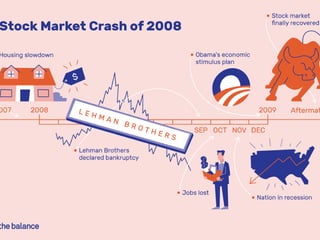
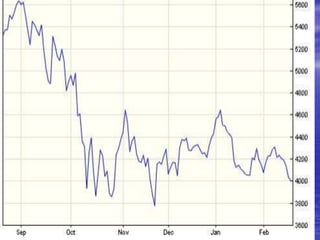
• Lehman’s bankruptcy sent financial markets reeling.
The Dow Jones Industrial Average fell 504.48 points,
its worst decline in seven years.8
Losses continued
until March 5, 2009, when the Dow closed at
6,594.44. That was a 53% drop from its peak of
14,164.53 on October 10, 2007.
• Lehman’s bankruptcy threatened the
financial institutions that owned its bonds. On Sept.
16, 2008, the Reserve Primary money market
fund "broke the buck." That meant its shares,
normally worth at least $1, were investors knew that
only worth $0.97.10
Investors lost confidence in the
money market fund when it announced losses of $785
million in Lehman’s commercial paper.
• On Sept. 17, 2008, the collapse spread.
Investors withdrew a record $196 billion
from their money market accounts. If the
run had continued, businesses wouldn’t have
been able to get money to fund their day-to-
day operations. In just a few weeks, the
economy would have collapsed.
IMPACT OF LEHMAN BROTHER
BANKRUPTANCY IN GLOBAL
MARKET
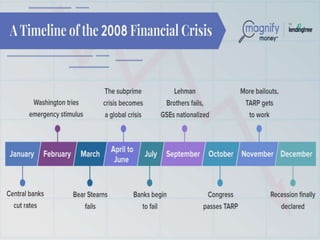
• After Lehman Brothers declared bankruptcy in September 2008,
approximately twenty-six thousand of the firm’s employees
worldwide lost their jobs, and investors suffered immense
losses, fueling the country’s greatest economic downturn since
the crash of 1929. On September 16, 2008, one day after
Lehman’s collapse, the Federal Reserve Bank of New York lent
$85 billion to the global insurance company American
International Group (AIG), whose assets failed to cover its
mounting credit Decrease in both consumer spending and
exports to the United States severely affected the flow of
goods, manufacturing, and job growth in Europe and Asia.
Stock markets plunged, resulting in the worst economic
downturn in global markets
THE BANKS WHICH GOT FAILED
BECAUSE OF LEHMAN BROTHERS
CRISIS
• The Financial crisis of 2007–2008 led to
many bank failures in the United States.
The Federal Deposit Insurance
Corporation (FDIC) closed 465 failed banks
from 2008 to 2012. In contrast, in the five
years prior to 2008, only 10 banks failed.
SCHOOL OF BUSINESS
AND MANAGEMENT
MONETARY POLICY ASSIGNMENT
Naveen Singh &
Bcom Honors
1st year (EAFM)
MONETARY POLICY

MONETARY POLICY

  • 1.
  • 2.
    INTRODUCTION It was aglobal financial firm. Before declaring bankruptancy in 2008, Lehman was the fourth-largest investment bank in the United States doing business in investment banking , equity and trading .Lehman was operational for 158 years from its founding in 1850 until 2008.On September 15,2008 the firm become bankrupt
  • 5.
    Who Are LemanBrothers In 1844, 23-year-old Henry Lehman the son of a Jewish cattle merchant, emigrated to the United States from Rimpar, Bavaria.He settled in Montgomery, Alabama where he opened a dry-goods store, "H. Lehman". In 1847, following the arrival of his brother Emanuel Lehman, the firm became "H. Lehman and Bro." With the arrival of their youngest brother, Mayer Lehman, in 1850, the firm changed its name again and "Lehman Brothers" was founded.
  • 6.
    HOW THEY STARTEDTHEIR COMPANY • Lehman Brothers began in the mid-nineteenth century, 1844 to be exact. It was started in Montgomery, Alabama by Henry Lehman, an immigrant from Germany. From being a dry-goods and general store, Henry’s brothers – Mayer and Emanuel – joined him, giving birth to Lehman Brothers in 1850. During the 1850s, Lehman began to become a major commodities trading company, specializing in the key cotton market. The company’s shift from commodity trading to investment banking began in 1906 when it partnered with Goldman Sachs on an IPO.
  • 8.
    HOW THEY BECOMEBANKRUPT • Lehman Brothers had become heavily involved in the mortgage market, owning the sub prime mortgage seller BNC Mortgage. By 2008, the bank held thirty times as much in real estate products as it had capital, and it had been borrowing too much money to fund its mortgage investments. When the market turned, Lehman was stuffed. As Lehman had held onto, or could not sell, so many risky low-rated mortgages, the sub prime mortgage crash affected the bank badly and, in the first half of 2008, it lost of 73% of its value. Investor confidence in the bank quickly declined, leading to the crises of early September.
  • 9.
    CAUSES OF BANKRUPTANCY •RISK: The bank had taken on too much risk without a corresponding ability to raise cash quickly. In 2008, it had $639 billion in assets, technically more than enough to cover its $613 billion in debt. However, the assets were difficult to sell. As a result, Lehman Brothers couldn’t sell them to raise sufficient funds • OVERCONFIDENCE:  In March 2006, Lehman bought heavily into commercial real estate and risky loans and instead of selling them right away, it kept them on its books. Management thought it would make more money owning these assets but its timing couldn’t have been worse, as real estate prices were falling.
  • 10.
    • Regulator Inaction:The Securities and Exchange Commission and other regulators didn’t take action. As early as 2007, the SEC knew Lehman Brothers was taking on too much risk, but the agency never required Lehman to do anything about it.
  • 11.
    IMPACT OF LEHMANBANKRUPT • Lehman’s bankruptcy sent financial markets reeling. The Dow Jones Industrial Average fell 504.48 points, its worst decline in seven years.8 Losses continued until March 5, 2009, when the Dow closed at 6,594.44. That was a 53% drop from its peak of 14,164.53 on October 10, 2007. • Lehman’s bankruptcy threatened the financial institutions that owned its bonds. On Sept. 16, 2008, the Reserve Primary money market fund "broke the buck." That meant its shares, normally worth at least $1, were investors knew that only worth $0.97.10 Investors lost confidence in the money market fund when it announced losses of $785 million in Lehman’s commercial paper.
  • 12.
    • On Sept.17, 2008, the collapse spread. Investors withdrew a record $196 billion from their money market accounts. If the run had continued, businesses wouldn’t have been able to get money to fund their day-to- day operations. In just a few weeks, the economy would have collapsed.
  • 15.
    IMPACT OF LEHMANBROTHER BANKRUPTANCY IN GLOBAL MARKET • After Lehman Brothers declared bankruptcy in September 2008, approximately twenty-six thousand of the firm’s employees worldwide lost their jobs, and investors suffered immense losses, fueling the country’s greatest economic downturn since the crash of 1929. On September 16, 2008, one day after Lehman’s collapse, the Federal Reserve Bank of New York lent $85 billion to the global insurance company American International Group (AIG), whose assets failed to cover its mounting credit Decrease in both consumer spending and exports to the United States severely affected the flow of goods, manufacturing, and job growth in Europe and Asia. Stock markets plunged, resulting in the worst economic downturn in global markets
  • 16.
    THE BANKS WHICHGOT FAILED BECAUSE OF LEHMAN BROTHERS CRISIS • The Financial crisis of 2007–2008 led to many bank failures in the United States. The Federal Deposit Insurance Corporation (FDIC) closed 465 failed banks from 2008 to 2012. In contrast, in the five years prior to 2008, only 10 banks failed.
  • 18.
    SCHOOL OF BUSINESS ANDMANAGEMENT MONETARY POLICY ASSIGNMENT Naveen Singh & Bcom Honors 1st year (EAFM)