Respirators and facepieces help us avoid bodily damage caused by
exposure to hazardous air conditions, chemicals, gases, vapors and dusts.
Breathe Easy!
SELECTING THE
RIGHT RESPIRATOR
www.labsource.com
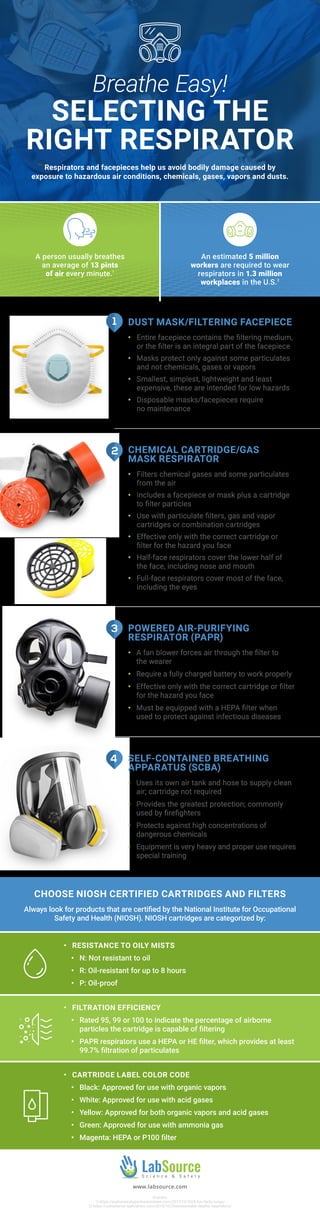
DUST MASK/FILTERING FACEPIECE
• Entire facepiece contains the filtering medium,
or the filter is an integral part of the facepiece
• Masks protect only against some particulates
and not chemicals, gases or vapors
• Smallest, simplest, lightweight and least
expensive, these are intended for low hazards
• Disposable masks/facepieces require
no maintenance
CHEMICAL CARTRIDGE/GAS
MASK RESPIRATOR
• Filters chemical gases and some particulates
from the air
• Includes a facepiece or mask plus a cartridge
to filter particles
• Use with particulate filters, gas and vapor
cartridges or combination cartridges
• Effective only with the correct cartridge or
filter for the hazard you face
• Half-face respirators cover the lower half of
the face, including nose and mouth
• Full-face respirators cover most of the face,
including the eyes
POWERED AIR-PURIFYING
RESPIRATOR (PAPR)
• A fan blower forces air through the filter to
the wearer
• Require a fully charged battery to work properly
• Effective only with the correct cartridge or filter
for the hazard you face
• Must be equipped with a HEPA filter when
used to protect against infectious diseases
SELF-CONTAINED BREATHING
APPARATUS (SCBA)
• Uses its own air tank and hose to supply clean
air; cartridge not required
• Provides the greatest protection; commonly
used by firefighters
• Protects against high concentrations of
dangerous chemicals
• Equipment is very heavy and proper use requires
special training
A person usually breathes
an average of 13 pints
of air every minute.1
An estimated 5 million
workers are required to wear
respirators in 1.3 million
workplaces in the U.S.2
• RESISTANCE TO OILY MISTS
• N: Not resistant to oil
• R: Oil-resistant for up to 8 hours
• P: Oil-proof
• FILTRATION EFFICIENCY
• Rated 95, 99 or 100 to indicate the percentage of airborne
particles the cartridge is capable of filtering
• PAPR respirators use a HEPA or HE filter, which provides at least
99.7% filtration of particulates
• CARTRIDGE LABEL COLOR CODE
• Black: Approved for use with organic vapors
• White: Approved for use with acid gases
• Yellow: Approved for both organic vapors and acid gases
• Green: Approved for use with ammonia gas
• Magenta: HEPA or P100 filter
Sources:
1) https://pulmonaryhypertensionnews.com/2017/12/20/8-fun-facts-lungs/
2) https://compliance-specialists.com/2015/10/28/preventable-deaths-respirators/
CHOOSE NIOSH CERTIFIED CARTRIDGES AND FILTERS
Always look for products that are certified by the National Institute for Occupational
Safety and Health (NIOSH). NIOSH cartridges are categorized by:

Selecting The Right Respirator

  • 1.
    Respirators and facepieceshelp us avoid bodily damage caused by exposure to hazardous air conditions, chemicals, gases, vapors and dusts. Breathe Easy! SELECTING THE RIGHT RESPIRATOR www.labsource.com DUST MASK/FILTERING FACEPIECE • Entire facepiece contains the filtering medium, or the filter is an integral part of the facepiece • Masks protect only against some particulates and not chemicals, gases or vapors • Smallest, simplest, lightweight and least expensive, these are intended for low hazards • Disposable masks/facepieces require no maintenance CHEMICAL CARTRIDGE/GAS MASK RESPIRATOR • Filters chemical gases and some particulates from the air • Includes a facepiece or mask plus a cartridge to filter particles • Use with particulate filters, gas and vapor cartridges or combination cartridges • Effective only with the correct cartridge or filter for the hazard you face • Half-face respirators cover the lower half of the face, including nose and mouth • Full-face respirators cover most of the face, including the eyes POWERED AIR-PURIFYING RESPIRATOR (PAPR) • A fan blower forces air through the filter to the wearer • Require a fully charged battery to work properly • Effective only with the correct cartridge or filter for the hazard you face • Must be equipped with a HEPA filter when used to protect against infectious diseases SELF-CONTAINED BREATHING APPARATUS (SCBA) • Uses its own air tank and hose to supply clean air; cartridge not required • Provides the greatest protection; commonly used by firefighters • Protects against high concentrations of dangerous chemicals • Equipment is very heavy and proper use requires special training A person usually breathes an average of 13 pints of air every minute.1 An estimated 5 million workers are required to wear respirators in 1.3 million workplaces in the U.S.2 • RESISTANCE TO OILY MISTS • N: Not resistant to oil • R: Oil-resistant for up to 8 hours • P: Oil-proof • FILTRATION EFFICIENCY • Rated 95, 99 or 100 to indicate the percentage of airborne particles the cartridge is capable of filtering • PAPR respirators use a HEPA or HE filter, which provides at least 99.7% filtration of particulates • CARTRIDGE LABEL COLOR CODE • Black: Approved for use with organic vapors • White: Approved for use with acid gases • Yellow: Approved for both organic vapors and acid gases • Green: Approved for use with ammonia gas • Magenta: HEPA or P100 filter Sources: 1) https://pulmonaryhypertensionnews.com/2017/12/20/8-fun-facts-lungs/ 2) https://compliance-specialists.com/2015/10/28/preventable-deaths-respirators/ CHOOSE NIOSH CERTIFIED CARTRIDGES AND FILTERS Always look for products that are certified by the National Institute for Occupational Safety and Health (NIOSH). NIOSH cartridges are categorized by: