Kevin’s Notes:
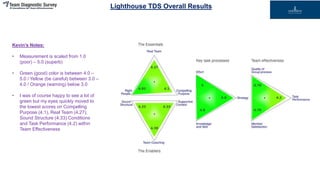
• Measurement is scaled from 1.0
(poor) – 5.0 (superb)
• Green (good) color is between 4.0 –
5.0 / Yellow (be careful) between 3.0 –
4.0 / Orange (warning) below 3.0
• I was of course happy to see a lot of
green but my eyes quickly moved to
the lowest scores on Compelling
Purpose (4.1), Real Team (4.27),
Sound Structure (4.33) Conditions
and Task Performance (4.2) within
Team Effectiveness
Lighthouse TDS Overall Results
Does The Team Have A Compelling Purpose?
TDS Notes:
Compelling Purpose means that the purpose is:
• challenging (a stretch, but not impossible)
• clear (they know what it would look like to accomplish it)
• consequential (it has meaningful impact on the lives and
work of others)
Compelling purpose orients and motivates team members so
that they are headed in the same direction—even when they
are not working in the same place at the same time—and they
do so with energy and conviction.
Kevin’s Notes:
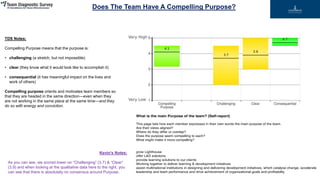
As you can see, we scored lower on “Challenging” (3.7) & “Clear”
(3.9) and when looking at the qualitative data here to the right, you
can see that there is absolutely no consensus around Purpose.
TDS Notes:
Real Team means:
• that the team is Bounded, meaning that members know who is
and is not on the team
• it is Stable, meaning that members stay together long enough to
learn how to work together
• it is Interdependent for a common purpose, meaning the team
must interact and share resources to accomplish their purposes
Is This A Real Team?
Kevin’s Notes:
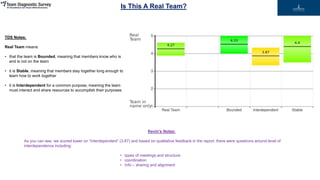
As you can see, we scored lower on “Interdependent” (3.87) and based on qualitative feedback in the report, there were questions around level of
interdependence including:
• types of meetings and structure
• coordination
• Info – sharing and alignment
TDS Notes:
Sound Structure has three elements:
• Task Design means the team performs work that
makes sense to be done by a team and that allows
members to use their judgment and experience to
complete it
• Team Size means the team is neither too big to
coordinate nor too small to have the resources they
need to do the work
• Team Norms means the team has clear ground
rules for how members are expected to work
together
Does The Team Have A sound Structure?
Kevin’s Notes:
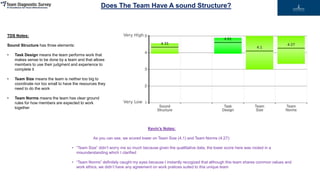
As you can see, we scored lower on Team Size (4.1) and Team Norms (4.27):
• “Team Size” didn’t worry me so much because given the qualtitative data, the lower score here was rooted in a
misunderstanding which I clarified
• “Team Norms” definitely caught my eyes because I instantly recogized that although this team shares common values and
work ethics, we didn’t have any agreement on work pratices suited to this unique team

Article Appendix

  • 1.
    Kevin’s Notes: • Measurementis scaled from 1.0 (poor) – 5.0 (superb) • Green (good) color is between 4.0 – 5.0 / Yellow (be careful) between 3.0 – 4.0 / Orange (warning) below 3.0 • I was of course happy to see a lot of green but my eyes quickly moved to the lowest scores on Compelling Purpose (4.1), Real Team (4.27), Sound Structure (4.33) Conditions and Task Performance (4.2) within Team Effectiveness Lighthouse TDS Overall Results
  • 2.
    Does The TeamHave A Compelling Purpose? TDS Notes: Compelling Purpose means that the purpose is: • challenging (a stretch, but not impossible) • clear (they know what it would look like to accomplish it) • consequential (it has meaningful impact on the lives and work of others) Compelling purpose orients and motivates team members so that they are headed in the same direction—even when they are not working in the same place at the same time—and they do so with energy and conviction. Kevin’s Notes: As you can see, we scored lower on “Challenging” (3.7) & “Clear” (3.9) and when looking at the qualitative data here to the right, you can see that there is absolutely no consensus around Purpose.
  • 3.
    TDS Notes: Real Teammeans: • that the team is Bounded, meaning that members know who is and is not on the team • it is Stable, meaning that members stay together long enough to learn how to work together • it is Interdependent for a common purpose, meaning the team must interact and share resources to accomplish their purposes Is This A Real Team? Kevin’s Notes: As you can see, we scored lower on “Interdependent” (3.87) and based on qualitative feedback in the report, there were questions around level of interdependence including: • types of meetings and structure • coordination • Info – sharing and alignment
  • 4.
    TDS Notes: Sound Structurehas three elements: • Task Design means the team performs work that makes sense to be done by a team and that allows members to use their judgment and experience to complete it • Team Size means the team is neither too big to coordinate nor too small to have the resources they need to do the work • Team Norms means the team has clear ground rules for how members are expected to work together Does The Team Have A sound Structure? Kevin’s Notes: As you can see, we scored lower on Team Size (4.1) and Team Norms (4.27): • “Team Size” didn’t worry me so much because given the qualtitative data, the lower score here was rooted in a misunderstanding which I clarified • “Team Norms” definitely caught my eyes because I instantly recogized that although this team shares common values and work ethics, we didn’t have any agreement on work pratices suited to this unique team