A Guide To
                Nursing

Preceptorship
Prepared by:

Kawther Ali
Topics
   What is precptorship
   Why we use the
    preceptorship
   When we use the
    preceptorship
   Where we use the
    preceptorship
   Who is the preceptor,
    and the preceptee
                  Steve Rose ver. 8.0   Practice Development Team, April 2007.
                                                                             2
Preceptorship
Definition:
 Preceptorship is considered a Community-based
  teaching is the teaching of medical or nursing
  novice by provider, or preceptor, in an office
  environment.
The one teacher/one learner/one patient relationship
  creates educational cognizance, where the learner
  experiences and learns from:
 Role modeling;
 Effective assessment;
 Immediate feedback; and
 Meaningful evaluation.


              Steve Rose ver. 8.0   Practice Development Team, April 2007.
                                                                         3
Preceptorship
   The aim of this Preceptorship program is to
    provide a
   structured, supportive bridge during this transition
    from new nurse to practitioner.
   It also aims to produce competent professional
    nurses to work in the High Secure Services.
   The purpose of this guide is to assist the
    facilitation of that program, in outlining the
    requirements and expectations of both preceptor
    and preceptee.

                   Steve Rose ver. 8.0   Practice Development Team, April 2007.
                                                                              4
Preceptorship
Who is the Preceptor
2) An expert or specialist who gives practical
   experience and training to a new nurse.
3) A person, generally a staff nurse, who
   teaches, counsels, inspires, serves as a role
   model and supports the growth and
   development of an individual (the novice)
   for a fixed and limited period of time with
   the specific purpose of socializing the
   novice into a new role.”
               Steve Rose ver. 8.0   Practice Development Team, April 2007.
                                                                          5
Preceptorship
Who is the Preceptee
1) The preceptee is a fully qualified,
  accountable practitioner.
2) Newly registered nurses, midwives or
  health visitors entering practice for the first
  time, and for practitioners entering a
  different field of practice.

                Steve Rose ver. 8.0   Practice Development Team, April 2007.
                                                                           6
The need for a preceptor
1) To promote patient care
3) To reduce the degree of stress you may
  experience as a newly qualified practitioner.
  .
4) To ensure responsibilities are not placed on
  you too soon or inappropriately.
5) To minimize risk to yourself and the
  patients in the high secure service.
               Steve Rose ver. 8.0   Practice Development Team, April 2007.
                                                                          7
The Preceptor: Attributes
Criteria determined to enable the preceptor to fulfill
   what is expected of him/her.
1) He/She must be a first level registered nurse.
2) He/She will have had at least 12 months
   experience within the clinical field.
3) He/She has been considered as a suitable role
   model for newly qualified practitioners.
4) He/She will have undergone specific
   preceptorship training, being familiar with the
   requirements of support, goal setting, action
   planning and evaluation.
                 Steve Rose ver. 8.0   Practice Development Team, April 2007.
                                                                            8
Expectations in practice
1) The preceptor should have sufficient knowledge to be able to identify
   the preceptee current learning needs.
2) He/She will be sufficiently experienced and competent, to apply
   theoretical knowledge to practice.
3) He/She will understand how the preceptee should integrate into the
   new practice area .
4) He/She understands and will assist with problems encountered in the
   transition to qualified practitioner.
5) He/She will, with the preceptee, formulate identified learning
   objectives to assist with this transition.
6) He/she will demonstrate skills in problem solving, decision making,
   delegation and accountability.
7) He/she will facilitate preceptee’s professional socialization into role.
8) He/She will provide ongoing and periodic feedback on preceptee’s
   progress.
9) He/She will be a resource for professional and personal support.
10) He/She will help the preceptee to assess, validate and document
   achievement of clinical competence.
                        Steve Rose ver. 8.0   Practice Development Team, April 2007.
                                                                                   9
Qualities of an effective
                preceptor
   1) Good communication skills.
   2) A professional role model.
   3) Willing to invest time in preceptee.
   4) A good listener and problem-solver.
   5) Sensitive to the needs and inexperience of the preceptee.
   6) Familiar with current theory and practice.
   7) Competent and confident, in the preceptor role.
   8) Non-judgmental attitude to co-workers
   9) Assertiveness
   10) Flexibility to change
   11) Adaptability to individual teaching needs
                     Steve Rose ver. 8.0   Practice Development Team, April 2007.
                                                                               10
Incentive for the Preceptor

   1) Enhanced skills.
   2) Recognition of role.
   3) Sense of achievement.
   4) Opportunity for professional development.
   5) Opportunity to contribute to the development of
    the program.
   6) Demonstration of responsibility.
                  Steve Rose ver. 8.0   Practice Development Team, April 2007.
                                                                            11
The Preceptee: Expectations of
      them within this program
1) To communicate learning needs to the preceptor.
2) To fulfill the set learning needs / goals.
3) To communicate any concerns immediately.
4) To seek feedback and ask questions.
5) To attend meetings / lectures as programmed.
6) To engage with the preceptor, and respond to advice.
7) To accept responsibility for preceptor conduct.
8) To keep a record of planned meetings with preceptor, and
   development i.e. preceptorship profile.
9) Utilize the appropriate resources available.
10) To have regular and sustained contact with preceptor.
                   Steve Rose ver. 8.0   Practice Development Team, April 2007.
                                                                             12
Preceptee Outcomes of
              Preceptorship
2.   To be supported in orientation and adapting to
     new role.
3.   To consolidate skills, under supervision.
4.   To become a safe and confident practitioner.
5.   To have had structured, collaborative support
     in the new role.

                 Steve Rose ver. 8.0   Practice Development Team, April 2007.
                                                                           13
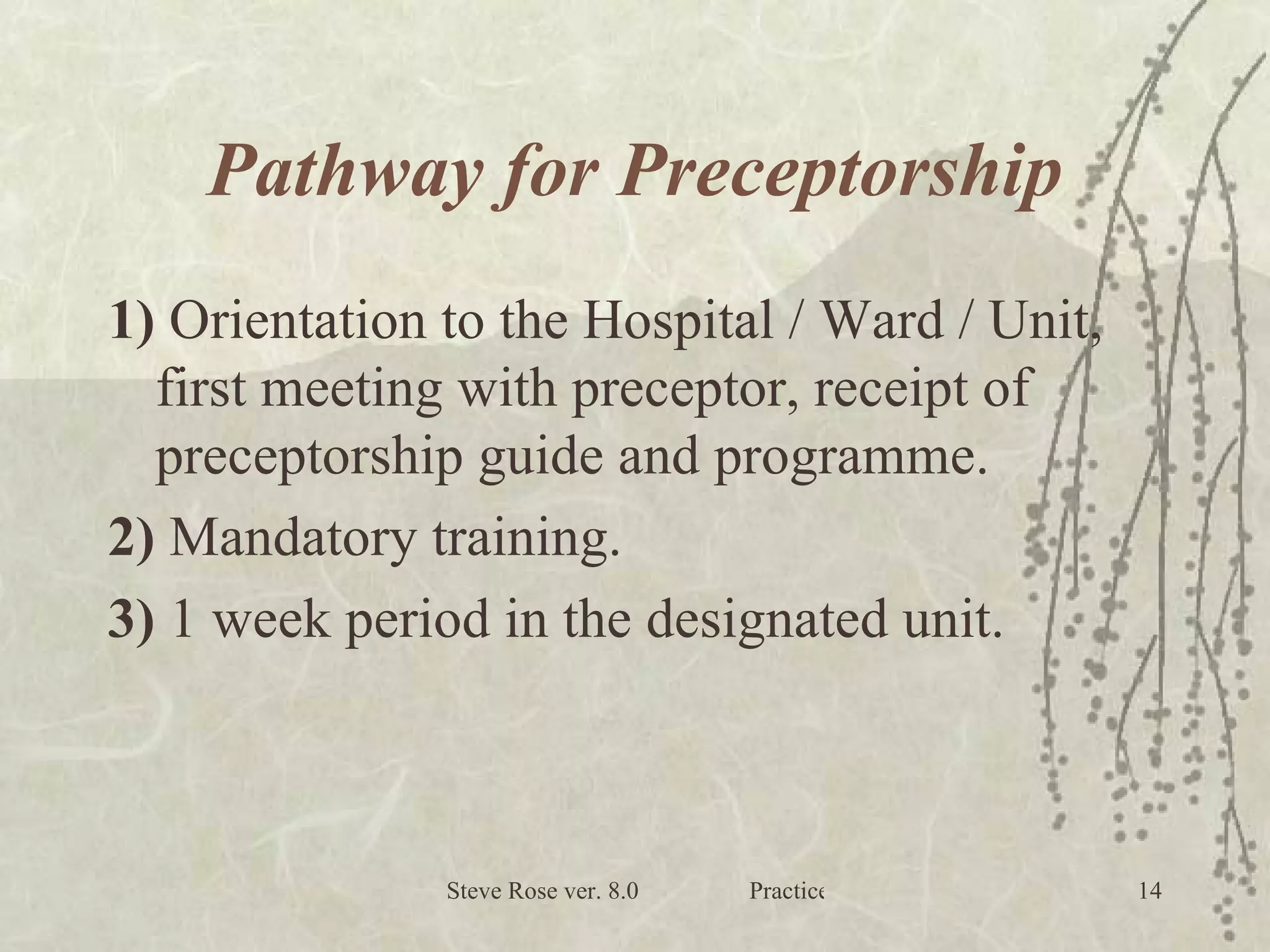
Pathway for Preceptorship
1) Orientation to the Hospital / Ward / Unit,
  first meeting with preceptor, receipt of
  preceptorship guide and programme.
2) Mandatory training.
3) 1 week period in the designated unit.


               Steve Rose ver. 8.0   Practice Development Team, April 2007.
                                                                         14
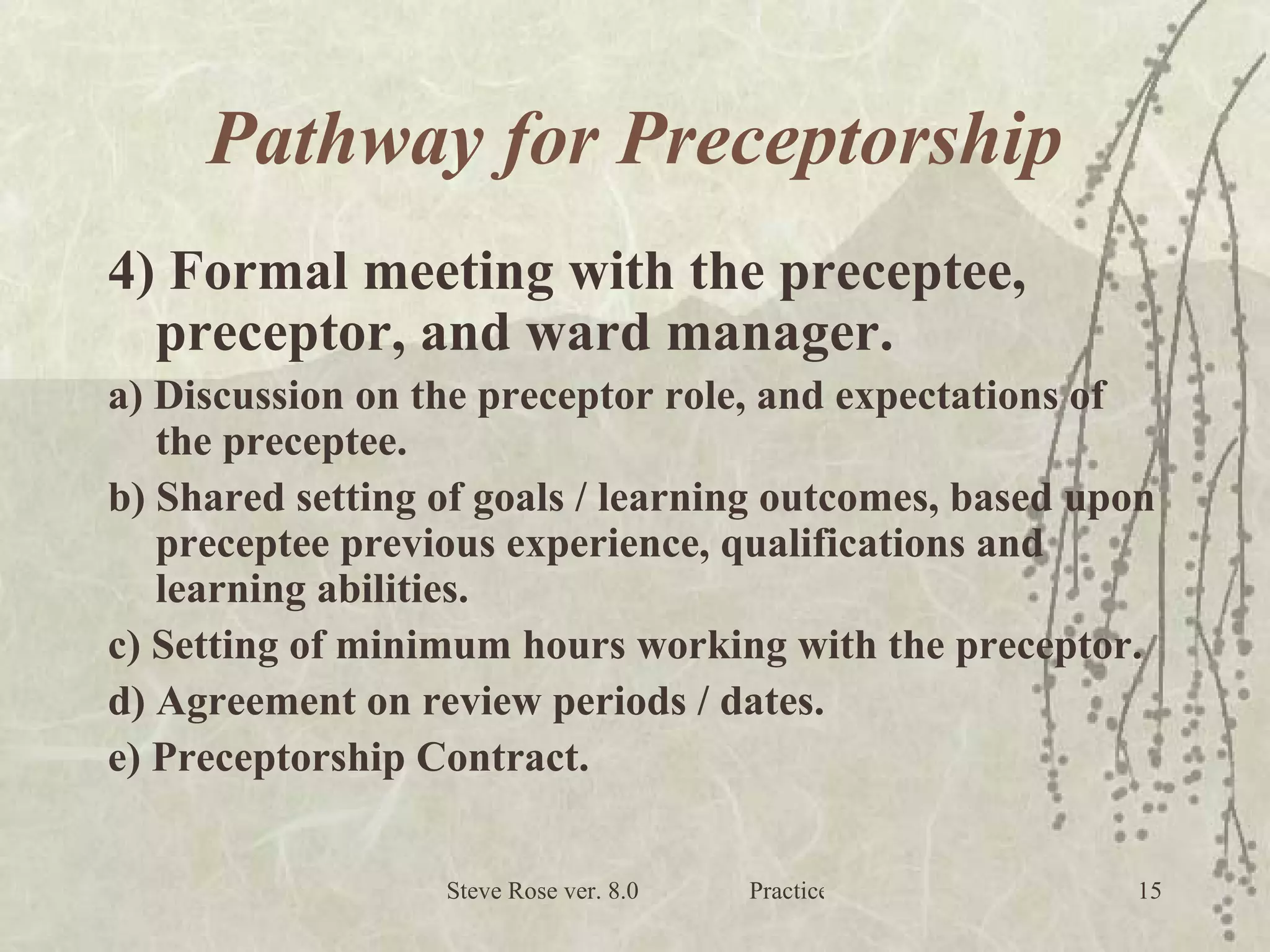
Pathway for Preceptorship
4) Formal meeting with the preceptee,
  preceptor, and ward manager.
a) Discussion on the preceptor role, and expectations of
   the preceptee.
b) Shared setting of goals / learning outcomes, based upon
   preceptee previous experience, qualifications and
   learning abilities.
c) Setting of minimum hours working with the preceptor.
d) Agreement on review periods / dates.
e) Preceptorship Contract.


                  Steve Rose ver. 8.0   Practice Development Team, April 2007.
                                                                            15
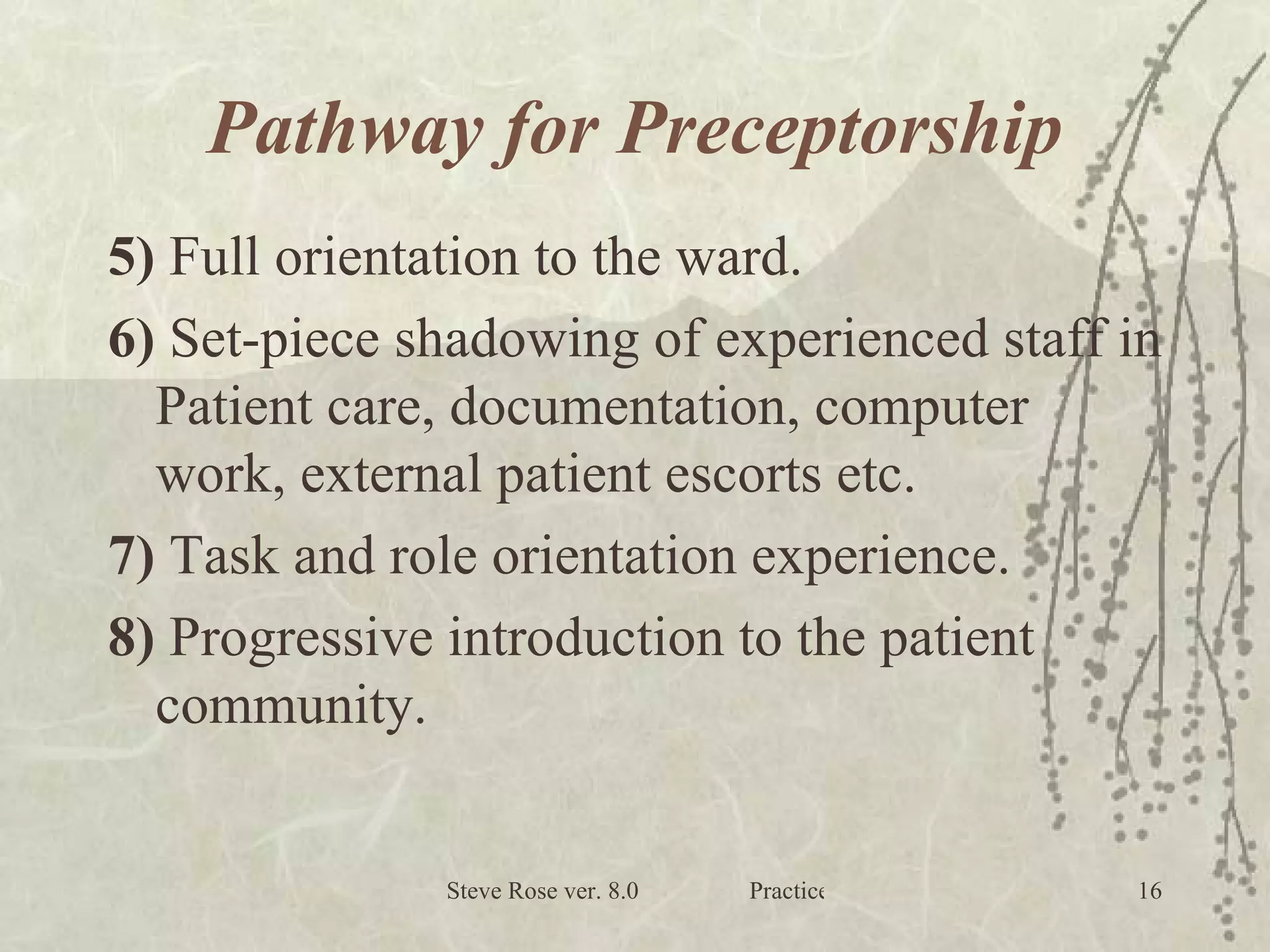
Pathway for Preceptorship
5) Full orientation to the ward.
6) Set-piece shadowing of experienced staff in
  Patient care, documentation, computer
  work, external patient escorts etc.
7) Task and role orientation experience.
8) Progressive introduction to the patient
  community.


              Steve Rose ver. 8.0   Practice Development Team, April 2007.
                                                                        16
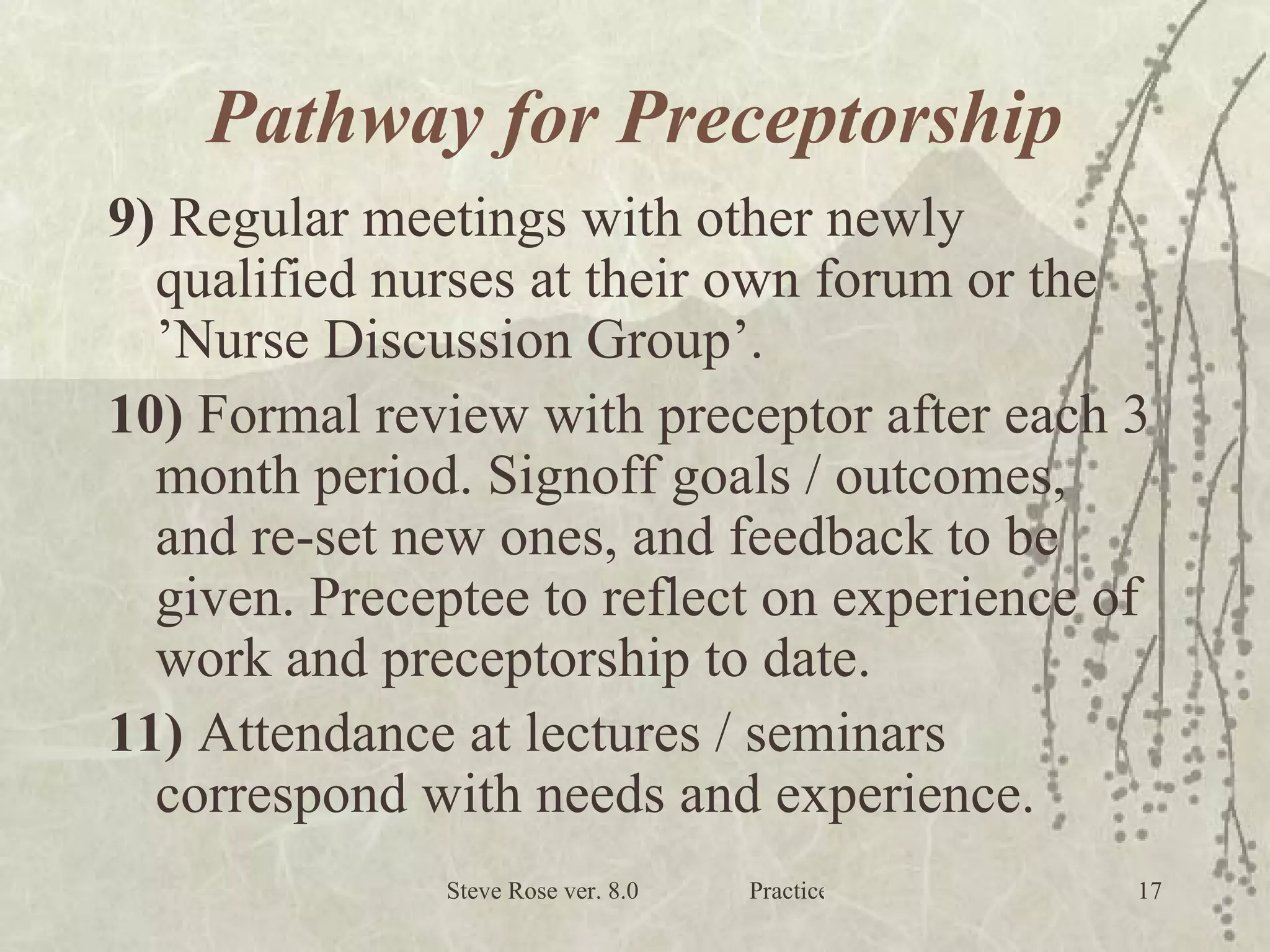
Pathway for Preceptorship
9) Regular meetings with other newly
  qualified nurses at their own forum or the
  ’Nurse Discussion Group’.
10) Formal review with preceptor after each 3
  month period. Signoff goals / outcomes,
  and re-set new ones, and feedback to be
  given. Preceptee to reflect on experience of
  work and preceptorship to date.
11) Attendance at lectures / seminars
  correspond with needs and experience.
              Steve Rose ver. 8.0   Practice Development Team, April 2007.
                                                                        17
Pathway for Preceptorship
12) At 3 months discuss termination /
  extension of the preceptorship period.
13) Evaluation of the preceptorship
  programme.
14) Transfer to individualized staff
  development programme, to include clinical
  supervision.

              Steve Rose ver. 8.0   Practice Development Team, April 2007.
                                                                        18
The difficulties in the implementation of
    preceptorship for the preceptor
   Preceptor might be placed in the conflicting roles of
    confidante and assessor .
   Demanding communication and mediation skills on the
    part of the preceptor and acceptance of peer evaluation
    on the part of the preceptee.
   Professionally, increased demands on experienced
    practitioners who will already have extensive
    responsibilities.
   Increase the possibility of ‘burnout’.
   Problems of lack of support from management and
    other staff.
   Insufficient time to fulfill the preceptor role alongside
    their other duties.

                    Steve Rose ver. 8.0   Practice Development Team, April 2007.
                                                                              19
The difficulties in the implementation of
         preceptorship for the preceptee
   Preceptee might find problems due to the
    preceptorship programme not meeting their
    individual needs especially if the preceptor has a
    heavy workload.
   The preceptorship package is outdated.
   Such issues that challenge the preceptee’s
    communication skills and Assertiveness.
   The preceptor’s personal ability to be flexible
    while objectively fulfilling the roles of
   confidante and assessor.

                   Steve Rose ver. 8.0   Practice Development Team, April 2007.
                                                                             20
Questions?


Steve Rose ver. 8.0   Practice Development Team, April 2007.
                                                          21

Nursing guide to preceptorship

  • 1.
    A Guide To Nursing Preceptorship Prepared by: Kawther Ali
  • 2.
    Topics  What is precptorship  Why we use the preceptorship  When we use the preceptorship  Where we use the preceptorship  Who is the preceptor, and the preceptee Steve Rose ver. 8.0 Practice Development Team, April 2007. 2
  • 3.
    Preceptorship Definition:  Preceptorship isconsidered a Community-based teaching is the teaching of medical or nursing novice by provider, or preceptor, in an office environment. The one teacher/one learner/one patient relationship creates educational cognizance, where the learner experiences and learns from:  Role modeling;  Effective assessment;  Immediate feedback; and  Meaningful evaluation. Steve Rose ver. 8.0 Practice Development Team, April 2007. 3
  • 4.
    Preceptorship  The aim of this Preceptorship program is to provide a  structured, supportive bridge during this transition from new nurse to practitioner.  It also aims to produce competent professional nurses to work in the High Secure Services.  The purpose of this guide is to assist the facilitation of that program, in outlining the requirements and expectations of both preceptor and preceptee. Steve Rose ver. 8.0 Practice Development Team, April 2007. 4
  • 5.
    Preceptorship Who is thePreceptor 2) An expert or specialist who gives practical experience and training to a new nurse. 3) A person, generally a staff nurse, who teaches, counsels, inspires, serves as a role model and supports the growth and development of an individual (the novice) for a fixed and limited period of time with the specific purpose of socializing the novice into a new role.” Steve Rose ver. 8.0 Practice Development Team, April 2007. 5
  • 6.
    Preceptorship Who is thePreceptee 1) The preceptee is a fully qualified, accountable practitioner. 2) Newly registered nurses, midwives or health visitors entering practice for the first time, and for practitioners entering a different field of practice. Steve Rose ver. 8.0 Practice Development Team, April 2007. 6
  • 7.
    The need fora preceptor 1) To promote patient care 3) To reduce the degree of stress you may experience as a newly qualified practitioner. . 4) To ensure responsibilities are not placed on you too soon or inappropriately. 5) To minimize risk to yourself and the patients in the high secure service. Steve Rose ver. 8.0 Practice Development Team, April 2007. 7
  • 8.
    The Preceptor: Attributes Criteriadetermined to enable the preceptor to fulfill what is expected of him/her. 1) He/She must be a first level registered nurse. 2) He/She will have had at least 12 months experience within the clinical field. 3) He/She has been considered as a suitable role model for newly qualified practitioners. 4) He/She will have undergone specific preceptorship training, being familiar with the requirements of support, goal setting, action planning and evaluation. Steve Rose ver. 8.0 Practice Development Team, April 2007. 8
  • 9.
    Expectations in practice 1)The preceptor should have sufficient knowledge to be able to identify the preceptee current learning needs. 2) He/She will be sufficiently experienced and competent, to apply theoretical knowledge to practice. 3) He/She will understand how the preceptee should integrate into the new practice area . 4) He/She understands and will assist with problems encountered in the transition to qualified practitioner. 5) He/She will, with the preceptee, formulate identified learning objectives to assist with this transition. 6) He/she will demonstrate skills in problem solving, decision making, delegation and accountability. 7) He/she will facilitate preceptee’s professional socialization into role. 8) He/She will provide ongoing and periodic feedback on preceptee’s progress. 9) He/She will be a resource for professional and personal support. 10) He/She will help the preceptee to assess, validate and document achievement of clinical competence. Steve Rose ver. 8.0 Practice Development Team, April 2007. 9
  • 10.
    Qualities of aneffective preceptor  1) Good communication skills.  2) A professional role model.  3) Willing to invest time in preceptee.  4) A good listener and problem-solver.  5) Sensitive to the needs and inexperience of the preceptee.  6) Familiar with current theory and practice.  7) Competent and confident, in the preceptor role.  8) Non-judgmental attitude to co-workers  9) Assertiveness  10) Flexibility to change  11) Adaptability to individual teaching needs Steve Rose ver. 8.0 Practice Development Team, April 2007. 10
  • 11.
    Incentive for thePreceptor  1) Enhanced skills.  2) Recognition of role.  3) Sense of achievement.  4) Opportunity for professional development.  5) Opportunity to contribute to the development of the program.  6) Demonstration of responsibility. Steve Rose ver. 8.0 Practice Development Team, April 2007. 11
  • 12.
    The Preceptee: Expectationsof them within this program 1) To communicate learning needs to the preceptor. 2) To fulfill the set learning needs / goals. 3) To communicate any concerns immediately. 4) To seek feedback and ask questions. 5) To attend meetings / lectures as programmed. 6) To engage with the preceptor, and respond to advice. 7) To accept responsibility for preceptor conduct. 8) To keep a record of planned meetings with preceptor, and development i.e. preceptorship profile. 9) Utilize the appropriate resources available. 10) To have regular and sustained contact with preceptor. Steve Rose ver. 8.0 Practice Development Team, April 2007. 12
  • 13.
    Preceptee Outcomes of Preceptorship 2. To be supported in orientation and adapting to new role. 3. To consolidate skills, under supervision. 4. To become a safe and confident practitioner. 5. To have had structured, collaborative support in the new role. Steve Rose ver. 8.0 Practice Development Team, April 2007. 13
  • 14.
    Pathway for Preceptorship 1)Orientation to the Hospital / Ward / Unit, first meeting with preceptor, receipt of preceptorship guide and programme. 2) Mandatory training. 3) 1 week period in the designated unit. Steve Rose ver. 8.0 Practice Development Team, April 2007. 14
  • 15.
    Pathway for Preceptorship 4)Formal meeting with the preceptee, preceptor, and ward manager. a) Discussion on the preceptor role, and expectations of the preceptee. b) Shared setting of goals / learning outcomes, based upon preceptee previous experience, qualifications and learning abilities. c) Setting of minimum hours working with the preceptor. d) Agreement on review periods / dates. e) Preceptorship Contract. Steve Rose ver. 8.0 Practice Development Team, April 2007. 15
  • 16.
    Pathway for Preceptorship 5)Full orientation to the ward. 6) Set-piece shadowing of experienced staff in Patient care, documentation, computer work, external patient escorts etc. 7) Task and role orientation experience. 8) Progressive introduction to the patient community. Steve Rose ver. 8.0 Practice Development Team, April 2007. 16
  • 17.
    Pathway for Preceptorship 9)Regular meetings with other newly qualified nurses at their own forum or the ’Nurse Discussion Group’. 10) Formal review with preceptor after each 3 month period. Signoff goals / outcomes, and re-set new ones, and feedback to be given. Preceptee to reflect on experience of work and preceptorship to date. 11) Attendance at lectures / seminars correspond with needs and experience. Steve Rose ver. 8.0 Practice Development Team, April 2007. 17
  • 18.
    Pathway for Preceptorship 12)At 3 months discuss termination / extension of the preceptorship period. 13) Evaluation of the preceptorship programme. 14) Transfer to individualized staff development programme, to include clinical supervision. Steve Rose ver. 8.0 Practice Development Team, April 2007. 18
  • 19.
    The difficulties inthe implementation of preceptorship for the preceptor  Preceptor might be placed in the conflicting roles of confidante and assessor .  Demanding communication and mediation skills on the part of the preceptor and acceptance of peer evaluation on the part of the preceptee.  Professionally, increased demands on experienced practitioners who will already have extensive responsibilities.  Increase the possibility of ‘burnout’.  Problems of lack of support from management and other staff.  Insufficient time to fulfill the preceptor role alongside their other duties. Steve Rose ver. 8.0 Practice Development Team, April 2007. 19
  • 20.
    The difficulties inthe implementation of preceptorship for the preceptee  Preceptee might find problems due to the preceptorship programme not meeting their individual needs especially if the preceptor has a heavy workload.  The preceptorship package is outdated.  Such issues that challenge the preceptee’s communication skills and Assertiveness.  The preceptor’s personal ability to be flexible while objectively fulfilling the roles of  confidante and assessor. Steve Rose ver. 8.0 Practice Development Team, April 2007. 20
  • 21.
    Questions? Steve Rose ver.8.0 Practice Development Team, April 2007. 21