© 2017 KEMET Corporation
Embedding Aluminum Polymer
Capacitors
Brandon Summey
Aluminum Polymer Development Manager
3-27-2017
© 2017 KEMET Corporation
The Push for Thin
© 2017 KEMET Corporation
Goal of Thin
• Thin means something different for each application
– Reducing overall device thickness
– Components in unused space
• Back of a board
• Inside or Under Chip
– Higher power density
• Goal: Provide the tools you need
© 2017 KEMET Corporation
Where does the height go?
Leadframe
Anode Lead
Aluminum or Tantalum
Solid Electrolytic Cathode
Conductive Polymer/Carbon ink/Silver ink
Mask
Encapsulant
Not to Scale
Height to scale
0.4mm thick part
• As the thickness of device is
reduced the percentage of
height used for capacitance
decreases quickly
© 2017 KEMET Corporation
Traditional Molded Capacitors
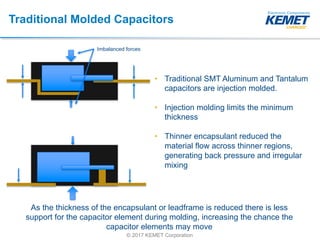
• Traditional SMT Aluminum and Tantalum
capacitors are injection molded.
• Injection molding limits the minimum
thickness
• Thinner encapsulant reduced the
material flow across thinner regions,
generating back pressure and irregular
mixing
As the thickness of the encapsulant or leadframe is reduced there is less
support for the capacitor element during molding, increasing the chance the
capacitor elements may move
Imbalanced forces
© 2017 KEMET Corporation
Where traditional methods run out
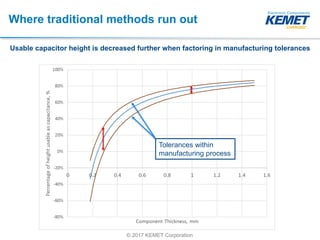
Usable capacitor height is decreased further when factoring in manufacturing tolerances
Tolerances within
manufacturing process
© 2017 KEMET Corporation
Advanced Packaging
KAP
© 2017 KEMET Corporation
KEMET Advanced Packaging - Process
Copper Foil Prepreg
Lamination
Step
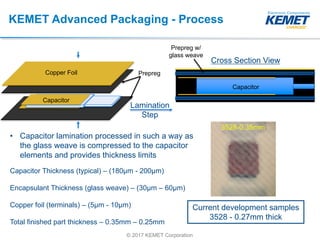
Capacitor Thickness (typical) – (180µm - 200µm)
Encapsulant Thickness (glass weave) – (30µm – 60µm)
Copper foil (terminals) – (5µm - 10µm)
Total finished part thickness – 0.35mm – 0.25mm
Cross Section View
Capacitor
Capacitor
Prepreg w/
glass weave
Current development samples
3528 - 0.27mm thick
3528-0.35mm
• Capacitor lamination processed in such a way as
the glass weave is compressed to the capacitor
elements and provides thickness limits
© 2017 KEMET Corporation
KAP - Terminal Forming
• Pockets cut into laminate form the
basis for the terminals
• Copper plating is formed inside the
pockets to connect the capacitor and
the copper cladding layer
Copper plating into vias/pockets
to form terminal connections
Copper etched to form discrete terminals
and capacitors cut free from the laminate
Capacitor Element
© 2017 KEMET Corporation
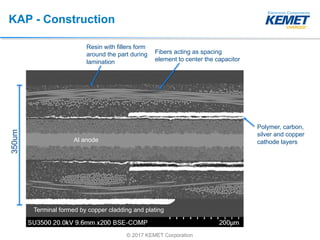
KAP - Construction
Fibers acting as spacing
element to center the capacitor
Resin with fillers form
around the part during
lamination
Al anode
Terminal formed by copper cladding and plating
350um
Polymer, carbon,
silver and copper
cathode layers
© 2017 KEMET Corporation
Target Capability of New Packaging vs. Traditional
Progression to lower case height
Volumetric Efficiency of Different Packaging Designs
Gen IIFacedownStandard KAP
Max Available Finished Anode Height (mm)
* Volumetric efficiency is based on construction design rules for ≤0.4mm, other limiting factors may exist above 0.4mm
KEMET Advanced Package = KAP
3528/Height 2.0	mm 	1.5mm 1.2mm 1.0mm 0.8mm 0.6mm 0.4mm 0.2mm
Standard 1.43 0.88 0.58 0.41 0.21 0.01 -0.19 -0.38
Facedown	(Target) 1.78 1.23 0.93 0.76 0.56 0.36 0.16 -0.03
Gen	II 1.78 1.23 0.93 0.76 0.56 0.36 0.16 -0.03
KAP 1.91 1.36 1.06 0.89 0.69 0.49 0.29 0.10
*0	mm 	1.5mm 1.2mm 1.0mm 0.8mm 0.6mm 0.4mm 0.2mm
27% 23% 19% 16% 10% 1% -19% -76%
55% 52% 50% 48% 44% 38% 26% -10%
67% 64% 61% 59% 54% 47% 32% -12%
84% 82% 81% 80% 77% 74% 67% 46%
3528/Height 2.0	mm 	1.5mm 1.2mm 1.0mm 0.8mm 0.6mm 0.4mm 0.2mm
Standard 1.43 0.88 0.58 0.41 0.21 0.01 -0.19 -0.38
Facedown	(Target) 1.78 1.23 0.93 0.76 0.56 0.36 0.16 -0.03
Gen	II 1.78 1.23 0.93 0.76 0.56 0.36 0.16 -0.03
KAP 1.91 1.36 1.06 0.89 0.69 0.49 0.29 0.10
*mm 	1.5mm 1.2mm 1.0mm 0.8mm 0.6mm 0.4mm 0.2mm
43 0.88 0.58 0.41 0.21 0.01 -0.19 -0.38
78 1.23 0.93 0.76 0.56 0.36 0.16 -0.03
78 1.23 0.93 0.76 0.56 0.36 0.16 -0.03
91 1.36 1.06 0.89 0.69 0.49 0.29 0.10
© 2017 KEMET Corporation
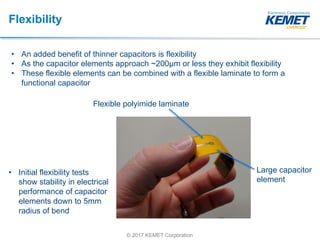
Flexibility
Flexible polyimide laminate
Large capacitor
element
• Initial flexibility tests
show stability in electrical
performance of capacitor
elements down to 5mm
radius of bend
• An added benefit of thinner capacitors is flexibility
• As the capacitor elements approach ~200µm or less they exhibit flexibility
• These flexible elements can be combined with a flexible laminate to form a
functional capacitor
© 2017 KEMET Corporation
Embedded/Integrated Capacitors
© 2017 KEMET Corporation
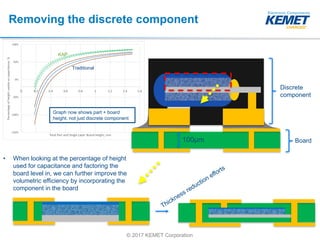
Removing the discrete component
100µm
• When looking at the percentage of height
used for capacitance and factoring the
board level in, we can further improve the
volumetric efficiency by incorporating the
component in the board
Discrete
component
Board
Graph now shows part + board
height, not just discrete component
KAP
Traditional
© 2017 KEMET Corporation
Board level height influence
• With thickness reduction and embedding the percentage of height used for
capacitance is significantly increased in a given board footprint
Embedded
© 2017 KEMET Corporation
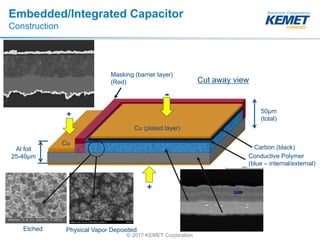
Embedded/Integrated Capacitor
Construction
Carbon (black)
Conductive Polymer
(blue – internal/external)
+
-
50µm
(total)
Al foil
25-40µm
+
Etched
Cu (plated layer)
Masking (barrier layer)
(Red)
Cu
Cut away view
Physical Vapor Deposited
© 2017 KEMET Corporation
Embedded/Integrated
Current layer Construction
Copper plated layer
Ultra thin carbon ink
Thin Electro-Chemical
Polymer layer (ECPoly)
Etched aluminum
layer/internal polymer
~80um
© 2017 KEMET Corporation
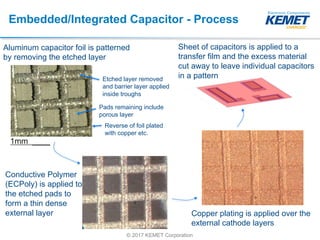
Embedded/Integrated Capacitor - Process
Aluminum capacitor foil is patterned
by removing the etched layer
Etched layer removed
and barrier layer applied
inside troughs
Conductive Polymer
(ECPoly) is applied to
the etched pads to
form a thin dense
external layer Copper plating is applied over the
external cathode layers
Sheet of capacitors is applied to a
transfer film and the excess material
cut away to leave individual capacitors
in a pattern
Pads remaining include
porous layer
Reverse of foil plated
with copper etc.
1mm ____
© 2017 KEMET Corporation
Patterning and Transport Concept
(-)
(-)
(-)
Top view
Transfer release film
(+)
Cross section
Arrayed
Sheets
Individual
Taping
© 2017 KEMET Corporation
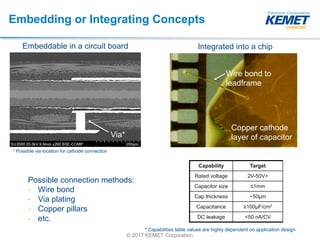
Embedding or Integrating Concepts
Embeddable in a circuit board Integrated into a chip
Possible connection methods:
- Wire bond
- Via plating
- Copper pillars
- etc.
Via*
Wire bond to
leadframe
* Possible via location for cathode connection
Copper cathode
layer of capacitor
Capability Target
Rated voltage 2V-50V+
Capacitor size ≤1mm
Cap thickness ~50µm
Capacitance ≥100µF/cm2
DC leakage <50 nA/CV
* Capabilities table values are highly dependent on application design
© 2017 KEMET Corporation
Thank You!
Download at:
ec.kemet.com/ao-embedded-apec

Embedded Capacitors - Aluminum Polymer APEC Preview

  • 1.
    © 2017 KEMETCorporation Embedding Aluminum Polymer Capacitors Brandon Summey Aluminum Polymer Development Manager 3-27-2017
  • 2.
    © 2017 KEMETCorporation The Push for Thin
  • 3.
    © 2017 KEMETCorporation Goal of Thin • Thin means something different for each application – Reducing overall device thickness – Components in unused space • Back of a board • Inside or Under Chip – Higher power density • Goal: Provide the tools you need
  • 4.
    © 2017 KEMETCorporation Where does the height go? Leadframe Anode Lead Aluminum or Tantalum Solid Electrolytic Cathode Conductive Polymer/Carbon ink/Silver ink Mask Encapsulant Not to Scale Height to scale 0.4mm thick part • As the thickness of device is reduced the percentage of height used for capacitance decreases quickly
  • 5.
    © 2017 KEMETCorporation Traditional Molded Capacitors • Traditional SMT Aluminum and Tantalum capacitors are injection molded. • Injection molding limits the minimum thickness • Thinner encapsulant reduced the material flow across thinner regions, generating back pressure and irregular mixing As the thickness of the encapsulant or leadframe is reduced there is less support for the capacitor element during molding, increasing the chance the capacitor elements may move Imbalanced forces
  • 6.
    © 2017 KEMETCorporation Where traditional methods run out Usable capacitor height is decreased further when factoring in manufacturing tolerances Tolerances within manufacturing process
  • 7.
    © 2017 KEMETCorporation Advanced Packaging KAP
  • 8.
    © 2017 KEMETCorporation KEMET Advanced Packaging - Process Copper Foil Prepreg Lamination Step Capacitor Thickness (typical) – (180µm - 200µm) Encapsulant Thickness (glass weave) – (30µm – 60µm) Copper foil (terminals) – (5µm - 10µm) Total finished part thickness – 0.35mm – 0.25mm Cross Section View Capacitor Capacitor Prepreg w/ glass weave Current development samples 3528 - 0.27mm thick 3528-0.35mm • Capacitor lamination processed in such a way as the glass weave is compressed to the capacitor elements and provides thickness limits
  • 9.
    © 2017 KEMETCorporation KAP - Terminal Forming • Pockets cut into laminate form the basis for the terminals • Copper plating is formed inside the pockets to connect the capacitor and the copper cladding layer Copper plating into vias/pockets to form terminal connections Copper etched to form discrete terminals and capacitors cut free from the laminate Capacitor Element
  • 10.
    © 2017 KEMETCorporation KAP - Construction Fibers acting as spacing element to center the capacitor Resin with fillers form around the part during lamination Al anode Terminal formed by copper cladding and plating 350um Polymer, carbon, silver and copper cathode layers
  • 11.
    © 2017 KEMETCorporation Target Capability of New Packaging vs. Traditional Progression to lower case height Volumetric Efficiency of Different Packaging Designs Gen IIFacedownStandard KAP Max Available Finished Anode Height (mm) * Volumetric efficiency is based on construction design rules for ≤0.4mm, other limiting factors may exist above 0.4mm KEMET Advanced Package = KAP 3528/Height 2.0 mm 1.5mm 1.2mm 1.0mm 0.8mm 0.6mm 0.4mm 0.2mm Standard 1.43 0.88 0.58 0.41 0.21 0.01 -0.19 -0.38 Facedown (Target) 1.78 1.23 0.93 0.76 0.56 0.36 0.16 -0.03 Gen II 1.78 1.23 0.93 0.76 0.56 0.36 0.16 -0.03 KAP 1.91 1.36 1.06 0.89 0.69 0.49 0.29 0.10 *0 mm 1.5mm 1.2mm 1.0mm 0.8mm 0.6mm 0.4mm 0.2mm 27% 23% 19% 16% 10% 1% -19% -76% 55% 52% 50% 48% 44% 38% 26% -10% 67% 64% 61% 59% 54% 47% 32% -12% 84% 82% 81% 80% 77% 74% 67% 46% 3528/Height 2.0 mm 1.5mm 1.2mm 1.0mm 0.8mm 0.6mm 0.4mm 0.2mm Standard 1.43 0.88 0.58 0.41 0.21 0.01 -0.19 -0.38 Facedown (Target) 1.78 1.23 0.93 0.76 0.56 0.36 0.16 -0.03 Gen II 1.78 1.23 0.93 0.76 0.56 0.36 0.16 -0.03 KAP 1.91 1.36 1.06 0.89 0.69 0.49 0.29 0.10 *mm 1.5mm 1.2mm 1.0mm 0.8mm 0.6mm 0.4mm 0.2mm 43 0.88 0.58 0.41 0.21 0.01 -0.19 -0.38 78 1.23 0.93 0.76 0.56 0.36 0.16 -0.03 78 1.23 0.93 0.76 0.56 0.36 0.16 -0.03 91 1.36 1.06 0.89 0.69 0.49 0.29 0.10
  • 12.
    © 2017 KEMETCorporation Flexibility Flexible polyimide laminate Large capacitor element • Initial flexibility tests show stability in electrical performance of capacitor elements down to 5mm radius of bend • An added benefit of thinner capacitors is flexibility • As the capacitor elements approach ~200µm or less they exhibit flexibility • These flexible elements can be combined with a flexible laminate to form a functional capacitor
  • 13.
    © 2017 KEMETCorporation Embedded/Integrated Capacitors
  • 14.
    © 2017 KEMETCorporation Removing the discrete component 100µm • When looking at the percentage of height used for capacitance and factoring the board level in, we can further improve the volumetric efficiency by incorporating the component in the board Discrete component Board Graph now shows part + board height, not just discrete component KAP Traditional
  • 15.
    © 2017 KEMETCorporation Board level height influence • With thickness reduction and embedding the percentage of height used for capacitance is significantly increased in a given board footprint Embedded
  • 16.
    © 2017 KEMETCorporation Embedded/Integrated Capacitor Construction Carbon (black) Conductive Polymer (blue – internal/external) + - 50µm (total) Al foil 25-40µm + Etched Cu (plated layer) Masking (barrier layer) (Red) Cu Cut away view Physical Vapor Deposited
  • 17.
    © 2017 KEMETCorporation Embedded/Integrated Current layer Construction Copper plated layer Ultra thin carbon ink Thin Electro-Chemical Polymer layer (ECPoly) Etched aluminum layer/internal polymer ~80um
  • 18.
    © 2017 KEMETCorporation Embedded/Integrated Capacitor - Process Aluminum capacitor foil is patterned by removing the etched layer Etched layer removed and barrier layer applied inside troughs Conductive Polymer (ECPoly) is applied to the etched pads to form a thin dense external layer Copper plating is applied over the external cathode layers Sheet of capacitors is applied to a transfer film and the excess material cut away to leave individual capacitors in a pattern Pads remaining include porous layer Reverse of foil plated with copper etc. 1mm ____
  • 19.
    © 2017 KEMETCorporation Patterning and Transport Concept (-) (-) (-) Top view Transfer release film (+) Cross section Arrayed Sheets Individual Taping
  • 20.
    © 2017 KEMETCorporation Embedding or Integrating Concepts Embeddable in a circuit board Integrated into a chip Possible connection methods: - Wire bond - Via plating - Copper pillars - etc. Via* Wire bond to leadframe * Possible via location for cathode connection Copper cathode layer of capacitor Capability Target Rated voltage 2V-50V+ Capacitor size ≤1mm Cap thickness ~50µm Capacitance ≥100µF/cm2 DC leakage <50 nA/CV * Capabilities table values are highly dependent on application design
  • 21.
    © 2017 KEMETCorporation Thank You! Download at: ec.kemet.com/ao-embedded-apec