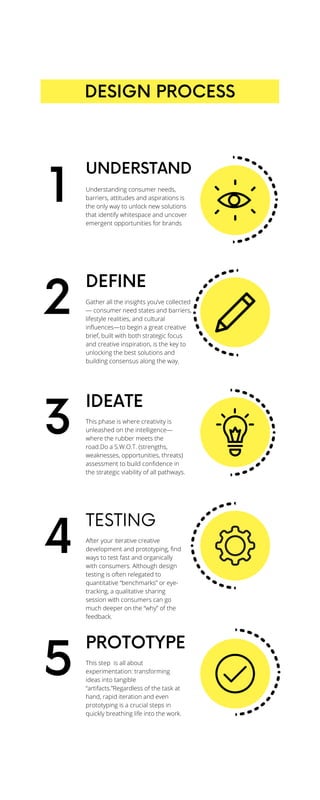
UNDERSTAND
Understanding consumer needs,
barriers, attitudes and aspirations is
the only way to unlock new solutions
that identify whitespace and uncover
emergent opportunities for brands
DESIGN PROCESS
1
DEFINE
2
IDEATE
This phase is where creativity is
unleashed on the intelligence—
where the rubber meets the
road.Do a S.W.O.T. (strengths,
weaknesses, opportunities, threats)
assessment to build confidence in
the strategic viability of all pathways.
3
TESTING
After your iterative creative
development and prototyping, find
ways to test fast and organically
with consumers. Although design
testing is often relegated to
quantitative “benchmarks” or eye-
tracking, a qualitative sharing
session with consumers can go
much deeper on the “why” of the
feedback.
4
PROTOTYPE
This step is all about
experimentation: transforming
ideas into tangible
“artifacts.”Regardless of the task at
hand, rapid iteration and even
prototyping is a crucial steps in
quickly breathing life into the work.
5
Gather all the insights you’ve collected
— consumer need states and barriers,
lifestyle realities, and cultural
influences—to begin a great creative
brief, built with both strategic focus
and creative inspiration, is the key to
unlocking the best solutions and
building consensus along the way.

Design Process .pdf

  • 1.
    UNDERSTAND Understanding consumer needs, barriers,attitudes and aspirations is the only way to unlock new solutions that identify whitespace and uncover emergent opportunities for brands DESIGN PROCESS 1 DEFINE 2 IDEATE This phase is where creativity is unleashed on the intelligence— where the rubber meets the road.Do a S.W.O.T. (strengths, weaknesses, opportunities, threats) assessment to build confidence in the strategic viability of all pathways. 3 TESTING After your iterative creative development and prototyping, find ways to test fast and organically with consumers. Although design testing is often relegated to quantitative “benchmarks” or eye- tracking, a qualitative sharing session with consumers can go much deeper on the “why” of the feedback. 4 PROTOTYPE This step is all about experimentation: transforming ideas into tangible “artifacts.”Regardless of the task at hand, rapid iteration and even prototyping is a crucial steps in quickly breathing life into the work. 5 Gather all the insights you’ve collected — consumer need states and barriers, lifestyle realities, and cultural influences—to begin a great creative brief, built with both strategic focus and creative inspiration, is the key to unlocking the best solutions and building consensus along the way.