Cycles 2.0
- The art of navigating cycles
Jiten Parmar
Twitter - @jitenkparmar
email : jiten.parmar@aurumcapital.in
https://aurumcapital.in
twitter - @Capitalaurum
email : info@aurumcapital.in
Dec 2019
 Jiten is co-founder of Aurum Capital. Aurum Capital
is a SEBI registered investment advisory company
 The stocks discussed in this presentation are not
recommendations from Aurum Capital or Jiten
Parmar
 Some of these stocks may have been recommended
to our clients and Jiten Parmar may hold some of
these.
 This presentation is only for educational purpose and
does not constitute investment advice.
JP
Disclosures
JP
Investing is
psychology, history,
sociology, politics
and ….. science
JP
Key Learning
JP
The first step to
successful investing is
knowing self. Knowing
your temperament and
mental fortitude
JP
Key Learning
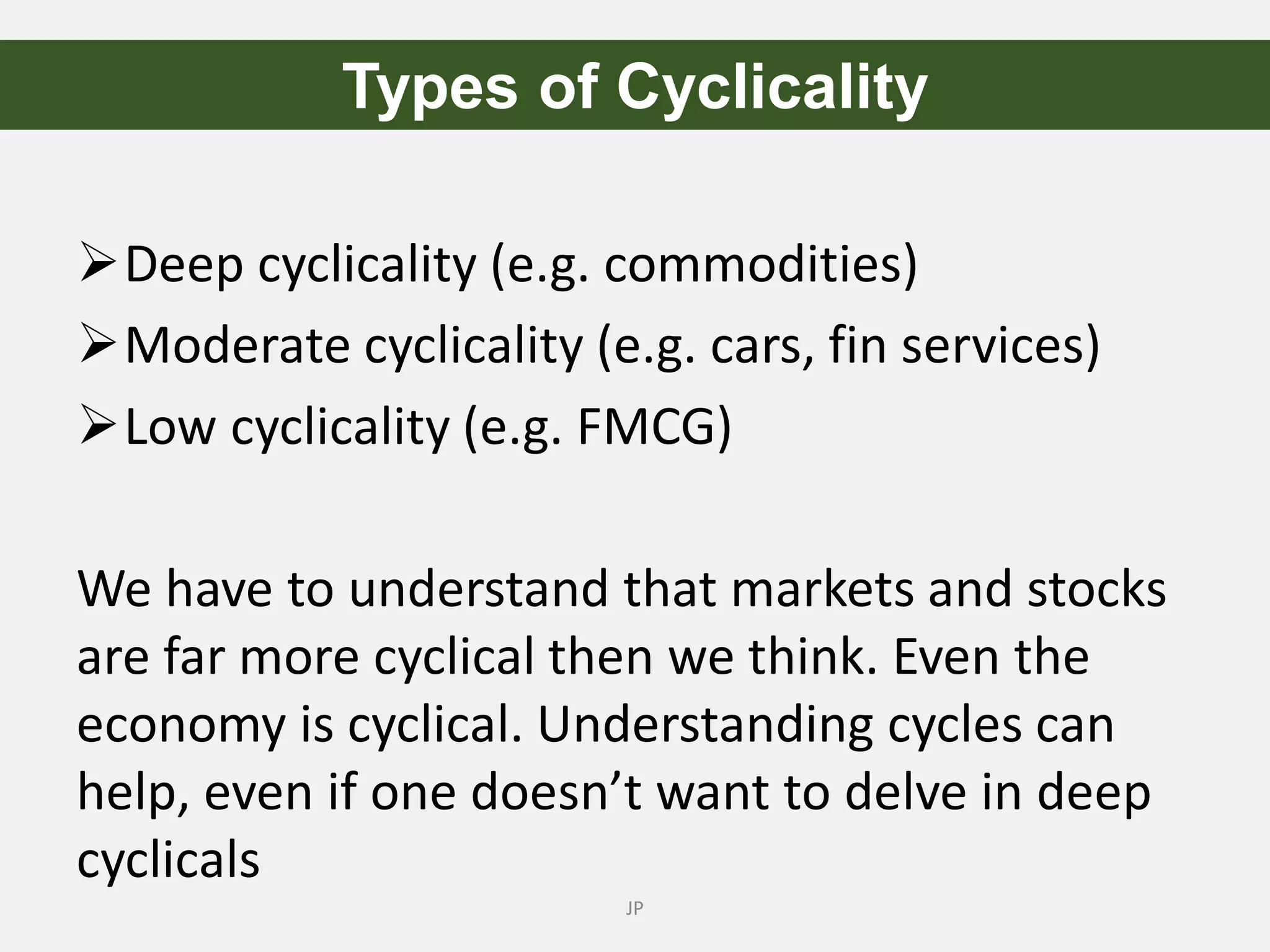
Deep cyclicality (e.g. commodities)
Moderate cyclicality (e.g. cars, fin services)
Low cyclicality (e.g. FMCG)
We have to understand that markets and stocks
are far more cyclical then we think. Even the
economy is cyclical. Understanding cycles can
help, even if one doesn’t want to delve in deep
cyclicals
JP
Types of Cyclicality
Rule No. 1: Most things will prove to
be cyclical
Rule No. 2: Some of the greatest
opportunities for gain and loss come
when other people forget Rule One.
-Howard Marks
JP
We don’t have to be “exactly right”. We are
good even if we are “approximately right”
Don’t have to get in at “bottom”, nor get out
at the “top”
You just have to get the general direction right
Don’t mind leaving something on the table,
during exits
JP
Timing
Within stocks and sectors, you have to
comprehend “business cycle” as well as
“market cycle”. They might not coincide. So do
make adjustments accordingly. “Best price”
may come before “best results” and “worst
price” may come before “worst results”
“Excel” investing rarely works in cyclicals,
especially in deep cyclicals
JP
What do we have to comprehend?
 A leading FMCG company from 2001 to 2011
increased revenue from 10000 cr to 19000 cr. Profits
from 1600 cr to 2300 cr. From 2011 to 2019 revenue
went to 37000 cr, profits to 6000 cr. Stock gave 0%
returns in 1st period and 900% in the 2nd period
 A leading IT company has multiplied profits 37 times
since 2000, but stock price yet to see price of year
2000
JP
Market Cycles
JP
What we expect/want
JP
What we get
JP
Don’t try this
JP
Or this
JP
Get help
JP
JP
An interesting analogy
Cyclical/Commodity plays are like going to
a pub. Enter during happy hours and leave
at midnight when party is in full swing.
Even if you stay late, be near the door, or
you might end up paying the bill for others
too
Jiten Parmar, Investors Carnival, Nov 2017
JP
Higher risk, higher returns
JP
 One ends up buying when ratios are bad - EBITDA margins,
ROE’s are down. Company might be in loss
 One sells when these show sharp uptick and company
becomes highly profitable
 Buy, let’s say, when PE is 60 (or -ve) and sell when it is 6
 Buy when sector is completely neglected and sell when it is
hot
 Buy when no one is covering the stock and sell when many
buy reports come
 Basically, a contrarian approach is required
 The bet is on “reversal to mean”
JP
Contrarian Approach/Inversion
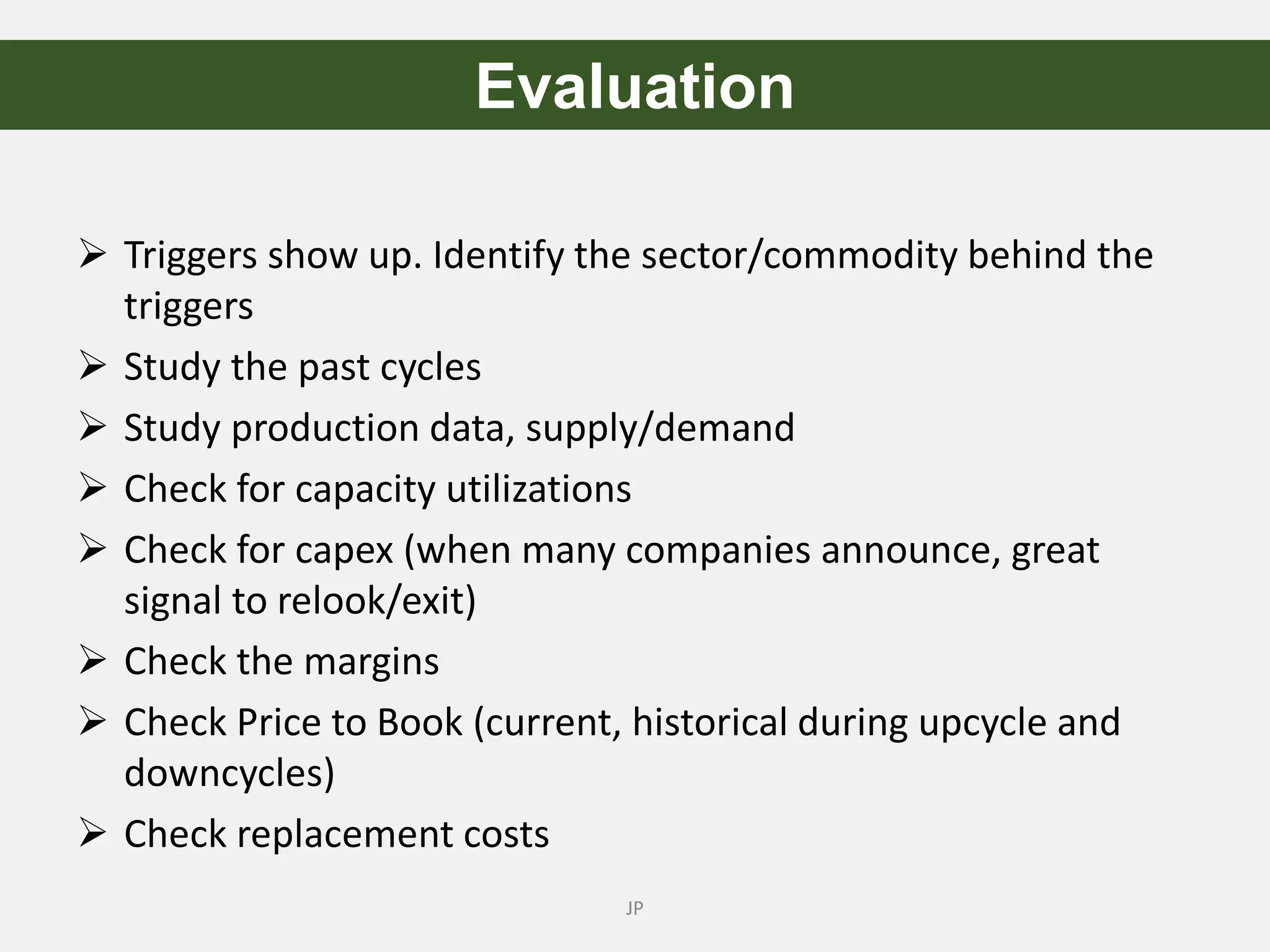
 Triggers show up. Identify the sector/commodity behind the
triggers
 Study the past cycles
 Study production data, supply/demand
 Check for capacity utilizations
 Check for capex (when many companies announce, great
signal to relook/exit)
 Check the margins
 Check Price to Book (current, historical during upcycle and
downcycles)
 Check replacement costs
JP
Evaluation
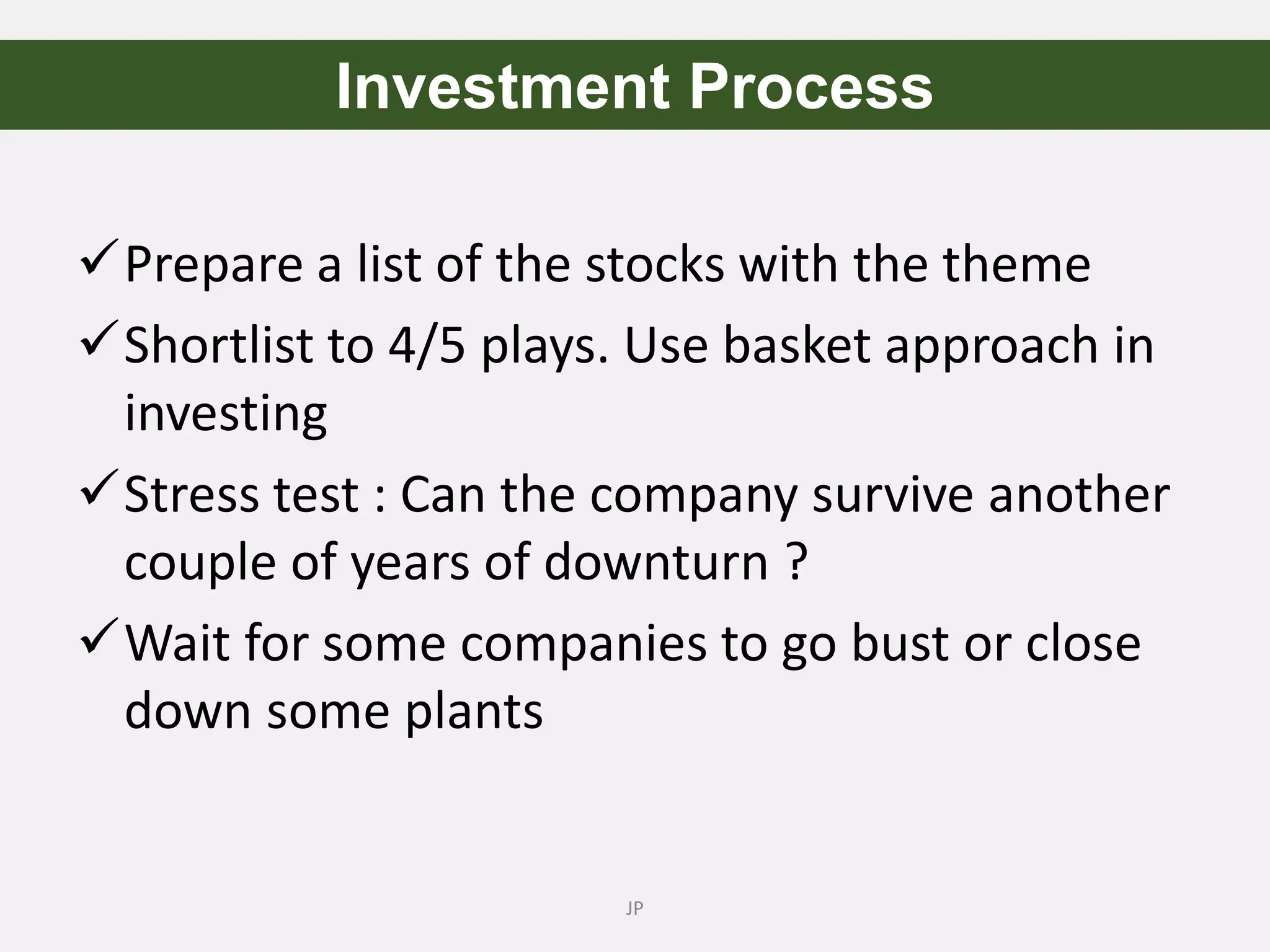
Prepare a list of the stocks with the theme
Shortlist to 4/5 plays. Use basket approach in
investing
Stress test : Can the company survive another
couple of years of downturn ?
Wait for some companies to go bust or close
down some plants
JP
Investment Process
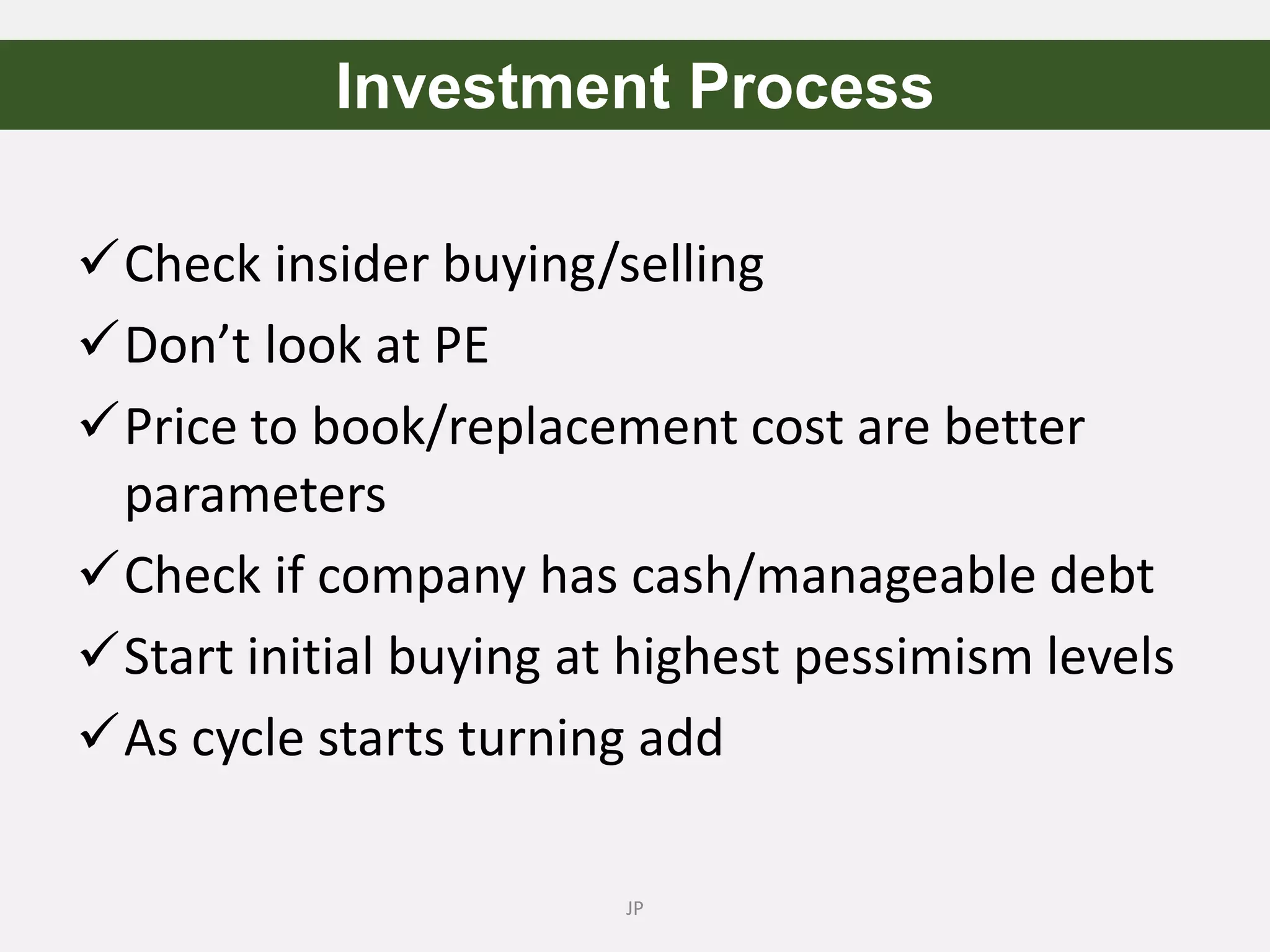
Check insider buying/selling
Don’t look at PE
Price to book/replacement cost are better
parameters
Check if company has cash/manageable debt
Start initial buying at highest pessimism levels
As cycle starts turning add
JP
Investment Process
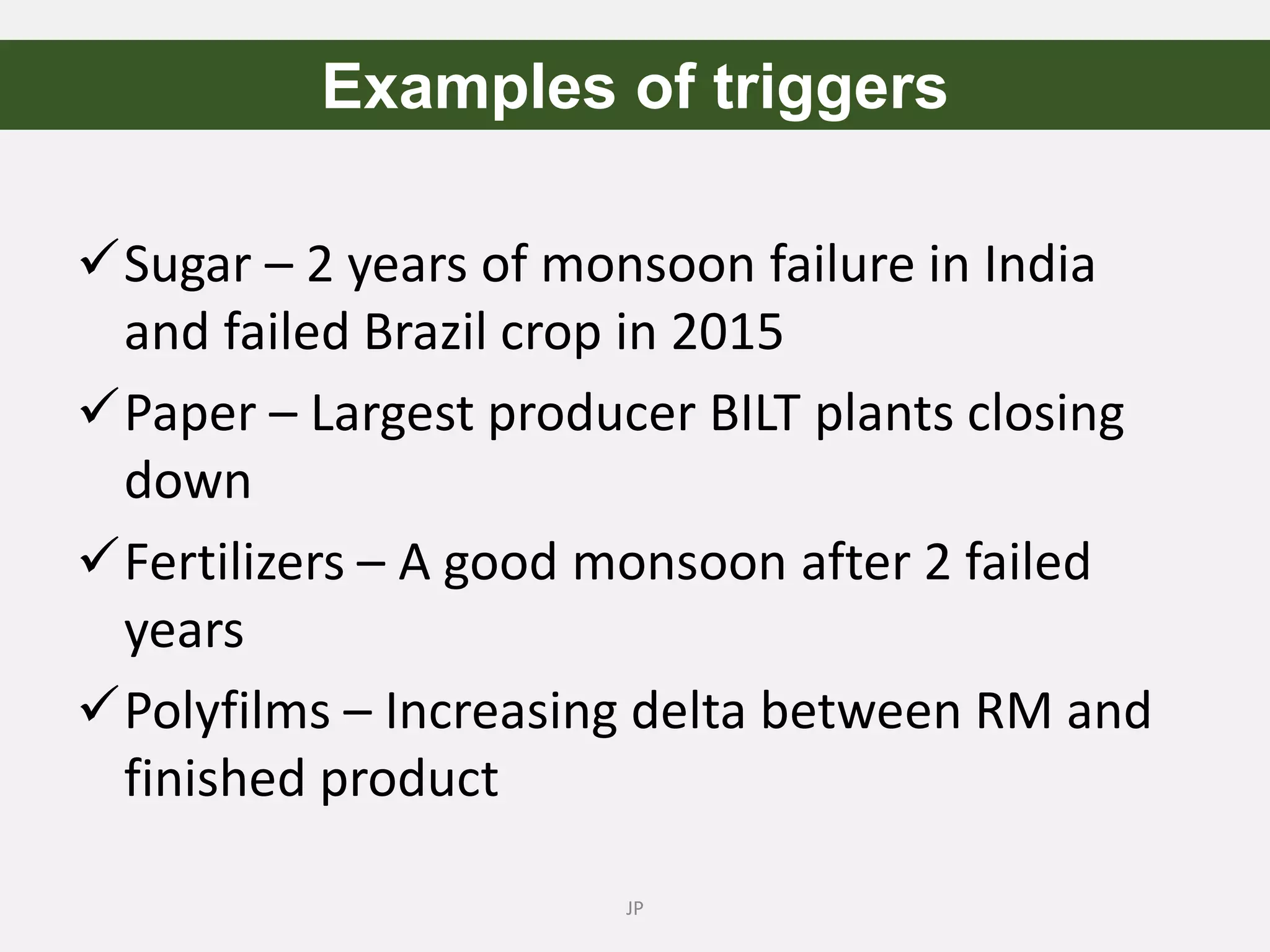
Sugar – 2 years of monsoon failure in India
and failed Brazil crop in 2015
Paper – Largest producer BILT plants closing
down
Fertilizers – A good monsoon after 2 failed
years
Polyfilms – Increasing delta between RM and
finished product
JP
Examples of triggers
Chemicals - China measures for pollution
control and closing of many units, ADD (anti-
dumping duty)
Metals/mining - Chinese plants started closing
down due to pollution. For Steel - MSP
(minimum support price), infra focus
 Cement - government focus on Infra, supply
not coming as per estimated demand leading
to higher capacity utilizations
JP
Examples of triggers
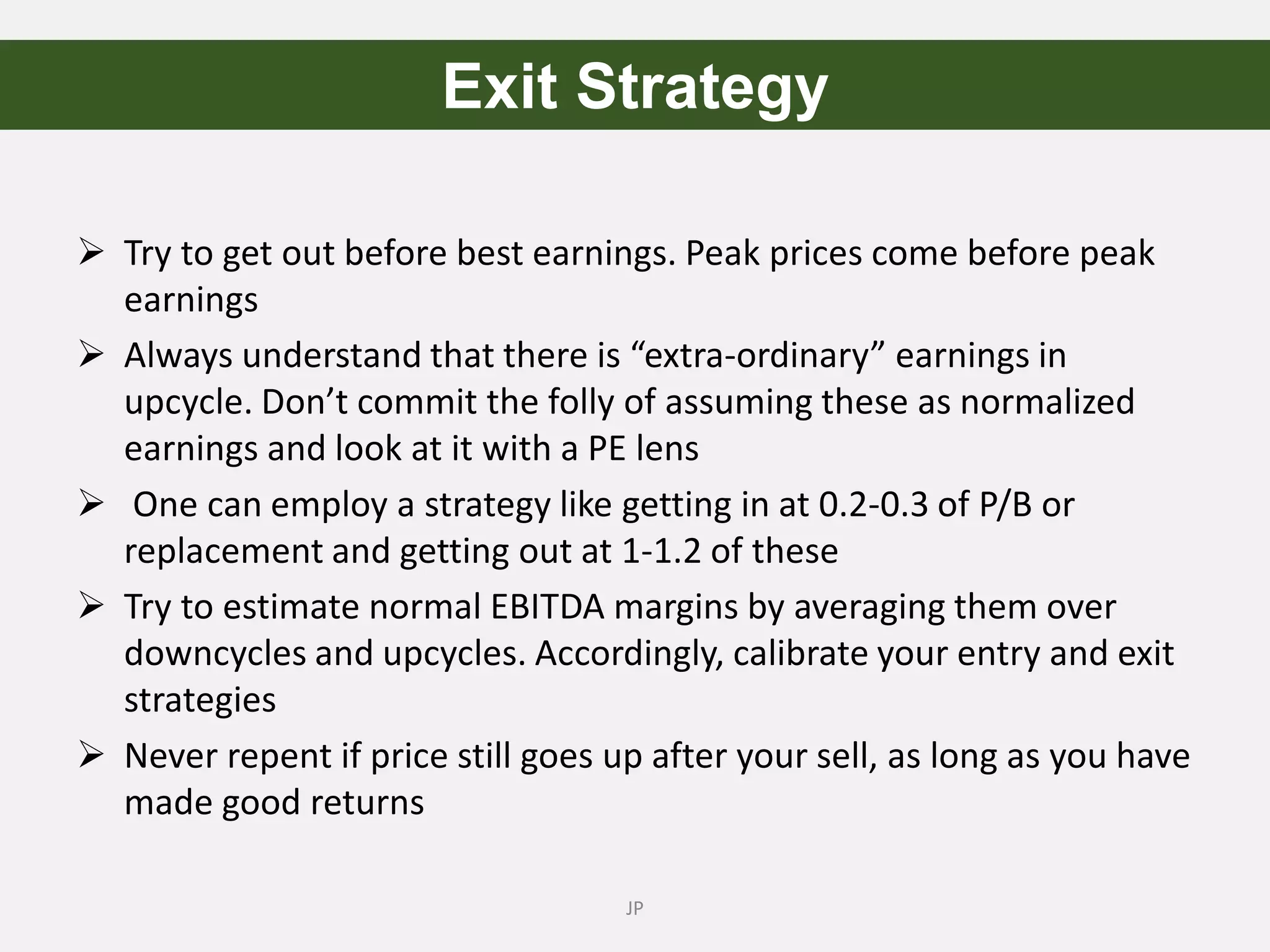
 Try to get out before best earnings. Peak prices come before peak
earnings
 Always understand that there is “extra-ordinary” earnings in
upcycle. Don’t commit the folly of assuming these as normalized
earnings and look at it with a PE lens
 One can employ a strategy like getting in at 0.2-0.3 of P/B or
replacement and getting out at 1-1.2 of these
 Try to estimate normal EBITDA margins by averaging them over
downcycles and upcycles. Accordingly, calibrate your entry and exit
strategies
 Never repent if price still goes up after your sell, as long as you have
made good returns
JP
Exit Strategy
 Always make positional plays
 These should never be 5-10 year plays
 Patience - Be ready to hold for a couple of years
 Make sure portfolio allocation is adhered to
 Never go more than 25% of your portfolio in a
single deep cyclical sector
 Do not change narrative, just to hold on to the
sector/stock
 Be prepared for failures. Cut when you realize it
JP
Rules I follow
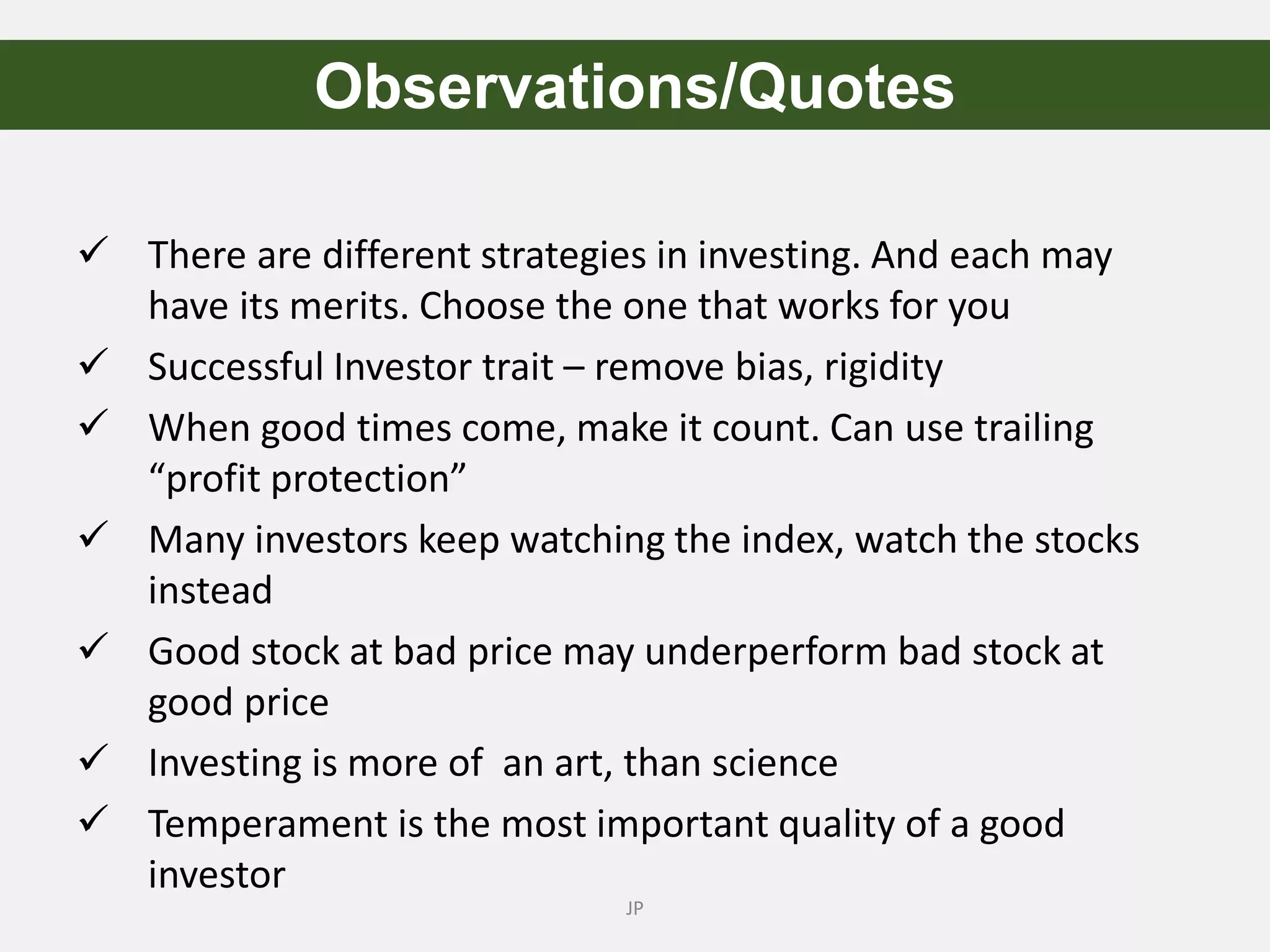
 There are different strategies in investing. And each may
have its merits. Choose the one that works for you
 Successful Investor trait – remove bias, rigidity
 When good times come, make it count. Can use trailing
“profit protection”
 Many investors keep watching the index, watch the stocks
instead
 Good stock at bad price may underperform bad stock at
good price
 Investing is more of an art, than science
 Temperament is the most important quality of a good
investor
JP
Observations/Quotes
Graphite Electrode company
JP
Case Studies
PE of 150 at price of 150 and PE of 5 at price of 4500
Graphite Electrode company
JP
Case Studies
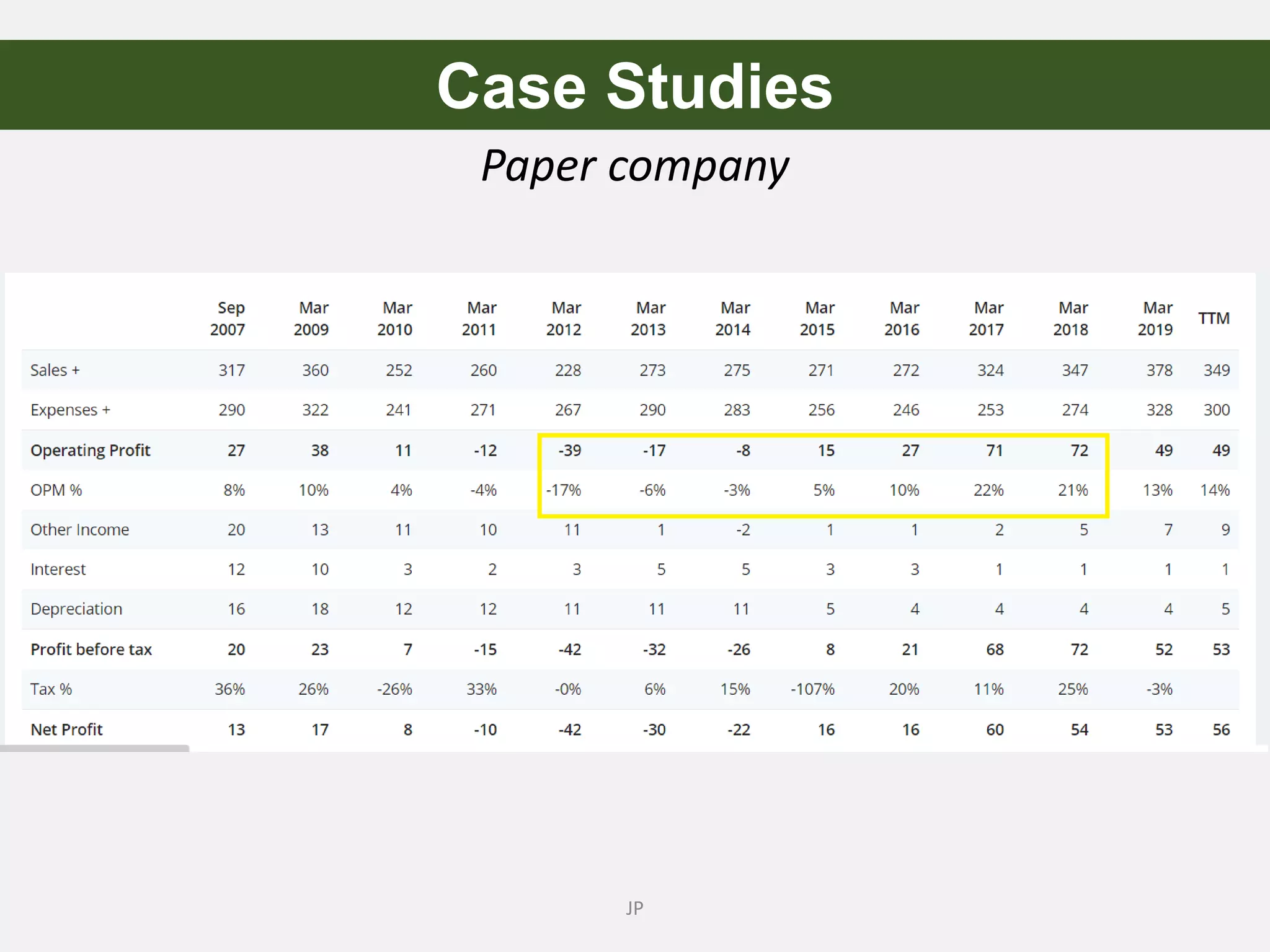
Paper company
JP
Case Studies
Paper company
JP
Case Studies
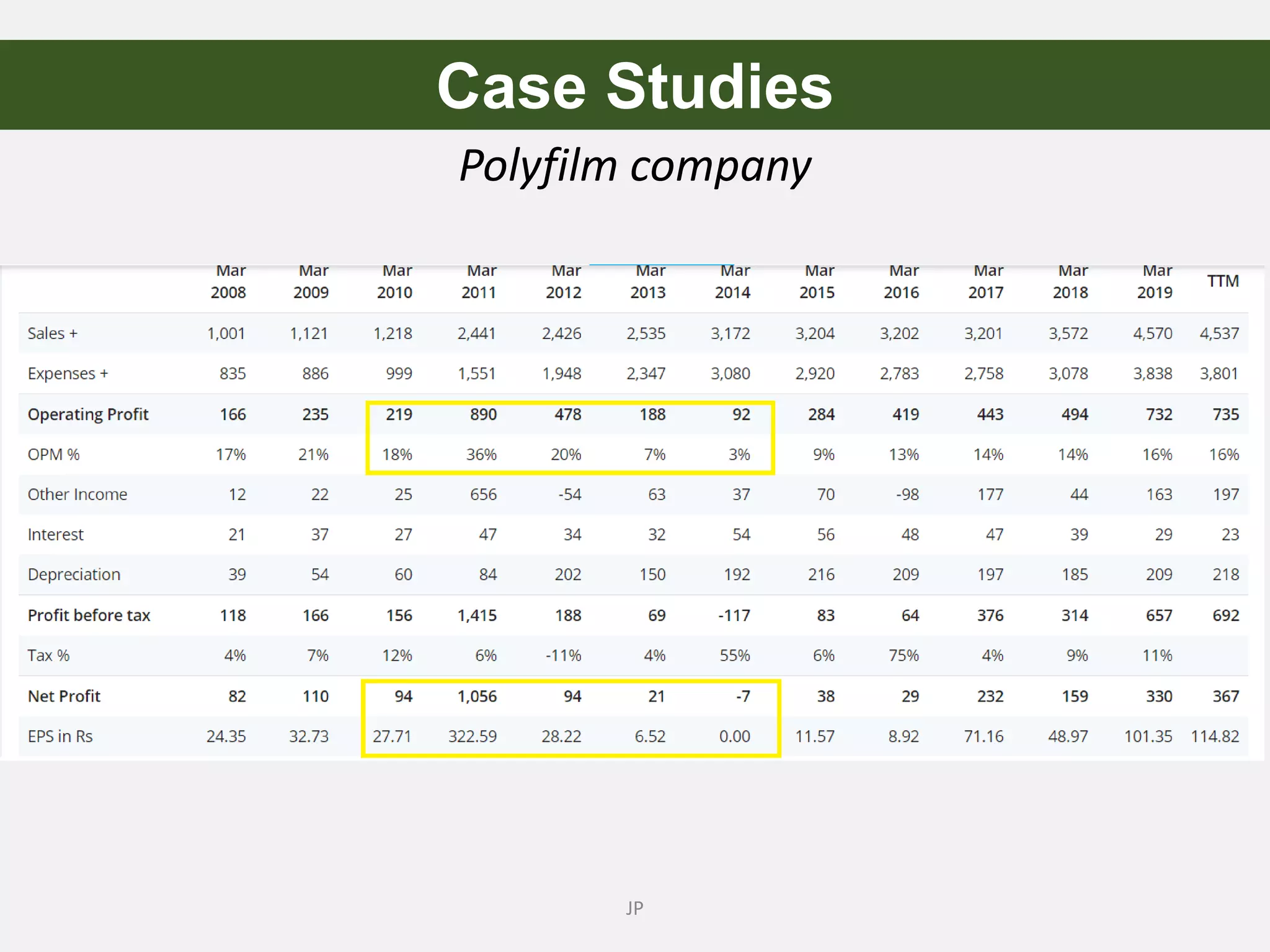
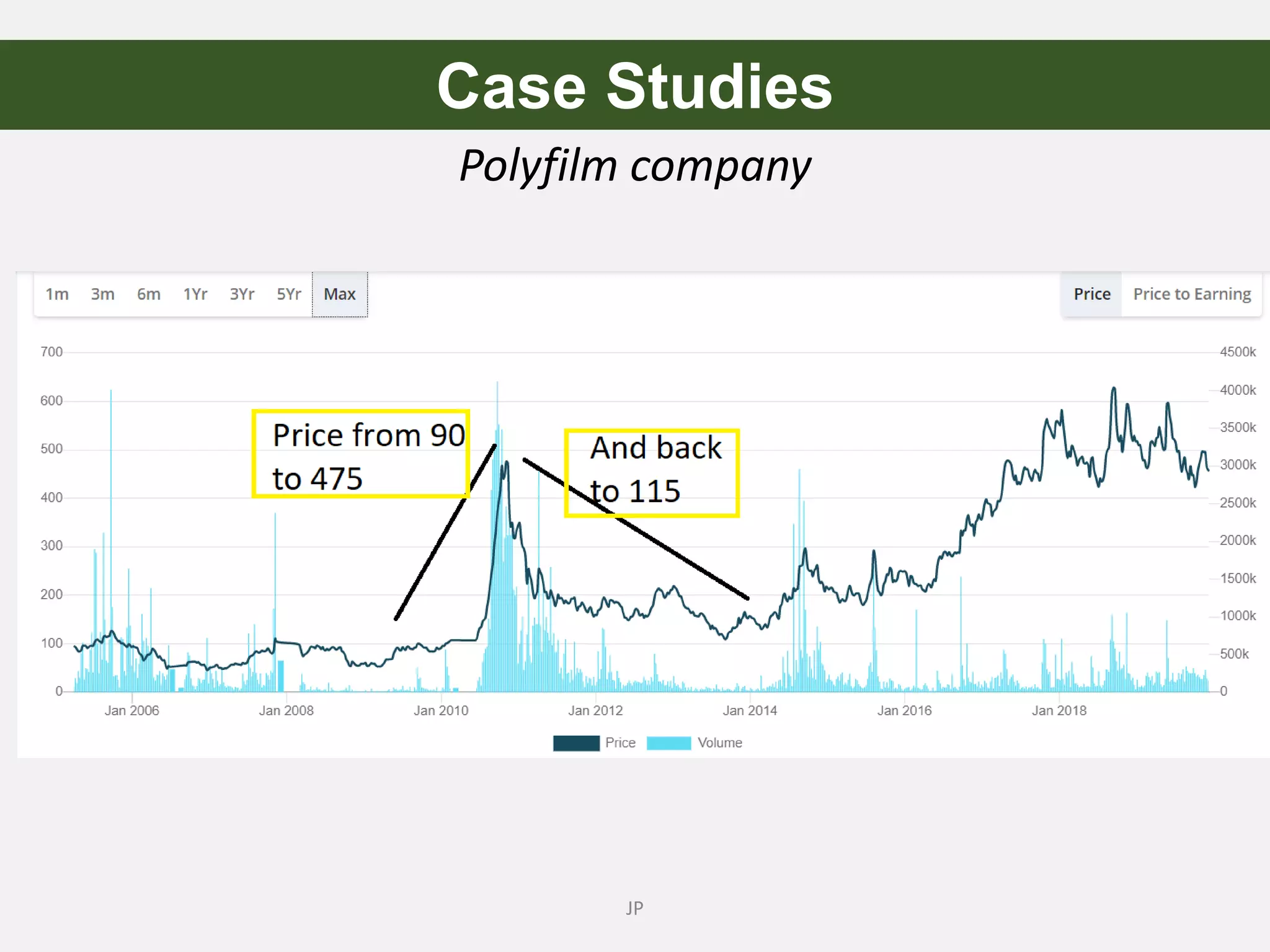
Polyfilm company
JP
Case Studies
Polyfilm company
JP
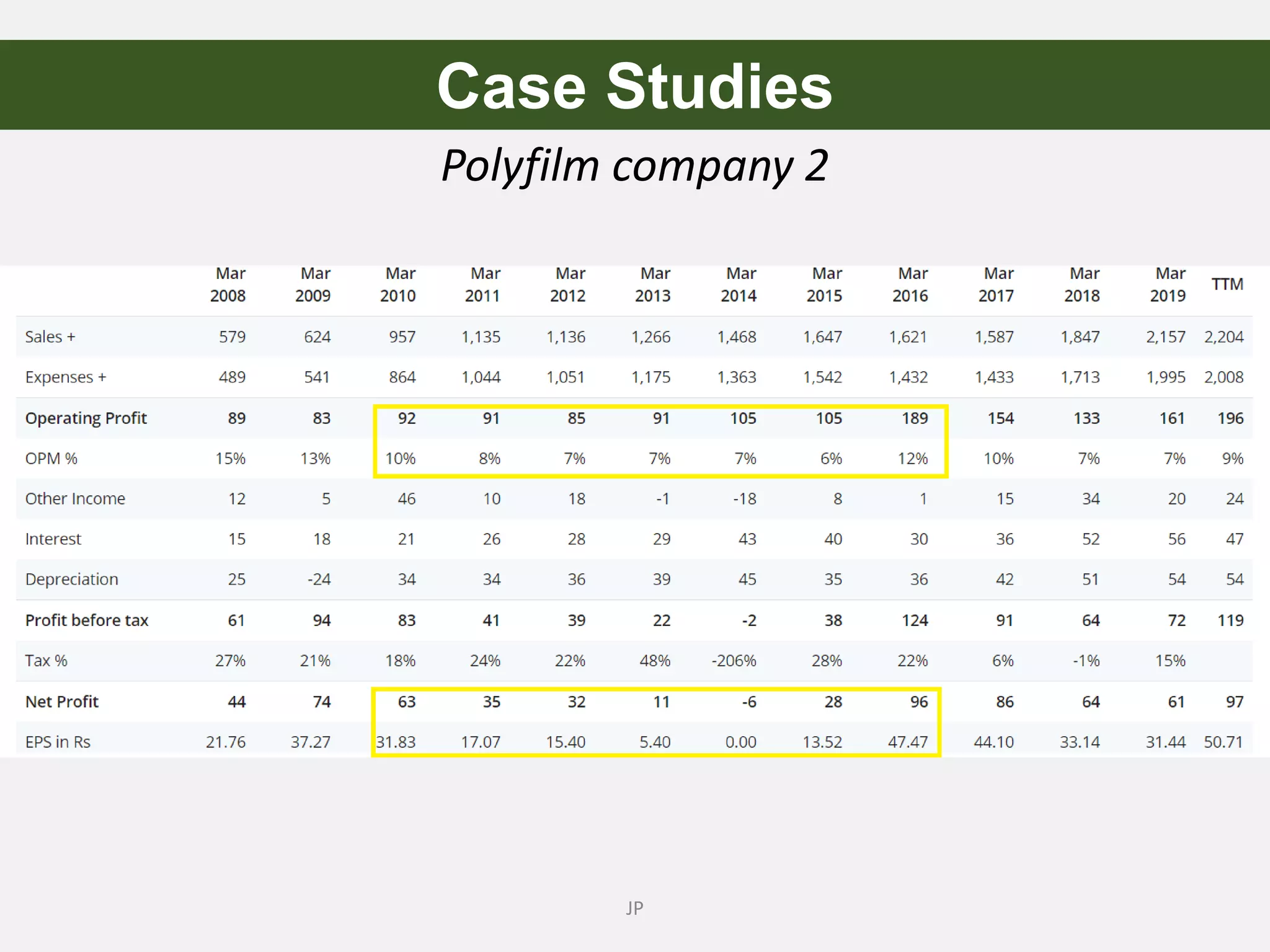
Case Studies
Polyfilm company 2
JP
Case Studies
Polyfilm company 2
JP
Case Studies
Metal mining company
JP
Case Studies
Metal mining company
JP
Case Studies
JP
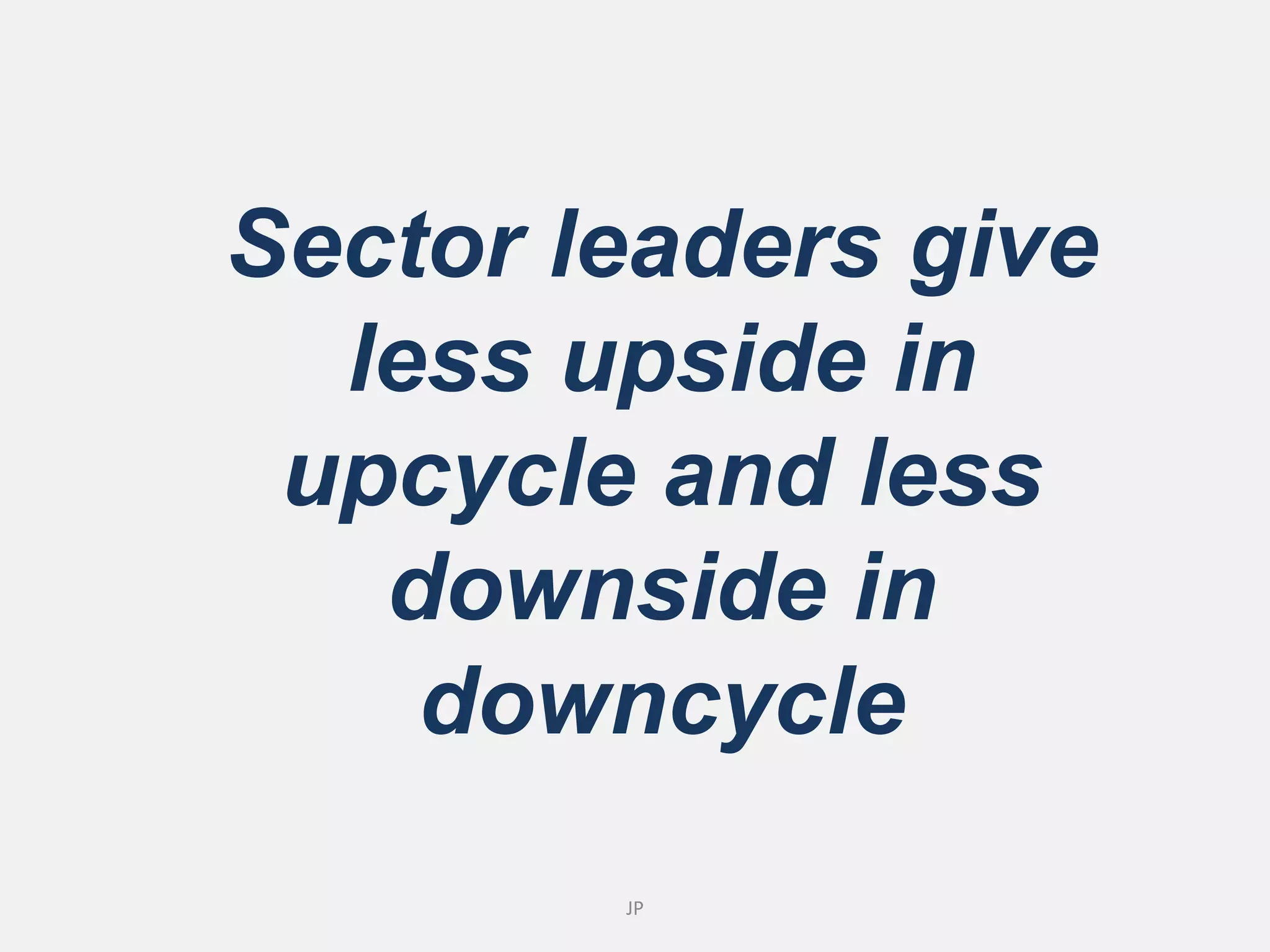
Sector leaders give
less upside in
upcycle and less
downside in
downcycle
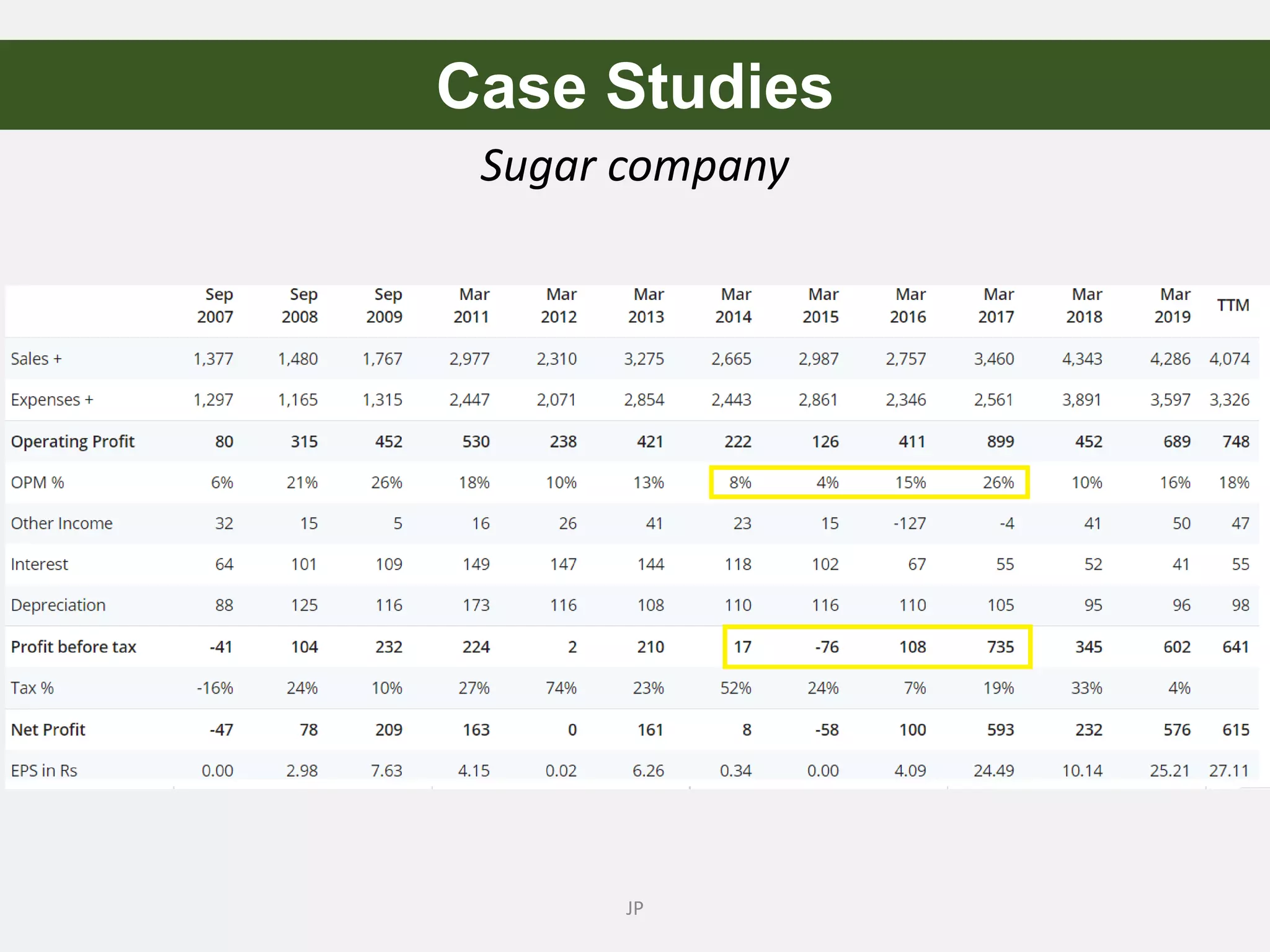
Sugar company
JP
Case Studies
Sugar company
JP
Case Studies
Sector Leader
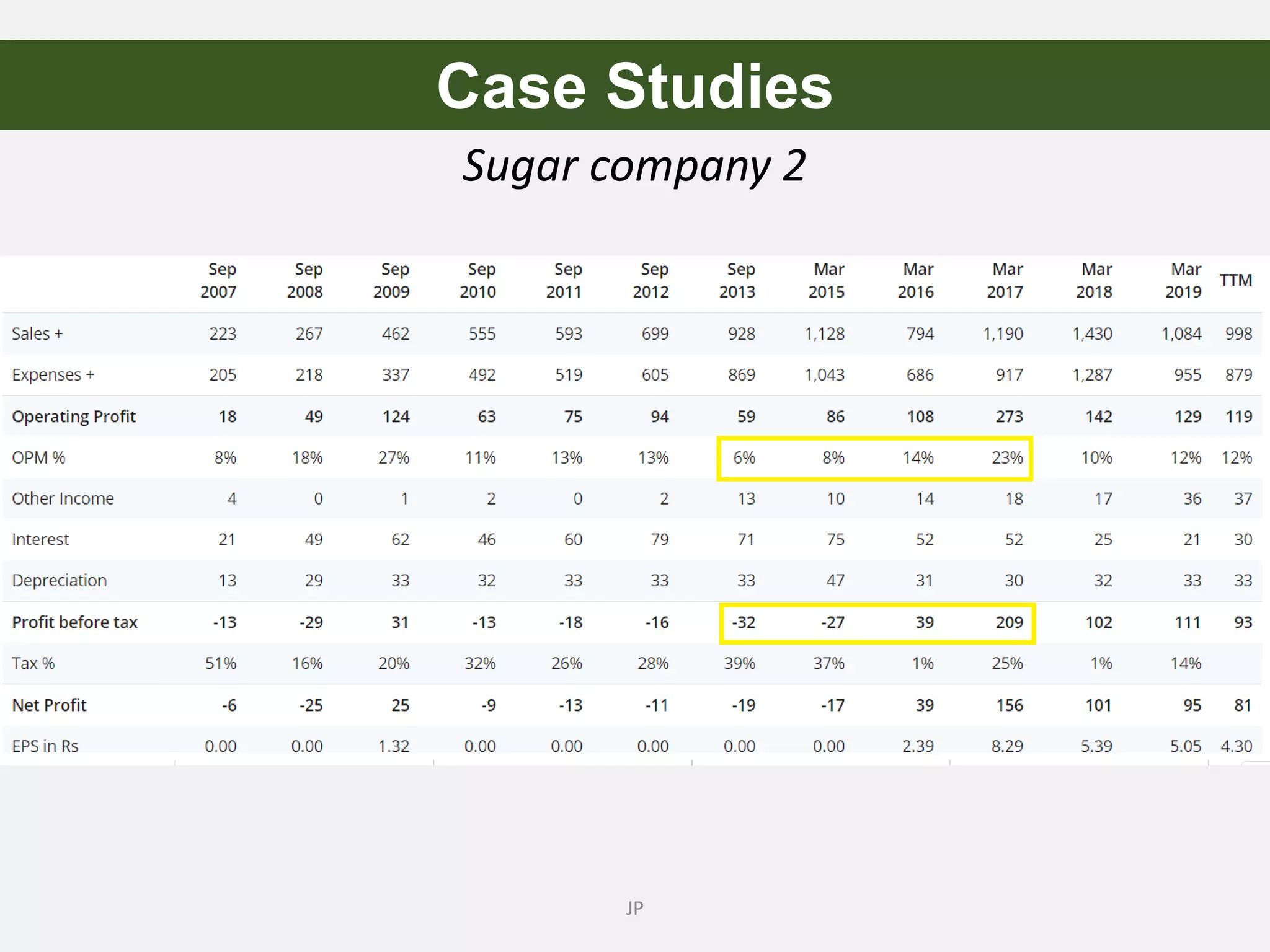
Sugar company 2
JP
Case Studies
Sugar company 2
JP
Case Studies
2nd tier company in the sector
 www.platts.com
 www.steelmint.com
 www.lme.com
 www.mcxindia.com
 www.zauba.com
 www.mining.com
 www.steel.gov.in
 www.businessinsider.com
www.google.com
JP
Sources

The art of understanding cycles

  • 1.
    Cycles 2.0 - Theart of navigating cycles Jiten Parmar Twitter - @jitenkparmar email : jiten.parmar@aurumcapital.in https://aurumcapital.in twitter - @Capitalaurum email : info@aurumcapital.in Dec 2019
  • 2.
     Jiten isco-founder of Aurum Capital. Aurum Capital is a SEBI registered investment advisory company  The stocks discussed in this presentation are not recommendations from Aurum Capital or Jiten Parmar  Some of these stocks may have been recommended to our clients and Jiten Parmar may hold some of these.  This presentation is only for educational purpose and does not constitute investment advice. JP Disclosures
  • 3.
  • 4.
    Investing is psychology, history, sociology,politics and ….. science JP Key Learning
  • 5.
  • 6.
    The first stepto successful investing is knowing self. Knowing your temperament and mental fortitude JP Key Learning
  • 7.
    Deep cyclicality (e.g.commodities) Moderate cyclicality (e.g. cars, fin services) Low cyclicality (e.g. FMCG) We have to understand that markets and stocks are far more cyclical then we think. Even the economy is cyclical. Understanding cycles can help, even if one doesn’t want to delve in deep cyclicals JP Types of Cyclicality
  • 8.
    Rule No. 1:Most things will prove to be cyclical Rule No. 2: Some of the greatest opportunities for gain and loss come when other people forget Rule One. -Howard Marks JP
  • 9.
    We don’t haveto be “exactly right”. We are good even if we are “approximately right” Don’t have to get in at “bottom”, nor get out at the “top” You just have to get the general direction right Don’t mind leaving something on the table, during exits JP Timing
  • 10.
    Within stocks andsectors, you have to comprehend “business cycle” as well as “market cycle”. They might not coincide. So do make adjustments accordingly. “Best price” may come before “best results” and “worst price” may come before “worst results” “Excel” investing rarely works in cyclicals, especially in deep cyclicals JP What do we have to comprehend?
  • 11.
     A leadingFMCG company from 2001 to 2011 increased revenue from 10000 cr to 19000 cr. Profits from 1600 cr to 2300 cr. From 2011 to 2019 revenue went to 37000 cr, profits to 6000 cr. Stock gave 0% returns in 1st period and 900% in the 2nd period  A leading IT company has multiplied profits 37 times since 2000, but stock price yet to see price of year 2000 JP Market Cycles
  • 12.
  • 13.
  • 14.
  • 15.
  • 16.
  • 17.
  • 18.
    JP An interesting analogy Cyclical/Commodityplays are like going to a pub. Enter during happy hours and leave at midnight when party is in full swing. Even if you stay late, be near the door, or you might end up paying the bill for others too Jiten Parmar, Investors Carnival, Nov 2017
  • 19.
  • 20.
  • 21.
     One endsup buying when ratios are bad - EBITDA margins, ROE’s are down. Company might be in loss  One sells when these show sharp uptick and company becomes highly profitable  Buy, let’s say, when PE is 60 (or -ve) and sell when it is 6  Buy when sector is completely neglected and sell when it is hot  Buy when no one is covering the stock and sell when many buy reports come  Basically, a contrarian approach is required  The bet is on “reversal to mean” JP Contrarian Approach/Inversion
  • 22.
     Triggers showup. Identify the sector/commodity behind the triggers  Study the past cycles  Study production data, supply/demand  Check for capacity utilizations  Check for capex (when many companies announce, great signal to relook/exit)  Check the margins  Check Price to Book (current, historical during upcycle and downcycles)  Check replacement costs JP Evaluation
  • 23.
    Prepare a listof the stocks with the theme Shortlist to 4/5 plays. Use basket approach in investing Stress test : Can the company survive another couple of years of downturn ? Wait for some companies to go bust or close down some plants JP Investment Process
  • 24.
    Check insider buying/selling Don’tlook at PE Price to book/replacement cost are better parameters Check if company has cash/manageable debt Start initial buying at highest pessimism levels As cycle starts turning add JP Investment Process
  • 25.
    Sugar – 2years of monsoon failure in India and failed Brazil crop in 2015 Paper – Largest producer BILT plants closing down Fertilizers – A good monsoon after 2 failed years Polyfilms – Increasing delta between RM and finished product JP Examples of triggers
  • 26.
    Chemicals - Chinameasures for pollution control and closing of many units, ADD (anti- dumping duty) Metals/mining - Chinese plants started closing down due to pollution. For Steel - MSP (minimum support price), infra focus  Cement - government focus on Infra, supply not coming as per estimated demand leading to higher capacity utilizations JP Examples of triggers
  • 27.
     Try toget out before best earnings. Peak prices come before peak earnings  Always understand that there is “extra-ordinary” earnings in upcycle. Don’t commit the folly of assuming these as normalized earnings and look at it with a PE lens  One can employ a strategy like getting in at 0.2-0.3 of P/B or replacement and getting out at 1-1.2 of these  Try to estimate normal EBITDA margins by averaging them over downcycles and upcycles. Accordingly, calibrate your entry and exit strategies  Never repent if price still goes up after your sell, as long as you have made good returns JP Exit Strategy
  • 28.
     Always makepositional plays  These should never be 5-10 year plays  Patience - Be ready to hold for a couple of years  Make sure portfolio allocation is adhered to  Never go more than 25% of your portfolio in a single deep cyclical sector  Do not change narrative, just to hold on to the sector/stock  Be prepared for failures. Cut when you realize it JP Rules I follow
  • 29.
     There aredifferent strategies in investing. And each may have its merits. Choose the one that works for you  Successful Investor trait – remove bias, rigidity  When good times come, make it count. Can use trailing “profit protection”  Many investors keep watching the index, watch the stocks instead  Good stock at bad price may underperform bad stock at good price  Investing is more of an art, than science  Temperament is the most important quality of a good investor JP Observations/Quotes
  • 30.
    Graphite Electrode company JP CaseStudies PE of 150 at price of 150 and PE of 5 at price of 4500
  • 31.
  • 32.
  • 33.
  • 34.
  • 35.
  • 36.
  • 37.
  • 38.
  • 39.
  • 40.
    JP Sector leaders give lessupside in upcycle and less downside in downcycle
  • 41.
  • 42.
  • 43.
  • 44.
    Sugar company 2 JP CaseStudies 2nd tier company in the sector
  • 45.
     www.platts.com  www.steelmint.com www.lme.com  www.mcxindia.com  www.zauba.com  www.mining.com  www.steel.gov.in  www.businessinsider.com www.google.com JP Sources