SAP – APO Overview
By
V K Agnihotri
Page 2
The course will cover the following subject areas:
 Advanced Supply Chain Planning overview
 Demand Planning
 Supply Network Planning
 Core Interface
Page 3
Course Goals
This course will prepare you to:
 Gain a basic understanding of SAP functions in the area of
advanced Supply Chain Planning
 Describe the Supply Chain Planning options available with the
SAP ECC and SAP SCM (APO) systems
Page 4
Course Objectives
After completing this course, you will be able to:
Briefly Describe the role of both the SAP ECC and SAP SCM
components in
 Advanced Supply Chain Planning
 Specify which master data and transaction data are used in
advanced Supply Chain Planning
 Explain the interplay and the integration of SAP ECC and SAP
SCM (Core Interface)
 Execute fundamental planning functions of Demand Planning
and Supply Network Planning.
Page 5
Page 6
Contents
• SCM Overview
• APO Overview
• SAP R/3 Vs APO
Page 7
Contents
• SCM Overview
• APO Overview
• SAP R/3 Vs APO
Page 8
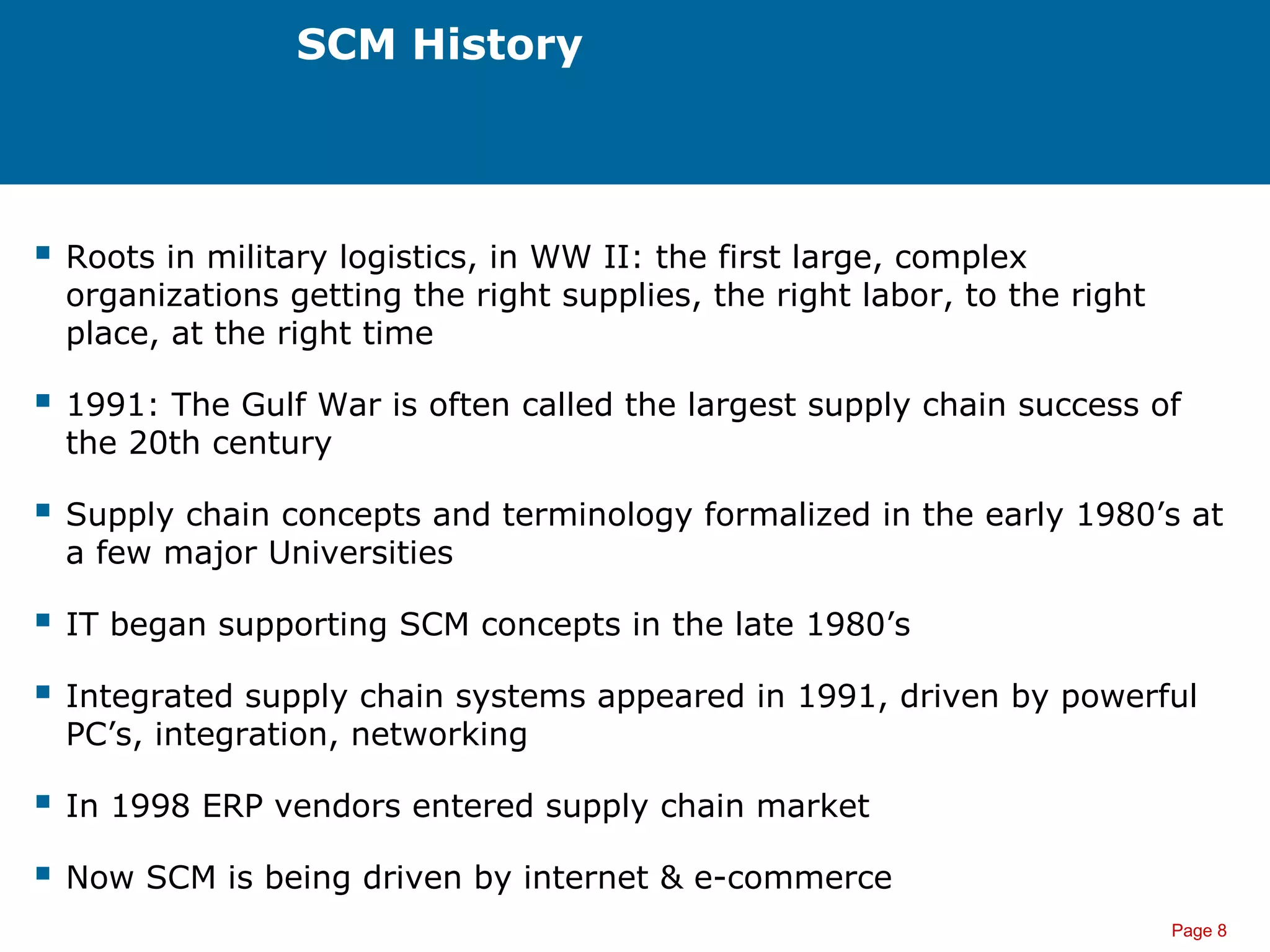
SCM History
 Roots in military logistics, in WW II: the first large, complex
organizations getting the right supplies, the right labor, to the right
place, at the right time
 1991: The Gulf War is often called the largest supply chain success of
the 20th century
 Supply chain concepts and terminology formalized in the early 1980’s at
a few major Universities
 IT began supporting SCM concepts in the late 1980’s
 Integrated supply chain systems appeared in 1991, driven by powerful
PC’s, integration, networking
 In 1998 ERP vendors entered supply chain market
 Now SCM is being driven by internet & e-commerce
Page 9
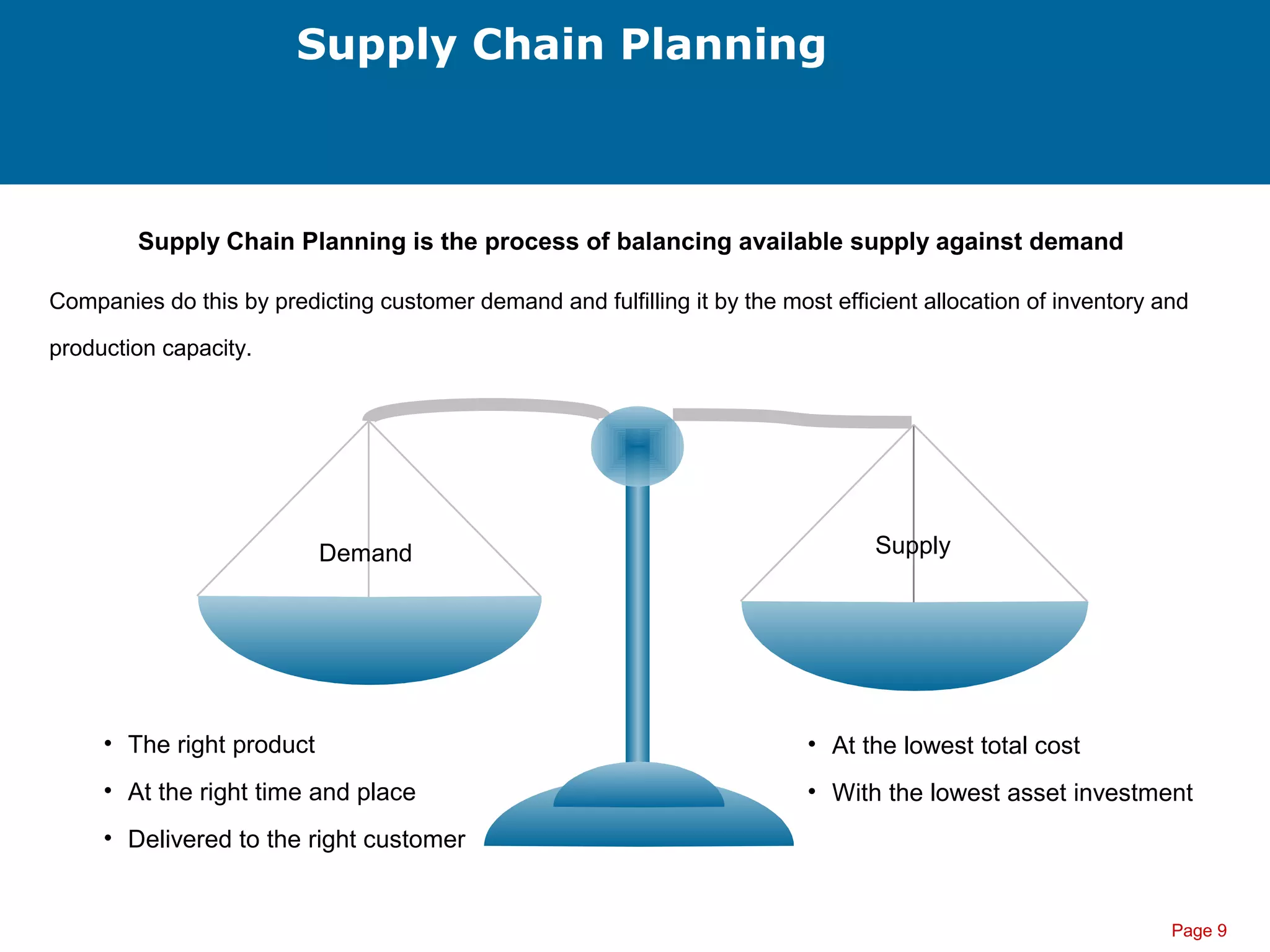
Supply Chain Planning
SupplyDemand
Companies do this by predicting customer demand and fulfilling it by the most efficient allocation of inventory and
production capacity.
• The right product
• At the right time and place
• Delivered to the right customer
• At the lowest total cost
• With the lowest asset investment
Supply Chain Planning is the process of balancing available supply against demand
Page 10
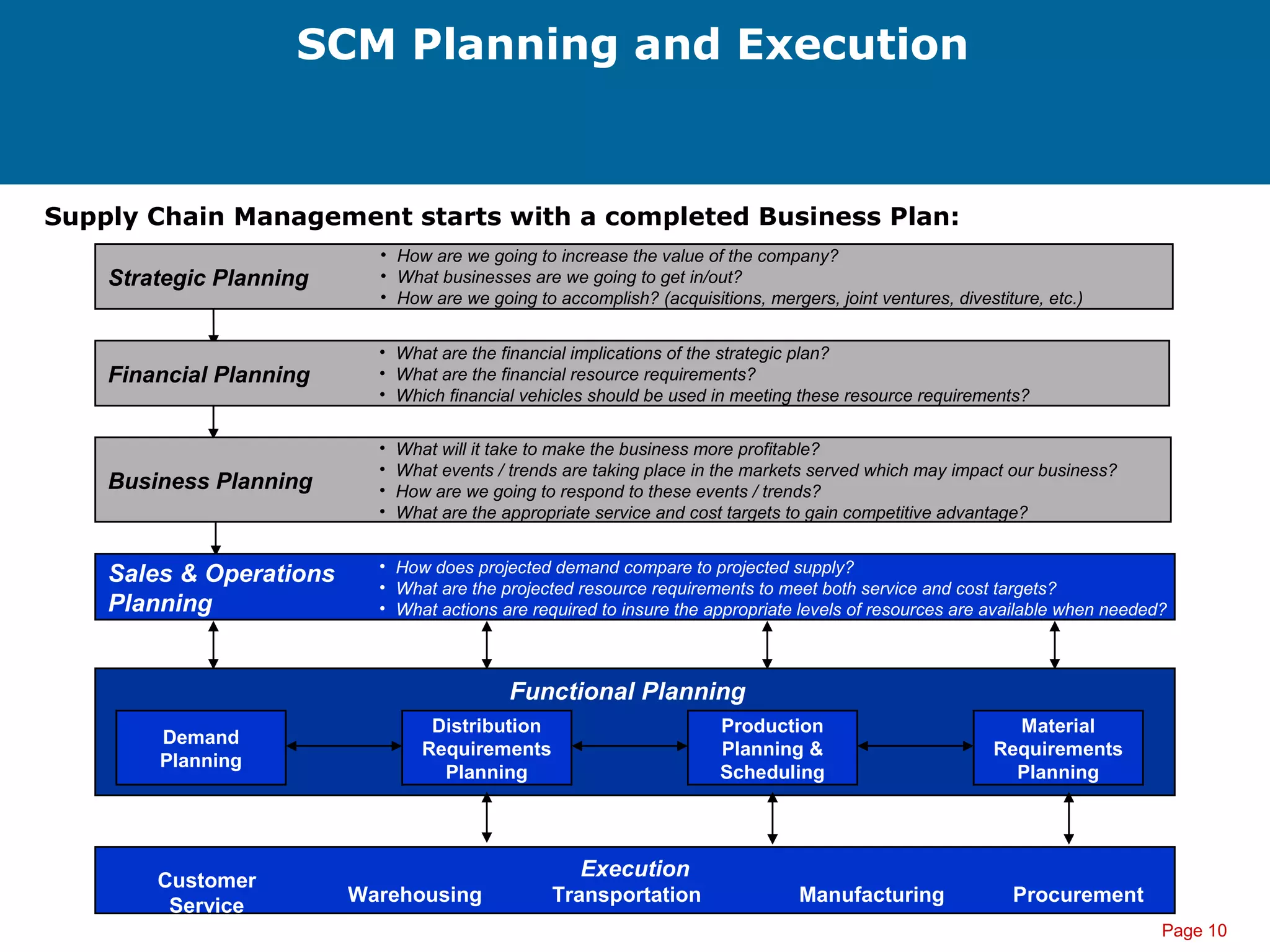
SCM Planning and Execution
Supply Chain Management starts with a completed Business Plan:
Strategic Planning
Business Planning
Sales & Operations
Planning
Financial Planning
Distribution
Requirements
Planning
Demand
Planning
Production
Planning &
Scheduling
Material
Requirements
Planning
Execution
Functional Planning
• How are we going to increase the value of the company?
• What businesses are we going to get in/out?
• How are we going to accomplish? (acquisitions, mergers, joint ventures, divestiture, etc.)
• What are the financial implications of the strategic plan?
• What are the financial resource requirements?
• Which financial vehicles should be used in meeting these resource requirements?
• What will it take to make the business more profitable?
• What events / trends are taking place in the markets served which may impact our business?
• How are we going to respond to these events / trends?
• What are the appropriate service and cost targets to gain competitive advantage?
• How does projected demand compare to projected supply?
• What are the projected resource requirements to meet both service and cost targets?
• What actions are required to insure the appropriate levels of resources are available when needed?
Customer
Service
Warehousing Transportation Manufacturing Procurement
Page 11
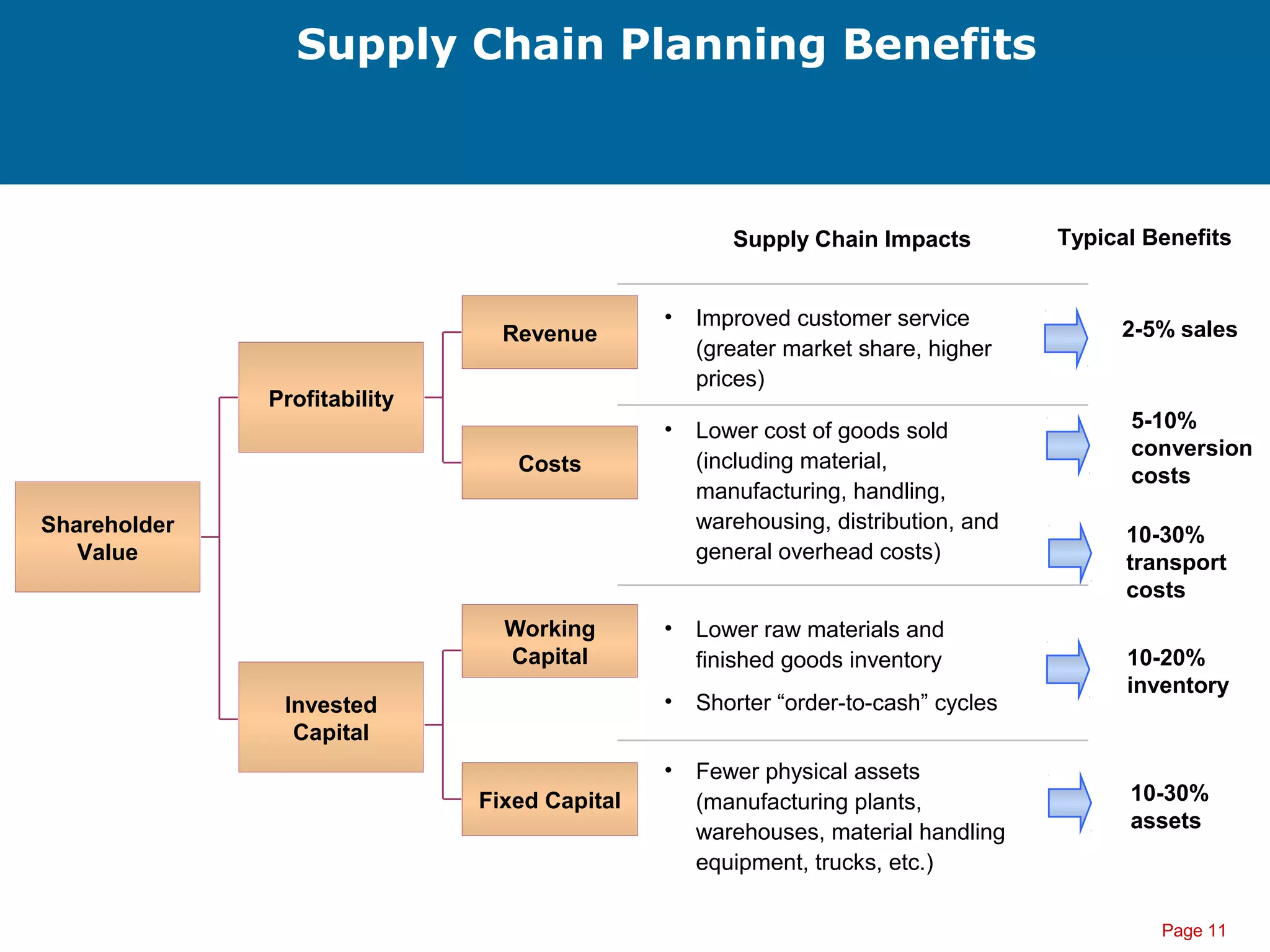
Supply Chain Planning Benefits
Revenue
Costs
Working
Capital
Fixed Capital
Supply Chain Impacts
• Improved customer service
(greater market share, higher
prices)
• Lower raw materials and
finished goods inventory
• Shorter “order-to-cash” cycles
Shareholder
Value
Profitability
Invested
Capital
• Fewer physical assets
(manufacturing plants,
warehouses, material handling
equipment, trucks, etc.)
• Lower cost of goods sold
(including material,
manufacturing, handling,
warehousing, distribution, and
general overhead costs)
10-30%
transport
costs
10-20%
inventory
10-30%
assets
5-10%
conversion
costs
Typical Benefits
2-5% sales
Page 12
Contents
• SCM Overview
• APO Overview
• SAP R/3 Vs APO
Page 13
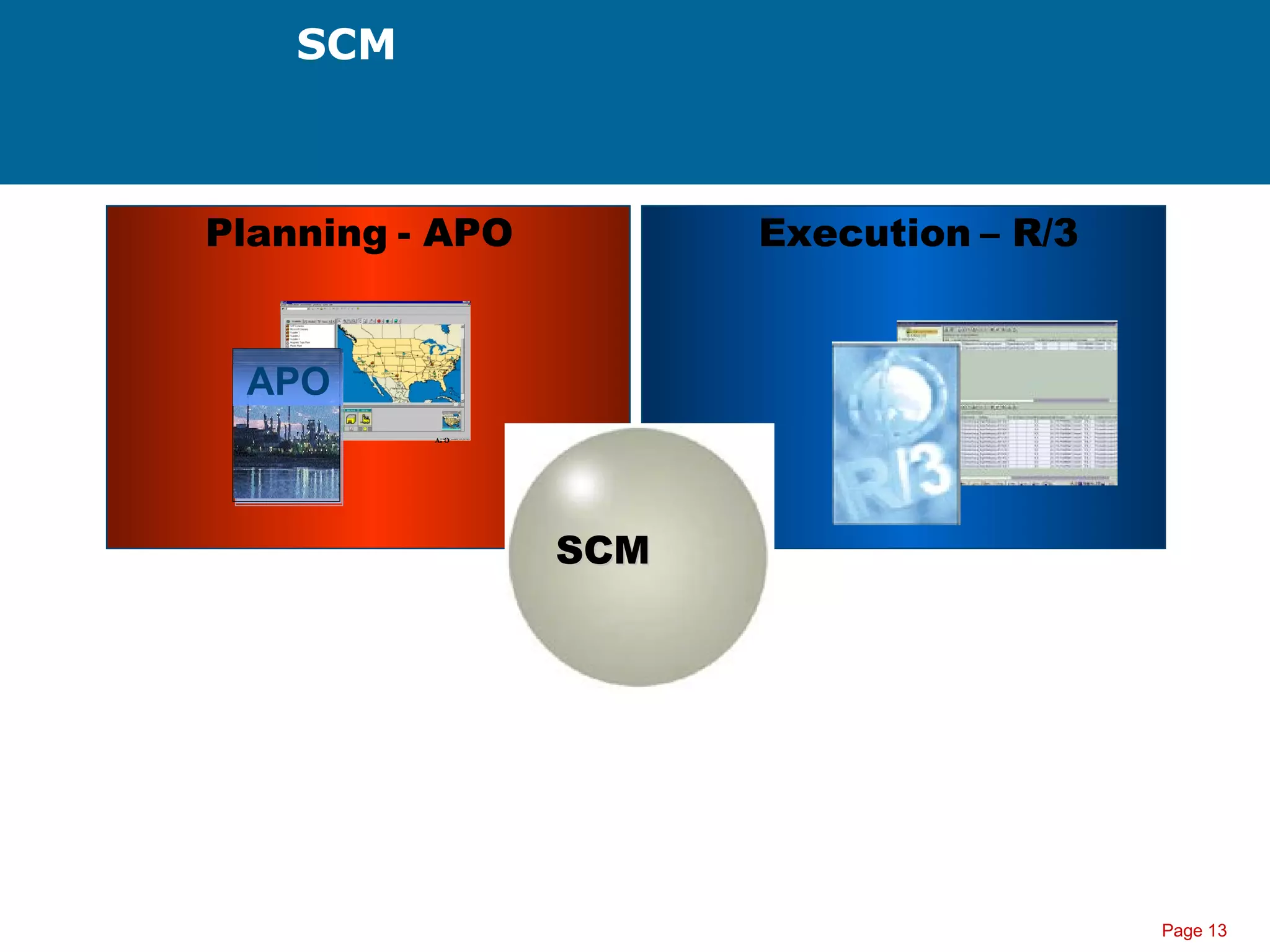
SCM
APOAPOAPO
Execution – R/3Planning - APO
SCMSCM
APO
Page 14
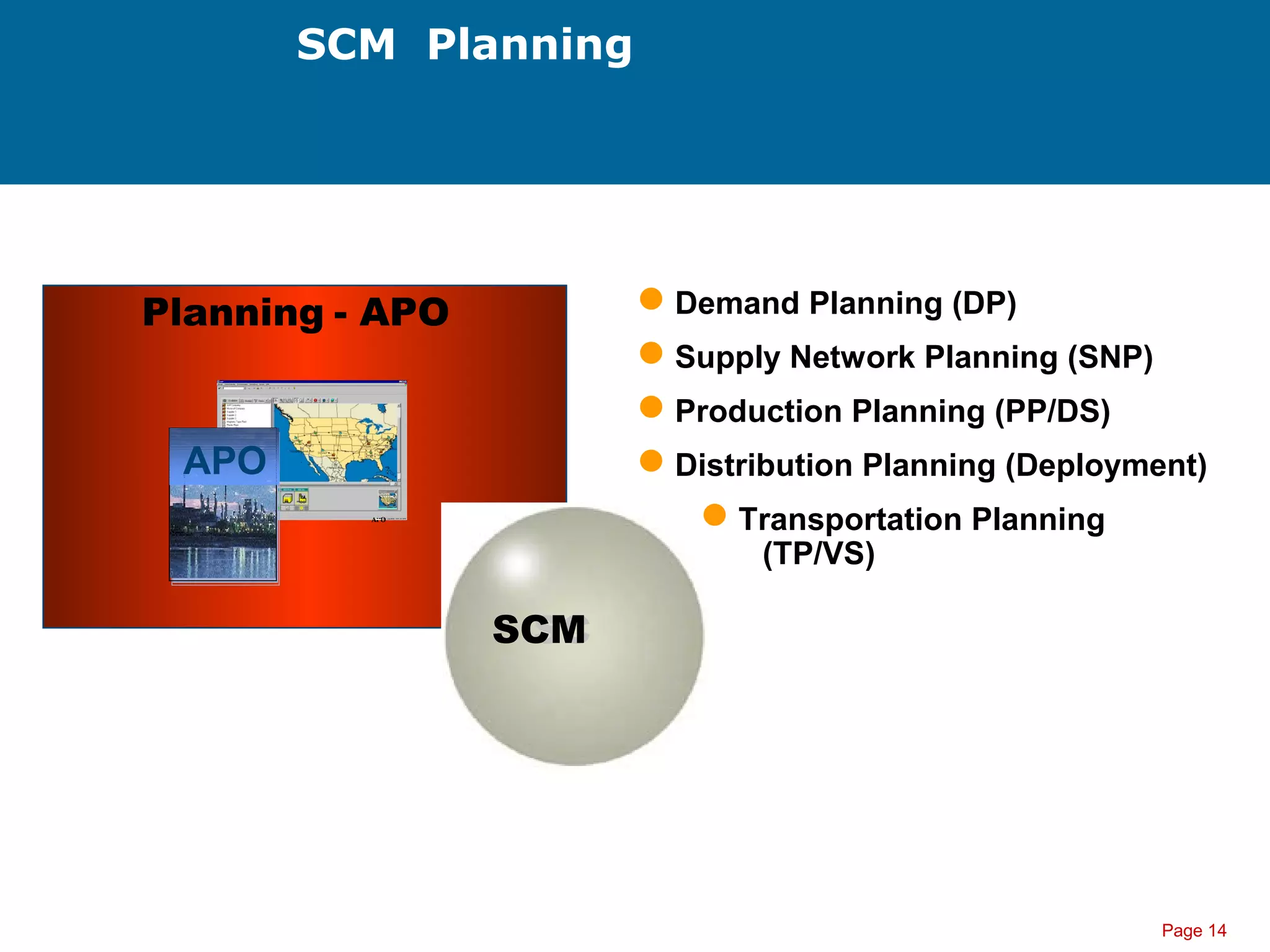
SCM Planning
APOAPOAPO
Planning - APO
SCSCM
APO
Demand Planning (DP)
Supply Network Planning (SNP)
Production Planning (PP/DS)
Distribution Planning (Deployment)
Transportation Planning
(TP/VS)
Page 15
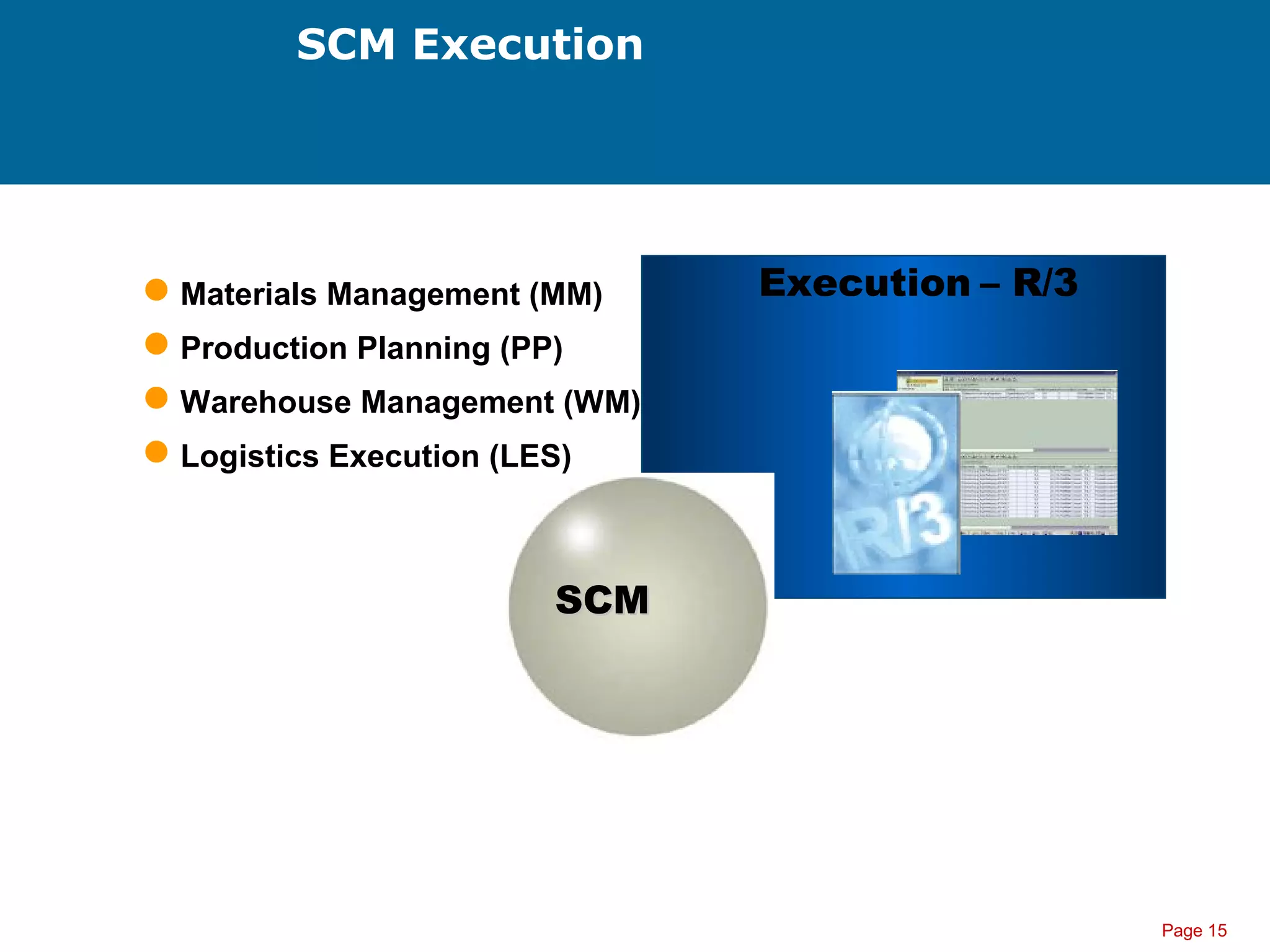
SCM Execution
Execution – R/3
SCMSCM
Materials Management (MM)
Production Planning (PP)
Warehouse Management (WM)
Logistics Execution (LES)
Page 16
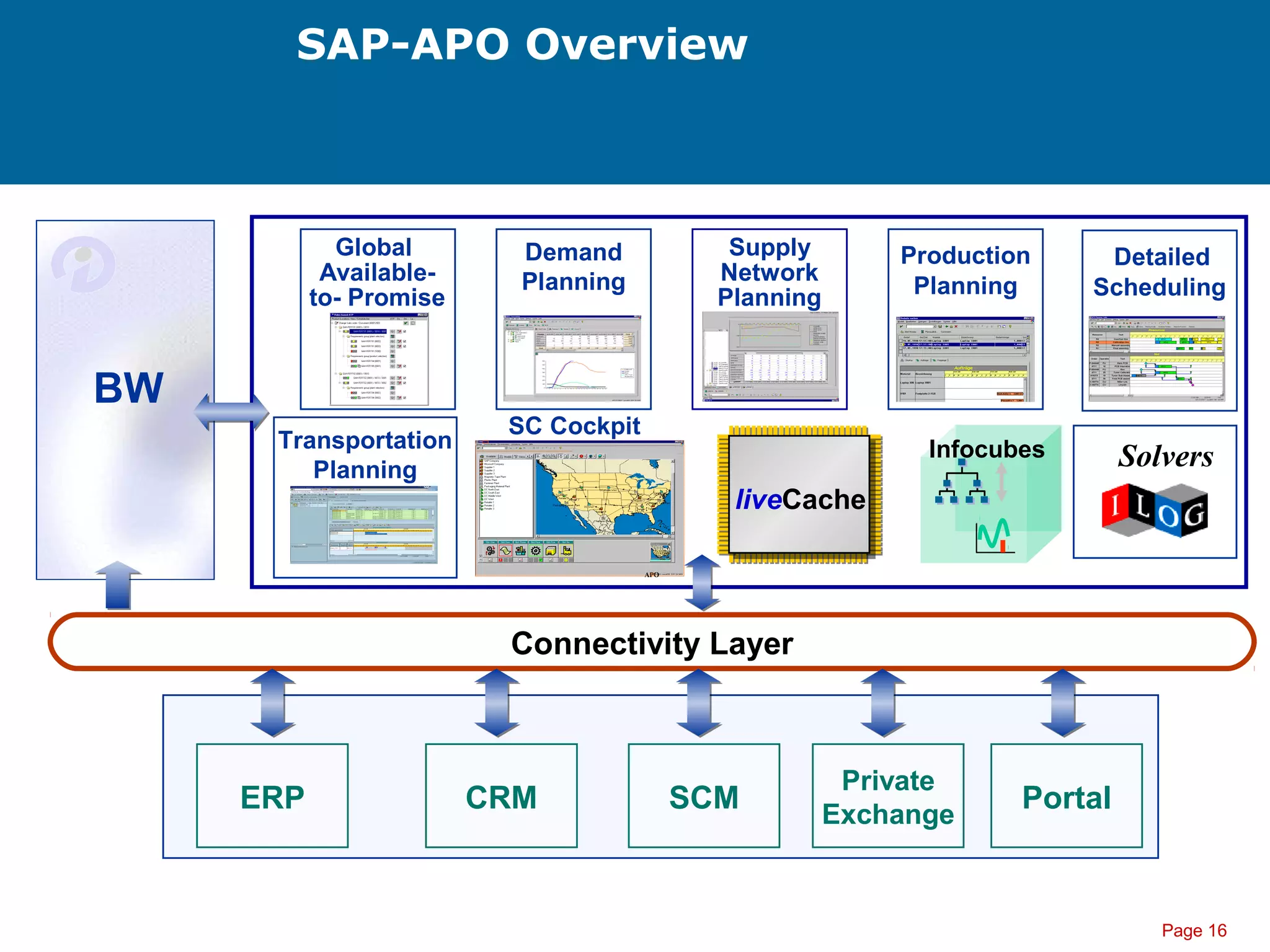
SAP-APO Overview
Connectivity Layer
ERP CRM SCM Portal
Private
Exchange
APO
liveCache
Demand
Planning
Detailed
Scheduling
Production
Planning
Supply
Network
Planning
Global
Available-
to- Promise
SC Cockpit
Infocubes Solvers
Transportation
Planning
BW
Page 17
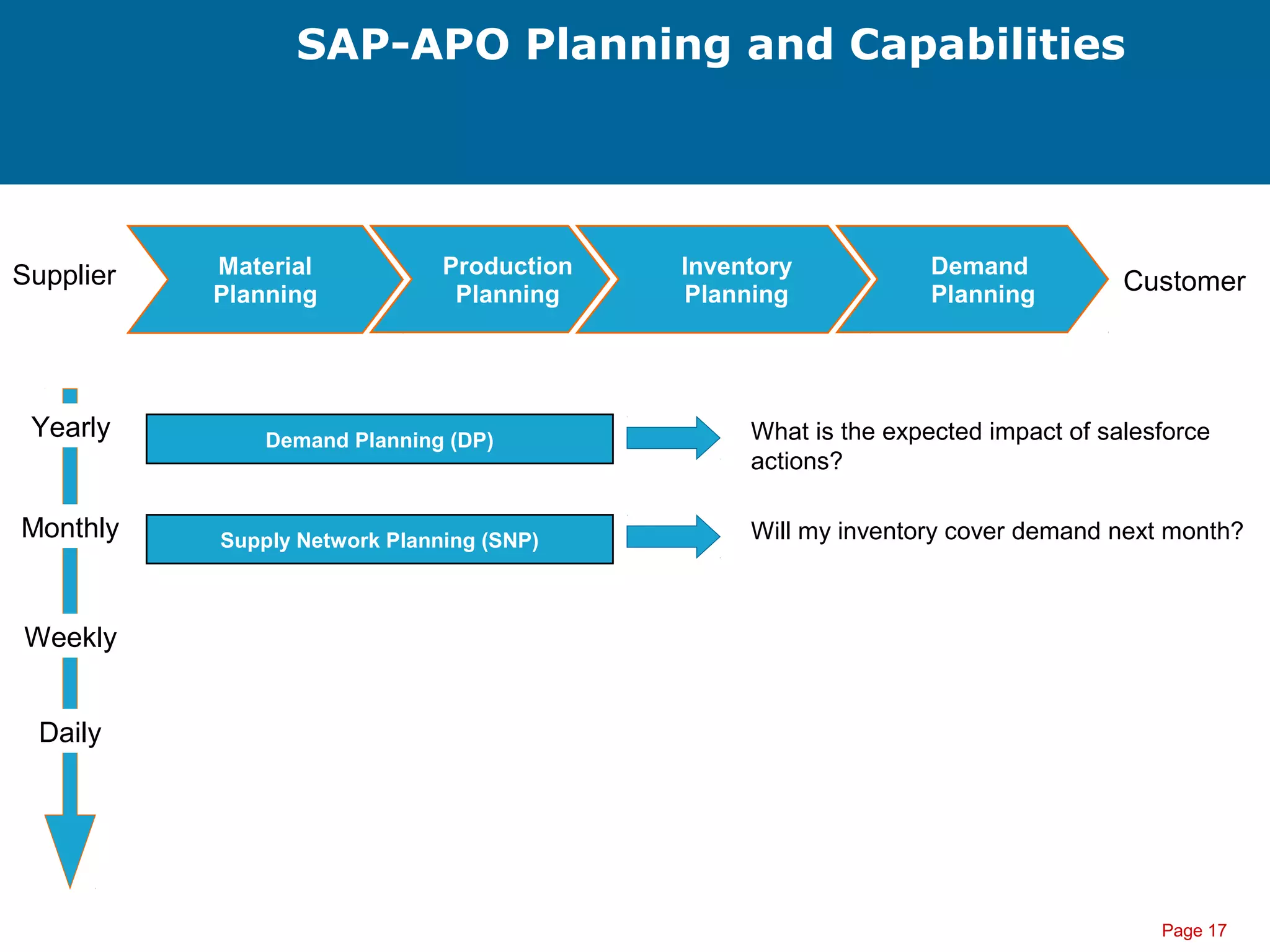
SAP-APO Planning and Capabilities
Supply Network Planning (SNP)
Demand Planning (DP)
Yearly
Monthly
Daily
What is the expected impact of salesforce
actions?
Will my inventory cover demand next month?
Weekly
Material
Planning
Production
Planning
Inventory
Planning
Demand
Planning
Supplier Customer
Page 18
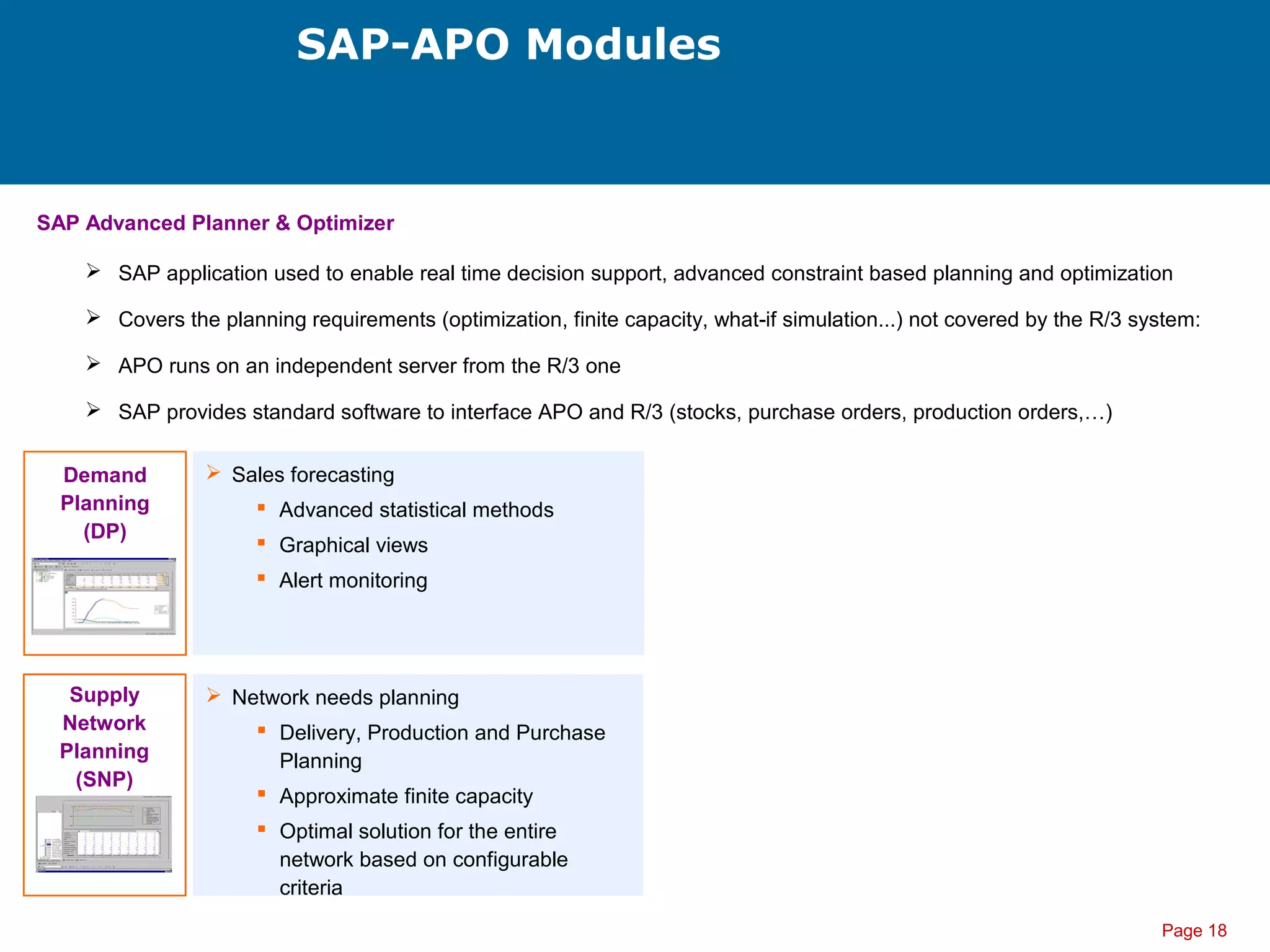
SAP-APO Modules
SAP Advanced Planner & Optimizer
 SAP application used to enable real time decision support, advanced constraint based planning and optimization
 Covers the planning requirements (optimization, finite capacity, what-if simulation...) not covered by the R/3 system:
 APO runs on an independent server from the R/3 one
 SAP provides standard software to interface APO and R/3 (stocks, purchase orders, production orders,…)
Demand
Planning
(DP)
Supply
Network
Planning
(SNP)
 Sales forecasting
 Advanced statistical methods
 Graphical views
 Alert monitoring
 Network needs planning
 Delivery, Production and Purchase
Planning
 Approximate finite capacity
 Optimal solution for the entire
network based on configurable
criteria
Page 19
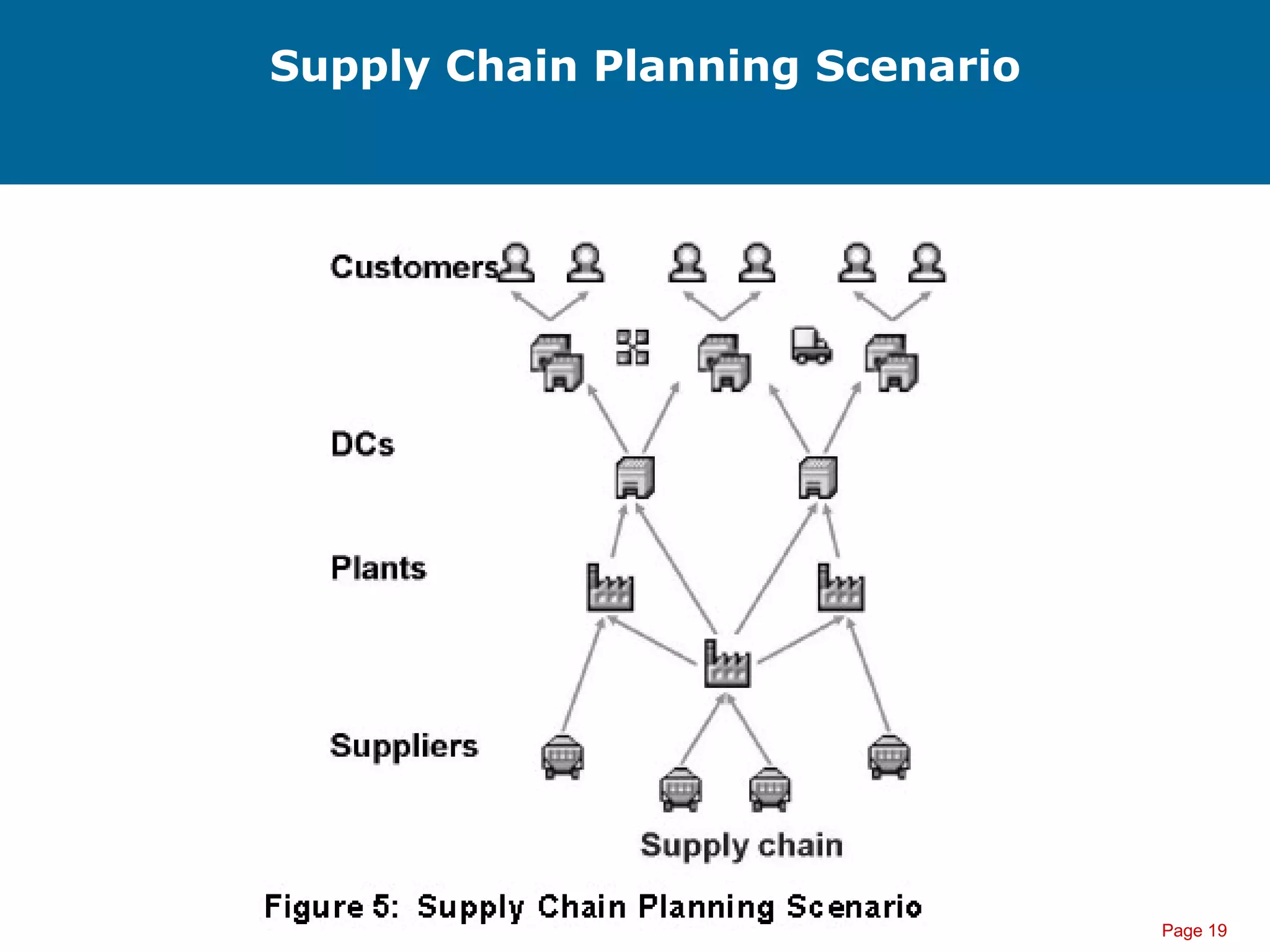
Supply Chain Planning Scenario
Page 20
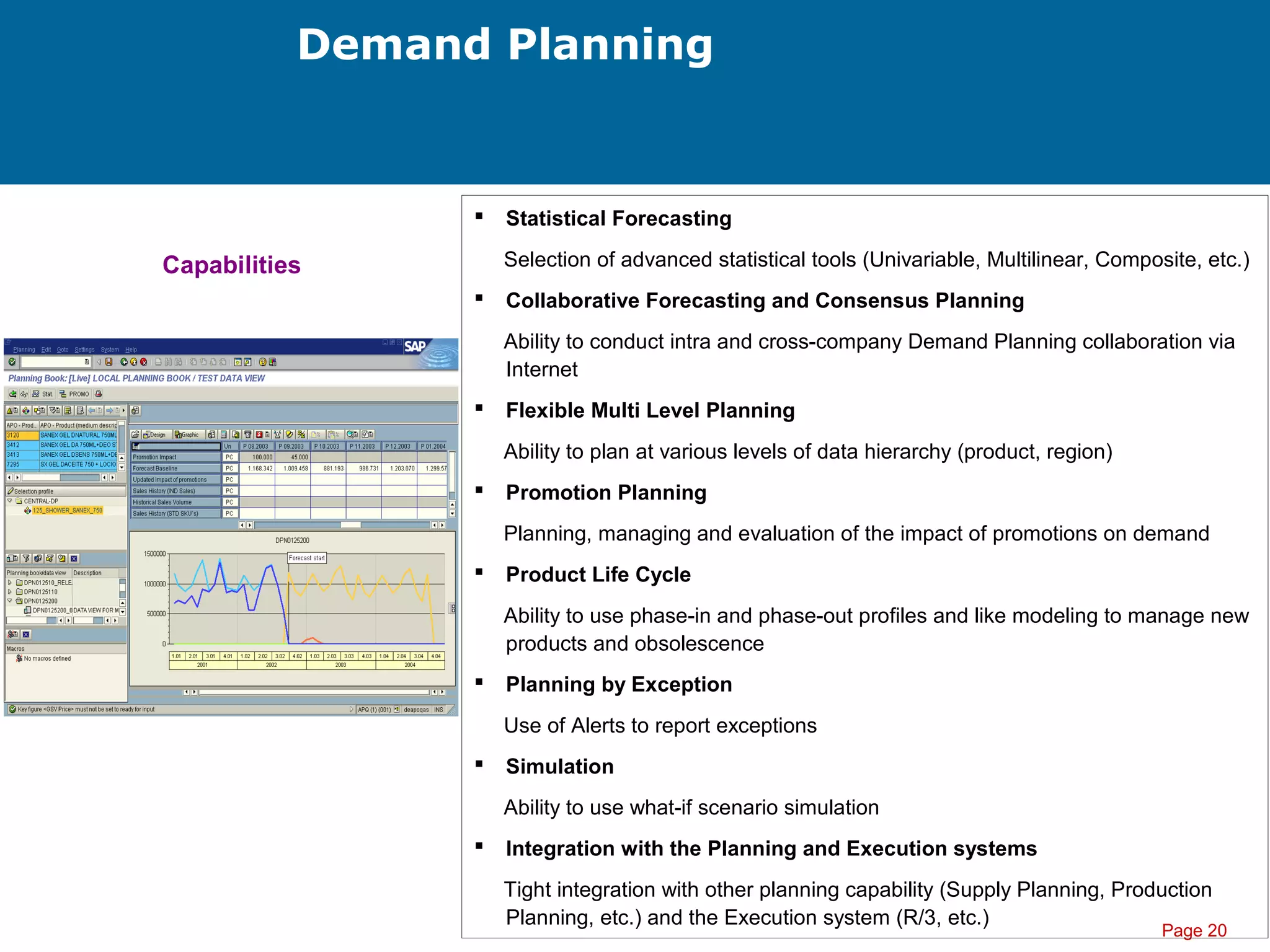
Demand Planning
 Statistical Forecasting
Selection of advanced statistical tools (Univariable, Multilinear, Composite, etc.)
 Collaborative Forecasting and Consensus Planning
Ability to conduct intra and cross-company Demand Planning collaboration via
Internet
 Flexible Multi Level Planning
Ability to plan at various levels of data hierarchy (product, region)
 Promotion Planning
Planning, managing and evaluation of the impact of promotions on demand
 Product Life Cycle
Ability to use phase-in and phase-out profiles and like modeling to manage new
products and obsolescence
 Planning by Exception
Use of Alerts to report exceptions
 Simulation
Ability to use what-if scenario simulation
 Integration with the Planning and Execution systems
Tight integration with other planning capability (Supply Planning, Production
Planning, etc.) and the Execution system (R/3, etc.)
Capabilities
Page 21
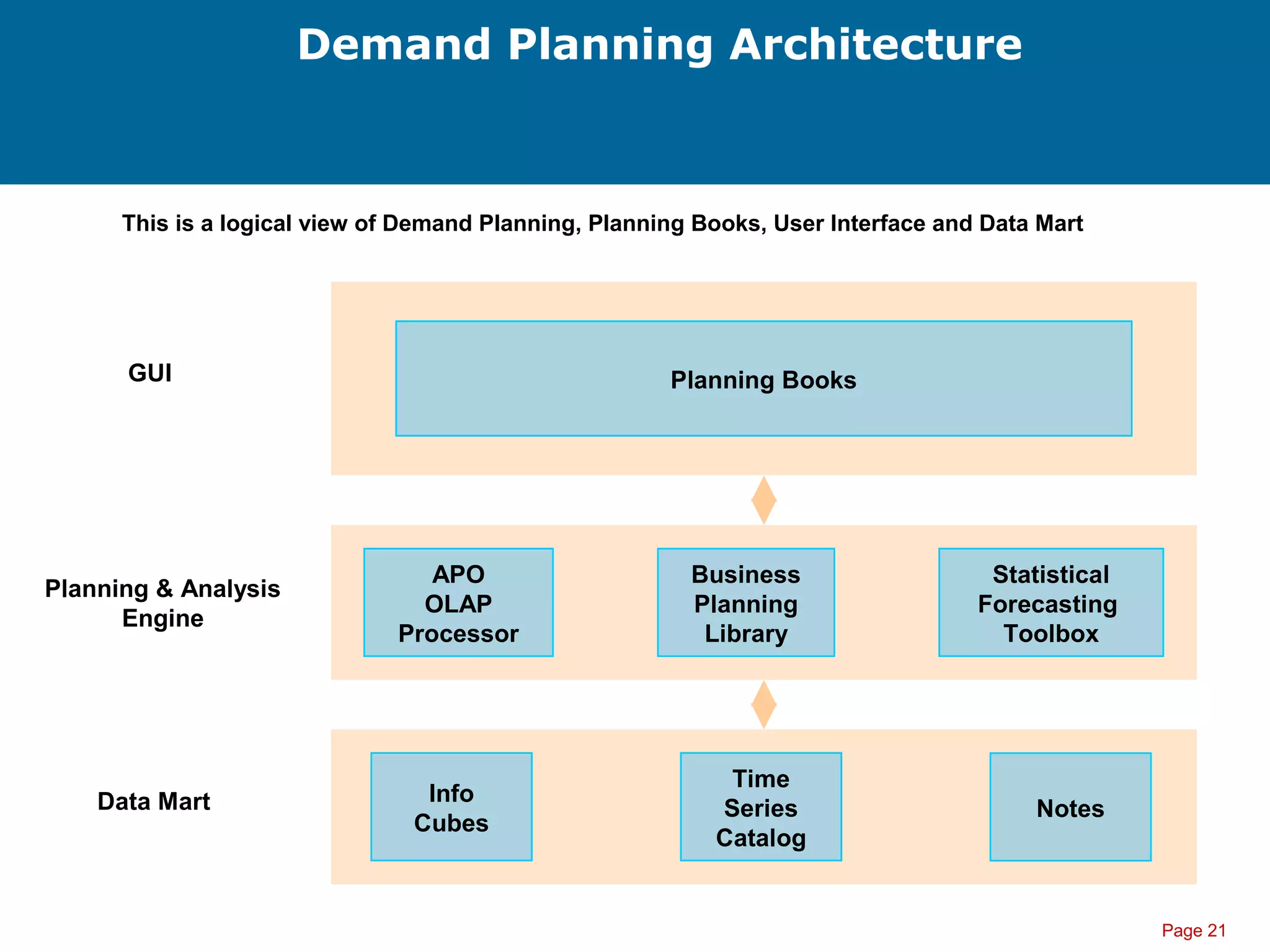
Demand Planning Architecture
Planning BooksGUI
APO
OLAP
Processor
Business
Planning
Library
Statistical
Forecasting
Toolbox
Planning & Analysis
Engine
Info
Cubes
Time
Series
Catalog
NotesData Mart
This is a logical view of Demand Planning, Planning Books, User Interface and Data Mart
Page 22
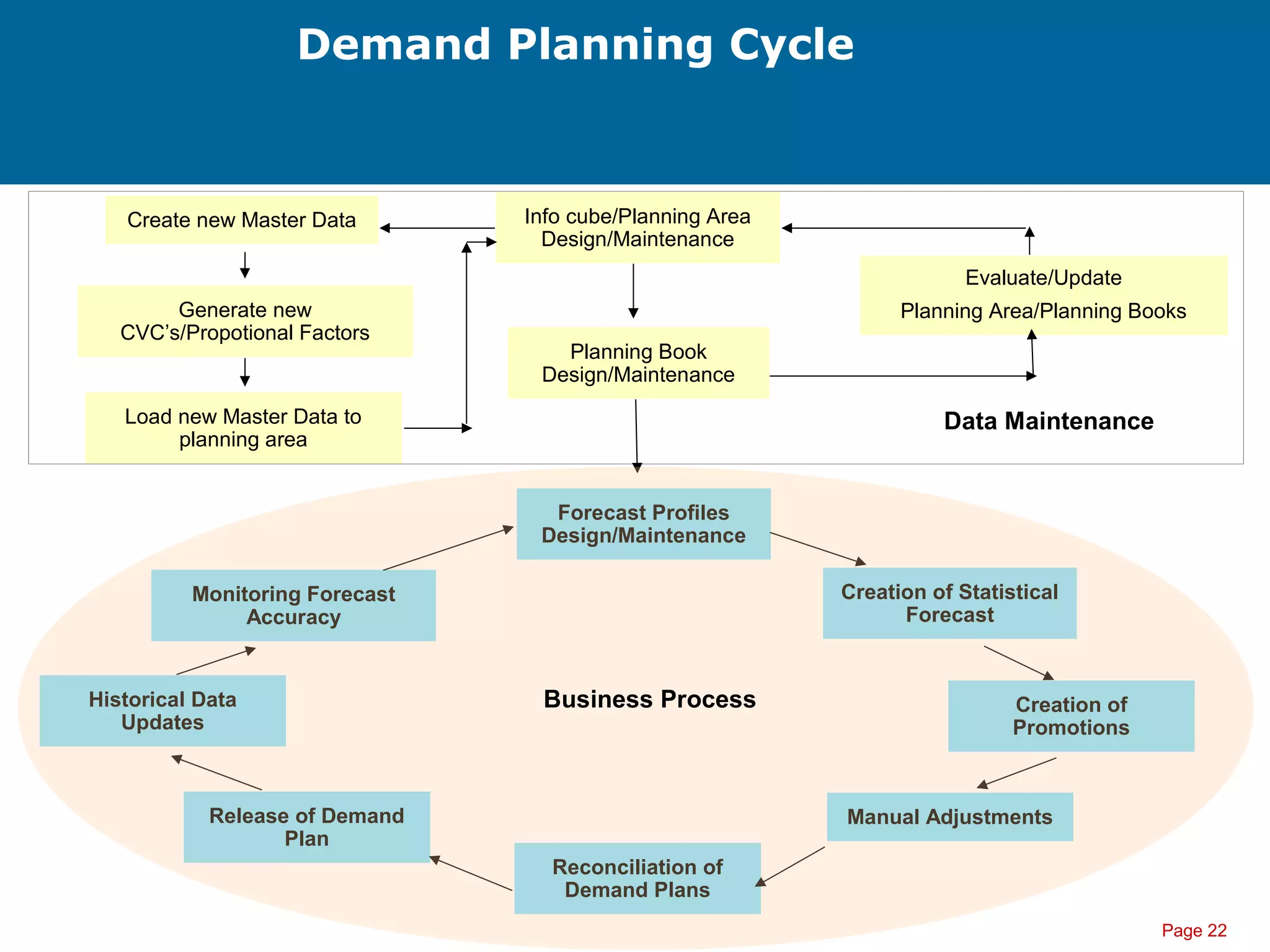
Demand Planning Cycle
Create new Master Data
Generate new
CVC’s/Propotional Factors
Info cube/Planning Area
Design/Maintenance
Planning Book
Design/Maintenance
Load new Master Data to
planning area
Evaluate/Update
Planning Area/Planning Books
Forecast Profiles
Design/Maintenance
Creation of Statistical
Forecast
Creation of
Promotions
Manual Adjustments
Reconciliation of
Demand Plans
Release of Demand
Plan
Historical Data
Updates
Monitoring Forecast
Accuracy
Business Process
Data Maintenance
Page 23
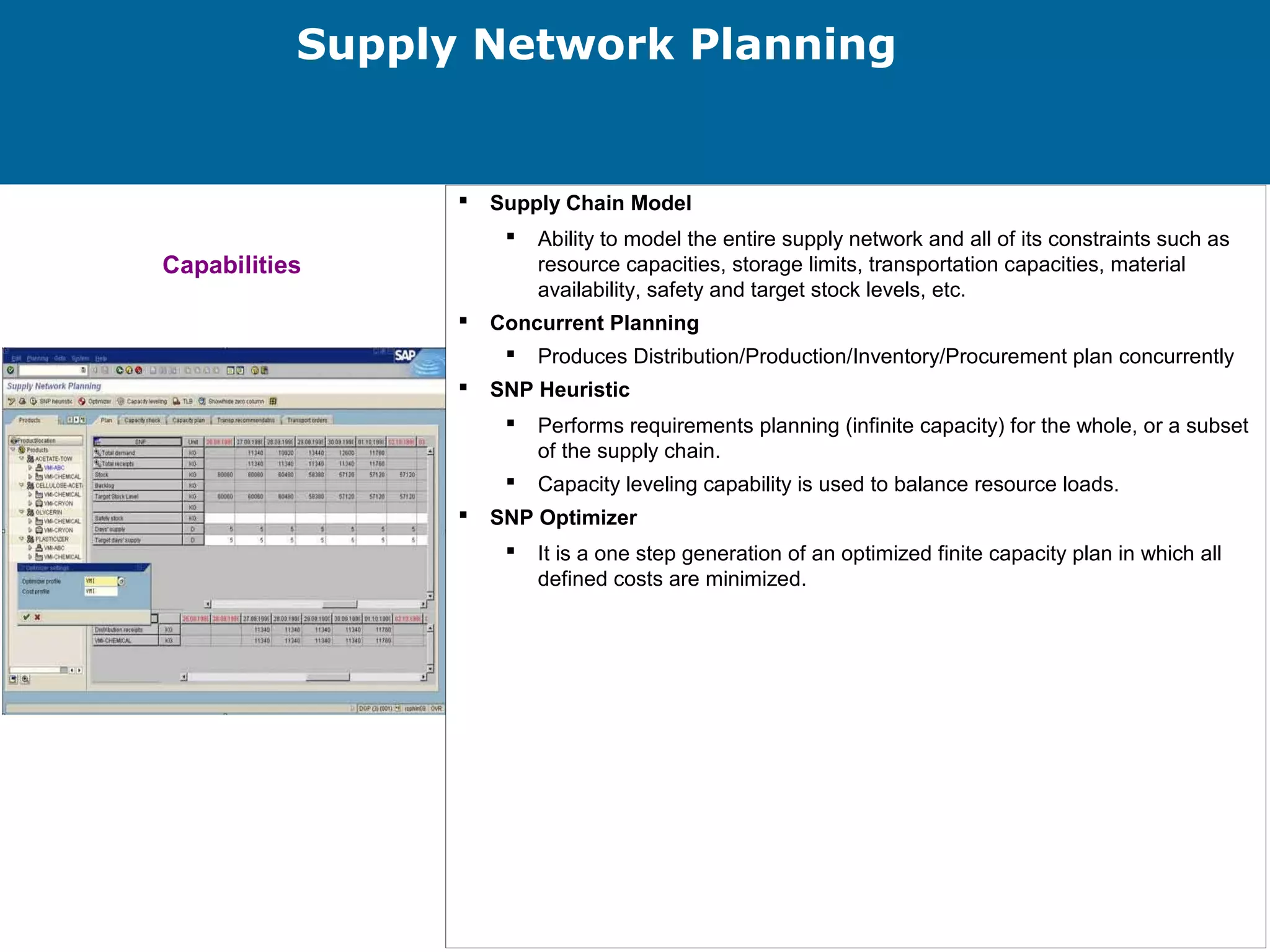
Supply Network Planning
 Supply Chain Model
 Ability to model the entire supply network and all of its constraints such as
resource capacities, storage limits, transportation capacities, material
availability, safety and target stock levels, etc.
 Concurrent Planning
 Produces Distribution/Production/Inventory/Procurement plan concurrently
 SNP Heuristic
 Performs requirements planning (infinite capacity) for the whole, or a subset
of the supply chain.
 Capacity leveling capability is used to balance resource loads.
 SNP Optimizer
 It is a one step generation of an optimized finite capacity plan in which all
defined costs are minimized.
Capabilities
Page 24
Supply Network Planning
• Supply Network Planning (SNP) integrates purchasing, manufacturing, distribution,
and transportation to develop tactical planning and sourcing decisions to be
implemented on the basis of a single, global consistent model.
• SNP uses advanced optimization techniques, based on constraints and penalties, to
plan product flow along the supply chain.
• Starting from a sales plan, SNP determines a permissible short-to-medium term plan
to cover both the quantities that must be transported between two locations and the
quantities to be produced and procured.
Page 25
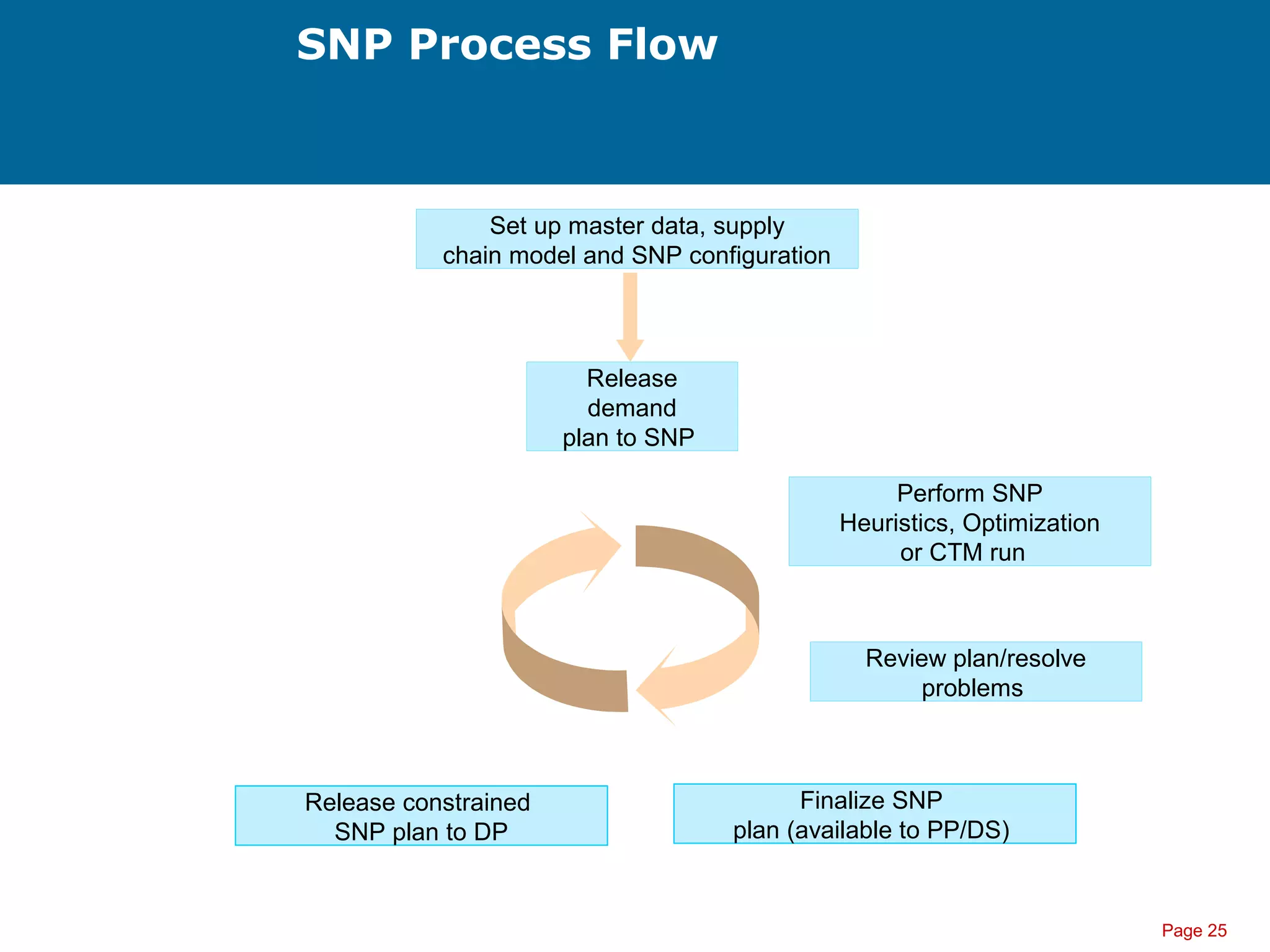
SNP Process Flow
Set up master data, supply
chain model and SNP configuration
Perform SNP
Heuristics, Optimization
or CTM run
Finalize SNP
plan (available to PP/DS)
Release
demand
plan to SNP
Review plan/resolve
problems
Release constrained
SNP plan to DP
Page 26
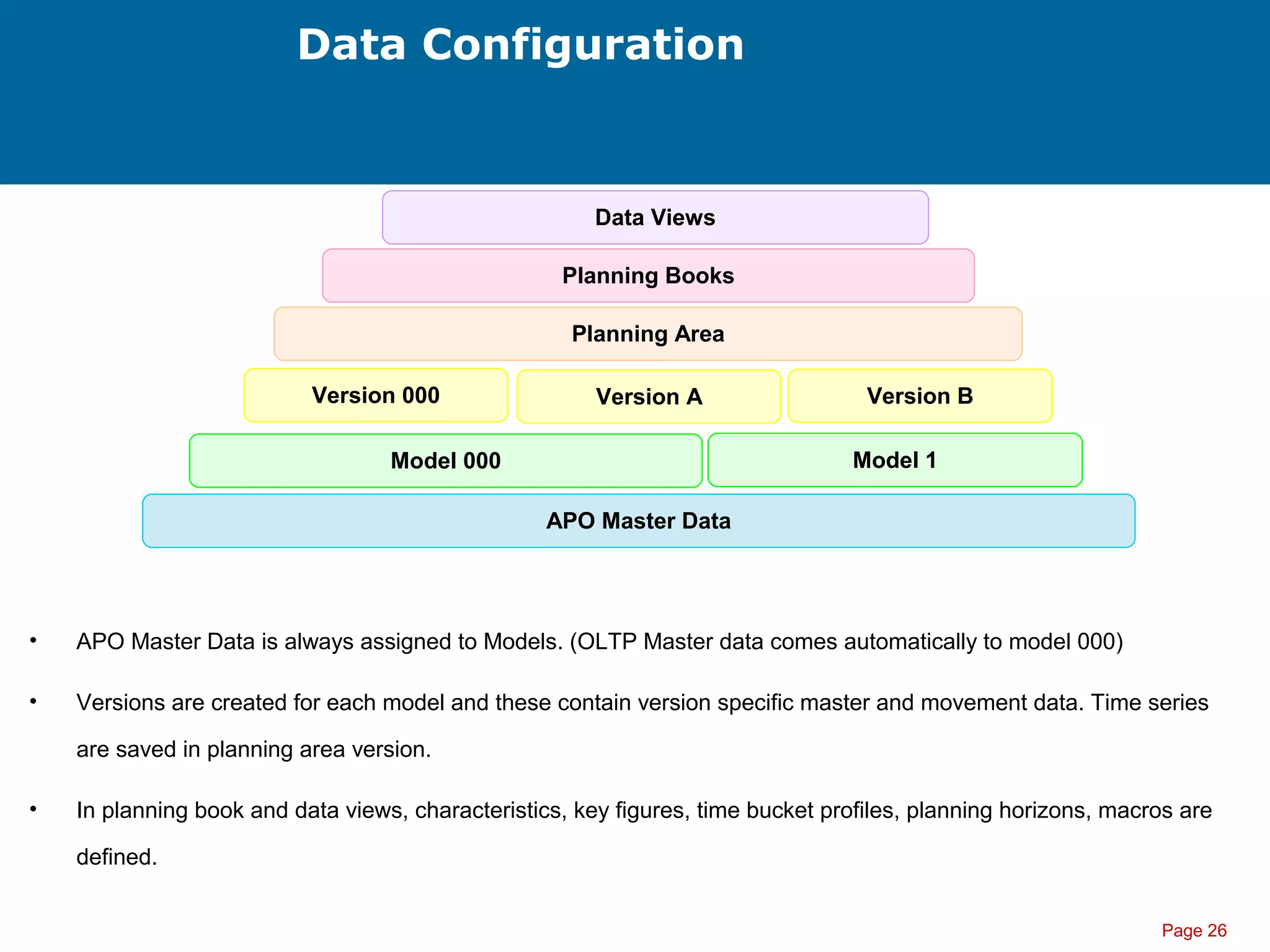
Data Configuration
APO Master Data
Model 000 Model 1
Version 000 Version A Version B
Planning Area
Planning Books
Data Views
• APO Master Data is always assigned to Models. (OLTP Master data comes automatically to model 000)
• Versions are created for each model and these contain version specific master and movement data. Time series
are saved in planning area version.
• In planning book and data views, characteristics, key figures, time bucket profiles, planning horizons, macros are
defined.
Page 27
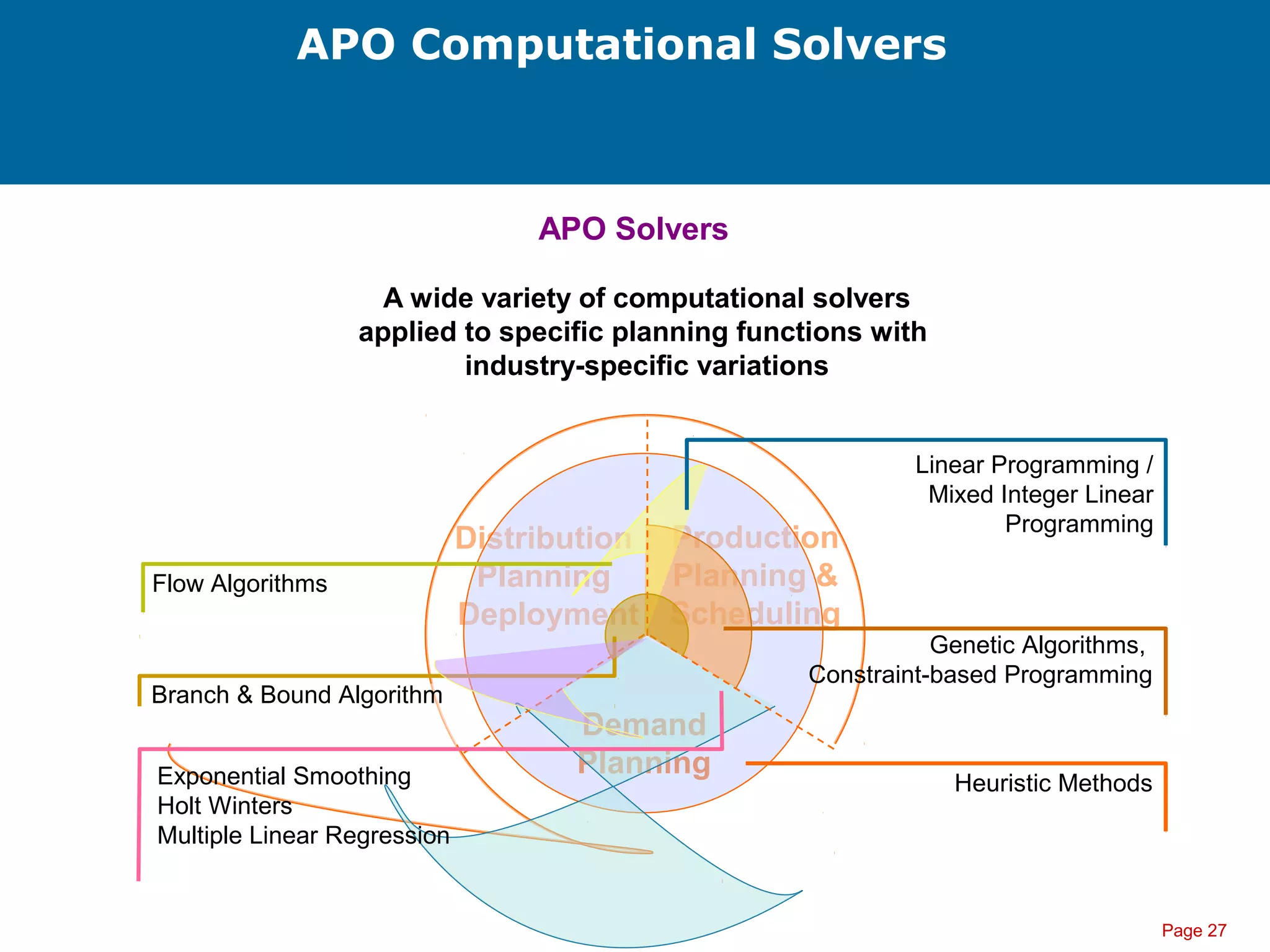
APO Computational Solvers
APO Solvers
Distribution
Planning
Deployment
A wide variety of computational solvers
applied to specific planning functions with
industry-specific variations
Production
Planning &
Scheduling
Demand
Planning
Heuristic Methods
Linear Programming /
Mixed Integer Linear
Programming
Genetic Algorithms,
Constraint-based Programming
Flow Algorithms
Branch & Bound Algorithm
Exponential Smoothing
Holt Winters
Multiple Linear Regression
Page 28
SAP R/3 and APO Integration
Master Data Integration
PlantPlant
Work CenterWork Center
Material MasterMaterial Master
VendorVendor
Bill of MaterialBill of Material
RoutingRouting
LocationLocation
Product MasterProduct Master
Production Process ModelProduction Process Model
ResourceResource
Planning (APO)Execution (SAP R/3)
Info RecordInfo Record Transportation LaneTransportation Lane
Page 29
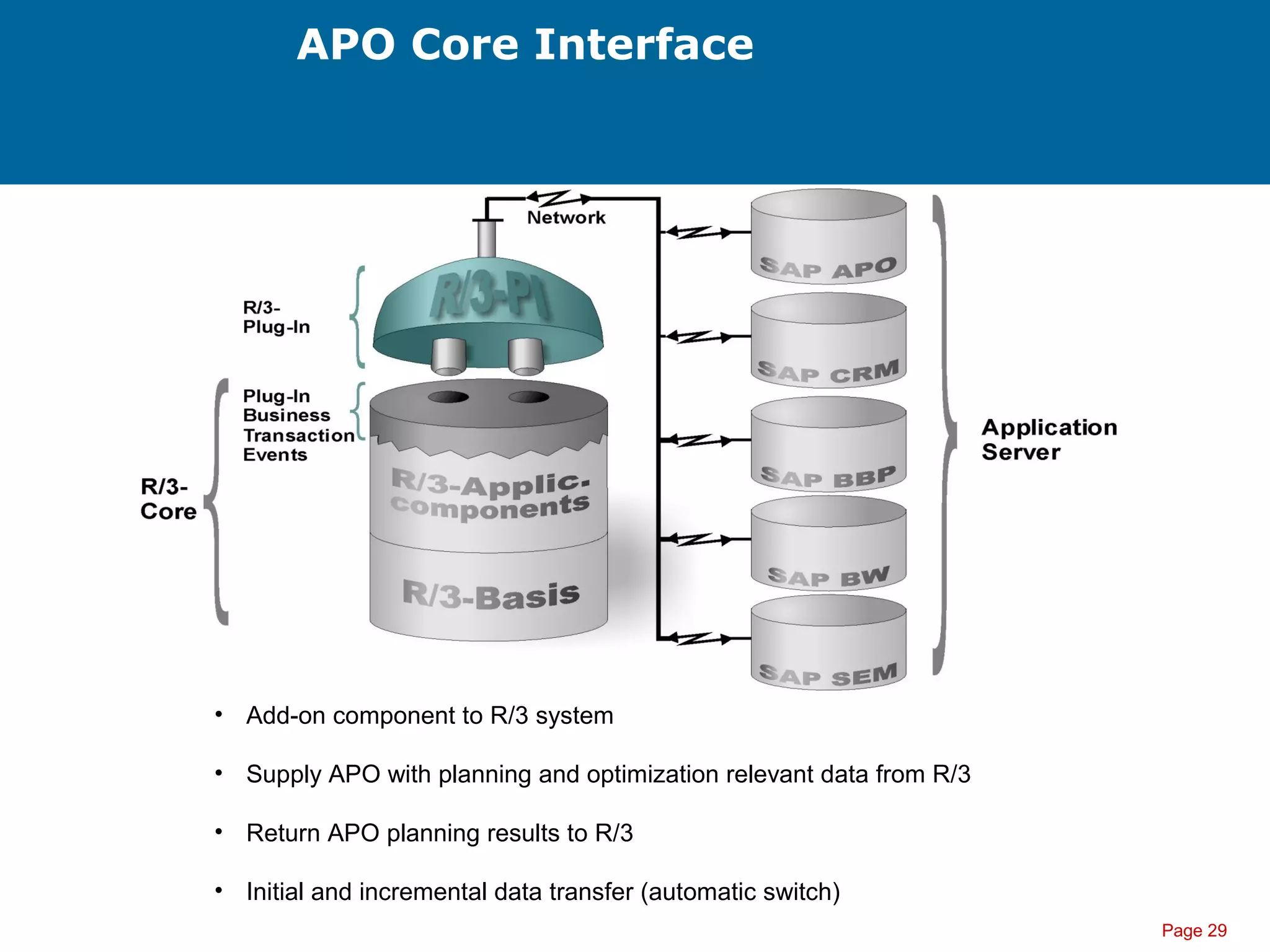
APO Core Interface
• Add-on component to R/3 system
• Supply APO with planning and optimization relevant data from R/3
• Return APO planning results to R/3
• Initial and incremental data transfer (automatic switch)
Page 30
Contents
• SCM Overview
• APO Overview
• SAP R/3 Vs APO
Page 31
What Are They?
 SAP R/3 is an Enterprise Resource Planning (ERP) system. It is a suite
of modules designed to integrate an organization. Its main purpose is
to integrate data throughout the organization and support the
execution of business processes.
 SAP’s Advanced Planner Optimizer (APO) is an Advanced Planning
System (APS). An APS supports any form of planning activities to
manage the supply chain and is a substitute to any planning modules
found in a ERP or legacy system.
Advanced Planner and Optimizer
 APO is:
o A planning tool
o A decision support tool for managing
throughout, inventory, and order/demand
management
o A modeling technology that enables the supply
chain planning process by:
 Modeling “what if” scenarios to solve
problems
 Incorporating resource and capacity
constraints
 Optimizing plans and schedules around
those constraints
Advanced Planner and Optimizer
 APO does not:
o Manage entire Bill of Materials
o Replace financial functions
o Maintain inventory movements and position
o Operate as an execution system
Page 34
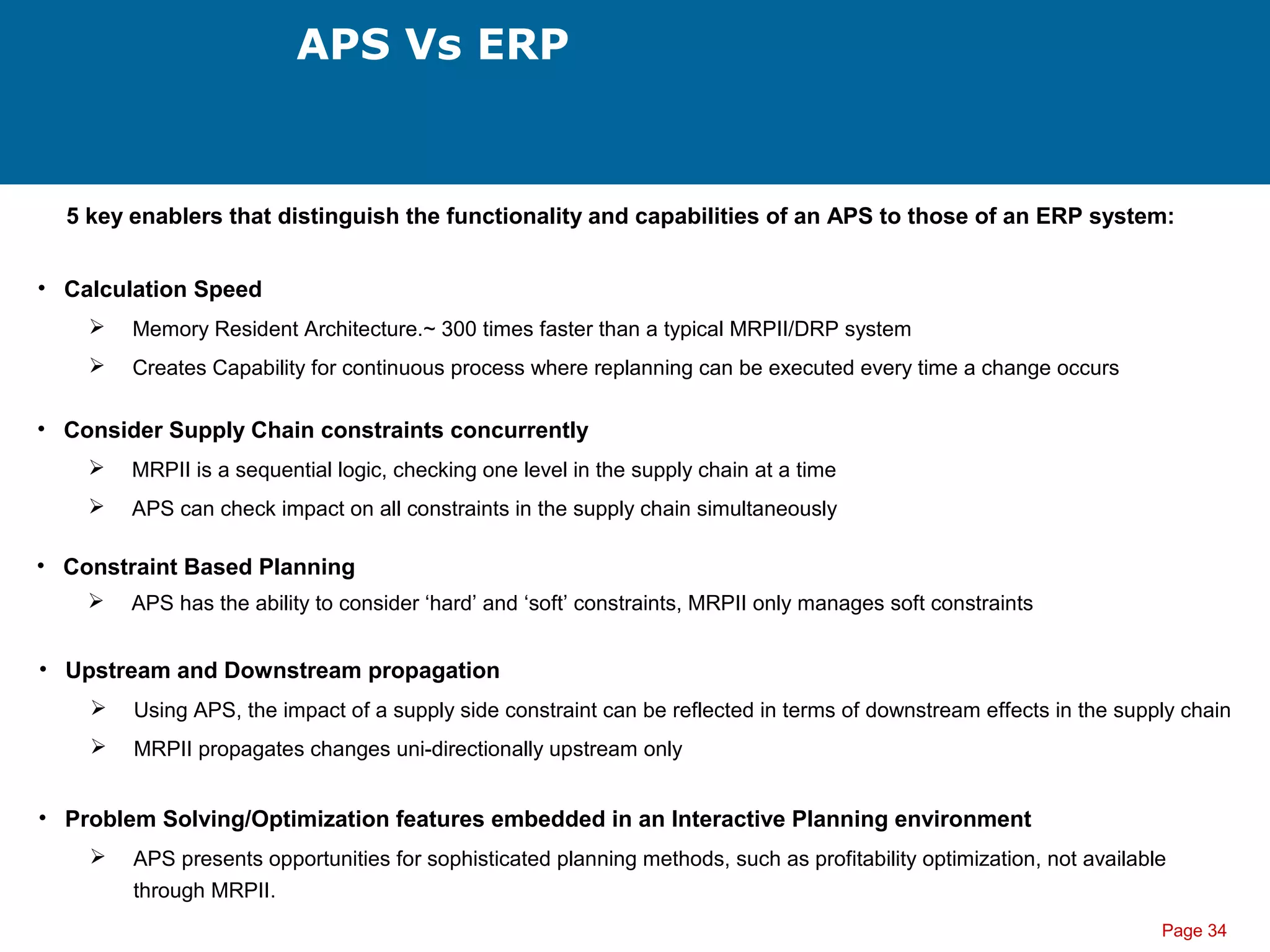
APS Vs ERP
5 key enablers that distinguish the functionality and capabilities of an APS to those of an ERP system:
• Calculation Speed
 Memory Resident Architecture.~ 300 times faster than a typical MRPII/DRP system
 Creates Capability for continuous process where replanning can be executed every time a change occurs
• Consider Supply Chain constraints concurrently
 MRPII is a sequential logic, checking one level in the supply chain at a time
 APS can check impact on all constraints in the supply chain simultaneously
• Constraint Based Planning
 APS has the ability to consider ‘hard’ and ‘soft’ constraints, MRPII only manages soft constraints
• Upstream and Downstream propagation
 Using APS, the impact of a supply side constraint can be reflected in terms of downstream effects in the supply chain
 MRPII propagates changes uni-directionally upstream only
• Problem Solving/Optimization features embedded in an Interactive Planning environment
 APS presents opportunities for sophisticated planning methods, such as profitability optimization, not available
through MRPII.
Page 35
Thank You
?

sap-apo overview

  • 1.
    SAP – APOOverview By V K Agnihotri
  • 2.
    Page 2 The coursewill cover the following subject areas:  Advanced Supply Chain Planning overview  Demand Planning  Supply Network Planning  Core Interface
  • 3.
    Page 3 Course Goals Thiscourse will prepare you to:  Gain a basic understanding of SAP functions in the area of advanced Supply Chain Planning  Describe the Supply Chain Planning options available with the SAP ECC and SAP SCM (APO) systems
  • 4.
    Page 4 Course Objectives Aftercompleting this course, you will be able to: Briefly Describe the role of both the SAP ECC and SAP SCM components in  Advanced Supply Chain Planning  Specify which master data and transaction data are used in advanced Supply Chain Planning  Explain the interplay and the integration of SAP ECC and SAP SCM (Core Interface)  Execute fundamental planning functions of Demand Planning and Supply Network Planning.
  • 5.
  • 6.
    Page 6 Contents • SCMOverview • APO Overview • SAP R/3 Vs APO
  • 7.
    Page 7 Contents • SCMOverview • APO Overview • SAP R/3 Vs APO
  • 8.
    Page 8 SCM History Roots in military logistics, in WW II: the first large, complex organizations getting the right supplies, the right labor, to the right place, at the right time  1991: The Gulf War is often called the largest supply chain success of the 20th century  Supply chain concepts and terminology formalized in the early 1980’s at a few major Universities  IT began supporting SCM concepts in the late 1980’s  Integrated supply chain systems appeared in 1991, driven by powerful PC’s, integration, networking  In 1998 ERP vendors entered supply chain market  Now SCM is being driven by internet & e-commerce
  • 9.
    Page 9 Supply ChainPlanning SupplyDemand Companies do this by predicting customer demand and fulfilling it by the most efficient allocation of inventory and production capacity. • The right product • At the right time and place • Delivered to the right customer • At the lowest total cost • With the lowest asset investment Supply Chain Planning is the process of balancing available supply against demand
  • 10.
    Page 10 SCM Planningand Execution Supply Chain Management starts with a completed Business Plan: Strategic Planning Business Planning Sales & Operations Planning Financial Planning Distribution Requirements Planning Demand Planning Production Planning & Scheduling Material Requirements Planning Execution Functional Planning • How are we going to increase the value of the company? • What businesses are we going to get in/out? • How are we going to accomplish? (acquisitions, mergers, joint ventures, divestiture, etc.) • What are the financial implications of the strategic plan? • What are the financial resource requirements? • Which financial vehicles should be used in meeting these resource requirements? • What will it take to make the business more profitable? • What events / trends are taking place in the markets served which may impact our business? • How are we going to respond to these events / trends? • What are the appropriate service and cost targets to gain competitive advantage? • How does projected demand compare to projected supply? • What are the projected resource requirements to meet both service and cost targets? • What actions are required to insure the appropriate levels of resources are available when needed? Customer Service Warehousing Transportation Manufacturing Procurement
  • 11.
    Page 11 Supply ChainPlanning Benefits Revenue Costs Working Capital Fixed Capital Supply Chain Impacts • Improved customer service (greater market share, higher prices) • Lower raw materials and finished goods inventory • Shorter “order-to-cash” cycles Shareholder Value Profitability Invested Capital • Fewer physical assets (manufacturing plants, warehouses, material handling equipment, trucks, etc.) • Lower cost of goods sold (including material, manufacturing, handling, warehousing, distribution, and general overhead costs) 10-30% transport costs 10-20% inventory 10-30% assets 5-10% conversion costs Typical Benefits 2-5% sales
  • 12.
    Page 12 Contents • SCMOverview • APO Overview • SAP R/3 Vs APO
  • 13.
    Page 13 SCM APOAPOAPO Execution –R/3Planning - APO SCMSCM APO
  • 14.
    Page 14 SCM Planning APOAPOAPO Planning- APO SCSCM APO Demand Planning (DP) Supply Network Planning (SNP) Production Planning (PP/DS) Distribution Planning (Deployment) Transportation Planning (TP/VS)
  • 15.
    Page 15 SCM Execution Execution– R/3 SCMSCM Materials Management (MM) Production Planning (PP) Warehouse Management (WM) Logistics Execution (LES)
  • 16.
    Page 16 SAP-APO Overview ConnectivityLayer ERP CRM SCM Portal Private Exchange APO liveCache Demand Planning Detailed Scheduling Production Planning Supply Network Planning Global Available- to- Promise SC Cockpit Infocubes Solvers Transportation Planning BW
  • 17.
    Page 17 SAP-APO Planningand Capabilities Supply Network Planning (SNP) Demand Planning (DP) Yearly Monthly Daily What is the expected impact of salesforce actions? Will my inventory cover demand next month? Weekly Material Planning Production Planning Inventory Planning Demand Planning Supplier Customer
  • 18.
    Page 18 SAP-APO Modules SAPAdvanced Planner & Optimizer  SAP application used to enable real time decision support, advanced constraint based planning and optimization  Covers the planning requirements (optimization, finite capacity, what-if simulation...) not covered by the R/3 system:  APO runs on an independent server from the R/3 one  SAP provides standard software to interface APO and R/3 (stocks, purchase orders, production orders,…) Demand Planning (DP) Supply Network Planning (SNP)  Sales forecasting  Advanced statistical methods  Graphical views  Alert monitoring  Network needs planning  Delivery, Production and Purchase Planning  Approximate finite capacity  Optimal solution for the entire network based on configurable criteria
  • 19.
    Page 19 Supply ChainPlanning Scenario
  • 20.
    Page 20 Demand Planning Statistical Forecasting Selection of advanced statistical tools (Univariable, Multilinear, Composite, etc.)  Collaborative Forecasting and Consensus Planning Ability to conduct intra and cross-company Demand Planning collaboration via Internet  Flexible Multi Level Planning Ability to plan at various levels of data hierarchy (product, region)  Promotion Planning Planning, managing and evaluation of the impact of promotions on demand  Product Life Cycle Ability to use phase-in and phase-out profiles and like modeling to manage new products and obsolescence  Planning by Exception Use of Alerts to report exceptions  Simulation Ability to use what-if scenario simulation  Integration with the Planning and Execution systems Tight integration with other planning capability (Supply Planning, Production Planning, etc.) and the Execution system (R/3, etc.) Capabilities
  • 21.
    Page 21 Demand PlanningArchitecture Planning BooksGUI APO OLAP Processor Business Planning Library Statistical Forecasting Toolbox Planning & Analysis Engine Info Cubes Time Series Catalog NotesData Mart This is a logical view of Demand Planning, Planning Books, User Interface and Data Mart
  • 22.
    Page 22 Demand PlanningCycle Create new Master Data Generate new CVC’s/Propotional Factors Info cube/Planning Area Design/Maintenance Planning Book Design/Maintenance Load new Master Data to planning area Evaluate/Update Planning Area/Planning Books Forecast Profiles Design/Maintenance Creation of Statistical Forecast Creation of Promotions Manual Adjustments Reconciliation of Demand Plans Release of Demand Plan Historical Data Updates Monitoring Forecast Accuracy Business Process Data Maintenance
  • 23.
    Page 23 Supply NetworkPlanning  Supply Chain Model  Ability to model the entire supply network and all of its constraints such as resource capacities, storage limits, transportation capacities, material availability, safety and target stock levels, etc.  Concurrent Planning  Produces Distribution/Production/Inventory/Procurement plan concurrently  SNP Heuristic  Performs requirements planning (infinite capacity) for the whole, or a subset of the supply chain.  Capacity leveling capability is used to balance resource loads.  SNP Optimizer  It is a one step generation of an optimized finite capacity plan in which all defined costs are minimized. Capabilities
  • 24.
    Page 24 Supply NetworkPlanning Supply Network Planning • Supply Network Planning (SNP) integrates purchasing, manufacturing, distribution, and transportation to develop tactical planning and sourcing decisions to be implemented on the basis of a single, global consistent model. • SNP uses advanced optimization techniques, based on constraints and penalties, to plan product flow along the supply chain. • Starting from a sales plan, SNP determines a permissible short-to-medium term plan to cover both the quantities that must be transported between two locations and the quantities to be produced and procured.
  • 25.
    Page 25 SNP ProcessFlow Set up master data, supply chain model and SNP configuration Perform SNP Heuristics, Optimization or CTM run Finalize SNP plan (available to PP/DS) Release demand plan to SNP Review plan/resolve problems Release constrained SNP plan to DP
  • 26.
    Page 26 Data Configuration APOMaster Data Model 000 Model 1 Version 000 Version A Version B Planning Area Planning Books Data Views • APO Master Data is always assigned to Models. (OLTP Master data comes automatically to model 000) • Versions are created for each model and these contain version specific master and movement data. Time series are saved in planning area version. • In planning book and data views, characteristics, key figures, time bucket profiles, planning horizons, macros are defined.
  • 27.
    Page 27 APO ComputationalSolvers APO Solvers Distribution Planning Deployment A wide variety of computational solvers applied to specific planning functions with industry-specific variations Production Planning & Scheduling Demand Planning Heuristic Methods Linear Programming / Mixed Integer Linear Programming Genetic Algorithms, Constraint-based Programming Flow Algorithms Branch & Bound Algorithm Exponential Smoothing Holt Winters Multiple Linear Regression
  • 28.
    Page 28 SAP R/3and APO Integration Master Data Integration PlantPlant Work CenterWork Center Material MasterMaterial Master VendorVendor Bill of MaterialBill of Material RoutingRouting LocationLocation Product MasterProduct Master Production Process ModelProduction Process Model ResourceResource Planning (APO)Execution (SAP R/3) Info RecordInfo Record Transportation LaneTransportation Lane
  • 29.
    Page 29 APO CoreInterface • Add-on component to R/3 system • Supply APO with planning and optimization relevant data from R/3 • Return APO planning results to R/3 • Initial and incremental data transfer (automatic switch)
  • 30.
    Page 30 Contents • SCMOverview • APO Overview • SAP R/3 Vs APO
  • 31.
    Page 31 What AreThey?  SAP R/3 is an Enterprise Resource Planning (ERP) system. It is a suite of modules designed to integrate an organization. Its main purpose is to integrate data throughout the organization and support the execution of business processes.  SAP’s Advanced Planner Optimizer (APO) is an Advanced Planning System (APS). An APS supports any form of planning activities to manage the supply chain and is a substitute to any planning modules found in a ERP or legacy system.
  • 32.
    Advanced Planner andOptimizer  APO is: o A planning tool o A decision support tool for managing throughout, inventory, and order/demand management o A modeling technology that enables the supply chain planning process by:  Modeling “what if” scenarios to solve problems  Incorporating resource and capacity constraints  Optimizing plans and schedules around those constraints
  • 33.
    Advanced Planner andOptimizer  APO does not: o Manage entire Bill of Materials o Replace financial functions o Maintain inventory movements and position o Operate as an execution system
  • 34.
    Page 34 APS VsERP 5 key enablers that distinguish the functionality and capabilities of an APS to those of an ERP system: • Calculation Speed  Memory Resident Architecture.~ 300 times faster than a typical MRPII/DRP system  Creates Capability for continuous process where replanning can be executed every time a change occurs • Consider Supply Chain constraints concurrently  MRPII is a sequential logic, checking one level in the supply chain at a time  APS can check impact on all constraints in the supply chain simultaneously • Constraint Based Planning  APS has the ability to consider ‘hard’ and ‘soft’ constraints, MRPII only manages soft constraints • Upstream and Downstream propagation  Using APS, the impact of a supply side constraint can be reflected in terms of downstream effects in the supply chain  MRPII propagates changes uni-directionally upstream only • Problem Solving/Optimization features embedded in an Interactive Planning environment  APS presents opportunities for sophisticated planning methods, such as profitability optimization, not available through MRPII.
  • 35.