Script Format
l   Correct formatting of a script is essential. Production
    company’s studios, directors or producers will not
    read a script that is incorrectly formatted.
l   12 Point, Courier font.
l   Use a formatting program to help you.
l   www.celtx.com
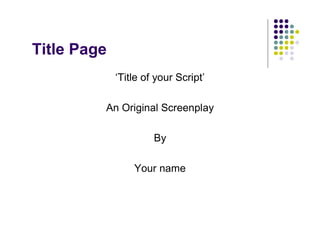
Title Page
             ‘Title of your Script’

         An Original Screenplay

                      By

                 Your name
l   Do not include artwork or “First Draft” or “Second
    Draft” on the front cover.
l   Professional film scripts should have one contact
    address in the bottom left-hand corner, with a phone
    number and email address where applicable.
l   The agent’s contact details (where applicable)
    belong in the bottom right-hand corner.
l   The scene heading (slugline)
    Interior or Exterior, Location and Time.

l   The action area (description)
    Only what you see if you were watching the screen

l   The character name

l   The dialogue
FADE IN:

INT. LABORATORY – MID-DAY
l   To establish a more definite context, you would
    write:

l   INT. LABORATORY – WORKBENCH – MID-DAY.
SCENE DESCRIPTIONS
l   Description will make up the bulk of what is written
    in a script.

l   Define the world of the story.

l   Introduce the principal characters.
l   Character introduction needs no more than a
    single descriptive sentence.
l   In all your descriptions cut out everything that does
    not further the story line.

l   Simplicity/Clarity/Visually captivating description.
l   The description tells the story.

l   Good descriptive writing provides the basic
    elements of visualisation.

l   It provides the opportunity to captivate your reader.
Correct Format
l   Only a production script contains editing and camera
    directions (and scene numbers).

l   These should not be included in a submission script,
    only present the basic story.

l   How the story is interpreted on the screen is up to
    the director.
l   A script contains no internal thought.

l   John walks slowly down the street,
    wondering why Carol did not return any
    of his calls.

l   How are John’s thoughts going to be shown to the
    audience.
l   Motivation and reasons for characters' behaviour will
    be revealed through their actions, reactions and
    dialogue.

l   Visual description should contain only what you
    would SEE if you were watching the screen.
DIALOGUE


l   The final essential element of any screenplay is the
    dialogue.

l   Decide if each speech contributes to the story or is it
    merely ‘fill’.
l   Try not to use more than 5-6 lines of dialogue at a
    time.
l   If a character has to give a long speech, break it up
    by inserting a suitable line of visual exposition.
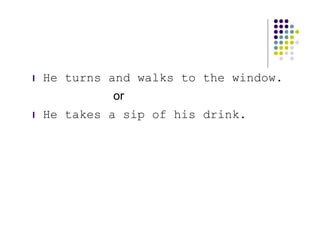
l   He turns and walks to the window.
             or
l   He takes a sip of his drink.
l   This may be inconsequential, but assists readability
    and prevents the script appearing "top-heavy" with
    dialogue.

l   Remember, film is a visual medium. Only write the
    dialogue that is essential to the story or your
    characters’ nature.
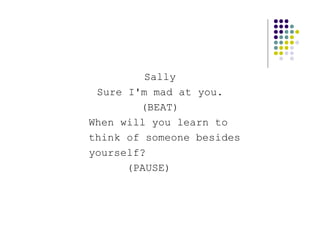
If a pause is desired between two lines in dialogue,
this is indicated by the words ‘beat’ or ‘pause’ in
parenthesis, lined up with the left margin of the
dialogue, as follows:
Sally
 Sure I'm mad at you.
        (BEAT)
When will you learn to
think of someone besides
yourself?
      (PAUSE)
l   (BEAT) and (PAUSE) are artistic directions: they
    appear within the dialogue.
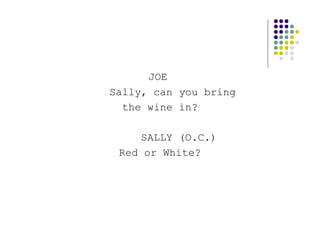
l   If Joe in the dining room is on camera, talking to
    Mary in the kitchen, whom we don’t see, the format
    is as follows: (O.S.), "Off Screen", as follows:
JOE
Sally, can you bring
  the wine in?

    SALLY (O.C.)
 Red or White?
Flashbacks
l   INT. JOE’S HOUSE – CELLAR – NIGHT
    (FLASHBACK)

l   Remember, each flashback is a new scene, even if
    it takes place in the same location as the current
    action.
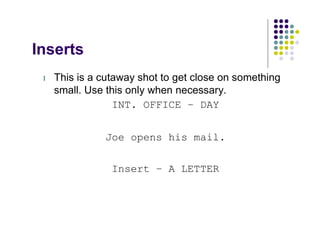
Inserts
 l   This is a cutaway shot to get close on something
     small. Use this only when necessary.
                  INT. OFFICE – DAY


               Joe opens his mail.


                 Insert – A LETTER
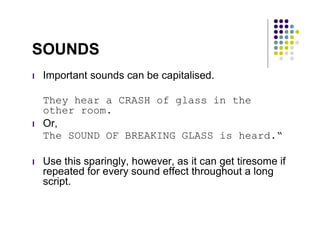
SOUNDS
l   Important sounds can be capitalised.

    They hear a CRASH of glass in the
    other room.
l   Or,
    The SOUND OF BREAKING GLASS is heard.“

l   Use this sparingly, however, as it can get tiresome if
    repeated for every sound effect throughout a long
    script.
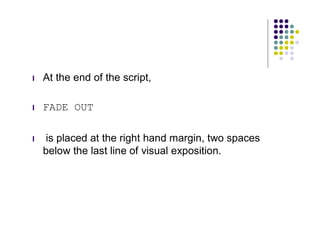
l   At the end of the script,

l   FADE OUT

l   is placed at the right hand margin, two spaces
    below the last line of visual exposition.
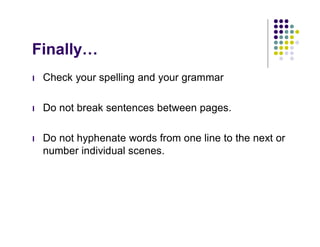
Finally…
l   Check your spelling and your grammar

l   Do not break sentences between pages.

l   Do not hyphenate words from one line to the next or
    number individual scenes.
l   Do not use semicolons anywhere.

l   Only commas or full stops between sentences.

l   Do not capitalise any lines of dialogue.
Production Script
l   The production script will be the dialogue script with
    the inclusion of camera, lighting and sound
    information.
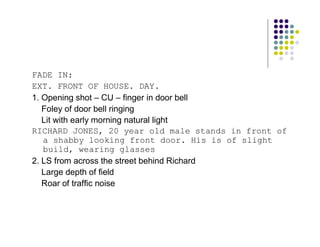
FADE IN:
EXT. FRONT OF HOUSE. DAY.
1. Opening shot – CU – finger in door bell
   Foley of door bell ringing
   Lit with early morning natural light
RICHARD JONES, 20 year old male stands in front of
   a shabby looking front door. His is of slight
   build, wearing glasses
2. LS from across the street behind Richard
   Large depth of field
   Roar of traffic noise
Camera Direction
l   Shot type – LS, MS, CU
l   Camera Movement
l   Focus techniques – DOF, Pull Focus etc
Lighting
l   Natural or artificial
l   Soft or Hard
l   Direction and angle
l   Shadows
Sound Design
l   Use of sound effects
l   Any particular music
l   The production script is not page limited.
l   For a 5 minute film it will usually be around 10 to 15
    pages
l   Think about how your shots go together.
l   How can you help tell the story through your camera
    and lighting set-ups.
l   How can you use sound to enhance the mood of a
    scene.
Next Week
l   TV

l   Please sign up tutorials or e-mail scripts.

Script format

  • 1.
  • 2.
    l Correct formatting of a script is essential. Production company’s studios, directors or producers will not read a script that is incorrectly formatted. l 12 Point, Courier font. l Use a formatting program to help you. l www.celtx.com
  • 3.
    Title Page ‘Title of your Script’ An Original Screenplay By Your name
  • 4.
    l Do not include artwork or “First Draft” or “Second Draft” on the front cover. l Professional film scripts should have one contact address in the bottom left-hand corner, with a phone number and email address where applicable. l The agent’s contact details (where applicable) belong in the bottom right-hand corner.
  • 5.
    l The scene heading (slugline) Interior or Exterior, Location and Time. l The action area (description) Only what you see if you were watching the screen l The character name l The dialogue
  • 6.
  • 7.
    l To establish a more definite context, you would write: l INT. LABORATORY – WORKBENCH – MID-DAY.
  • 8.
    SCENE DESCRIPTIONS l Description will make up the bulk of what is written in a script. l Define the world of the story. l Introduce the principal characters. l Character introduction needs no more than a single descriptive sentence.
  • 9.
    l In all your descriptions cut out everything that does not further the story line. l Simplicity/Clarity/Visually captivating description.
  • 10.
    l The description tells the story. l Good descriptive writing provides the basic elements of visualisation. l It provides the opportunity to captivate your reader.
  • 11.
    Correct Format l Only a production script contains editing and camera directions (and scene numbers). l These should not be included in a submission script, only present the basic story. l How the story is interpreted on the screen is up to the director.
  • 12.
    l A script contains no internal thought. l John walks slowly down the street, wondering why Carol did not return any of his calls. l How are John’s thoughts going to be shown to the audience.
  • 13.
    l Motivation and reasons for characters' behaviour will be revealed through their actions, reactions and dialogue. l Visual description should contain only what you would SEE if you were watching the screen.
  • 14.
    DIALOGUE l The final essential element of any screenplay is the dialogue. l Decide if each speech contributes to the story or is it merely ‘fill’.
  • 15.
    l Try not to use more than 5-6 lines of dialogue at a time. l If a character has to give a long speech, break it up by inserting a suitable line of visual exposition.
  • 16.
    l He turns and walks to the window. or l He takes a sip of his drink.
  • 17.
    l This may be inconsequential, but assists readability and prevents the script appearing "top-heavy" with dialogue. l Remember, film is a visual medium. Only write the dialogue that is essential to the story or your characters’ nature.
  • 18.
    If a pauseis desired between two lines in dialogue, this is indicated by the words ‘beat’ or ‘pause’ in parenthesis, lined up with the left margin of the dialogue, as follows:
  • 19.
    Sally Sure I'mmad at you. (BEAT) When will you learn to think of someone besides yourself? (PAUSE)
  • 20.
    l (BEAT) and (PAUSE) are artistic directions: they appear within the dialogue.
  • 21.
    l If Joe in the dining room is on camera, talking to Mary in the kitchen, whom we don’t see, the format is as follows: (O.S.), "Off Screen", as follows:
  • 22.
    JOE Sally, can youbring the wine in? SALLY (O.C.) Red or White?
  • 23.
    Flashbacks l INT. JOE’S HOUSE – CELLAR – NIGHT (FLASHBACK) l Remember, each flashback is a new scene, even if it takes place in the same location as the current action.
  • 24.
    Inserts l This is a cutaway shot to get close on something small. Use this only when necessary. INT. OFFICE – DAY Joe opens his mail. Insert – A LETTER
  • 25.
    SOUNDS l Important sounds can be capitalised. They hear a CRASH of glass in the other room. l Or, The SOUND OF BREAKING GLASS is heard.“ l Use this sparingly, however, as it can get tiresome if repeated for every sound effect throughout a long script.
  • 26.
    l At the end of the script, l FADE OUT l is placed at the right hand margin, two spaces below the last line of visual exposition.
  • 27.
    Finally… l Check your spelling and your grammar l Do not break sentences between pages. l Do not hyphenate words from one line to the next or number individual scenes.
  • 28.
    l Do not use semicolons anywhere. l Only commas or full stops between sentences. l Do not capitalise any lines of dialogue.
  • 29.
    Production Script l The production script will be the dialogue script with the inclusion of camera, lighting and sound information.
  • 30.
    FADE IN: EXT. FRONTOF HOUSE. DAY. 1. Opening shot – CU – finger in door bell Foley of door bell ringing Lit with early morning natural light RICHARD JONES, 20 year old male stands in front of a shabby looking front door. His is of slight build, wearing glasses 2. LS from across the street behind Richard Large depth of field Roar of traffic noise
  • 31.
    Camera Direction l Shot type – LS, MS, CU l Camera Movement l Focus techniques – DOF, Pull Focus etc
  • 32.
    Lighting l Natural or artificial l Soft or Hard l Direction and angle l Shadows
  • 33.
    Sound Design l Use of sound effects l Any particular music
  • 34.
    l The production script is not page limited. l For a 5 minute film it will usually be around 10 to 15 pages
  • 35.
    l Think about how your shots go together. l How can you help tell the story through your camera and lighting set-ups. l How can you use sound to enhance the mood of a scene.
  • 36.
    Next Week l TV l Please sign up tutorials or e-mail scripts.