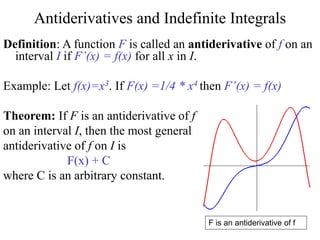
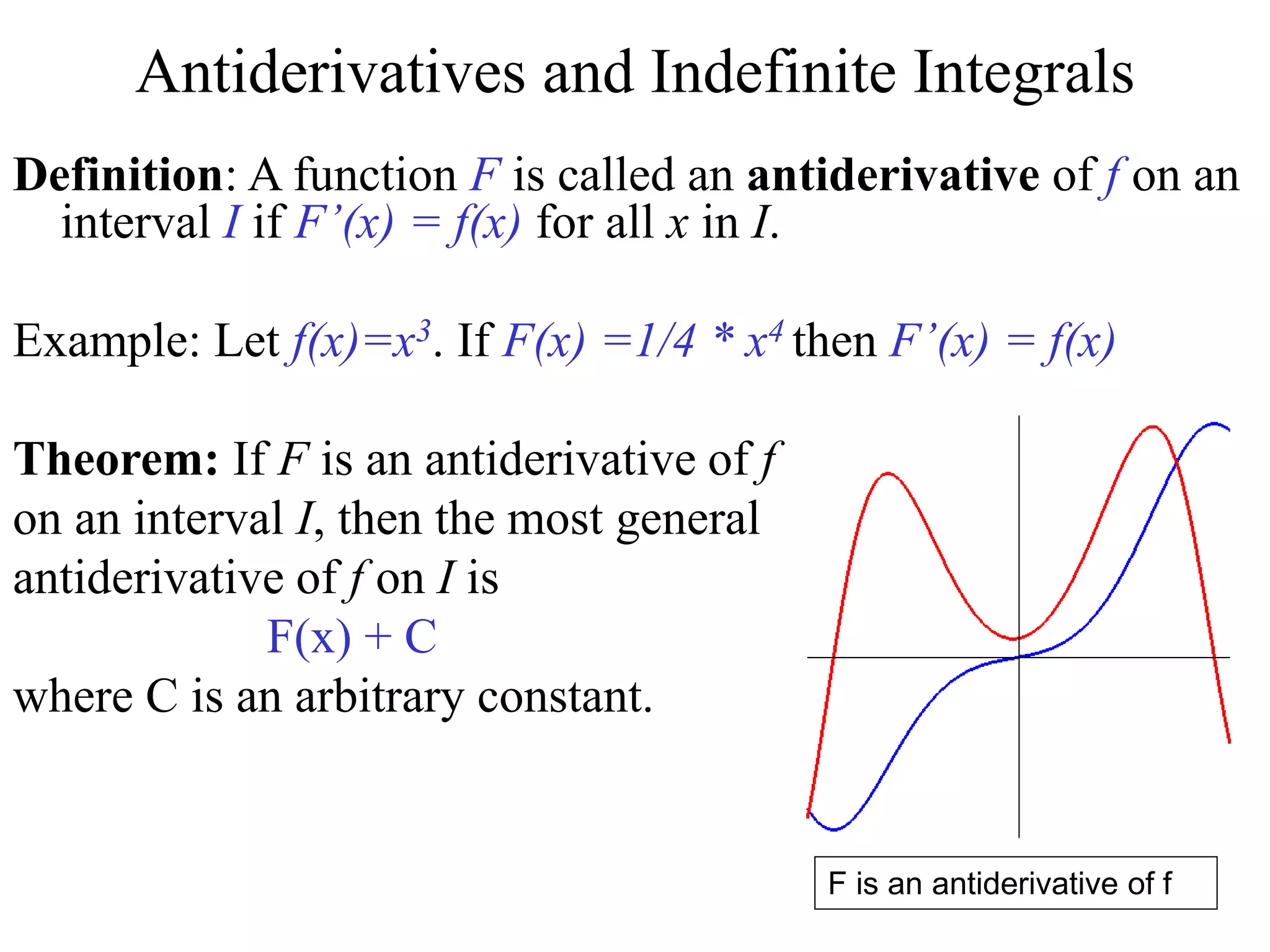
Definition: A function F is called an antiderivative of f on an
interval I if F’(x) = f(x) for all x in I.
Example: Let f(x)=x3. If F(x) =1/4 * x4 then F’(x) = f(x)
Theorem: If F is an antiderivative of f
on an interval I, then the most general
antiderivative of f on I is
F(x) + C
where C is an arbitrary constant.
Antiderivatives and Indefinite Integrals
F is an antiderivative of f
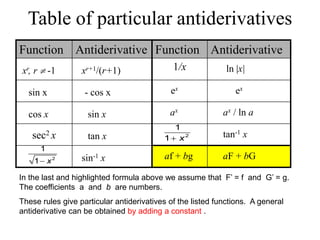
Table of particular antiderivatives
Function Antiderivative Function Antiderivative
xr, r  -1 xr+1/(r+1) 1/x ln |x|
sin x - cos x ex ex
cos x sin x ax ax / ln a
sec2 x tan x tan-1 x
sin-1 x af + bg aF + bG
2
1
1 x

2
1
1 x

In the last and highlighted formula above we assume that F’ = f and G’ = g.
The coefficients a and b are numbers.
These rules give particular antiderivatives of the listed functions. A general
antiderivative can be obtained by adding a constant .
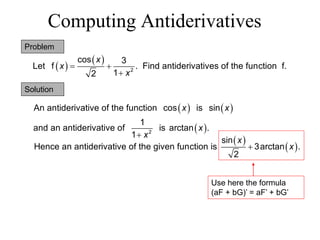
Computing Antiderivatives
Problem
 
 
2
cos 3
Let f . Find antiderivatives of the function f.
1
2
x
x
x
 

Solution
   
 
2
An antiderivative of the function cos is sin
1
and an antiderivative of is arctan .
1
x x
x
x

 
 
sin
Hence an antiderivative of the given function is 3arctan .
2
x
x

Use here the formula
(aF + bG)’ = aF’ + bG’
Indefinite Integral
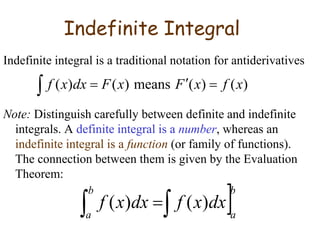
Indefinite integral is a traditional notation for antiderivatives
Note: Distinguish carefully between definite and indefinite
integrals. A definite integral is a number, whereas an
indefinite integral is a function (or family of functions).
The connection between them is given by the Evaluation
Theorem:
 

 )
(
)
(
means
)
(
)
( x
f
x
F
x
F
dx
x
f
b
a
b
a
dx
x
f
dx
x
f 
  )
(
)
(
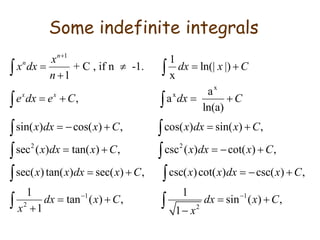
Some indefinite integrals
1
x
x
2 2
1
+ C , if n -1. ln(| |)
1 x
a
, a
ln(a)
sin( ) cos( ) , cos( ) sin( ) ,
sec ( ) tan( ) , csc ( )
n
n
x x
x
x dx dx x C
n
e dx e C dx C
x dx x C x dx x C
x dx x C x dx

   

   
    
  
 
 
 

1 1
2 2
cot( ) ,
sec( )tan( ) sec( ) , csc( )cot( ) csc( ) ,
1 1
tan ( ) , sin ( ) ,
1 1
x C
x x dx x C x x dx x C
dx x C dx x C
x x
 
 
    
   
 

 
 
Analyzing the motion of an object
using antiderivatives
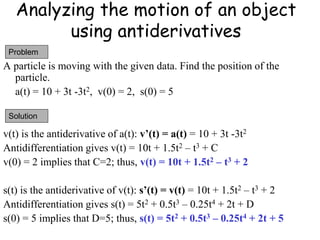
A particle is moving with the given data. Find the position of the
particle.
a(t) = 10 + 3t -3t2, v(0) = 2, s(0) = 5
v(t) is the antiderivative of a(t): v’(t) = a(t) = 10 + 3t -3t2
Antidifferentiation gives v(t) = 10t + 1.5t2 – t3 + C
v(0) = 2 implies that C=2; thus, v(t) = 10t + 1.5t2 – t3 + 2
s(t) is the antiderivative of v(t): s’(t) = v(t) = 10t + 1.5t2 – t3 + 2
Antidifferentiation gives s(t) = 5t2 + 0.5t3 – 0.25t4 + 2t + D
s(0) = 5 implies that D=5; thus, s(t) = 5t2 + 0.5t3 – 0.25t4 + 2t + 5
Problem
Solution

2301Antiderivatives_and_Indefinite_Integrals.ppt

  • 1.
    Definition: A functionF is called an antiderivative of f on an interval I if F’(x) = f(x) for all x in I. Example: Let f(x)=x3. If F(x) =1/4 * x4 then F’(x) = f(x) Theorem: If F is an antiderivative of f on an interval I, then the most general antiderivative of f on I is F(x) + C where C is an arbitrary constant. Antiderivatives and Indefinite Integrals F is an antiderivative of f
  • 2.
    Table of particularantiderivatives Function Antiderivative Function Antiderivative xr, r  -1 xr+1/(r+1) 1/x ln |x| sin x - cos x ex ex cos x sin x ax ax / ln a sec2 x tan x tan-1 x sin-1 x af + bg aF + bG 2 1 1 x  2 1 1 x  In the last and highlighted formula above we assume that F’ = f and G’ = g. The coefficients a and b are numbers. These rules give particular antiderivatives of the listed functions. A general antiderivative can be obtained by adding a constant .
  • 3.
    Computing Antiderivatives Problem    2 cos 3 Let f . Find antiderivatives of the function f. 1 2 x x x    Solution       2 An antiderivative of the function cos is sin 1 and an antiderivative of is arctan . 1 x x x x      sin Hence an antiderivative of the given function is 3arctan . 2 x x  Use here the formula (aF + bG)’ = aF’ + bG’
  • 4.
    Indefinite Integral Indefinite integralis a traditional notation for antiderivatives Note: Distinguish carefully between definite and indefinite integrals. A definite integral is a number, whereas an indefinite integral is a function (or family of functions). The connection between them is given by the Evaluation Theorem:     ) ( ) ( means ) ( ) ( x f x F x F dx x f b a b a dx x f dx x f    ) ( ) (
  • 5.
    Some indefinite integrals 1 x x 22 1 + C , if n -1. ln(| |) 1 x a , a ln(a) sin( ) cos( ) , cos( ) sin( ) , sec ( ) tan( ) , csc ( ) n n x x x x dx dx x C n e dx e C dx C x dx x C x dx x C x dx x C x dx                          1 1 2 2 cot( ) , sec( )tan( ) sec( ) , csc( )cot( ) csc( ) , 1 1 tan ( ) , sin ( ) , 1 1 x C x x dx x C x x dx x C dx x C dx x C x x                    
  • 6.
    Analyzing the motionof an object using antiderivatives A particle is moving with the given data. Find the position of the particle. a(t) = 10 + 3t -3t2, v(0) = 2, s(0) = 5 v(t) is the antiderivative of a(t): v’(t) = a(t) = 10 + 3t -3t2 Antidifferentiation gives v(t) = 10t + 1.5t2 – t3 + C v(0) = 2 implies that C=2; thus, v(t) = 10t + 1.5t2 – t3 + 2 s(t) is the antiderivative of v(t): s’(t) = v(t) = 10t + 1.5t2 – t3 + 2 Antidifferentiation gives s(t) = 5t2 + 0.5t3 – 0.25t4 + 2t + D s(0) = 5 implies that D=5; thus, s(t) = 5t2 + 0.5t3 – 0.25t4 + 2t + 5 Problem Solution