Welcome to our Bible
Study
4th Sunday of Advent A
18 December 2016
In preparation for this Sunday’s Liturgy
In aid of focusing our homilies and sharing
Prepared by Fr. Cielo R. Almazan, OFM
1st reading: Isaiah 7:10-14
 10 Again the LORD spoke to Ahaz: 11 Ask for a
sign from the LORD, your God; let it be deep as the
nether world, or high as the sky! 12 But Ahaz
answered, "I will not ask! I will not tempt the LORD!"
13 Then he said: Listen, O house of David! Is it not
enough for you to weary men, must you also weary
my God? 14 Therefore the Lord himself will give
you this sign: the virgin shall be with child, and bear
a son, and shall name him Immanuel.
1st reading: Isaiah 7,10-14
 10 Again the LORD spoke to Ahaz: 11 Ask for a
sign from the LORD, your God; let it be deep as the
nether world, or high as the sky! 12 But Ahaz
answered, "I will not ask! I will not tempt the LORD!"
13 Then he said: Listen, O house of David! Is it not
enough for you to weary men, must you also weary
my God? 14 Therefore the Lord himself will give
you this sign: the virgin shall be with child, and bear
a son, and shall name him Immanuel.
The focus is on the child called Immanuel.
1st reading: Isaiah 7,10-14
God’s offer to King Ahaz
 10 Again the LORD spoke to Ahaz: 11 Ask for a
sign from the LORD, your God; let it be deep as the
nether world, or high as the sky!
Response of King Ahaz: no good
 12 But Ahaz answered, "I will not ask! I will not
tempt the LORD!"
God’s “forced” offer: A sign
 13 Then he said: Listen, O house of David! Is it not
enough for you to weary men, must you also weary
my God? 14 Therefore the Lord himself will give
you this sign: the virgin shall be with child, and bear
a son, and shall name him Immanuel.
A simple outline!
1st reading: Isaiah 7,10-14
God’s offer to King Ahaz
 10 Again the LORD
spoke to Ahaz: 11 Ask
for a sign from the
LORD, your God; let it
be deep as the nether
world, or high as the
sky!
Response of King Ahaz:
no good
 12 But Ahaz answered,
"I will not ask! I will not
tempt the LORD!"
God’s “forced” offer: A
sign
 13 Then he said: Listen,
O house of David! Is it
not enough for you to
weary men, must you
also weary my God? 14
Therefore the Lord
himself will give you this
sign: the virgin shall be
with child, and bear a
son, and shall name him
Immanuel.
Commentary
 Ahaz is the king of Judah in 734 B.C.
 Judah is in danger of being invaded by
Northern Israel and Syria, to force Judah to
form a coalition with them against Assyria.
 God offers his help, but Ahaz must ask for it.
 He must ask for a sign. Vv.10-11
 But Ahaz refuses to accept God’s offer. V.12
(Maarte)
 Instead, he later asks help from Assyria. A
big mistake! He does not ask help from God.
 God himself initiates his plan as he
expresses his disappointment (Ahaz wearying
God, and men). V.13
 God announces his plan. The sign of
fulfillment is “a virgin shall be with child.”
V.14
 The name of the child / son is Immanuel,
which means God (el) is with us (immanu).
“With us is God” is the literal meaning.
Reflections on the 1st reading
 Unlike King Ahaz, we must learn how to listen to the voice
of the prophets (to the voice of God).
 We must learn how to trust in God’s power, not in our own
power, intelligence and little knowledge, especially in
times of need and confusion.
 God is generous. He volunteers to help us.
 We must respond to him with trust and confidence.
 We do not fight our own fights alone.
 God is willing to assist us.
 He is Immanuel. He is with us.
 Come on, Christians, stop pretending that you can
manage. Take recourse in God, when you feel you cannot
do it anymore.
Resp. Ps 24:1-2, 3-4, 5-6
 R. (7c and 10b) Let the Lord enter; he is king of glory.
 1 The LORD’s are the earth and its fullness;
the world and those who dwell in it.
2 For he founded it upon the seas
and established it upon the rivers.
 3 Who can ascend the mountain of the LORD?
or who may stand in his holy place?
4 One whose hands are sinless, whose heart is clean,
who desires not what is vain.
 5 He shall receive a blessing from the LORD,
a reward from God his savior.
6 Such is the race that seeks for him,
that seeks the face of the God of Jacob.
Resp. Ps 24:1-2, 3-4, 5-6
 R. (7c and 10b) Let the Lord
enter; he is king of glory.
 1 The LORD’s are the earth and its
fullness;
the world and those who dwell in it.
2 For he founded it upon the seas
and established it upon the rivers.
 3 Who can ascend the mountain of
the LORD?
or who may stand in his holy
place?
4 One whose hands are sinless,
whose heart is clean,
who desires not what is vain.
 5 He shall receive a blessing from
the LORD,
a reward from God his savior.
6 Such is the race that seeks for
him,
that seeks the face of the God of
Jacob.
Commentary
 The psalm recognizes God’s greatness.
 God owns the land and all that is in it. V.1
 V.2 recalls the Genesis creation story,
when God makes the waters gather
together into sea, to make the dry land
(earth) appear.
 V.3 asks the qualifications of those who
can go up to Jerusalem (God’s mountain),
and who can pray in the Temple (holy
place).
 V.4 answers the question:
 One with sinless hands (not violent, not
criminal)
 One with clean heart (pure intention, no
hidden agenda)
 One with lofty desires (not focused on
material things, or what is not necessary)
 V.5 indicates the reward of the just man:
God’s blessings.
 In v.6, the psalmist believes that the just
man (race) seeks the face of God (not
money and gold)
Reflections on the Psalm
 The earth is the Lord’s, we should not pretend to
own it or any of its parts.
 The psalmist was not joking when he said, “The
Lord’s is the earth and all that is in it.”
 To appropriate God’s property is being arrogant and
greedy. The indigenous peoples are better off than
us, in terms of dealing with the earth.
 For us to appear worthily before God in the temple
(church), let us give back what is due to Him.
2nd reading: Romans 1:1-7
 1 Paul, a slave of Christ Jesus, called to be an apostle
and set apart for the gospel of God, 2 which he
promised previously through his prophets in the holy
scriptures, 3 the gospel about his Son, descended from
David according to the flesh, 4 but established as Son
of God in power according to the spirit of holiness
through resurrection from the dead, Jesus Christ our
Lord. 5 Through him we have received the grace of
apostleship, to bring about the obedience of faith, for the
sake of his name, among all the Gentiles, 6 among
whom are you also, who are called to belong to Jesus
Christ; 7 to all the beloved of God in Rome, called to be
holy. Grace to you and peace from God our Father and
the Lord Jesus Christ.
2nd reading: Romans 1,1-7
 1 Paul, a slave of Christ Jesus, called to be an apostle
and set apart for the gospel of God, 2 which he
promised previously through his prophets in the holy
scriptures, 3 the gospel about his Son, descended from
David according to the flesh, 4 but established as Son
of God in power according to the spirit of holiness
through resurrection from the dead, Jesus Christ our
Lord. 5 Through him we have received the grace of
apostleship, to bring about the obedience of faith, for the
sake of his name, among all the Gentiles, 6 among
whom are you also, who are called to belong to Jesus
Christ; 7 to all the beloved of God in Rome, called to be
holy. Grace to you and peace from God our Father and
the Lord Jesus Christ.
The focus is on Jesus Christ as fulfillment of the prophecies.
2nd reading: Romans 1,1-7
Paul
 1 Paul, a slave of Christ Jesus, called to be an apostle and set
apart for the gospel of God, 2 which he promised previously
through his prophets in the holy scriptures, 3 the gospel about his
Son, descended from David according to the flesh, 4 but
established as Son of God in power according to the spirit of
holiness through resurrection from the dead, Jesus Christ our Lord.
Jesus
 5 Through him we have received the grace of apostleship, to bring
about the obedience of faith, for the sake of his name, among all
the Gentiles, 6 among whom are you also, who are called to
belong to Jesus Christ;
Greetings
 7 To all the beloved of God in Rome, called to be holy: Grace to
you and peace from God our Father and the Lord Jesus Christ.
A simple outline!
2nd reading: Romans 1,1-7
Paul
 1 Paul, a slave of Christ Jesus,
called to be an apostle and set
apart for the gospel of God, 2
which he promised previously
through his prophets in the holy
scriptures, 3 the gospel about his
Son, descended from David
according to the flesh, 4 but
established as Son of God in
power according to the spirit of
holiness through resurrection from
the dead, Jesus Christ our Lord.
Jesus
 5 Through him we have received
the grace of apostleship, to bring
about the obedience of faith, for
the sake of his name, among all
the Gentiles, 6 among whom are
you also, who are called to belong
to Jesus Christ;
Greetings
 7 To all the beloved of God in
Rome, called to be holy: Grace to
you and peace from God our
Father and the Lord Jesus Christ.
Commentary
 In v.1, Paul introduces himself as
 A slave of Christ Jesus
 Called to be an apostle
 Set apart for the gospel.
 V.2 immediately shifts the attention
from the author to God.
 V.2 introduces who God is:
 Who promised through the prophets,
what?
 V.3 gives the answer:
 The gospel about his son, in v.1 too
 A descendant of David
 Established as Son of God,
 Through the resurrection of the
dead
 Jesus Christ our Lord. V.4
 Vv.1-4 move rapidly from Paul himself
to God and then to Jesus.
2nd reading: Romans 1,1-7
Paul
 1 Paul, a slave of Christ Jesus,
called to be an apostle and set
apart for the gospel of God, 2
which he promised previously
through his prophets in the holy
scriptures, 3 the gospel about his
Son, descended from David
according to the flesh, 4 but
established as Son of God in
power according to the spirit of
holiness through resurrection from
the dead, Jesus Christ our Lord.
Jesus
 5 Through him we have received
the grace of apostleship, to bring
about the obedience of faith, for
the sake of his name, among all
the Gentiles, 6 among whom are
you also, who are called to belong
to Jesus Christ;
Greetings
 7 To all the beloved of God in
Rome, called to be holy: Grace to
you and peace from God our
Father and the Lord Jesus Christ.
 V.5 goes back to Paul and others, now in
plural “we”.
 The grace of apostleship (their vocation)
comes through Jesus.
 The purpose of apostleship is to bring
obedience of faith (to bring Christ to
people) among the Gentiles (non-Jews),
v.5, including the Romans themselves.
V.6
 V.7 mentions the addressees.
 Paul describes them as
 Beloved of God in Rome
 Called to be holy.
 To them, Paul sends his greetings:
Grace and peace from God the Father
and the Lord Jesus Christ.
 Vv.1-7 form the introduction of Paul’s
letter to the Romans, which contains the
writer, the content, and addressees.
 Paul did not convert the Romans. Some
other Christians did.
Reflections on the 2nd reading
 Paul is focused on Jesus. In a few verses, he has
accomplished a lot. (introduction of himself, of God
and of Jesus Christ).
 In his greetings, he makes known his readers.
 The words he uses are theologically heavy. Where
did he learn all these?
 Paul was a former Pharisee. He is learned. He knows
how to listen (to the apostles), to study (the Torah), to
make some theological statements (to make sense
out of his readings and learnings from the OT and
teachings about Jesus Christ) and to teach (to
evangelize, to communicate).
 Paul understands very well his vocation: to be an
evangelizer. He is equipped to evangelize.
 He is set apart for the gospel, promised of old by God.
 His work is to introduce Jesus to the people.
Gospel reading: Matthew 1:18-24
 18 This is how the birth of Jesus Christ came about.
When his mother Mary was betrothed to Joseph, but
before they lived together, she was found with child
through the holy Spirit. 19 Joseph her husband, since
he was a righteous man, yet unwilling to expose her to
shame, decided to divorce her quietly. 20 Such was his
intention when, behold, the angel of the Lord appeared
to him in a dream and said, "Joseph, son of David, do
not be afraid to take Mary your wife into your home. For
it is through the holy Spirit that this child has been
conceived in her. 21 She will bear a son and you are to
name him Jesus, because he will save his people from
their sins." 22 All this took place to fulfill what the Lord
had said through the prophet: 23 "Behold, the virgin
shall be with child and bear a son, and they shall name
him Emmanuel," which means "God is with us." 24
When Joseph awoke, he did as the angel of the Lord
had commanded him and took his wife into his home.
Gospel reading: Matthew 1,18-24
 18 This is how the birth of Jesus Christ came about.
When his mother Mary was betrothed to Joseph, but
before they lived together, she was found with child
through the holy Spirit. 19 Joseph her husband, since
he was a righteous man, yet unwilling to expose her to
shame, decided to divorce her quietly. 20 Such was his
intention when, behold, the angel of the Lord appeared
to him in a dream and said, "Joseph, son of David, do
not be afraid to take Mary your wife into your home. For
it is through the holy Spirit that this child has been
conceived in her. 21 She will bear a son and you are to
name him Jesus, because he will save his people from
their sins." 22 All this took place to fulfill what the Lord
had said through the prophet: 23 "Behold, the virgin
shall be with child and bear a son, and they shall name
him Emmanuel," which means "God is with us." 24
When Joseph awoke, he did as the angel of the Lord
had commanded him and took his wife into his home.
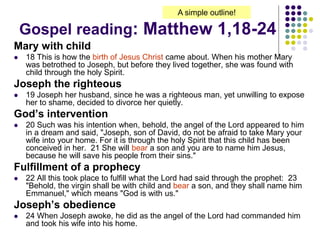
Gospel reading: Matthew 1,18-24
Mary with child
 18 This is how the birth of Jesus Christ came about. When his mother Mary
was betrothed to Joseph, but before they lived together, she was found with
child through the holy Spirit.
Joseph the righteous
 19 Joseph her husband, since he was a righteous man, yet unwilling to expose
her to shame, decided to divorce her quietly.
God’s intervention
 20 Such was his intention when, behold, the angel of the Lord appeared to him
in a dream and said, "Joseph, son of David, do not be afraid to take Mary your
wife into your home. For it is through the holy Spirit that this child has been
conceived in her. 21 She will bear a son and you are to name him Jesus,
because he will save his people from their sins."
Fulfillment of a prophecy
 22 All this took place to fulfill what the Lord had said through the prophet: 23
"Behold, the virgin shall be with child and bear a son, and they shall name him
Emmanuel," which means "God is with us."
Joseph’s obedience
 24 When Joseph awoke, he did as the angel of the Lord had commanded him
and took his wife into his home.
A simple outline!
Gospel reading: Matthew 1,18-24
Mary with child
 18 This is how the birth of Jesus Christ came
about. When his mother Mary was betrothed to
Joseph, but before they lived together, she was
found with child through the holy Spirit.
Joseph the righteous
 19 Joseph her husband, since he was a righteous
man, yet unwilling to expose her to shame,
decided to divorce her quietly.
God’s intervention
 20 Such was his intention when, behold, the angel
of the Lord appeared to him in a dream and said,
"Joseph, son of David, do not be afraid to take
Mary your wife into your home. For it is through
the holy Spirit that this child has been conceived
in her. 21 She will bear a son and you are to
name him Jesus, because he will save his people
from their sins."
Fulfillment of a prophecy
 22 All this took place to fulfill what the Lord had
said through the prophet: 23 "Behold, the virgin
shall be with child and bear a son, and they shall
name him Emmanuel," which means "God is with
us."
Joseph’s obedience
 24 When Joseph awoke, he did as the angel of
the Lord had commanded him and took his wife
into his home.
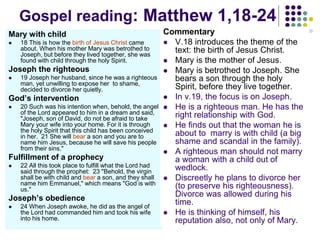
Commentary
 V.18 introduces the theme of the
text: the birth of Jesus Christ.
 Mary is the mother of Jesus.
 Mary is betrothed to Joseph. She
bears a son through the holy
Spirit, before they live together.
 In v.19, the focus is on Joseph.
 He is a righteous man. He has the
right relationship with God.
 He finds out that the woman he is
about to marry is with child (a big
shame and scandal in the family).
 A righteous man should not marry
a woman with a child out of
wedlock.
 Discreetly he plans to divorce her
(to preserve his righteousness).
Divorce was allowed during his
time.
 He is thinking of himself, his
reputation also, not only of Mary.
Gospel reading: Matthew 1,18-24
Mary with child
 18 This is how the birth of Jesus Christ came
about. When his mother Mary was betrothed to
Joseph, but before they lived together, she was
found with child through the holy Spirit.
Joseph the righteous
 19 Joseph her husband, since he was a righteous
man, yet unwilling to expose her to shame,
decided to divorce her quietly.
God’s intervention
 20 Such was his intention when, behold, the angel
of the Lord appeared to him in a dream and said,
"Joseph, son of David, do not be afraid to take
Mary your wife into your home. For it is through
the holy Spirit that this child has been conceived
in her. 21 She will bear a son and you are to
name him Jesus, because he will save his people
from their sins."
Fulfillment of a prophecy
 22 All this took place to fulfill what the Lord had
said through the prophet: 23 "Behold, the virgin
shall be with child and bear a son, and they shall
name him Emmanuel," which means "God is with
us."
Joseph’s obedience
 24 When Joseph awoke, he did as the angel of
the Lord had commanded him and took his wife
into his home.
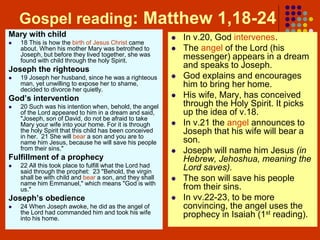
 In v.20, God intervenes.
 The angel of the Lord (his
messenger) appears in a dream
and speaks to Joseph.
 God explains and encourages
him to bring her home.
 His wife, Mary, has conceived
through the Holy Spirit. It picks
up the idea of v.18.
 In v.21 the angel announces to
Joseph that his wife will bear a
son.
 Joseph will name him Jesus (in
Hebrew, Jehoshua, meaning the
Lord saves).
 The son will save his people
from their sins.
 In vv.22-23, to be more
convincing, the angel uses the
prophecy in Isaiah (1st reading).
Gospel reading: Matthew 1,18-24
Mary with child
 18 This is how the birth of Jesus Christ came
about. When his mother Mary was betrothed to
Joseph, but before they lived together, she was
found with child through the holy Spirit.
Joseph the righteous
 19 Joseph her husband, since he was a righteous
man, yet unwilling to expose her to shame,
decided to divorce her quietly.
God’s intervention
 20 Such was his intention when, behold, the angel
of the Lord appeared to him in a dream and said,
"Joseph, son of David, do not be afraid to take
Mary your wife into your home. For it is through
the holy Spirit that this child has been conceived
in her. 21 She will bear a son and you are to
name him Jesus, because he will save his people
from their sins."
Fulfillment of a prophecy
 22 All this took place to fulfill what the Lord had
said through the prophet: 23 "Behold, the virgin
shall be with child and bear a son, and they shall
name him Emmanuel," which means "God is with
us."
Joseph’s obedience
 24 When Joseph awoke, he did as the angel of
the Lord had commanded him and took his wife
into his home.
 V.24 indicates Joseph’s positive
response.
 Joseph obeys God and takes Mary
home.
 The author uses devices like “the
angel of the Lord” and “dream” to
portray God’s intervention.
 God overrules human law (Mosaic
law) to advance his plan.
 Joseph is correct in terms of their
law, but God has to intervene.
 The Holy Spirit has previously
acted in her life. She did not
commit any sin of adultery or
fornication.
 Joseph should not feel stupid
because he is bringing home a
pregnant woman, with a child not
his own
 Mary’s pregnancy is simply God’s
intervention.
 His fatherhood to Jesus is also
God’s intervention.
Reflections on the gospel reading
 Like Mary, we, too, as a Church can give birth to
Jesus, if we allow God to intervene in our lives.
 Giving birth to Jesus is not just a thing of the past,
2000 years ago, but also in our own times.
 For Jesus to come out and hear his voice, we have
to labor very hard.
 Like the women in travail, we have to sweat it out to
give birth to Jesus.
Tying the 3 readings and the Psalm
 The first reading is about the birth of the Immanuel
from a virgin.
 The psalm reclaims God’s (Jesus’) ownership of all
things.
 The second reading is about the man Jesus Christ,
the son of God, whom Paul preaches to the people.
 The gospel reading is about the birth of Jesus to save
us.
How to develop your homily / sharing
 Do you understand the deeper meaning of
Christmas?
 Here, we refer to the God-meaning of Christmas,
not the meaning that we put into it, which is highly
commercialized.
 We get God’s meaning from the three readings.
 Based on the 1st reading, the birth of Christ is
nothing else than God’s intervention.
 His intervention is meant to free us from sin
and oppression.
 We pray that God intervenes in our lives,
especially when we are in trouble.
 Christ is not just the God who is with us, but an
active God who defends us.
 The gospel reading teaches us that the birth of
Christ fulfills God’s promises.
 The birth of Christ is not just God’s affair.
 It happens with man’s cooperation.
 Joseph follows everything that God tells him in a
dream, through an angel.
 Every step that Joseph undertakes is in
obedience to God’s instructions.
 He works quietly. He obeys quietly.
 God works with him with so much ease, unlike
King Ahaz.
 King Ahaz is spiritually bankrupt. He refuses to
listen to the proposal of the intervening God.
 As king, he makes a mistake that he is the
highest authority. God is a nuisance to him.
 He considers God’s offer (sign) as politically
irrelevant.
 We can also learn from Paul in the second reading.
 In his conversion (or transformation), Christ is born
to him.
 As a result, he goes to mission.
 He proclaims that God intervened in his life through
Christ.
 He harnesses his old discipline of reading, studying,
listening to those who know (about Jesus and the
gospel) and making theological conclusions.
 In this way, Paul is also facilitating the birth of Jesus
in the Church of Rome.
 Do you want to feel the joy of Christ’s birth?
 You must learn how to trust in God’s power in times
of trouble, unlike King Ahaz. (1st reading)
 You must learn how to obey God’s instructions, like
Joseph. (gospel reading)
 Like Paul, you must communicate to others how
God is taking hold of you. (2nd reading)
 Shun away from people (or communities) who have no trust in
God, who don’t care to listen to God’s Word, and who are lazy
to communicate their faith.
 The eucharist gives meaning to the
celebration of the birth of Jesus.
 It is also a sign of our consent to his
intervention in our lives.
 In the eucharist, we ask God to strengthen us
to be true and relevant missionaries of our
times.
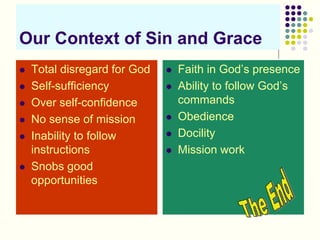
Our Context of Sin and Grace
 Total disregard for God
 Self-sufficiency
 Over self-confidence
 No sense of mission
 Inability to follow
instructions
 Snobs good
opportunities
 Faith in God’s presence
 Ability to follow God’s
commands
 Obedience
 Docility
 Mission work
Suggested Songs
 Mukha ng Panginoon
 http://www.youtube.com/watch?v=yZadzbLaRJ8
 Lord, I know, communion
 http://www.youtube.com/watch?v=ulqjOjYZOns
 Dear sisters and brothers,
 Are we all set for Christmas? How spiritually
prepared are we?
 Fr. Cielo

4th Advent A

  • 1.
    Welcome to ourBible Study 4th Sunday of Advent A 18 December 2016 In preparation for this Sunday’s Liturgy In aid of focusing our homilies and sharing Prepared by Fr. Cielo R. Almazan, OFM
  • 2.
    1st reading: Isaiah7:10-14  10 Again the LORD spoke to Ahaz: 11 Ask for a sign from the LORD, your God; let it be deep as the nether world, or high as the sky! 12 But Ahaz answered, "I will not ask! I will not tempt the LORD!" 13 Then he said: Listen, O house of David! Is it not enough for you to weary men, must you also weary my God? 14 Therefore the Lord himself will give you this sign: the virgin shall be with child, and bear a son, and shall name him Immanuel.
  • 3.
    1st reading: Isaiah7,10-14  10 Again the LORD spoke to Ahaz: 11 Ask for a sign from the LORD, your God; let it be deep as the nether world, or high as the sky! 12 But Ahaz answered, "I will not ask! I will not tempt the LORD!" 13 Then he said: Listen, O house of David! Is it not enough for you to weary men, must you also weary my God? 14 Therefore the Lord himself will give you this sign: the virgin shall be with child, and bear a son, and shall name him Immanuel. The focus is on the child called Immanuel.
  • 4.
    1st reading: Isaiah7,10-14 God’s offer to King Ahaz  10 Again the LORD spoke to Ahaz: 11 Ask for a sign from the LORD, your God; let it be deep as the nether world, or high as the sky! Response of King Ahaz: no good  12 But Ahaz answered, "I will not ask! I will not tempt the LORD!" God’s “forced” offer: A sign  13 Then he said: Listen, O house of David! Is it not enough for you to weary men, must you also weary my God? 14 Therefore the Lord himself will give you this sign: the virgin shall be with child, and bear a son, and shall name him Immanuel. A simple outline!
  • 5.
    1st reading: Isaiah7,10-14 God’s offer to King Ahaz  10 Again the LORD spoke to Ahaz: 11 Ask for a sign from the LORD, your God; let it be deep as the nether world, or high as the sky! Response of King Ahaz: no good  12 But Ahaz answered, "I will not ask! I will not tempt the LORD!" God’s “forced” offer: A sign  13 Then he said: Listen, O house of David! Is it not enough for you to weary men, must you also weary my God? 14 Therefore the Lord himself will give you this sign: the virgin shall be with child, and bear a son, and shall name him Immanuel. Commentary  Ahaz is the king of Judah in 734 B.C.  Judah is in danger of being invaded by Northern Israel and Syria, to force Judah to form a coalition with them against Assyria.  God offers his help, but Ahaz must ask for it.  He must ask for a sign. Vv.10-11  But Ahaz refuses to accept God’s offer. V.12 (Maarte)  Instead, he later asks help from Assyria. A big mistake! He does not ask help from God.  God himself initiates his plan as he expresses his disappointment (Ahaz wearying God, and men). V.13  God announces his plan. The sign of fulfillment is “a virgin shall be with child.” V.14  The name of the child / son is Immanuel, which means God (el) is with us (immanu). “With us is God” is the literal meaning.
  • 6.
    Reflections on the1st reading  Unlike King Ahaz, we must learn how to listen to the voice of the prophets (to the voice of God).  We must learn how to trust in God’s power, not in our own power, intelligence and little knowledge, especially in times of need and confusion.  God is generous. He volunteers to help us.  We must respond to him with trust and confidence.  We do not fight our own fights alone.  God is willing to assist us.  He is Immanuel. He is with us.  Come on, Christians, stop pretending that you can manage. Take recourse in God, when you feel you cannot do it anymore.
  • 7.
    Resp. Ps 24:1-2,3-4, 5-6  R. (7c and 10b) Let the Lord enter; he is king of glory.  1 The LORD’s are the earth and its fullness; the world and those who dwell in it. 2 For he founded it upon the seas and established it upon the rivers.  3 Who can ascend the mountain of the LORD? or who may stand in his holy place? 4 One whose hands are sinless, whose heart is clean, who desires not what is vain.  5 He shall receive a blessing from the LORD, a reward from God his savior. 6 Such is the race that seeks for him, that seeks the face of the God of Jacob.
  • 8.
    Resp. Ps 24:1-2,3-4, 5-6  R. (7c and 10b) Let the Lord enter; he is king of glory.  1 The LORD’s are the earth and its fullness; the world and those who dwell in it. 2 For he founded it upon the seas and established it upon the rivers.  3 Who can ascend the mountain of the LORD? or who may stand in his holy place? 4 One whose hands are sinless, whose heart is clean, who desires not what is vain.  5 He shall receive a blessing from the LORD, a reward from God his savior. 6 Such is the race that seeks for him, that seeks the face of the God of Jacob. Commentary  The psalm recognizes God’s greatness.  God owns the land and all that is in it. V.1  V.2 recalls the Genesis creation story, when God makes the waters gather together into sea, to make the dry land (earth) appear.  V.3 asks the qualifications of those who can go up to Jerusalem (God’s mountain), and who can pray in the Temple (holy place).  V.4 answers the question:  One with sinless hands (not violent, not criminal)  One with clean heart (pure intention, no hidden agenda)  One with lofty desires (not focused on material things, or what is not necessary)  V.5 indicates the reward of the just man: God’s blessings.  In v.6, the psalmist believes that the just man (race) seeks the face of God (not money and gold)
  • 9.
    Reflections on thePsalm  The earth is the Lord’s, we should not pretend to own it or any of its parts.  The psalmist was not joking when he said, “The Lord’s is the earth and all that is in it.”  To appropriate God’s property is being arrogant and greedy. The indigenous peoples are better off than us, in terms of dealing with the earth.  For us to appear worthily before God in the temple (church), let us give back what is due to Him.
  • 10.
    2nd reading: Romans1:1-7  1 Paul, a slave of Christ Jesus, called to be an apostle and set apart for the gospel of God, 2 which he promised previously through his prophets in the holy scriptures, 3 the gospel about his Son, descended from David according to the flesh, 4 but established as Son of God in power according to the spirit of holiness through resurrection from the dead, Jesus Christ our Lord. 5 Through him we have received the grace of apostleship, to bring about the obedience of faith, for the sake of his name, among all the Gentiles, 6 among whom are you also, who are called to belong to Jesus Christ; 7 to all the beloved of God in Rome, called to be holy. Grace to you and peace from God our Father and the Lord Jesus Christ.
  • 11.
    2nd reading: Romans1,1-7  1 Paul, a slave of Christ Jesus, called to be an apostle and set apart for the gospel of God, 2 which he promised previously through his prophets in the holy scriptures, 3 the gospel about his Son, descended from David according to the flesh, 4 but established as Son of God in power according to the spirit of holiness through resurrection from the dead, Jesus Christ our Lord. 5 Through him we have received the grace of apostleship, to bring about the obedience of faith, for the sake of his name, among all the Gentiles, 6 among whom are you also, who are called to belong to Jesus Christ; 7 to all the beloved of God in Rome, called to be holy. Grace to you and peace from God our Father and the Lord Jesus Christ. The focus is on Jesus Christ as fulfillment of the prophecies.
  • 12.
    2nd reading: Romans1,1-7 Paul  1 Paul, a slave of Christ Jesus, called to be an apostle and set apart for the gospel of God, 2 which he promised previously through his prophets in the holy scriptures, 3 the gospel about his Son, descended from David according to the flesh, 4 but established as Son of God in power according to the spirit of holiness through resurrection from the dead, Jesus Christ our Lord. Jesus  5 Through him we have received the grace of apostleship, to bring about the obedience of faith, for the sake of his name, among all the Gentiles, 6 among whom are you also, who are called to belong to Jesus Christ; Greetings  7 To all the beloved of God in Rome, called to be holy: Grace to you and peace from God our Father and the Lord Jesus Christ. A simple outline!
  • 13.
    2nd reading: Romans1,1-7 Paul  1 Paul, a slave of Christ Jesus, called to be an apostle and set apart for the gospel of God, 2 which he promised previously through his prophets in the holy scriptures, 3 the gospel about his Son, descended from David according to the flesh, 4 but established as Son of God in power according to the spirit of holiness through resurrection from the dead, Jesus Christ our Lord. Jesus  5 Through him we have received the grace of apostleship, to bring about the obedience of faith, for the sake of his name, among all the Gentiles, 6 among whom are you also, who are called to belong to Jesus Christ; Greetings  7 To all the beloved of God in Rome, called to be holy: Grace to you and peace from God our Father and the Lord Jesus Christ. Commentary  In v.1, Paul introduces himself as  A slave of Christ Jesus  Called to be an apostle  Set apart for the gospel.  V.2 immediately shifts the attention from the author to God.  V.2 introduces who God is:  Who promised through the prophets, what?  V.3 gives the answer:  The gospel about his son, in v.1 too  A descendant of David  Established as Son of God,  Through the resurrection of the dead  Jesus Christ our Lord. V.4  Vv.1-4 move rapidly from Paul himself to God and then to Jesus.
  • 14.
    2nd reading: Romans1,1-7 Paul  1 Paul, a slave of Christ Jesus, called to be an apostle and set apart for the gospel of God, 2 which he promised previously through his prophets in the holy scriptures, 3 the gospel about his Son, descended from David according to the flesh, 4 but established as Son of God in power according to the spirit of holiness through resurrection from the dead, Jesus Christ our Lord. Jesus  5 Through him we have received the grace of apostleship, to bring about the obedience of faith, for the sake of his name, among all the Gentiles, 6 among whom are you also, who are called to belong to Jesus Christ; Greetings  7 To all the beloved of God in Rome, called to be holy: Grace to you and peace from God our Father and the Lord Jesus Christ.  V.5 goes back to Paul and others, now in plural “we”.  The grace of apostleship (their vocation) comes through Jesus.  The purpose of apostleship is to bring obedience of faith (to bring Christ to people) among the Gentiles (non-Jews), v.5, including the Romans themselves. V.6  V.7 mentions the addressees.  Paul describes them as  Beloved of God in Rome  Called to be holy.  To them, Paul sends his greetings: Grace and peace from God the Father and the Lord Jesus Christ.  Vv.1-7 form the introduction of Paul’s letter to the Romans, which contains the writer, the content, and addressees.  Paul did not convert the Romans. Some other Christians did.
  • 15.
    Reflections on the2nd reading  Paul is focused on Jesus. In a few verses, he has accomplished a lot. (introduction of himself, of God and of Jesus Christ).  In his greetings, he makes known his readers.  The words he uses are theologically heavy. Where did he learn all these?  Paul was a former Pharisee. He is learned. He knows how to listen (to the apostles), to study (the Torah), to make some theological statements (to make sense out of his readings and learnings from the OT and teachings about Jesus Christ) and to teach (to evangelize, to communicate).  Paul understands very well his vocation: to be an evangelizer. He is equipped to evangelize.  He is set apart for the gospel, promised of old by God.  His work is to introduce Jesus to the people.
  • 16.
    Gospel reading: Matthew1:18-24  18 This is how the birth of Jesus Christ came about. When his mother Mary was betrothed to Joseph, but before they lived together, she was found with child through the holy Spirit. 19 Joseph her husband, since he was a righteous man, yet unwilling to expose her to shame, decided to divorce her quietly. 20 Such was his intention when, behold, the angel of the Lord appeared to him in a dream and said, "Joseph, son of David, do not be afraid to take Mary your wife into your home. For it is through the holy Spirit that this child has been conceived in her. 21 She will bear a son and you are to name him Jesus, because he will save his people from their sins." 22 All this took place to fulfill what the Lord had said through the prophet: 23 "Behold, the virgin shall be with child and bear a son, and they shall name him Emmanuel," which means "God is with us." 24 When Joseph awoke, he did as the angel of the Lord had commanded him and took his wife into his home.
  • 17.
    Gospel reading: Matthew1,18-24  18 This is how the birth of Jesus Christ came about. When his mother Mary was betrothed to Joseph, but before they lived together, she was found with child through the holy Spirit. 19 Joseph her husband, since he was a righteous man, yet unwilling to expose her to shame, decided to divorce her quietly. 20 Such was his intention when, behold, the angel of the Lord appeared to him in a dream and said, "Joseph, son of David, do not be afraid to take Mary your wife into your home. For it is through the holy Spirit that this child has been conceived in her. 21 She will bear a son and you are to name him Jesus, because he will save his people from their sins." 22 All this took place to fulfill what the Lord had said through the prophet: 23 "Behold, the virgin shall be with child and bear a son, and they shall name him Emmanuel," which means "God is with us." 24 When Joseph awoke, he did as the angel of the Lord had commanded him and took his wife into his home.
  • 18.
    Gospel reading: Matthew1,18-24 Mary with child  18 This is how the birth of Jesus Christ came about. When his mother Mary was betrothed to Joseph, but before they lived together, she was found with child through the holy Spirit. Joseph the righteous  19 Joseph her husband, since he was a righteous man, yet unwilling to expose her to shame, decided to divorce her quietly. God’s intervention  20 Such was his intention when, behold, the angel of the Lord appeared to him in a dream and said, "Joseph, son of David, do not be afraid to take Mary your wife into your home. For it is through the holy Spirit that this child has been conceived in her. 21 She will bear a son and you are to name him Jesus, because he will save his people from their sins." Fulfillment of a prophecy  22 All this took place to fulfill what the Lord had said through the prophet: 23 "Behold, the virgin shall be with child and bear a son, and they shall name him Emmanuel," which means "God is with us." Joseph’s obedience  24 When Joseph awoke, he did as the angel of the Lord had commanded him and took his wife into his home. A simple outline!
  • 19.
    Gospel reading: Matthew1,18-24 Mary with child  18 This is how the birth of Jesus Christ came about. When his mother Mary was betrothed to Joseph, but before they lived together, she was found with child through the holy Spirit. Joseph the righteous  19 Joseph her husband, since he was a righteous man, yet unwilling to expose her to shame, decided to divorce her quietly. God’s intervention  20 Such was his intention when, behold, the angel of the Lord appeared to him in a dream and said, "Joseph, son of David, do not be afraid to take Mary your wife into your home. For it is through the holy Spirit that this child has been conceived in her. 21 She will bear a son and you are to name him Jesus, because he will save his people from their sins." Fulfillment of a prophecy  22 All this took place to fulfill what the Lord had said through the prophet: 23 "Behold, the virgin shall be with child and bear a son, and they shall name him Emmanuel," which means "God is with us." Joseph’s obedience  24 When Joseph awoke, he did as the angel of the Lord had commanded him and took his wife into his home. Commentary  V.18 introduces the theme of the text: the birth of Jesus Christ.  Mary is the mother of Jesus.  Mary is betrothed to Joseph. She bears a son through the holy Spirit, before they live together.  In v.19, the focus is on Joseph.  He is a righteous man. He has the right relationship with God.  He finds out that the woman he is about to marry is with child (a big shame and scandal in the family).  A righteous man should not marry a woman with a child out of wedlock.  Discreetly he plans to divorce her (to preserve his righteousness). Divorce was allowed during his time.  He is thinking of himself, his reputation also, not only of Mary.
  • 20.
    Gospel reading: Matthew1,18-24 Mary with child  18 This is how the birth of Jesus Christ came about. When his mother Mary was betrothed to Joseph, but before they lived together, she was found with child through the holy Spirit. Joseph the righteous  19 Joseph her husband, since he was a righteous man, yet unwilling to expose her to shame, decided to divorce her quietly. God’s intervention  20 Such was his intention when, behold, the angel of the Lord appeared to him in a dream and said, "Joseph, son of David, do not be afraid to take Mary your wife into your home. For it is through the holy Spirit that this child has been conceived in her. 21 She will bear a son and you are to name him Jesus, because he will save his people from their sins." Fulfillment of a prophecy  22 All this took place to fulfill what the Lord had said through the prophet: 23 "Behold, the virgin shall be with child and bear a son, and they shall name him Emmanuel," which means "God is with us." Joseph’s obedience  24 When Joseph awoke, he did as the angel of the Lord had commanded him and took his wife into his home.  In v.20, God intervenes.  The angel of the Lord (his messenger) appears in a dream and speaks to Joseph.  God explains and encourages him to bring her home.  His wife, Mary, has conceived through the Holy Spirit. It picks up the idea of v.18.  In v.21 the angel announces to Joseph that his wife will bear a son.  Joseph will name him Jesus (in Hebrew, Jehoshua, meaning the Lord saves).  The son will save his people from their sins.  In vv.22-23, to be more convincing, the angel uses the prophecy in Isaiah (1st reading).
  • 21.
    Gospel reading: Matthew1,18-24 Mary with child  18 This is how the birth of Jesus Christ came about. When his mother Mary was betrothed to Joseph, but before they lived together, she was found with child through the holy Spirit. Joseph the righteous  19 Joseph her husband, since he was a righteous man, yet unwilling to expose her to shame, decided to divorce her quietly. God’s intervention  20 Such was his intention when, behold, the angel of the Lord appeared to him in a dream and said, "Joseph, son of David, do not be afraid to take Mary your wife into your home. For it is through the holy Spirit that this child has been conceived in her. 21 She will bear a son and you are to name him Jesus, because he will save his people from their sins." Fulfillment of a prophecy  22 All this took place to fulfill what the Lord had said through the prophet: 23 "Behold, the virgin shall be with child and bear a son, and they shall name him Emmanuel," which means "God is with us." Joseph’s obedience  24 When Joseph awoke, he did as the angel of the Lord had commanded him and took his wife into his home.  V.24 indicates Joseph’s positive response.  Joseph obeys God and takes Mary home.  The author uses devices like “the angel of the Lord” and “dream” to portray God’s intervention.  God overrules human law (Mosaic law) to advance his plan.  Joseph is correct in terms of their law, but God has to intervene.  The Holy Spirit has previously acted in her life. She did not commit any sin of adultery or fornication.  Joseph should not feel stupid because he is bringing home a pregnant woman, with a child not his own  Mary’s pregnancy is simply God’s intervention.  His fatherhood to Jesus is also God’s intervention.
  • 22.
    Reflections on thegospel reading  Like Mary, we, too, as a Church can give birth to Jesus, if we allow God to intervene in our lives.  Giving birth to Jesus is not just a thing of the past, 2000 years ago, but also in our own times.  For Jesus to come out and hear his voice, we have to labor very hard.  Like the women in travail, we have to sweat it out to give birth to Jesus.
  • 23.
    Tying the 3readings and the Psalm  The first reading is about the birth of the Immanuel from a virgin.  The psalm reclaims God’s (Jesus’) ownership of all things.  The second reading is about the man Jesus Christ, the son of God, whom Paul preaches to the people.  The gospel reading is about the birth of Jesus to save us.
  • 24.
    How to developyour homily / sharing  Do you understand the deeper meaning of Christmas?  Here, we refer to the God-meaning of Christmas, not the meaning that we put into it, which is highly commercialized.  We get God’s meaning from the three readings.
  • 25.
     Based onthe 1st reading, the birth of Christ is nothing else than God’s intervention.  His intervention is meant to free us from sin and oppression.  We pray that God intervenes in our lives, especially when we are in trouble.  Christ is not just the God who is with us, but an active God who defends us.
  • 26.
     The gospelreading teaches us that the birth of Christ fulfills God’s promises.  The birth of Christ is not just God’s affair.  It happens with man’s cooperation.  Joseph follows everything that God tells him in a dream, through an angel.  Every step that Joseph undertakes is in obedience to God’s instructions.  He works quietly. He obeys quietly.  God works with him with so much ease, unlike King Ahaz.
  • 27.
     King Ahazis spiritually bankrupt. He refuses to listen to the proposal of the intervening God.  As king, he makes a mistake that he is the highest authority. God is a nuisance to him.  He considers God’s offer (sign) as politically irrelevant.
  • 28.
     We canalso learn from Paul in the second reading.  In his conversion (or transformation), Christ is born to him.  As a result, he goes to mission.  He proclaims that God intervened in his life through Christ.  He harnesses his old discipline of reading, studying, listening to those who know (about Jesus and the gospel) and making theological conclusions.  In this way, Paul is also facilitating the birth of Jesus in the Church of Rome.
  • 29.
     Do youwant to feel the joy of Christ’s birth?  You must learn how to trust in God’s power in times of trouble, unlike King Ahaz. (1st reading)  You must learn how to obey God’s instructions, like Joseph. (gospel reading)  Like Paul, you must communicate to others how God is taking hold of you. (2nd reading)  Shun away from people (or communities) who have no trust in God, who don’t care to listen to God’s Word, and who are lazy to communicate their faith.
  • 30.
     The eucharistgives meaning to the celebration of the birth of Jesus.  It is also a sign of our consent to his intervention in our lives.  In the eucharist, we ask God to strengthen us to be true and relevant missionaries of our times.
  • 31.
    Our Context ofSin and Grace  Total disregard for God  Self-sufficiency  Over self-confidence  No sense of mission  Inability to follow instructions  Snobs good opportunities  Faith in God’s presence  Ability to follow God’s commands  Obedience  Docility  Mission work
  • 32.
    Suggested Songs  Mukhang Panginoon  http://www.youtube.com/watch?v=yZadzbLaRJ8  Lord, I know, communion  http://www.youtube.com/watch?v=ulqjOjYZOns
  • 33.
     Dear sistersand brothers,  Are we all set for Christmas? How spiritually prepared are we?  Fr. Cielo