Welcome to our Bible Study
27th
Sunday in the Ordinary Time C
2 October 2016
In preparation for this Sunday’s Liturgy
As aid in focusing our homilies and sharing
Prepared by Fr. Cielo R. Almazan, OFM
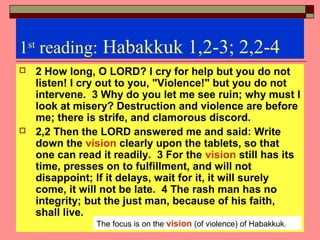
1st
reading: Habakkuk 1,2-3; 2,2-4
 2 How long, O LORD? I cry for help but you do not
listen! I cry out to you, "Violence!" but you do not
intervene. 3 Why do you let me see ruin; why must I
look at misery? Destruction and violence are before
me; there is strife, and clamorous discord.
 2,2 Then the LORD answered me and said: Write
down the vision clearly upon the tablets, so that
one can read it readily. 3 For the vision still has its
time, presses on to fulfillment, and will not
disappoint; If it delays, wait for it, it will surely
come, it will not be late. 4 The rash man has no
integrity; but the just man, because of his faith,
shall live.
The focus is on the vision (of violence) of Habakkuk.
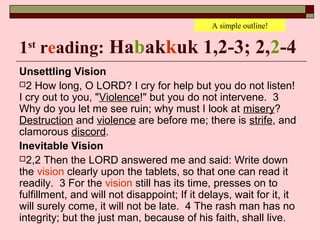
1st
reading: Habakkuk 1,2-3; 2,2-4
Unsettling Vision
2 How long, O LORD? I cry for help but you do not listen!
I cry out to you, "Violence!" but you do not intervene. 3
Why do you let me see ruin; why must I look at misery?
Destruction and violence are before me; there is strife, and
clamorous discord.
Inevitable Vision
2,2 Then the LORD answered me and said: Write down
the vision clearly upon the tablets, so that one can read it
readily. 3 For the vision still has its time, presses on to
fulfillment, and will not disappoint; If it delays, wait for it, it
will surely come, it will not be late. 4 The rash man has no
integrity; but the just man, because of his faith, shall live.
A simple outline!
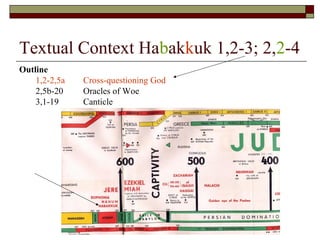
Textual Context Habakkuk 1,2-3; 2,2-4
Outline
1,2-2,5a Cross-questioning God
2,5b-20 Oracles of Woe
3,1-19 Canticle
1st
reading: Habakkuk 1,2-3; 2,2-4
 2 How long, O LORD? I cry for
help but you do not listen! I cry
out to you, "Violence!" but you
do not intervene. 3 Why do
you let me see ruin; why must I
look at misery? Destruction
and violence are before me;
there is strife, and clamorous
discord.
 2,2 Then the LORD answered
me and said: Write down the
vision clearly upon the tablets,
so that one can read it readily.
3 For the vision still has its
time, presses on to fulfillment,
and will not disappoint; If it
delays, wait for it, it will surely
come, it will not be late. 4 The
rash man has no integrity; but
the just man, because of his
faith, shall live.
Commentary
 Habakkuk (means to embrace)
prophesies sometime before King
Josiah’s death (around 600 BC).
 The prophet laments, cries out because
he cannot take what he sees. Very
appalling! Terrible!
 Vv.2-3 enumerate what Habakkuk sees:
 Violence, ruin, misery, destruction, strife,
discord.
 V.2 expresses the prophet’s
helplessness. He is disappointed at
God’s silence. He accuses God of not
listening, of indifference.
1st
reading: Habakkuk 1,2-3; 2,2-4
 2 How long, O LORD? I cry
for help but you do not
listen! I cry out to you,
"Violence!" but you do not
intervene. 3 Why do you let
me see ruin; why must I look
at misery? Destruction and
violence are before me;
there is strife, and
clamorous discord.
 2,2 Then the LORD
answered me and said:
Write down the vision
clearly upon the tablets, so
that one can read it readily.
3 For the vision still has its
time, presses on to
fulfillment, and will not
disappoint; If it delays, wait
for it, it will surely come, it
will not be late. 4 The rash
man has no integrity; but the
just man, because of his
faith, shall live.
 In 2,2 God finally answers the
prophet and gives instruction.
 To write the vision clearly…
 V.3 describes the nature of the
vision:
 Still has its time.
 It will surely come to pass.
 Will not disappoint.
 If late (wait for it)
 Surely the destruction will come.
 V.4 contrasts the rash man and
the just man.
 The rash man has no integrity.
 The just man has faith and will live
(survive the calamities).
Reflections on the 1st
reading
 Visions are part of biblical tradition.
 They are scary and horrific at times.
 The prophetic vision is a warning to those who live a
disintegrated life (‘schizophrenic’ life, double life, double
standard, inconsistent and insincere).
 They should mend their ways.
 There is no future for the rash man (padalos-dalos,
can’t wait, tactless).
 But, if one is just, he will survive amidst destruction.
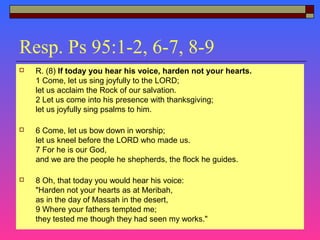
Resp. Ps 95:1-2, 6-7, 8-9
 R. (8) If today you hear his voice, harden not your hearts.
1 Come, let us sing joyfully to the LORD;
let us acclaim the Rock of our salvation.
2 Let us come into his presence with thanksgiving;
let us joyfully sing psalms to him.
 6 Come, let us bow down in worship;
let us kneel before the LORD who made us.
7 For he is our God,
and we are the people he shepherds, the flock he guides.
 8 Oh, that today you would hear his voice:
"Harden not your hearts as at Meribah,
as in the day of Massah in the desert,
9 Where your fathers tempted me;
they tested me though they had seen my works."
Resp. Ps 95:1-2, 6-7, 8-9
 R. (8) If today you hear his voice,
harden not your hearts.
1 Come, let us sing joyfully to the
LORD;
let us acclaim the Rock of our
salvation.
2 Let us come into his presence with
thanksgiving;
let us joyfully sing psalms to him.
 6 Come, let us bow down in worship;
let us kneel before the LORD who
made us.
7 For he is our God,
and we are the people he shepherds,
the flock he guides.
 8 Oh, that today you would hear his
voice: "Harden not your hearts as at
Meribah, as in the day of Massah in
the desert,
9 Where your fathers tempted me;
they tested me though they had seen
my works."
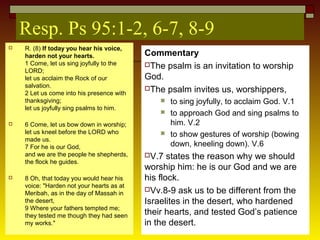
Commentary
The psalm is an invitation to worship
God.
The psalm invites us, worshippers,
 to sing joyfully, to acclaim God. V.1
 to approach God and sing psalms to
him. V.2
 to show gestures of worship (bowing
down, kneeling down). V.6
V.7 states the reason why we should
worship him: he is our God and we are
his flock.
Vv.8-9 ask us to be different from the
Israelites in the desert, who hardened
their hearts, and tested God’s patience
in the desert.
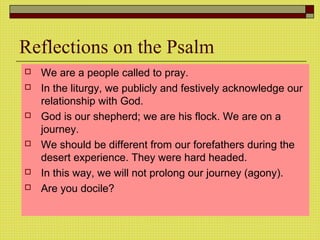
Reflections on the Psalm
 We are a people called to pray.
 In the liturgy, we publicly and festively acknowledge our
relationship with God.
 God is our shepherd; we are his flock. We are on a
journey.
 We should be different from our forefathers during the
desert experience. They were hard headed.
 In this way, we will not prolong our journey (agony).
 Are you docile?
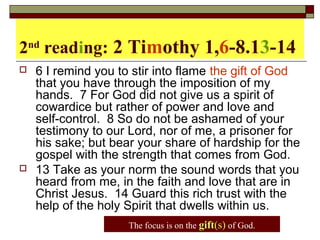
2nd
reading: 2 Timothy 1,6-8.13-14
 6 I remind you to stir into flame the gift of God
that you have through the imposition of my
hands. 7 For God did not give us a spirit of
cowardice but rather of power and love and
self-control. 8 So do not be ashamed of your
testimony to our Lord, nor of me, a prisoner for
his sake; but bear your share of hardship for the
gospel with the strength that comes from God.
 13 Take as your norm the sound words that you
heard from me, in the faith and love that are in
Christ Jesus. 14 Guard this rich trust with the
help of the holy Spirit that dwells within us.
The focus is on the giftgift(s)(s) of God.
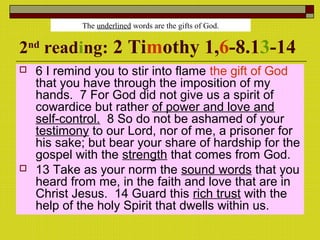
2nd
reading: 2 Timothy 1,6-8.13-14
 6 I remind you to stir into flame the gift of God
that you have through the imposition of my
hands. 7 For God did not give us a spirit of
cowardice but rather of power and love and
self-control. 8 So do not be ashamed of your
testimony to our Lord, nor of me, a prisoner for
his sake; but bear your share of hardship for the
gospel with the strength that comes from God.
 13 Take as your norm the sound words that you
heard from me, in the faith and love that are in
Christ Jesus. 14 Guard this rich trust with the
help of the holy Spirit that dwells within us.
The underlined words are the gifts of God.
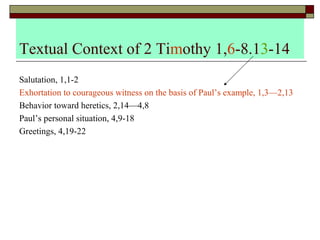
Textual Context of 2 Timothy 1,6-8.13-14
Salutation, 1,1-2
Exhortation to courageous witness on the basis of Paul’s example, 1,3—2,13
Behavior toward heretics, 2,14—4,8
Paul’s personal situation, 4,9-18
Greetings, 4,19-22
2nd
reading: 2 Timothy 1,6-8.13-14
 6 I remind you to stir
into flame the gift of
God that you have
through the imposition
of my hands. 7 For
God did not give us a
spirit of cowardice but
rather of power and
love and self-control. 8
So do not be ashamed
of your testimony to our
Lord, nor of me, a
prisoner for his sake;
but bear your share of
hardship for the gospel
with the strength that
comes from God.
 13 Take as your norm
the sound words that
you heard from me, in
the faith and love that
are in Christ Jesus. 14
Guard this rich trust
with the help of the holy
Spirit that dwells within
us.
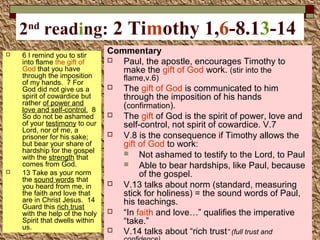
Commentary
 Paul, the apostle, encourages Timothy to
make the gift of God work. (stir into the
flame,v.6)
 The gift of God is communicated to him
through the imposition of his hands
(confirmation).
 The gift of God is the spirit of power, love and
self-control, not spirit of cowardice. V.7
 V.8 is the consequence if Timothy allows the
gift of God to work:
 Not ashamed to testify to the Lord, to Paul
 Able to bear hardships, like Paul, because
of the gospel.
 V.13 talks about norm (standard, measuring
stick for holiness) = the sound words of Paul,
his teachings.
 “In faith and love…” qualifies the imperative
“take.”
 V.14 talks about “rich trust” (full trust and
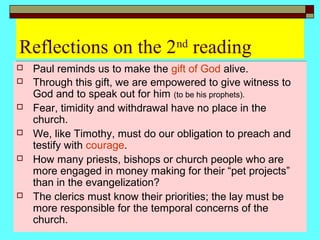
Reflections on the 2nd
reading
 Paul reminds us to make the gift of God alive.
 Through this gift, we are empowered to give witness to
God and to speak out for him (to be his prophets).
 Fear, timidity and withdrawal have no place in the
church.
 We, like Timothy, must do our obligation to preach and
testify with courage.
 How many priests, bishops or church people who are
more engaged in money making for their “pet projects”
than in the evangelization?
 The clerics must know their priorities; the lay must be
more responsible for the temporal concerns of the
church.
Gospel reading: Luke 17,5-10
 5 The apostles said to the Lord, "Increase our faith." 6
The Lord replied, "If you have faith the size of a mustard
seed, you would say to (this) mulberry tree, 'Be
uprooted and planted in the sea,' and it would obey you.
7 "Who among you would say to your servant who has
just come in from plowing or tending sheep in the field,
'Come here immediately and take your place at table'?
8 Would he not rather say to him, 'Prepare something
for me to eat. Put on your apron and wait on me while I
eat and drink. You may eat and drink when I am
finished'? 9 Is he grateful to that servant because he
did what was commanded? 10 So should it be with
you. When you have done all you have been
commanded, say, 'We are unprofitable servants; we
have done what we were obliged to do.'"
The focus is on faith and being servants.
Gospel reading: Luke 17,5-10
Faith
 5 The apostles said to the Lord, "Increase our faith." 6
The Lord replied, "If you have faith the size of a mustard
seed, you would say to (this) mulberry tree, 'Be
uprooted and planted in the sea,' and it would obey you.
Being servants
 7 "Who among you would say to your servant who has
just come in from plowing or tending sheep in the field,
'Come here immediately and take your place at table'?
8 Would he not rather say to him, 'Prepare something
for me to eat. Put on your apron and wait on me while I
eat and drink. You may eat and drink when I am
finished'? 9 Is he grateful to that servant because he
did what was commanded? 10 So should it be with
you. When you have done all you have been
commanded, say, 'We are unprofitable servants; we
have done what we were obliged to do.'"
A simple outline!
Textual Context of Luke 17,5-10
 16,14-18 A Saying Against the Pharisees
 16, 19-31 The Rich Man and Lazarus
 17,1-10 Some sayings of Jesus
 17,11-19 Jesus Cleanses the Ten Lepers
 17,20-37 The Coming of the Kingdom
 18,1-8 The Parable of the Widow and the Unjust
Judge
Gospel reading: Luke 17,5-10
Faith
 5 The apostles said to the Lord,
"Increase our faith." 6 The Lord
replied, "If you have faith the size of
a mustard seed, you would say to
(this) mulberry tree, 'Be uprooted
and planted in the sea,' and it would
obey you.
Being servants
 7 "Who among you would say to
your servant who has just come in
from plowing or tending sheep in the
field, 'Come here immediately and
take your place at table'? 8 Would
he not rather say to him, 'Prepare
something for me to eat. Put on
your apron and wait on me while I
eat and drink. You may eat and
drink when I am finished'? 9 Is he
grateful to that servant because he
did what was commanded? 10 So
should it be with you. When you
have done all you have been
commanded, say, 'We are
unprofitable servants; we have done
what we were obliged to do.'"
Commentary
 The gospel reading is about 2
things: faith and being servants.
 There seems to be no connection
between the two.
On faith
 In v.5, the apostles themselves
ask the Lord to increase their
faith. Why? Is their faith small
and weak?
 Jesus employs a short parable,
or imagery, to portray what faith
can do no matter how small it
can be.
 The size of a mustard seed is
very small, while the mulberry
tree is very big.
 When you have faith even if it is
small, you can do the impossible.
Gospel reading: Luke 17,5-10
Faith
 5 The apostles said to the Lord,
"Increase our faith." 6 The Lord
replied, "If you have faith the size
of a mustard seed, you would
say to (this) mulberry tree, 'Be
uprooted and planted in the sea,'
and it would obey you.
Being servants
 7 "Who among you would say to
your servant who has just come
in from plowing or tending sheep
in the field, 'Come here
immediately and take your place
at table'? 8 Would he not rather
say to him, 'Prepare something
for me to eat. Put on your apron
and wait on me while I eat and
drink. You may eat and drink
when I am finished'? 9 Is he
grateful to that servant because
he did what was commanded?
10 So should it be with you.
When you have done all you
have been commanded, say,
'We are unprofitable servants;
we have done what we were
obliged to do.'"
 In a question form, v.7 hypothetically
puts the apostles as masters, “who
among you would say to your servant…
farmer or shepherd?
 The expected answer: no one.
 In another question, in v.8, the master
will not allow his servant to eat with him,
but commands to prepare food and to
serve at table. The servant will eat later.
 The expected answer: I agree.
 In v.9, another question is formulated
on being grateful on the part of the
master.
 The expected answer: No. The master
has no “utang na loob” (not indebted) to
his servant.
 V.10 provides the conclusion to the 3
questions. Meaning, the apostles
likewise, as servants, will not expect
special treatment from the master
(Jesus).
On being servants
Reflections on the gospel reading
 The gospel reading talks about the power of
faith.
 Though it may be small, it has the power to do
the impossible.
 If we feel we don’t have enough faith, we pray
that it may increase (become stronger).
 Strong faith can sustain us in times of trial and
in our thankless jobs as missionaries and
servants of the kingdom.
 All Christians are servants of the Lord.
 Even if we may be tired of doing our duties like
“farming and shepherding flocks,” we do not
have the luxury to relax, because many more
work still await us.
 We can only relax (eat and drink) when the
master says so.
 Christians should not expect anything in return.
We are just useless servants, not really useless
in the strict sense, but unworthy to demand
recognition. Jesus does not owe us anything.
Tying the 3 readings and the PsalmTying the 3 readings and the Psalm
 The first reading talks about visions of violence, but it
has an important note to those who have faith. They will
survive.
 The psalm exhorts us to be docile to the voice of God.
 The second reading talks about making the gift of God
work. We must listen to God in faith and love in Christ
Jesus.
 The gospel reading talks about faith and servanthood.
The focus of our homilies and sharing should be on
servanthood.
How to develop your sharing/homily
 Who are the servants in our midst?
 Domestic helpers
 Employees who have big bosses and
superiors
 No matter who you are, do you consider
yourself a servant of God?
 What is to be a servant of God?
 We must base our answers on the
readings.
 Based on the gospel reading, the servant must
learn how to pray and pray “Lord, increase our faith.”
 The servant must have faith, even if it is small,
because he is tasked to do the impossible.
 Better still, the servant must have strong faith that
keeps him going / struggling in the midst of
controversies, contradictions, betrayals and
persecutions.
 We are non-stop servants of the Lord.
 As servants, we should not expect thanksgiving from
our master or from any fellow servants for the
“favors” we do.
 The Year of Faith means something to them.
 The second reading reminds us, God’s
servants, to make use of our gifts.
 Gifted with the Holy Spirit and God’s grace, we
must take the courage to communicate the
Word of God to other people.
 To be quiet about our faith, failure to articulate
our reflections and faith-experiences, is
unbecoming of a servant.
 You fail as a servant, if until now, after all the
years of formation and going to church, you still
cannot teach other people to love God and to
receive the sacraments and be just.
 In the first reading, the servant of God must
have integrity (wholesome personality, self-respect,
respect for others, sees the connection between life and
faith).
 Because of his faith, he is not carried away by
fear.
 He survives graciously in times of frustrations,
contradictions, catastrophes, crises and the
like.
 God’s servants reject what is disintegrative,
destructive, divisive and any act that can
aggravate or worsen a situation.
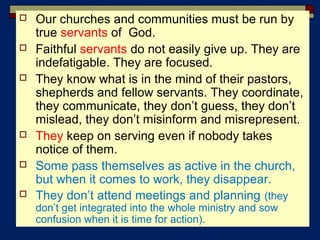
 Our churches and communities must be run by
true servants of God.
 Faithful servants do not easily give up. They are
indefatigable. They are focused.
 They know what is in the mind of their pastors,
shepherds and fellow servants. They coordinate,
they communicate, they don’t guess, they don’t
mislead, they don’t misinform and misrepresent.
 They keep on serving even if nobody takes
notice of them.
 Some pass themselves as active in the church,
but when it comes to work, they disappear.
 They don’t attend meetings and planning (they
don’t get integrated into the whole ministry and sow
confusion when it is time for action).
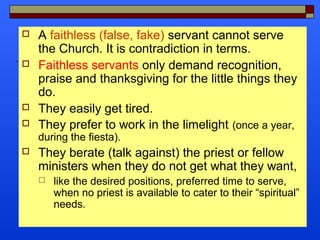
 A faithless (false, fake) servant cannot serve
the Church. It is contradiction in terms.
 Faithless servants only demand recognition,
praise and thanksgiving for the little things they
do.
 They easily get tired.
 They prefer to work in the limelight (once a year,
during the fiesta).
 They berate (talk against) the priest or fellow
ministers when they do not get what they want,
 like the desired positions, preferred time to serve,
when no priest is available to cater to their “spiritual”
needs.
 The eucharist is the food of the humble and
faithful servants of the Lord.
 We can best celebrate our true servanthood in
the eucharist.
 The eucharist is a sacrament that strengthens
God’s servants in times of difficulties.
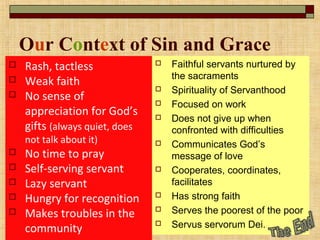
Our Context of Sin and Grace
 Rash, tactless
 Weak faith
 No sense of
appreciation for God’s
gifts (always quiet, does
not talk about it)
 No time to pray
 Self-serving servant
 Lazy servant
 Hungry for recognition
 Makes troubles in the
community
 Faithful servants nurtured by
the sacraments
 Spirituality of Servanthood
 Focused on work
 Does not give up when
confronted with difficulties
 Communicates God’s
message of love
 Cooperates, coordinates,
facilitates
 Has strong faith
 Serves the poorest of the poor
 Servus servorum Dei.
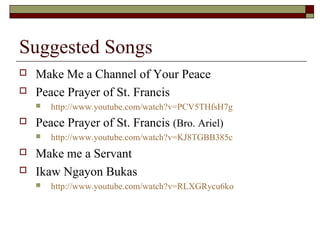
Suggested Songs
 Make Me a Channel of Your Peace
 Peace Prayer of St. Francis
 http://www.youtube.com/watch?v=PCV5THfsH7g
 Peace Prayer of St. Francis (Bro. Ariel)
 http://www.youtube.com/watch?v=KJ8TGBB385c
 Make me a Servant
 Ikaw Ngayon Bukas
 http://www.youtube.com/watch?v=RLXGRycu6ko
 Dear sisters and brothers,
 Let us be hardworking servants of the Lord.
 Fr. Cielo

27th Sunday C

  • 1.
    Welcome to ourBible Study 27th Sunday in the Ordinary Time C 2 October 2016 In preparation for this Sunday’s Liturgy As aid in focusing our homilies and sharing Prepared by Fr. Cielo R. Almazan, OFM
  • 2.
    1st reading: Habakkuk 1,2-3;2,2-4  2 How long, O LORD? I cry for help but you do not listen! I cry out to you, "Violence!" but you do not intervene. 3 Why do you let me see ruin; why must I look at misery? Destruction and violence are before me; there is strife, and clamorous discord.  2,2 Then the LORD answered me and said: Write down the vision clearly upon the tablets, so that one can read it readily. 3 For the vision still has its time, presses on to fulfillment, and will not disappoint; If it delays, wait for it, it will surely come, it will not be late. 4 The rash man has no integrity; but the just man, because of his faith, shall live. The focus is on the vision (of violence) of Habakkuk.
  • 3.
    1st reading: Habakkuk 1,2-3;2,2-4 Unsettling Vision 2 How long, O LORD? I cry for help but you do not listen! I cry out to you, "Violence!" but you do not intervene. 3 Why do you let me see ruin; why must I look at misery? Destruction and violence are before me; there is strife, and clamorous discord. Inevitable Vision 2,2 Then the LORD answered me and said: Write down the vision clearly upon the tablets, so that one can read it readily. 3 For the vision still has its time, presses on to fulfillment, and will not disappoint; If it delays, wait for it, it will surely come, it will not be late. 4 The rash man has no integrity; but the just man, because of his faith, shall live. A simple outline!
  • 4.
    Textual Context Habakkuk1,2-3; 2,2-4 Outline 1,2-2,5a Cross-questioning God 2,5b-20 Oracles of Woe 3,1-19 Canticle
  • 5.
    1st reading: Habakkuk 1,2-3;2,2-4  2 How long, O LORD? I cry for help but you do not listen! I cry out to you, "Violence!" but you do not intervene. 3 Why do you let me see ruin; why must I look at misery? Destruction and violence are before me; there is strife, and clamorous discord.  2,2 Then the LORD answered me and said: Write down the vision clearly upon the tablets, so that one can read it readily. 3 For the vision still has its time, presses on to fulfillment, and will not disappoint; If it delays, wait for it, it will surely come, it will not be late. 4 The rash man has no integrity; but the just man, because of his faith, shall live. Commentary  Habakkuk (means to embrace) prophesies sometime before King Josiah’s death (around 600 BC).  The prophet laments, cries out because he cannot take what he sees. Very appalling! Terrible!  Vv.2-3 enumerate what Habakkuk sees:  Violence, ruin, misery, destruction, strife, discord.  V.2 expresses the prophet’s helplessness. He is disappointed at God’s silence. He accuses God of not listening, of indifference.
  • 6.
    1st reading: Habakkuk 1,2-3;2,2-4  2 How long, O LORD? I cry for help but you do not listen! I cry out to you, "Violence!" but you do not intervene. 3 Why do you let me see ruin; why must I look at misery? Destruction and violence are before me; there is strife, and clamorous discord.  2,2 Then the LORD answered me and said: Write down the vision clearly upon the tablets, so that one can read it readily. 3 For the vision still has its time, presses on to fulfillment, and will not disappoint; If it delays, wait for it, it will surely come, it will not be late. 4 The rash man has no integrity; but the just man, because of his faith, shall live.  In 2,2 God finally answers the prophet and gives instruction.  To write the vision clearly…  V.3 describes the nature of the vision:  Still has its time.  It will surely come to pass.  Will not disappoint.  If late (wait for it)  Surely the destruction will come.  V.4 contrasts the rash man and the just man.  The rash man has no integrity.  The just man has faith and will live (survive the calamities).
  • 7.
    Reflections on the1st reading  Visions are part of biblical tradition.  They are scary and horrific at times.  The prophetic vision is a warning to those who live a disintegrated life (‘schizophrenic’ life, double life, double standard, inconsistent and insincere).  They should mend their ways.  There is no future for the rash man (padalos-dalos, can’t wait, tactless).  But, if one is just, he will survive amidst destruction.
  • 8.
    Resp. Ps 95:1-2,6-7, 8-9  R. (8) If today you hear his voice, harden not your hearts. 1 Come, let us sing joyfully to the LORD; let us acclaim the Rock of our salvation. 2 Let us come into his presence with thanksgiving; let us joyfully sing psalms to him.  6 Come, let us bow down in worship; let us kneel before the LORD who made us. 7 For he is our God, and we are the people he shepherds, the flock he guides.  8 Oh, that today you would hear his voice: "Harden not your hearts as at Meribah, as in the day of Massah in the desert, 9 Where your fathers tempted me; they tested me though they had seen my works."
  • 9.
    Resp. Ps 95:1-2,6-7, 8-9  R. (8) If today you hear his voice, harden not your hearts. 1 Come, let us sing joyfully to the LORD; let us acclaim the Rock of our salvation. 2 Let us come into his presence with thanksgiving; let us joyfully sing psalms to him.  6 Come, let us bow down in worship; let us kneel before the LORD who made us. 7 For he is our God, and we are the people he shepherds, the flock he guides.  8 Oh, that today you would hear his voice: "Harden not your hearts as at Meribah, as in the day of Massah in the desert, 9 Where your fathers tempted me; they tested me though they had seen my works." Commentary The psalm is an invitation to worship God. The psalm invites us, worshippers,  to sing joyfully, to acclaim God. V.1  to approach God and sing psalms to him. V.2  to show gestures of worship (bowing down, kneeling down). V.6 V.7 states the reason why we should worship him: he is our God and we are his flock. Vv.8-9 ask us to be different from the Israelites in the desert, who hardened their hearts, and tested God’s patience in the desert.
  • 10.
    Reflections on thePsalm  We are a people called to pray.  In the liturgy, we publicly and festively acknowledge our relationship with God.  God is our shepherd; we are his flock. We are on a journey.  We should be different from our forefathers during the desert experience. They were hard headed.  In this way, we will not prolong our journey (agony).  Are you docile?
  • 11.
    2nd reading: 2 Timothy1,6-8.13-14  6 I remind you to stir into flame the gift of God that you have through the imposition of my hands. 7 For God did not give us a spirit of cowardice but rather of power and love and self-control. 8 So do not be ashamed of your testimony to our Lord, nor of me, a prisoner for his sake; but bear your share of hardship for the gospel with the strength that comes from God.  13 Take as your norm the sound words that you heard from me, in the faith and love that are in Christ Jesus. 14 Guard this rich trust with the help of the holy Spirit that dwells within us. The focus is on the giftgift(s)(s) of God.
  • 12.
    2nd reading: 2 Timothy1,6-8.13-14  6 I remind you to stir into flame the gift of God that you have through the imposition of my hands. 7 For God did not give us a spirit of cowardice but rather of power and love and self-control. 8 So do not be ashamed of your testimony to our Lord, nor of me, a prisoner for his sake; but bear your share of hardship for the gospel with the strength that comes from God.  13 Take as your norm the sound words that you heard from me, in the faith and love that are in Christ Jesus. 14 Guard this rich trust with the help of the holy Spirit that dwells within us. The underlined words are the gifts of God.
  • 13.
    Textual Context of2 Timothy 1,6-8.13-14 Salutation, 1,1-2 Exhortation to courageous witness on the basis of Paul’s example, 1,3—2,13 Behavior toward heretics, 2,14—4,8 Paul’s personal situation, 4,9-18 Greetings, 4,19-22
  • 14.
    2nd reading: 2 Timothy1,6-8.13-14  6 I remind you to stir into flame the gift of God that you have through the imposition of my hands. 7 For God did not give us a spirit of cowardice but rather of power and love and self-control. 8 So do not be ashamed of your testimony to our Lord, nor of me, a prisoner for his sake; but bear your share of hardship for the gospel with the strength that comes from God.  13 Take as your norm the sound words that you heard from me, in the faith and love that are in Christ Jesus. 14 Guard this rich trust with the help of the holy Spirit that dwells within us. Commentary  Paul, the apostle, encourages Timothy to make the gift of God work. (stir into the flame,v.6)  The gift of God is communicated to him through the imposition of his hands (confirmation).  The gift of God is the spirit of power, love and self-control, not spirit of cowardice. V.7  V.8 is the consequence if Timothy allows the gift of God to work:  Not ashamed to testify to the Lord, to Paul  Able to bear hardships, like Paul, because of the gospel.  V.13 talks about norm (standard, measuring stick for holiness) = the sound words of Paul, his teachings.  “In faith and love…” qualifies the imperative “take.”  V.14 talks about “rich trust” (full trust and
  • 15.
    Reflections on the2nd reading  Paul reminds us to make the gift of God alive.  Through this gift, we are empowered to give witness to God and to speak out for him (to be his prophets).  Fear, timidity and withdrawal have no place in the church.  We, like Timothy, must do our obligation to preach and testify with courage.  How many priests, bishops or church people who are more engaged in money making for their “pet projects” than in the evangelization?  The clerics must know their priorities; the lay must be more responsible for the temporal concerns of the church.
  • 16.
    Gospel reading: Luke17,5-10  5 The apostles said to the Lord, "Increase our faith." 6 The Lord replied, "If you have faith the size of a mustard seed, you would say to (this) mulberry tree, 'Be uprooted and planted in the sea,' and it would obey you. 7 "Who among you would say to your servant who has just come in from plowing or tending sheep in the field, 'Come here immediately and take your place at table'? 8 Would he not rather say to him, 'Prepare something for me to eat. Put on your apron and wait on me while I eat and drink. You may eat and drink when I am finished'? 9 Is he grateful to that servant because he did what was commanded? 10 So should it be with you. When you have done all you have been commanded, say, 'We are unprofitable servants; we have done what we were obliged to do.'" The focus is on faith and being servants.
  • 17.
    Gospel reading: Luke17,5-10 Faith  5 The apostles said to the Lord, "Increase our faith." 6 The Lord replied, "If you have faith the size of a mustard seed, you would say to (this) mulberry tree, 'Be uprooted and planted in the sea,' and it would obey you. Being servants  7 "Who among you would say to your servant who has just come in from plowing or tending sheep in the field, 'Come here immediately and take your place at table'? 8 Would he not rather say to him, 'Prepare something for me to eat. Put on your apron and wait on me while I eat and drink. You may eat and drink when I am finished'? 9 Is he grateful to that servant because he did what was commanded? 10 So should it be with you. When you have done all you have been commanded, say, 'We are unprofitable servants; we have done what we were obliged to do.'" A simple outline!
  • 18.
    Textual Context ofLuke 17,5-10  16,14-18 A Saying Against the Pharisees  16, 19-31 The Rich Man and Lazarus  17,1-10 Some sayings of Jesus  17,11-19 Jesus Cleanses the Ten Lepers  17,20-37 The Coming of the Kingdom  18,1-8 The Parable of the Widow and the Unjust Judge
  • 19.
    Gospel reading: Luke17,5-10 Faith  5 The apostles said to the Lord, "Increase our faith." 6 The Lord replied, "If you have faith the size of a mustard seed, you would say to (this) mulberry tree, 'Be uprooted and planted in the sea,' and it would obey you. Being servants  7 "Who among you would say to your servant who has just come in from plowing or tending sheep in the field, 'Come here immediately and take your place at table'? 8 Would he not rather say to him, 'Prepare something for me to eat. Put on your apron and wait on me while I eat and drink. You may eat and drink when I am finished'? 9 Is he grateful to that servant because he did what was commanded? 10 So should it be with you. When you have done all you have been commanded, say, 'We are unprofitable servants; we have done what we were obliged to do.'" Commentary  The gospel reading is about 2 things: faith and being servants.  There seems to be no connection between the two. On faith  In v.5, the apostles themselves ask the Lord to increase their faith. Why? Is their faith small and weak?  Jesus employs a short parable, or imagery, to portray what faith can do no matter how small it can be.  The size of a mustard seed is very small, while the mulberry tree is very big.  When you have faith even if it is small, you can do the impossible.
  • 20.
    Gospel reading: Luke17,5-10 Faith  5 The apostles said to the Lord, "Increase our faith." 6 The Lord replied, "If you have faith the size of a mustard seed, you would say to (this) mulberry tree, 'Be uprooted and planted in the sea,' and it would obey you. Being servants  7 "Who among you would say to your servant who has just come in from plowing or tending sheep in the field, 'Come here immediately and take your place at table'? 8 Would he not rather say to him, 'Prepare something for me to eat. Put on your apron and wait on me while I eat and drink. You may eat and drink when I am finished'? 9 Is he grateful to that servant because he did what was commanded? 10 So should it be with you. When you have done all you have been commanded, say, 'We are unprofitable servants; we have done what we were obliged to do.'"  In a question form, v.7 hypothetically puts the apostles as masters, “who among you would say to your servant… farmer or shepherd?  The expected answer: no one.  In another question, in v.8, the master will not allow his servant to eat with him, but commands to prepare food and to serve at table. The servant will eat later.  The expected answer: I agree.  In v.9, another question is formulated on being grateful on the part of the master.  The expected answer: No. The master has no “utang na loob” (not indebted) to his servant.  V.10 provides the conclusion to the 3 questions. Meaning, the apostles likewise, as servants, will not expect special treatment from the master (Jesus). On being servants
  • 21.
    Reflections on thegospel reading  The gospel reading talks about the power of faith.  Though it may be small, it has the power to do the impossible.  If we feel we don’t have enough faith, we pray that it may increase (become stronger).  Strong faith can sustain us in times of trial and in our thankless jobs as missionaries and servants of the kingdom.
  • 22.
     All Christiansare servants of the Lord.  Even if we may be tired of doing our duties like “farming and shepherding flocks,” we do not have the luxury to relax, because many more work still await us.  We can only relax (eat and drink) when the master says so.  Christians should not expect anything in return. We are just useless servants, not really useless in the strict sense, but unworthy to demand recognition. Jesus does not owe us anything.
  • 23.
    Tying the 3readings and the PsalmTying the 3 readings and the Psalm  The first reading talks about visions of violence, but it has an important note to those who have faith. They will survive.  The psalm exhorts us to be docile to the voice of God.  The second reading talks about making the gift of God work. We must listen to God in faith and love in Christ Jesus.  The gospel reading talks about faith and servanthood. The focus of our homilies and sharing should be on servanthood.
  • 24.
    How to developyour sharing/homily  Who are the servants in our midst?  Domestic helpers  Employees who have big bosses and superiors  No matter who you are, do you consider yourself a servant of God?  What is to be a servant of God?  We must base our answers on the readings.
  • 25.
     Based onthe gospel reading, the servant must learn how to pray and pray “Lord, increase our faith.”  The servant must have faith, even if it is small, because he is tasked to do the impossible.  Better still, the servant must have strong faith that keeps him going / struggling in the midst of controversies, contradictions, betrayals and persecutions.  We are non-stop servants of the Lord.  As servants, we should not expect thanksgiving from our master or from any fellow servants for the “favors” we do.  The Year of Faith means something to them.
  • 26.
     The secondreading reminds us, God’s servants, to make use of our gifts.  Gifted with the Holy Spirit and God’s grace, we must take the courage to communicate the Word of God to other people.  To be quiet about our faith, failure to articulate our reflections and faith-experiences, is unbecoming of a servant.  You fail as a servant, if until now, after all the years of formation and going to church, you still cannot teach other people to love God and to receive the sacraments and be just.
  • 27.
     In thefirst reading, the servant of God must have integrity (wholesome personality, self-respect, respect for others, sees the connection between life and faith).  Because of his faith, he is not carried away by fear.  He survives graciously in times of frustrations, contradictions, catastrophes, crises and the like.  God’s servants reject what is disintegrative, destructive, divisive and any act that can aggravate or worsen a situation.
  • 28.
     Our churchesand communities must be run by true servants of God.  Faithful servants do not easily give up. They are indefatigable. They are focused.  They know what is in the mind of their pastors, shepherds and fellow servants. They coordinate, they communicate, they don’t guess, they don’t mislead, they don’t misinform and misrepresent.  They keep on serving even if nobody takes notice of them.  Some pass themselves as active in the church, but when it comes to work, they disappear.  They don’t attend meetings and planning (they don’t get integrated into the whole ministry and sow confusion when it is time for action).
  • 29.
     A faithless(false, fake) servant cannot serve the Church. It is contradiction in terms.  Faithless servants only demand recognition, praise and thanksgiving for the little things they do.  They easily get tired.  They prefer to work in the limelight (once a year, during the fiesta).  They berate (talk against) the priest or fellow ministers when they do not get what they want,  like the desired positions, preferred time to serve, when no priest is available to cater to their “spiritual” needs.
  • 30.
     The eucharistis the food of the humble and faithful servants of the Lord.  We can best celebrate our true servanthood in the eucharist.  The eucharist is a sacrament that strengthens God’s servants in times of difficulties.
  • 31.
    Our Context ofSin and Grace  Rash, tactless  Weak faith  No sense of appreciation for God’s gifts (always quiet, does not talk about it)  No time to pray  Self-serving servant  Lazy servant  Hungry for recognition  Makes troubles in the community  Faithful servants nurtured by the sacraments  Spirituality of Servanthood  Focused on work  Does not give up when confronted with difficulties  Communicates God’s message of love  Cooperates, coordinates, facilitates  Has strong faith  Serves the poorest of the poor  Servus servorum Dei.
  • 32.
    Suggested Songs  MakeMe a Channel of Your Peace  Peace Prayer of St. Francis  http://www.youtube.com/watch?v=PCV5THfsH7g  Peace Prayer of St. Francis (Bro. Ariel)  http://www.youtube.com/watch?v=KJ8TGBB385c  Make me a Servant  Ikaw Ngayon Bukas  http://www.youtube.com/watch?v=RLXGRycu6ko
  • 33.
     Dear sistersand brothers,  Let us be hardworking servants of the Lord.  Fr. Cielo