Introduction
Name-Sahil kumar
Class-VIII-A
Roll no-827
Subject-Science ppt
School-JNV jaffarpur
kalan new delhi-73
STARS AND SOLAR SYSTEM
1.THE SOLAR SYSTEM
2.THE PLANETS
3.phases of moons
4.moon and moon surface
5. the stars
6.contellations-like –great bear,orion,
leo major, pole stars .
7.ASTEROIDS AND COMETS
THE SOLAR SYSTEM
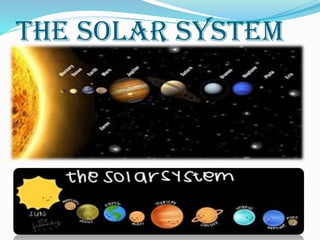
The sun its family of planets and other celestial bodies comprise
The solar system . There are 8 planets in this family these 8 planets
Contains the majority of the mass of solar system . These planets
Can be categorized into two groups , viz . Terrestrial planets
And gas giants .
MERCURY
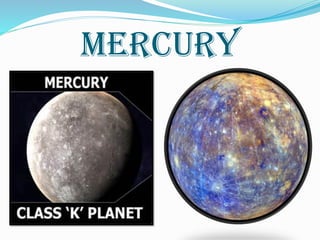
In Hindi , mercury is known as budh . Mercury is nearest
Planet to sun . Ti is smallest planets of our solar system
Because mercury is very close to sun it very difficult to observe
It, as most of the time it is hidden in the glare of the sun .
However , it can observe just before sunrise or just at sunset,
near to the horizon . So it is visible only at place where trees
Or building do not obstruct the view of the horizon . Mercury
Has no satellite of its own .
venus
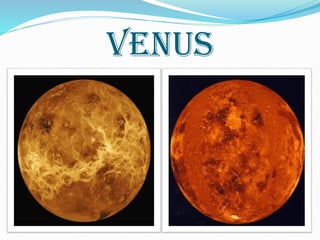
Venus is earth ‘s nearest planetary neighbours . Its is the
brightest planets in the night sky .
Sometimes Venus appears in the eastern sky before sunrise .
Sometimes it appears in the western sky just after sunset .
Therefore it is often called a morning or an evening star ,
although it is not a star . Try to locate Venus in the night sky.
Venus has no moon or satellite of its own . Rotation of Venus
On its axis is to west while the earth rotates form west to east .
earth
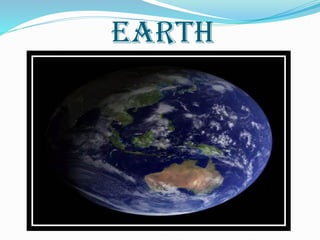
The earth is the only planets in the solar system on which life
Is known to exist . Some special environmental conditions
Are responsible for the existence and continuation of life on the
Earth . These include just the right distance from the sun , so
That it has the right temperature range , the presence of water
And suitable atmosphere and a blanket of ozone .
mars
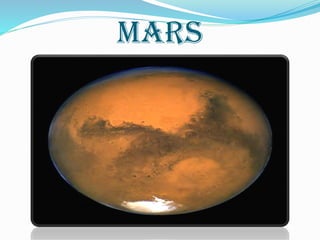
The next planets , the first outside the orbit of the earth is mars
It appears slight reddish and ,therefore it is also called the red
planets . Mars has two small satellites .
jupiter
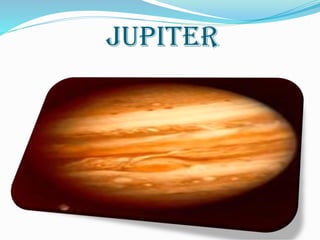
Jupiter is the largest planets of the solar system . It is so large
That about 1300 earth can be placed inside this giant Jupiter has
Large of satellites . It also has faint rings around it . You can
Easily recognise Jupiter as it appears quite bright in the sky .
If you observe it it with the help of telescope, you can also
See four of its large moons .
saturn
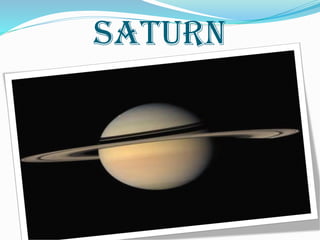
Beyond Jupiter is Saturn which appears yellowish in colour .
What makes it t he solar system is its beautiful rings are not
visible with naked eyes . You can be observe them with a small
Telescope . Saturn also has a large number of satellite .
One interesting thing about Saturn is that it is the least dense
Among all the planets . Its density is less than that of water .
uranus
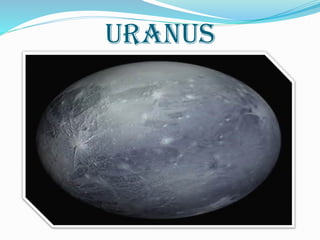
Uranus is at a distance of 19.6 AU from the sun , which means;
The distance between Uranus and sun is 19.6 times the distance
Between earth and the sun . The mass of Uranus is times of
earth . Among upper planets , Uranus is a lightest planet.
The axis of Uranus is at 90 degree to its orbit . Uranus has 27
known satellites .
neptune
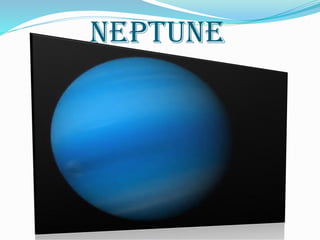
Neptune is at a distance of 30 AU form to the sun , which
means; the distance between the sun and the Neptune is 30
times the distance between the sun and the earth . The mass of
the Neptune 17 times that of earth . Neptune has 13 known
satellites .
The phases of moon
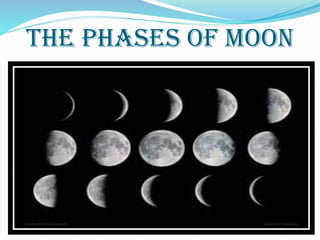
The various shapes of bright part of moon as seen during a
month are called phases of moon . Let us try to understand why
phases of the moon occurs . You have studies in chapter 16
That the moon does not produce its own light , whereas the
sun and other stars do . We see the moon because the sun light
falling on its get reflected towards us . We therefore , see only
that part of the moon , form which the light of the sun is
reflected towards us .
The moon and moon surface
The day on which the whole disc of the moon is visible is known
As the full moon day . Thereafter , every night the size of the
bright part of the moon appears to become thinner and thinner
On the fifteenth day of the moon is known as the new moon day
The next day only a small portion of the moon appears in the
sky . This is the crescent moon. The moon is the fascinating
object for poets and story –tellers . But when astronauts landed
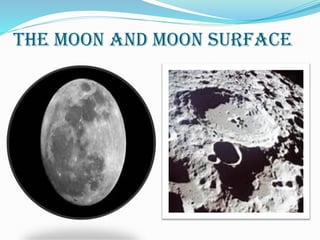
On the moon , they found that the moon’s surface is dusty and
barren . There are many craters of different sizes.
The stars
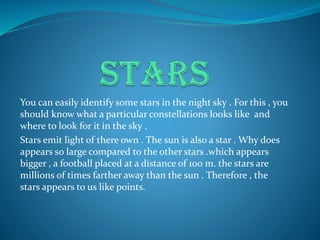
You can easily identify some stars in the night sky . For this , you
should know what a particular constellations looks like and
where to look for it in the sky .
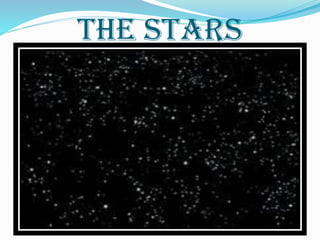
Stars emit light of there own . The sun is also a star . Why does
appears so large compared to the other stars .which appears
bigger , a football placed at a distance of 100 m. the stars are
millions of times farther away than the sun . Therefore , the
stars appears to us like points.
contellation
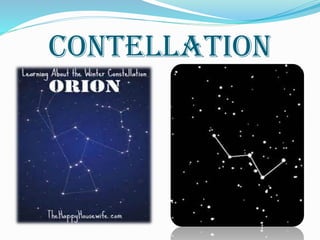
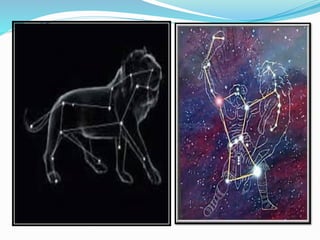
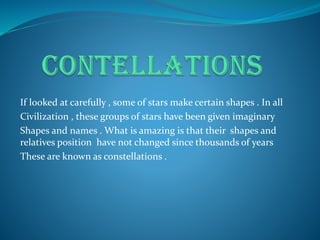
If looked at carefully , some of stars make certain shapes . In all
Civilization , these groups of stars have been given imaginary
Shapes and names . What is amazing is that their shapes and
relatives position have not changed since thousands of years
These are known as constellations .
asteroids
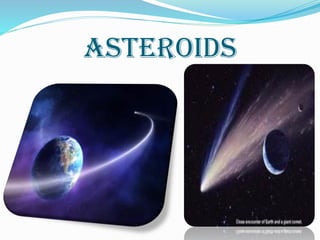
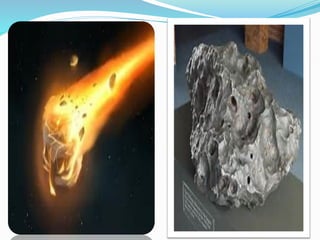
There is a large gap in between the orbits of mars and Jupiter .
This gap is occupied by a large number of sun . These are called
asteroids can only be seen through large telescope. Comets are
also members of our solar system . They revolve around the sun
in highly elliptical orbits . However , their period of revolution
Round the sun . The tail of a comets is always dtrected aways
from the sun .
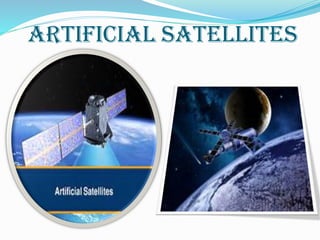
Artificial satellites
You must have heard that there are a number of artificial
satellites which are orbiting the earth . You might wonder how
artificial satellites are different form natural satellites . Artificial
satellites are made satellites . They are launched form the earth.
They revolve around the earth much closer than earth’s natural
satellites , the moon .
class_8_sun_and_solar_system.pdf

class_8_sun_and_solar_system.pdf

  • 1.
  • 2.
    STARS AND SOLARSYSTEM 1.THE SOLAR SYSTEM 2.THE PLANETS 3.phases of moons 4.moon and moon surface 5. the stars 6.contellations-like –great bear,orion, leo major, pole stars . 7.ASTEROIDS AND COMETS
  • 3.
  • 4.
    The sun itsfamily of planets and other celestial bodies comprise The solar system . There are 8 planets in this family these 8 planets Contains the majority of the mass of solar system . These planets Can be categorized into two groups , viz . Terrestrial planets And gas giants .
  • 5.
  • 6.
    In Hindi ,mercury is known as budh . Mercury is nearest Planet to sun . Ti is smallest planets of our solar system Because mercury is very close to sun it very difficult to observe It, as most of the time it is hidden in the glare of the sun . However , it can observe just before sunrise or just at sunset, near to the horizon . So it is visible only at place where trees Or building do not obstruct the view of the horizon . Mercury Has no satellite of its own .
  • 7.
  • 8.
    Venus is earth‘s nearest planetary neighbours . Its is the brightest planets in the night sky . Sometimes Venus appears in the eastern sky before sunrise . Sometimes it appears in the western sky just after sunset . Therefore it is often called a morning or an evening star , although it is not a star . Try to locate Venus in the night sky. Venus has no moon or satellite of its own . Rotation of Venus On its axis is to west while the earth rotates form west to east .
  • 9.
  • 10.
    The earth isthe only planets in the solar system on which life Is known to exist . Some special environmental conditions Are responsible for the existence and continuation of life on the Earth . These include just the right distance from the sun , so That it has the right temperature range , the presence of water And suitable atmosphere and a blanket of ozone .
  • 11.
  • 12.
    The next planets, the first outside the orbit of the earth is mars It appears slight reddish and ,therefore it is also called the red planets . Mars has two small satellites .
  • 13.
  • 14.
    Jupiter is thelargest planets of the solar system . It is so large That about 1300 earth can be placed inside this giant Jupiter has Large of satellites . It also has faint rings around it . You can Easily recognise Jupiter as it appears quite bright in the sky . If you observe it it with the help of telescope, you can also See four of its large moons .
  • 15.
  • 16.
    Beyond Jupiter isSaturn which appears yellowish in colour . What makes it t he solar system is its beautiful rings are not visible with naked eyes . You can be observe them with a small Telescope . Saturn also has a large number of satellite . One interesting thing about Saturn is that it is the least dense Among all the planets . Its density is less than that of water .
  • 17.
  • 18.
    Uranus is ata distance of 19.6 AU from the sun , which means; The distance between Uranus and sun is 19.6 times the distance Between earth and the sun . The mass of Uranus is times of earth . Among upper planets , Uranus is a lightest planet. The axis of Uranus is at 90 degree to its orbit . Uranus has 27 known satellites .
  • 19.
  • 20.
    Neptune is ata distance of 30 AU form to the sun , which means; the distance between the sun and the Neptune is 30 times the distance between the sun and the earth . The mass of the Neptune 17 times that of earth . Neptune has 13 known satellites .
  • 21.
  • 22.
    The various shapesof bright part of moon as seen during a month are called phases of moon . Let us try to understand why phases of the moon occurs . You have studies in chapter 16 That the moon does not produce its own light , whereas the sun and other stars do . We see the moon because the sun light falling on its get reflected towards us . We therefore , see only that part of the moon , form which the light of the sun is reflected towards us .
  • 23.
    The moon andmoon surface
  • 24.
    The day onwhich the whole disc of the moon is visible is known As the full moon day . Thereafter , every night the size of the bright part of the moon appears to become thinner and thinner On the fifteenth day of the moon is known as the new moon day The next day only a small portion of the moon appears in the sky . This is the crescent moon. The moon is the fascinating object for poets and story –tellers . But when astronauts landed On the moon , they found that the moon’s surface is dusty and barren . There are many craters of different sizes.
  • 25.
  • 26.
    You can easilyidentify some stars in the night sky . For this , you should know what a particular constellations looks like and where to look for it in the sky . Stars emit light of there own . The sun is also a star . Why does appears so large compared to the other stars .which appears bigger , a football placed at a distance of 100 m. the stars are millions of times farther away than the sun . Therefore , the stars appears to us like points.
  • 27.
  • 29.
    If looked atcarefully , some of stars make certain shapes . In all Civilization , these groups of stars have been given imaginary Shapes and names . What is amazing is that their shapes and relatives position have not changed since thousands of years These are known as constellations .
  • 30.
  • 32.
    There is alarge gap in between the orbits of mars and Jupiter . This gap is occupied by a large number of sun . These are called asteroids can only be seen through large telescope. Comets are also members of our solar system . They revolve around the sun in highly elliptical orbits . However , their period of revolution Round the sun . The tail of a comets is always dtrected aways from the sun .
  • 33.
  • 34.
    You must haveheard that there are a number of artificial satellites which are orbiting the earth . You might wonder how artificial satellites are different form natural satellites . Artificial satellites are made satellites . They are launched form the earth. They revolve around the earth much closer than earth’s natural satellites , the moon .