










WiFi: QB Connect Password: Connect2017#QBConnect
Chris Hooper – Accodex
What accounting will look like
in 2030
Take a few moments
to Connect with
your neighbour
3
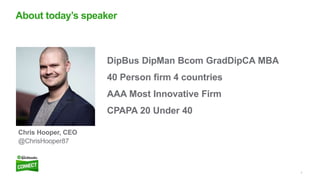
DipBus DipMan Bcom GradDipCA MBA
40 Person firm 4 countries
AAA Most Innovative Firm
CPAPA 20 Under 40
About today’s speaker
Chris Hooper, CEO
@ChrisHooper87
2030 Vision
State of the Profession
Action Steps
Q&A
Agenda
2030 Vision
There has never been a better time to be
an accountant than right now.
@ChrisHooper87 #QBConnect
7
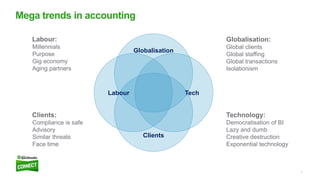
Mega trends in accounting
Globalisation
Clients
TechLabour
Labour:
Millennials
Purpose
Gig economy
Aging partners
Clients:
Compliance is safe
Advisory
Similar threats
Face time
Globalisation:
Global clients
Global staffing
Global transactions
Isolationism
Technology:
Democratisation of BI
Lazy and dumb
Creative destruction
Exponential technology
8
Natural language processing “chatbots”
Augmented reality
Machine learning
Bitcoin and blockchain
Tech to watch
9
10
11
12
Compliance never going away
Accounting and data science will converge
Data real time, reliable, relevant and remote
Narrow AI will assist accountants
Graduates will be client facing from day one
Big firms will be highly diversified, small firms highly specialized
In 2030
State of the profession
14
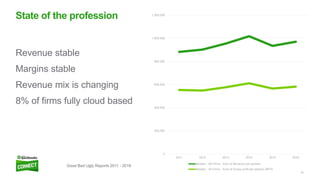
Revenue stable
Margins stable
Revenue mix is changing
8% of firms fully cloud based
State of the profession
0
200,000
400,000
600,000
800,000
1,000,000
1,200,000
2011 2012 2013 2014 2015 2016
Median - All Firms - Sum of Revenue per partner
Median - All Firms - Sum of Gross profit per partner (BPS)
Good Bad Ugly Reports 2011 - 2016
15
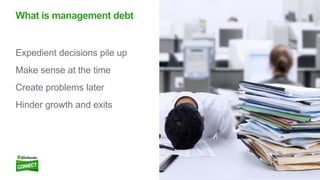
Expedient decisions pile up
Make sense at the time
Create problems later
Hinder growth and exits
What is management debt
16
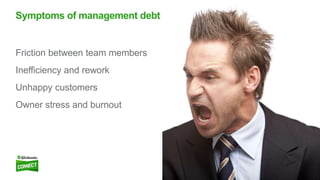
Friction between team members
Inefficiency and rework
Unhappy customers
Owner stress and burnout
Symptoms of management debt
Management debt is the most high risk
liability in modern companies.
@ChrisHooper87 #QBConnect
Take action
19
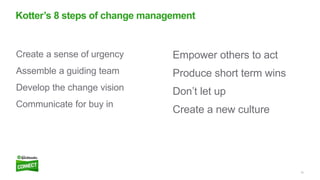
Empower others to act
Produce short term wins
Don’t let up
Create a new culture
Create a sense of urgency
Assemble a guiding team
Develop the change vision
Communicate for buy in
Kotter’s 8 steps of change management
20
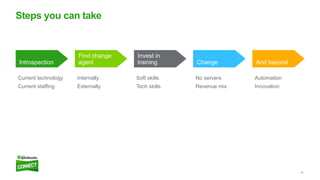
Steps you can take
Introspection
Find change
agent
Invest in
training Change And beyond
Current technology
Current staffing
Internally
Externally
Soft skills
Tech skills
No servers
Revenue mix
Automation
Innovation
Questions?
Missed something?
Today’s presentations are available in the event mobile app
and at http://www.slideshare.com/tag/QBCAU17
Don’t forget to rate my session:
Open up the event app, find my session title in the agenda
and click on rate & review

What Accounting Will Look Like in 2030

  • 1.
    WiFi: QB ConnectPassword: Connect2017#QBConnect Chris Hooper – Accodex What accounting will look like in 2030
  • 2.
    Take a fewmoments to Connect with your neighbour
  • 3.
    3 DipBus DipMan BcomGradDipCA MBA 40 Person firm 4 countries AAA Most Innovative Firm CPAPA 20 Under 40 About today’s speaker Chris Hooper, CEO @ChrisHooper87
  • 4.
    2030 Vision State ofthe Profession Action Steps Q&A Agenda
  • 5.
  • 6.
    There has neverbeen a better time to be an accountant than right now. @ChrisHooper87 #QBConnect
  • 7.
    7 Mega trends inaccounting Globalisation Clients TechLabour Labour: Millennials Purpose Gig economy Aging partners Clients: Compliance is safe Advisory Similar threats Face time Globalisation: Global clients Global staffing Global transactions Isolationism Technology: Democratisation of BI Lazy and dumb Creative destruction Exponential technology
  • 8.
    8 Natural language processing“chatbots” Augmented reality Machine learning Bitcoin and blockchain Tech to watch
  • 9.
  • 10.
  • 11.
  • 12.
    12 Compliance never goingaway Accounting and data science will converge Data real time, reliable, relevant and remote Narrow AI will assist accountants Graduates will be client facing from day one Big firms will be highly diversified, small firms highly specialized In 2030
  • 13.
    State of theprofession
  • 14.
    14 Revenue stable Margins stable Revenuemix is changing 8% of firms fully cloud based State of the profession 0 200,000 400,000 600,000 800,000 1,000,000 1,200,000 2011 2012 2013 2014 2015 2016 Median - All Firms - Sum of Revenue per partner Median - All Firms - Sum of Gross profit per partner (BPS) Good Bad Ugly Reports 2011 - 2016
  • 15.
    15 Expedient decisions pileup Make sense at the time Create problems later Hinder growth and exits What is management debt
  • 16.
    16 Friction between teammembers Inefficiency and rework Unhappy customers Owner stress and burnout Symptoms of management debt
  • 17.
    Management debt isthe most high risk liability in modern companies. @ChrisHooper87 #QBConnect
  • 18.
  • 19.
    19 Empower others toact Produce short term wins Don’t let up Create a new culture Create a sense of urgency Assemble a guiding team Develop the change vision Communicate for buy in Kotter’s 8 steps of change management
  • 20.
    20 Steps you cantake Introspection Find change agent Invest in training Change And beyond Current technology Current staffing Internally Externally Soft skills Tech skills No servers Revenue mix Automation Innovation
  • 21.
  • 22.
    Missed something? Today’s presentationsare available in the event mobile app and at http://www.slideshare.com/tag/QBCAU17 Don’t forget to rate my session: Open up the event app, find my session title in the agenda and click on rate & review

Editor's Notes

  • #3 Why did you come to this session, and what do you want to get out of it. We’ll share a few examples.
  • #8 Before I go any further I wanted to first talk about the “Mega Trends” that are effecting the industry, and the rest of the world for that matter. First the labour market is being disrupted by millennials and the movement to the gig economy Millennials Purpose Aging Partners Clients are disrupting our services, they want more for less, and I’ll explain how that’s a big opportunity. Compliance is Safe Advisory Similar Threats Face Time Globalization on one hand the world is becoming more and more a global community, and on the other you’ve got isolationist movements that I find fascinating Global Clients Global Staffing Global Transactions Isolationism Tech is leaving no stone unturned, every industry on every corner of the globe is going to be impacted by technology in some way shape or form Democratisation of BI Lazy and Dumb Creative Destruction Exponential Technology
  • #9 Natural Language Processing “Chatbots”: Now I’m yet to be convinced of the value of this application, I do not chat with Siri, Cortana or Alexa but I do appreciate that value of natural language process. Having a search engine that understands how we communicate can unlock an wealth of information. Augmented Reality: At Accodex we are very interested in this technology, because the keyboard-mouse interface is getting old and we’re currently being constrained by out screens. Machine Learning: As accountants we process a lot of data, and that’s only going to increase, Bitcoin and Blockchain: We’re keeping one eye on this place, given the right conditions this technology may change the face of the accounting profession. Here’s a few examples of the technology that Quickbooks is cooking up.
  • #13 Compliance never going away: Historically tax and corporations law has gotten more complex, not less. Accounting and data science will converge: The only reason accountants count money, is because that was the only thing that could be reliably measured 400 years ago. These days our methods of capturing data have gotten more sophisticated. Data real time, reliable, relevant and remote: I call this the democratization of business intelligence, every CEO I have spoken to wants this in their hands to support decisions. Narrow AI will assist accountants: Artificial intelligence is not coming for our jobs, it’s here to make our jobs even easier. Graduates will be client facing from day one: They will need to be, the scut work that grads used to cut their teeth on is being automated and the balance is being shipped to lower cost centres. Big firms will be highly diversified, small firms highly specialized: The Big4 aren’t going anywhere anytime soon, they will provide diverse services, only achievable through enourmous economies of scale. Small firms will be specialized either by area of practice, or by industry segment.
  • #15 *Good B
  • #20 To that end I wanted to introduce you to the theoretical framework I now use to drive continuous improvement. It’s called Kotter’s 8 steps of change management. It’s a proven system and can be used for things from changing software or moving offices to reinventing the entire company. In their rush to make a plan and take action, most manages ignore this step — indeed close to 50% of the companies that fail to make needed change make their mistakes at the very beginning. Leaders may underestimate how hard it is to drive people out of their comfort zones, or overestimate how successfully they have already done so, or simply lack the patience necessary to develop appropriate urgency. Leaders who understand the importance of a sense of urgency are good at taking the pulse of their company and determining whether the state of the organization is: Complacency - Complacency can occur whether your organization is at the top of their market or facing bankruptcy. It's a state where people fail to react to signs that action must be taken, telling themselves and each other, "Everything is fine.“ “That’s how we’ve always done it.” or how about the old, “If it ain’t broke don’t fix it.” False urgency - People are busy, working-working-working, but their actions don't result in helping the business succeed in their primary goal. This leads to unproductive results, and eventually, burnout.   True urgency - People are clearly focused on making real progress every single day. Urgent behavior is driven by a belief that the world contains great opportunities and great hazards. It inspires a gut-level determination to move, and win, now. There are some tried and true ways companies go about creating true urgency. Usually the urge is to skip to the doing rather than spend the required time it takes to get a significant number of employees urgent. Here are the most common ways companies fail and succeed at establishing true urgency: Guaranteed to Fail:  The problem in failed change initiatives is rarely that the case for change is poorly thought out, or not supported with sufficient facts. A solid business case that has a theoretically "compelling" rationale only appeals to people's head and not their heart. No one person, no matter how competent, is capable of single-handedly:  developing the right vision,  communicating it to vast numbers of people,  eliminating all of the key obstacles,  generating short term wins,  leading and managing dozens of change projects, and  anchoring new approaches deep in an organization’s culture.  Putting together the right coalition of people to lead a change initiative is critical to its success. That coalition must have the right composition, a significant level of trust, and a shared objective.  The Importance of Teams to Decision Making In a rapidly changing world, complex organizations are forced to make decisions more quickly and with less certainty than they would like and with greater sacrifice than they would prefer. It is clear that teams of leaders and managers, acting in concert, are the only effective entities that can make productive decisions under these circumstances.   It is essential that the team develop a level of trust in one another. This is the glue that makes the team function well. In today’s world, team building has to happen quickly. Typically, this occurs in an off-site with carefully facilitated activities that allows for team members to make connections between both hearts and minds.   Constructing the right team and then combining a level of trust with a shared goal in which the team believes can result in a guiding coalition that has the capacity to make needed change happen despite all of the forces of inertia. The Four Qualities of an Effective Guiding Coalition In putting together a Guiding Coalition, the team as a whole should reflect: Position Power:  Enough key players should be on board so that those left out cannot block progress. Expertise:  All relevant points of view should be represented so that informed intelligent decisions can be made. Credibility:  The group should be seen and respected by those in the firm so that the group’s pronouncements will be taken seriously by other employees. Leadership:  The group should have enough proven leaders to be able to drive the change process.  A clear vision serves three important purposes. First, it simplifies hundreds or thousands of more detailed decisions. Second, it motivates people to take action in the right direction even if the first steps are painful. Third, it helps to coordinate the actions of different people in a remarkably fast and efficient way. A clear and powerful vision will do far more than an authoritarian decree or micromanagement can ever hope to accomplish.  Many visions are deceptively mundane. Often the vision is part of a larger system that includes strategies, plans and budgets. However, the vision is the glue that holds these things together and makes sense of them both for the mind and the heart. A good vision can demand sacrifices in order to create a better future for all of the enterprise’s stakeholders.   Such visions must be seen as strategically feasible. To be effective, a vision must take into account the current realities of the enterprise, but also set forth goals that are truly ambitious. Great leaders know how to make these ambitious goals look doable. When a vision is undergirded with a strong, credible strategy, it becomes evident to the stakeholders that the vision is not a pipe dream. A vision must provide real guidance. It must be focused, flexible and easy to communicate. It must both inspire action and guide that action. It should be a touchstone for making relevant decisions, but not be so constricting as to reduce the possibility of empowering action. Finally, it must be communicable. If it cannot be explained quickly in a way that makes intuitive sense, it becomes useless. Thus, effective visions have six key characteristics. They are: Imaginable: They convey a clear picture of what the future will look like. Desirable: They appeal to the long-term interest of those who have a stake in the enterprise. Feasible: They contain realistic and attainable goals. Focused: They are clear enough to provide guidance in decision making. Flexible: They allow individual initiative and alternative responses in light of changing conditions. Communicable: They are easy to communicate and can be explained quickly.