Score Distribution Analysis
Why is the score distribution analysis done?
› Recruiters shouldn’t have to flip between the job
description and a candidate’s score report to identify how
well the candidate fits the role.
› At a glance, a recruiter should be able to quickly identify
if a candidate’s score falls within the “acceptable fit or
average” zone of the scale.
Ergo, Mocha’s score distribution analysis does
the job!
Identify the candidate amongst average score
via
› Standard Deviation
› Mean
› Bell Curve
Standard Deviation (SD)
SD is used to indicate how many candidates are spread out
in relation to the average(mean) score.
› A low SD value close to 0, indicates candidates close to
average score.
› A high SD value is spread out, away from the average
score.
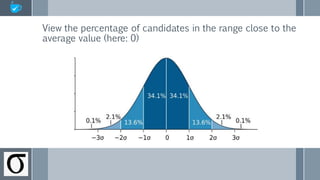
View the percentage of candidates in the range close to the
average value (here: 0)
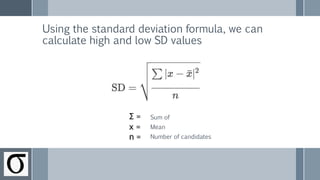
Using the standard deviation formula, we can
calculate high and low SD values
Sum of
Mean
Number of candidates
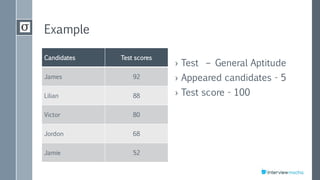
Example
Candidates Test scores
James 92
Lilian 88
Victor 80
Jordon 68
Jamie 52
› Test – General Aptitude
› Appeared candidates - 5
› Test score - 100
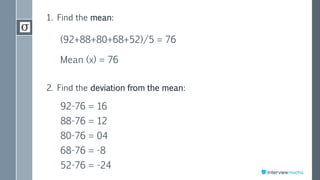
1. Find the mean:
(92+88+80+68+52)/5 = 76
Mean (x) = 76
2. Find the deviation from the mean:
92-76 = 16
88-76 = 12
80-76 = 04
68-76 = -8
52-76 = -24
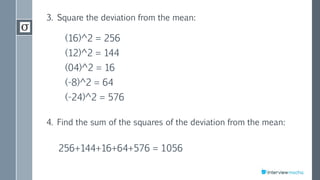
3. Square the deviation from the mean:
(16)^2 = 256
(12)^2 = 144
(04)^2 = 16
(-8)^2 = 64
(-24)^2 = 576
4. Find the sum of the squares of the deviation from the mean:
256+144+16+64+576 = 1056
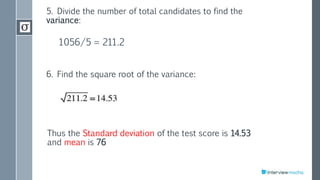
5. Divide the number of total candidates to find the
variance:
1056/5 = 211.2
6. Find the square root of the variance:
Thus the Standard deviation of the test score is 14.53
and mean is 76
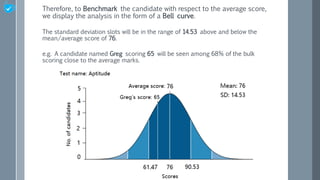
Therefore, to Benchmark the candidate with respect to the average score,
we display the analysis in the form of a Bell curve.
The standard deviation slots will be in the range of 14.53 above and below the
mean/average score of 76.
e.g. A candidate named Greg scoring 65 will be seen among 68% of the bulk
scoring close to the average marks.
THANK YOU!

Interview Mocha's Score Distribution Analysis

  • 1.
  • 2.
    Why is thescore distribution analysis done? › Recruiters shouldn’t have to flip between the job description and a candidate’s score report to identify how well the candidate fits the role. › At a glance, a recruiter should be able to quickly identify if a candidate’s score falls within the “acceptable fit or average” zone of the scale. Ergo, Mocha’s score distribution analysis does the job!
  • 3.
    Identify the candidateamongst average score via › Standard Deviation › Mean › Bell Curve
  • 4.
    Standard Deviation (SD) SDis used to indicate how many candidates are spread out in relation to the average(mean) score. › A low SD value close to 0, indicates candidates close to average score. › A high SD value is spread out, away from the average score.
  • 5.
    View the percentageof candidates in the range close to the average value (here: 0)
  • 6.
    Using the standarddeviation formula, we can calculate high and low SD values Sum of Mean Number of candidates
  • 7.
    Example Candidates Test scores James92 Lilian 88 Victor 80 Jordon 68 Jamie 52 › Test – General Aptitude › Appeared candidates - 5 › Test score - 100
  • 8.
    1. Find themean: (92+88+80+68+52)/5 = 76 Mean (x) = 76 2. Find the deviation from the mean: 92-76 = 16 88-76 = 12 80-76 = 04 68-76 = -8 52-76 = -24
  • 9.
    3. Square thedeviation from the mean: (16)^2 = 256 (12)^2 = 144 (04)^2 = 16 (-8)^2 = 64 (-24)^2 = 576 4. Find the sum of the squares of the deviation from the mean: 256+144+16+64+576 = 1056
  • 10.
    5. Divide thenumber of total candidates to find the variance: 1056/5 = 211.2 6. Find the square root of the variance: Thus the Standard deviation of the test score is 14.53 and mean is 76
  • 11.
    Therefore, to Benchmarkthe candidate with respect to the average score, we display the analysis in the form of a Bell curve. The standard deviation slots will be in the range of 14.53 above and below the mean/average score of 76. e.g. A candidate named Greg scoring 65 will be seen among 68% of the bulk scoring close to the average marks.
  • 12.