Definition
A computer uses given
labels as examples to
take and sort series of
data and thus to
predict future events.
In supervised learning
people teach or train
the machine using
labeled data.
Input Data
07
Messages
Unsupervised learning
sorts data without
using predefined labels.
The unsupervised
machine learning
algorithms act without
human guidance.
Input Data
Uses known and
labeled input data
Uses unknown input
data
More complex in
computation
Less complex in
computation
Computational
Complexity
Number of classes is
not known
Number of classes
is known
Number of Classes
Real Time
Uses real-time
analysis of data
Classification
Regression
Uses off-line
analysis
Clustering
Association
Types 
Supervised learning: Unsupervised learning:
Unsupervised vs Supervised Learning
Two types of
supervised
machine learning:
Two types
of unsupervised
machine learning:
List of popular
algorithms
Decision Trees
K Nearest Neighbors
Linear SVC (Support
vector Classifier)
Logistic Regression
Naive Bayes
Neural Networks
Linear Regression
Support Vector
Regression (SVR)
Regression Trees
(e.g. Random Forest)
Gradient boosting
Fisher linear
discriminant.
K-means clustering
K-NN (k nearest
neighbors)
Dimensionality
Reduction
Neural networks /
Deep Learning
Principal Component
Analysis
Singular Value
Decomposition
Independent
Component Analysis
Distribution models
Hierarchical
clustering
Mixture models
Credit card fraud
detection (fraud,
not fraud)
Email spam
detection (spam,
not spam)
Text sentiment
analysis (happy, not
happy)
For predicting
patient risk (such as
high-risk patient,
low-risk patient)
Examples of
application
In marketing
segmentation, when
a company wants
to segment its
customers to better
adjust products and
offerings
Social network
analysis
Image
Segmentation
Anomaly detection
and etc.
http://intellspot.com

Supervised vs unsupervised learning - infographic

  • 1.
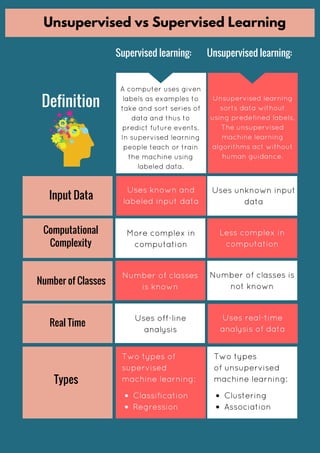
    Definition A computer usesgiven labels as examples to take and sort series of data and thus to predict future events. In supervised learning people teach or train the machine using labeled data. Input Data 07 Messages Unsupervised learning sorts data without using predefined labels. The unsupervised machine learning algorithms act without human guidance. Input Data Uses known and labeled input data Uses unknown input data More complex in computation Less complex in computation Computational Complexity Number of classes is not known Number of classes is known Number of Classes Real Time Uses real-time analysis of data Classification Regression Uses off-line analysis Clustering Association Types  Supervised learning: Unsupervised learning: Unsupervised vs Supervised Learning Two types of supervised machine learning: Two types of unsupervised machine learning:
  • 2.
    List of popular algorithms DecisionTrees K Nearest Neighbors Linear SVC (Support vector Classifier) Logistic Regression Naive Bayes Neural Networks Linear Regression Support Vector Regression (SVR) Regression Trees (e.g. Random Forest) Gradient boosting Fisher linear discriminant. K-means clustering K-NN (k nearest neighbors) Dimensionality Reduction Neural networks / Deep Learning Principal Component Analysis Singular Value Decomposition Independent Component Analysis Distribution models Hierarchical clustering Mixture models Credit card fraud detection (fraud, not fraud) Email spam detection (spam, not spam) Text sentiment analysis (happy, not happy) For predicting patient risk (such as high-risk patient, low-risk patient) Examples of application In marketing segmentation, when a company wants to segment its customers to better adjust products and offerings Social network analysis Image Segmentation Anomaly detection and etc. http://intellspot.com