Towards Continuous Consistency Checking of DevOps
Artefacts
Alessandro Colantoni1, Benedek Horváth1,2, Ákos Horváth2, Luca Berardinelli1,
Manuel Wimmer1
1 Johannes Kepler University Linz, Linz, Austria
2 IncQuery Labs cPlc, Budapest, Hungary
Contact: Benedek.Horvath@incquerylabs.com
Motivation
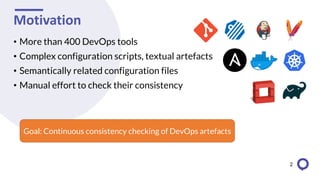
• More than 400 DevOps tools
• Complex configuration scripts, textual artefacts
• Semantically related configuration files
• Manual effort to check their consistency
2
Goal: Continuous consistency checking of DevOps artefacts
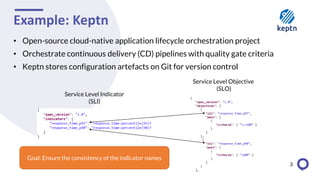
Example: Keptn
• Open-source cloud-native application lifecycle orchestration project
• Orchestrate continuous delivery (CD) pipelines with quality gate criteria
• Keptn stores configuration artefacts on Git for version control
3
Service Level Indicator
(SLI)
Service Level Objective
(SLO)
Goal: Ensure the consistency of the indicator names
Proposed Solution
4
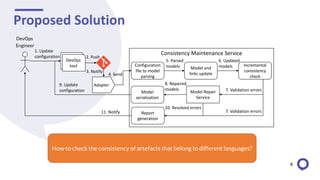
Consistency Maintenance Service
1. Update
configuration
9. Update
configuration
5. Parsed
models
6. Updated
models
7. Validation errors
10. Resolved errors
3. Notify
Configuration
file to model
parsing
Model and
links update
Incremental
consistency
check
Report
generation
Model
serialization
8. Repaired
models
11. Notify 7. Validation errors
DevOps
tool
Model Repair
Service
2. Push
Adapter
4. Send
DevOps
Engineer
How to check the consistency of artefacts that belong to different languages?
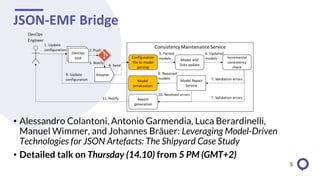
JSON-EMF Bridge
• Alessandro Colantoni, Antonio Garmendia, Luca Berardinelli,
Manuel Wimmer, and Johannes Bräuer: Leveraging Model-Driven
Technologies for JSON Artefacts: The Shipyard Case Study
• Detailed talk on Thursday (14.10) from 5 PM (GMT+2)
5
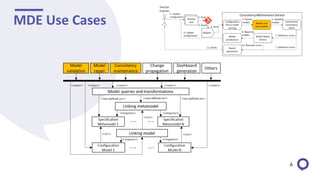
MDE Use Cases
6
Viatra
7
• Model query, transformation, validation framework [1]
• Validation rules as graph patterns
• Model repairs as reactive model transformations
Case Study
8
SLO metamodel
Linking metamodel
SLI metamodel
Sli2SloLinks
sli
1..*
1..*
links
ServiceLevelIndicators
Sli2SloLink
Indicators
IndicatorsPatternProperties
key : EString [1]
value : EString [1]
ServiceLevelObjectives
Objective
sli : EString [1]
pass: SLICriteria [0..*]
1..*
objectives
indicators 1..1
patternProperties 0..*
slo
1..*
{ …
“indicators” : {
“response_time_p95”:
“builtin:service.response.time:merge(0):percentile(95….”,
“response_time_p90”:
“builtin:service.response.time:merge(0):percentile(90….”
}
…
} example.sli
{ …
“objectives” : {
“sli” : “response_time_p95”,
“pass” : [
{“criteria”: [“<=+10%”]}
]
}
…
} example.slo
https://github.com/lowcomote/keptn-consistency-maintenance
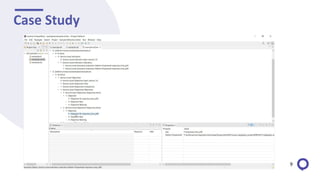
Case Study
9
Case Study Limitations
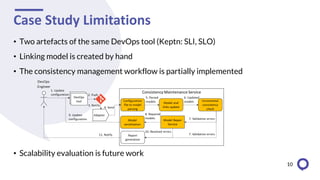
• Two artefacts of the same DevOps tool (Keptn: SLI, SLO)
• Linking model is created by hand
• The consistency management workflow is partially implemented
• Scalability evaluation is future work
10
Conclusions and Future Work
• Proposed GitOps workflow to check the artefacts’ consistency
• Proof of concept implementation of the workflow
• Several MDE use cases for DevOps configuration artefacts
• Modeling:
• GitOps adapter to reflect the Git structure as a megamodel
• Query-driven soft-links to maintain the linking model [2]
• Research-oriented:
• Incremental parsing to have better integrations with Viatra [3]
11
Acknowledgements
• This work was funded by the European Union’s Horizon 2020
research and innovation programme under the Marie
Skłodowska-Curie grant agreement No 813884,
• the AIDOaRt project ECSEL Joint Undertaking (JU) under grant
agreement No. 101007350,
• by the Austrian Research Promotion Agency (FFG), program ICT
of the Future, project number 867535,
• and contributed to the ITEA3 BUMBLE project (18006).
• The authors are grateful for the valuable feedback of the
anonymous reviewers about the paper.
12
References
[1] Dániel Varró, Gábor Bergmann, Ábel Hegedüs, Ákos Horváth, István Ráth,
Zoltán Ujhelyi: Road to a reactive and incremental model transformation
platform: three generations of the VIATRA framework. Softw. Syst. Model.
15(3): 609-629 (2016)
[2] Ábel Hegedüs, Ákos Horváth, István Ráth, Rodrigo Rizzi Starr, Dániel
Varró: Query-driven soft traceability links for models. Softw. Syst. Model.
15(3): 733-756 (2016)
[3] Thomas Goldschmidt, Steffen Becker, Axel Uhl: Classification of Concrete
Textual Syntax Mapping Approaches. ECMDA-FA 2008: 169-184
13

Towards Continuous Consistency Checking of DevOps Artefacts

  • 1.
    Towards Continuous ConsistencyChecking of DevOps Artefacts Alessandro Colantoni1, Benedek Horváth1,2, Ákos Horváth2, Luca Berardinelli1, Manuel Wimmer1 1 Johannes Kepler University Linz, Linz, Austria 2 IncQuery Labs cPlc, Budapest, Hungary Contact: Benedek.Horvath@incquerylabs.com
  • 2.
    Motivation • More than400 DevOps tools • Complex configuration scripts, textual artefacts • Semantically related configuration files • Manual effort to check their consistency 2 Goal: Continuous consistency checking of DevOps artefacts
  • 3.
    Example: Keptn • Open-sourcecloud-native application lifecycle orchestration project • Orchestrate continuous delivery (CD) pipelines with quality gate criteria • Keptn stores configuration artefacts on Git for version control 3 Service Level Indicator (SLI) Service Level Objective (SLO) Goal: Ensure the consistency of the indicator names
  • 4.
    Proposed Solution 4 Consistency MaintenanceService 1. Update configuration 9. Update configuration 5. Parsed models 6. Updated models 7. Validation errors 10. Resolved errors 3. Notify Configuration file to model parsing Model and links update Incremental consistency check Report generation Model serialization 8. Repaired models 11. Notify 7. Validation errors DevOps tool Model Repair Service 2. Push Adapter 4. Send DevOps Engineer How to check the consistency of artefacts that belong to different languages?
  • 5.
    JSON-EMF Bridge • AlessandroColantoni, Antonio Garmendia, Luca Berardinelli, Manuel Wimmer, and Johannes Bräuer: Leveraging Model-Driven Technologies for JSON Artefacts: The Shipyard Case Study • Detailed talk on Thursday (14.10) from 5 PM (GMT+2) 5
  • 6.
  • 7.
    Viatra 7 • Model query,transformation, validation framework [1] • Validation rules as graph patterns • Model repairs as reactive model transformations
  • 8.
    Case Study 8 SLO metamodel Linkingmetamodel SLI metamodel Sli2SloLinks sli 1..* 1..* links ServiceLevelIndicators Sli2SloLink Indicators IndicatorsPatternProperties key : EString [1] value : EString [1] ServiceLevelObjectives Objective sli : EString [1] pass: SLICriteria [0..*] 1..* objectives indicators 1..1 patternProperties 0..* slo 1..* { … “indicators” : { “response_time_p95”: “builtin:service.response.time:merge(0):percentile(95….”, “response_time_p90”: “builtin:service.response.time:merge(0):percentile(90….” } … } example.sli { … “objectives” : { “sli” : “response_time_p95”, “pass” : [ {“criteria”: [“<=+10%”]} ] } … } example.slo https://github.com/lowcomote/keptn-consistency-maintenance
  • 9.
  • 10.
    Case Study Limitations •Two artefacts of the same DevOps tool (Keptn: SLI, SLO) • Linking model is created by hand • The consistency management workflow is partially implemented • Scalability evaluation is future work 10
  • 11.
    Conclusions and FutureWork • Proposed GitOps workflow to check the artefacts’ consistency • Proof of concept implementation of the workflow • Several MDE use cases for DevOps configuration artefacts • Modeling: • GitOps adapter to reflect the Git structure as a megamodel • Query-driven soft-links to maintain the linking model [2] • Research-oriented: • Incremental parsing to have better integrations with Viatra [3] 11
  • 12.
    Acknowledgements • This workwas funded by the European Union’s Horizon 2020 research and innovation programme under the Marie Skłodowska-Curie grant agreement No 813884, • the AIDOaRt project ECSEL Joint Undertaking (JU) under grant agreement No. 101007350, • by the Austrian Research Promotion Agency (FFG), program ICT of the Future, project number 867535, • and contributed to the ITEA3 BUMBLE project (18006). • The authors are grateful for the valuable feedback of the anonymous reviewers about the paper. 12
  • 13.
    References [1] Dániel Varró,Gábor Bergmann, Ábel Hegedüs, Ákos Horváth, István Ráth, Zoltán Ujhelyi: Road to a reactive and incremental model transformation platform: three generations of the VIATRA framework. Softw. Syst. Model. 15(3): 609-629 (2016) [2] Ábel Hegedüs, Ákos Horváth, István Ráth, Rodrigo Rizzi Starr, Dániel Varró: Query-driven soft traceability links for models. Softw. Syst. Model. 15(3): 733-756 (2016) [3] Thomas Goldschmidt, Steffen Becker, Axel Uhl: Classification of Concrete Textual Syntax Mapping Approaches. ECMDA-FA 2008: 169-184 13