June 2013

Understanding
Healthcare Access
in India
What is the current state?
Expanding healthcare access is a critical priority for India today. Despite numerous efforts made to address this problem
and the progress made to date, the gap between the aspiration - providing quality healthcare on an equitable, accessible
and affordable basis across all regions and communities of the country — and today’s reality still remains.
The inception of National Rural Health Mission (NRHM) and the implementation of other policies over the last decade
have shown a positive improvement in India’s healthcare system. To do more, and at a faster rate, it is important to
understand the current state of healthcare. This understanding will play a pivotal role in determining priorities,
resource allocation and goals for the future, as well as plugging the existing gaps in the system.
This report brings fresh, objective perspective to the status of healthcare in India, and offers the most comprehensive view
of this issue since 2004.

Objectives of the Study
This study has been undertaken for the benefit of all healthcare, including the government; pharmaceutical, payer,
and provider companies; civil society organizations and non-governmental organizations.
The study has the following objectives:
	 1.	 Map the current status of healthcare access to gain a comprehensive view on successes and key areas of challenge
	 2.	 Prioritize challenges or gaps in terms of their relative impact on healthcare access
	 3.	 Provide a roadmap to guide future improvements
This study is intended to help drive the following:
	 •	 Educate all relevant stakeholders in the healthcare community about the true status of healthcare access in India
	 •	 Clearly establish that healthcare access is multi-dimensional in nature and hence to truly address current gaps,
		 all dimensions need to be considered and not just one
	 •	 Provide clarity on the priorities required to improve healthcare access
	 •	 Highlight the need for more effective implementation of existing healthcare policies

Methodology of the Study
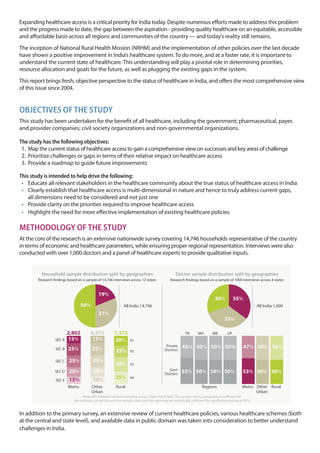
At the core of the research is an extensive nationwide survey covering 14,746 households representative of the country
in terms of economic and healthcare parameters, while ensuring proper regional representation. Interviews were also
conducted with over 1,000 doctors and a panel of healthcare experts to provide qualitative inputs.
Household sample distribution split by geographies

Doctor sample distribution split by geographies

19%
50%

30%

35%
All India 1,000

All India 14,746

31%

35%

SEC A

2,802
15%

4,571
15%

7,373
20%

R1

SEC B

25%

25%

25%

R2

SEC C

25%

25%

30%

R3

SEC D

20%

20%

15%

15%

Metro

SEC E

Other
Urban

25%
Rural

TN

R4

MH

WB

UP

Private
Doctors

45% 50% 50% 50%

47% 50% 50%

Govt
Doctors

55% 50% 50% 50%

53% 50% 50%

Regions

Metro Other Rural
Urban

In addition to the primary survey, an extensive review of current healthcare policies, various healthcare schemes (both
at the central and state level), and available data in public domain was taken into consideration to better understand
challenges in India.
Defining Healthcare Access
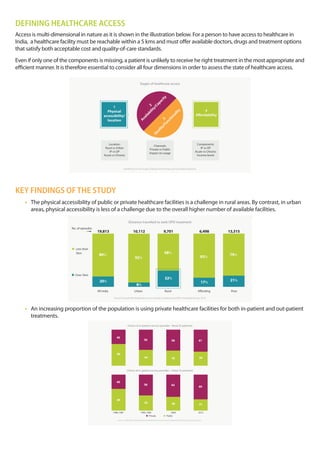
Access is multi-dimensional in nature as it is shown in the illustration below. For a person to have access to healthcare in
India, a healthcare facility must be reachable within a 5 kms and must offer available doctors, drugs and treatment options
that satisfy both acceptable cost and quality-of-care standards.
Even if only one of the components is missing, a patient is unlikely to receive he right treatment in the most appropriate and
efficient manner. It is therefore essential to consider all four dimensions in order to assess the state of healthcare access.

1
Physical
accessibility/
location

Av
ai
la
bi 2
lit
y/
Q
Ca
ua
pa
lit
ci
y/ 3
ty
Fu
nc
tio
na
lit
y

Stages of healthcare access

Location:
Rural vs Urban
IP vs OP
Acute vs Chronic

4

Components:
IP vs OP
Acute vs Chronic
Income levels

Channels:
Private vs Public
Impact on usage

Healthcare Access Study. Findings from Primary and Secondary Research

Key Findings of the study
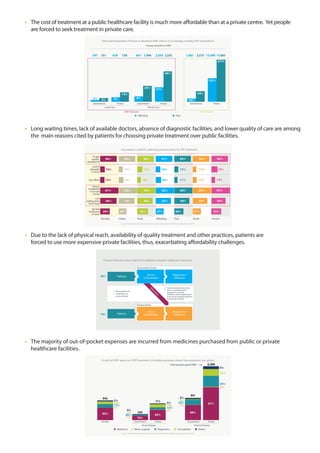
		 •	 The physical accessibility of public or private healthcare facilities is a challenge in rural areas. By contrast, in urban

			 areas, physical accessibility is less of a challenge due to the overall higher number of available facilities.
Distance travelled to seek OPD treatment
No. of episodes

Less than
5km

19,813

10,112

9,701

68%

80%

92%

Over 5km

32%

20%

8%

All India

Urban

6,498

13,315

83%

79%

17%

21%

Rural

Poor

Source: Household Healthcare Access Survey Conducted by IMS Consulting Group, 2012

		 •	 An increasing proportion of the population is using private healthcare facilities for both in-patient and out-patient
			 treatments.
Choice of in-patient service provider - Rural (% patients)

40

60

56

58

61

44

42

39

Choice of in-patient service provider - Urban (% patients)

40

60

1986-1987

58

62

42

38

1995-1996
Private

2004
Public

69

31
2012

Source: NSSO Data 2004; Household Healthcare Access Survey Conducted by IMS Consulting Group, 2012
•

are forced to seek treatment in private care.
Total spend/episode of illness in absolute (INR) and as % of average monthly HH expenditure
Average spend/Event (INR)

247

251

678

728

667 1,096

4.5x
1,481 2,575 13,485 11,605

2,255 2,325

217%

44%
121%
23%

21%
54%

14%
3%

5%

8%

7%

Government

Private

16%

Government

Acute Care

Private

Government

Private

Chronic Care
OPD Treatment

IPD Treatment

Poor

• Long waiting times, lack of available doctors, absence of diagnostic facilities, and lower quality of care are among
the main reasons cited by patients for choosing private treatment over public facilities.
Key reasons cited for selecting private sector for OP treatment
To get
quickly
attended to

56%

Lack of
specialist
in Govt.

14%
13%

Less
waiting2.6
than
Govt Hosp

4.8 62%

29%
All India

11%

3.8
13%

62%

60%

60%
6.2

63%

49%

50%

50%

52%

3.9

Rural

13%

27%

Poor

35%

Acute

30%

27%

32%

Urban

12%

18% 6.4

46%
1.3

26%

22%

13%

16%

6.1
60%

1.4 54%

50%

No free
medicines
in Govt.

imsexecutivesummaryindiae-versionfinal2-130722213510-php

10%

16%

61%

Doctor
availability
in private
sector

15%

13%

56%

56%

56%

57%

56%

56%

Chronic

Source: Household Healthcare Access Survey Conducted by IMS Consulting Group, 2012

• Due to the lack of physical reach, availability of quality treatment and other practices, patients are

00

Channel diversion due to lack of availability of quality healthcare resources

00bn

Government Sector

26%

Doctor
Consultation

Patients

00%

2

ve

Di
n

io

rs

1

More patients are
using high cost
private channel

Diagnostics/
Medicine

00

00bn
3.3%

Doctor
Consultation

Patients

0

5

10

Diagnostics/
Medicine

• The majority of out-of-pocket expenses are incurred title
from medicines purchased from public or private
Key title
Key
healthcare facilities.
% split of OOP spend on OPD treatment (including episodes where free treatment was given)

2,296

Total episode spend (INR)

All other state spending

5%
13%

US Federal Budget 2011
$3.6 Trillion

Medicaid

Social Security

842

Total of State’s Budgets 2011
$1.6 Trillion

Defense

Higher Education

Source: National Association of State Budget O

5%
14%
17%
1%

63%

Elementary & Secondary Education

5%
19%
13%
1%

6%

All India

250
73%
Government

All other spending

941

62%
Private

61%

1%

69%
Government

Acute Diseases

Medicines

20%
1%

, State Expenditure Report, 2010-2012; Congressional Budget O

711

0%
20%
1%

6%
2%
23%

Minor sugeries

Private

Chronic Diseases

Diagnostics

00b

00bn 00bn

00bn
Further diversion when Govt.
doctors send patients for
diagnostics to private
facilities or when patients have
to purchase essential medicines
from private channels

Private Sector

74%

00bn

00

Consultation

Source: Household Healthcare Access Survey Conducted by IMS Consulting Group, 2012

Others

15

20

25

30

35
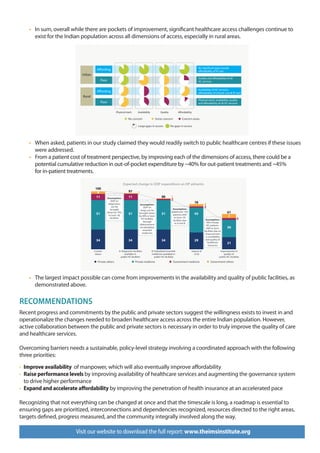
•

exist for the Indian population across all dimensions of access, especially in rural areas.

Urban
Poor

HC services
Availability of HC services;

Rural

Physical reach, availability, quality

Poor
Physical reach

Availability

Quality

No concern

Some concern

Large gaps in access

Concern areas

No gaps in access

• When asked, patients in our study claimed they would readily switch to public healthcare centres if these issues
were addressed.
• From a patient cost of treatment perspective, by improving each of the dimensions of access, there could be a
potential cumulative reduction in out-of-pocket expenditure by ~40% for out-patient treatments and ~45%
for in-patient treatments.
100
4
11

51

Expected change in OOP expenditure on OP ailments
97
Assumption:
OOP on
diagnostics
can be
brought
down by 75%
in Govt. HC
facilities

11

51

1

88

Assumption:
OOP on
drugs can be
brought down
by 90% in Govt.
HC facilities
through
disbursement
of subsidized
essential
medicines

51

1
2
Assumption:
Additional 15%
patients shift
to Govt. HC
facilities due
to A and B

78
43

34

34

34

29

Current
status

A: Diagnostic facilities
available in
public HC facilities

B: Subsidized essential
medicines available in
public HC facilities

Impact of
A+B

Private others

Private medicine

4
2

Government medicine

Assumption:
40% Private
HC patients
shift to Govt.
facilities due to
improvement
in availability
and quality of
healthcare
resources

61
7

3

30

21

Improvement in
quality of
public HC Facilities

Government others

• The largest impact possible can come from improvements in the availability and quality of public facilities, as
demonstrated above.

RECOMMENDATIONS
Recent progress and commitments by the public and private sectors suggest the willingness exists to invest in and
operationalize the changes needed to broaden healthcare access across the entire Indian population. However,
active collaboration between the public and private sectors is necessary in order to truly improve the quality of care
and healthcare services.
Overcoming barriers needs a sustainable, policy-level strategy involving a coordinated approach with the following
three priorities:
• Improve availability
• Raise performance levels by improving availability of healthcare services and augmenting the governance system
to drive higher performance
•
by improving the penetration of health insurance at an accelerated pace
Recognizing that not everything can be changed at once and that the timescale is long, a roadmap is essential to
ensuring gaps are prioritized, interconnections and dependencies recognized, resources directed to the right areas,

Visit our website to download the full report: www.theimsinstitute.org
IMS HEALTH®
IMS INSTITUTE FOR HEALTHCARE INFORMATICS INDIA
24 Barakhamba Road,
New Delhi 110001
India
Contact us for more information:
Dr. Raghavan Gopa Kumar,
Head of IMS Institute for Healthcare Information, India
graghavan@in.imshealth.com
Tlf: +91-11-33 58-25-50
www.theimsinstitute.org

IMS Health is present in over 100 markets.
F

ABOUT THE IMS INSTITUTE FOR HEALTHCARE INFORMATICS
The IMS Institute for Healthcare Informatics provides key policy setters and decision makers in the global health sector
with unique and transformational insights into healthcare dynamics derived from granular analysis of information.
It is a research-driven entity with a worldwide reach that collaborates with external healthcare experts from across
academia and the public and private sectors to objectively apply IMS’s proprietary global information and analytical
assets. More information about the IMS Institute can be found at: http://www.theimsinstitute.org.

Understanding Healthcare Access in India

  • 1.
    June 2013 Understanding Healthcare Access inIndia What is the current state?
  • 2.
    Expanding healthcare accessis a critical priority for India today. Despite numerous efforts made to address this problem and the progress made to date, the gap between the aspiration - providing quality healthcare on an equitable, accessible and affordable basis across all regions and communities of the country — and today’s reality still remains. The inception of National Rural Health Mission (NRHM) and the implementation of other policies over the last decade have shown a positive improvement in India’s healthcare system. To do more, and at a faster rate, it is important to understand the current state of healthcare. This understanding will play a pivotal role in determining priorities, resource allocation and goals for the future, as well as plugging the existing gaps in the system. This report brings fresh, objective perspective to the status of healthcare in India, and offers the most comprehensive view of this issue since 2004. Objectives of the Study This study has been undertaken for the benefit of all healthcare, including the government; pharmaceutical, payer, and provider companies; civil society organizations and non-governmental organizations. The study has the following objectives: 1. Map the current status of healthcare access to gain a comprehensive view on successes and key areas of challenge 2. Prioritize challenges or gaps in terms of their relative impact on healthcare access 3. Provide a roadmap to guide future improvements This study is intended to help drive the following: • Educate all relevant stakeholders in the healthcare community about the true status of healthcare access in India • Clearly establish that healthcare access is multi-dimensional in nature and hence to truly address current gaps, all dimensions need to be considered and not just one • Provide clarity on the priorities required to improve healthcare access • Highlight the need for more effective implementation of existing healthcare policies Methodology of the Study At the core of the research is an extensive nationwide survey covering 14,746 households representative of the country in terms of economic and healthcare parameters, while ensuring proper regional representation. Interviews were also conducted with over 1,000 doctors and a panel of healthcare experts to provide qualitative inputs. Household sample distribution split by geographies Doctor sample distribution split by geographies 19% 50% 30% 35% All India 1,000 All India 14,746 31% 35% SEC A 2,802 15% 4,571 15% 7,373 20% R1 SEC B 25% 25% 25% R2 SEC C 25% 25% 30% R3 SEC D 20% 20% 15% 15% Metro SEC E Other Urban 25% Rural TN R4 MH WB UP Private Doctors 45% 50% 50% 50% 47% 50% 50% Govt Doctors 55% 50% 50% 50% 53% 50% 50% Regions Metro Other Rural Urban In addition to the primary survey, an extensive review of current healthcare policies, various healthcare schemes (both at the central and state level), and available data in public domain was taken into consideration to better understand challenges in India.
  • 3.
    Defining Healthcare Access Accessis multi-dimensional in nature as it is shown in the illustration below. For a person to have access to healthcare in India, a healthcare facility must be reachable within a 5 kms and must offer available doctors, drugs and treatment options that satisfy both acceptable cost and quality-of-care standards. Even if only one of the components is missing, a patient is unlikely to receive he right treatment in the most appropriate and efficient manner. It is therefore essential to consider all four dimensions in order to assess the state of healthcare access. 1 Physical accessibility/ location Av ai la bi 2 lit y/ Q Ca ua pa lit ci y/ 3 ty Fu nc tio na lit y Stages of healthcare access Location: Rural vs Urban IP vs OP Acute vs Chronic 4 Components: IP vs OP Acute vs Chronic Income levels Channels: Private vs Public Impact on usage Healthcare Access Study. Findings from Primary and Secondary Research Key Findings of the study • The physical accessibility of public or private healthcare facilities is a challenge in rural areas. By contrast, in urban areas, physical accessibility is less of a challenge due to the overall higher number of available facilities. Distance travelled to seek OPD treatment No. of episodes Less than 5km 19,813 10,112 9,701 68% 80% 92% Over 5km 32% 20% 8% All India Urban 6,498 13,315 83% 79% 17% 21% Rural Poor Source: Household Healthcare Access Survey Conducted by IMS Consulting Group, 2012 • An increasing proportion of the population is using private healthcare facilities for both in-patient and out-patient treatments. Choice of in-patient service provider - Rural (% patients) 40 60 56 58 61 44 42 39 Choice of in-patient service provider - Urban (% patients) 40 60 1986-1987 58 62 42 38 1995-1996 Private 2004 Public 69 31 2012 Source: NSSO Data 2004; Household Healthcare Access Survey Conducted by IMS Consulting Group, 2012
  • 4.
    • are forced toseek treatment in private care. Total spend/episode of illness in absolute (INR) and as % of average monthly HH expenditure Average spend/Event (INR) 247 251 678 728 667 1,096 4.5x 1,481 2,575 13,485 11,605 2,255 2,325 217% 44% 121% 23% 21% 54% 14% 3% 5% 8% 7% Government Private 16% Government Acute Care Private Government Private Chronic Care OPD Treatment IPD Treatment Poor • Long waiting times, lack of available doctors, absence of diagnostic facilities, and lower quality of care are among the main reasons cited by patients for choosing private treatment over public facilities. Key reasons cited for selecting private sector for OP treatment To get quickly attended to 56% Lack of specialist in Govt. 14% 13% Less waiting2.6 than Govt Hosp 4.8 62% 29% All India 11% 3.8 13% 62% 60% 60% 6.2 63% 49% 50% 50% 52% 3.9 Rural 13% 27% Poor 35% Acute 30% 27% 32% Urban 12% 18% 6.4 46% 1.3 26% 22% 13% 16% 6.1 60% 1.4 54% 50% No free medicines in Govt. imsexecutivesummaryindiae-versionfinal2-130722213510-php 10% 16% 61% Doctor availability in private sector 15% 13% 56% 56% 56% 57% 56% 56% Chronic Source: Household Healthcare Access Survey Conducted by IMS Consulting Group, 2012 • Due to the lack of physical reach, availability of quality treatment and other practices, patients are 00 Channel diversion due to lack of availability of quality healthcare resources 00bn Government Sector 26% Doctor Consultation Patients 00% 2 ve Di n io rs 1 More patients are using high cost private channel Diagnostics/ Medicine 00 00bn 3.3% Doctor Consultation Patients 0 5 10 Diagnostics/ Medicine • The majority of out-of-pocket expenses are incurred title from medicines purchased from public or private Key title Key healthcare facilities. % split of OOP spend on OPD treatment (including episodes where free treatment was given) 2,296 Total episode spend (INR) All other state spending 5% 13% US Federal Budget 2011 $3.6 Trillion Medicaid Social Security 842 Total of State’s Budgets 2011 $1.6 Trillion Defense Higher Education Source: National Association of State Budget O 5% 14% 17% 1% 63% Elementary & Secondary Education 5% 19% 13% 1% 6% All India 250 73% Government All other spending 941 62% Private 61% 1% 69% Government Acute Diseases Medicines 20% 1% , State Expenditure Report, 2010-2012; Congressional Budget O 711 0% 20% 1% 6% 2% 23% Minor sugeries Private Chronic Diseases Diagnostics 00b 00bn 00bn 00bn Further diversion when Govt. doctors send patients for diagnostics to private facilities or when patients have to purchase essential medicines from private channels Private Sector 74% 00bn 00 Consultation Source: Household Healthcare Access Survey Conducted by IMS Consulting Group, 2012 Others 15 20 25 30 35
  • 5.
    • exist for theIndian population across all dimensions of access, especially in rural areas. Urban Poor HC services Availability of HC services; Rural Physical reach, availability, quality Poor Physical reach Availability Quality No concern Some concern Large gaps in access Concern areas No gaps in access • When asked, patients in our study claimed they would readily switch to public healthcare centres if these issues were addressed. • From a patient cost of treatment perspective, by improving each of the dimensions of access, there could be a potential cumulative reduction in out-of-pocket expenditure by ~40% for out-patient treatments and ~45% for in-patient treatments. 100 4 11 51 Expected change in OOP expenditure on OP ailments 97 Assumption: OOP on diagnostics can be brought down by 75% in Govt. HC facilities 11 51 1 88 Assumption: OOP on drugs can be brought down by 90% in Govt. HC facilities through disbursement of subsidized essential medicines 51 1 2 Assumption: Additional 15% patients shift to Govt. HC facilities due to A and B 78 43 34 34 34 29 Current status A: Diagnostic facilities available in public HC facilities B: Subsidized essential medicines available in public HC facilities Impact of A+B Private others Private medicine 4 2 Government medicine Assumption: 40% Private HC patients shift to Govt. facilities due to improvement in availability and quality of healthcare resources 61 7 3 30 21 Improvement in quality of public HC Facilities Government others • The largest impact possible can come from improvements in the availability and quality of public facilities, as demonstrated above. RECOMMENDATIONS Recent progress and commitments by the public and private sectors suggest the willingness exists to invest in and operationalize the changes needed to broaden healthcare access across the entire Indian population. However, active collaboration between the public and private sectors is necessary in order to truly improve the quality of care and healthcare services. Overcoming barriers needs a sustainable, policy-level strategy involving a coordinated approach with the following three priorities: • Improve availability • Raise performance levels by improving availability of healthcare services and augmenting the governance system to drive higher performance • by improving the penetration of health insurance at an accelerated pace Recognizing that not everything can be changed at once and that the timescale is long, a roadmap is essential to ensuring gaps are prioritized, interconnections and dependencies recognized, resources directed to the right areas, Visit our website to download the full report: www.theimsinstitute.org
  • 6.
    IMS HEALTH® IMS INSTITUTEFOR HEALTHCARE INFORMATICS INDIA 24 Barakhamba Road, New Delhi 110001 India Contact us for more information: Dr. Raghavan Gopa Kumar, Head of IMS Institute for Healthcare Information, India graghavan@in.imshealth.com Tlf: +91-11-33 58-25-50 www.theimsinstitute.org IMS Health is present in over 100 markets. F ABOUT THE IMS INSTITUTE FOR HEALTHCARE INFORMATICS The IMS Institute for Healthcare Informatics provides key policy setters and decision makers in the global health sector with unique and transformational insights into healthcare dynamics derived from granular analysis of information. It is a research-driven entity with a worldwide reach that collaborates with external healthcare experts from across academia and the public and private sectors to objectively apply IMS’s proprietary global information and analytical assets. More information about the IMS Institute can be found at: http://www.theimsinstitute.org.