1
Professional Skepticism Panel Discussion
June 17, 2015
Helen Munter, Director
Division of Registration and Inspections, PCAOB
2
Disclaimer
The views I express are my individual views and do not
necessarily reflect the views of the Board as a whole,
Board Members, or other staff of the PCAOB.
Overview
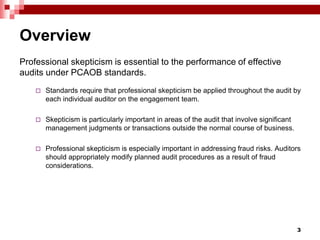
Professional skepticism is essential to the performance of effective
audits under PCAOB standards.
 Standards require that professional skepticism be applied throughout the audit by
each individual auditor on the engagement team.
 Skepticism is particularly important in areas of the audit that involve significant
management judgments or transactions outside the normal course of business.
 Professional skepticism is especially important in addressing fraud risks. Auditors
should appropriately modify planned audit procedures as a result of fraud
considerations.
3
Inspection Observations
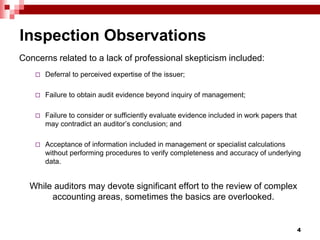
Concerns related to a lack of professional skepticism included:
 Deferral to perceived expertise of the issuer;
 Failure to obtain audit evidence beyond inquiry of management;
 Failure to consider or sufficiently evaluate evidence included in work papers that
may contradict an auditor’s conclusion; and
 Acceptance of information included in management or specialist calculations
without performing procedures to verify completeness and accuracy of underlying
data.
While auditors may devote significant effort to the review of complex
accounting areas, sometimes the basics are overlooked.
4
5
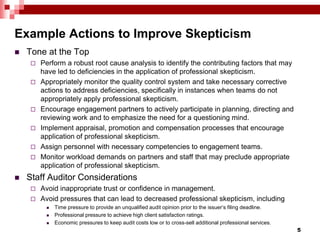
Example Actions to Improve Skepticism
 Tone at the Top
 Perform a robust root cause analysis to identify the contributing factors that may
have led to deficiencies in the application of professional skepticism.
 Appropriately monitor the quality control system and take necessary corrective
actions to address deficiencies, specifically in instances when teams do not
appropriately apply professional skepticism.
 Encourage engagement partners to actively participate in planning, directing and
reviewing work and to emphasize the need for a questioning mind.
 Implement appraisal, promotion and compensation processes that encourage
application of professional skepticism.
 Assign personnel with necessary competencies to engagement teams.
 Monitor workload demands on partners and staff that may preclude appropriate
application of professional skepticism.
 Staff Auditor Considerations
 Avoid inappropriate trust or confidence in management.
 Avoid pressures that can lead to decreased professional skepticism, including
 Time pressure to provide an unqualified audit opinion prior to the issuer’s filing deadline.
 Professional pressure to achieve high client satisfaction ratings.
 Economic pressures to keep audit costs low or to cross-sell additional professional services.
Questions
6
7
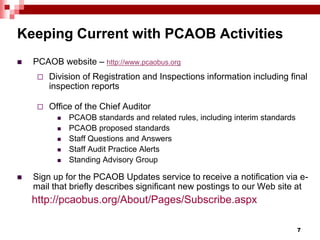
Keeping Current with PCAOB Activities
 PCAOB website – http://www.pcaobus.org
 Division of Registration and Inspections information including final
inspection reports
 Office of the Chief Auditor
 PCAOB standards and related rules, including interim standards
 PCAOB proposed standards
 Staff Questions and Answers
 Staff Audit Practice Alerts
 Standing Advisory Group
 Sign up for the PCAOB Updates service to receive a notification via e-
mail that briefly describes significant new postings to our Web site at
http://pcaobus.org/About/Pages/Subscribe.aspx

Professional Skepticism Panelist Discussion

  • 1.
    1 Professional Skepticism PanelDiscussion June 17, 2015 Helen Munter, Director Division of Registration and Inspections, PCAOB
  • 2.
    2 Disclaimer The views Iexpress are my individual views and do not necessarily reflect the views of the Board as a whole, Board Members, or other staff of the PCAOB.
  • 3.
    Overview Professional skepticism isessential to the performance of effective audits under PCAOB standards.  Standards require that professional skepticism be applied throughout the audit by each individual auditor on the engagement team.  Skepticism is particularly important in areas of the audit that involve significant management judgments or transactions outside the normal course of business.  Professional skepticism is especially important in addressing fraud risks. Auditors should appropriately modify planned audit procedures as a result of fraud considerations. 3
  • 4.
    Inspection Observations Concerns relatedto a lack of professional skepticism included:  Deferral to perceived expertise of the issuer;  Failure to obtain audit evidence beyond inquiry of management;  Failure to consider or sufficiently evaluate evidence included in work papers that may contradict an auditor’s conclusion; and  Acceptance of information included in management or specialist calculations without performing procedures to verify completeness and accuracy of underlying data. While auditors may devote significant effort to the review of complex accounting areas, sometimes the basics are overlooked. 4
  • 5.
    5 Example Actions toImprove Skepticism  Tone at the Top  Perform a robust root cause analysis to identify the contributing factors that may have led to deficiencies in the application of professional skepticism.  Appropriately monitor the quality control system and take necessary corrective actions to address deficiencies, specifically in instances when teams do not appropriately apply professional skepticism.  Encourage engagement partners to actively participate in planning, directing and reviewing work and to emphasize the need for a questioning mind.  Implement appraisal, promotion and compensation processes that encourage application of professional skepticism.  Assign personnel with necessary competencies to engagement teams.  Monitor workload demands on partners and staff that may preclude appropriate application of professional skepticism.  Staff Auditor Considerations  Avoid inappropriate trust or confidence in management.  Avoid pressures that can lead to decreased professional skepticism, including  Time pressure to provide an unqualified audit opinion prior to the issuer’s filing deadline.  Professional pressure to achieve high client satisfaction ratings.  Economic pressures to keep audit costs low or to cross-sell additional professional services.
  • 6.
  • 7.
    7 Keeping Current withPCAOB Activities  PCAOB website – http://www.pcaobus.org  Division of Registration and Inspections information including final inspection reports  Office of the Chief Auditor  PCAOB standards and related rules, including interim standards  PCAOB proposed standards  Staff Questions and Answers  Staff Audit Practice Alerts  Standing Advisory Group  Sign up for the PCAOB Updates service to receive a notification via e- mail that briefly describes significant new postings to our Web site at http://pcaobus.org/About/Pages/Subscribe.aspx

Editor's Notes

  • #4 See staff audit Practice Alert #10 on the PCAOB website for further information  http://pcaobus.org/standards/qanda/12-04-2012_sapa_10.pdf
  • #8 7