DUTY DRAWBACK CLAIM PROCEDURES!!
Submitted to:
Mr. Asif Ali Syed
Submitted by:
Diksha Chaudhary (14MBAIB 08)
Haniya Khan (14MBAIB 21)
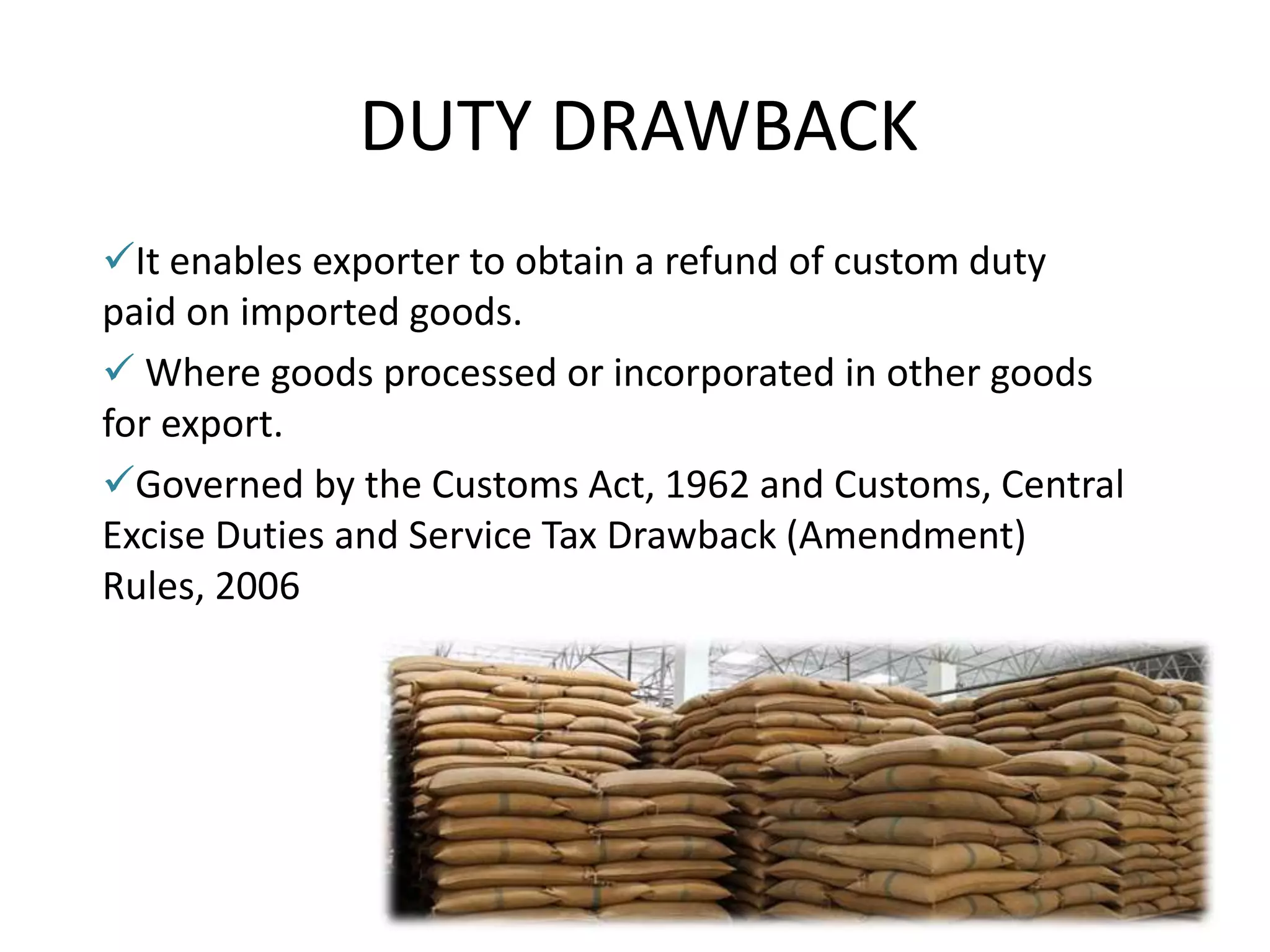
DUTY DRAWBACK
It enables exporter to obtain a refund of custom duty
paid on imported goods.
 Where goods processed or incorporated in other goods
for export.
Governed by the Customs Act, 1962 and Customs, Central
Excise Duties and Service Tax Drawback (Amendment)
Rules, 2006
CONCEPT OF DUTY DRAWBACK
 Central Government empowered to grant duty drawback
under section 74 and 75 of the Customs Act, 1962.
 Under section 74 -to the extent of 98 percent of the duty paid
on imported goods can be claimed for re-export.
 Section 75- empowers drawback on export of manufactured
articles.
CATEGORIES OF DUTY DRAWBACK:
Divided into two categories :
 Drawback allowable on re-export of duty-paid goods.
 Drawback on imported materials used in the manufacture of
goods which are exported.
GOODS ELIGIBLE FOR DRAWBACK:
 To export goods imported into India
 To export goods imported into India after having been taken
for use.
 To export goods manufactured/produced out of imported
materials.
 To export goods manufactured/produced out of indigenous
materials.
 To export goods manufactured/produced out of imported or
indigenous materials.
NECESSARY ELEMENTS
FOR DRAWBACK
 Goods previously imported.
 Import duty must have been paid.
 The goods should be entered for export within two years.
 Goods identified as imported goods.
 The goods must actually be re-exported to any place outside
India.
 MP of such goods must not be less than the amount of
drawback claimed.
 The amount of drawback should not be less than Rs. 50/- as
per section 76 (1)(c) of the Customs Act.
DRAWBACK CLAIM PROCEDURE
 At the time of export, exporter shall endorse the ‘shipping bill’.
 To proper officer of Customs .
 Customs officer makes an order permitting clearance for
exportation under section 51 of Customs Act .
 said claim for drawback shall be retained by the proper officer
making such order.
 Supplementary claim of duty drawback
PAYMENT OF DUTY DRAWBACK
 The drawback under
drawback rules shall be paid
by the proper officer of
Customs to the exporter
(or)
 to the agent specially
authorized by the exporter
to receive the said amount
of drawback and interest.
RECOVERY OF DUTY DRAWBACK:
 If an amount of drawback and
interest paid in excess of what
the claimant is entitled to, the
claimant, on demand by a
proper officer repay the
amount.
 An amount of drawback paid
to exporter but sale proceeds
of such export goods have not
been realized by the exporter
within specified period
allowed under the Foreign
Exchange Management Act,
1999, such drawback shall be
recovered.
RATE OF DUTY DRAWBACK
 Under Duty Drawback Scheme
 An exporter can opt for either All Industry Rate (AIR) of Duty
Drawback Scheme
(or)
 Brand Rate of Duty Drawback.
 Duty Drawback Rate shall not exceed 33% of MP of export
goods in any case.
 The Central Government may revise amount or rates
determined under rule 3.
(According to Rule 3 (1), a drawback may be allowed on the export of goods at
such amount, or at such rates, as may be determined by the Central Government.)
ALL INDUSTRY
DRAWBACK RATE
 It is fixed by Directorate of
Drawback, Dept. of
Revenue, Ministry of
Finance, Govt. of India.
 The rates are periodically
revised – normally on
1st June every year.
 Fixed under Rule 3 of
Drawback Rules
BRAND RATE OF
DRAWBACK
 AIR cannot be fixed for
special type of products. In
such cases, Brand Rate is
fixed.
 The manufacturer has to
submit application with all
details to Commissioner,
Central Excise.
 Such application must be
made within 60 days of
export.
SPECIAL BRAND RATE OF DRAWBACK
(If)
 AIR is fixed on average basis. If a particular manufacture or exporter
find the actual custom duty paid is higher than AIR fixed for his
product.
 In such case, he can apply under Rule 7 of Drawback Rules for
fixation of Special Brand Rate, within 30 days from export.
 The conditions for eligibility are:
 The AIR should be less than 80% of the duties paid by him.
 Rate should not be less than 1% of FOB value of product except
when amount of drawback per shipment is more than Rs. 500.
 Export value is not less than the value of imported material used in
them i.e. there should not be ‘negative value addition’.
INTEREST ON DUTY DRAWBACK
On the part of Custom Authorities:
 Duty drawback must be paid within one month.
 If not paid, interest is payable to the claimant at rate fixed
under section 27A from the date after the expiry of such
period.
 The interest rate will be between 10% to 30% as may be fixed
by Board from time to time.
 If the drawback claim is deficient, the interest will commence
only after all required papers are submitted.
INTEREST ON DUTY DRAWBACK
 On the part of exporter:
 Where any drawback has been paid to the claimant in excess
 It becomes recoverable under this Act.
 The claimant shall, within a period of two months pay in
addition to the said amount of drawback
 Interest at the rate fixed under section 28AA
 The amount of interest shall be calculated for the period
beginning from the date of payment of such drawback to the
claimant till the date of recovery of such drawback.
PROHIBITION OF DUTY DRAWBACK IN
CERTAIN CASES
As per Section 76 no drawback shall be allowed :
 in respect of any goods the market-price of the goods is less
than the amount of drawback.
 where the drawback due in respect of any goods is less than
fifty rupees.
CONCLUSION
 Duty Drawback enables exporting companies to obtain a
refund
 Neutralizing the tax element in export products is an
internationally accepted methodology to encourage exports.
 Duty Drawback can only be claimed by the exporter
 duty drawback scheme is helpful to maintain and accelerate
the GDP growth.
 It helps to encourage the export and to make the foreign
exchange though export.
Cont...
 There are some loopholes in this scheme also.
 Sometimes, the exporters show the fraudulent invoice or
shipment details to earn profit
 by showing the transaction value more than the original.
 Many times exporter succeeded to defraud the custom
officer.
 Then those issues are challenged in the Tribunal and Court by
the authority.
Duty drawback claim procedures

Duty drawback claim procedures

  • 1.
    DUTY DRAWBACK CLAIMPROCEDURES!! Submitted to: Mr. Asif Ali Syed Submitted by: Diksha Chaudhary (14MBAIB 08) Haniya Khan (14MBAIB 21)
  • 2.
    DUTY DRAWBACK It enablesexporter to obtain a refund of custom duty paid on imported goods.  Where goods processed or incorporated in other goods for export. Governed by the Customs Act, 1962 and Customs, Central Excise Duties and Service Tax Drawback (Amendment) Rules, 2006
  • 3.
    CONCEPT OF DUTYDRAWBACK  Central Government empowered to grant duty drawback under section 74 and 75 of the Customs Act, 1962.  Under section 74 -to the extent of 98 percent of the duty paid on imported goods can be claimed for re-export.  Section 75- empowers drawback on export of manufactured articles.
  • 4.
    CATEGORIES OF DUTYDRAWBACK: Divided into two categories :  Drawback allowable on re-export of duty-paid goods.  Drawback on imported materials used in the manufacture of goods which are exported.
  • 5.
    GOODS ELIGIBLE FORDRAWBACK:  To export goods imported into India  To export goods imported into India after having been taken for use.  To export goods manufactured/produced out of imported materials.  To export goods manufactured/produced out of indigenous materials.  To export goods manufactured/produced out of imported or indigenous materials.
  • 6.
    NECESSARY ELEMENTS FOR DRAWBACK Goods previously imported.  Import duty must have been paid.  The goods should be entered for export within two years.  Goods identified as imported goods.  The goods must actually be re-exported to any place outside India.  MP of such goods must not be less than the amount of drawback claimed.  The amount of drawback should not be less than Rs. 50/- as per section 76 (1)(c) of the Customs Act.
  • 7.
    DRAWBACK CLAIM PROCEDURE At the time of export, exporter shall endorse the ‘shipping bill’.  To proper officer of Customs .  Customs officer makes an order permitting clearance for exportation under section 51 of Customs Act .  said claim for drawback shall be retained by the proper officer making such order.  Supplementary claim of duty drawback
  • 8.
    PAYMENT OF DUTYDRAWBACK  The drawback under drawback rules shall be paid by the proper officer of Customs to the exporter (or)  to the agent specially authorized by the exporter to receive the said amount of drawback and interest. RECOVERY OF DUTY DRAWBACK:  If an amount of drawback and interest paid in excess of what the claimant is entitled to, the claimant, on demand by a proper officer repay the amount.  An amount of drawback paid to exporter but sale proceeds of such export goods have not been realized by the exporter within specified period allowed under the Foreign Exchange Management Act, 1999, such drawback shall be recovered.
  • 9.
    RATE OF DUTYDRAWBACK  Under Duty Drawback Scheme  An exporter can opt for either All Industry Rate (AIR) of Duty Drawback Scheme (or)  Brand Rate of Duty Drawback.  Duty Drawback Rate shall not exceed 33% of MP of export goods in any case.  The Central Government may revise amount or rates determined under rule 3. (According to Rule 3 (1), a drawback may be allowed on the export of goods at such amount, or at such rates, as may be determined by the Central Government.)
  • 10.
    ALL INDUSTRY DRAWBACK RATE It is fixed by Directorate of Drawback, Dept. of Revenue, Ministry of Finance, Govt. of India.  The rates are periodically revised – normally on 1st June every year.  Fixed under Rule 3 of Drawback Rules BRAND RATE OF DRAWBACK  AIR cannot be fixed for special type of products. In such cases, Brand Rate is fixed.  The manufacturer has to submit application with all details to Commissioner, Central Excise.  Such application must be made within 60 days of export.
  • 11.
    SPECIAL BRAND RATEOF DRAWBACK (If)  AIR is fixed on average basis. If a particular manufacture or exporter find the actual custom duty paid is higher than AIR fixed for his product.  In such case, he can apply under Rule 7 of Drawback Rules for fixation of Special Brand Rate, within 30 days from export.  The conditions for eligibility are:  The AIR should be less than 80% of the duties paid by him.  Rate should not be less than 1% of FOB value of product except when amount of drawback per shipment is more than Rs. 500.  Export value is not less than the value of imported material used in them i.e. there should not be ‘negative value addition’.
  • 12.
    INTEREST ON DUTYDRAWBACK On the part of Custom Authorities:  Duty drawback must be paid within one month.  If not paid, interest is payable to the claimant at rate fixed under section 27A from the date after the expiry of such period.  The interest rate will be between 10% to 30% as may be fixed by Board from time to time.  If the drawback claim is deficient, the interest will commence only after all required papers are submitted.
  • 13.
    INTEREST ON DUTYDRAWBACK  On the part of exporter:  Where any drawback has been paid to the claimant in excess  It becomes recoverable under this Act.  The claimant shall, within a period of two months pay in addition to the said amount of drawback  Interest at the rate fixed under section 28AA  The amount of interest shall be calculated for the period beginning from the date of payment of such drawback to the claimant till the date of recovery of such drawback.
  • 14.
    PROHIBITION OF DUTYDRAWBACK IN CERTAIN CASES As per Section 76 no drawback shall be allowed :  in respect of any goods the market-price of the goods is less than the amount of drawback.  where the drawback due in respect of any goods is less than fifty rupees.
  • 15.
    CONCLUSION  Duty Drawbackenables exporting companies to obtain a refund  Neutralizing the tax element in export products is an internationally accepted methodology to encourage exports.  Duty Drawback can only be claimed by the exporter  duty drawback scheme is helpful to maintain and accelerate the GDP growth.  It helps to encourage the export and to make the foreign exchange though export.
  • 16.
    Cont...  There aresome loopholes in this scheme also.  Sometimes, the exporters show the fraudulent invoice or shipment details to earn profit  by showing the transaction value more than the original.  Many times exporter succeeded to defraud the custom officer.  Then those issues are challenged in the Tribunal and Court by the authority.