www.buffalo.edu
High-Surface-Area Graphitized Carbon Derived from Polymers for
Supercapacitor Applications
Haiyang Sheng, Yiran Chen, Hanguang Zhang, and Gang Wu
Department of Chemical and Biological Engineering, University at Buffalo, SUNY, Buffalo, New York 14260
Introduction
With a fast-growing market for portable electronic devices and
the development of hybrid electric vehicles, there has been an
ever increasing and urgent demand for environmentally friendly
high-power energy resources. Supercapacitors, also known as
electrochemical capacith ors or ultracapacitors, have attracted
much attention because of their pulse power supply, long cycle
life (100,000 cycles), simple principle, and high dynamic of
charge propagation.
+
+ +
-
-
-
-
--
Synthesis & Characterization
NH2
+
-
O
S
O
O
O O
S
O-
O
O
NH4
+
NH4
+
+ Fe
Cl
Cl Cl
evaporate
solvent
heat
treatment
Chemical
Activition
stirring high
& heating temperature
NaOH
or KOH
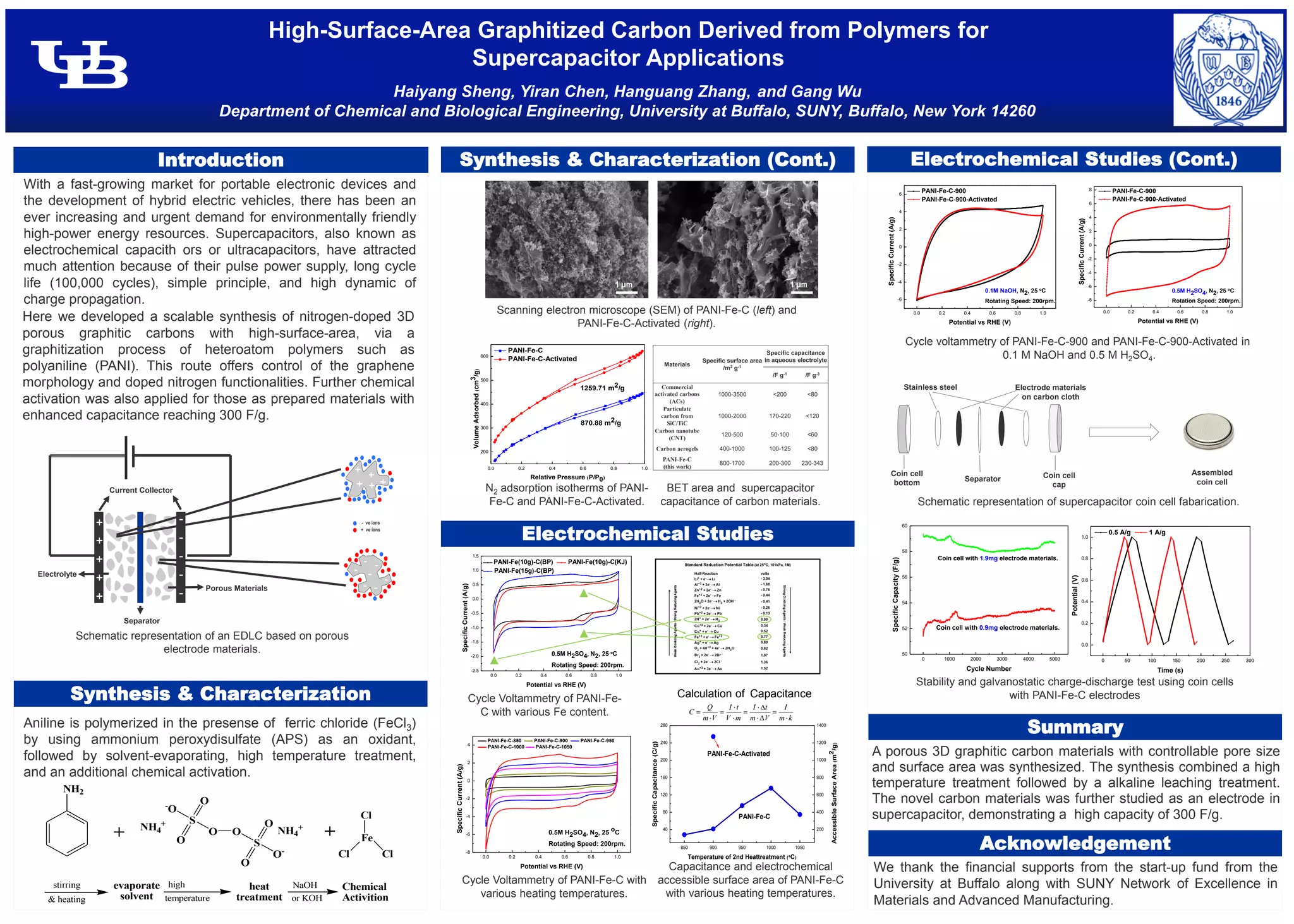
Here we developed a scalable synthesis of nitrogen-doped 3D
porous graphitic carbons with high-surface-area, via a
graphitization process of heteroatom polymers such as
polyaniline (PANI). This route offers control of the graphene
morphology and doped nitrogen functionalities. Further chemical
activation was also applied for those as prepared materials with
enhanced capacitance reaching 300 F/g.
Electrochemical Studies
0.0 0.2 0.4 0.6 0.8 1.0
-8
-6
-4
-2
0
2
4
SpecificCurrent(A/g)
Potential vs RHE (V)
PANI-Fe-C-850 PANI-Fe-C-900 PANI-Fe-C-950
PANI-Fe-C-1000 PANI-Fe-C-1050
0.5M H2SO4, N2, 25 oC
Rotating Speed: 200rpm.
0.0 0.2 0.4 0.6 0.8 1.0
-8
-6
-4
-2
0
2
4
6
8 PANI-Fe-C-900
PANI-Fe-C-900-Activated
SpecificCurrent(A/g)
Potential vs RHE (V)
0.5M H2SO4, N2, 25 C
Rotation Speed: 200rpm.
0.0 0.2 0.4 0.6 0.8 1.0
-6
-4
-2
0
2
4
6 PANI-Fe-C-900
PANI-Fe-C-900-Activated
SpecificCurrent(A/g)
Potential vs RHE (V)
0.1M NaOH, N2, 25 C
Rotating Speed: 200rpm.
850 900 950 1000 1050
40
80
120
160
200
240
280
PANI-Fe-C
SpecificCapacitance(C/g)
Temperature of 2nd Heattreatment (C)
PANI-Fe-C-Activated
200
400
600
800
1000
1200
1400
AccessibleSurfaceArea(m2/g)
Calculation of Capacitance
Q I t I t I
C
m V V m m V m k
 
   
   
0 50 100 150 200 250 300
0.0
0.2
0.4
0.6
0.8
1.0
Potential(V)
Time (s)
0.5 A/g 1 A/g
Summary
Acknowledgement
0 1000 2000 3000 4000 5000
50
52
54
56
58
60
Coin cell with 0.9mg electrode materials.
SpecificCapacity(F/g)
Cycle Number
Coin cell with 1.9mg electrode materials.
Electrode materials
on carbon cloth
Stainless steel
Coin cell
bottom
Separator Coin cell
cap
Assembled
coin cell
0.0 0.2 0.4 0.6 0.8 1.0
-2.5
-2.0
-1.5
-1.0
-0.5
0.0
0.5
1.0
1.5
SpecificCurrent(A/g)
Potential vs RHE (V)
PANI-Fe(10g)-C(BP) PANI-Fe(10g)-C(KJ)
PANI-Fe(15g)-C(BP)
0.5M H2SO4, N2, 25 C
Rotating Speed: 200rpm.
Synthesis & Characterization (Cont.) Electrochemical Studies (Cont.)
A porous 3D graphitic carbon materials with controllable pore size
and surface area was synthesized. The synthesis combined a high
temperature treatment followed by a alkaline leaching treatment.
The novel carbon materials was further studied as an electrode in
supercapacitor, demonstrating a high capacity of 300 F/g.
We thank the financial supports from the start-up fund from the
University at Buffalo along with SUNY Network of Excellence in
Materials and Advanced Manufacturing.
Schematic representation of an EDLC based on porous
electrode materials.
Aniline is polymerized in the presense of ferric chloride (FeCl3)
by using ammonium peroxydisulfate (APS) as an oxidant,
followed by solvent-evaporating, high temperature treatment,
and an additional chemical activation.
0.0 0.2 0.4 0.6 0.8 1.0
200
300
400
500
600
870.88 m2/g
VolumeAdsorbed(cm3/g) Relative Pressure (P/P0)
PANI-Fe-C
PANI-Fe-C-Activated
1259.71 m2/g
Materials
Specific surface area
/m2 g-1
Specific capacitance
in aqueous electrolyte
/F g-1 /F g-3
Commercial
activated carbons
(ACs)
1000-3500 <200 <80
Particulate
carbon from
SiC/TiC
1000-2000 170-220 <120
Carbon nanotube
(CNT)
120-500 50-100 <60
Carbon aerogels 400-1000 100-125 <80
PANI-Fe-C
(this work)
800-1700 200-300 230-343
Scanning electron microscope (SEM) of PANI-Fe-C (left) and
PANI-Fe-C-Activated (right).
N2 adsorption isotherms of PANI-
Fe-C and PANI-Fe-C-Activated.
BET area and supercapacitor
capacitance of carbon materials.
Cycle Voltammetry of PANI-Fe-
C with various Fe content.
Cycle Voltammetry of PANI-Fe-C with
various heating temperatures.
Capacitance and electrochemical
accessible surface area of PANI-Fe-C
with various heating temperatures.
Cycle voltammetry of PANI-Fe-C-900 and PANI-Fe-C-900-Activated in
0.1 M NaOH and 0.5 M H2SO4.
Schematic representation of supercapacitor coin cell fabarication.
Stability and galvanostatic charge-discharge test using coin cells
with PANI-Fe-C electrodes
1 µ m 1 µ m
+
+
+
+
+
-
-
-
-
-
+
- ve ions
+ ve ions
Separator
Electrolyte
Current Collector
Porous Materials
+
+ + +
- -- -
- -
-

Haiyang-2015 Symposium Poster (9 22 modified)-Final

  • 1.
    www.buffalo.edu High-Surface-Area Graphitized CarbonDerived from Polymers for Supercapacitor Applications Haiyang Sheng, Yiran Chen, Hanguang Zhang, and Gang Wu Department of Chemical and Biological Engineering, University at Buffalo, SUNY, Buffalo, New York 14260 Introduction With a fast-growing market for portable electronic devices and the development of hybrid electric vehicles, there has been an ever increasing and urgent demand for environmentally friendly high-power energy resources. Supercapacitors, also known as electrochemical capacith ors or ultracapacitors, have attracted much attention because of their pulse power supply, long cycle life (100,000 cycles), simple principle, and high dynamic of charge propagation. + + + - - - - -- Synthesis & Characterization NH2 + - O S O O O O S O- O O NH4 + NH4 + + Fe Cl Cl Cl evaporate solvent heat treatment Chemical Activition stirring high & heating temperature NaOH or KOH Here we developed a scalable synthesis of nitrogen-doped 3D porous graphitic carbons with high-surface-area, via a graphitization process of heteroatom polymers such as polyaniline (PANI). This route offers control of the graphene morphology and doped nitrogen functionalities. Further chemical activation was also applied for those as prepared materials with enhanced capacitance reaching 300 F/g. Electrochemical Studies 0.0 0.2 0.4 0.6 0.8 1.0 -8 -6 -4 -2 0 2 4 SpecificCurrent(A/g) Potential vs RHE (V) PANI-Fe-C-850 PANI-Fe-C-900 PANI-Fe-C-950 PANI-Fe-C-1000 PANI-Fe-C-1050 0.5M H2SO4, N2, 25 oC Rotating Speed: 200rpm. 0.0 0.2 0.4 0.6 0.8 1.0 -8 -6 -4 -2 0 2 4 6 8 PANI-Fe-C-900 PANI-Fe-C-900-Activated SpecificCurrent(A/g) Potential vs RHE (V) 0.5M H2SO4, N2, 25 C Rotation Speed: 200rpm. 0.0 0.2 0.4 0.6 0.8 1.0 -6 -4 -2 0 2 4 6 PANI-Fe-C-900 PANI-Fe-C-900-Activated SpecificCurrent(A/g) Potential vs RHE (V) 0.1M NaOH, N2, 25 C Rotating Speed: 200rpm. 850 900 950 1000 1050 40 80 120 160 200 240 280 PANI-Fe-C SpecificCapacitance(C/g) Temperature of 2nd Heattreatment (C) PANI-Fe-C-Activated 200 400 600 800 1000 1200 1400 AccessibleSurfaceArea(m2/g) Calculation of Capacitance Q I t I t I C m V V m m V m k           0 50 100 150 200 250 300 0.0 0.2 0.4 0.6 0.8 1.0 Potential(V) Time (s) 0.5 A/g 1 A/g Summary Acknowledgement 0 1000 2000 3000 4000 5000 50 52 54 56 58 60 Coin cell with 0.9mg electrode materials. SpecificCapacity(F/g) Cycle Number Coin cell with 1.9mg electrode materials. Electrode materials on carbon cloth Stainless steel Coin cell bottom Separator Coin cell cap Assembled coin cell 0.0 0.2 0.4 0.6 0.8 1.0 -2.5 -2.0 -1.5 -1.0 -0.5 0.0 0.5 1.0 1.5 SpecificCurrent(A/g) Potential vs RHE (V) PANI-Fe(10g)-C(BP) PANI-Fe(10g)-C(KJ) PANI-Fe(15g)-C(BP) 0.5M H2SO4, N2, 25 C Rotating Speed: 200rpm. Synthesis & Characterization (Cont.) Electrochemical Studies (Cont.) A porous 3D graphitic carbon materials with controllable pore size and surface area was synthesized. The synthesis combined a high temperature treatment followed by a alkaline leaching treatment. The novel carbon materials was further studied as an electrode in supercapacitor, demonstrating a high capacity of 300 F/g. We thank the financial supports from the start-up fund from the University at Buffalo along with SUNY Network of Excellence in Materials and Advanced Manufacturing. Schematic representation of an EDLC based on porous electrode materials. Aniline is polymerized in the presense of ferric chloride (FeCl3) by using ammonium peroxydisulfate (APS) as an oxidant, followed by solvent-evaporating, high temperature treatment, and an additional chemical activation. 0.0 0.2 0.4 0.6 0.8 1.0 200 300 400 500 600 870.88 m2/g VolumeAdsorbed(cm3/g) Relative Pressure (P/P0) PANI-Fe-C PANI-Fe-C-Activated 1259.71 m2/g Materials Specific surface area /m2 g-1 Specific capacitance in aqueous electrolyte /F g-1 /F g-3 Commercial activated carbons (ACs) 1000-3500 <200 <80 Particulate carbon from SiC/TiC 1000-2000 170-220 <120 Carbon nanotube (CNT) 120-500 50-100 <60 Carbon aerogels 400-1000 100-125 <80 PANI-Fe-C (this work) 800-1700 200-300 230-343 Scanning electron microscope (SEM) of PANI-Fe-C (left) and PANI-Fe-C-Activated (right). N2 adsorption isotherms of PANI- Fe-C and PANI-Fe-C-Activated. BET area and supercapacitor capacitance of carbon materials. Cycle Voltammetry of PANI-Fe- C with various Fe content. Cycle Voltammetry of PANI-Fe-C with various heating temperatures. Capacitance and electrochemical accessible surface area of PANI-Fe-C with various heating temperatures. Cycle voltammetry of PANI-Fe-C-900 and PANI-Fe-C-900-Activated in 0.1 M NaOH and 0.5 M H2SO4. Schematic representation of supercapacitor coin cell fabarication. Stability and galvanostatic charge-discharge test using coin cells with PANI-Fe-C electrodes 1 µ m 1 µ m + + + + + - - - - - + - ve ions + ve ions Separator Electrolyte Current Collector Porous Materials + + + + - -- - - - -